Journal of Chemical and Pharmaceutical Research, 2014, 6(2):347-352
Research Article
CODEN(USA) : JCPRC5
ISSN : 0975-7384
Photodecolorization of methylene blue using CuO/
γ
-Al
2O
3prepared by
low-temperature combustion method
Jucheng Zhang
a,b, Ying He*
,a,b, Yuqian Liu
a,b, Xianlan Chen
a,b, Yashun Chen
a,band Guowei Zhang
a,ba
Key Laboratory of Natural Pharmaceutical and Chemical Biology of Yunnan Province, Mengzi, China
b
School of Science Honghe University, Mengzi, China
_____________________________________________________________________________________________
ABSTRACT
The CuO/γ-Al2O3 catalyst has been prepared by the low-temperature combustion method. And the photo-activity of the catalyst was investigated for decoloration methylene blue. The X-ray powder diffraction (XRD) was employed to characterize the catalysts. The concentrations of CuO, volume of H2O2, temperature of reaction system and the light source were studied. The results indicated CuO/γ-Al2O3 catalyst could efficient photodecoloration metheylene blue (MB) under irradiation by solar and fluorescent lamp.
Keywords: low-temperature combustion method, CuO/γ-Al2O3, photo-decoloration, methlyene blue
_____________________________________________________________________________________________
INTRODUCTION
Dyes, the majority of them do not readily biodegrade and characterize by high chemical oxygen demand, represent potential environmental pollutants. There are many literatures reporting that many semiconductors have used to
remove some pollutants with photoreaction, such as TiO2, ZnO, Er3+:YAlO3/TiO2, CdSe/ZnS[1-4].
Copper oxide (CuO), is a p-type semiconductor, has used as a passive and active component in solar cell technology
and photovoltaic applications[5]. CuO supported on Al2O3 has been widely studied for detecting gases and removal
SO2, NO etc,[6,7] it is a biosensor for detecting Aspergillus niger fungi[8]. And it has used to catalyst some organic
reaction, oxidize levulinic acid[9]. The CuO/Al2O3 catalyst, which has prepared by consecutive impregnation
method, has used degraded azo dyes[10,11]. and S.S. Ashour indicates that the mixed oxide catalysts often have catalytic properties that are superior to those of pure oxides[12].
In this work, the CuO/γ-Al2O3 catalyst is prepared by low-temperature combustion method and characterized by
X-ray powder diffraction (XRD), the photo-activity has investigated on light source, concentration of CuO, system
temperature and H2O2 concentrations. The results suggest the CuO/γ-Al2O3 catalyst has good photo-activity for
decolorizing dye under irradiation.
EXPERIEMTNAL SECTION
2.1 Materials
Cu(NO3)2·3H2O, Al(NO3)3·9H2O, CO(NH2) 2, Methlene Blue (MB), H2O2(30%) were purchased from China
National Medicines Corp. All reagents were analytical grade and used as received without further purification. Ultrapure water was employed in all experimental work. Methlene Blue solution was made at a concentration 0.01%.
______________________________________________________________________________
condensed in the crucible on electro cooker, then the sample was sintered at 300 ℃ for 20 min and at 550 ℃ for 4 h
in a muffle furnace. The catalysts were prepared containing 0, 5, 7, 9, 11, 13, 15 wt.% CuO, respectively. The samples were named C0, C5, C7, C9, C11, C13, C15.
2.3 General reaction conditions
In each trial, 0.2 g catalyst was added to 200 mL 2 ppm aqueous MB solution and avoided irradiation 12 h, then the mixture was stirred under irradiation. After the allotted reaction time had elapsed, stirring was stopped and centrifuged, then the solution was detected at 664 nm by TU-1901 UV-vis spectrophotometer (Beijing Purkinje General Instrument Co. Ltd., China).
2.4 The decoloration ratio (DR)
The decolorization ratio is according the next equation:
DR (%) =
100
%
0
0
−
×
A
A
A
t(1)
Where the A0 and At are the initial and final absorbance value of MB solution respectively.
RESULTS AND DISCUSSION
3.1 Wide-angle XRD
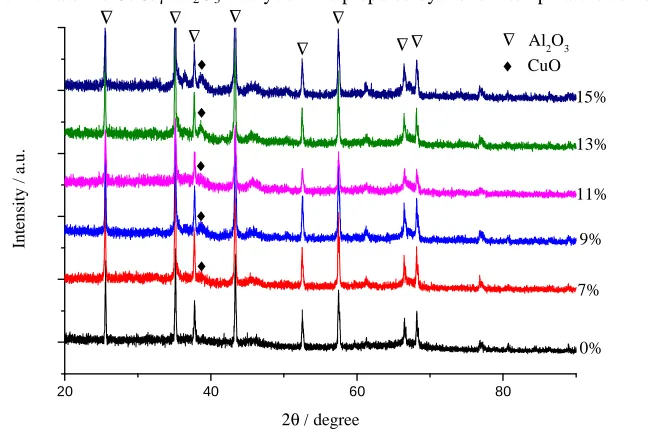
The XRD was employed to characterize the CuO/γ-Al2O3 catalysts. Figure 1 shows an XRD pattern of CuO dope
γ-Al2O3, and the data indicate the CuO/γ-Al2O3 catalysts have prepared by the low-temperature combustion method.
20 40 60 80
♦
♦ ♦ ♦
∇ Al2O3
♦ CuO
♦ ∇
∇
∇ ∇
∇ ∇ ∇
2θ / degree
∇
0% 7% 9% 11% 13% 15%
In
te
n
si
ty
/
a
.u
[image:2.595.151.476.328.545.2].
Figure 1. XRD pattern for the CuO/γ-Al2O3 catalysts
In the literatures, the CuO/γ-Al2O3 catalysts have prepared by the consecutive impregnation method, so the CuO is
absorbed at the surface of γ-Al2O3. But in this work, the CuO/γ-Al2O3 catalysts have prepared by solution, so CuO
homogeneously incorporated in γ-Al2O3. According to the XRD spectra, there are no obvious CuO peak appears
which indicated the CuO is non-crystalloid phase [11].
3.2 Compare the decoloration activity between CuO/γ-Al2O3 with γ-Al2O3
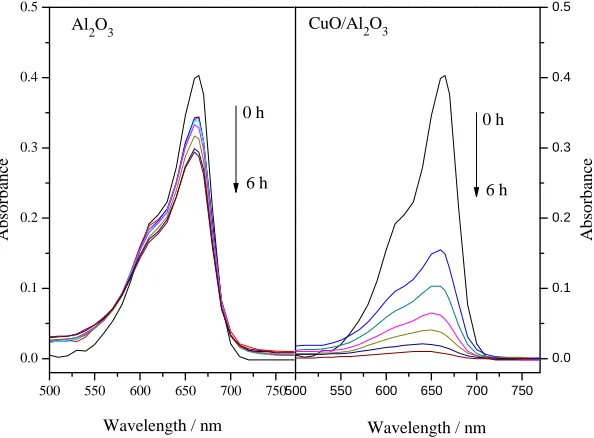
The decolorization rate for γ-Al2O3 and CuO/γ-Al2O3 were investigated at the same conditions. In the trails, 0.9mL
H2O2 was injected in the reaction system, the temperature was controlled at 37 ℃ by a water cycle system, and
irradiation with 36w fluorescent lamp. The data show in figure 2.
Figure 2 show the γ-Al2O3 could photo-decolorize MB under irradiation, the DR is 28.5%. The catalyst C13, 13 %
CuO/γ-Al2O3, decolorized ratio is 98.3%, far higher than γ-Al2O3. The result indicated the CuO is the activity
______________________________________________________________________________
500 550 600 650 700 750 0.0 0.1 0.2 0.3 0.4 0.5
Wavelength / nm
A
b
so
rb
an
ce
Wavelength / nm
0 h
6 h CuO/Al2O3
500 550 600 650 700 750
0.0 0.1 0.2 0.3 0.4 0.5
A
b
so
rb
an
ce
0 h
[image:3.595.158.455.73.292.2]6 h Al2O3
Figure 2. The spectra of MB which was decolorized in present γ-Al2O3 and Cu/γ-Al2O3 respectively
3.3 Effect of CuO content
The effect of different proportion of CuO in the CuO/γ-Al2O3 catalyst on photo-decoloration of the dye MB was
investigated. The different catalysts, including 0, 5, 7, 9, 11, 13 and 15% CuO respectively, were employed to decolorize the MB at the same conditions. The results show in figure 3.
0 1 2 3 4 5 6
0 20 40 60 80
(C
0
-C
t
)/
C0
*
1
0
0
/
%
Reaction Time / h control
[image:3.595.172.436.365.555.2]C0 C5 C7 C9 C11 C13 C15
Figure 3. The decoloration ratio against reaction time with different catalyst, 0%, 5%, 7%, 9%, 11%, 13%, 15% CuO
Figure 3 shows the decoloration ratio after 6 h increased with the CuO concentration from 0 to 13%, then the decolorization decrease with the increasing concentration of CuO in catalyst. The reason is the content of CuO increased in catalyst could produce more photo-electron, and then transited to MB to cause the decoloration. But the
excessive CuO in catalyst decrease the activity site in γ-Al2O3, so the dye molecular could not efficiency absorption
at catalyst.
3.4 The effect of light source
Three type light sources were employed to investigate the influence on decolorization ratio. The reaction worked
under solar irradiation in room temperature without control, but the other reaction system worked in 25 ℃ with a
cycle water system. The results show in figure 4.
______________________________________________________________________________
0 1 2 3 4 5 6
0 10 20 30 40 50 60
(C
0
-C
t
)/
C0
*1
0
0
/
%
Reaction Time / h
soalr
[image:4.595.175.438.69.268.2]fluorescent lamp ultraviolet lamp
Figure 4. The effect of the light source
3.5 The concentration of H2O2
The influence of H2O2 on DR was investigated. The different volume of H2O2 was added to system from 0.1mL to 1.3mL. The data show in figure 5.
0.0 0.1 0.2 0.3 0.4 0.5 0.6 0.7 0.8 0.9 1.0 1.1 1.2 1.3 1.4 0
10 20 30 40 50 60 70 80
(C
0
-C
t
)/
C0
*
1
0
0
/
%
[image:4.595.170.440.331.513.2]The Volume of H2O2 / mL
Figure 5. The effect of the volume of H2O2
Figure 5 shows the DR increased with the volume of H2O2, from 0.1 mL to 0.9 mL, but the DR descent with the
further increased H2O2, from 0.9 mL to 1.3 mL. So the best H2O2 content is 4.5 mL/L.
3.6 The effect of temperature
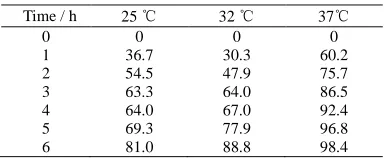
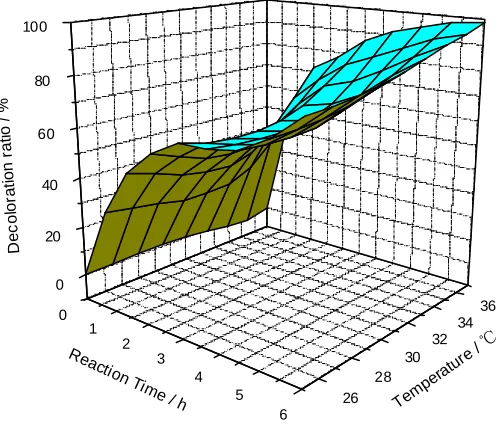
The effect of the temperature of reaction system on DR was also investigated. A cycle water pump was used to
[image:4.595.210.402.652.731.2]control the temperature of the mixture system at 25, 32 and 37℃. The results were shown in figure 6 and table 1.
Table 1. The effect of temperature on decoloration ratio (%)
Time / h 25 ℃ 32 ℃ 37℃
0 0 0 0
1 36.7 30.3 60.2
2 54.5 47.9 75.7
3 63.3 64.0 86.5
4 64.0 67.0 92.4
5 69.3 77.9 96.8
______________________________________________________________________________
0 1
2 3
4 5
6 0
20 40 60 80 100
26 28
30 32
34 36
D
e
c
o
lo
ra
ti
o
n
r
a
tio
/
%
Tem pera
ture / ℃ Rea
[image:5.595.175.424.72.285.2]ction Tim e / h
Figure 6. The effect of reaction temperature in different time
Figure 6 and table 1 show the DR increased with the increased temperature from 25 to 37 ℃. After 6 h, the DR is
98.4% at 37 ℃, this result suggest the CuO/γ-Al2O3 catalyst has more activity in higher temperature, and the initial
speed at 37 ℃ is higher than the other. The reason is the higher temperature is beneficial to H2O2 to produce O2
· and
MB or degraded product in adsorption and desorption of on the catalyst surface.
3.7 The recycle trial
To investigate the stability of the CuO/γ-Al2O3 catalyst, recycling trials were conducted at the same conditions.
After the initial reaction, the catalyst was separated and washed with distilled water, then sintered 5h at 550 ℃ in a
muffle furnace. Figure 7 shows the decoloration ratios obtain on the first use of the catalyst and the subsequent recycled use. It evidence that the catalyst maintained practically the same activity in the second reaction.
0 1 2 3 4 5 6
0 20 40 60 80 100
D
e
c
o
lo
ra
ti
o
n
r
a
ti
o
/
%
Reaction Time / h
[image:5.595.171.441.423.630.2]first second
Figure 7. Decoloration ratios over fresh and recycled CuO/γ-Al2O3 catalyst
CONCLUSION
This work prepared the CuO/γ-Al2O3 catalyst by low-temperature combustion method at first time, and the
photo-activity was investigated by methylene blue decoloration ratio. The decoloration rate increased with the contents of CuO in catalyst increased from 0% to 13%, but decreased at content above 13%. The data showed that
the CuO/γ-Al2O3 catalyst was capable of rapidly decolorizing 98.4% MB with 0.9 mL 30% H2O2 at 37 ℃ under
______________________________________________________________________________
Acknowledgments
This work is supported by Natural Science Foundation of P.R. China (No:21362010) and Natural Science
Foundation of Yunnan Province P.R. China. (No:2010ZC153).
REFERENCES
[1] Zhang, Y. L.; Wang, D. J.; Zhang, G. K.; Chem. Eng. J. 2011, (173), 1-10.
[2] Nagaraja, R.; Kottam Nagaraju; Girija, C. R.; Nagabhushana, B. M.; Powder Technol. 2011, (215-216), 91-97. [3] Wang, J.; Xie, Y. P.; Zhang, Z. H.; Li, J.; Li, C. W.; Zhang, L. Q.; Xing, Z. Q.; Xu, R.; Zhang, X. D.; Environ.
Chem. Lett. 2010, (8), 87-93.
[4] Li, Y.; Zhang, W.; Li, K. G.; Yao, Y.; Niu, J. F.; Chen, Y. S.; Environ. Pollut. 2012, (164), 259-266.
[5] Kumar, A.; Perumal, K.; Thirunavukkarasu, P.; S J. Optoelectron. Adv. Mater. Rapid Commun. 2010, (4), 831-833.
[6] Liu, Q. Y.; Zhenyu Liu, Z.Y.; Zhu, Z. P.; Xie, G. Y.; Wang, Y. L.; Ind. Eng. Chem. Res. 2004, (43), 4031-4037. [7] Liu, Q. Y.; Liu, Z. Y.; Huang, Z. G.; Liu, T.; Zhang, J.; Ind. Eng. Chem. Res. 2005, (44), 651-657.
[8] Etefagh, R.; Azhir, E.; Shahtahmasebi, N.; Scientia Iranica 2013, (20), 1055-1058. [9] Gong, Y.; Lin, L.; Jianbin Shi, J. B.; Liu, S. J.;molecules 2010, (15), 7946-7960.
[10] Zhang, G. Q.; Wang, S.; Zhao, S.; Fu, L.; Chen, G. H.; Yang, F. L.; Appl. Catal. B: Environ. 2011, 106):370-378. [11] Hua, L.; Ma, H. R.; Zhang, L.; Chemosphere 2013, (90), 143-149.