The Attitudes of Field Dependence Learners towards
Learner Interface Design in e-Learning Instruction
Ömer Faruk Sözcü
*, İsmail İpek, Hüseyin Kınay
Faculty of Education, Fatih University, Turkey
Copyright©2016 by authors, all rights reserved. Authors agree that this article remains permanently open access under the terms of the Creative Commons Attribution License 4.0 International License
Abstract
The purpose of the study is to explore relationships between learners’ cognitive styles and learner variables in preferences about learner interface design and attitudes to e-learning instruction in distance education. Cognitive style has historically been referred to as a psychological dimension representing consistencies in an individual’s manner of cognitive functioning, particularly with respect to acquiring and processing information. In this work, to determine learners’ field dependence levels, The Group Embedded Figures Test (GEFT) was administered to 157 students enrolled on courses in various fields at Fatih University, Turkey. An attitude survey of students’ preferences was carried out. The survey was developed and controlled by three experts in the field of instructional design and technology. It consisted of three sections with 20 items each. The cognitive styles field dependent (FD), field neutral (FN) and field independent (FI) were defined based on the mean scores of the GEFT groups. One-half standard deviation was added to or subtracted from the mean to calculate the cognitive styles. The relationships between groups and attitudes and preferences in e-learning instruction were investigated and the findings presented in tables. These tables included evaluation results for distance education programs as well as successful learning interface design principles defined by content, empowerment, control, clarity of context, visuals, challenges and feedback decisions.Keywords
Cognitive Style, Field Dependence, e-learning, Learner Interface Design
1. Introduction
Recently, the term e-learning has emerged to describe an increasingly important learning technique in the field of instructional technology. It involves different working locations and learning environments [1]. Computer-based instruction (CBI) has been redefined as multimedia learning in educational institutions, and has been discussed efficiently
in relation to distance education and e-learning technologies [2]. CBI methods are also used in new concepts of multimedia and e-learning instruction, such as tutorials, drill-practice, simulation, games, and others, all of them designed with online instruction [3-5]. With the new technologies, expectations of the instructional process have changed in relation to the rules of visual and interface design rules, according to user characteristics including age, attitudes and gender. In this context the CBI process has been defined as a multimedia form of instruction and learning [3-4]. There are also relationships between type of instruction such as e-learning, distance education and interface design. High-quality lesson design now often uses e-learning tools and their visual design characteristics and related tasks as a foundation, as multimedia tools can create effective learning and affect learner attitudes and perceptions. At the same time, instructional variables can be defined such as student age, preferences and cognitive styles as Field dependence. Field dependence levels can be defined as field dependent (FD), field neutral (FN), and field independent based on GEFT scores. Field dependence is “the tendency to rely on external referents, while field-independence is the tendency to rely upon internal referents” (p.189) [6].
years [11-15]. Hence, this study focuses on the FD/FI continuum.
Dwyer and Moore [21] concluded that field dependence is an important variable, noting that for some types of learning objective color coding and instructional materials may reduce achievement differences attributed to differences in cognitive style. They also observed that FD learners scored significantly higher on a drawing test than FI learners, both in a black-and-white and a color-coded treatment [22,23].
Cultural features of e-learning and related tasks have been identified for marketing management in different geographic regions, as well as internet or web-based learning [16]. Culture is defined as a pattern of thinking, feeling, understanding events, perceiving things and acting that learners display in information processing as a mental program [17]; it is also related to learning and education as social phenomena. Most of the effects of the link between FD and FI and interpersonal behavior can be understood based on differing cognitive styles in seeking information. Education can be both formal and informal.
E-learning can be defined as an instructional concept or learning strategy to make connections between cultures. It concerns content delivery and tutorials with learners in different cultures via online or web instruction, or other learning tasks. These tasks can be related to affective skills and motor control, and have neurological and social implications. Cognitive approaches and several other external factors have been identified as cultural and environmental influences on educational systems, distance education and design of e-learning. E-learning was developed as a tool based on the principles of learner interface design (LID): content, empowerment, control, clarity of context, visuals, challenges, and feedback decisions; also taken into consideration were the roles of instructor and administrator, the attitudes or perceptions of learners, and return on investment (RIO) problems. Successful LID principles were defined towards making learning technology polite and effective, as well as aiding rapid instructional design in e-learning [18-20]. Attitudes to learning technology and preferences relating to e-learning design strategies have come to be seen as vital instructional variables to develop effective, efficient displays in e-learning environments, as mentioned above [24]. These perceptions can be defined as FD and FI concepts for the respective kinds of learner. Field dependence is a continuum including the levels FD, FN, and FI. This study was designed to examine learners’ attitudes and perceptions in relation to LID in e-learning instruction, based on field dependence cognitive styles. Several research questions were addressed, as detailed below.
2. Research Design
2.1. Purpose
The purpose of the study was to explore relationships between learners’ cognitive styles and learner variables in preferences relating to LID and attitudes towards e-learning instruction in distance education. The research questions were developed as follows.
2.2. Research Questions
1. What are the relationships between cognitive style and learner variables in LID preferences?
2. What are the relationships between cognitive style and attitudes in e-learning instruction?
3. What are the relationships between cognitive style and experiences of e-learning in distance education?
3. Methodology
3.1. Participants
In the fall semester of 2012, 157 freshman undergraduate students at Fatih University, İstanbul, Turkey, were assigned to one of three cognitive style groups: FD, FN, and FI. The Group Embedded Figures Test (GEFT) was used to determine the participants’ cognitive style. The students were on different programs, their native language was Turkish, and English was their second language. Instruction at the university was in English. The students participated voluntarily.
3.2. Gathering Data
The sampling frame used for this study was convenience sampling. To collect the data, the researchers asked instructors delivering e-learning distance education courses in different subjects at the university to allow students to participate. The demographics of the participants are presented in the findings section below, including gender, age, access to distance education, and experiences of e-learning.
4. Instruments
4.1. Group Embedded Figure Test
4.2. Student Survey
The attitude survey of students’ preferences aimed to gain data on perceptions of LID in distance education. The survey was developed and controlled by three experts in the field of instructional design and technology. The results therefore have content and expert validity. Furthermore, one author is an expert in the field of measurement and evaluation in education. The survey consisted of three sections (A, B, C) with 20 items, including experience of e-learning, attitudes to e-learning instruction, and preferences relating to LID items. The responses to the last two sections were analyzed separately by Cronbach’s alpha, and the results yielded reliability estimates of 0.91 and 0.93, respectively. Each section of the survey contained five, six and nine items, respectively.
5. Analysis of Data
After receiving the responses, the results from the literature were compared with our own, using SPSS version 15 to analyze students’ answers for each item. The objectives were reviewed to explain students’ preferences. Except for the opening parts, the survey used a five-point Likert scale, with labeled alternatives ranging from ‘Strongly disagree’ (1), to ‘Strongly Agree’ (5). To avoid the halo effect, several questions were phrased negatively. The Likert results were calculated using the formula (5-1)/5. The mean was calculated as 0.80. All ranges were calculated according to the rule based on the scale of 5 to 1.
6. Findings and Results
Based on the GEFT test scores, of the 157 students, 40 (25.47%) were identified as FD, 57 (36.31%) as FN, and 60 (38.22) as FI learners. One hundred and twenty-eight (128) students (81.5%) were female and 29 (18.5%) were male. Other demographic information is given in the tables below.
The levels of cognitive style were identified as follows: FI – high; FN and FD – low. Low field dependence was demonstrated by low scores (σcoreσ<10(Χ−0.5σ) on the GEFT, and FI by high scores (scores 14(≥ X+0.5 )σ .
Students achieving scores (10≤σcoreσ<14(Χ+0.5σ) were considered FN. The test took approximately 20 minutes to complete. Materials created by the researcher were used to facilitate and examine the performance of students. Students’ attitudes and preferences were defined in relation to instructional e-learning variables based on their field dependence cognitive styles. The variables were related to LID guidelines and concepts: connect, empower, clarity of context, challenge, obtain feedback and develop activity design principles.
6.1. Students’ Attitudes and Preferences in relation to e-learning with LID
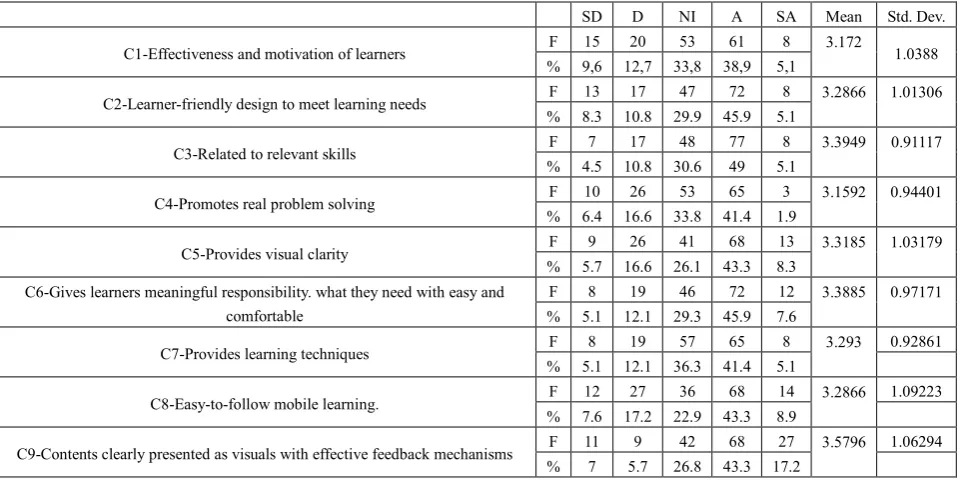
The nine items on the student questionnaire aimed to investigate the participants’ attitudes towards use of LID and its principles. Table 1 shows that students agreed with all the statements. The LID characteristics were accepted by the majority of learners.
[image:3.595.67.548.506.748.2]Table 1 shows that LID was found to be effective and motivational in e-learning tools by 69 students. Item C2 was supported by 80 students (44%). The other items were generally evaluated positively (in general, over 50%) as important variables.
Table 1. Students’ attitudes and preferences for use of LID
SD D NI A SA Mean Std. Dev.
C1-Effectiveness and motivation of learners F 15 20 53 61 8 3.172 1.0388
% 9,6 12,7 33,8 38,9 5,1
C2-Learner-friendly design to meet learning needs F 13 17 47 72 8 3.2866 1.01306
% 8.3 10.8 29.9 45.9 5.1
C3-Related to relevant skills F 7 17 48 77 8 3.3949 0.91117
% 4.5 10.8 30.6 49 5.1
C4-Promotes real problem solving F 10 26 53 65 3 3.1592 0.94401
% 6.4 16.6 33.8 41.4 1.9
C5-Provides visual clarity F 9 26 41 68 13 3.3185 1.03179
% 5.7 16.6 26.1 43.3 8.3
C6-Gives learners meaningful responsibility. what they need with easy and comfortable
F 8 19 46 72 12 3.3885 0.97171
% 5.1 12.1 29.3 45.9 7.6
C7-Provides learning techniques F 8 19 57 65 8 3.293 0.92861
% 5.1 12.1 36.3 41.4 5.1
C8-Easy-to-follow mobile learning. F 12 27 36 68 14 3.2866 1.09223
% 7.6 17.2 22.9 43.3 8.9
C9-Contents clearly presented as visuals with effective feedback mechanisms F 11 9 42 68 27 3.5796 1.06294
% 7 5.7 26.8 43.3 17.2
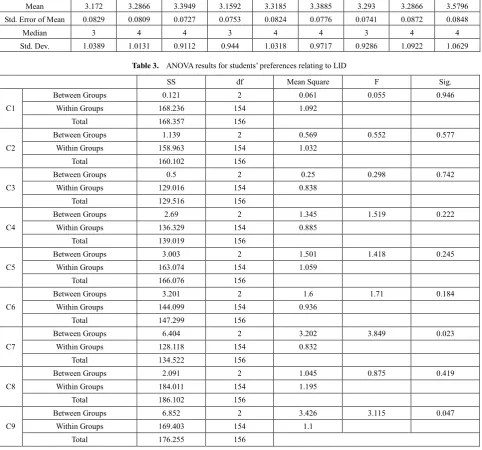
As Table 2 indicates, the preferences about LID items in survey were given to show connect, empower, orchestrate concepts for designing e-learning environments for distance education which are covered as context, challenge, feedback and activity design principles and also given as statistical values. As the table indicates, items in survey based on LID variables in instruction were preferred very close each other. There were no differences based on FD levels. Items C9, C6 and C3 were evaluated more positively based on the mean values. These items are strongly related to practical use, skills, meaningful design, and visual and real effects with feedback mechanisms. All items relating to the e-learning design process consider relationships between student preferences and effective LID principles. All instructional and software designers should be aware of these variables
and design facts in relation to context, challenge, feedback and activity design skills in e-learning instruction. According to Allen [18], the terms connect, empower and orchestrate (CEO) include context, challenge, activity and feedback (CCAF). All interactive learning events and visual designs are built from CCAF, and perceptions and preferences can change a little between FD/FI students, as shown in previous research [11,12,18].
Table 3 shows that the items C7 and C9 and instructional design variables were found to be significant. The results indicate that LID is important for e-learning design and distance education, as well as providing feedback and making visuals clear and real. The ANOVA results for all items are presented in Table 3.
Table 2. Means and standard deviations from survey based on LID variables and cognitive styles
Items C1 C2 C3 C4 C5 C6 C7 C8 C9
Mean 3.172 3.2866 3.3949 3.1592 3.3185 3.3885 3.293 3.2866 3.5796
Std. Error of Mean 0.0829 0.0809 0.0727 0.0753 0.0824 0.0776 0.0741 0.0872 0.0848
Median 3 4 4 3 4 4 3 4 4
Std. Dev. 1.0389 1.0131 0.9112 0.944 1.0318 0.9717 0.9286 1.0922 1.0629
Table 3. ANOVA results for students’ preferences relating to LID
SS df Mean Square F Sig.
C1
Between Groups 0.121 2 0.061 0.055 0.946
Within Groups 168.236 154 1.092
Total 168.357 156
C2
Between Groups 1.139 2 0.569 0.552 0.577
Within Groups 158.963 154 1.032
Total 160.102 156
C3
Between Groups 0.5 2 0.25 0.298 0.742
Within Groups 129.016 154 0.838
Total 129.516 156
C4
Between Groups 2.69 2 1.345 1.519 0.222
Within Groups 136.329 154 0.885
Total 139.019 156
C5
Between Groups 3.003 2 1.501 1.418 0.245
Within Groups 163.074 154 1.059
Total 166.076 156
C6
Between Groups 3.201 2 1.6 1.71 0.184
Within Groups 144.099 154 0.936
Total 147.299 156
C7
Between Groups 6.404 2 3.202 3.849 0.023
Within Groups 128.118 154 0.832
Total 134.522 156
C8
Between Groups 2.091 2 1.045 0.875 0.419
Within Groups 184.011 154 1.195
Total 186.102 156
C9
Between Groups 6.852 2 3.426 3.115 0.047
Within Groups 169.403 154 1.1
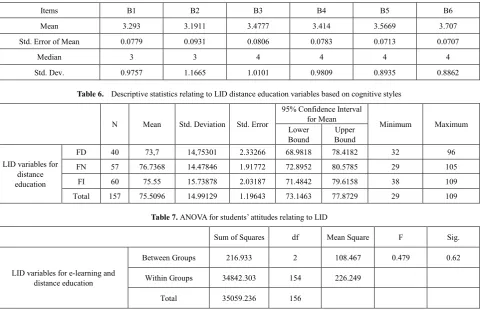
[image:4.595.65.548.297.747.2]Students’ attitudes and preferences were defined relating to instructional variables and techniques based on their cognitive styles (see Tables 1 and 4). The variables are related to LID as detailed below. The six questionnaire items in Table 4 explore the students’ attitudes and preferences relating to the use of e-learning instruction in distance education specifically in terms of instructional, visual and technical issues. The results in Tables 4 and 5 show a slight contradiction: the effects of distance education based on students’ attitudes and preferences while learning through distance education and e-learning tools.
In the study, a broad range of English-as-a-foreign-language students from different departments at Fatih University were surveyed in order to learn about their opinions and attitudes on distance education tools and LID for e-learning courses based on cognitive styles. Previous studies of students’ attitudes and preferences based on field dependence cognitive styles were generally conducted in schools. In this field of research, each learner in a group is understood as showing different perceptions and
[image:5.595.64.548.348.615.2]attitudes in relation to screen and information design issues. Tables 1, 4 and 5 show the items from the survey on LID and students’ attitudes. The findings of the investigation are consistent with those of earlier studies [11-15]. Such as students who have an experience and in the FI group learners preferred LID principles as well. However, there was no meaningful relationship among FDI groups. For this reason, there is a need for further experimental research into the effects of LID variables in e-learning or distance education. Preferences and attitudes of FDI groups are shown in Tables 3 and 4; LID variables and their relationships between or within groups are given in Tables 1, 3 and 7; descriptive analysis and ANOVA results are presented in Table 6, and group relationships and interactions in Table 7. The findings indicate that LID variables are useful and effective for distance education programs and courses. This conclusion can benefit developers of instructional software and lesson materials such as video, audio and multimedia projects for learning and teaching.
Table 4. Students’ attitudes and preferences toward instructional variables in e-learning instruction (distance education), based on cognitive style
SD D NI A SA Mean Std. Dev.
B1 Presenting courses in e-learning F 6 25 58 53 15 3.293 0.97574
% 3.8 15.9 36.9 33.8 9.6
B2 Increasing learner motivation F 18 24 41 58 16 3.1911 1.16649
% 11.5 15.3 26.1 36.9 10.2
B3 Sequencing topics in e-learning F 7 19 43 68 20 3.4777 1.01012
% 4.5 12.1 27.4 43.3 12.7
B4 Using storyboards and screen effects F 7 21 43 72 14 3.414 0.98087
% 4.5 13.4 27.4 45.9 8.9
B5 Using video and sound effectively F 5 14 39 85 14 3.5669 0.89352
% 3.2 8.9 24.8 54.1 8.9
B6 Use of interesting instructional videos F 3 18 19 99 18 3.707 0.88623
% 1.9 11.5 12.1 63.1 11.5
Table 5. Means and standard deviations from survey on the use of e-learning instruction (distance education)
Items B1 B2 B3 B4 B5 B6
Mean 3.293 3.1911 3.4777 3.414 3.5669 3.707
Std. Error of Mean 0.0779 0.0931 0.0806 0.0783 0.0713 0.0707
Median 3 3 4 4 4 4
Std. Dev. 0.9757 1.1665 1.0101 0.9809 0.8935 0.8862
Table 6. Descriptive statistics relating to LID distance education variables based on cognitive styles
N Mean Std. Deviation Std. Error
95% Confidence Interval
for Mean Minimum Maximum
Lower
Bound Bound Upper
LID variables for distance education
FD 40 73,7 14,75301 2.33266 68.9818 78.4182 32 96
FN 57 76.7368 14.47846 1.91772 72.8952 80.5785 29 105
FI 60 75.55 15.73878 2.03187 71.4842 79.6158 38 109
Total 157 75.5096 14.99129 1.19643 73.1463 77.8729 29 109
Table 7. ANOVA for students’ attitudes relating to LID
Sum of Squares df Mean Square F Sig.
LID variables for e-learning and distance education
Between Groups 216.933 2 108.467 0.479 0.62
Within Groups 34842.303 154 226.249
Total 35059.236 156
7. Discussion
Although the findings are not significant, the LID characteristics were positively evaluated by the majority of learners. Different students’ attitudes and preferences relating to the use of LID in e-learning show positive values. Distance education design variables and e-learning visual design variables were preferred very close by learners. FI students evaluated LID variables most positively. This is understandable because FI learners tend to be better in selecting figures and pictures and assessing details than FD learners (see Table 6). The variables are related to LID guidelines and concepts. The e-learning design process includes the following principles: connect, empower, orchestrate parts which are covered by context, challenge, feedback and activity design principles. These principles can provide important instructional variables for designers and instructors [18-20]. As a result, FD/FI learners have clear criteria for evaluating LID variables, such as the design of storyboards as visual and text materials. However, there was no significant difference between cognitive styles in learners’ preferences, attitudes, and experiences relating to these variables in the study. Future research could include different demographic variables such as age, socio-economic and gender differences.
8. Conclusions
The findings of this study show that students at Fatih University have positive attitudes towards distance
education and e-learning programs because of the advantages of e-learning technologies and LID principles. Learners indicated preferences relating to e-learning design variables and distance education. Although no interactions and high-level correlations were identified between the cognitive styles and LID variables, FI learners preferred e-learning technologies and LID characteristics based on the theoretical features of the cognitive style. It was seen that FD, FN and FI learners can be defined by attitudes and perceptions. New research studies must be conducted to develop effective, efficient and engaged e-learning courseware for future distance education and e-learning programs.
Finally, e-learning programs need to be provided that have an effectively designed LID approach, both from a theoretical and practical perspective, including technical, instructional and material-based support for design of future multimedia projects. Multimedia designers should be aware of learners’ field dependence cognitive styles as well as attitudes towards distance education and e-learning visuals.
REFERENCES
[1] Reiser, R. A. & Dempsey, J. V. Trends and issues in instructional design and technology. (3rd Ed.) Upper Saddle River, New Jersey: Pearson Education Inc., 2012.
[image:6.595.65.550.87.397.2]e-learning: implications for pedagogy, technology and organization, London: Routledge Falmer, 2005.
[3] Alessi, S. M., & Trollip, S. R. Multimedia for learning: methods and development. (2nd Ed.) Boston: Allyn and Bacon, 2005.
[4] Ipek, I. Bilgisayarla öğretim: Tasarım, geliştirme ve
yöntemler (Computer-Based Instruction: Design,
development and methods). Ankara, Turkey: Tıp-Teknik
Kitapcılık Ltd. Sti., 2001.
[5] İpek, İ., Sözcü, Ö. F., & Ziatdinov, R. Birleştirilmiş
E-Öğrenme Tasarımı Modeli ve Hızlı Öğretim Tasarımı
Stratejileri (E-learning design model and rapid learning design strategies), Akademik Bilişim Konferansı, Antalya,
Turkey: Akdeniz Üniversitesi, 2013.
[6] Goodenough, D. K. & Witkin, H. A. Origins of the field-dependent and field-independent cognitive styles. Educational testing services (ERIC Documentation Reproduction Service No. ED 150155), Princeton, New Jersey, July, 1977.
[7] Witkin H., Moore C., Goodenough D. & Cox, P. Field dependent and field cognitive styles and their educational implications. Review of Educational Research, 47, 1-64, 1977.
[8] Witkin, H.A. & Goodenough D. Cognitive styles: essence and origins. New York: International Universities Press, Inc., 1981.
[9] Riding R. and Rayner S. G. Cognitive styles and learning strategies. London: David Fulton, 1998.
[10] Allport, G. W. Personality: A Psychological Interpretation. New York: Holt and Co., 1937.
[11] Ipek, I. The effects of window presentation type and field dependence on learning from a CBI geology tutorial, Dissertations Abstracts International (University Microfilms No. UMI DAO 72699), 1995.
[12] Ipek, I. The effects of CBI lesson sequence type and field dependence on learning from computer-based cooperative instruction in web, Turkish Online Journal of Educational Technology (TOJET), 9(1), 221-234, 2010.
[13] Ipek, I. The Effects of Text Density Levels and the Cognitive Style of Field Dependence on Learning from a CBI Tutorial,
The Turkish Online Journal of Educational Technology (TOJET), 11(1), 167-182, 2013.
[14] Moore, D. M., & Bedient, D. Effects of presentation mode and visual characteristics on cognitive style. Journal of Instructional Psychology, 13, 19-24, 1986.
[15] Moore, D. M., & Dwyer, F. M. Effect of color coded information on students’ levels of field dependence. Perceptual and Motor Skills, 72, 611-616, 1991.
[16] Swierczek, F. W. & Bechter, C. Cultures features of e-learning. In M. Spector, D. Ifenthaler, P. I. Kinshuk, D. Sampson. (Eds). Learning and Instruction in the Digital Age (pp. 291-308). New York: Springer, 2010.
[17] Hofstede, G. Cultures and organizations. New York: McGraw-Hill, 1997.
[18] Allen, M. V., Successful e-Learning Interface: Making Learning Technology Polite, Effective and Fun. San Francisco, CA: Pfeiffer, 2011.
[19] Piskurich, G. M. Rapid Instructional Design: Learning ID Fast and Right. (2nd ed.) San Francisco, CA: Pfeiffer, 2006. [20] Piskurich, G. M. Rapid Training Development: Developing
Training Courses Fast and Right. San Francisco, CA: Pfeiffer, 2009.
[21] Dwyer, F., & Moore, D. M. Effect of color coding on visually oriented tests with students of different cognitive styles. The Journal of Psychology, 125(6), 677-680, 1991.
[22] Dwyer, F. M., & Moore, D. M. Effect of color coding on visually and verbally oriented tests with students of different field dependence levels. Journal of Educational Technology Systems, 20(4), 311-320, 1992
[23] Dwyer, F. M., & Moore, D. M. Effect of color coding and test type (visual/verbal) on students identified as possessing different field dependence levels. Paper presented at the International Visual Literacy Association Annual Meeting,
Tempe, AZ, 1994.
[24] Waterhouse, S. The power of e-learning: The essential guide for teaching in the digital age. New York: Pearson Education Inc., 2005.