Larval feeding skeletonizes the foliage, often causing the leaves to drop.
IPM
helps
control elm leaf
Donald L. Dahlsten
o
David L. Rowney ;1 Andrew B. LawsonThe elm leaf beetle, first discov- ered in California in the 1920s, quickly became one of the
state’s major urban tree pests. In the past 15 years, monitoring methods have become integral to the design of the Integrated Pest Management program for the elm leaf beetle (ELB). A sampling protocol has been developed that can successfully predict ELB damage based on the pres- ence or absence of egg clusters. A monitoring program based on this sampling technique may al- low managers to direct control efforts to only those trees requir- ing treatment, thus avoiding un- necessary environmental and
economic costs. Chemical insec- ticides are still a temporary solu- tion to the problem, but increas- ing concern for human and environmental health has
s
timu- lated the pursuit of nonchemical approaches. Releases of egg parasitoids have been largely unsuccessful over the past 12 years. An effort is currently un- der way in Sacramento to im- prove the Integrated Pest Man- agement program based on monitoring, spot treatments with injected chemical insecticides, foliar application of Bacillusthuringiensis and the release of a new strain of egg parasitoid from Granada, Spain.
The elm leaf beetle was accidentally introduced into the eastern United States from Europe in the 1830s. The beetle was not found in California un- til the 1920s, but it can now be found almost anywhere there are elms. The horticultural industry has undoubt- edly been responsible for the move- ment of the beetles, and as modes of transportation have improved so has the ability of the beetles to spread. The beetle, which defoliates and weakens trees, can now be found in such dis- tant places as Argentina and Australia.
There are no native elms in Califor- nia, but it is estimated that 2.5 million elms have been planted in the state. The most common elms planted are English (Ulmus procera), Siberian
(U.
pumila), Chinese
(U.
parvaflora) and American(U.
americana). English elm is the most susceptible to elm leaf beetle feeding and the Siberian elm is the second most susceptible (Luck and Scriven 1979). The elm leaf beetle (ELB), Xantkogaleruca luteola, is the most important pest of elms in Califor- nia; it is ranked as the second most im- portant urban tree pest in the western United States and third nationwide(Wu et al. 1991).
Life cycle and damage
their hiding places and feed on the fo- liage for 1 to 2 weeks before starting to lay eggs. Adult feeding is character- ized by circular BB-size holes in the fo- liage. The oblong yellow eggs are laid in clusters of 15 to 20. The larvae, which are the most damaging stage, develop through three instars. Larval feeding skeletonizes the foliage, often causing the leaves to drop. When ready to pupate, the larvae crawl into holes in the trunk of the tree, in limb crotches, beneath loose bark or com- monly at the base of the tree, where they gather in large numbers. Depend- ing on the climate, there can be one to three generations per year in the northern part of the state and even more in Southern California. The lar- val stage is usually the focal point for chemical control efforts.
the loss of shade during the summer months and the cost of control. Defo- liation, even annually, does not nor- mally kill trees, but it does weaken them, making them more susceptible to other mortality agents. To prevent defoliation, various agencies and indi- viduals have been willing to spend thousands of dollars per year. The re- sponsibility for elm pest manage- ment falls on city government for streetside trees, park managers for park trees, and homeowners for trees in yards.
Monitoring program
The primary impact of defoliation is
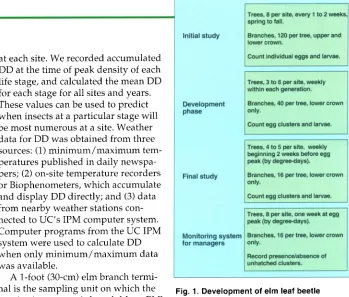
From 1984 to 1993, we developed a user-friendly sampling technique (fig. 1). During this period we sampled more than 200 trees in more than 25 cities in Central and Northern California. Because English elm is the most susceptible elm, we have focused most of our efforts on this species.
The optimal time
ta
sample and treat ELB is best determined by moni- toring heat accumulation, expressed in degree-days (DD). We sampled eggs, three larval instars, and adults throughout the season at numerous sites and years, while monitoring DD above the ELB developmental thresh- old of 50°F (11"C), starting on March 1at each site. We recorded accumulated DD at the time of peak density of each life stage, and calculated the mean DD for each stage for all sites and years. These values can be used to predict when insects at a particular stage will be most numerous at a site. Weather data for DD was obtained from three sources: (1) minimum/maximum tem- peratures published in daily newspa- pers; (2) on-site temperature recorders or Biophenometers, which accumulate and display DD directly; and (3) data from nearby weather stations con- nected to UC's IPM computer system. Computer programs from the UC IPM system were used to calculate DD when only minimum/maximum data was available.
A 1-foot (30-cm) elm branch termi- nal is the sampling unit on which the monitoring system is based. Mean ELB
Initial study
I I
Development phase
Final study
I
eggI
[image:2.612.218.567.38.335.2]Monitoring system for managers
Fig. 1. Development of elm leaf beetle sampling.
TABLE 1. Suggested sample size for elm leaf beetle egg cluster monitoring on English elm in stands of different sizes. Eight locations per tree are sampled: north, east, south and west; inner
and outer crown
Total Sample Samples1 Samples/ Total
trees trees tree segment samples Trees
%
3 3 40 5 120 100
4 4 32 4 128 100
5 5 32 4 160 100
6 6 24 3 144 100
7 6 24 3 144 86
8 7 24 3 168 88
9 8 16 2 128 89
10 8 16 2 128 80
1 1 8 16 2 128 73
12 8 16 2 128 67
13 8 16 2 128 62
14 8 16 2 128 57
15 8 16 2 I28 53
16 9 16 2 144 56
17 9 16 2 144 53
18 9 16 2 144 50
19 9 16 2 144 47
20 9 16 2 144 45
21 9 16 2 144 43
22 10 16 2 160 45
23 10 16 2 160 43
24 10 16 2 160 42
25 10 16 2 160 40
26 10 16 2 160 38
27 10 16 2 160 37
28 10 16 2 160 36
29 10 16 2 160 34
30 10 16 2 160 33
40 12 16 2 192 30
50 15 16 2 240 30
60 15 16 2 240 25
[image:2.612.217.570.376.712.2]Oomyzus gallerucae may parasitize 50% to 90% of an egg cluster. In addition, these small wasps host-feed on other eggs, es- sentially destroying the entire egg cluster.
Erynniopsis antennata is one of two para- sitoids released in California in the 1930s. ELB parasitism can exceed 40%.
viable (unhatched) egg-cluster density was used for damage prediction ini- tially because of convenience, and sampling clusters allows time to make treatment decisions before the damag- ing larval stage occurs. We have deter- mined that simply recording the pres- ence or absence of viable egg clusters on each sample unit provides good damage prediction. Because we found significant differences in egg density between cardinal directions but not between the upper and lower crown, branches are now taken from the more easily sampled lower crown at eight locations around the tree. Sampling lo- cations are north, east, south and west, in both the inner ‘crown (from trunk halfway to drip line) and the outer crown.
We developed a scheme that offers
a good compromise between sampling effort and precision for sites of differ- ent sizes. This scheme gives the num- ber of trees to be sampled and the
number of branches to be examined per tree, depending on the site (table
1). Trees for sampling should initially be chosen randomly, and the same trees should be sampled on each later date. Large sites may be divided into sections and trees chosen randomly within those sections so that samples pick u p any spatial variation in ELB
density. For example, a 60-tree site could be divided into three 20-tree sec- tions and 5 sample trees chosen per section.
We also developed a rating system to determine foliage damage levels by
ELB. We rate the combined adult and larval damage on each 1-foot (30-cm) branch terminal on a scale of 0 to 10, where 1 equals 10% and 10 equals 100% defoliation. Damage on a foliage sample is rated by comparing it to a
visual standard, which shows ex- amples of leaves with each damage rating. Managers may want to rate damage using this method, or they may use the less labor-intensive and less accurate method of visually rating the whole tree from 0 to 10 to estimate damage from each ELB generation. For sites with a single ELB generation, that generation’s damage is measured at the end of the season in the fall. For sites with multiple generations, dam- age is rated for each generation; dam- age at the peak of egg levels (or at the end of the season for the last genera- tion), minus damage at the prior egg peak, equals the damage caused by the previous generation’s larvae and adults.
Because there were no previously established treatment thresholds, we chose a damage rating of 4 as our threshold, based on our experience with homeowners and tree managers. In the first generation, when sampling at the peak of egg cluster density, if 45% or fewer samples have viable egg clusters present, then the damage at the end of that generation will be in the acceptable range (damage rating of 4 or less), with a probability of error of 10%. In the second generation, the maxi- mum percentage of branches infested for acceptable damage is about 30%.
Vary by year, generation, site
We originally hoped to predict ELB
damage and the need for control throughout the season by sampling vi- able egg clusters only in the first gen- eration. However, first-generation sampling did not always predict season-long damage adequately be- cause of differences in population pat- terns between generations, years and sites. For instance, the damage in 4 years of sampling at Cloverdale, Sonoma County (fig. 2 ) was well above the acceptable level at season’s end, but it would have been difficult to predict this result from either the very low first-generation samples in 1988 or the moderate egg level for the first generation of 1989. At this site, in some years the ELB population level was low in the first generation and high in the second, and sometimes the opposite. At another site, Santa Margarita in San Luis Obispo County, first generations were mostly high in the 4 years we sampled (1989,1990, 1991 and 19931, and after the first gen- eration, damage was above 40% for 3 of the 4 years. Second generations were relatively low for all years except 1989, when beetle emergence coin- cided with a heavy reflush of new foli- age. A third site, St. Helena, Napa County, had relatively light damage from ELB first generation in 1986,1988 and 1990, and much heavier (> 90%) damage in 1987 and 1989. All years ex- cept 1987 and 1989 had heavy second- generation cluster density, which caused significant additional damage by season’s end.
based on monitoring so that control ef- forts can be directed to these "hot spots" of ELB activity.
Because of population variation across the various ELB generations just discussed, each generation needs to be monitored. We recommend weekly presence/absence egg cluster monitoring starting about 50 DD be- fore the predicted egg peak for each generation (for example, at 233 DD for generation one and 903 DD for genera- tion two) and continuing for l or 2 more weeks (DD calculated in degrees Centigrade).
Monitoring is key to an integrated pest management program for ELB be- cause it gives advance notice of when treatments are needed or when noth- ing should be done. Although chemi- cal insecticides - either by foliar ap- plication or injection - are very effective, they have been used in many instances when ELB populations were not dense enough to cause significant damage. The monitoring system is not only important for timing control methods but also for determining which areas or trees should be treated and for which generation. Recent in- terest in systemic insecticides, which must be applied well in advance of the first generation of beetles, defeats the purpose of monitoring and often re- sults in control costs when none are necessary. The monitoring system alone, therefore, not only reduces the
17 May 19 Jul 7 Sep amount of chemicals used, it also
avoids expenditures for controls when they are not necessary.
Biological control
For the last 15 years, the focus in our laboratory has been on classical biological control by the introduction of a small eulophid egg parasitoid,
Oornyzus gallerucne. These small wasps may parasitize 50% to 90% of the eggs in a cluster in addition to host-feeding on other eggs in the cluster, essentially destroying the entire egg cluster. The first releases of this parasitoid in Cali- fornia were made from 1932 to 1935, but there was little in the way of evalu- ation. A strain from Iran was released at several locations in the mid-1970s.
Since our program began in 1984, we have released approximately 400,000 0. gallerucae in 28 locations in California, representing at least seven strains from several European sources (fig. 4). The parasitoids collected in Ohio and Stockton were believed to be originally from France and Morocco, respectively. In Sacramento over the past 2 years, we have focused on re- leases of a strain from Granada, Spain.
Studies with the egg parasitoid have been frustrating. Parasitism dur- ing the year of release may be as high as 95% of ELB eggs, but the parasi- toids apparently do not overwinter well in California; they are normally not recovered the year after release.
6 May 8 Jul 12 Aug 28 Apr 23 Jun 13 Aug
4.5 1
4.0- 3.5-
W P 3.0-
$ 2.5-
-
E
2
2.0-L
'
1.5-:::I
0.0
10
+ 1987
-1- - 1988
-*--
1989-
1990I I I T
15 20 25 30 35 1
[image:4.612.404.566.36.264.2]Week
Fig. 2. Elm leaf beetle egg cluster weekly density during a 4-year period in Cloverdale.
Elm leaf beetles completely defoliated this tree in San Luis Obispo County.
Occasionally, however, parasitoids have been recovered in years subse- quent to field release, indicating that a small number may be surviving, but not enough to significantly affect ELB
levels. In laboratory studies, we have confirmed that a low percentage of parasitoids possess the longevity to successfully overwinter in our climate.
We still do not understand the dif- ference between collection sites in ELI-
rope, where egg parasitoids can be col- lected regularly in the spring, and release sites in California. We do not know why the parasitoids apparently overwinter with ease in Europe but not in California, even though the cli- mates of the two areas are very simi-
1.0 I
0.6
.- 0.3
0.1
0.0
p'
1996
0
1997
PARASlTOlD SOURCE
A Granada
+
Rhonearea Chateauneuf le Rouge Stockton6
Marysville (Rhone)since 1984 in Northern and Cen- tral California for dif- ferent strains of the para-
sitoid Oomyzus gallerucae. \---
lar. We are currently working with the Granada strain in Sacramento, not only because there is a close climatic match, but also because this strain is known to regulate ELB populations in certain areas of Granada.
Because the parasitoids are effective within a season when they are present in significant numbers, it is possible to make inoculative releases of insectary- reared parasitoids in the spring. This would require a large-scale insectary- rearing program to be in operation over the winter, as well as a monitor- ing program to determine where and when parasitoids should be released. Another option would be to ship field- collected parasitoids from the South- ern Hemisphere’s fall season (in Ar- gentina or Australia for instance), for release in the Northern Hemisphere’s coincident spring season.
Two other parasitoids, Apvosfocrftis bveuistigyna and
Evynniopsis
antennafa,were released in California in 1934 and 1938 respectively. We found the eulophid wasp A. bveuisfigma, a gre- garious pupal parasitoid from the northeastern United States, at many of our study sites in the state, but it was never very abundant. Evynniopsis antennata is a tachinid fly that is an in- ternal larval parasitoid that emerges
from the ELB pupae or adult. First re- Program”(STEP), which works with leased in Stockton, it can now be
found all over California. Parasitism can exceed 40% at some sample sites, and it can help to reduce ELB popula- tions, but its efficacy is often reduced by a eulophid hyperparasite,
Apvostocetus evymziae (Dreistadt and Dahlsten 1990). Erynnzopszs may have potential in areas that are free of the
hyperparasite, such as Argentina and Australia.
To complement our biologi- cal control program, we
have worked with two other procedures that do not harm the egg parasi- toids. The first is a 2% solu- tion of carbaryl sprayed on infested elms as a 1.6-foot
about 10 feet (about 3 meters) above the ground. It is not effective on the first ELB generation, because it acts af- ter first-generation larval feeding has occurred. This procedure is effective in reducing damage to Siberian elm. With English elm, repeated annual treatments may be necessary before a significant effect, if any, is noted (Dreistadt et al. 1991).
the San Diego strain of Bacillus tkuvingzensis (Bt), which is specific to chrysomelid beetles. Two applications per generation, timed 1 week apart, at the first-instar larval peak, has pro- duced good results at one location in Sacramento.
Demonstration in Sacramento
To see if an IPM program could be developed for ELB, we decided to fo- cus on English elm, which suffers the most damage, in a large urban area with many elms. Sacramento has more elms (several thousand) than any other city in California, and currently has two organizations involved in their upkeep. The city government’s Department of Neighborhood Services is responsible for controlling ELB in street trees and parks, and a nongov- ernment organization, the Sacramento Tree Foundation, has a ”Save the Elms
(0.5-meter) band on the trunk,
The second procedure is the use of
the public on elm problems. STEP has a volunteer force of more than 200,
dedicated to monitoring the elms of Sacramento for Dutch elm disease. In 1996, STEP incorporated some of our ELB monitoring techniques into their training and outreach programs in the neighborhoods.
In 1996, the three agencies (City of Sacramento Department of Neighbor- hood Services, STEP and UC) received
a grant from the California Depart- ment of Pesticide Regulation to imple- ment the IPM program. Each of the agencies was therefore able to hire ex- tra help to implement our monitoring methods in Sacramento. In addition, the group began to look at the devel- opment of new methods for large ur- ban areas, as well as to evaluate new and existing control methods.
We were successful in training city and STEP personnel to use the degree- day model and ELB monitoring tech- niques described earlier. Surveys in 1996 showed damage to be spotty, and efforts will be made in the future to identify these ”hot spots” of high ELB
activity so that control activities can be concentrated where they are most needed. In one of our study sites at the city cemetery, Bt sprayed twice in each of two generations reduced damage to acceptable levels in treated plots in comparison with untreated plots. ’Granada’ strain parasitoids released in the first generation controlled the third generation in spray plot trees. As with our previous experience, egg parasitism in 1997 was not detected.
It appears from our initial effort that the monitoring experiment is working. If only the areas with signifi- cant numbers of beetles are treated, even by the conventional chemical- insecticide injection method the city uses now, monitoring will result in much less insecticide in the environment and considerable savings to the city.
mation on ELB, the goals of the pro- gram and specifics on the treatments in their area. STEP also made presen- tations to neighborhood associations and displayed an information table at
a popular outdoor market throughout the summer. Through community education and outreach, the coopera- tion of city agencies, good monitoring and the development of new strategies to control elm leaf beetles in ”hot spots,” the IPM program for Sacra- mento is being developed and should be fully implemented within several years.
D.L. Dahlsten is Professor and Associate Dean, D.L. Rowney is Biostatistician and A.B. Lazuson is Graduate Student Re- searcher, Center for Biological Control, Division of Insect Biology, College of Natural Resources, U C Berkeley.
The authors thank the many individu- als and agencies that have assisted in the development of this program over the years, and particularly Steve Dreistadt,
UC Davis, UC/IPM Project; Beverly Gingg, San Luis Obispo; A n n e Fenkner and Barbara Gemmill, Sacramento Tree Foundation, Sacramento; and Martin Fitch and Bob Hughes, Department of Neighborhood Services, Sacramento.
They thank the UC/IPM Project, UC Davis and the Slosson Foundation for funding earlier aspects of the study, and the California Department of Pesticide Regulation Grant
#95-0254
for funding the current program in Sacramento.References
Dreistadt SH, Dahlsten DL. 1990. Distribu- tion and abundance of Eurnniopsis antennata
[Dipt: Tachinidae] and Tetrastichus
brevisfigma [Hyrn.: Eulophidae], two intro-
duced elm leaf beetle parasitoids in northern California. Entomphaga 35(4):527-36.
al. 1991. Treatment of destructive elm leaf beetle should be timed by temperature. Cat
Dreistadt SH, Dahlsteh DL, Rowney DL, et
~. Ag 45(2):23-5.
Luck RF. Scriven GT. 1979. The elm leaf beetle, Pyrrhalfa luteola, in southern Califor- nia: Its host preference and host impact. En- vironmental Entomology 8:307-13.
Wu 2 , Jarnieson S, Kielbaso J. 1991. Ur-
ban forest pest management. J Arboriculture 17(6).
Invisible invaders
. .
.
I
nsect-t ransm itted viruses
threaten agriculture
Robert L. Gilbertson
a
Diane E. Ullman, first authors Raquel Salati 3 Douglas P. MaxwellElizabeth
E.
Grafton-CardwellThe vast movement of people and agricultural products between dis- tant geographical regions has cre- ated unprecedented opportunities for introducing plant viruses and the insects that carry them (vec- tors) to new areas. Outbreaks of new viruses may be favored in these agroecosystems by crop susceptibility, the presence of par- ticular weeds and certain agricul- tural practices. In some cases, conditions in these ecosystems may be ideal for the emergence of sltered plant viruses and new virus/vector relationships. This may result in the appearance of insect-transmitted plant viruses in crops and regions where they have not been seen before. Be- Zause plant viruses and their in- sect vectors are intimately linked, rhe status of both must be consid- ?red in formulating strategies to wevent or slow their introduction, 3s well as to manage any inva- sions. To illustrate these points we 9ighlight two situations that could Weaten California agriculture. First,
9 devastating plant virus, tomato
iellow leaf curl geminivirus, is not wesent in California, but an insect ‘the silverleaf whitefly) that trans- nits it is present. Second, the brown citrus aphid is not present in Zalifornia, but a citrus virus (citrus ‘risteza closterovirus) that this in- sect efficiently spreads, is present.
o MaryLou Polek
Despite technological advances lead- ing to tremendous yield increases for many crops, modern agricultural pro- duction continues to face pest threats, among them insects, plant pathogens, and weeds. Often growers are faced with multiple pests, which exacerbates crop damage and complicates manage- ment strategies. A dramatic example of how two types of pests “team up” to cause major problems for California agricultural production is the case of plant viruses and their insect vectors.