Blockchain in Operations Management
1KAMAKSHI GUPTA, 2ANJALI SAM
1Indian Institute of Management, Calcutta 2 Indian Institute of Management, Calcutta
DOI: 10.29322/IJSRP.9.11.2019.p9551
http://dx.doi.org/10.29322/IJSRP.9.11.2019.p9551
Abstract- This paper presents a study on Blockchain and its application in operations management. Blockchain technology, characterized by its transparent, decentralized and fraud resistant properties, has endless use cases. Different industries ranging from banking, infrastructure, ride sharing, voting to public policy are now using blockchain for greater transparency in digital ecosystem. This study is not limited to a particular industry or function, but it will question the effectiveness of using blockchain in improving efficiency across industries. Research is conducted through multiple in-depth interviews by professionals working on blockchain.
Index Terms- Blockchain, Operations Management, Walmart, IBM Food Trust, Blockchain in Pharma.
I. INTRODUCTION
1.1 OBJECTIVE
nalyze the strengths, weaknesses, opportunities and threats of Blockchain technology specific to operations management, with emphasized focus on its limitations. Highlight the current uses and applications of Blockchain in industries, identify promising areas of adoption for Blockchain, and understand the reasons behind it not being put to use in these areas currently.
1.2 SIGNIFICANCE
Blockchain is the incorruptible and decentralized public ledger of records programmable to automatically record high volume of digital transactions. It gained significant popularity via Bitcoin and other virtual currencies. These virtual currencies led to the realization of the importance of blockchain not only in finance, but various other industries.
Blockchain technology enables a wide variety of business applications, and it promises to completely transform the value chains of organizations. Over the next few years, blockchain will play a critical role in helping businesses unlock value from their partner ecosystems and unleash the full benefits of technologies such as artificial intelligence and IoT.
Businesses are only as strong as their value chains. Often businesses have seen their operations disrupted or slowed down by inefficient processes, and value remains locked within the chain. This is where Blockchain comes in by enabling a new approach to rapid and secure information exchange across the value chain. In effect, blockchain puts an end to data silos, providing a secure and controlled access to a shared copy of the same data to every stakeholder. This results in a seamless and
near-instantaneous information reconciliation, which reduces costs and friction across the supply chain.
II. BLOCKCHAIN
2.1 WHAT IS BLOCKCHAIN
Blockchain is a growing list of records, called blocks, that are linked to each other using cryptography. Each block is linked to the previous block using a cryptographic hash. The blocks also contain transaction data, and a timestamp in addition to the hash. It can be described as a digitally distributed ledger for transactions. A blockchain is resistant to data modification, and hence is known for its data immutability characteristic. It is an open, distributed ledger that can record transactions between two parties efficiently and in a verifiable and permanent way. For use as a distributed ledger, it is typically managed by a peer-to-peer network which collectively adheres to a protocol for inter-node communication and to validate new blocks. The data in any given block once recorded, cannot be altered without alteration of all subsequent blocks, and this process requires consensus of majority participants in the network.
The ledger is stored and maintained on a distributed set of computers that can communicate with one another. The replicated ledger is synchronized via the internet. If the Blockchain is public, then anybody can access the network if they have a device and an internet connection.
Blockchain was invented by an unknown person (or group of people) using the name Satoshi Nakamoto in 2008 to serve as the public transaction ledger of the cryptocurrency Bitcoin. Until the invention of Bitcoin, double-spending was a potential flaw in digital transactions (the same single digital token being spent more than once). The invention of blockchain for bitcoin made it the first digital currency to solve this problem without the need of a trusted authority or central server.
[image:1.612.315.555.605.699.2]2.2 THE TECHNOLOGY
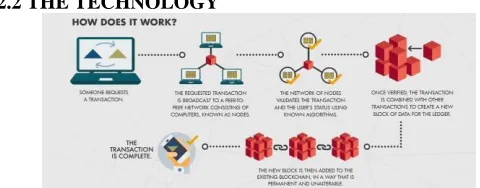
Figure 1 (Source: The Bernie Group)
A block in a blockchain is a collection of data. The blockchain keeps on adding data by connecting the first block (called as Genesis block) with other blocks in chronological order, creating a chain of blocks linked together. Blocks have two parts - header and content. The header includes a unique reference number, the timestamp, and a link to the previous block. The content includes a validated list of the assets. The block size, transaction amount, and addresses of parties involved in the transaction are also included. A node can start a transaction by creating and signing it digitally with its cryptographically created private key. A transaction can represent different actions in a blockchain. Most commonly, it is a data structure which represents transfer of value between peers on the blockchain network. The data structure usually consists of some logic of transfer of value, relevant rules, source and destination addresses, and other validation information.[1]
A transaction is flooded by using a protocol, called Gossip protocol, to peers that validate the transaction based on some criteria that is preset. Once the transactions are validated, data is electronically arranged and stored in cryptographically protected structures known as blocks. The transaction is considered confirmed at this point. These blocks are linked together in a linear, chronological chain. The blocks identify each other with the help of a cryptographic hash from the immediate previous block in the chain. The blocks have a timestamp, and the chain is continuously updated on every ledger on every node. Transactions are reconfirmed every time a new block is created in the chain.
2.3 FEATURES OF BLOCKCHAIN
Below are the key features of blockchain technology.
Decentralized technology
Blockchain is decentralized by design in that the transactions ledger is stored and maintained on a distributed set of computers that can communicate with one another. The network does not have a single governing authority, rather a group of nodes maintain it. This can help avoid the need of a third party in transactions and maintain data transparency.
Data immutability
The blockchain technology is a permanent, unalterable network. One cannot modify the data in any node without corrupting all nodes in the network. This ensures data authenticity and can be used to fight corruption. This feature has a significant use in cybersecurity.
Enhanced security
Blockchain uses encryption to store the data in blocks, which provides an additional layer of security. The technology uses cryptography in comparison with other existing technologies available in the market. Every information on the blockchain is stored using a cryptographic hash.
Faster settlement
This feature is mainly of use in areas like banking where traditional banking systems are quite slow in processing of transactions and final settlement.
Consensus
Consensus helps the decision-making process in the network by coming to a quick and faster agreement. The algorithm is key in making the network trustless. The nodes to do not trust each other, but can trust the algorithm over which blockchain runs.
Increased capacity
Blockchain increases the capacity of the whole network. The computing power is distributed across the devices ensure a better outcome. Supercomputers are used in the mining of blocks for the same reason.
2.4 TYPES OF BLOCKCHAIN
There are 3 types of blockchain networks primarily — public blockchains, private blockchains and hybrid blockchains.
Public blockchains
A public blockchain has no access restrictions. Anyone with an Internet connection can send transactions to it and become a validator. They are fully decentralized by design and transparent in transactions. They are highly censorship resistant, and hence is difficult to shut down. Some of the most popular and largest public blockchains are the Bitcoin and Ethereum.
Private blockchains
The main difference between a public and private blockchain is the level of access. Private blockchains maintain a closed network in which only authorized entities are allowed to participate. It is also referred to as ‘Permissioned blockchain’ since it grants specific rights and restrictions to participants in a network.
Private blockchains are more centralized since the control lies with a small group of participants. They are valuable for enterprises who want to collaborate and share data, but don’t want to display their sensitive business data in public. Examples of private blockchains include Ripple (XRP) and Hyperledger.[9]
Consortium blockchains
They differ from private blockchains in that control is not granted to a single entity, but a group of approved individuals. These types of blockchains could also be described as being semi-decentralized. Consortium blockchains are often associated with enterprise use, with a group of companies collaborating together to leverage blockchain technology for improved business processes. Examples of consortium blockchains would be: Quorum and Corda.[8]
Hybrid blockchains
A hybrid blockchain is a combination of the privacy benefits of a private blockchain with the security and transparency benefits of a public blockchain. It allows the users of the blockchain APIs to determine what information stays private and what information is made public. It is useful for businesses who need flexibility in determining what data stays public and what stays private. Examples of hybrid blockchain are XinFin and Dragonchain.
We conducted in-depth interviews to gather industry insights from professionals who worked in different sectors with blockchain. Key insights from the interviews are listed below with focus on current use cases, future opportunities and challenges of blockchain implementation.
Current use cases
Below are the fields in which blockchain is currently being used, and is known to be a success case.
1. Private sector
Data immutability is a general requirement in private sector. Blockchain is used to implement solutions where data needs to be secure and unaltered.
2. Data processing
Blockchain has significant applications in fields which require a lot of data processing, because of its immutability and faster settlement feature. Below are some use cases.
a. Internal processing in banks
b. Insurance sector - Blockchain is used in processing of insurance claims
c. Data reconciliation d. Digital onboarding e. CIBIL Score calculation f. Smart contracts
A smart contract is a computer protocol intended to digitally facilitate, verify, or enforce the negotiation or performance of a contract. Blockchain is used for market facilitation in energy trading using smart contracts.
3. Supply chain management
Blockchain is used in supply chain management where a continuous record of data needs to be maintained throughout the whole supply chain. Data immutability and decentralized authority are important here.
a. Walmart, Carrefour-French Multinational Retailer, Albertsons (tracking from farmer to store)
b. Pharma industry
In pharmaceutical industry, blockchain is used to track medicine lifecycle from production to pharmacy point.
4. Verification
The technology has applications in areas where data needs to be verified, since it can help maintain authentic data.
a. KYC verification b. Aadhar verification
c. Hospitality industry - For data verification at hotel reservations etc.
5. Land and property
a. Property registration - Blockchain is used to execute digital ownership. Andhra government has undertaken a project in this field.
b. Deeds transfer – For fast & seamless transfer of records from seller to owner.
6. New product development
Blockchain is highly efficient in applications where new product is being developed, since the fresh data can be stored on
blockchain from the start of the development. This has applications in fields like health care.
7. Online transactions
A major application of the technology is in peer-to-peer online transactions.
a. Online gambling
b. Music artist payment on Spotify
c. Over 13 banks in India have implemented blockchain in transactions
d. Carbon trading
8. Decentralized finance
Blockchain is used for cross border payments by Ripple, Facebook global coin, JPMorgan Coin etc.
9. Decentralized internet
Applications include Tron, Web 3.0 etc.
10. Trading Platform
Cross border trading for SMEs by Nordea
11. DAO (Decentralized Autonomous Organization)
It is an organization represented by rules encoded as a computer program that is transparent, controlled by shareholders and decentralized. The organization’s financial transaction records and program rules are maintained on a blockchain. Use cases include smart contract auditing services implemented by PwC
12. Healthcare
a. Patient registration system is implemented in blockchain by Alibaba.
b. Hospital records – Medi Chain integrates blockchain with Artificial Intelligence. Medical history of patients is recorded through smart watch, post which AI makes suggestions to the doctor.
13. Smart city
Implementation using blockchain in Ahmedabad with cryptocurrency for transactions
14. Digital Identity Management Network
Sovrin, Evernym (Public + Permissioned Blockchain network), Deloitte is using Verity (Evernym) for onboarding of remote users.
FUTURE OPPORTUNITIES
Below are the areas where block chain can possibly venture. It also mentions some areas that it has started implementing use cases in, and could help the technology in achieving greater success.
1. Customer data handling
Data irreversibility is an issue that is preventing companies from implementing blockchain in customer data handling.
2. Taxation, GST
To ensure authenticity and cross-verification of data. 3. Digital lockers
To measure the traffic density and implement solutions in the transportation segment.
5. Smart contracts
Smart contracts give programmability to block chain. This is a relatively new application in block chain which will gain popularity in the years to come.
6. Predictive analytics
Blockchain can be used for predictive analytics in combination with technologies like artificial intelligence, robotics and Internet of Things.
7. Trustworthiness in Digital Media 8. Daily Auditing
IV. SWOT ANALYSIS
Below is an analysis of the characteristics of blockchain based on the primary and secondary research undertaken:
STRENGTHS
Data immutability & encryption
Decentralized control -
Has applications in
distributed governance
No hidden transaction charges like in current legal tenders
Worldwide accessibility
Transparency and
selective visibility
No SPOF (Single Point of Failure)
Trust - Non reputability
Privacy and security
WEAKNESSES
Compliance issues
Data backup stored at
different locations
since it is
decentralized
No possibility of
linking between 2
block chains currently
OPPORTUNITIES
Irreversibility of
blockchain can be
overcome by
programming the
business layer to create
reversibility or by
keeping data backup in RDBMS
THREATS
Government
regulations and
policies
Quantum computing could be a potential replacement as it can
Data governance -
blockchain will ensure authenticity of the data fed in
Scalability is currently an issue which is being
resolved with every
upgrade. Bitcoin
transaction takes up to 30mins and Ethereum up to 10-15mins currently.
process transactions faster
IOTA Tangle which
uses DAG (Direct
Acyclic Graph) instead of blockchain
There is a mass
adoption of blockchain by everyone
V. BLOCKCHAIN IN OPERATIONS MANAGEMENT
Blockchain is often thought of as being synonymous with cryptocurrency, but it enables varied business applications while completely transforming value chains of organizations. For efficiently and effectively running operations, organizations need to enable regular and reliable information sharing with value chain partners in their ecosystem i.e. the suppliers, logistics companies, service providers, buyers, etc. This information sharing has been dominantly manual such as documents, point to point communications increasing complexity, time and expenditure. Blockchain enables an approach to secure, fast information exchange across value chain by providing every partner in the chain, controlled access to a shared copy of the same data. It allows parties to immutably record business transactions with selected visibility across network. Applications where blockchain is being implemented and provides benefits to manufacturers are -
Supply chain optimization
Data which is trustworthy, about inventory levels, track of shipments, status of goods (certificates, temperature, humidity, quality), regulatory requirements, payment processes, etc. is the key for effective coordination of supply chains. DTL - Distributed Ledger Technology establishes this trust to give a single version of truth. Distributed ledger provides cryptographic security, defines shared access and establishes audit trail required by participants to trust.
Companies are leveraging Blockchain’s improved trust, transparency to enhance supply chain visibility, track ownership, and streamline manual processes. With shared data across value chain, products, raw materials can be effectively tracked, better forecasted and can enable real-time cross-company planning and decision synchronization. It also reduces the risk of fraud and non-compliance.
Risk reduction in sourcing
5.1 WALMART FULLY TRANSPARENT FOOD SUPPLY CHAIN
During an outbreak of a food borne disease (E.g. Outbreak of E.coli virus in Chipotle stores in 2015 with 500 reported cases 43 restaurants were closed with an 80% drop in Chipotle’s Profit - the cause was never identified), it may take weeks to find its source. Companies need to act swiftly by having a better traceability of the food to save lives and livelihoods of farmers by discarding only the affected produce.
Challenges in traditional supply chain (relying on manual processes involving farmers, processors, distributors working in silos and manual record keeping with minimal communication) - 1. Poor communication across multiple parties
2. Low traceability of individual items 3. Variable quality for different food items
4. Limited shelf lives (include time spent during transportation) - Wastage
5. Health implications - possible infestation/contamination by toxins, insects, bacteria, viruses, Spoilage/Expiry of product due to temperature, humidity, etc.
Successful Proof of Concepts (POCs) - Walmart together with IBM started two projects on Blockchain and IoT sensors to implement food traceability system based on Hyperledger Fabric. The shipments were tracked by signing and logging at multiple checkpoints using six-digit IoT numeric identification. Open source, vendor neutral blockchain were the features, Walmart chose Hyperledger Fabric hosted by The Linux Foundation. Project 1 - Tracing mangoes from Mexico to be sold in US stores. Time to trace the origin of mangoes reduced from 7 days to 2.2 seconds.
Project 2 - Tracing Pork sold in China stores where food safety mandates are known to be frequently violated and a serious issue. Walmart was able to successfully trace pork products from producer to retailer to consumers highlighting high scalability and flexibility of technology.[2]
Key tasks to reap the benefit - Gaining buy-in and cooperation from all involved parties, maintenance of software and hardware, licensing costs, integration across systems. These successes led to the implementation consideration of IBM
[image:5.612.51.283.541.602.2]Food Trust.
Figure 2:
(Source: hyperledger.org/resources/publications/walmart-case-study)
5.2 IBM FOOD TRUST - INTEGRATED ENTERPRISE-GRADE BLOCKCHAIN SOLUTION
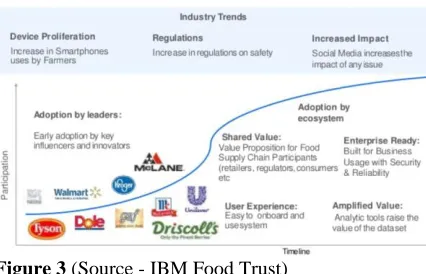
Walmart collaborated with IBM and other prominent players in the food industry like Nestle, Dole, Golden State Foods, McLane Company, Kroger, and Unilever to set up IBM Food Trust. Walmart in 2018 could trace over 25 products from different suppliers using Hyperledger Fabric which could visualize the whole supply chain in seconds. Buy-in of all stakeholders in the chain is required, they need to input detailed
information about food. All the data is stored on blockchain hyper ledgers fabric which are protected with high encryption to make them tamperproof. Once it is done, all the data can be leveraged to track food freshness, minimize wastage, longer product shelf lives, better access to shared information, etc. It provides participants of the supply chain with permission-based shared view of the information. This solution is to bring back the customers’ trust in the food supply chain. It allows the customers to not only track the food ingredients but also check whether the food went through the required safety processing (certifications, test data, temperature) or whether the food item is truly organic in seconds.
‘IBM Food Trust creates a secure, shared, and permissioned record of transactions. This enables unprecedented visibility during each step of the food supply chain. IBM Food Trust achieves new levels of trust and transparency, making food
safer and smarter from farm to fork.’[3]
EFFECTIVENESS
Pilot Test Case to identify the time taken to trace a sliced mango packet in US to Farm in Mexico proved the possibility of successful implementation of Blockchain in supply chain. The typical mixed manual, paper based and digital method which earlier took 6 days, 18 hours and 26 minutes, now with IBM Food Trust Digital solution took 2.2 seconds.
EFFECIENCIES
IBM VP, Brigid McDermott, during demonstration, broke the financial costs of supply chain tracking inefficiencies into three categories.
1. Cost of Human life and health - According to the WHO, 420k people die every year due to food poisoning resultant of food contamination.
2. Cost of recalling affected food item - To act swiftly entire stock is recalled from all the farms which brings loss to the farmers.
3. Cost of food wasted because of consumer fears - Tracking the tainted items would takes weeks resulting in a price drop as people stop buying the item; creating financial cost to owners of even non affected safe products.
These losses together (economic impact of foodborne illnesses) have been estimated to vary around $4.4bn per year to
$93.2 bn per year for U.S. economy alone.[4]
ADOPTION OF IBM FOOD TRUST
Figure 3 (Source - IBM Food Trust)
[image:5.612.316.529.562.699.2]The pharmaceutical industry is exploring the technology to implement several use cases, the top four of which are mentioned below.
1. Verifying the Authenticity of Returned Drugs
Drugs are frequently returned to the pharmaceutical manufacturers in cases where wholesalers may return unsold excess inventory. Instead of destroying these perfectly good drug shipments, pharmaceutical companies opt to re-sell them. But before they can re-sell them, the pharmaceutical companies have to verify the authenticity of these returned drugs.
In the US, the Drug Supply Chain Security Act (DSCSA) has mandated serialization or barcoding of drugs at a package level. These serial numbers must then be used to verify the authenticity of the returned drugs. Europe has a similar regulatory enactment called the Falsified Medicine Directive (FMD). While the EU has opted for a centralized approach, in the US there is no centralized database regulator. In such a scenario, pharmaceutical manufacturers can record the serial numbers of their packages on a blockchain, which can serve as a decentralized and distributed ledger. Wholesalers and customers can then verify the authenticity of a drug package by connecting to the blockchain. Merck in partnership with SAP has developed the SAP Pharma Blockchain POC app for this use case.
2. Prevention of Counterfeit Drugs and Medical Devices
Blockchain’s ability to establish provenance of data makes it suited for prevention of counterfeit drugs & medical devices. Drug companies have a difficult time keeping track of their products because of the large volume, thereby leaving an opportunity for counterfeiters to introduce fake drugs into the system.
The problem of counterfeiting also extends to medical instruments manufacturers. 8% of medical devices are estimated to be counterfeit copies by the World Health Organization. Counterfeit drugs and medical devices are a major risk to consumers, and also result in lost revenue for the manufacturers. The DSCSA mandate provides a unique product identifier for each drug package, and allow the authenticity verification of every product sold. The transactions at every point of the drug’s supply chain can be recorded on a blockchain, thereby providing a distributed provenance ledger. This will make it possible for all involved parties to track drugs through the entire life-cycle of supply chain, and make it harder for counterfeit drugs from being introduced.
Novartis is experimenting with blockchain to identify counterfeit medicines and track their temperature with real-time visibility for all participants in the supply chain, with the use of Blockchain and IoT. Novartis is also engaged in developing a consortium blockchain network between the European pharmaceutical industry and the EU, called the Innovative Medicine Initiative (IMI) Blockchain Enabled Healthcare program. The consortium will comprise SME blockchain companies, universities, clinical labs, hospitals, patient representatives and others. It aims at exploring use cases in counterfeit drug detection, supply chain, patient data, and clinical trials.[5]
3. Compliance in Pharma supply chain
As drugs move through the supply chain, logistics companies need to track several operating constraints in terms of drug handling, transport and storage guidelines. These may
include maintenance of temperature range, humidity, air quality, etc.
The quality and efficacy of drugs may be directly impacted by environmental conditions within the supply chain. However, since each participant in the supply chain maintain their own separate ledger, it is difficult to track a problem within any particular segment of the supply chain. Blockchain provides a better way to add compliance and governance in such scenarios. Additionally, smart contracts can be programmed to alert the relevant parties in the supply chain. For example, if there is a temperature rise during transportation, the consumer can easily see at what point the event occurred with the help of blockchain.
4. Transparency and traceability of consent in clinical
trials
Informed patient consent is the process of making the patient aware of each step in the Clinical Trial process including any possible risks involved. Clinical trial consent for protocols need to be transparent for the benefit of patients and traceable for stakeholders. In practice, the informed consent process is difficult to handle in a satisfactory way.
The FDA reports that about 10% of the trials they monitor feature some issues related to consent collection. Blockchain can provide transparency and traceability of consent if used in clinical trials. The technology provides a mechanism for unfalsifiable time-stamping of consent forms, storing and tracking the consent in a secure, and publicly verifiable way, and enabling the sharing of this information in real time.[5] Smart contracts can also be additionally be tied to protocol revisions, such that any change in the protocol requires the patient's consent.
VI. ENTRY BARRIERS
Establishing trust and getting everyone on board, is the fundamental factor for blockchain’s successful implementation. Following are the barriers for Blockchain adoption.
1. Trust of Multiple players many wary of sharing data 2. Enforcement or Government policies
3. Standard bodies and their resistance to change 4. Transactions speed, Latency
VII. POTENTIAL REPLACEMENTS
7.1 QUANTUM COMPUTING
The security of a blockchain is guaranteed by standard cryptographic functions which are relatively secure since breaking them requires huge computing resources, which are not easily available. Its validity, however, is heavily dependent on the “state of technology” assumption.
Experts suggest the architects of blockchain to start taking precautions immediately to address this potential threat. Possible solutions are:
1. Adding quantum cryptography to blockchains might guarantee their security as quantum computers cannot break quantum cryptographic codes.
2. A better and more secure solutions would be to make the entire blockchain a quantum phenomenon
3. Another remedy will only be available with the advent of a quantum internet, which is still several decades away. When implemented, this will unlock a wealth of new blockchain models and designs.
Quantum computing could be the next big future of supply chain. The minimized energy expenditure in this technology will help organizations create more driverless supply chains. It also has the potential to disrupt the way advanced planning and optimization systems work by performing scenario planning on the fly. However, the use of quantum computing in supply chain could be very expensive and therefore impractical.
7.2 IOTA TANGLE TECHNOLOGY AND THE FUTURE OF SUPPLY CHAIN
IOTA Tangle is a set of interlinked, individual transactions. Like blockchain, these transactions are distributed, stored among a decentralized network with access to different participants. Tangle is a DAG with vertices representing transactions and edges representing approvals. A new transaction is added as a new vertex while getting attached to previous two transactions which it approves. A transaction being approved means history being verified. A transaction when approved by a large number of new transactions becomes impossible to change. Every transaction requires participants to do a small proof of work computation which ensures it is expensive to spam or fork after establishment of consensus.
Comparison to Blockchain - With its main motivation is being scalable, IOTA uses DAG (Direct Acyclic Graphs) unlike blockchain to store its ledger. In Blockchain, all participants have to agree on the longest chain creating a transaction limit. Tangle allows branches in DAG to eventually merge into the DAG, resulting in a faster throughput. Tangle overcomes some limitations of blockchain like - Scaling, Fees and Miners Conflict of Interest that slow network to raise fees. It doesn’t use blocks or miners. IOTA scale and support millions of transactions of global supply chains today.[6]
In late June 2019, Alyx, a luxury fashion brand, launched a pilot for supply chain implementation of IOTA-Tangle. As for the pilot, digital ID tag is created for every Alyx piece where all the supplier’s data (uploaded on ledger) is available to customers on a scannable QR-code.[7]
VIII. CONCLUSION
Blockchain has been successful in reducing costs of supply chain. It is economically viable for small transactions, has low marginal costs if IoT is already in place to detect and track processes. Tracking via IoT in situation of crisis involving food contamination will ensure easy identification of source to remove only affected products. It will eliminate manual keeping of paper records by providing digitally signed contracts with encrypted storage and transmission. Data immutability can help in easy auditing and hence reduce regulatory compliance costs. Transparency minimizes possibilities of frauds. Stored data related to temperature, humidity, motion, chemical compositions captured by IoT devices on equipment and available to consumers and manufacturers, distributers ensures quality check. Blockchain based digital certificates ensures validation, ownership. Shared Permissioned Blockchain with identity validation increases dependability. Thus, Blockchain with its characteristics and various use cases in Operations Management improves the supply chain parameters like cost reduction increased speed, dependability and increased risk reduction.
REFERENCES
[1] Ibad Siddiqui, “What The Hell Is Blockchain And How Does It Works? (Simplified)” Medium, Coinmonks, 2018.
[2] Sarina, “Linking the Food Chain, Supply Chain, and Blockchain: Walmart’s Path to a Fully Transparent Food System,” Digital HBS Education, RC TOM Challenge 2017.
[3] IBM Food Trust – Blockchain Solutions – Food Trust.
[4] Michael del Castillo, “Walmart, Kroger & Nestle Team with IBM Blockchain to Fight Food Poisoning” — CoinDesk, 2017.
[5] “Top 5 Blockchain Use Cases in Pharma and Healthcare — that you should know about!” – Medium, Blockchainbistro, 2018.
[6] “Meet the Tangle” – IOTA org
[7] “Alyx Fashion Brand Launches IOTA-Powered Pilot for Supply Chain Transparency” – Cointelegraph, 2019.
[8] “Consortium Blockchain Explained” – Mycryptopedia, 2018.
[9] “PUBLIC VS PRIVATE BLOCKCHAIN: WHAT’S THE DIFFERENCE?” – Master the crypto, 2018.
AUTHORS
First Author – Kamakshi Gupta, Indian Institute of
Management, Calcutta, [email protected], +91-9993553779
Second Author – Anjali Sam, Indian Institute of Management,