Communication Theses Department of Communication
11-28-2007
Communicating a Crisis: The Public Information
Officer's Perspective
Susan Hale
Follow this and additional works at:https://scholarworks.gsu.edu/communication_theses
Part of theCommunication Commons
This Thesis is brought to you for free and open access by the Department of Communication at ScholarWorks @ Georgia State University. It has been accepted for inclusion in Communication Theses by an authorized administrator of ScholarWorks @ Georgia State University. For more information, please [email protected].
Recommended Citation
COMMUNICATING A CRISIS:
THE PUBLIC INFORMATION OFFICER’S PERSPECTIVE
by
SUSAN HALE
Under the Direction of Greg Lisby
ABSTRACT
Established research on certain professions – such as police officers, firefighters, and
emergency rescue workers (also called “first responders”) – suggests that psychological trauma is
related to traumatic events experienced on the job. This has led to research on journalists who have
experienced comparable psychological effects due to repeated traumatic exposure that comes from
reporting on crimes, murders, car accidents, natural disasters, or other stressful situations – the
same events experienced by first responders. This study examines public information officers and
any similar psychological effects since this occupational group is a near professional cousin to
journalists. Using an online survey, public information officers’ exposure to traumatic events
experienced on the job was measured as well as the frequency and intensity of trauma exposure.
COMMUNICATING A CRISIS:
THE PUBLIC INFORMATION OFFICER’S PERSPECTIVE
by
SUSAN HALE
A Research Thesis Presented in Partial Fulfillment of the Requirements for the Degree of
Master of Arts
in the College of Arts and Sciences
Georgia State University
Copyright by Susan Lynn Hale
COMMUNICATING A CRISIS:
THE PUBLIC INFORMATION OFFICER’S PERSPECTIVE
by
SUSAN HALE
Committee Chair:
Committee:
Greg Lisby
Yuki Fujioka Merrill Morris
Electronic Version Approved:
DEDICATION
This has truly been a labor of love. I did not enjoy every minute of graduate school, but I
certainly feel as though I am a better person for it. I want to thank so many people for standing
by me, but since this journey has taken much of my memory and my energy, I will just note
those who have gone above-and-beyond to keep me moving forward and from not giving up.
• To my friends, for acknowledging that this was an important goal to me and for understanding
why I couldn’t always “come out to play.” For three years, it was always a “school night!”
Anna, Christy, Lisa, and Lynda – thank you for being my constant cheerleaders.
• To my co-workers, for suffering through – and forgiving me for – my vents of frustration and
mood swings, the occasional series of four-letter words when describing my classes or
projects, and for providing encouragement when it was needed. Liquan, I brought you all As!
• To Sammy and Sophie, for being the best paperweights – or cats – I could ever have. Every
time you accidentally turned off the power surge protector and I lost my unsaved work, I
knew it was your special way of saying “That wasn’t your best effort. Why don’t you try it
again?” Your unconditional love and purring has been a comfort on some long, tiring days.
• To the Vinings Starbucks and the Waffle House on South Atlanta Road, for letting a poor,
exhausted college student work in peace. There are few places you won’t be hassled for
spending only $4 over four hours. You have always been friendly and encouraging. For that,
I will always leave a good tip!
• To Alan, Amy, and Steve, for your quiet support and ongoing pep talks throughout the journey.
• And to my Mom, for believing that I was good enough and smart enough. Many times I
doubted that, but you never did. Looking at myself through your eyes, I feel like the smartest
ACKNOWLEDGEMENTS
Gratitude is extended to my thesis committee for their guidance and advice regarding this
research study. Dr. Greg Lisby, my committee chair, exhibited timeless patience with my many
emails seeking help or counsel and encouraged me through the difficult times as I completed this
study. Dr. Yuki Fujioka, who instructed me in how to collect and analyze data in her Research
Methods class, gave excellent insight regarding my survey instrument, and Dr. Merrill Morris,
with her journalism background, brought a real-world perspective to the committee and
straightforward suggestions. I appreciate that they supported my study, recognizing that I was
not just researching this thesis to fulfill a degree requirement, but also because the conclusions I
draw are meaningful to my profession. And that means something to me.
In addition, this study could not have been completed without the assistance of Mike
Tellef, immediate past president of the National Information Officers Association, and Rich
Bagin, APR, executive director of the National School Public Relations Association. As leaders
of their respective organizations, they provided research support by allowing their memberships
to participate in a survey. Knowing just how demanding their jobs are, I appreciate the time they
took to consider this research study and their willingness to help a graduate student. I sincerely
TABLE OF CONTENTS
DEDICATION... iv
ACKNOWLEDGEMENTS...v
LIST OF TABLES... viii
CHAPTER 1 INTRODUCTION ...1
Significance of Study...2
2: REVIEW OF THE LITERATURE ...4
Professional Similarities and Differences...4
Indications of Traumatic Stress ...5
Physical and Psychological Pressures...6
Coping Behaviors...10
Support Programs and Training Organizations...12
Research Objectives...14
3 METHODOLOGY ...15
Participants...15
Procedure ...16
Measures ...17
4 RESULTS ...19
Demographic Data ...19
Exposure to Work-Related Traumatic Events ...20
Intensity of Exposure ...22
Intrusion and Avoidance Indicators ...24
5 DISCUSSION ...30
Research Question 1 ...30
Research Question 2 ...32
Research Question 3 ...34
Limitations ...34
Recommendations for Future Research ...39
6 CONCLUSIONS...42
REFERENCES ...44
APPENDICES ...49
A Sample Public Information Officer Job Description ...49
B Invitations to Participate in Research Study ...51
LIST OF TABLES
Table 1: Communication Events Providing Exposure to Trauma or Stress...page 21
Table 2: Situations Adding Intensity to Work-Related Traumatic or Stressful Events ....page 23
Table 3: Statements Measuring PTSD Intrusion and Avoidance Indicators...page 25
Table 4: Responses Disaggregated by Intrusion and Avoidance Subsets...page 26
Table 5: Response Rate for Public Information Officers Seeking Emotional Help ...page 28
Table 6: Public Information Officers Accepting or Seeking Help...page 29
Table 7: Public Information Officers Declining or Not Seeking Help ...page 29
CHAPTER 1:
INTRODUCTION
Police officers, firefighters, and emergency rescue workers witness emotionally
disturbing events as a routine part of their jobs (Haslam & Mallon, 2003; McFarlane & Bookless,
2001; Renck, Weisæth, & Skarbö, 2002). While these “first responders” are common at the
scenes of deadly automobile accidents, fires, or violent crimes, there are often journalists and
public information officers at the scene as well. The nature of these professions places journalists
and public information officers in unique situations where they may witness traumatic events and
then must communicate about them, often not fully realizing the potential long-term effects of
what they have seen or experienced. Consider this journalist’s account of reporting a story where
a car was struck by a train (Dworznik, 2006). The driver, a popular teenager, died at the scene.
“Fridays are supposed to be easy.” That is what I was thinking as I stared at the remains of a black Dodge Daytona. A closer look revealed I was also looking at some of what remained of its driver. “So this is what happens when you get hit by a train?” remarked my photographer, as he busily went about his business of shooting video of the car. I closed my eyes and turned my face to the sun.
That was fall of 2000 and I was a reporter for the NBC affiliate in Toledo, Ohio. It was a beautiful afternoon; perfect for high school football. And that’s exactly where the driver of that Daytona should have been. Joe, the famed center of the Lake High School football team, was dead after having misjudged the speed of an oncoming Amtrak train. The train was traveling 75 miles per hour and rescue workers at the scene said Joe never had a chance. The twisted remains of the car looked almost fake, almost surreal. But the blood covering the seats was as real as it gets. It is an image I can still see when I close my eyes.
Dworznik noted that the accident scene drew news media in addition to emergency
responders. Though not specifically noted, it is likely that several public information officers
also were present. A public information officer (sometimes called “spokesperson” or “press
secretary”) is often the key communicator for an organization and commonly represents
common among hospitals, school systems, utilities companies, and other public-type
organizations that serve the community. Public information officers regularly work with the
news media, frequently responding to questions from television news reporters, newspaper
journalists, or radio reporters. For illustration, Appendix A provides a sample of an average job
description for a public information officer.
As the first responders do their jobs to rescue or care for victims, the journalists and
public information officers are busy with their own jobs. The journalists take notes and
transcribe every detail of the scene, record witnesses’ testimonies, and photograph wreckage or
other carnage, while the public information officers also collect information to determine what
happened and why so they can effectively respond to questions from the news media. At the
accident scene described by Dworznik, a police department public information officer would be
there to manage information related to the actual accident and a hospital public information
officer would respond to questions regarding any medical attention given to the driver or
passengers. A school system public information officer would become involved as the news
media request personal details about the deceased teen, such as what kind of student he was,
whether he was well liked, how he will be remembered by his classmates, and how his death will
impact the school.
Significance of Study
Because of their jobs, both the journalist and public information officer often share the
same space at an incident scene; both witness much of the same images, sounds, odors, and other
sensory information. Public information officers, however, have greater access to confidential or
sensitive information as well as restricted areas due to their employment with the agency they
represent. And because their job “marries” them to any situation involving their agency, the
has filed his story or submitted photographs for the late edition. An Associated Press story
released during the height of the Hurricane Katrina crisis chronicled the suicide of Sergeant Paul
Accardo, a public information officer for the New Orleans Police Department (Burdeau, 2005).
Back when life was normal and structured, Accardo served as one of the Police Department’s chief spokesmen. He reported murders, hostage situations and rapes in measured words, his bespectacled face benign and familiar on the nightly news.
A public information officer…turns the senseless – murder, rape, mayhem – into something orderly for the public. … But in New Orleans for the past week, the chaos seemed endless. Like the rest of the Police Department, Accardo worked hard and long days – sometimes 20 hours. He waded through the mass of flesh and stench in the Louisiana Superdome. He saw the dead in the streets. … Unable to stop the madness and hurt, Accardo sank into depression.
Though the article was a news report on an apparent suicide, the unwitting result is that
attention was drawn to public information officers and the psychological affects of
communicating during a crisis. A New Orleans television station web site posting the AP story
even ran the headline, “Officer who delivered bad news daily found Katrina’s news too much to
take,” taking note of the irony that a public information officer who reported the news had
himself become a news story (www.wwltv.com, 2005).
This study examines the psychological effects of those who communicate tragic news
events and crises – in particular, the public information officer. Numerous studies have been
conducted on professions, including journalists and first responders, that respond to violent and
traumatic situations and the psychological effects that can result (Haslam & Mallon, 2003;
McFarlane & Bookless, 2001; Renck, Weisæth, & Skarbö, 2002; Simpson & Boggs, 1999). But
unlike first responders or journalists, little is known about how public information officers respond
to the unique stresses of their jobs. In addition, little is known about their coping responses and any
CHAPTER 2:
REVIEW OF THE LITERATURE
To date, no known research about public information officers has been conducted. It is
not known why this profession has not been studied, other than to assume that no group or
individual has yet been interested in the similarities between journalists and public information
officers and how they may parallel in respect to communicating during difficult times. As a
result, this literature review primarily focuses on the public information officer’s nearest
professional cousin – the journalist – in the hopes that similar conclusions may be drawn.
Professional Similarities and Differences
Both journalists and public information officers are part of the communication field and
have similar professional goals – to inform and to educate. Training also is comparable; both
generally have the same journalistic foundations in fact-gathering and information compilation.
Communications departments at colleges and universities often require the same basic writing
courses for students majoring in journalism or public relations, as strong writing and reporting
skills are necessary for success in both vocations. In addition, both professions experience tight
deadlines and the challenge of sometimes communicating sensitive and difficult information to
their audiences.
Public information officers routinely have direct communication with the news media
and the public in times of emergency or crisis. Like journalists, they often are witnesses to
gruesome and horrifying events, yet must carry out their communication duties. But as a main
difference between the two professions, public information officers are part of the “responding
team” during a crisis and often have direct access to confidential information, crime scenes and
traumatic events. Whereas a journalist may cover a story and move on to a completely different
topic or issue once the deadline is met, the public information officer continues with the original
story – often for days, weeks, or even years. As an example, journalists who covered the April
1999 Columbine High School shootings reported on the story as long as it was of major news
interest, but once it was no longer a top headline, they moved on to other non-Columbine stories.
Meanwhile, the public information officers for both the Jefferson County School System and the
Jefferson County Sheriff’s Office are still heavily involved in any recurring story relating to the
incident. For these public information officers, the Columbine tragedy never ends.
Indications of Traumatic Stress
Journalists are still a relatively unstudied group when it comes to determining the
psychological effects of their jobs, particularly those that come from exposure to traumatic
events. Simpson and Boggs (1999) were among the first researchers to make a correlation
between emergency first responders’ psychological well-being and that of journalists. The
professions share similarities in their emotional responses to trauma, and both groups are prone
to symptoms of post-traumatic stress disorder (PTSD) or other psychological problems
(American Psychiatric Association, 1994).
The American Psychiatric Association’s Diagnostic and Statistical Manual of Mental
Disorders, 4th Ed. (1994) characterizes post-traumatic stress disorder through four main criteria:
re-experiencing the stressful event, persistent avoidance, increased anxiety and arousal, and
impairment. Specific symptoms include recurring recollections or dreams and intense distress
over reminders of or actual re-exposure to the event (i.e., re-experiencing the event). Symptoms
also include an effort to avoid thoughts and feelings related to the event as well as an inability to
remember important aspects (i.e., persistent avoidance). Sleep difficulties and problems with
exaggerated startle responses, and exhibiting irritability and/or outbursts of anger (i.e., increased
anxiety and arousal). The combined symptoms can cause distress and/or impairment in social,
occupational, or other critical areas of functioning (i.e., impairment).
In 1994, the American Psychological Association added a diagnosis for acute stress
disorder (ASD), which is used to identify people who have experienced trauma and are at risk for
developing post-traumatic stress disorder. Acute stress disorder differs from PTSD by its focus on
dissociation, a coping strategy where individuals dissociate or “remove themselves emotionally”
from a situation. Individuals affected by acute stress disorder experience a sense of numbing or
detachment, reduced awareness of their surroundings, loss of reality, depersonalization, or
dissociative amnesia (American Psychological Association, 1994; Bryant, 2003).
Journalists have unique job responsibilities that often put them in harm’s way, creating a
higher likelihood for trauma-related disorders. The documentary nature of journalism calls for
the study and review of cultures, conflicts, and situations that are unstable, unpredictable, and
ever-changing (Collins, 2001; Owens, 2001). While many journalists appear to enjoy the
challenges brought on by potential risk, the true danger is that too much exposure to trauma and
violence may have negative consequences on mental and physical health. Research has shown
that journalists are increasingly prone to experience post-traumatic stress disorder or other
psychological problems due to repeated exposure to traumatic events (Feinstein & Nicolson,
2005; Feinstein & Owen, 2002; Feinstein, Owen, & Blair, 2002; Simpson, 2004; Simpson &
Boggs, 1999). Since public information officers are often at the same incidents as journalists, it
might be assumed that they too experience prolonged exposure to stress or trauma.
Physical and Psychological Pressures
Pressures are increasing on journalists as they find themselves in new territory, literally,
coverage of disasters around the world. Technology allows journalists to report from nearly
anywhere, at any time. Imbedded reporting is becoming a common assignment, requiring that
journalists live and travel with military groups for extended periods (Feinstein & Nicolson, 2005;
Ghaffar & Feinstein, 2005). Not only are these journalists prone to witnessing horrific war
events, there are the added pressures of meeting tighter than normal deadlines in keeping with
24-hour reporting. And there is the ultimate anxiety – keeping safe, or even alive, in a war zone
where violence against journalists is on the rise (Collins, 2001). The 2002 beheading of Wall
Street Journal reporter Daniel Pearl in Pakistan and the 2006 Iraq roadside bomb that seriously
injured ABC News’ Bob Woodruff and cameraman Doug Vogt are both chilling reminders of the
new dangers facing international journalists. Feinstein, Owen, and Blair (2002) studied wartime
journalists and concluded that the pressures of the job directly contribute to symptoms of PTSD.
Journalists who were eyewitnesses to state-ordered executions were similarly affected and found
to suffer PTSD and/or acute stress disorder (Freinkel, Koopman, & Spiegel, 1994).
Public information officers are not dissimilar to journalists in relation to imbedded
reporting and adhering to strict deadlines. Military groups have public affairs officers which
serve the same function as public information officers. Unlike journalists, public affairs officers
are not temporarily assigned to the military unit; they are full-time military staff. They do,
however, often live and travel with the unit, similar to an imbedded reporter.
During situations of extreme crisis, public information officers work around the clock to
satisfy the hunger of a 24-hour news media and their deadlines. A reporter’s deadline becomes
the public information officer’s deadline. Consider this example posted on CNN’s Special
Reports web site (www.cnn.com, 2001):
filled the Sheriff’s PIO slot before Davis. As the crisis wore on, Parr served as the back-up, on-camera spokesman. Davis started work at 4 a.m., and then Parr came in at noon. The two worked together for several hours to insure they were
dispensing consistent, accurate information, and then Davis would go back to his office for a few hours and then home to sleep. Meanwhile, Parr took over the reigns [sic] as spokesman for the late afternoon and evening.
The high media interest was immediately evident. By 11:33 a.m., local media had contacted dispatch asking for information about the shootings; by 11:42 a.m., the first national news organization had called. Soon news helicopters were flying over the school, and other media figures – including Jay Leno and Larry King –were calling to request interviews with responding officers and Sheriff [John P.] Stone. By midnight, 339 media calls had come into dispatch from more than 60 countries.
In addition to emotional strain, stress manifests itself physically in journalists. Journalists
experience severe physical fatigue due to the increasing demands of a global village of news
consumers and 24-hour news coverage. Other work-related health problems include headaches,
sleeping and concentration difficulties, short temper, upset stomachs, and low morale and job
dissatisfaction (Collins, 2001). Public information officers may suffer from these symptoms as
well due to long-term stress exposure.
Pyevich, Newman, and Daleiden (2003) studied the frequency and intensity of exposure
to job-related traumatic events and its relationship to developing PTSD or PTSD symptoms.
Their conclusions were that frequency and intensity of exposure to traumatic events did indeed
affect development of PTSD among journalists since they are at a higher risk of exposure than
the general public due to their unique job responsibilities.
Identifying PTSD or PTSD symptoms, however, is not a simple process and has many
compounding factors. Marais and Stuart (2005) found that a journalist’s biological factors and
emotional temperament has an impact on an individual developing PTSD; that exposure to the
traumatic event itself was not the only origin of PTSD. Similarly, Pyevich, Newman, and
Daleiden (2003) studied journalists’ cognitive mindsets, such aswhether the journalist was a
The studies are relevant because they provide an alternative view to how and why some
journalists are heavily affected by reporting on traumatic events, and why others are seemingly
unaffected. It is possible that the traumatic event was not the only cause of traumatization or
stress; the journalist may be predisposed to psychological impact because of existing biological
factors, such as depression or generalized anxiety disorder. The studies also suggest that there is
a relationship between personal beliefs and positive/negative outlooks on life with the
development or prevention of post-traumatic stress disorder among journalists.
In addition to PTSD, research suggests that journalists can suffer from “vicarious
traumatization,” also called “secondary traumatization,” as a result of interviewing victims of a
crime or crisis (Lerias & Byrne, 2003; McMahon, 2001). Vicarious traumatization is most often
associated with those who routinely work with victims, such as firefighters, rescue workers,
hospital staff, and therapists (Palm, Polusny, & Follette, 2004), but Simpson and Boggs (1999)
noted that journalists can suffer from it as well. The personal nature of interviewing leads some
journalists to identify with the victim and absorb their feelings of pain, anxiety, or guilt.
Similarly, Ochberg (1996) indicated that journalists are especially prone to suffer from a form of
PTSD known as “secondary traumatic stress” or “compassion fatigue.” Lerias and Byrne (2003)
concluded that vicarious traumatization can be a precursor to developing post-traumatic stress
disorder. Although public information officers do not routinely interview victims, they do spend
an extended period of time with those affected by traumatic situations. The nature of their
employment with the responding agencies gives public information officers extensive access to
the incident scenes and to any parties involved, whereas journalists often have temporary or
limited access. This makes the notion credible that public information officers also may suffer
from aspects of vicarious traumatization, secondary traumatization, secondary traumatic stress,
News photographers, including videographers, also have been found to experience
job-related stress (Feinstein & Owen, 2002; Newman, Simpson, & Handschuh, 2003). Schwanbeck’s
(2004) article on journalists’ reactions to reporting on The Station nightclub fire – the 2003
Rhode Island fire where 100 people died due to faulty pyrotechnics – notes the special
challenges facing photojournalists.
For the people that are taking the visuals, there’s that sense (that) interposing that sheet of glass between you and what’s happening is going to protect you to a degree, but it doesn’t. … In fact…reporters can turn away from a gruesome scene but it’s the photographer who ends up seeing everything.
This study is relevant in that it documents the effects of witnessing a traumatic scene. As
mentioned, public information officers have greater access to restricted areas, which indicates
that they may witness more gruesome details than the average journalist.
Coping Behaviors
Little is known about the coping responses used by public information officers. For
journalists, it is known that post-traumatic stress disorder and acute stress disorder both trigger
emotional responses of dissociation, which prompt avoidance, defined as ignoring or consciously
pushing away negative feelings (Freinkel, Koopman, & Spiegel, 1994; McFarlane, 1992). Both
behaviors serve as a coping mechanism for dealing with highly stressful or traumatic events.
Some journalists have reported “feeling numb” as a result of experiencing high levels of
traumatic events; that when an emotional response is warranted they often feel nothing at all.
This desensitized response, according to Simpson and Boggs (1999), is an emotional reaction in
itself and one that promotes avoidance, allowing the journalist to cope with what was
experienced by pushing away the uncomfortable feelings.
The Transactional Model of Stress and Coping lends additional insight into how
The person’s primary appraisal of the event judges its significance and whether it is “stressful,
positive, controllable, challenging, benign, or irrelevant” (Wenzel, Glanz, & Lerman, 2002). The
secondary appraisal then assesses the “controllability” of the situation and how he or she will
allocate emotional resources to coping. Coping efforts include problem management (aiming to
change the stressful situation) and emotional regulation (changing the way one thinks or feels
about the situation). These efforts are important in that positive-minded individuals likely will
choose healthier, more positive coping strategies such as problem solving, talking about the issue
with others, or seeking professional help. Negative-minded individuals likely will turn to
emotional avoidance or dissociation rather than facing the stressor.
Another coping strategy is the act of finding meaning within a traumatic event – called
“meaning-based coping” in the Transactional Model. Folkman and Moskowitz (2004) suggest
that an individual can reframe or re-interpret the event to align with their own values, beliefs, and
goals; therefore providing the individual a sense of mastery or control and that the event was
ultimately a positive occurrence. Likewise, “stress-related growth” can be a coping strategy
when an individual gains acceptance and positive re-interpretation over the stressful event by
associating it with a perception of personal change or growth (Folkman and Moskowitz, 2004).
Pennebaker and Seagal (1999) suggest that coping also occurs in the actual act of writing
a narrative; referred to as a “talking cure” in Himmelstein and Faithorn’s research (2002). This
holds special significance for journalists, and perhaps for public information officers, as the
nature of journalism requires that information be assimilated, analyzed, and then reported. This
act allows the journalist to confront what they have encountered and then make sense of it so
they can report it effectively. The cathartic behavior helps minimize the psychological effects of
the traumatic event and is unique to the communication profession; emergency first responders
Dworznik’s study (2006) on journalism and trauma suggested that journalists cope by
reframing their experience through narratives. Using Baumeister and Newman’s (1994)
autobiographical narratives study as a framework, Dworznik interviewed journalists to learn
what their individual accounts of a traumatic event revealed about coping styles and behaviors.
She found that the journalists used meaning-based coping strategies by reframing the event in
their memory as one of four motivations – goal achievement (“getting the story,” giving a victim
or the victim’s family an opportunity to share their story); fulfillment (learning something about
themselves or their lives, learning to value their own/others’ lives, learning to perform their job
better); justification (doing whatever it took to get the story, shifting blame or responsibility);
control/lack of control (maintaining or losing composure under stress); and self-worth
(congratulating self on good performance). Public information officers might benefit from
“talking cures” or using narratives as they prepare for press briefings, write media statements,
and give interviews to the news media.
Like others facing traumatic stress, some journalists are prone to excessive alcohol or drug
use to relieve the psychological impact of what they have seen or heard. Studies on wartime
journalists indicate that they are likely to self-medicate with alcohol or marijuana and share “war
stories” – in this case, literally – with colleagues to deal with work-related stress (Feinstein &
Nicolson, 2005; Ghaffar & Feinstein, 2005; Himmelstein & Faithorn, 2002). This act of colleague
bonding and search for social support becomes a way to cope with the traumatic events they
witness. By sharing their stories and drinking together, the journalists are able to confront the
horrors instead of dissociating from or avoiding their memories.
Support Programs and Training Organizations
Coping strategies are being addressed by educational programs for journalists, such as the
in Seattle, the Dart Center provides journalism students preparing to enter the workforce, as well as
veteran journalists, with resources and training on how to work with victims (Maxson, 1999). The
program also teaches how to recognize and cope with job-related stress. Similar programs are
located at Michigan State University and the University of Central Oklahoma (Johnson, 1999). For
photojournalists, the National Press Photographers Association created the Critical Incident
Response Team, a volunteer network of experienced, trained photographers who provide counsel
and support (National Press Photographers Association, 2004).
Programs are established internationally as well. Newscoverage Unlimited was founded in
2000 by a Montreal journalist in response to a Nova Scotia jetliner crash that killed 229 people.
The support organization began informally, almost unintentionally, as journalists covering the
accident continually gathered and discussed what they saw or experienced (Sibbald, 2002). The
Dart Center (spelled ‘Centre’ outside of the United States) has offices in London and Sydney to
continue its training and research programs among a more global audience of journalists.
No known centralized support and training programs, such as those offered through the
Dart Center, have been formed primarily for public information officers. Several professional
organizations exist for public information officers of different industries, such as the National
Information Officers Association (emergency responders) and the National School Public
Relations Association (school systems). Each has an annual conference devoted to professional
development and training. With the exception of the National Information Officers Association,
none has a focus on support related to communicating during a crisis. As an example, the
following was listed in the organization’s 2007 conference agenda (www.nioa.org, 2007):
“Caring for the Caregiver: Surviving the Stress of Being an Emergency
In this session, meet Chaplain George Doebler from the University of Tennessee Medical Center. He will provide important tips on how to maintain our emotional balance when forces are pushing from every angle. Doebler spent more than 10 years at the National Institute of Mental Health and has spent the last 20 years counseling doctors and other medical professionals at the medical center’s Level I Trauma Center. In addition to training chaplain residents, Doebler spends much of his time lecturing to groups across the country about dealing with stress. If the NIOA could mandate attendance at one session at the conference, this would be it!
The last line, “If the NIOA could mandate attendance at one session at the conference,
this would be it!” illustrates the importance of training and support programs in this
communication field.
Research Objectives
While journalists’ emotional responses to traumatic events have been studied, currently
there is no known research about the job-related psychological effects on public information
officers. Therefore, the specific aims of this preliminary research study were to study the effects
on public information officers who have duties to communicate tragic news events and crises.
For the context of this study, it was public information officers that were examined rather than
members of the public relations professional community at large.
The established research on journalists may provide insight into the experiences of public
information officers; however, conclusions needed to be drawn by new studies targeted toward this
specific group. After a review of the literature and a discussion with other public information
officers, three research questions were posed in this preliminary study:
RQ1: How frequently – and at what magnitude – are public information officers exposed to job-related traumatic events?
RQ2: Are public information officers psychologically affected by traumatic events? How are they affected?
CHAPTER 3
METHODOLOGY
A cross-sectional “Public Information Officer Survey” (see Appendix C) was used to
measure public information officers’ personal and professional backgrounds, coping behaviors,
and exposure to traumatic events experienced on the job. It also measured the intensity of trauma
exposure. The survey was hosted on a web site, rather than distributed as a traditional paper
survey, because web surveys allow more convenience for both the participant – in taking the
survey – and the researcher – in reaching the target audience and then analyzing the results. In
addition, online survey companies offer data analysis features that reduce error on the part of the
researcher and decrease tabulation time.
QuestionPro was chosen as the host web survey site because of its previous work with
companies such as Microsoft, U.S. Bancorp, Quest Communications, UBS Investment Bank and
other large, prominent companies. The researcher received a free, but limited, six-month
subscription to use the web survey software due to her affiliation with Georgia State University’s
graduate programs. QuestionPro’s “student research sponsorship” subscription allowed basic
data analysis, such as calculating means and percentages for each question’s answer options, but
did not allow data to be filtered by gender, age, ethnicity, education level, professional
organization, etc., to see if those factors had any additional influence.
Participants
Members of the National Information Officers Association (NIOA) and the National
School Public Relations Association (NSPRA) were targeted for the online survey. NIOA was
chosen because its members consist of public information officers for fire, police, and
communications officers for public school systems. At the time of this study, NIOA reported 600
members and NSPRA reported 1,960 members nationally – a combined population of
approximately 2,500. NIOA and NSPRA represent communications officers who work in the
public sector and have specific duties to communicate to the general public and/or news media,
rather than private shareholders or other insulated audiences. Their members are more likely to
be “true” public information officers; meaning, the members’ job responsibilities require
communication to various publics during times of a crisis or emergency. They have different
responsibilities than a general public relations professional who manages publicity, marketing, or
advertising campaigns. Therefore, the memberships of other general public relations
organizations were not targeted for the survey.
Procedure
The survey was made available online for approximately two weeks to all NIOA and
NSPRA members. Contact was made with the organizations’ leadership to request cooperation
and assistance with the survey. The organizations sent their entire membership an invitation
email (see Appendix B) encouraging participation. The email message provided a brief
introduction to the study as well as a web link leading to the QuestionPro web site hosting the
survey. In return for their assistance, the researcher agreed to share the survey results with the
organizations’ leadership so that they may address possible professional development needs
identified through the study. Survey responses were confidential and no personally identifiable
information was collected unless the respondent provided it voluntarily.
Prior to beginning the survey, participants read and approved a consent form posted on
the web site. They were informed of the study’s general purpose, how their responses were being
used, and that participation could be discontinued at any time. After completing the survey,
voluntary feedback on the survey process. If desired, they also could provide contact information
so that the completed study could be shared with them.
Measures
The survey measured four key areas: exposure to trauma experienced on the job, intensity
of exposure, attitudes toward traumatic events, and coping behaviors. Demographic data also were
collected.
Exposure to trauma. Exposure to trauma experienced on the job was assessed using a scale
modified from Pyevich, Newman, and Daleiden’s (2003) Journalist Trauma Exposure Scale.
Questions 12-25 of the survey examined exposure to different types of traumatic events that public
information officers might experience while performing their jobs. The scale required slight
modification since it was framed in the context of a journalist’s experiences and job
responsibilities. The statements were restructured so that they reflected the nature of the public
information officer’s job to communicate as an agency/organization spokesperson, rather than as a
news reporter. Participants responded using a nominal “Yes / No / No Answer” scale.
Intensity of exposure. Intensity of exposure also was examined using Pyevich et al’s
Journalist Trauma Exposure Scale. Questions 26-36 provided types of extreme situations possibly
encountered by public information officers as they perform their communication duties.
Participants responded using a nominal “Yes / No / No Answer” scale.
Attitudes toward traumatic events. Attitudes toward traumatic events were collected
through an Impact of Event Scale originally developed by Horowitz, Wilner, and Alvarez (1979).
Specifically, the scale looked for “intrusion” and “avoidance,” which are indicators of
post-traumatic stress disorder. Simpson and Boggs (1999) modified the scale to measure the
occurrence of PTSD symptoms among journalists. The “Adapted Impact of Event Scale”
respondents used for recalling intrusion and avoidance indicators. Simpson and Boggs asked
respondents to only think back over the most recent week. However, in the scale used in this
study, respondents were not limited to recall only the past seven days. Participants were
presented 15 statements concerning their attitudes toward stressful events and responded to a
five-point Likert scale. These were addressed by questions 37-51 in the survey.
Coping behaviors. Attitudes toward coping behaviors, as well as increases in alcohol
and/or drug use, were assessed through questions 52-63 using a nominal “Yes / No / No Answer”
scale. The questions were developed through discussions with other public information officers
and Georgia State University professors while setting the study’s parameters.
Demographic data. Demographic data, such as years of work experience and general
information about the respondents’ company/organization (questions 1-11), and gender, age,
CHAPTER 4:
RESULTS
Demographic Data
According to web analysis reports, 83 individuals completed the online Public
Information Officer Survey during the two-week period. Forty-three responses (51.8%) were
received from the National Information Officers Association and 37 responses (44.5%) were
received from the National School Public Relations Association. The remaining participants did
not identify an organization. Of the 83 respondents, 44 were male and 39 were female, with a
mean age of 45.4 years (oldest reported age was 65 and youngest was 25). Responses were
received from 75 Caucasian/White participants (90.3%), three African-American/Black
participants (3.6%), and one Hispanic/Latino participant (1.2%). Four participants (4.8%) did not
identify their race or ethnicity.
The mean tenure for having public relations or communications as part of the
respondents’ professional duties was 14.7 years, with the longest reported tenure being 38 years
and shortest being six months. Sixty-nine percent reported an annual salary in the range of
$50,000-$100,000, with 15.6% reporting higher than $100,000. Ninety-six percent were
employed full-time in the communications field.
More than half (57.8%) of the respondents reported that 100% of their work is devoted to
communications or public relations and 79.5% were employed in upper or middle management
positions. Most participants reported that, during an average week, they communicated most
regularly with the news media (36.1%) followed by the community (27.7%), internal employees
(19.2%), and senior management (13.2%).
Overwhelmingly, most participants reported working in the public sector (91.5%) with
Public safety (42.1%) and primary/secondary education (42.1%) were the industries respondents
most closely identified with, with the remaining 15.8% working in marketing, media, local
government, public health, or emergency management capacities. Organizational size ranged
from fewer than 100 employees (7.2%), to 101-1,000 employees (45.7%), 1,001-5,000
employees (33.7%), 5,001-10,000 employees (7.2%), to more than 10,000 employees (3.6%).
At least one survey response was received from half of the 50 states, with Georgia (15.6%) and
Florida (13.2%) providing the most responses. Most participants (49.4%) reported serving
suburban communities, with others serving communities in urban (30.1%) and rural (18%) areas.
Education levels varied among the participants. Nearly 76% were college graduates with
their highest level of education completed being a Bachelor’s program (50.6%), Master’s
program (22.8%), or Doctoral program (2.4%). Three percent held only a high school diploma,
12% completed some coursework toward a college degree, and 8.4% earned an Associate’s
(two-year) degree. Sixty-five percent of those with a college degree reported studying journalism or
public relations, or having had other formal communications training.
Exposure to Work-Related Traumatic Events
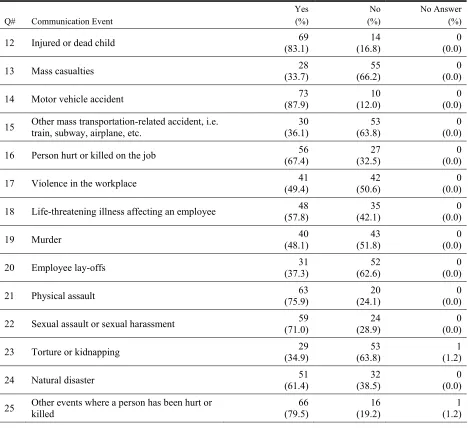
Table 1 presents 14 statements describing different types of traumatic events that public
information officers commonly are called on to communicate as part of their jobs. Of the 83 survey
respondents, 80 answered that they had experienced one or more events listed in Table 1 at least
once during their communication career. According to survey data, the top four events public
information officers had communicated about were “motor vehicle accident” (87.9% of respondents
had experienced), “injured or dead child” (83.1% had experienced), “other events where a person
had been hurt or killed” (79.5% had experienced), and “physical assault” (75.9% had experienced).
The results were not unexpected considering that those targeted for the survey were largely public
Chapter 5). The four least experienced events were “mass casualties” (66.2% of respondents had
never experienced), “torture or kidnapping” (63.8% had never experienced), “other
mass-transportation related accidents” (63.8% had never experienced), and “employee lay-offs” (62.6%
[image:31.612.73.541.224.652.2]had never experienced).
Table 1
Communication Events Providing Exposure to Trauma or Stress (N = 83)
Q# Communication Event
Yes (%)
No (%)
No Answer (%)
12 Injured or dead child (83.1) 69 (16.8) 14 (0.0) 0
13 Mass casualties (33.7) 28 (66.2) 55 (0.0) 0
14 Motor vehicle accident (87.9) 73 (12.0) 10 (0.0) 0
15 Other mass transportation-related accident, i.e.train, subway, airplane, etc. (36.1) 30 (63.8) 53 (0.0) 0
16 Person hurt or killed on the job (67.4) 56 (32.5) 27 (0.0) 0
17 Violence in the workplace (49.4) 41 (50.6) 42 (0.0) 0
18 Life-threatening illness affecting an employee (57.8) 48 (42.1) 35 (0.0) 0
19 Murder (48.1) 40 (51.8) 43 (0.0) 0
20 Employee lay-offs (37.3) 31 (62.6) 52 (0.0) 0
21 Physical assault (75.9) 63 (24.1) 20 (0.0) 0
22 Sexual assault or sexual harassment (71.0) 59 (28.9) 24 (0.0) 0
23 Torture or kidnapping (34.9) 29 (63.8) 53 (1.2) 1
24 Natural disaster (61.4) 51 (38.5) 32 (0.0) 0
25 Other events where a person has been hurt or killed (79.5) 66 (19.2) 16 (1.2) 1
Nearly half (48.1%) of those responding ‘yes’ to an event had communicated about at least
child” (83.1%), “other events where a person has been hurt or killed” (79.5%), “physical assault”
(75.9%), “sexual assault/sexual harassment” (71.0%), “person hurt or killed on the job” (67.4%),
“natural disaster” (61.4%), “life-threatening illness affecting an employee” (57.8%), “violence in the
workplace” (49.4%), and “murder” (48.1%). “Murder” and “violence in the workplace” were the
only events where nearly an equal amount of respondents reported communicating about it at least
once or reported that they had not communicated about it at all. Forty respondents (48.1%) said that
they had communicated about murder at least once while 43 (51.8%) had not. Forty-one respondents
(49.4%) reported communicating about violence in the workplace whereas 42 respondents (50.6%)
had not.
Intensity of Exposure
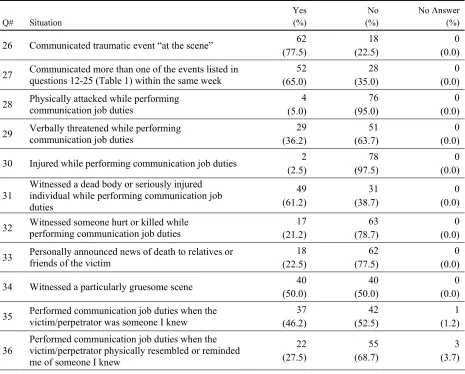
Table 2 presents 11 statements that describe situations where public information officers
may face a higher level of intensity while performing their communication job duties. For
example, the statement “communicated traumatic event ‘at the scene’ ” describes a situation where
the public information is not only communicating about a particular event or issue (such as those
listed in Table 1), but also is facing additional pressures because the communication is occurring at
the scene rather than at a neutral location. All respondents provided ‘yes’ or ‘no’ answers to each
of the events except “performed communication duties when the victim/perpetrator was someone I
knew” and “performed communication job duties when the victim/perpetrator physically
resembled or reminded me of someone I knew.” One respondent selected ‘no answer’ for the first
statement and three respondents selected ‘no answer’ for the second statement.
As would be expected for a public information officer, who has working with the news
media as a major job responsibility (see Appendix A), more than a third (77.5%) of all
participants reported communicating at the scene of a traumatic or stressful event. This was not
information officers often must be physically on site to meet the media’s communication needs.
In addition, survey data showed that 65% of the participants have handled more than one of the
[image:33.612.75.540.201.575.2]communication events listed in Table 1 during the same week.
Table 2
Situations Adding Intensity to Work-Related Traumatic or Stressful Events (N = 80)
Q# Situation Yes (%) No (%) No Answer (%)
26 Communicated traumatic event “at the scene” 62 (77.5)
18 (22.5)
0 (0.0)
27 Communicated more than one of the events listed in questions 12-25 (Table 1) within the same week 52 (65.0)
28 (35.0)
0 (0.0)
28 Physically attacked while performing communication job duties 4 (5.0)
76 (95.0)
0 (0.0)
29 Verbally threatened while performing communication job duties 29 (36.2)
51 (63.7)
0 (0.0)
30 Injured while performing communication job duties 2 (2.5)
78 (97.5)
0 (0.0)
31 Witnessed a dead body or seriously injured individual while performing communication job duties 49 (61.2) 31 (38.7) 0 (0.0)
32 Witnessed someone hurt or killed while performing communication job duties 17 (21.2)
63 (78.7)
0 (0.0)
33 Personally announced news of death to relatives or friends of the victim 18 (22.5)
62 (77.5)
0 (0.0)
34 Witnessed a particularly gruesome scene 40 (50.0)
40 (50.0)
0 (0.0)
35 Performed communication job duties when the victim/perpetrator was someone I knew 37 (46.2)
42 (52.5)
1 (1.2)
36 Performed communication job duties when the victim/perpetrator physically resembled or reminded me of someone I knew
22 (27.5) 55 (68.7) 3 (3.7)
Data also showed that 61.2% of the respondents reported witnessing a dead body or a
seriously injured individual as part of their communication job duties and 21.2% had witnessed a
person get hurt or killed while working. Physical harm to oneself was not highly reported among
their communication duties and 2.5% actually were physically injured on the job. However,
36.2% of public information officers reported being verbally threatened at least once.
The number of public information officers witnessing a “particularly gruesome scene”
was equally split among those who had (40 responses; 50%) and those who had not (40
responses, 50%). Likewise, there was not a great difference between those who reported
knowing the victim/perpetrator that they were communicating about (37 responses; 46.2%) and
those who did not know the individuals (42 responses; 52.5%). There was, however, a larger
difference in responses to the question, “I have performed communication job duties when the
victim/perpetrator physically resembled or reminded me of someone I knew.” Nearly 69% of the
respondents indicated they had never encountered that situation.
Avoidance and Intrusion Indicators
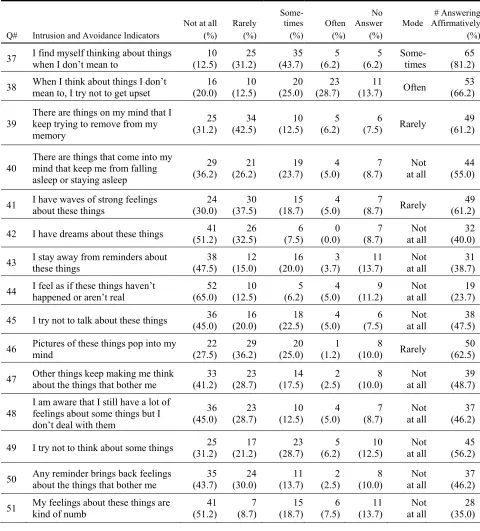
Table 3 depicts public information officers’ emotional experiences when recalling
stressful or traumatic events. The most frequent response was “not at all” in 10 of the 15
statements. “Rarely” was the second most frequently reported answer, occurring in three
statements, while “sometimes” and “often” were reported as the most common answer in one
statement each. A larger number of respondents selected ‘no answer’ to this series of questions
than others within the survey. The reason is not known – perhaps it was due to the participants
growing tired of answering questions and desiring to get to the end or it could be due to a larger
issue relating directly to avoidance; that not answering the question is a way of avoiding
memories of the situation.
In addition, participants responding with an affirmative answer (i.e., ‘rarely,’ ‘sometimes,’
or ‘often,’ as opposed to ‘not at all’ or ‘no answer’) were counted together and reported as a
However, a high percentage answering affirmatively to the statements did not necessarily mean
[image:35.612.71.551.173.704.2]that a high level of psychological trauma had been experienced (see discussion in Chapter 5).
Table 3
Statements Measuring PTSD Intrusion and Avoidance Indicators (N = 80)
Q# Intrusion and Avoidance Indicators
Not at all (%) Rarely (%) Some-times (%) Often (%) No Answer (%)
Mode Affirmatively# Answering (%)
37 I find myself thinking about things when I don’t mean to (12.5)10 (31.2) 25 (43.7)35 (6.2) 5 (6.2) 5 Some-times (81.2) 65
38 When I think about things I don’t mean to, I try not to get upset (20.0)16 (12.5) 10 (25.0)20 (28.7) 23 (13.7) 11 Often (66.2) 53
39 There are things on my mind that I keep trying to remove from my memory
25
(31.2) (42.5) 34 (12.5)10 (6.2) 5 (7.5) 6 Rarely (61.2) 49
40
There are things that come into my mind that keep me from falling asleep or staying asleep
29
(36.2) (26.2) 21 (23.7)19 (5.0) 4 (8.7) 7 at allNot (55.0) 44
41 I have waves of strong feelings about these things (30.0)24 (37.5) 30 (18.7)15 (5.0) 4 (8.7) 7 Rarely (61.2) 49
42 I have dreams about these things (51.2)41 (32.5) 26 (7.5)6 (0.0) 0 (8.7) 7 at allNot (40.0) 32
43 I stay away from reminders about these things (47.5)38 (15.0) 12 (20.0)16 (3.7) 3 (13.7) 11 at allNot (38.7) 31
44 I feel as if these things haven’t happened or aren’t real (65.0)52 (12.5) 10 (6.2)5 (5.0) 4 (11.2) 9 at allNot (23.7) 19
45 I try not to talk about these things (45.0)36 (20.0) 16 (22.5)18 (5.0) 4 (7.5) 6 at allNot (47.5) 38
46 Pictures of these things pop into my mind (27.5)22 (36.2) 29 (25.0)20 (1.2) 1 (10.0) 8 Rarely (62.5) 50
47 Other things keep making me think about the things that bother me (41.2)33 (28.7) 23 (17.5)14 (2.5) 2 (10.0) 8 at allNot (48.7) 39
48 I am aware that I still have a lot of feelings about some things but I don’t deal with them
36
(45.0) (28.7) 23 (12.5)10 (5.0) 4 (8.7) 7 at allNot (46.2) 37
49 I try not to think about some things (31.2)25 (21.2) 17 (28.7)23 (6.2) 5 (12.5) 10 at allNot (56.2) 45
50 Any reminder brings back feelings about the things that bother me (43.7)35 (30.0) 24 (13.7)11 (2.5) 2 (10.0) 8 at allNot (46.2) 37
Questions 37, 40, 41, 42, 46, 47, and 50 measured intrusion indicators whereas questions
38, 39, 43, 44, 45, 48, 49, and 51 measured avoidance indicators. Table 4 shows the data for
[image:36.612.72.553.193.732.2]those individual subsets.
Table 4
Responses Disaggregated by Intrusion and Avoidance Subsets (N = 80)
Q# Intrusion Subset
Not at all (%) Rarely (%) Some-times (%) Often (%) No Answer (%) Mode # Answering Affirmatively (%)
37 I find myself thinking about things when I don’t mean to (12.5)10 (31.2) 25 (43.7)35 (6.2) 5 (6.2) 5 Some-times (81.2) 65
40 There are things that come into my mind that keep me from falling asleep or staying asleep
29
(36.2) (26.2) 21 (23.7)19 (5.0) 4 (8.7) 7 at allNot (55.0) 44
41 I have waves of strong feelings about these things (30.0)24 (37.5) 30 (18.7)15 (5.0) 4 (8.7) 7 Rarely (61.2) 49
42 I have dreams about these things (51.2)41 (32.5) 26 (7.5)6 (0.0) 0 (8.7) 7 at allNot (40.0) 32
46 Pictures of these things pop into my mind (27.5)22 (36.2) 29 (25.0)20 (1.2) 1 (10.0) 8 Rarely (62.5) 50
47 Other things keep making me think about the things that bother me (41.2)33 (28.7) 23 (17.5)14 (2.5) 2 (10.0) 8 at allNot (48.7) 39
50 Any reminder brings back feelings about the things that bother me (43.7)35 (30.0) 24 (13.7)11 (2.5) 2 (10.0) 8 at allNot (46.2) 37
Q# Avoidance Subset
Not at all (%) Rarely (%) Some-times (%) Often (%) No Answer (%) Mode # Answering Affirmatively (%)
38 When I think about things I don’t mean to, I try not to get upset (20.0)16 (12.5) 10 (25.0)20 (28.7) 23 (13.7) 11 Often (66.2) 53
39 There are things on my mind that I keep trying to remove from my memory 25 (31.2) 34 (42.5) 10 (12.5) 5 (6.2) 6
(7.5) Rarely
49 (61.2)
43 I stay away from reminders about these things (47.5)38 (15.0) 12 (20.0)16 (3.7) 3 (13.7) 11 at allNot (38.7) 31
44 I feel as if these things haven’t happened or aren’t real (65.0)52 (12.5) 10 (6.2)5 (5.0) 4 (11.2) 9 at allNot (23.7) 19
45 I try not to talk about these things (45.0)36 (20.0) 16 (22.5)18 (5.0) 4 (7.5) 6 at allNot (47.5) 38
48 I am aware that I still have a lot of feelings about some things but I don’t deal with them
36
(45.0) (28.7) 23 (12.5)10 (5.0) 4 (8.7) 7 at allNot (46.2) 37
49 I try not to think about some things (31.2)25 (21.2) 17 (28.7)23 (6.2) 5 (12.5) 10 at allNot (56.2) 45
Intrusion subset. In the intrusion subset of questions, respondents most frequently answered
‘not at all’ for four questions (“There are things that come into my mind that keep me from falling
asleep or staying asleep,” “I have dreams about these things,” “Other things keep making me think
about the things that bother me,” and “Any reminder brings back feelings about the things that
bother me”) and ‘rarely’ for two questions (“I have waves of strong feelings about these things”
and “Pictures of these things pop into my mind”). Respondents answered ‘sometimes’ most
frequently to one question – “I find myself thinking about things when I don’t mean to.”
Avoidance subset. Similarly, in the avoidance subset, respondents most frequently
indicated ‘not at all’ for six questions – “I stay away from reminders about these things, “I feel as
if these things haven’t happened or aren’t real,” “I try not to talk about these things,” “I am
aware that I still have a lot of feelings about some things but I don’t deal with them,” “I try not to
think about some things,” and “My feelings about these things are kind of numb.” ‘Often’ was
the most frequently selected answer for the question, “When I think about things I don’t mean to,
I try not to get upset.” ‘Rarely’ was most frequently chosen response for “There are things on my
mind that I keep trying to remove from my memory.”
Most of the data in the intrusion and avoidance subsets pointed to much larger responses
to one of the answers. In four questions, however, data were more closely distributed – “There
are things that come into my mind that keep me from falling asleep or staying asleep” (‘not at
all’: 29 responses; ‘rarely’: 21 responses, ‘sometimes’: 19 responses); “Pictures of these things
pop into my mind” (‘not at all’: 22 responses; ‘rarely’: 29 responses, and ‘sometimes’: 20
responses); “I try not to think about some things” (‘not at all’: 25 responses; ‘rarely’: 17
responses,” and ‘sometimes’: 23 responses); and “When I think about things I don’t mean to, I
try not to get upset” (‘not at all’: 16 responses; ‘rarely’: 10 responses, ‘sometimes’: 20 responses,
The responses for the question, “I try not to think about some things,” were interesting in
that they showed a nearly equal level of response to ‘not at all’ and ‘sometimes.’ Having
comparable responses to ‘not at all’ or ‘rarely’ would not have been unexpected, but comparable
responses among ‘not at all’ and ‘sometimes’ shows a disproportion among the avoidance
reactions reported by some participants. The same observation is made for the question, “When I
think about things I don’t mean to, I try not to get upset.” The response levels were well
distributed among all of the answer choices.
Coping Behaviors
Table 5 shows that only eight respondents (10%) reported that they sought assistance in
coping with their psychological trauma, whereas 63 respondents (78.7%) never sought help.
Nine participants (11.2%) provided no answer, which could indicate they felt that they had not
experienced an event traumatic enough to necessitate coping behaviors. It also could mean that
[image:38.612.70.544.492.547.2]they simply did not feel compelled to answer the question.
Table 5
Response Rate for Public Information Officers Seeking Emotional Help (N = 80)
Q# Coping Behaviors
Yes (%)
No (%)
No Answer (%)
52 I have sought help or support in dealing emotionally with an incident/situation (10.0) 8 (78.7) 63 (11.2) 9
Tables 6 and 7 show the responses of those answering questions related to coping behaviors.
Of the eight participants (see Table 6) that reported accepting or seeking help, assistance was more
commonly sought from colleagues, employers, friends, and/or family. Professional counseling was
less commonly used, as were web sites, books, journals, or other information sources.
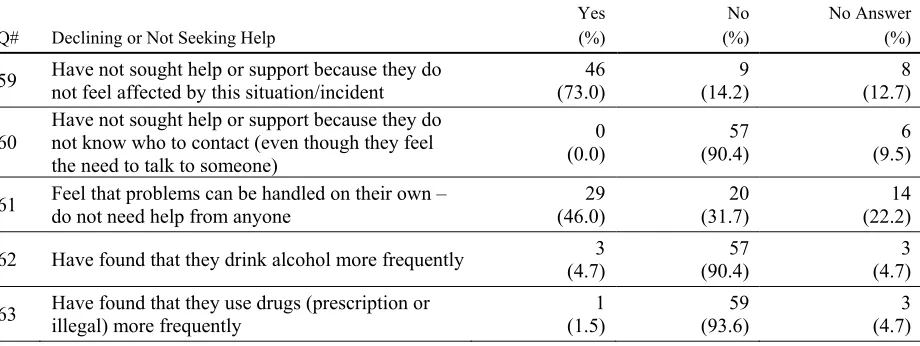
Of the 63 participants (see Table 7) who reported declining or not seeking help, 73%
their problems could be handled on their own. None of the respondents indicated that help was
not sought because they did not know who to contact. More participants in the “Declining or Not
Seeking Help” group provided ‘no answer’ as a response than those in the “Accepting or Seeking
Help” group but this finding was not remarkable since the sample sizes were so uneven.
Similarly, respondents also were asked about any increase in alcohol or drug use (prescription or
illegal) but due to the small samples, the data did not suggest any noteworthy difference between
[image:39.612.74.541.311.505.2]those who sought emotional help and those who did not.
Table 6
Public Information Officers Accepting or Seeking Help (N = 8)
Q# Accepting or Seeking Help
Yes (%)
No (%)
No Answer (%)
53 Have sought help or support from colleagues and/or employer (87.5) 7 (12.5) 1 (0.0) 0
54 Have sought help or support from friends and/or family (87.5) 7 (12.5) 1 (0.0) 0
55 Have sought help or support from a professional counselor (62.5) 5 (25.0) 2 (12.5) 1
56 Have sought help or support through web sites, books, journals, or other information sources (37.5) 3 (62.5) 5 (0.0) 0
57 Have found that they drink alcohol more frequently (25.0) 2 (75.0) 6 (0.0) 0
58 Have found that they use drugs (prescription or illegal) more frequently (0.0) 0 (87.5) 7 (12.5) 1
Table 7
Public Information Officers Declining or Not Seeking Help (N = 63)
Q# Declining or Not Seeking Help
Yes (%)
No (%)
No Answer (%)
59 Have not sought help or support because they do not feel affected by this situation/incident (73.0) 46 (14.2) 9 (12.7) 8
60 Have not sought help or support because they do not know who to contact (even though they feel the need to talk to someone)
0
(0.0) (90.4) 57 (9.5) 6
61 Feel that problems can be handled on their own – do not need help from anyone (46.0) 29 (31.7) 20 (22.2) 14
62 Have found that they drink alcohol more frequently (4.7) 3 (90.4) 57 (4.7) 3
[image:39.612.79.539.565.738.2]