An Artificial neural network (ANN) based solution
approach to FMS loading problem
Suman Kant*, Rahul O Vaishya**
*,** Assistant Professor, Department of Production Engineering, PEC University of Technology Chandigarh-160012
Abstract In this Paper, the FMS loading problem is solved with the bi-criterion objective to minimize the system unbalance and maximizing the throughput by the use of artificial neural networkin the presence of available machine time and tool slots as constraints. The complexity of machine loading Problem in FMS is very high due to the different flexibility criteria such as part selection, operation allocation and various constraints involved such as availability of tool slot and time available on machines. This encourages various researchers to apply various heuristic techniquesto get optimal/ near optimal solution. Artificial Neural Network (ANN), inspired by the structure and functional aspects of biological neural networks which is an adaptive system changes its structure based on internal and external information flow during learning Phase. In this current decade ANN has emerged as one of the important problem solving tool for complex engineering problems. Keeping this views present research adopted ANN to solve FMS loading problem. It gave optimal/near optimal results in less computational time. It has also been found simple and naive tool for solving loading problems of FMSs.
I. INTRODUCTION
flexible manufacturing system (FMS) consists of Numerical Controlled Machine tools, automated material handling system and other production assisted equipment. It is an integrated computer-controlled configuration with a supervisory computer named as host computer, which has a control over production in FMS. Pallets and fixtures are used to reduce the set-up times on machines to zero. The objective of an FMS lies in having strategy between large volume of mass production and low volume job-shop production. Therefore Medium volume and medium variety production are used in FMS. The main purpose of the FMS is to achieve efficiency of a well-balanced transfer line while retaining the flexibility of the job shop (Stecke, 1983). There are two types of decision problems associated with FMSs: Design problems(machine selection, lay out decisions of robots, selection of AGVs and paths etc.) and
Operational problems (selection of part types, determination of production ratio, allocation of resources and loading). The machine loading problem is one of the major operational problem where decision is to be made regarding part types i.e. which part types are selected from a pool of part types and assigned to be which machines in order to meet certain specified objectives while satisfying the system constraints.
These objectives are:
(1) Balancing the machine processing time. (2) Minimizing the number of movements.
(3) Balancing the workloads per machine for a system of groups of pooled machines of equal
sizes.
(4) Unbalancing the load per machine for a system of groups of pooled machines of unequal sizes.
(5) Filling the tool magazines as densely as possible. (6) Maximizing the sum of operation priorities.
It has been found through various literatures(Stecke and Solberg 1981, Shanker and Tzen (1985),Shanker and Srinivasulu 1989,Mukhopadhyay et al. (1991 ,) that multiple objectives have been considered while solving the FMS Problem.
Numerous authors solved the loading problems with different solution methodology Mukhopadhyay et al. (1991) prioritized the loading of machine tools and parts in random FMSs through eigenvalue analysis. Mukhopadhyay and Tiwari (1995) solved the machine loading problem using the principle of conjoint measurement. Mukhopadhyay et al. (1991) prioritized the loading of machine tools and parts in random FMSs through eigenvalue analysis. The machine loading problem has been solved using different solution methodologies, which are given as follows:
(1) Heuristic oriented (Stecke and Solberg 1981,Stecke 1983, Mukhopadhyay et al. 1992, Morino and Ding 1993, Chen and Chung 1996, Tiwari et al. 1997).
(2) Simulation based (Jain et al. 1989, Sabuneuogloand Hommerzhein 1992, Basnet and Mize1993).
(3) Multi-criterion decision making (Kumar et al.
1990, Chen and Askin 1990, Kim and Yano 1997,Sawik 1998). (4) Mathematical programming (Stecke 1983, Laskariet al. 1987, Shanker and Srinivasulu 1989, Sawik 1990, Liang and Dutta 1992, 1993,Guerrero et al. 1999).
Shanker and Tzen (1985) solved the machine loading problem with their objectives include balancing workloads and meeting due date of part types. Ammons et al. (1985) solved with the bi-criterion objective of minimizing workstation and balancing workloads. Rajagopalan (1986) solved the machine loading problem with other problems inherently found in the planning stage, such as job selection and production ratio determination, with the aim of achieving better production schedules without too many iterations. Mukhopadhyay et al. (1992) and Tiwari et al. (1997) made an attempt to solve machine loading with an objective of minimizing system unbalance by maximizing throughput using heuristic approaches.
Although numerous researchers have solved this combinatorial problem of FMS with different perception of objective/objectives, but it has been observed that majority of the authors applied more than one heuristic to solve the same. Computer programming was also required by several authors to solve the same problem. In the present manufacturing scenario
International Journal of Scientific and Research Publications, Volume 3, Issue 2, February 2013 2 ISSN 2250-3153
decisions are made in short time regarding part types (i.e. which part types are to be assigned on which machines and sequence of parts) in FMS. Keeping these views in mind, an attempt has been made by authors to solve the same problem with the minimum of computational time. The other gap was also observed in various literatures about lack of predictive model for objectives of loading problem.
The objective of this paper is also to develop an ANN based predictive model for the solution of machine loading problem, which includes a dual objectives of minimizing system unbalance and maximizing the throughput in the presence of available machine time and tool slots as constraints. These objectives ultimately result into maximizing the machine utilization and system output. It is revealed by several researchers that SPT finds good initial solution for many sequencing problem.
In this article, initially SPT rule has been adopted to find the fixed part sequence. After that this fixed part sequence is perturbed to find 16 more number of sequences by selecting two numbers between 1 and number of jobs and interchanging these jobs. If tie comes then another new sequence is obtained by perturbation. These sixteen part sequences are used for training the neural network with back propagation algorithm. Further an ANN based predictive model has been developed to solve the machine loading problem of FMS. This model can predict the dual objectives for any given part sequence in very less span of time.
II. DESCRIPTION OF THE PROBLEM
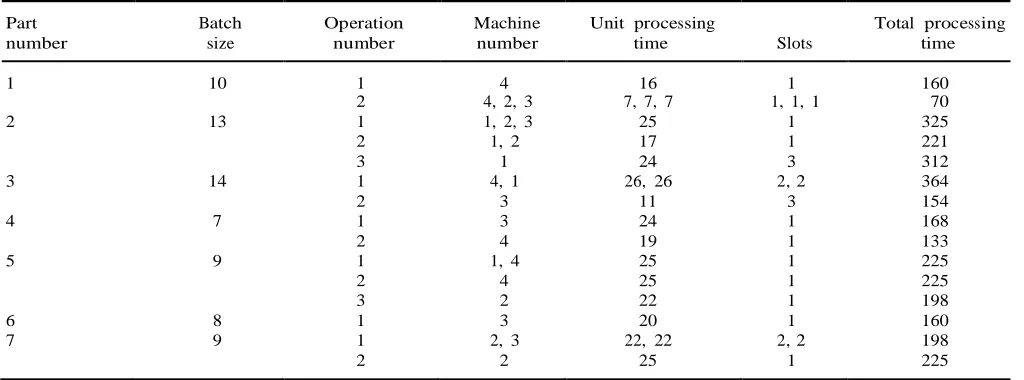
[image:2.612.53.565.424.614.2]The machine-loading problem of an FMS has been analyzed in this paper with multiple machines associated with FMS. It is also to be mentioned that for a particular planning horizon part types comes at shop floor randomly. Out of two types of FMSs (random and dedicated FMS) random FMS has been considered in this problem which is capable to perform both optional and essential operations. Essential operations have zero machine flexibility; however optional operations have machines flexibility linearly varying with number of operations. It is customary to keep optional operations alive as long as possible in order to have more flexibility in the system. It is quite clear from above discussion that optional operations of part types provide flexibility in FMS. However selection of part-type sequence among given part types adds further flexibility and complexity too in an FMS. The complexity of an FMS loading Problem may be illustrated with the following example: Consider five parts to be processed on three machines. One essential and two optional operations are to be processed on each part. Therefore, for this problem (5! x3x3x3x2x2x2= 25920) ways of part-operation machine allocation is possible. It is quite obvious that as the problem size increases this number will increase multiplicatively. The optimal/near optimal solution can be achieved in conventional fashion if each and every possible part-operation machine allocation is evaluated with fulfilling the constraints of availability of tool slots on machines. The problem considered in this research with the same as of Sarma et. al.
Table 1. FMS Loading Problem
Part
number Batch size Operation number Machine number Unit processing time Slots Total processing time
1 10 1 4 16 1 160
2 4, 2, 3 7, 7, 7 1, 1, 1 70
2 13 1 1, 2, 3 25 1 325
2 1, 2 17 1 221
3 1 24 3 312
3 14 1 4, 1 26, 26 2, 2 364
2 3 11 3 154
4 7 1 3 24 1 168
2 4 19 1 133
5 9 1 1, 4 25 1 225
2 4 25 1 225
3 2 22 1 198
6 8 1 3 20 1 160
7 9 1 2, 3 22, 22 2, 2 198
2 2 25 1 225
(Problem of FMS loading as of Sarma et. al.)
III. SOLUTION METHODOLOGY
As mentioned in earlier section 1 the initial feasible solution is obtained through SPT rule. The system unbalance may be obtained as ratio of total unutilized time to total available time on machine; however throughput is sum of batch sizes for all
generated, because most of the authors(Esfahani et al 2009, sangeeta yadav et al 2010) have considered minimum 12-18 number of data to train successfully the network. These all fourteen sequences are used as input for Artificial Neural Network for training the network through back propagation Feed Forward technique.
(Sangeeta yadav et al. 2010). It is a nonlinear algorithm that is used to model the process parameters. This algorithm can be applied to find relationship between process parameters and outcome, when no analytical relationship exists between them. It does aggregation of its input from other neurons or the external environment and generation of an output from the aggregated inputs. . Modern neural networks are non-linear statistical data modeling tools. They are usually used to model complex relationships between inputs and outputs or to find patterns in data. ANN is suitable for correlations that are hard to describe by physical model because of the ability to learn by example and to recognize patterns (Examine patterns from their background, and make decisions about the categories of the patterns) in a series of input and output values from examples and cases.
3.2 Neural Network Structure
The basic element of an artificial neural network is the processing neuron that is a computational model inspired in the Natural Neurons of the human brain. Natural Neurons receive signals through synapses located on the dendrites or membrane of the neuron. When the signals received are strong enough (surpass a certain threshold), the neuron is activated and emits a signal though axon (Neural Network for beginners, Gershenson, C.,2011). Input data is received by neuron and after the values passes through activation function to produce the output value. Information is received and stored at each neuron in an input layer of network and communicated after processing to the neurons in a next layer.
3.3 Learning of ANN
There are two main methods for learning the ANN. In the supervised learning input and output information is provided to adjust the weights in such a way that the network can produce the given outputs from the inputs. In unsupervised learning, the network is fed only input data to produce the output data.
3.4 Feed Forward Back Propagation Neural Network (BPNN)
Back propagation (BP) is the commonly used training method for FFNN model among the various kinds of ANNs especially in casting and manufacturing science problem. Three layers ( Input, output and Hidden) are present in feed forward network. BPNN works in a feed forward direction where information progresses from an input layer to an output layer in the learning phase. Hidden layer(s) is also available between input and output layer to overcome the problem of model. Input, hidden and output layers are orderly connected to configure the network (Figure 1).
Trial and error procedure is used to determine the number of hidden layers and the number of neurons in each hidden layer for better convergence. The value of error is calculated for each unit, after compared the target output with output obtained through neural network at output layer. Initially the back propagation adjusts the weights of the network to decrease the error between the network output and target output for first set of input. Similarly the weights from second set onwards are adjusted with objective to keep mean square error (MSE) minimum.
The error reduction phenomenon starts from output layer and propagates backward to reach at input layer via. hidden layer. The traingdm function with varying momentum and learning rate were considered.
3.5Development of ANN model
There are no fixed rules for designing and developing an ANN, however some issues that typically arise while developing ANN are briefly summarized as Selection of input and output variables, Data normalization, Selection of number of hidden layer and number of neurons in each hidden layer, Selection of learning rate and momentum factor. Input and output variables selection is aimed at determining which input variables are required for a model. The task is to determine a set of inputs which leads to an optimal model that produces desired outputs. Data is normalized between 0 and 1 to smooth the solution space and to avoid large numerical error in the computation. Number of hidden layer and number of neurons in each hidden layer, Selection of learning rate and momentum factor are decided on trial and error basis. A number of trails are to be run to get suitable values of these parameters to get optimal results.
3.6 ANN for Present study
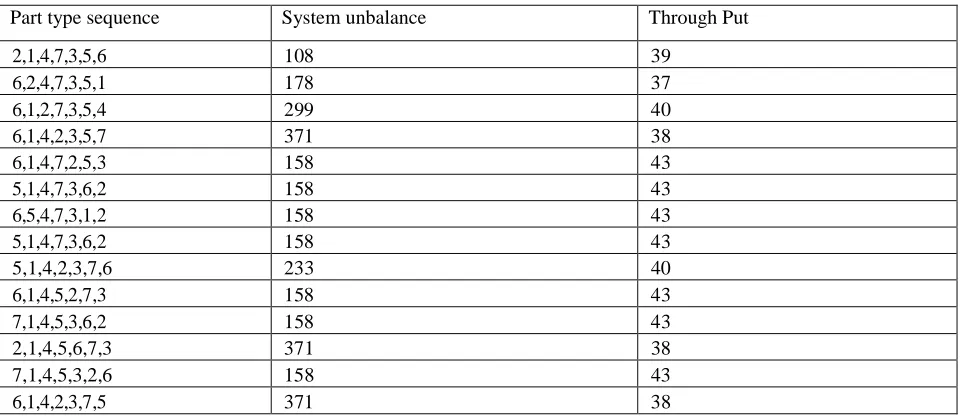
The data of table 2 is used for training the network. Training is concerned with adjustment of weights among neurons. In the present study input data are job sequence, while the output data are system unbalance and throughput. In training Two hidden layers with 9 neurons each considered in this Back propagation algorithm. Hyperbolic tangent sigmoid (tansig) transfer function is used in hidden layer, however linear transfer function (purelin) is used at the output layer. The momentum and learning rate are 0.8 and 0.35 respectively. The mean squared error was set as 0.0001. Number of iterations set to be 35000.Training ended once the Mean squared error (MSE) was reduced to 0.0001 or the number of iterations reached to 35000.
International Journal of Scientific and Research Publications, Volume 3, Issue 2, February 2013 4 ISSN 2250-3153
IV. RESULTS OBTAINED THROUGH ANN
The part types are assigned on various machines through SPT procedure for the FMS loading problem given in Table 2.This sequence obtained [6,1,4,7,3,5,2] with system unbalance of 158 and throughput of 43. Further this sequence is perturbed through method given in section. The fourteen (14) numbers of sequences and their output results are as in Table 2. It is to be mentioned that these sequences outputs (system unbalance and throughput)
are evaluated with fulfilling all the constraints of the loading problem. Artificial Neural network exploits these sequences for training the network. On the basis of these trained data ANN developed an input-output relationship of its own. This input output relationship is able to predict the output values for given input sequence. Though number of arbitrary sequences can be put as input of this predictive model, only fewer numbers of sequences is explored once it has been seen the change in sequence offers no better results.
Table 2 (Various Part type Sequences obtained for Training the Network)
Part type sequence System unbalance Through Put 2,1,4,7,3,5,6 108 39
6,2,4,7,3,5,1 178 37 6,1,2,7,3,5,4 299 40 6,1,4,2,3,5,7 371 38 6,1,4,7,2,5,3 158 43 5,1,4,7,3,6,2 158 43 6,5,4,7,3,1,2 158 43 5,1,4,7,3,6,2 158 43 5,1,4,2,3,7,6 233 40 6,1,4,5,2,7,3 158 43 7,1,4,5,3,6,2 158 43 2,1,4,5,6,7,3 371 38 7,1,4,5,3,2,6 158 43 6,1,4,2,3,7,5 371 38
After training of these sequences through Artificial Neural Network, newer set of sequences are generated randomly to explore for getting optimal/ near optimal solution. These
following given sequences provide reasonably good results over other sequences (which are not being reported).
6,1,4,5,3,7,2 62 49 6,2,4,5,3,7,1 83 42 2,1,4,5,3,7,6 18 46
The sequences which produce best results in terms of minimum system balance and maximum throughput are 2,1,4,5,3,7,6 with through put. The value of these objective functions is 18 and 46. The Artificial neural network has been trained with help of Programming in MATLAB.
V. CONCLUSION
The loading problem of FMS environment has been solved with the help of Artificial Neural Network. Previous authors also solved the FMS loading problem with other heuristic techniques like tabu search, Simulated Annealing and Genetic algorithm. The substantial effort was required to solve the problem with the se computer programming based techniques. On the other hand Artificial Neural Network is naive tool to solve this problem. This method also gives second benefit of obtaining a predictive
throughput are predicted for any part type sequences. These benefits may especially be exploited in Dynamic FMS environment where some times few part types are required to be manufactured in priority. The results of part type sequences can also be predicted with ease of placing their values in Artificial Neural Network based Model.
REFERENCES
[1] Ammonus, J. C., Lofgren , C. B. and Mcginnis, L. F.,” A large scale machine loading problem in flexibility assembly”. Annals of Operation Research, 3,1985 pp 319 – 322.
[2] Basnet, C and Mize, J. H.,“A rule based object-oriente d framework for operating flexible manufacturing systems” International Journal of Production Researc h, 33(5),1995.pp 1417 – 1431.
[image:4.612.67.552.199.408.2]ISSN 2250-3153
[4] Chen, Y. J. and Askin, R.G, “A multi-objective evaluationof flexible manufacturing system loading heuristic” Interna- tional Journal of Production Researc h, 28(5),1990,pp895 – 911.
[5] Esfahani Mohsen Botlani, Toroghinejad Mohammad Reza and Abbasi Shahram ““ Artificial Neural Network Moedeling the tensile strength of Hot Strip Mill Products, ISIJ International, 49(10), 2009 pp 1583-1587 [6] Gershenson, C., “ Artificial Neural Network for beginners” Formal
computational skills teaching package, COGS. 2011
[7] Guerrero, F., Lozana, S., Kotial,. and Larreneta, J., “Machine loading and part type selection in flexible manufacturing systems” Internationa l Journal of Production Research , 37(6),1999,1303 – 1317.
[8] Jain, S., Barber, K. and Osterfeld, D.,“Expert simulation for on-line scheduling.” Proceedings of the 1989 winter simulation conference,1989,pp 930 – 935.
[9] Kim, Y. D. and Yano, C. A., “Impact of throughput based objectives and machine grouping decisions on the short- term performance of flexible manufacturing systems”.Inter- national Journal of Production Research, 35(12),1997,pp3303 – 3322.
[10] Kumar, P., Singh, N. and Tiwari , N. K.,“ Multi-criterionanalysis of the loading problem in flexible manufacturing system using min-max approach”. Internationa l Journal of Advanced Manufacturing Technolog y, 2(2),1990,pp13 – 23.
[11] Kusiak, A., “ Loading models in flexible manufacturingsystems.” In A. Raouf and S. H. Ahmed (Eds), ManufacturingResearc h and Technology-1, (Amsterdam: Elsevier). 1985
[12] Lashkari, R. S., Dutta, S. P. and Dadhye, A. M, “A new formulation of operation allocation problem in flexible manufacturing systems: mathematical modelling and com- putational experience”.Internationa l Journal of Production Research , 25(9),1987,pp 1267 – 1283.
[13] Liang, M. and Dutta, S.P.,“ Combined part-selection,load-sharing and machine-loading problem in flexible manufacturing system”. International Journal of Production Research , 30(10),1992,pp 2335 – 2350.
[14] Liang, M. and Dutta, S. P.,” A integrated approach to partselection and machine loading problem in a class of flexible manufacturing system”. Europea n Journa l of Operationa l Research , 67(3),1993, pp387 – 404. [15] Morino, A. A. and Ding, F. Y.,” Heuristics for FMS-loading and part-type
selection problems”. International Journal of Flexible Manufacturing Systems, 5,1993, pp287 – 300.
[16] Mukhopadhyay , S. K., Maiti, B. and Garg, S.,”Heuristic solution to the scheduling problems in flexible manufacturing systems”. Internationa l Journal of Production Researc h,29(10),1991,pp2003 – 2024.
[17] Mukhopadhyay , S. K., Midha, S. and Krishna,V. A.,”A heuristic procedure for loading problem in flexible manufacturing system”.
International Journal of Production Research , 30(9),1992,pp2213 – 2228.
[18] Mukhopadhyay, S. K. and Tiwari, M. K. “Solving machine loading problems of FMS using conjoint measurement”.Proceedings of 13th Internationa l Conference on Production Research , Jerusalem,1995,pp74 – 76.
[19] Rajagopalan, S., “Formulation and heuristic solutions for parts grouping and tool loading in flexible manufacturing systems”. Proceedings of the 2nd ORSA/TIMS Conferenc e on Flexible Manufacturing Systems, Ann Arbor, MI (Amsterdam: Elsevier Science),1986,pp. 312 – 314. [20] Sabuncuoglu, I. and Hommertzheim, L. D., “Experimental Investigation of
FMS machine and AGV scheduling rules against the mean flow time criterion. Internationa l Journal of Production Researc h, 30(7),1992,pp 1617 – 1635.
[21] Sawik, T., Modeling and scheduling of flexible manufacturing system. Europea n Journal of Operational Research, 45,1990, pp 177 – 190 [22] Sawik, T., “A lexicographic approach to bi-objective loading of a
flexible assembly system”. Europea n Journal of Operational Research, 107,1998,pp 656 – 668.
[23] Shanker, K. and Srinivasulu, A., “Some solution meth-odologies for a loading problem in a flexible manufacturing system”. International Journal of Production Researc h, 27(6),1989,pp1019 – 1034.
[24] Shanker, K. and Tzen, Y. J., “A loading and dispatching problem in a random FMS”. Internationa l Journal of Production Research, 23(3),1985,pp 579 – 595.
[25] Stecke, K. E. and Solberg , J. J.,“Loading and controlpolicies for a flexible manufacturing system”. International Journal of Production Research, 19,1981,pp 481 – 490.
[26] Stecke, K. E., “Formulation and solution of nonlinear integer production planning problem for flexible manu- facturing system”. Managemen t Science, 29(3),1983,pp 273 – 288.
[27] Tiwari , M. K., Hazarika, B., Vidyarathi, N. K., Jaggi, P. and Mukhopadhyay , S. K., “A heuristic solution approach to the machine loading problem of FMS and its petri-net model”. Internationa l Journal of Production Research, 35(8),1997, pp2269 – 2284.
[28] Sarma U.M.B.S, Kant Suman, Rai Rahul and Tiwari M.K. Modelling the machine loading problem ofFMSs and its solution using a tabu-search-based heuristic int. J. Computer integrated manufacturing, 15(4), 2002,. pp 285–295