Optimized Hybrid Ant Colony and Greedy Algorithm
Technique based Load Balancing for Energy
Conservation in WSN
Mamta Tewari
Computer Science Department BTKIT, Dwarahat
Kunwar Singh Vaisla
Computer Science Department BTKIT, Dwarahat
ABSTRACT
A Wireless Sensor Network (WSN) is a network comprising of wirelessly linked sensor nodes. These low computational, tiny devices can communicate in short distances. Each sensor node consists of sensing, data processing, and communication components. To ensure scalability and to increase the efficiency of the network operation, sensor nodes are often grouped into clusters. A lot of work is being done in this field; however, there is still a scope of improvement with modern meta-heuristic route optimization technique inspired from natural swarm. The area of WSN always needs research and development to contribute the more advancement to this era of technology. This paper deals with the energy conservation and at the same time on basis of energy the load balancing of existing network. Since network traffic is growing day by day the energy conservation and some fruitful measures are still needed to maintain its smooth working. In this paper, we develop an algorithm by integrating techniques such as greedy algorithm and ant colony optimization (ACO) thus making it a hybrid approach in balancing load in a WSN. This approach is simulated in java and also a same approach is implemented and the result parameters are analyzed.
Keywords
WSN, swarm intelligence (SI), Greedy algorithm, ACO, energy consumption
1.
INTRODUCTION
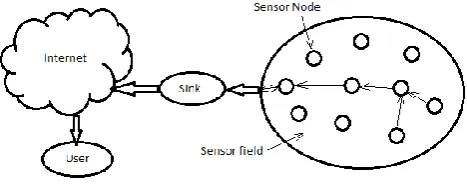
[image:1.595.62.296.617.711.2]The advancement in field of electronics and wireless communication have facilitated the design of low cost and limited power multifunctional sensor nodes which are small in size and communicate unethered in short distances [1]. A wireless sensor network is composed of small devices called sensor nodes which are deployed over a geographical area to monitor physical phenomena like temperature, humidity, vibrations, and so on [2]. The basic architecture of a Wireless sensor network is shown in figure 1.1.
Figure 1: Basic WSN architecture
Wireless sensor networks are used for many critical applications such as target tracking in battlefields. In such applications the timely delivery of data is required for the
successful completion of mission. So, efficient data routing becomes important and a challenging area.
A new approach for solving a problem known as swarm intelligence is used now-a-days which is inspired from the social behaviors insects and other animals. Specially, the ants have encouraged a number of techniques and among which the most successful technique is the ant colony optimization. Ant Colony Optimization, a swarm intelligence based optimization technique, is widely used in network routing. WSNs provide reliable operations in various application areas including environmental monitoring, health monitoring, vehicle tracking system, military surveillance and earthquake observation.
2.
LITERATURE SURVEY
A new energy efficient routing protocol based on swarm intelligence was proposed in [4] known as Energy-Efficient Ant-based Routing algorithm (EEABR). In this algorithm, the next network node is selected based on the probability of the energy of node and pheromone quantity deposited on the links between the nodes. In EEABR algorithm, every node stored the information of ant and routing table stored the value of previous and forward node information, time out value and ant identification. The proposed algorithm is simulated in ns2 and result comparison is done against ant-based routing algorithm (BABR) and improved ant-based routing algorithm (IABR) on the basis of following metrics: average energy, minimum energy, standard deviation and energy efficiency. The result proves that the proposed protocol is an efficient protocol.
complexity for the wireless sensor networks. The proposed scheme is compared against HOPNET in simulation environment GLOMOSIM and the results shows that AD-ZRP causes lower routing overhead than HOPNET due to the reduction of ants in the network. Data packet delivery ratio is higher and bro ken routes ratio is lower of proposed protocol than HOPNET.
In [7], an ant colony optimization based heuristic approach is proposed to minimize the energy consumption for sensor networks. In this work three algorithms based on ACO namely Ant System, Ant Colony System and improved AS, are presented for wireless sensor network. In ACS, local pheromone updating is done in the course of tour building. After each construction step, all ants used to update the local pheromone value. In AS and ASW the mechanism for choosing next node is same but the pheromone updating process is different. The results of these protocols are evaluated and found that ACS total energy is lesser than AS and ASW, the energy consumption standard deviation of ACS is more stable andlower than the AS and ASW techniques. So the application of ACS to WSNs is promising for routing and aims in prolonging the network life.
In [8], a routing protocol based on ACO was proposed for WSN. The proposed protocol utilizes the behaviour of ants to balance the energy consumption of node so as to enhance the lifetime of the network. The proposed technique consists of three stages, neighbor discovery, routing and data transmission, and route maintenance. The neighbor discovery is propelled on the destination node. During the neighbor discovery process broadcast packets, (consisting of send time, receive time and packet delay) are exchanged between the nodes. In the second phase, data is transmitted, by exploiting information of earlier phase, from source to destination. The selection is done probabilistically depending on the path delay, node energy and frequency of a node working as a router. The last phase is route maintenance, in which inquiries are flooded through the destination node to thesource node. The route maintenance helps in maintaining theroutes, validity of route and checking of alternate routes for the future usage. The proposed approach is simulated in GLOMOSIM and results are compared SPEED protocol and EAR and showed improved results.
Authors in [9] have given a optimization technique for WSN which aid in optimal utilization of sensor node resources so as to balance energy consumption in the whole network. Taking inspiration from the colony of ants, they proposed SensorAnt to use a routing mechanism which optimizes the power of the nodes contributing in the routes to forward the data in the network. The quality function depends on multi-criteria metrics such as the minimum residual energy or battery power, hop numbers, and average energy of both route and the network [9]. The traffic load is uniformly distributed in the network thus resulting in reduced energy usage, prolonged network lifetime and reduced packet loss.The results of this scheme proves to be better than Energy Efficient Ant-Based Routing (EEABR) in terms of energy consumption and efficiency.
In [10], a multipath routing protocol (MRP) was proposed which is based on dynamic clustering and ACO basically for monitoring burst events in a responsive WSN. An objective function was introduced in this protocol to perform dynamic clustering. It works in improving the proficiency of data aggregation, thus minimizing theenergy consumption. The improved ACO algorithm is used to explore the optimal and suboptimal routes based on numerousmetrics (e.g., path length
and energy consumption of communication) that can balance the energy consumption in network. Moreover, a load balancing function is offered for dynamic selection of a path to transmit data. Simulation results present that Multipath Routing Protocol accomplished better load balancing and lower energy consumption, and extended network lifetime. In [11], routing algorithms were introduces implemented using two types of ACO and an improved ant system algorithm. On the basis of the average energy consumption and average delay a performance comparison of the three algorithms is done. The results of simulation shows that the routing algorithm implemented using ACO can efficiently minimize the total energy consumption. It can be concluded that ACO is an efficient method to decrease the energy consumption and extend the lifetime in WSNs.
An uneven clustering routing algorithm for WSNs based on ACO was proposed in [12]. It exploited the self-motivated adaptability and optimization abilities of the ACO to obtain the optimum path between the CH. Clusters nearer to BS had smaller sizes than those distant from the BS, thus the closer CHs could reserve energy for the inter -cluster data forwarding. Simulation result shows that the algorithm considerablyimproved the average energy consumption and existence rate, and prolonged the network lift time in comparison to LEACH.
3.
PROPOSED WORK
3.1
Problem Statement
In this work, the problem formulation for wireless sensing network simulation is defined. The wireless sensor networks works as a nodes and shifts or routes the corresponding traffic to belonging node where the traffic is less or energy is less utilized. This problem states that the conservation of energy of wireless nodes must be minimum enough and fault tolerance must be maintained in order to utilize best of QOS (quality of service). Due to leakage of energy the node may be vulnerable to crash or failure. This will be sorted out by defining a master node which maintains the energy route from node to node with help of greedy algorithm. The greedy algorithm will decide the nodal path from least to high energy consumption as well as the shortest path. And the ACO will route the traffic on the corresponding optimal path provided to transfer to traffic to corresponding node with minimum energy utilization. Further for load balancing and shifting of traffic to the optimal path decided by master node and running greedy algorithm will be decided by Ant Colony Optimization algorithm. This algorithm will maintain the fault tolerance and will dynamically shift the traffic from least to high energy utilization nodes. Also we can assign n number of master nodes working together in case the network area is large carrying n number of nodes. The energy consumption of each node will be measured and analyzed in Joules (J).
3.2
ACO
3.3
Proposed Solution
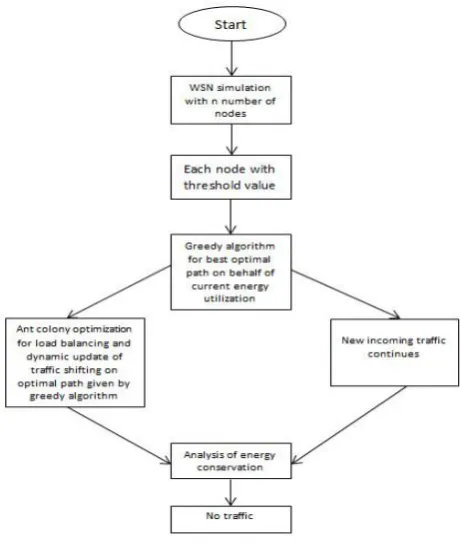
The flow chart explains the methodology followed in this research and all the techniques which are mentioned are carried out in simulation. The detailed description of implementation and working is explained in later sections accordingly.. It is also concluded that ACO is more accurate in routing purposes as compared to other optimization algorithm and thus in this work we need to overcome this disadvantage as well as our main objective which is to overcome the extra energy dissipation prevention and conservation, on the basis of energy using hybrid greedy algorithm and ACO we proposed a protocol which purely works on the basis of energy. The greedy algorithm initially gets the energy state of clusters i.e. their limit of handling the traffic and on basis of traffic data handling (their total energy) we defined some threshold energy value. The greedy algorithm decides the best optimal path thus incoming data traffic on clusters are scheduled to its nodes and corresponding another clusters defined on decided particular path by greedy algorithm. We proposed our own set of parameters making this thesis a novel approach to preserve the energy. Once the threshold energy of cluster is reached it will dynamically shift the traffic to another path decided by greedy algorithm. The nodes in this simulation doesn’t allowed as, as soon as cluster see’s the threshold value is reached it shifts the route to another shortest path. In this way we are successful in preserving the nodes to die early as well as energy is conserved. This energy is consumed in worst case scenario if the data traffic reaches the high extent value. Due to overhead issue is ruled out the node is not vulnerable to die out early due to traffic accommodation pressure. In this, efforts were made to preserve the life time of nodes by efficiently handling the traffic of the network.Below are some of the achieved objectives of the proposed work.
1. To reduce the overhead on clusters by taking the best optimal path on basis of energy from least to high energy value cluster.
2. Accommodating the traffic on basis of optimal path decided initially with the help of greedy algorithm. 3. To preserve the overall energy of the cluster by
assigning the threshold energy of each cluster. When threshold energy is reached the clusters will dynamically change its path again from least to high energy.
[image:3.595.321.552.79.351.2]4. To increase the life time of cluster and nodes. As in previous researches the disadvantage of dead node is common as node reach its high peak energy value it dies.
Fig 2: Flow chart of proposed work
4.
SIMULATION AND RESULTS
The proposed work is implemented in Java net beans ide and the result snapshots are shown below. The simulation is done is java and the description of the simulation is a s below:
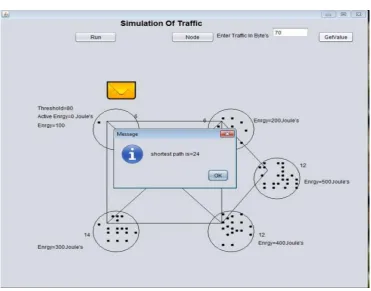
We have simulated five clusters and sensor node are placed in the clusters. Each cluster is attached with some energy such as 100J, 200J, 300J, 400J and 500J respectively. There are weights associated with each connection. When any amount of traffic enters the system, the greedy algorithm is calculating the shortest path from least to high energy nodes and gives the value of the shortest path. There is certain amount of threshold is associated with each cluster and whenever the energy of the cluster goes beyond this threshold value the traffic is shifted to another route with the help of ant colony optimization. The ACO dynamically shift the route to another cluster and hence aid in balancing the load of network equally.
The figure 3 is the snapshot of the performed simulation. The In the text field box the traffic entering the system is given. Two buttons run and node is shown in the diagram. Figure 3 and 4 gives the simulation of the proposed work. There are five clusters shown in the diagram and nodes are represented by the dots. The working of the proposed work is as follows:
In this work we have shown five clusters.
Energy level is defined for each cluster.
If the nodes are trying to send any packet, then our greedy algorithm will compute the shortest path based on energy of clusters in ascending order i.e. from low to high energy cluster.
cluster. Thus the total energy of the cluster is not exhausted.
The work of ant algorithm is that it will ping each cluster for their energy and allocates the traffic to
[image:4.595.110.489.141.429.2] [image:4.595.114.486.447.738.2]the cluster which can accommodate the required request.
Fig 4: Snapshot of simulation and determination of optimized route
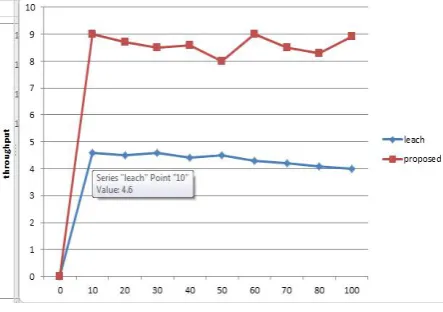
After simulating the proposed technique the result obtained are shown in the form of graph shown below. The throughput of the scheme is calculated and a graph is plotted in comparison to Leach. Figure 5 gives the throughput of the two techniques and we can see from the figure that the throughput of the proposed work is more as compared to leach. In table 1 the network lifetime of the two techniques is given and it is more for the proposed work.
[image:5.595.56.278.251.407.2]The figure 5 gives the throughput of leach and proposed work and the throughput of the proposed work is more than the Leach. As we can see from the diagram that the throughput of the proposed algorithm is more as compared to leach. In the table 1 the network lifetime of the proposed work and also the lifetime of LEACH is shown. From the values of network lifetime of the two techniques, it can be concluded that the proposed work is a better technique.
[image:5.595.59.256.437.534.2]Fig 5: The throughput of leach and proposed work
Table 1. Network Lifetime
Algorithm Network
lifetime
LEACH 510
Proposed 700
5.
CONCLUSION
In this work it came into conclusion that WSN required a lot into improvement. Since WSN is a vast area for research and development numerous number techniques exists in this field. So far the PSO (particle swarm optimization), Leach and ACO (ant colony optimization) were deeply studied and hence their disadvantages over node die out always persist. Since this disadvantage prohibits the node to increase its life time. We proposed a hybrid protocol adding ACO and Greedy algorithm for shortest path finding on the basis of energy also the threshold value of cluster prohibits the cluster to reach to peak value and at once route the traffic to another path. Remember the shortest path from source to destination depends on cluster’s energy value not the shortest path from one node to another. By this method we are successful in getting marginally better results than Leach. The life time has increased and throughput came out to be marginally better. We took the predefined novel parameters and worked on improving the WSN energy parameters.
In future the proposed technique can be implemented is real time scenario and the performance of the system can be measured.
6.
REFERENCES
[1] Akyildiz, W. Su, Y. Sankarasubramaniam and E. Cayirci, "A survey on sensor networks," IEEE Commun. Mag., vol. 40, pp. 102-114,2002.
[2] Jamal N. Al-Karaki, Ahmed E. Kamal, “Routing Techniques In Wireless Sensor Networks: A Survey”, IEEE Wireless Communications, Volume: 11, Issue: 6, 26- 28, December 2004.
[3] M. R. Patel and B. Kubde, An Improved Ant Colony Optimization Algorithm for Multiple QoS Routing to find multiple feasible paths for packet switched Network, International Journal.ofComputer Technology & Applications,Vol 3 (3), 1150-1152.
[4] Tiago Camilo, Carlos Carreto, Jorge Sá Silva, and Fernando Boavida. “An energy-efficient ant–based routing algorithm for wireless sensor networks”, In Proceedings of the 5th international conference on Ant Colony Optimization and Swarm Intelligence (ANTS'06), pp. 49-59, 2006.
[5] Liao Ming-hua, Zhang Hua, Sun Guang, "Energy Aware Routing Algorithm for Wireless Sensor Network Based on Ant Colony Principle", JCIT: Journal of Convergence Information Technology, Vol. 7, No. 4, pp. 215 – 221, 2012.
[6] A.M Okazaki, and A.A Frohlich, “Ant-based Dynamic Hop Optimization Protocol: A routing algorithm for Mobile Wireless Sensor Networks”, in conference GLOBECOM Workshops (GC Wkshps), IEEE, 1139 – 1143, Dec. 2011.
[7] Jian-FengYan, Yang Gao and LuYang, “Ant colony optimization for wireless sensor networks routing”, International Conference on Machine Learning and Cybernetics (ICMLC), pp. 400 - 403 , July 2011. [8] XieHui, Zhang Zhigang and Zhou Xueguang, “A Novel
Routing Protocol in Wireless Sensor Networks Based on Ant Colony Optimization”, on International Conference, Environmental Science and Information Application Technology(ESIAT), pp. 646 – 649, July 2009.
[9] A.M.S. Almshreqi, B.M. Ali, M.F.A. Rasid, A. Ismail,P. Varahram, An Improved Routing Mechanism Using Bio-inspired for Energy Balancing in Wireless Sensor Networks. In Proceedings of the 2012 International Conference on Information Networking (ICOIN) , Bali Island, 2012; pp. 150–153.
[10]J. Du, L. Wang, Uneven Clustering Routing Algorithm for Wireless Sensor Networks Based on Ant Colony Optimization. In Proceedings of the 3rd IEEE International Conference on Computer Research and Development, Shanghai, China, 11–13 March 2011; pp. 67–71.
[11]J. F. Yan, Y. Gao, L. Yang, Ant Colony Optimization For Wireless Sensor Networks Ro uting. In Proceedings of the 2011 International Conference on Machine Learning and Cybernetics, Guilin, China, 10–13 July 2011; pp. 400–403.