Performance Evaluation of Spatial Domain Contrast
Enhancement Techniques for Underwater Images
Shivendra Singh
Department of Electronics &Communication SISTEC Bhopal India
Manish Soni, Arun Patel
Department of Electronics &Communication SISTEC Bhopal India
Ravi Shankar Mishra
Department of Electronics &Communication SISTEC Bhopal India
ABSTRACT
Image enhancement methods are widely used for improving the feature and quality of the images. Researchers have designed various contrast enhancement methods in the past. But since underwater image contain low contrast and resolution due to poor visibility conditions and refractions of light rays. Thus analysis and identification of the underwater object is a challenging and difficult task. In this paper presents a comparative analysis of various contrast enhancement techniques for such underwater images. Performance of contrast limited adaptive histogram equalization (CLAHE) method is compared with contrast stretching, global histogram equalization (HE) Brightness preserving Bi-histogram equalization (BBHE) and finally Dual Sub-Image histogram equalization (DSIHE) methods. Different colour underwater images are enhanced in the RGB colour space. The performance is evaluated based on discrete entropy, signal to noise ratio (SNR) and Standard deviation difference and the mean brightness. Performance of methods is evaluated under various type of underwater image environment.
General Terms
Image processing, Image enhancement, Underwater Images
Keywords
Contrast enhancement, Local contrast stretching, histogram equalization, Bi-Histogram Equalization, Contrast limited Adaptive Histogram Equalization, Discrete Entropy
1.
INTRODUCTION
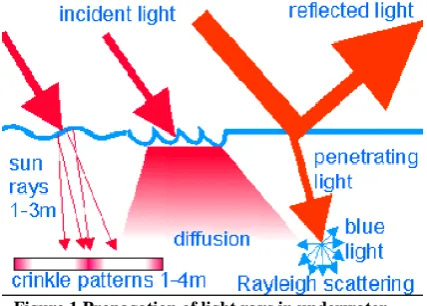
In the last two decade, analyses of underwater images have received greater attention for see spices identification, coral reefs, monitoring the underwater mountains and plants. Underwater image enhancement techniques provide a way to improving the object identification in underwater environment. There is lot of research started for the improvement of image quality, but limited work has been done in the area of underwater images; because the underwater image suffers from the many problems such as, absorption, reflection, and bending scattering of light as sown in Figure 1.
[image:1.595.328.542.215.368.2]Due to these effects the quality of the underwater images are degraded. The most common method of enhancing the image quality is to enhance its contrast. The image contrast is basically defined as the perceived difference in colours which are in the close proximity to each other. The researchers have designed various techniques for enhancing the images Viz. local contrast stretching (CS), global histogram equalization (HE), and contrast limited adaptive histogram equalization (CLAHE), Bi-histogram equalization, scaling the DCT or DWT coefficients.
Figure 1 Propagation of light rays in underwater environment
In this paper spatial domain enhancement techniques are compared for underwater colour images. The performance is compared on the basis of entropy and SNR as parameter. T he rest of the paper is organized as follows: Next section describes the review of various type of image enhancement method and algorithms, Section III describe the basic local contrast stretching techniques,. The section IV details with standard histogram equalization methods. CLAHE method is explained in section V. In section VI comparative result are presented. Finally section VII describes conclusion and future work.
2.
LITERATURE REVIEW
Most methods for contrast enhancement can be placed into one of two main categories, intensity based or spatial domain methods and compressed domain methods. Many methods have been proposed for enhancing the quality of an image such as local contrast stretching [3, and 15], histogram equalization [1, 4 and 15], contrast limited adaptive histogram equalization (CLAHE) [5] and Bi histogram equalization (BHE) [6] are the spatial domain, enhancement methods. The methods using DWT [2, 18] and DCT [16] are most widely used compressed domain methods which emphasize on different properties or components of an image. In this paper our main concern is on the spatial domain methods.
The above mentioned methods are useful for colour image enhancement. However, colour shifting and brightness change is major problem. Colour shifting means, that one colour is changed to another. This is because these methods increase the brightness values of the regions.
Y. T. Kim [6] has proposed an improved method of brightness preserving contrast enhancement using Bi- histogram equalization technique the. This method overcome the limitations of the conventional histogram equalization methods and preserves the mean brightness. But the performance of this method is inconsistent for the different underwater images. Manpreet Kaur et al. [11] have presented a survey of various histogram based contrast enhancement methods. They have concluded that HE, BBHE, and DSIHE methods produce variation in gray levels distribution. John et al.[10] have presented a novel method of underwater image enhancement using wavelength compensation and dehazing. Method deals effectively with scattering and colour change simultaneously.
Etaa D. Pisano et al [5] have suggested using contrast limited adaptive histogram equalization (CLAHE) method for improving the image quality. Letter on various researchers used CLAHE as tool for pre processing task as [5, 8 and 9]. Rafael Garcia et.al, studied different local histogram equalization methods and its variations. They have also discussed CLAHE enhancement method in their research in order to solve lighting problems in underwater imaging. Antonis Daskalakis [8] et.al, suggested under their research an efficient spot-adaptive CLAHE based image segmentation technique for improuvent of microarray gènes quantification. They found that this technique improved the display of spots and emphasized on the depiction of spots. Hitam et al. [9] have presented a combination of the CHAHE in RGB and HSV colour spaces for underwater images.
Among all spatial domain methods CHAHE is less affected by colour and brightness shifting problem thus widely used..
3.
CONTRAST STRETCHING
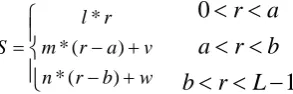
In the local stretching method contrast is stretched between the upper and lower threshold limit [3]. It is an intensity based contrast enhancement method defined as where , is the original image the output image is after contrast enhancement, and T is the transformation function. The transformation function T (r) is given as
w
b
r
n
v
a
r
m
r
l
S
)
(
*
)
(
*
*
1
0
L
r
b
b
r
a
a
r
(1)For the colour images the contrast is adjusted separately in RGB colour space.
3.1 RGB Color Space
[image:2.595.334.519.74.227.2]Colors displayed on a computer monitor are usually defined in the tri colors as red, green and blue, space is called as RGB colour space. This is another technique of making approximately same colors as CMYK. The RGB colour space can be generated by limited reproduction medium, Viz. phosphor used in CRT) display or filters and backlight are used in LCD screens. The RGB colour model is basically approximated as cube and red, green and blue are considered as the X, Y and Z axes as shown in the Figure 1.
Figure 2 Representation of the RGB colour space as a cubic model
The comparison of these two colour spaces are given in Figure 2. RGB colour space is widely used in compression techniques. In RGB format every image contains three 2D images each corresponds to the Red, Green, and Blue colour spaces.
4.
HISTOGRAM EQUALIZATION
Histogram equalization (HE) is one of the widely used methods for improving the contrast of the given images [15]. The enhanced images have a uniform distribution of the gray levels. The current section deals with the various histogram based contrast enhancement methods sequentially.
3.1
Global Histogram Equalization
The HE method flattens and stretches dynamic range of the image histogram thus results in overall contrast improvement [4]. Cumulative density function (CDF) is efficiently used to generate the flat histogram [15]. The CDF function is obtained by simply summing up the Probability density functions (PDF) and is given as;
=
r
dr
r
P
0
;
)
(
0 r 1 (2)Now differentiating the equation 2 gives;
)
(r
P
dr
ds
(3)
Thus finding the CDF will flatten the histogram. In this paper histogram equalization is implemented individually for all three RGB colour spaces. Then equalized RGB components are merged to get the coloured equalized results. But HE method may significantly change the brightness of an input image and cause problem in some applications where brightness preservation is necessary
3.2 Brightness preserving Bi Histogram
Equalization
This method is an improvement over the conventional histogram equalization method [HE]. The Brightness preserving Bi Histogram Equalization (BBHE) method was proposed by Y.T.Kim [6], this method sub divides the input image into two images as and based on the mean brightness as threshold.
Let is the mean brightness of the input image. by setting mean brightness as threshold the input image is divided to two sub images and represented as;
I ILIH (4)
[image:2.595.87.234.550.597.2]and IH
I(x,y)I(x,y)M,I(X,Y)I
(6)Then, the probability density function is individually calculated for the and images as;
L k L K L
n
n
I
P
(
)
Where,k
0
,
1
,
m
(7)H k H K H
n
n
I
P
(
)
Where,k
m
1
,
M
2
N
(8)Where, and are the gray levels in both sub images and are the total number of gray levels in and sub images. N is the length of the gray levels in the images and is given as . Then cumulative density function CDFL and CDFH are calculated using equation (2) defined as;.
m
k 1PL(IK) L
CDF , and
N
m
k
1
P
H
(
I
K
)
H
CDF
(9)Then each sub image is equalized independently.
3.3 Dual Sub-Image Histogram
Equalization
This method of Dual Sub-Image histogram equalization (DSIHE) [14], is similar to the BBHE method but instead of mean the median threshold is used to divide the image into sub images. The median threshold is defined as the
M
d
median
(
g
(
r
))
(9) Where, Md is the median threshold and g(r) is the gray levels.The method is based on the maximization of the Shannon’s entropy of the gray levels in the input image. The method basically uses the entropy values for the histogram separation. The brightness of the image enhanced by the DSIHE method is given as the average of the sub equal area level of the input image I and the middle value of the gray levels in the image, i.e., N/ 2.
By using the equations (9) the transfer functions for the histogram equalization are defined as;
fL(Ik)I0(ImI0)CDFL (10)
and fH(Ik)Im1(IN Im1)CDFH (11) the equalized image is the union of the both transformed gray levels and is given by;
Y fL(Ik)fH(Ik) (12)
This method preserves the brightness much better than the BBHE method. Sandeep Kumar et al.[17] have sown that the equalized image with DSIHE method contains the noise. All these methods enhance the contrast of the image, but also may cause serious change in the gray level distribution.
5.
CONTRAST LIMITED ADAPTIVE
HISTOGRAM EQUALIZATION
Finally in this paper, a novel CLAHE enhancement method is proposed which yields the optimal equalization and also limit the contrast range of the image. The suggested method is very useful for enhancing the video and image in the underwater environment. CLAHE was initially designed for medical imaging and has proven to be successful to enhancing the low-contrast images such as portal films. The CLAHE algorithm partitions the images into contextual regions and applies the histogram equalization to each one. This evens out the distribution of used grey values and thus improves the visibility of the hidden features of the image. The images are equalized in RGB colour spaces individually. Thus the method improves the efficiency of the conventional method.
Contrast Limited Adaptive Histogram Equalization (CLAHE) method is basicale an improved formé of Adaptive Histogram Equalization (AHE). Method overcomes the limitations of standard histogram equalization. A variety of adaptive contrast limited histogram equalization techniques (CLAHE) are provided. Noise can be reduced while maintaining the high spatial frequency content of the image by applying a combination of CLAHE, median filtration and edge sharpening. A variation of the contrast limited technique called adaptive histogram clip (AHC) can also be applied. AHC automatically adjusts clipping level and moderates over enhancement of background regions of portal images.
Method sub divides an image in to small regions called tiles, instead of entire image. Each tile's contrast is enhanced, so that the histogram of the output region approximately matches the histogram specified by the distribution types. The step wise algorithm is explained as follows;
1. Read the colour underwater images and then convert the image into RGB colour space of image size 240 X 320. 2 Separate the Red, Green, and Blue colour space.and save to
different variables
3. Divide the images into small regions called Tiles. 3. Calculate the probability distribution of the gray levels as;
N
k
n
f
P
(
)
(13)4. Calculate the modified gray levels using the expression of modified gray levels in each tiles, separately. For standard CLAHE method with Uniform Distribution can be given as (14)
Where Maximum gray level value
Minimum gray value
g is the computed pixel value
=CPD (Cumulative probability distribution) For exponential distribution gray level can be adapted as (15)
Where is defined as clipping parameter. In this paper the uniform distribution is used since it is needed for applications like segmentation. Using the difference
improves the image contrast. Then is
adaptively appended to cumulative distribution, 5. Plot the enhanced image and Histogram 6. End of the algorithm.
Thus the CLAHE method not only stretches the contrast range but also optimizes the entropy of the image. Thus is widely used for the high level applications such as segmentation and object detection.
6.
EXPERIMENTAL RESULTS
In this section, some experimental results of performance comparison for various contrast based enhancement method are presented.
6.1 Input Images Used
a) See image b) Marine_image_1
c) Bubble_vision_2 plant image d) Redang_Island_2
Figure.3 Original input images used in the paper
6.2 Results of Image Enhancement
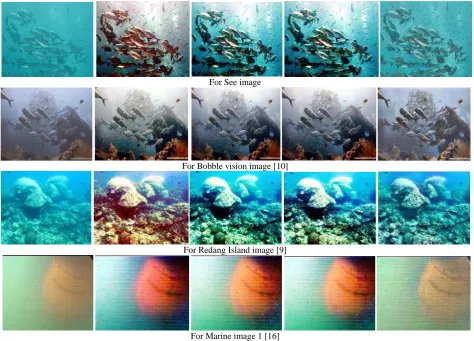
In this paper the result of the four different enhancement methods based on the histogram are compared. These methods include, HE, BBHE, DSIHE, and CLAHE. In the Figure 4 results of the various enhancement methods for all input images are given. It is observed that HE method suffer from the colour shifting problem. The DSIHE method preserves the brightness better then the BBHE method. For CLAHE method image is divided into tiles of size is 8x8, and clip limit is taken 0.05 and distribution is uniform CLAHE.
a) Original image b) Original Histogram
c) Histogram of HE d) Histogram of BBHE
[image:4.595.57.281.67.257.2]
e) Histogram of DSIHE f) Histogram of CLAHE
Figure 5 Comparison of the enhanced histograms for the Bobble vision image
For See image
For Bobble vision image [10]
For Redang Island image [9]
For Marine image 1 [16]
[image:4.595.317.541.71.370.2] [image:4.595.62.537.393.734.2]Method perform consistently for all images it not only enhances the contrast but also equalizes the histogram better..This is clear from the Fig. 5 which presents the histogram comparison.
6.3
Quantitative Performance Evaluation
In this paper four performance evaluation parameters are used which are defined as follows;
6.3.1. Mean Brightness (MB)
The mean brightness of all the enhanced images are computed and compared to the mean brightness of the original image. The mean brightness is mathematically defined as;
Where, is the brightness value of the each pixel and .
6.3.2. Signal to Noise Ration (SNR)
The ratio between the maximum possible power of a signal and the power of corrupting noise is defined as . It is basically used as the measure of fidelity of the system. Mathematically SNR is calculated as;
Where, is the input image and is the enhanced image.
6.3.3. Discrete Entropy )
The entropy is defined as the measure of the information in the image. More the entropy more is the information. In the discrete form entropy may be defined as;
6.3.3.Absolute Standard Deviation Difference
(ASDD)
The difference in Standard Deviation of input image and enhanced image is used as the measure of contrast enhancement. If the standard deviation difference is high then the image is over enhanced. Therefore SD difference should be low. The difference SD for contrast enhancement measure is defined in terms of variance as;
var
(
)
*
(
)
1
0
2
x
P
MB
x
iance
L
x
(19)
SD
var
iance
(20)The absolute SD difference is given as;
ASDD SDEnhance SDinput
(21)
Where, P is the probability density function.
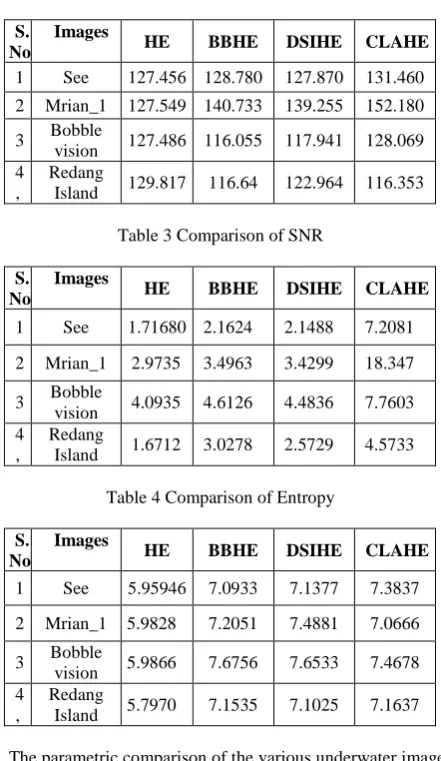
Table 1 Comparison of Standard deviation Difference
S. No.
Images
HE BBHE DSIHE CLAHE
1 See 13.9317 20.5841 20.5372 8.6881 2 Mrian_1 36.2093 36.064 36.1806 3.4106 3 Bobble
vision 26.0813 24.1659 25.2162 0.0014 4
,
Redang
[image:5.595.318.539.83.464.2]Island 11.1413 5.1638 4.0882 9,0599
Table 2 Comparison of Mean Brightness
S. No.
Images
HE BBHE DSIHE CLAHE
1 See 127.456 128.780 127.870 131.460
2 Mrian_1 127.549 140.733 139.255 152.180
3 Bobble
vision 127.486 116.055 117.941 128.069 4
,
Redang
[image:5.595.53.278.560.648.2]Island 129.817 116.64 122.964 116.353
Table 3 Comparison of SNR
S. No.
Images
HE BBHE DSIHE CLAHE
1 See 1.71680 2.1624 2.1488 7.2081
2 Mrian_1 2.9735 3.4963 3.4299 18.347
3 Bobble
vision 4.0935 4.6126 4.4836 7.7603 4
,
Redang
Island 1.6712 3.0278 2.5729 4.5733
Table 4 Comparison of Entropy
S. No.
Images
HE BBHE DSIHE CLAHE
1 See 5.95946 7.0933 7.1377 7.3837
2 Mrian_1 5.9828 7.2051 7.4881 7.0666
3 Bobble
vision 5.9866 7.6756 7.6533 7.4678 4
,
Redang
Island 5.7970 7.1535 7.1025 7.1637
The parametric comparison of the various underwater image enhancement methods are presented in the Table 1 to Table 4. It can be observed that the performance of the BBHE and DSIHE method varies with the kind of image environment. The CLAHE method gives less standard deviation difference and higher SNR values and also improves the entropy of the most of the input image. Thus performs better,
7.
CONCLUSION
The performance comparison of various spatial domain enhancement methods is presented in the paper. It is observed that CLAHE method performs better than other methods in terms of contrast enhancement and equalization both. It is observed that CLAHE method provides higher SNR value thus is less affected by the noise. The HE method gives worst SNR performance and also suffers from the colour shifting due to poor contrast enhancement. The performance of BBHE and DSIHE methods is not consistent and performs better for different images Paper also measures the contrast performance using new measure as absolute standard deviation difference. It is find that CLAHE method out performs in terms of contrast enhancement over other methods. The enhancement methods effectively improve the visibility of underwater images.
8.
ACKNOWLEDGMENTS
[image:5.595.59.276.675.763.2]9.
REFERENCES
[1] Ravichandran, C.G. , V. Magudeeswaran, “An Efficient Method for Contrast Enhancement in Still Images using Histogram Modification Framework”, Journal of Computer Science Vol. 8 No. 5: PP. 775-779, 2012 [2] Prateek S. Sengar, Tarun K. Rawat, Harish Parthasarathy,
“Color Image Enhancement by Scaling the Discrete Wavelet Transform Coefficients”, IEEE International Conference on Microelectronics, Communication and Renewable Energy , (ICMiCR), 2013.
[3] Jagatheeswari P..Kumar, S. S. Rajaram M., “Contrast Streaching Recursively Separated Histogram Equalization for Brightness Preservation and Contrast Enhancement”, in International Conf. on Advances in Computing, Control, and Tele-communication Technologies, pp. 111-115, 2009.
[4] Vasile V. Buruloin, Mihai Ciuc, Raugaraj M. Rangavyan, Loic Kjj, Constantim Vertan., “Histogramequalization of colour images using the adaptive neighbourhood approach”, Proc. SPIE 3646, Nonlinear Image Processing, X, 330, 1999.
[5] Etta D, Pisano, S. Zong, R. E Jhonston “Contrast limited adaptive histogram equalization image processing to improve the detection of simulated speculation in Dense Monograms”, Journal of Digital Imaging, vol. 11, No. 4, pp 193-200, 1998
[6] Y.-T. Kim Contrast Enhancement Using Brightness Preserving Bi-Histogram Equalization , IEEE Transactions on Consumer Electronics, Vol. 43, No. 1, FEBRUARY 1997
[7] B. A. Thomas, R. N. Strickland, & J. J. Rodriguez, “Color image enhancement using spatially adaptive saturation feedback”, Proc. 4th IEEE Conf. on Image Processing, Santa Barbara, CA, USA, pp. 30-33, 1997.
[8] A. Daskalakis, D. Cavouras, P. Bougioukos, S. Kostopoulos, P. Georgiadis, I. Kalatzis and G. Nikiforidis,, “An Efficient CLAHE-based, Spot-Adaptive, image segmentation technique for improving Microarray Genes’ Quantification”, in 2nd International Conference on Experiments/ Process/ System Modelling/Simulation/ Optimization (IC_EpsMsO), Athens, Greece, July 4-7, 2007
[9] Muhammad Suzuri Hitam,. Wan Nural Jawahir Hj Wan Yussof, Ezmahamrul Afreen Awalludin,, Zainuddin Bachok, “Mixture Contrast Limited Adaptive Histogram Equalization for Underwater Image Enhancement”,
[10]. M. Abdullah-Al-Wadud, M. H. Kabir, M. A. A. Dewan, and Oksam Chae, “A dynamic histogram equalization for image contrast enhancement”, IEEE Trans. Consumer Electronics, vol. 53, no. 2, pp. 593 - 600, May 2007. [11] Manpreet Kaur, Jasdeep Kaur, Jappreet Kaur, “Survey of
Contrast Enhancement Techniques based on Histogram Equalization”, (IJACSA) International Journal of Advanced Computer Science and Applications, Vol. 2, No. 7, 2011
[12] S. A. Hariprasad, Arunlal. K. S, Vikhar Ahmed, “Novel Weighted Mean Separated Histogram Equalization for Contrast Enhancement of Underwater Images”, International Journal of Scientific & Engineering Research, Volume 4, Issue 12, December-2013.
[13]. K. Wongsritong, K. Kittayaruasiriwat, F. Cheevasuvit, K. Dejhan, and A Somboonkaew, “Contrast enhancement using multipeak histogram equalization with brightness preserving”, The 1998 IEEE Asia-PasificConference on Circuit and Systems, pp. 24-27, November 1998.
[14]. Y. Wang, Q. Chen, and B. Zhang, “Image enhancement based on equal area dualistic sub-image histogram equalization method,” IEEE Trans. on Consumer Electronics, vol. 45, no. 1, pp. 68-75, Feb. 1999. [15] Jyoti Singhai, Paresh Rawat, "Image Enhancement
Method for Underwater, Ground and Satellite Images Using Brightness Preserving Histogram Equalization with Maximum Entropy," iccima, vol. 3, pp.507-512, 2007 International Conference on Computational Intelligence and Multimedia Applications, 2007
[16] Jayanta M., and Sanjit K. Mitra, “Enhancement of Color Images by Scaling the DCT Coefficients”, IEEE Transactions on Image Processing, Vol. 17, No. 10, pp. 1783-1794, 2008
[17] Sandeep Kumar ,Puneet Verma, Manoj Dahiya,Aakash Gupta, “Presence Of Noise In Dualistic Sub-Image Histogram Equalization Technique of Image Enhancement”, International Journal of Engineering Research & Technology (IJERT) Vol. 1 Issue 3, May – 2012
[18] K. K. Sharma, Supriya M.,” Color Image Enhancement using Nonlinear Mapping in Color and Transform Domains”, International Journal of Advanced Electronics & Communication Systems, Issue 2 Vol. 1 2012.
10.
AUTHOR’S PROFILE
1. Shivendra Singh: have completed the BE in Electronics and Communication engineering and is currently pursuing M. Tech degree from SISTECH college Bhopal India.
2. Manish Soni: Have received M. Tech degree and is currently working as Astt. Prof at SISTEC College Bhopal in Electronics and communication department
3.Prof. Arun Kumar Patel : Have received M. Tech degree and pursuing PhD, and is currently working as Astt. Prof at SISTEC College Bhopal in Electronics and communication department