Combined Application of Color Histogram and Wavelet
Techniques for Content based Image Retrieval
Asheesh
IIT-BHU VaranasiA.K.Tripathi
IIT-BHU VaranasiABSTRACT
In this paper, we have proposed a novel method of content based image retrieval using combination of color histogram and wavelet techniques. We have used RGB color space to exploit the color features of image both for color histogram and wavelet decomposition of images. F-norm theory is used to extract features from wavelet transformed image. For histogram technique Euclidean distance is used and for wavelet technique F-norm theory based criteria is used to calculate similarity. We have shown that how individual techniques perform and have given approach to use both techniques in combination. Using recall rate it is shown that results have improved when both techniques are used together. We have also implemented the system in parallel and using speedup parameter it is shown that it has reduced the processing time making it practically useful in real world applications.
General Terms
CBIR, Content Based Image Retrieval
Keywords
CBIR, RGB, Histogram, Wavelets, Haar Wavelet, Parallel, Threads, Recall Rate etc
1.
INTRODUCTION
CBIR or content based image retrieval is allowing the system to automatically extract out the features from the image and compare it with other images in database and retrieving results based on the similarity of the extracted features of query image with other images in database rather than the metadata associated with the image [1]. Now-a-days the image data is growing at a very rapid rate and manual annotation for all images is becoming more difficult. Moreover there are many limitations of manual annotation such as different names for same object, different emphasis laid by different persons for different objects in same image etc [2]. It makes CBIR demand more relevant and pragmatic. Many related works are already done in this field(e.g.: QBIC, Virage, Pichunter, visual SEEK, Chabot, Excalibur, photobook, Jacob) [3].Content based image retrieval, which is allowing to automatically extract targets according to objective visual contents of image itself(e.g. color, texture and shape) has become increasingly attractive, in Multimedia Information Service System (MISS) [4].With appealing time frequency localization and multi-scale properties, wavelet transform proved to be effective in visual feature extraction and representation [4]. The color feature is one of the most appealing feature of an image to human eyes [5]. Color feature is exploited by extracting out red, green and blue color information from the image by making their respective histograms. The images are compared using Euclidean distance between RGB histograms of the image and that of database images. The wavelet transform is a tool that cuts up
components and then studies each component with a resolution matched to its scale [6]. In this paper, we used Haar wavelet transforms to decompose color images into multilevel scale and wavelet coefficients, with which we perform image feature extraction and similarity match by means of F-norm theory [7]. The efficiency in terms of recall rate and retrieval speed is tested with five types of images and the results reflect the importance of combination of coarse feature color and wavelets which divides the image into approximate and detail parts in CBIR. Both the techniques are also implemented in parallel to efficiently utilize the multicore processors.
The rest of this paper is organized as follows. In section 2, we introduced the general structure of the proposed CBIR system, and it provides the image decomposition using wavelets and color histograms. Section 3 describes feature extraction, similarity criteria and proposed combined retrieval strategy. Section 4 presents CBIR results using color histograms, wavelets and combined retrieval strategy. Finally conclusions are offered in section 5.
2.
GENERAL STRUCTURE OF
PROPOSED CBIR
Volume 94 – No 10, May 2014
User Input
[image:2.595.51.552.78.255.2]Query image
Fig. 1 General Structure of Proposed CBIR System
2.1
Color Histogram
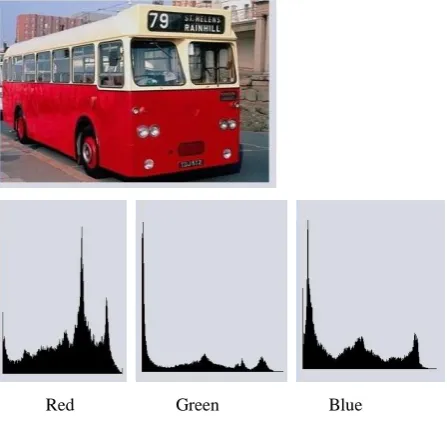
Color histograms are frequently used to compare images [5]. Color histograms are popular because they are trivial to compute, and tend to be robust against small changes in camera viewpoint. For example, Swain and Ballard [8] describe the use of color histograms for identifying objects. Stricker and Swain [9] analyze the information capacity of color histograms. It is assumed that all images are scaled to contain the same number of pixels M (here in our case it is 256X256). We discretize the color space of the image such that there are n distinct (discretized) (256) colors. A color histogram H is a vector < h1,h2,………,hn >, in which each
bucket hj contains the number of pixels of color j in the image.
For a given image I, the color histogram HI is a compact summary of the image.
[image:2.595.56.280.469.681.2]
Red Green Blue
Fig. 2 RGB histograms of an image
A database of images can be queried with an example image I and the images with minimum Euclidean distances with the query image can be returned. The following is an outline of the method which is proposed by Jain and Vailaya [10] with some modifications:
1. Read images in database and extract RGB format pixel information from images.
(In Java getRGB method is used to get RGB information of image).
2. Create 256 bin normalized histograms for each of the RGB components of each image of database. Thus, each image will have 3 histograms associated with each image, one each for RGB (Where R=>Red, G=>Green, B=>Blue).
3. Read in a query image and extract RGB format pixel information.
4. Create histograms for query image for each of the RGB.
5. Compute Euclidean distance by comparing the query image histograms to that of each image in the database. Add the Euclidean distances of RGB histograms to get the final Euclidean distance of that image with query image.
6. Sort images in database in order of ascending Euclidean distance to query image and return as result.
256 bins were used in the proposed approach. Generally to increase the speed the number of bins is decreased to 64 or 32 but it leads to loss of information. Therefore it is a tradeoff of speed and accuracy. To increase speed system is implemented in parallel therefore speed and accuracy both have improved.
2.2
Image decomposition with Haar
wavelet
We have used Haar wavelet approach for color image decomposition. The wavelet transformation produces average and fine detail coefficients [4]. These resulting decomposition coefficients are used to perform image feature extraction and similarity match by virtue of F-norm theory [7].
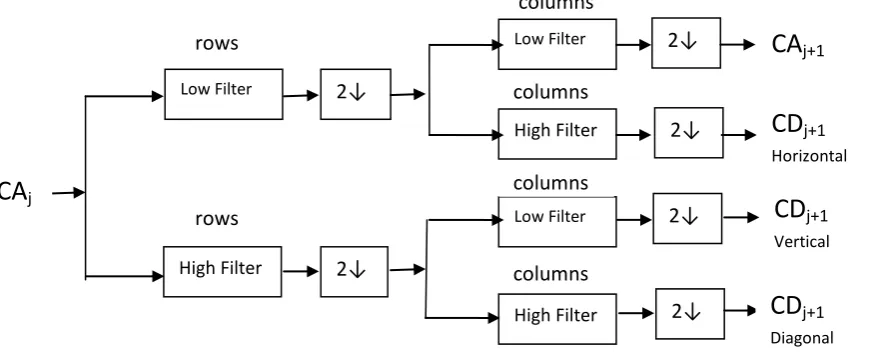
Wavelet analysis consists of decomposing a signal or an image into a hierarchical set of approximations and details. For images analysis two-dimensional wavelets are used. The discreet wavelet transform (DWT) of a signal is calculated by passing it through a series of filters (high and low pass filters) and then down-sampled [11], as we can see from Figure 3.
Fig 3 Multilevel 2-D Wavelet Decomposition
At each level, the signal is decomposed into low and high frequencies, and this decomposition halves the resolution since only half the number of samples are retained to characterize the entire signal. The algorithm retains the even indexed columns respectively rows. Based on this scheme, two-dimensional DWT leads to a decomposition of approximation coefficients at level j in four components: the approximation (CA) at level j+1 and the details (CD) in three orientations (horizontal, vertical, and diagonal) [11].
2.3
Haar Wavelet Transform
If a data set S0, S1 ….SN-1 contains N elements, after
transformation there will be N/2 averages and N/2 wavelet coefficient values. The averages are stored in the upper half of the N element array and the coefficients are stored in the lower half as shown in the Fig.4. The averages become the input for the next step in the wavelet calculation, where for iteration i+1, Ni+1 = Ni/2. The recursive iterations are executed as many times as much as we want continue until a single average and a single coefficient are calculated. This replaces the original data set of N elements with an average, followed by a set of coefficients whose size is an increasing power of two. The Haar equations [4] to calculate an average ai and a wavelet coefficient ci from an odd and even element
[image:3.595.314.539.465.617.2]in the data set are:
Fig. 4 Haar Transform
3.
FEATURE EXTRACTION AND
SIMILARITY CRITERIA
Our CBIR algorithm is based on direct wavelet decomposition of image in RGB color space and utilizes the “query by example” method. With approaches mentioned above, database images are decomposed offline into multi-level coefficients from -1 to -J levels, with which, we can generate color feature database and can perform similarity match between images. After decomposition, each resulting sub image is in fact a coefficient matrix, where, by special processing, large coefficients with more energy can be distributed in the upleft area, therefore, with F-norm theory, we can well decrease the dimension of image feature and perform highly efficient image matching.
3.1
Feature Vector
Suppose A is a square matrix and Ai is its ith order sub matrix where
The F-norm of Ai is given as
Let Δ Ai = || Ai||F - ||Ai-1||F and ||A0||F = 0, we can define the
feature vector of A as [4]: VAF = {ΔA1, ΔA2…… ΔAn}
3.2
Similarity criteria
Define the Similarity αi of ΔAi and ΔBi as [4]:
and we can thus give the similarity α of the matrices A and B as:
Low Filter
Low Filter
High Filter
Low Filter
2↓
2↓
2↓
2↓
High Filter
2↓
2↓
High Filter
rows
columns
rows
columns
columns
columns
CA
jCA
j+1CD
j+1 HorizontalCD
j+1 VerticalVe
Volume 94 – No 10, May 2014
Where i=(1,2,3,…..n)
Higher the similarity values higher the similarity between the images.
3.3
Retrieval Strategy
In our setup we have used two different strategies to fetch results. First the color histogram based technique which is based on the Euclidean distance between query image and database image’s histograms. The comparison is made between Red, Green and Blue components separately. The total distance is the sum of all the 3 components distance. The top 10 results are shown.
For wavelet transformation we have used haar transformation. We have decomposed the images upto 4 levels. Based on F-norm theory we match images with query image.
The top 10 images with highest similarity factor are shown in results. With results obtained from both the strategies the combined result is shown in order of increasing rank which is assigned as follows:
If the image is present in top 30 results of both color histogram and wavelet transformation method then its rank is (i+j) where i is its rank in color histogram method and j is in wavelet method.
If it is present only in one of the top 30 results of anyone of the two methods then its rank is (i+30) where i is the rank in the list.
4. RESULTS AND ANALYSIS
We have used a database of 500 images of 256X256 dimensions. It has 5 types of images in it; Horses, Buses, Landscapes, Dinosaurs and Roses. We have used the parameter of Recall rate to assess the effectiveness of the system. The Recall rate is defined as the ratio of the number of relevant (same category) retrieved images to the number of relevant items in collection [12].
The time taken in returning results is a crucial factor in CBIR. We have used the speedup [13] parameter to assess the speed factor as we have implemented the system both in parallel and sequential manner.
Database sample images:
Some terms used in results representation: Time taken in serial = Ts
Time taken in parallel= Tp
Here in our results the first image (in the top left corner of every result) is the query image.
Results Using wavelets transformation and
F-norm Theory
Ts= 331 Tp= 288 RR=10/10
Ts= 398 Tp= 277 RR=10/10
Ts= 430 Tp= 392 RR=9/10
Ts= 490 Tp= 309 RR=9/10
Results using Color Histograms and
Euclidean Distance
Ts= 236 Tp= 219 RR=10/10
Ts= 193 Tp=200 RR=10/10
Ts= 179 Tp= 139 RR=10/10
Ts= 230 Tp= 230 RR=10/10
Ts= 275 Tp= 228 RR=7/10
Results using proposed retrieval strategy
Volume 94 – No 10, May 2014
Ts= 701 Tp= 639 RR=10/10
Ts= 722 Tp= 672 RR=10/10
Ts= 613 Tp= 608 RR=9/10
Ts= 699 Tp= 632 RR= 7/10
Recall Rate for Different categories of images
Category Bus Dinosaurs Rose Horses Scene
Wavelets 8/10 8/10 7/10 7/10 7/10
Color Histogram
8/10 9/10 6/10 6/10 5/10
Both 9/10 10/10 9/10 8/10 7/10
Recall Rate Graph
Speedup Graph
5. CONCLUSIONS
The results show that the system is effective in bringing out visually similar images from the database. It is also observed that combining both color histogram technique and wavelet technique the results have improved and recall rate has increased. The parallel implementation of the system has helped in reducing the processing time and better utilization of processor. According to requirement the user can select to search on basis of color , on basis of wavelet transformation or the combined approach. The future work includes the clustering of database images in groups and taking the relevance feedback from user so that the system can learn.
6.
REFERENCES
[1] http://en.wikipedia.org/wiki/Content-based_image_retrieval
[2] Felci Rajam1 and S. Valli; A Survey on Content Based Image Retrieval; Life Science Journal 2013
[3] Rui Y. & Huang T. S., Chang S. F. “Image retrieval: current techniques, promising directions, and open issues”. Journal of Visual Communication and Image Representation, 10, 39-62, 1999.
[4] Mrs.Y. M. Latha, Dr.B.C.Jinaga, V.S.K.Reddy;Content Based Color Image Retrieval via Wavelet Transforms , IJCSNS International Journal of Computer Science and Network Security.
[6] D.N. Verma, Vrinda Maru' and Bharti ;An Efficient Approach for Color ImageRetrieval Using Haar Wavelet; International Conference on Methods and Models in Computer Science , 2009
[7] Huihui Huang; Wei Huang; Zhigang Liu; Weirong Chen; Qingquan Qian; “Content-based color image retrieval via lifting scheme” Autonomous Decentralized Systems, 2005. ISADS Proceedings 2005.
[8] Michael Swain and Dana Ballard. Color indexing. International Journal of Computer Vision, 7(1):11{32, 1991.
[9] Markus Stricker and Michael Swain. The capacity of color histogram indexing. In Proceedings of IEEE
Conference on Computer Vision and Pattern Recognition, pages 704{708, 1994.
[10] Jain, Anil K., and Aditya Vailaya. Image Retrieval Using Color And Shape. Great Britain: Elsevier Science Ltd
[11] Wavelets as features for object recognition; Anca Apatean, Alexandrina Rogozan , Simina Emerich, Abdelaziz Bensrjtair
[12] Tang, J., Z. Chen, A.W. Fu, and D.W. Cheung, “Capabilities of Outlier Detection Schemes in Large Databases, Framework and Methodologies”, Knowledge and Information Systems, 11(1): 45-84.