GE-International Journal of Management Research
Vol. 3, Issue 10, Oct 2015 IF- 4.316 ISSN: (2321-1709)© Associated Asia Research Foundation (AARF)
Website: www.aarf.asia Email : [email protected] , [email protected]
“A STUDY ON IMPACT OF MERGER ON MOTIVATIONAL BEHAVIOR
WITH SPECIAL REFERENCE TO STATE BANK OF INDIA AND STATE
BANK OF INDORE”
Mrs. Isha Jain
Assistant Professor, Pioneer Institute of Professional Studies, India.
INTRODUCTION
Motivation is a theoretical construct used to explain behavior. It represents the reasons for
people's actions, desires, and needs. Motivation can also be defined as one's direction to behavior
or what causes a person to want to repeat a behavior and vice versa. A motive is what prompts
the person to act in a certain way or at least develop an inclination for specific behavior.
The word motivation has been derived from motive which means any idea, need or emotion that
prompts a man in to action. Whatever may be the behavior of man, there is some stimulus behind
it .Stimulus is dependent upon the motive of the person concerned. Motive can be known by
studying his needs and desires. There is no universal theory that can explain the factors
influencing motives which control mans behavior at any particular point of time. In general, the
different motives operate at different times among different people and influence their behaviors.
The process of motivation studies the motives of individuals which cause different type of
behavior. According to Edwin B Flippo, “Motivation is the process of attempting to influence
others to do their work through the possibility of gain or reward.
Internal and external factors that stimulate desire and energy in people to be continually
Motivation results from the interaction of both conscious and unconscious factors such as the (1)
intensity of desire or need, (2) incentive or reward value of the goal, and (3) expectations of the
individual and of his or her peers. These factors are the reasons one has for behaving a certain
way. An example is a student that spends extra time studying for a test because he or she wants a
better grade in the class.
Motivated behavior is a dynamic, ever-changing product of these components and their
interactions. Four components are: biology, environment, cognition, and emotion. Each
contributes to the production of behavior in its own unique way and, each can interact with one
or more of the others to produce motivated behavior. Motivation that energizes behavior is the
result of a complex interaction among at least four factors: biology, environment, cognition, and
emotion. Each factor makes independent contributions to the production of behavior, but in
addition, each factor is capable of, and typically does, interact with the other factors to produce
various combinations of behavior. Unless we study these interactions, our understanding of what
motivates people to behave the way that they do will be incomplete.
Mergers and acquisitions are increasing in the world as organizations try to expand their
operations and increase their competitive advantage. Despite optimistic expectations, mergers
and acquisitions frequently fail or succeed, in part because of the little attention given on the
project planning and management part of it and the great neglect of human resource issues,
which are rarely considered until serious problems arise. This is against the conception that the
success of any merger or acquisition is as much about people and culture as it is about the
financials. As such, organizations that recognize the link between people and performance make
it their business to understand how to shape employee behavior during and after the mergers.
Thus the present study will be focused on identifying the impact of merger on the motivational
behavior of employees.
LITERATURE REVIEW:
Impact of Mergers & Acquisitions on Job Security and Motivation: A Case Study of Banking
Employees of Pakistan. The Article has highlighted the following: To achieve competitive
advantage M&A’s has become a strategic option for organizations. The process of M&A is
change has been witnessed in the banking industry of Pakistan in recent years, owing to the
liberal reforms executed by the State Bank of Pakistan and the effective restructuring of banks.
This theoretical framework demonstrates how this process of M&A has recently affected the
occupational and skill profiles of job in banking industry of Pakistan. On the basis of different
views of authors, a conceptual framework is developed that is supported by a questionnaire. This
framework investigated the impact of M&A on the employee’s job motivation and job
satisfaction having both pre & post M&A job experience and those having only post M&A
experience.
Based on the findings of the research study different dimensions have
been evaluated from the information gathered through questionnaire. Employees those who have
worked in both pre and post mergers & acquisitions environment strongly feel that their
motivation level is unsatisfactory. Employees who worked at both pre and post-mergers &
acquisitions environment feel strong threat to their job security while working in such
environment. On the other hand the employees having only post M&A job experience had shown
satisfactory results as they didn’t work in a pre M&A environment. Therefore, their response was
positive regarding job motivation and job security. Employees join the bank after mergers are
very satisfied with their job security and they are fully motivated because they don’t have any
threat and this has increased their level of motivation.
Bhansing (2010), while studying the change in perception of organizational culture after merger:
The influence of Motivation, Acceptance and Knowledge focused on to what extent support for
mergers and acquisitions has an impact on organizational change over time. This support will be
seen as the degree of motivation, acceptance and knowledge that employees have at the
beginning of the M&A. The data used in this study was gathered from two companies operating
in the IT- sector. Sample collected from 527 respondents were analyzed. The results showed that
the culture perception changed in time and depends on the perception they had at the beginning
of the M&A. Motivation did had an impact on the change. The degree of Acceptance and
Knowledge of the employees had no influence on this change. Interaction effects of the support
variables on the change in perception over time were also investigated. These findings suggests
that the perception of organizational culture at the beginning of the M&A plays an important role
for the culture perception after the M&A. The more employees are motivated, the more
they are willing to change. Managers should take this into account for the implementation of the
change.
Olubukunola R et.al (2009) while studying a psychological effects of mergers and acquisition on
employees in selected banks in Nigeria found that mergers and acquisitions have had a
significant impact on the banking industry in Nigeria and around the world, over the last decade.
Due to this reason many bank employees have experienced numerous psychological effects of
mergers and acquisition. Acquisition is often seen to have negative impacts on employee's
behavior, resulting in counterproductive practices, absenteeism, low morale and job
dissatisfaction. This paper studied the effects of merger and acquisition on the morale and
psychology of employees in the Nigerian banking sector and how it affects employee's
productivity. It identified the different stages in mergers and acquisition and also the problems
that may emerge at each stage of mergers and acquisition integration process. The researcher in
the study observed that various factors relate to pre and post mergers and acquisition stages
among which communication seems to be the most vital. Thus it is concluded from the research
that open, timely, and accurate communication with employees may effectively reduce the
negative psychological and behavioral consequences, thereby reducing employee's anxiety,
uncertainty, confusion, rumour activity and labour turnover.
Geete Vishal (2013) conducted a study on Impact of Merger of State Bank of India with its
Associate Bank and Bankers View towards Merger. The researcher explored the merger of two
nationalized banks State Bank of India and State Bank of Indore on different parameters. For the
purpose of study the data has been collected for the pre-merger period and post-merger period of
State Bank of Indian and the other associated banks which were merged with it. The researcher
also tried to find out what are the reactions of employees of the bank which is going to merger
with SBI. The response were received from 100 employees of Indore city in the form of
structured questionnaire. In this exploration the researcher came to know that there is increase in
the profitability, network, revenue and ranking of the bank as world level. Not even this majority
of the employees were also happy with this Merger because they are getting better salary and
customers were also satisfied because they are getting bigger accessible network and services.
MARY KIVUTI (2013) suggested that employee pay and remuneration affect employee
allowances/bonuses, as well as terms of employment and performance based pay affect the
employee performance in the current merger setting. The study further concludes that mergers
affect the sense of ownership and belonging among the employees in the Bank hence their
performance. The study also established that employee contributions, employee composition,
shareholder wealth and merger satisfaction and communication affect employee performance in
the Bank. Thus it was made clear that same job satisfaction, job skills and traits, employee
retention and organizational commitment affects employee performance. The study finally
deduces that chain of command affects the employees’ performance in the Bank. It was also
ascertained that personal relationship, task conflicts, coordination, workloads, cultural
compatibility, management support, working conditions, employees’ attitudes, strategic
rationale, non-monetary benefits and employee commitment affects employee performance in
the merged Bank.
OBJECTIVES:
1) A study on impact of merger on Motivational Behaviour of employees of State Bank of
India and State Bank of Indore.
2) To suggest strategies to enhance the Motivation of employees of State Bank of India and
State Bank of Indore.
RESEARCH METHODOLOGY:
A study undertaken is of descriptive and exploratory in nature. The present study has been
carried out in Indore City. Indore city has been considered as a parent city for State Bank of
Indore and due to this reason the researcher has selected Indore City for the purpose of research.
For the purpose of this research all employees of State Bank of Indore and State Bank of India
(SBI) working with different branches of SBI in Indore City are taken in to consideration.
Sample size selected for the present study comprises of 100 employees of State Bank of Indore
(later on becomes State Bank of India) and State Bank of India in Indore City. Indore city is
considered as the major city in the state of Madhya Pradesh with around 111 branches of State
Bank of India. Due to this reason researcher have chosen Indore city for the purpose of research.
For the purpose of this study Non Probability Convenience Sampling was used. Data collected
was analyzed by using Paired T-test and for the representation of data Pie Charts, Tables and
HYPOTHESIS FORMULATED:
On the basis of review of literature and detailed discussion with various employees of both the
banks the following Hypothesis has been formulated for study of research problem:
Ho1: There is no significant impact of merger on Motivational Behaviour of employees of State
bank of India and State bank of Indore.
H11: There is significant impact of merger on Motivational Behaviour of employees of State bank
[image:6.612.69.526.321.622.2]of India and State bank of Indore.
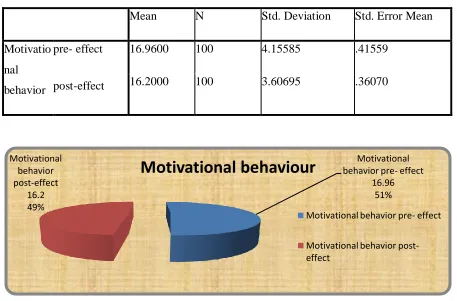
Table No 4.A
Mean Difference between Pre and Post effect of Merger on Motivational Behaviour of
employees of State Bank of Indore and State Bank of India
Paired Samples Statistics
Mean N Std. Deviation Std. Error Mean
Motivatio
nal
behavior
pre- effect 16.9600 100 4.15585 .41559
post-effect 16.2000 100 3.60695 .36070
Motivational behavior pre- effect
16.96 51% Motivational
behavior post-effect
16.2 49%
Motivational behaviour
Motivational behavior pre- effect
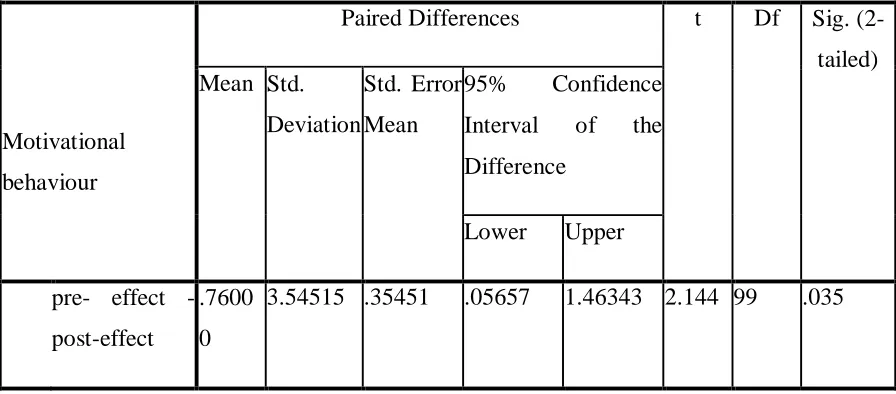
Table No 4.B
Paired t test for Pre and Post effect of Merger on Motivational Behaviorof employees of
State Bank of Indore and State Bank of India
Table No 4.B represents the result of paired t-test which indicates that the P value is 0.00/2=0.00
which is less than α= 0.05, which indicates that null hypothesis H04 is rejected. Thus it is said
that there is a significant impact of merger of state bank of India and state bank of Indore on the
Motivational Behaviour of employees.
From table no 4.A it is observed that Mean value for Motivational Behaviour amongst
employees pre-merger is 16.9 and post-merger is 16.2. Thus it may be said that Motivational
Behaviour amongst employees is decreases post-merger of state bank of Indore and state bank of
India.
Same finding was reported by Fink. He commented that if the majority of individuals in the
workplace are in a poor mental state after the merger, morale will likely be poor. The result of
the study suggests that poor morale in the workplace can result in lack of motivation, poor
performance and increased absenteeism, among other results.
Paired Samples Test
Motivational
behaviour
Paired Differences t Df Sig.
(2-tailed) Mean Std.
Deviation
Std. Error
Mean
95% Confidence
Interval of the
Difference
Lower Upper
pre- effect -
post-effect
.7600
0
Statements relating to Motivational Behavior:
*FIGURES IN BLACK COLOUR SHOW OVERALL PROBABILITY OF RESPONCES OF RESPONDENTS.
*FIGURES IN BLUE COLOUR SHOW PERCENTAGE OF INDIVIDUAL PARAMETRES.
S.N O
FACTOR PRE- EFFECT POST- EFFECT
FAVOURAB LE UNFAVOURA BLE COMMO N FAVOURAB LE UNFAVOURA BLE COMMO N
1 I give more
importance to personal relationship s then to organization al matters.
3.6 36% 1.4 14% 5.0 1.4 14% 0.4 4% 8.2 82
%
2 I seek the
approval of my seniors
for new
ideas/propo sals
3.8 38% 2.0 20% 4.2 3.4 34% 2.4 24% 4.2 42
%
3 I have
difficulty in expressing negative feelings to others
3.0 30% 1.6 16% 5.4 2.2 22% 1.2 12% 6.6 66
%
4 I expect
conformity
from the
people who work for or with me.
4.1 41% 0.2 2% 5.7 2.9 29% 1.0 10% 6.1 61
%
5 I tend to
take responsibilit y for others
work in
order to
help them.
4.3 43% 1.1 11% 4.6 2.8 28% 1.0 10% 6.2 62
%
6 I am excited
about new things and try them out even without consolidatin
g the
previous one.
0.9 9% 1.2 12% 7.9 3.2 32% 0.7 7% 6.1 61
FINDINGS & CONCLUSION:
Motivational behavior of the people represents the reasons for people’s actions, desires and
needs. In the present study the researcher have found that there is a significant impact of merger
of state bank of India and state bank of Indore on the Motivational Behavior of employees. It is
also observed from the analysis that Motivational Behavior amongst employees is decreases
post-merger of state bank of Indore and state bank of India. As employees feel that before
merger of banks, employees are motivated to give their ideas to management as well as they are
helping others in completion of their work too i.e. organizational citizenship was there amongst
the employees before merger and it is diminishing after the merger of both the banks.
SUGGESTIONS AND RECOMMENDATIONS:
From the above findings, there are some suggestions which can be used to improve the
motivation of employees after the merger are involve all employees in the development,
implementation and revision of rewards programs, Recognize small and large accomplishments,
Employees need to be a little more adjusting and compromising at the workplace. Don’t expect
everything to be done just the way they like it. They will have all types of people around them.
Avoid fighting over petty things. Do not always look at the negative side of things. Accept
people as they are. It is also essential to look at the positive side of an individual. Being flexible
at work always helps. Some employees feel about the changes in the attitude of their superiors.
This should be taken sensitively as the employees would not feel comfortable and their
performance will also get affected if they do not get proper support from their superiors.
REFERENCES:
1. Vishal Geete, A Study of Impact of Merger of State Bank of India with its Associate Bank
and Bankers View towards Merger, Wealth: International Journal of Money, Banking &
Finance; Jan-Jun2013, Vol. 2 Issue 1, p62
2. Mary Kivuti “The Influence of Mergers and Acquisitions on Employee Performance: A Case
3. Neeta Bhansing, Change in perception of organizational culture after merger: The influence
of Motivation, Acceptance and Knowledge, University of Twente, Behaviorly Science
Psychology, Enshede, 2010.
4. Olubukunola R et.al, Psychological effects of mergers and acquisition on employees: case
study of some selected banks in Nigeria, World Review of Entrepreneurship, Management
and Sustainable Development, 2009 Vol.5, No.1, pp.102 - 115
5. http://reme.uji.es/articulos/numero20/5petri/reme.numero.20.21.four.motivational.component
s.of.behavior.pdf
6. http://www.businessdictionary.com/definition/motivation.html#ixzz3mAwsipJH
7. https://en.wikipedia.org/wiki/Motivation
8.