International Journal of Mathematics and Mathematical Sciences Volume 2012, Article ID 574634,7pages
doi:10.1155/2012/574634
Research Article
On Generalized Flett’s Mean Value Theorem
Jana Moln ´arov ´a
Institute of Mathematics, Faculty of Science, Pavol Jozef ˇSaf´arik University in Koˇsice, Jesenn´a 5, 040 01 Koˇsice, Slovakia
Correspondence should be addressed to Jana Moln´arov´a,[email protected]
Received 27 March 2012; Accepted 20 September 2012
Academic Editor: Adolfo Ballester-Bolinches
Copyrightq2012 Jana Moln´arov´a. This is an open access article distributed under the Creative Commons Attribution License, which permits unrestricted use, distribution, and reproduction in any medium, provided the original work is properly cited.
We present a new proof of generalized Flett’s mean value theorem due to Pawlikowskafrom 1999 using only the original Flett’s mean value theorem. Also, a Trahan-type condition is established in general case.
1. Introduction
Mean value theorems play an essential role in analysis. The simplest form of the mean value theorem due to Rolle is well known.
Theorem 1.1 Rolle’s mean value theorem. Iff : a, b → Ris continuous on a, b and differentiable ona, bandfa fb, then there exist a numberη∈a, bsuch thatfη 0.
A geometric interpretation of Theorem 1.1 states that if the curve y fx has a tangent at each point in a, b and fa fb, then there exists a pointη ∈ a, b such that the tangent atη, fηis parallel to thex-axis. One may ask a natural question: What
if we remove the boundary conditionfa fb? The answer is well known as the Lagrange mean value theorem. For the sake of brevity put
b
aK
fn, gn fnb−fna
gnb−gna, n∈N∪ {0}, 1.1
for functionsf, gdefined ona, bfor which the expression has a sense. Ifgnb−gna
x y
a η b
[image:2.600.204.402.95.234.2]y=f(a) +f′(η)(x−a)
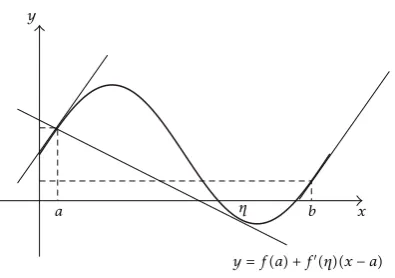
Figure 1: Geometric interpretation of Flett’s mean value theorem.
Theorem 1.2Lagrange’s mean value theorem. Iff :a, b → Ris continuous ona, band differentiable ona, b, then there exist a numberη∈a, bsuch thatfη baKf.
Clearly, Theorem1.2reduces to Theorem1.1iffa fb. Geometrically, Theorem1.2
states that given a line joining two points on the graph of a differentiable functionf, namely,
a, faandb, fb, then there exists a pointη∈a, bsuch that the tangent atη, fηis parallel to the given line.
In connection with Theorem1.1, the following question may arise: Are there changes if in
Theorem1.1the hypothesisfa fbrefers to higher-order derivatives? Flett, see1, first proved in 1958 the following answer to this question forn 1 which gives a variant of Lagrange’s mean value theorem with the Rolle-type condition.
Theorem 1.3Flett’s mean value theorem. Iff:a, b → Ris a differentiable function ona, b andfa fb, then there exists a numberη∈a, bsuch that
fη η
aK
f. 1.2
Flett’s original proof, see 1, uses Theorem 1.1. A slightly different proof which uses Fermat’s theorem instead of Rolle’s can be found in 2. There is a nice geometric interpretation of Theorem 1.3: if the curve y fx has a tangent at each point ina, b and if the tangents ata, faandb, fbare parallel, then there exists a pointη ∈a, b such that the tangent atη, fηpasses through the pointa, fa; see Figure1.
Similarly as in the case of Rolle’s theorem, we may ask about possibility to remove the boundary assumptionfa fbin Theorem1.3. As far as we know, the first result of that kind is given in the book3.
Theorem 1.4Riedel-Sahoo. Iff :a, b → Ris a differentiable function ona, b, then there exist a numberη∈a, bsuch that
fη η
aK
fbaKf· η−a
2 . 1.3
An interesting idea is presented in paper5where the discrete and integral arithmetic mean is used. We suppose that this idea may be further generalized for the case of means studied, for example, in6–8.
In recent years there has been renewed interest in Flett’s mean value theorem; see a survey in9. Among the many other extensions and generalizations of Theorem1.3, see, for example,10–13, we focus on that of Iwona Pawlikowska14solving the question of Zsolt Pales raised at the 35th International Symposium on Functional Equations held in Graz in 1997.
Theorem 1.5Pawlikowska. Letfben-times differentiable ona, bandfna fnb. Then there existsη∈a, bsuch that
fη−fa n
i1
−1i1
i!
η−aifiη. 1.4
Observe that Pawlikowska’s theorem has a close relationship with the nth Taylor polynomial off. Indeed, for
Tnf, x0
x fx0
fx
0
1! x−x0 · · ·
fnx
0
n! x−x0
n, 1.5
Pawlikowska’s theorem has the following very easy formfa Tnf, ηa.
Pawlikowska’s proof follows up the original idea of Flett; see 1, considering the auxiliary function
Gfx ⎧ ⎨ ⎩
gn−1x, x∈a, b,
1
nfna, xa,
1.6
wheregx xaKfforx ∈ a, band using Theorem1.1. In what follows we provide a different proof of Theorem1.5which uses only iterations of an appropriate auxiliary function and Theorem1.3. In Section3 we give a general version of Trahan condition, compare4
under which Pawlikowska’s theorem holds.
2. New Proof of Pawlikowska’s Theorem
The key tool in our proof consists in using the auxiliary function
ϕkx xfn−k1a k
i0
−1i1
i! k−ix−a
ifn−kix, k1,2, . . . , n. 2.1
Running through all indicesk1,2, . . . , n, we show that its derivative fulfills assumptions of Flett’s mean value theorem and it implies the validity of Flett’s mean value theorem for the
Indeed, fork1 we haveϕ1x −fn−1x xfnaandϕ1x −fnx fna.
Clearly,ϕ1a 0ϕ1b, so applying Flett’s mean value theorem forϕ1ona, bthere exists
u1∈a, b, such thatϕ1u1u1−a ϕ1u1−ϕ1a; that is,
fn−1u
1−fn−1a u1−afnu1. 2.2
Then forϕ2x −2fn−2x x−afn−1x xfn−1a, we get
ϕ
2x −fn−1x x−afnx fn−1a 2.3
andϕ2a 0 ϕ2u1by2.2. So, by Flett’s mean value theorem forϕ2 ona, u1, there
existsu2∈a, u1⊂a, bsuch thatϕ2u2u2−a ϕ2u2−ϕ2a, which is equivalent to
fn−2u
2−fn−2a u2−afn−1u2−
1
2u2−a
2fnu
2. 2.4
Continuing this way aftern−1 steps,n≥2, there existsun−1∈a, bsuch that
fu
n−1−fa
n−1
i1
−1i1
i! un−1−a
ifi1u
n−1. 2.5
Considering the functionϕn, we get
ϕ
nx −fx fa
n−1
i1
−1i1
i! x−a
ifix
fa n−1 i0
−1i1
i! x−a
ifi1x.
2.6
Clearly,ϕna 0ϕnun−1by2.5. Then by Flett’s mean value theorem forϕnona, un−1,
there existsη∈a, un−1⊂a, bsuch that
ϕ
nηη−aϕnη−ϕna. 2.7
Since
ϕ
nηη−aη−afa
n
i1
−1i
i−1!
η−aifiη,
ϕnη−ϕna η−afa−nfη−fa n
i1
−1i1
i! n−i
η−aifiη,
the equality2.7yields
−nfη−fan
i1
−1i
i−1!
η−aifiη1n−i
i
nn
i1
−1i
i!
η−aifiη,
2.9
which corresponds to1.4.
It is also possible to state the result which no longer requires any endpoint conditions. If we consider the auxiliary function
ψkx ϕkx −1 k1
k1!x−a
k1·b
aK
fn, 2.10
then the analogous way as in the proof of Theorem1.5yields the following result also given in14including Riedel-Sahoo’s Theorem1.4as a special casen1.
Theorem 2.1. Iff :a, b → Risn-times differentiable ona, b, then there existsη∈a, bsuch that
fa Tnf, ηa
a−ηn1 n1! ·
b
aK
fn. 2.11
Note that the case n 1 is used to extend Flett’s mean value theorem for holomorphic functions; see10. An easy generalization of Pawlikowska’s theorem involving two functions is the following one.
Theorem 2.2. Letf,g ben-times differentiable ona, bandgna/gnb. Then there exists
η∈a, bsuch that
fa−Tnf, ηa b
aK
fn, gn·ga−T
ng, ηa. 2.12
This may be verified applying Pawlikowska’s theorem to the auxiliary function
hx fx− baKfn, gn·
,gx, x∈ a, b. 2.13
3. A Trahan-Type Condition
In4Trahan gave a sufficient condition for the existence of a pointη∈a, bsatisfying1.2
under the assumptions of differentiability offona, band inequality
fb− b
aK
f·fa− b
aK
f≥0. 3.1
Modifying Trahan’s original proof using Pawlikowska’s auxiliary functionGf, we are
able to state the following condition for validity1.4.
Theorem 3.1. Letfben-times differentiable ona, band
fnaa−bn
n! Mf
fnba−bn
n! Mf
≥0, 3.2
whereMf Tn−1f, ba−fa. Then there existsη∈a, bsatisfying1.4.
Proof. SinceGfis continuous ona, band differentiable ona, bwith
G
fx gnx −
1nn!
x−an1
fx−fa n
i1
−1i
i! x−a
ifix
, 3.3
forx∈a, b,14, page 282, then
Gfb−GfaGfb
gn−1b−1
nfna
gnb
− n!n−1! b−a2n1
fnaa−bn
n! Tn−1
f, ba−fa
·
fnba−bn
n! Tn−1
f, ba−fa
≤0.
3.4
According to4, Lemma 1, there existsη ∈a, bsuch thatGfη 0 which corresponds to
1.4.
Now we provide an alternative proof of Theorem 2.2which does not use, original Pawlikowska’s theorem.
Proof of Theorem2.2. For x ∈ a, b put ϕx xaKf and ψx xaKg. Define the
auxiliary functionFas follows:
Fx
⎧ ⎨ ⎩
ϕn−1x− b
aKfn, gn·ψn−1x, x∈a, b,
1
n
fna− b
aK
Clearly,Fis continuous ona, b, differentiable ona, b, and forx∈a, bthere holds
Fx ϕnx− b
aK
fn, gn·ψnx. 3.6
Then
FbFb−Fa − n
b−aFb−Fa2≤0, 3.7
and by4, Lemma 1there existsη∈a, bsuch thatFη 0; that is,
fa−Tnf, ηa b
aK
fn, gn·ga−Tng, ηa, 3.8
which completes the proof.
Acknowledgment
The work was partially supported by the Internal Grant VVGS-PF-2012-36.
References
1 T. M. Flett, “A mean value theorem,” The Mathematical Gazette, vol. 42, pp. 38–39, 1958.
2 T.-L. R˘adulescu, V. D. R˘adulescu, and T. Andreescu, Problems in Real Analysis: Advanced Calculus on the
Real Axis, Springer, New York, NY, USA, 2009.
3 P. K. Sahoo and T. Riedel, Mean Value Theorems and Functional Equations, World Scientific, River Edge, NJ, USA, 1998.
4 D. H. Trahan, “A new type of mean value theorem,” Mathematics Magazine, vol. 39, pp. 264–268, 1966. 5 J. Tong, “On Flett’s mean value theorem,” International Journal of Mathematical Education in Science &
Technology, vol. 35, pp. 936–941, 2004.
6 J. Haluˇska and O. Hutn´ık, “Some inequalities involving integral means,” Tatra Mountains Mathematical
Publications, vol. 35, pp. 131–146, 2007.
7 O. Hutn´ık, “On Hadamard type inequalities for generalized weighted quasi-arithmetic means,”
Journal of Inequalities in Pure and Applied Mathematics, vol. 7, no. 3, article 96, 2006.
8 O. Hutn´ık, “Some integral inequalities of H ¨older and Minkowski type,” Colloquium Mathematicum, vol. 108, no. 2, pp. 247–261, 2007.
9 O. Hutn´ık and J. Moln´arov´a, “On Flett’s mean value theorem,” In press.
10 R. M. Davitt, R. C. Powers, T. Riedel, and P. K. Sahoo, “Flett’s mean value theorem for holomorphic functions,” Mathematics Magazine, vol. 72, no. 4, pp. 304–307, 1999.
11 M. Das, T. Riedel, and P. K. Sahoo, “Flett’s mean value theorem for approximately differentiable functions,” Radovi Matematiˇcki, vol. 10, no. 2, pp. 157–164, 2001.
12 I. Je¸drzejewska and B. Szkopi ´nska, “On generalizations of Flett’s theorem,” Real Analysis Exchange, vol. 30, no. 1, pp. 75–86, 2004.
13 R. C. Powers, T. Riedel, and P. K. Sahoo, “Flett’s mean value theorem in topological vector spaces,”
International Journal of Mathematics and Mathematical Sciences, vol. 27, no. 11, pp. 689–694, 2001.
Submit your manuscripts at
http://www.hindawi.com
Hindawi Publishing Corporation
http://www.hindawi.com Volume 2014
Mathematics
Journal ofHindawi Publishing Corporation
http://www.hindawi.com Volume 2014
Hindawi Publishing Corporation http://www.hindawi.com
Differential Equations
International Journal of
Volume 2014
Applied MathematicsJournal of
Hindawi Publishing Corporation
http://www.hindawi.com Volume 2014
Hindawi Publishing Corporation
http://www.hindawi.com Volume 2014
Hindawi Publishing Corporation
http://www.hindawi.com Volume 2014 Mathematical PhysicsAdvances in
Complex Analysis
Journal of Hindawi Publishing Corporationhttp://www.hindawi.com Volume 2014
Optimization
Journal ofHindawi Publishing Corporation
http://www.hindawi.com Volume 2014
Combinatorics
Hindawi Publishing Corporation
http://www.hindawi.com Volume 2014
International Journal of Hindawi Publishing Corporation
http://www.hindawi.com Volume 2014
Journal of
Hindawi Publishing Corporation
http://www.hindawi.com Volume 2014
Function Spaces
Abstract and Applied Analysis Hindawi Publishing Corporation
http://www.hindawi.com Volume 2014
International Journal of Mathematics and Mathematical Sciences
Hindawi Publishing Corporation http://www.hindawi.com Volume 2014
The Scientific
World Journal
Hindawi Publishing Corporation
http://www.hindawi.com Volume 2014
Hindawi Publishing Corporation
http://www.hindawi.com Volume 2014
Discrete Dynamics in Nature and Society Hindawi Publishing Corporation
http://www.hindawi.com Volume 2014 Hindawi Publishing Corporation
http://www.hindawi.com Volume 2014
Discrete Mathematics
Journal ofHindawi Publishing Corporation
http://www.hindawi.com Volume 2014
Hindawi Publishing Corporation
http://www.hindawi.com Volume 2014