The gendered politics of generational contracts
Changing discourses and practices of intergenerational
commitments in West Germany
A thesis submitted for the degree o f Doctor o f Philosophy London School o f Economics
submitted by
Dagmar Regine Lorenz-Meyer
UMI Number: U150727
All rights reserved
INFORMATION TO ALL USERS
The quality of this reproduction is dependent upon the quality of the copy submitted. In the unlikely event that the author did not send a complete manuscript and there are missing pages, these will be noted. Also, if material had to be removed,
a note will indicate the deletion.
Dissertation Publishing
UMI U150727
Published by ProQuest LLC 2014. Copyright in the Dissertation held by the Author. Microform Edition © ProQuest LLC.
All rights reserved. This work is protected against unauthorized copying under Title 17, United States Code.
ProQuest LLC
789 East Eisenhower Parkway P.O. Box 1346
'T^as£
s
F
ABSTRACT
In the context of policy recommendations to re-establish intergenerational equity this thesis enquires into the ways in which intergenerational relations in Germany became framed by the metaphor of the generational contract. Taking gender as an analytical tool, the thesis explored the discursive repertoires of generation and contract in a historical perspective. On this basis social contract theories are analysed with respect to the conflicting justifications they establish for the regulation of intergenerational relations. The analysis then focuses on how generational politics in the German welfare state drew on these justifications and how the generational contract came to be associated with fraud. It is argued that the ruse of the metaphor of the generational contract was its claim to embody social solidarity ‘for all’ Germans, while constituting and maintaining divisions of gender and social class in and by a social insurance system tailored to the male life course. Women’s positioning in the proposed measures to restructure the generational contract reveals its inherent multiplicity and contradictory structure.
List of Figures
FIGURE 4.1. Socio-historical dimensions of the framework of kinscripts...130
FIGURE 4.2. Functions and heuristic dimensions of kin work...138
FIGURE 5.1. Characteristics of sample of older German women
and their adult children... 146
FIGURE 5.2. Geographical areas of research and mobility
of the younger generation...149
FIGURE 5.3. Life course graphs of mother, son and daughter (ID no 814)...153
CONTENTS
ABSTRACT...3
LIST OF FIGURES...4
ACKNOWLEDGEMENTS ...7
INTRODUCTION ... 9
CHAPTER 1: REPERTOIRES AND LEGACIES OF ‘CONTRACT’ AND ‘GENERATION’ ... 26
1.1. INTRODUCTION... 26
1.2. REPERTOIRES OF INTERPERSONAL CONTRACTS...27
1.3. REPERTOIRES OF GENERATION...37
1.4. CONCLUSION... 49
CHAPTER 2: JUSTIFICATIONS OF INTERGENERATIONAL RESPONSIBILITIES IN SOCIAL CONTRACT THEORIES ...52
2.1. INTRODUCTION... 52
2.2. THE LOGIC OF THE SOCIAL CONTRACT ARGUMENT... 55
2.3. INTERGENERATIONAL COMMITMENTS IN CLASSICAL SOCIAL CONTRACT THEORIES... 57
2.4. INTERGENERATIONAL RESPONSIBILITIES AND JUSTICE IN CONTEMPORARY CONTRACT THEORIES...74
2.5. CONCLUSION... 81
CHAPTER 3: GENERATIONAL POLITICS AND DISCOURSES IN THE GERMAN WELFARE S T A T E ...84
3.1. INTRODUCTION... 84
3.2. ENFORCING INTERGENERATIONAL SUPPORT ALONG THE LINES OF INHERITANCE: EARLY GERMAN POOR RELIEF...87
3.3. RETIREMENT CONTRACTS AMONG THE PROPERTY-OWNING CLASSES IN AGRARIAN GERMANY...90
3.4. THE ‘SOCIALE IDEE’ AND BISMARCK’S SOCIAL INSURANCE LEGISLATION 95 3.5. THE EMERGENCE OF THE DISCOURSE OF INTERGENERATIONAL SOLIDARITY IN THE WEIMAR REPUBLIC... 99
3.6. GENERATIONAL CONTRACTS IN THE FEDERAL REPUBLIC: PROMISE, CHALLENGE AND DISASTER... 101
3.7. CONCLUSION...117
CHAPTER 4: RESEARCHING THE MICRO-POLITICS OF INTERGENERATIONAL RELATIONS: THE HEURISTIC FRAMEWORK OF KINSCRIPTS... 119
4.1. INTRODUCTION... 119
4.2. THEORETICAL APPROACHES TO INTERGENERATIONAL COMMITMENTS... 121
4.3. REVISTING LIFE COURSE, KINSHIP AND SCRIPT THEORIES... 124
4.4. DEVELOPING THE CONCEPT OF KIN WORK...131
CHAPTER 5: RESEARCH DESIGN AND M ETHODS... 140
5.1 INTRODUCTION... 140
5.2. SAMPLE CHARATERISTICS AND GENERATIONAL POSITIONINGS OF THE RESEARCH PARTICIPANTS... 142
5.3. THE SOCIO-CULTURAL CONTEXT OF THE STUDY... 146
5.4. THE PROBLEM-CENTRED INTERVIEW... 150
5.5. THE PROCESS OF THEME-CENTRED ANALYSIS...159
5.6. CONCLUSION...165
CHAPTER 6: OPPORTUNITIES AND CONSTRAINTS IN CONTRACTS OF NEED BETWEEN MOTHERS AND DAUGHTERS IN POST-WAR GERM ANY...167
6.1. INTRODUCTION... 167
6.2. KIN WORK OF DAUGHTERS: OBLIGATIONS AND EMOTIONAL DISTANCE... 170
6.3. WOMEN’S APPRENTICESHIP AFTER 1945: BETWEEN THE QUEST FOR INDEPENDENCE AND PLACEMENT IN THE KIN NETWORK...177
6.4. THE REORGANISATION OF NEED RELATED HOUSEHOLDS: DAUGHTERS AS BREADWINNERS...184
6.5. THE CONTINUATION OF WOMEN’S COOPERATION WITHIN AND ACROSS HOUSEHOLD BOUNDARIES: MOTHERS AS GRANDCHILD MINDERS...191
6.6. CONCLUSION...194
CHAPTER 7: CONTINUITY AND CHANGE IN OLDER WOMEN’S KIN COMMITMENTS IN THE GERMAN WELFARE STATE... 198
7.1. INTRODUCTION... 198
7.2. AMBIVALENT SUPPORT FOR THEIR CHILDREN: MINDING GRANDCHILDREN 201 7.3. THE FALLACY OF SELF-EVIDENCE: CARE FOR RELATIVES OF THE OLDER GENERATION... 205
7.4. EXPECTATION OF FILIAL SUPPORT IN OLD AGE...216
7.5. WOMEN’S PENSION ENTITELMENTS: ‘WELL, BETTER THAN NOTHING...’ ... 219
7.6. CONCLUSION...222
CHAPTER 8: NEGOTIATING AND TRANSFORMING INTERGENERATIONAL LEGACIES: KIN WORK PRACTICES AND ANTICIPATIONS FROMTHE PERSPECTIVE OF ADULT CH ILDREN... 226
8.1. INTRODUCTION... 226
8.2. KIN WORK COMMITMENTS AND FAMILY FEELINGS BETWEEN PARENTS AND ADULT CHILDREN... 227
8.3. INTERGENERATIONAL LEGACIES... 233
8.4. THE ANTICIPATION OF PARENTAL CARE: ‘WHY SHOULD THIS AGAIN BE UP TO WOMEN OF ALL PEOPLE?’...240
8.5. CONTEMPLATING GENDER EQUALITY: ‘MY IDEALS HAVE BEEN RATHER SCATTERED IN THE LAST YEARS, I HAVE TO SAY’ ...252
8.6. CONCLUSION...254
CONCLUSION... 257
BIBLIOGRAPHY... 270
APPENDIX A: OBJECTIVES AND SEQUENTIAL SAMPLING PROCEDURE OF THE BREMEN RESEARCH PROJECTS... 292
ACKNOWLEDGEMENTS
During the production of numerous drafts and papers, which finally were integrated into the present thesis, I have received crucial practical, emotional and intellectual support from a great many people.
My first thanks go to the women and men who agreed to participate in the research and were willing to remember, reflect on and share parts of their life stories with me and the other three interviewers in Bremen. Their narratives became a source of puzzlement, excitement and incomprehension, inspiring and challenging my theoretical pursuits.
Gail Wilson has been a wonderful supervisor, a continuous source of encouragement and willing to follow my many detours into ‘the heavy continental stuff. Her insightful comments and her unremitting insistence on splitting long ‘Germanised’ sentences have helped me a great deal to rethink and formulate more precisely what I was after.
The Research and Visiting Fellows at the Gender Institute at the London School of Economics, the administrator Hazel Johnstone and my fellow research students Carolina Ladino, Ceri Willmott, Clare Ferguson, Sally Crook and Anna Coates have helped to create a supportive and personal environment, which put the vision of a committed, personal and political academia into practice.
I would like to thank Claudia Bom and Helga Kruger for setting me en route, instilling a
passion for women’s life courses and providing training in some of the methods used. Christian Erzberger provided access to the quantitative data that informed the sample construction. Yasmin Gunaratnam provided helpful suggestions for chapters 1,4 and 5, Timothy Childers extensively commented on chapter 2 and Regine Heidenreich offered suggestions for chapter 3. Timothy also carefully proofread the entire manuscript and offered various suggestions, improving its clarity. In all cases, intellectual companionship has been deeply interconnected with friendship, and critical comments have been as important as the encouragement and emotional support in getting me going.
I would also like to thank Bettina Pohlmann for providing access to the Media Print Archive in Hamburg and accommodating me in her flat during my stays. Sophie Talbot helped produce some of the illustrations and offered important practical assistance in creating the master document. Anna Coates has provided invaluable last-minute help with the bibliography.
I am very grateful for the financial support of this project provided by two research grants of the European Commission. These grants enabled encounters and exchanges with a number of European women researchers, which go much beyond the scope of this thesis. My cousins Amelie and Henning Lorenz-Meyer offered me accommodation in my late aunt’s house in France in the winter of 1997 when money was low and London too hectic.
INTRODUCTION
At the end of the twentieth century intergenerational relations, or to be more precise the
cohesion between generations, is (again) seen to be at risk. In a plea for recognition of the
contributions of older people and to mutual understanding between generations, the UN
proclaimed 1999 ‘International Year for Older Persons’. The motto ‘Towards a society
for all ages’ calls for the creation of multigenerational social policies, thus
acknowledging inequalities, exclusions and potential tensions in intergenerational
relations. By way of introducing the contemporary discourse on intergenerational
relations I will present three very different genres of texts, the first a macro socio
economic analysis of intergenerational transfers, the second an outline of
intergenerational family therapy and the third a depiction of the alleged confrontation of
generations in two German popular science books. I suggest that these texts in their own
way conceptualise mechanisms of intergenerational cohesion that in Germany are called
the generational contract, and highlight the ways in which the scenarios of the
generational contract under threat and the measures to remedy them are currently framed.
They thereby exemplify dominant meaning systems and imageries of the generational
contract. As outlined below the aim of this study was to explore both theoretically and
empirically the underlying assumptions of the generational contract in a historical and
gender perspective. By bringing out the gendered implications of generational contracts,
the thesis aims to contribute to a shift in the current debates about mobilising ‘new forms
of solidarity’ in order to maintain the German welfare state.
The metaphoricity of the generational contract
The essay ‘Preventing conflicts between generations. For an active management o f the
(1996) integrates a range of demographic and economic data into an interpretation of the
current state of resource allocation between generations in industrialised countries. From
this description he draws several guidelines for future policy development in the context
of fundamental demographic change.
Kessler’s essay suggests that intergenerational cohesion in western societies is manifest
in and regulated by ‘a permanent overlapping of a great many forms of exchange and
transfers between coexisting generations’ (Kessler op. cit., p. 12). Following the
dominant conceptual divide between public and private the author distinguishes public
transfers that are organised by the state and local authorities, from private transfers that
are organised within families. According to Kessler these transfers rest on different
foundations, that is, on assumptions about human self-interest and/or altruism in the case
of private, and personal and structural factors such as the lack of forethought, information
and resources of social actors to protect themselves adequately in the case of public
transfers. Public transfers are mainly passed from the younger ‘active’ generations to the
older ones, with expenditure on contributory pensions being the largest item, followed by
health insurance spending. Whereas these transfers in most industrialised countries are
paid by payroll taxes, the smaller amount of public transfers that benefits the younger
generations, such as spending on education and training, is paid by the general budget.
Private transfers, such as the financial assistance of children, inter-vivo bequests and
inheritances are mainly passed in the opposite direction from the older to the younger
generation. Yet, because they are smaller in volume, Kessler concludes that the net
balance of private and public transfers favours the older generations, even though, as he
admits, he has to disregard all non-monetary transfers such as assistance in kind and the
giving of time and attention.
Kessler (op. cit., p. 2) holds that ‘the relative equilibrium of present-day intergenerational
transfer mechanisms’, is currently threatened by an ‘unprecedented demographic
breakdown’ in western societies. This breakdown refers to the well-documented predicted
relative increase of older in relation to younger generations due to a sharp decline in the
birth rate over the last thirty years and to a rise in life expectancy. Drawing on a range of
population will age and shrink, concentrating the volume of primary income on a smaller
fraction of an ageing population. This shift will threaten public pay-as-you-go pension
(PAYG) schemes where people in gainful employment constantly pay through their
social security contributions for the pensions of those retired, with a projected rise of
public expenditure for retirement, in Germany e.g. by more than 40% (see also Kaufrnann
1997). The three well-known measures for adapting the PAYG pension system are first,
an increase in contributions and/or budgetary financing with expected adverse effects on
economic competitiveness, unemployment, saving rates and public deficits; second, the
increase of the average retirement age, which would require a labour market for people
aged over 60; and third, a decrease of the relative value of pensions in relation to the
income of the working population. With respect to changes in private transfers Kessler
points to the expected increase in the volume of inheritance and wealth that the older
generation accumulated under favourable economic conditions and will pass on to the
younger generation.
To avoid unprecedented conflicts and competition between different age groups over the
sharing of resources - that under the assumption of generational selfishness could be
aggravated by the increasing power of decision-making by an ageing electorate - Kessler
suggests several guidelines for a political management of resources. These guidelines
claim to take into account both justice between coexisting and successive generations and
to contribute to the renewal o f ‘the fundamental social contract’ (Kessler op. cit. p. 30).
They include an increase in investment in occupational training to assure that numerically
smaller generations will be qualitatively better trained; the encouragement or compulsion
of younger generations to vote; an extension of retirement age; a shift of financing
transfers from payroll to a broad-based contribution system; a limitation of seniority rules
that link salaries to increasing age; a limitation of health insurance spending; a limitation
of public debts which places a burden on future generations; the encouragement of
younger generations to finance their retirement by private savings to alleviate successive
generations and promote investment; and the encouragement of the private transmission
of wealth.
case (for Britain see Jamieson 1990) or the political recommendations I will merely
emphasise here that interrelations between what is constructed as private and public as
well as any form of intergenerational support provided within and across household
boundaries remain outside the dominant economic frame of reference. They can therefore
not be included in any form of ‘intergenerational accounting system’ (Kessler op. cit., p.
33), whether or not such a system is desirable. Neither are transfers and their proposed
changes reviewed with respect to gender or indeed any other parameter of social
inequality such as class or ethnicity. A fundamental part of intergenerational cohesion is
thus lacking.
The series of essays on transgenerational solidarity by the renowned North American
family therapist Ivan Boszormenyi-Nagy (1987) expresses a commitment to
acknowledging, maintaining and restoring balanced exchanges and reciprocal fairness in
intergenerational family interaction. The family in this approach is conceived of as an
ongoing social system held together by visible and invisible loyalties. Boszormenyi-Nagy
metaphorically calls the mechanism of this intra- and intergenerational cohesion a ‘ledger
of fairness’ (Boszormenyi-Nagy op. cit., p. 305). Its criterion of ‘relational justice’ is
derived from the family members’ personal considerations of ‘balances of reciprocal
fairness of both observable transactions and resultant interpersonal ... consequences’
(Boszormenyi-Nagy op. cit., p. 307). The author holds that family members incur
responsibility for their exchanges. Whereas reciprocal fairness generates merited trust,
‘injustice’, such as the exploitation of a child’s feelings of loyalty, leads to imbalance,
stagnation and lost of trust. Worst of all intergenerational injustice suffered is likely to be
passed down the generational line.
The role of the intergenerational family therapist is to help family members to review
their ‘side of mutual entitlements and indebtednesses’ (Boszormenyi-Nagy op. cit., p.
192) and design adequate action strategies. These can include the development of
‘appropriate terms of repaying’ one’s parents for care received earlier as well as the
development of the parents’ acceptance of such repayments. The overall therapeutic aim
is to rebuild and mobilise trust in close relationships with an emphasis on accountability,
Although Boszormenyi-Nagy on the one hand holds that reciprocal fairness has to be
determined in a ‘committed dialogue’ (Boszormenyi-Nagy op. cit., p. 191) between
members of different generations the foundations of reciprocal justice on the other hand
are assumed to be grounded in the biological ‘facts’ of generation. These facts are used to
naturalise intergenerational rights and duties.
The legacy of parental accountability originates from the existential fact of reproduction. Having given life to a dependent infant, parents owe it nurturance. Conversely, the legacy of filial loyalty originates from the fact of conception, early human survival, and growth ... it should be noted that in modified form the legacy of filial loyalty exists even when children have been given up or abandoned very early in life. Whatever the degree of parental responsibility or behavior after a child’s birth, the child’s relationship to the parents who give him or her life is a unique, nonsubstitutable, and unreworkable fact of his or her existence.
(Boszormenyi-Nagy 1987, p. 220)
This acknowledgement of accountability for reciprocal intergenerational exchanges,
Boszormenyi-Nagy argues, becomes increasingly important in a societal context of
‘disintegrating trustworthiness’ and decreasing family commitments. Threats of
transgenerational solidarity are said to result from people’s increased mobility and
geographical dispersion but also from ‘women’s more active pursuit of their careers’, the
increase in divorces and ‘for certain segments of the society, the welfare support of
mothers with their dependent children’ (Boszormenyi-Nagy op. cit., p. 289).
Again I do not want to evaluate these scenarios here but merely draw attention to the
ways in which intergenerational relationships, by seemingly referring to biological facts,
are vested with normative notions of obligations and entitlements. Gender is conspicuous
by its absence in the discussion of ledgers of fairness and yet it reappears in the scenario
of declining family commitments.
As stated above in Germany the mechanisms of intergenerational cohesion exemplified in
these essays are called the ‘generational contract’. Although always used in the singular
this term refers both to the distributive mechanism of contributory social insurance,
different family generations. Its common denominator is that ‘in the history of human
kind it has always been the active generation who provided for the other two’
(Biedenkopf 1996, p. 2), i.e. the oldest and youngest members of society. This provision
of the ‘active’ generation is based on the trust that when they get older subsequent
generations will provide for them. Although cast as a natural law, the foregoing texts
illustrate that mechanisms of intergenerational cohesion and solidarity are currently
considered to be under threat, with a hegemonic focus on the socio-political side of the
generational contract, the social security system and in particular the pension insurance
system (see below).
Crisis scenarios are disseminated and dramatised in the German media (see Chapter 3.6.)
but also in the genre of non-fiction or popular (social) science books. In the context of the
ageing of population, fiscal pressure and rising social expenditure generations are
identified as competing interest groups in the distribution of welfare, a novel theme in the
age-old discourse on intergenerational solidarity and conflict. The widely discussed
popular social science books by the theologian and sociologist Reimar Gronemeyer (1991)
and the ex-medical practitioner and journalist Heidi Schuller (1996) are notable examples of
these emotionally loaded scenarios of a bellicose confrontation between ‘the young’ and
‘the old’ that allegedly will lead to a break up of the generational contract. Because these
books had a wide dissemination and received great media attention, they can be expected to
have some impact in shaping public opinion (Brauninger et al. 1998). Schuller was
designated shadow minister in the Social Democratic opposition and at the launch of her
book in 1995 the ex-SPD prime minister of Saarland Oskar Lafontaine presented her theses
‘For a new generational contract\l Schuller’s book is woven around a critique of
contemporary German society and social policy; Gronemeyer’s book consists of a sombre
cultural pessimism. Their sensational rhetoric and alternating loose references to
demographic and statistical data and everyday life encounters have striking similarities.
Both authors take the generational contract, once the embodiment of social cohesion and
solidarity, as a major cause for an impending ‘age class struggle’ that ‘from the turn of the
millennium could divide the world deeper than racism, gender war or class struggle’
(Gronemeyer op. cit., p. 125).
In a mixture of statistics, generalisations and dystopian vision Gronemeyer corroborates the
‘death of the family’ and the inhuman institutionalisation and segregation of the youngest
and oldest members of society. Whereas the family in the past had been a ‘community of
interest’ (Gronemeyer op. cit., p. 7), the ‘bracket that held generations together’
(Gronemeyer op. cit., p. 23) its collapse now leaves ‘expelled elders, consumption addicted
adults, neglected children’ (Gronemeyer op. cit., p. 171). The answer to the question ‘How
could we get into this dilemma?’ is simple: ‘It’s Bismarck’s fault. ... When Bismarck’s
social legislation started to replace familial provision in old age, the family started to
dissolve’ (Gronemeyer op. cit., p. 128-9). Schuller shares this view of the erosion of family
structures for which she assigns responsibility to the current ‘women and family hostile
politics’ (Schuller op. cit., p. 57).
Both authors argue that the inflated social security system in Germany has promoted a
general ‘provision and insurance mentality’ (Gronemeyer op. cit., p. 43) and produced a
self-serving expert system. Boundaries are drawn between the egoistic young old who
benefit from early retirement and generous sick leave regulations and those in advanced old
age who rely extensively on health and care provision. Referring to the alleged fraud of the
public pension system under changing demographic conditions both authors evoke the
metaphor of a ‘chain letter fraud’: ‘those who enter early take the cream, the late comers
lose their investment’ (Gronemeyer op. cit., p. 126).
According to Gronemeyer this crisis of the generational contract is further aggravated by
the legacy of the older generation of irreversible ecological destruction. As a result he
envisions that the younger generation will end the contract with ‘administrative hardness’
(Gronemeyer op. cit., p. 128): spending on hospitals, elder care homes and pensions will be
cut, the number of operations on older patients limited, and older people obliged to do
ecological compensation work. Schuller presents her recommendations of cut backs and
welfare retrenchment (‘the principle of equality has its limits at the scarcity of resources’
(Schuller op. cit., p. 188) and a simultaneous strengthening of self-help and friendship as
constructive suggestions for building a ‘new generational contract’. Institutionally, the
occupational and optional private pension schemes and eligibility criteria for social and
health services have to be tightened. To compensate for state provision the ‘vertical’
generational contract (Schuller op. cit., p. 9) has to be extended horizontally: young old
people have to help people in advanced old age as well as doing voluntary work in the
social sector in support of younger generations. For these suggestions not to fail in a
democracy where elders will constitute the majority of the electorate a limitation on the
voting age is considered as well as an extension of the right to vote according to the number
of children one has.
Whether the current state of the generational contract is phrased in terms of ‘break up’,
expected ‘renewal’ (Kessler op. cit., p. 30) or ‘renegotiation and modification’ (Walker
1996b, p. 11) it is clear that no codified contract has ever been made between generations
or their representatives. Even if ‘institutions and individuals ... behave as if such a
contract exists’ (Walker 1996a, p. 2, my emphasis), how can the dominant assumption
that contracts regulate things in a determinate manner be reconciled with the conception
of a revisable contract that is continually open to negotiation (Laslett 1992)?
In order to explore the constructions of the generational contract I suggest that it is
productive to conceive of the generational contract as a metaphor, which, as the
foregoing extracts have shown, frames policy recommendations and knowledge. After
briefly considering the characteristics of such metaphors I will set out the general
questions of my study. A decisive criteria of metaphor is often conceived in the
meta-pherein, the ‘carrying over’ of frames or perspectives from one domain to another (Schon
1993). Max Black, for example, asserts that the investment of an utterance with
metaphorical force ‘works by “projecting upon” the primary subject a set of “associated
implications”, comprised by the implication complex’ (Black 1993, p. 28). In this
perspective the associated implications of contract would be projected on and frame the
focus of generation, an equally metaphoric concept as the analysis in Chapter 1.3. will
show.
In effect metaphors rest on and at the same time defy the common distinction between the
contention that the signifier (the acoustic image of the sign) does not represent the
signified (the concept), but meaning is constituted as an effect of articulation, that is
through difference from and reference to other signifiers, some scholars have argued that
words and concepts are necessarily defined in terms of one another (Lakoff 1993).
Jonathan Culler (1981), for example, has suggested that the crucial aspect of metaphor is
the metaphoric effect, not its structure. For there to be a ‘flash of insight’ it is often
posited that there be a ‘semantic clash’ or tension between ‘focus’ and ‘frame’. In his
insightful book ‘The reason o f metaphor ’ Donald Miller (1992) on the contrary has
argued that undue privilege has been given to those ‘vital metaphors’ that according to
Ricoeur (1981) go beyond the known polysemy of words. A worn-out ‘dead’ metaphor
(‘the foot of the mountain’), Miller writes, is still a metaphor but one that has become
part of common sense, and ‘seems to us to be the literal, the obvious, the natural, the true,
the correct classification’ (Miller op. cit., p. 41).
[The metaphors] which we have worn away longest, which have become part of our unconscious and implicit knowledge have acquired a hegemony in our thoughts and are taken as the real. So, the most powerful metaphors in any society are ... the ones least likely to occur to us, the ones we have hidden from our conscious selves by constant wear and tear.
(Miller op. cit., p. 42)
I shall argue that the generational contract, even perhaps where it has become symptomatic
of the crisis of intergenerational cohesion (‘the ozone layer of social policy’ as German ex-
Minister of Health Seehofer (Der Stern 1996) put it), has obtained this pervasive guise of
naturalness or, more recently, of a natural catastrophe. It is a metaphor that does not
exceed, deform or deviate from the cultural code; it has become part of the cultural code.
As such the generational contract operates as what Donald Schon has called a ‘generative
metaphor’ (Schon 1993). Generative metaphors construct views of social reality ‘through
a complementary process of naming andframing’ (Schon op. cit., p. 146), thereby setting
problems and implicitly delineating the range of possible solutions. They convey a ‘sense
of obviousness of what is wrong and what needs fixing’ (Schon op. cit., p. 148). This
process is illustrated in Nadia Naples’s (1997) analysis of the ‘new welfare consensus’ in
the United States, a discursive frame that focuses solely on the obligations of welfare
recipients towards the state so that counterclaims based on the structural analysis of
poverty could not be discussed or heard in the U.S. Congressional Hearings on welfare
up. ‘Certain statements within particular discursive frames achieve status and authority
when tied to larger discourses that resonate with prevailing cultural constructions’
(Naples op. cit., p. 908).
Outline of the thesis
Taking the metaphoricity of generational contracts seriously is therefore the point of entry
to this thesis. As Drucilla Cornell (1997, p. 48) has argued with respect to her use of
psychoanalysis, ‘we need to have an understanding of both of how symbolic systems
come to hold sway and of how they are inevitably governed by social fantasies’. I shall
argue that to engage in the current debates about the generational contract at risk in
Germany it is necessary to inquire into the ways in which it names and frames debates and
practices by ‘decomposing’ (Nandy 1992, p. 9) this metaphor. By decomposing I mean to
undertake a series of investigations across disciplinary boundaries into the ‘associated
implications’ of the generational contract, its history, legacies and repertories as well as into
that which often remains excluded from hegemonic discourse: the practices of
intergenerational commitments. Both its constitutive parts ‘generation’ and ‘contract’ have
multiple meanings, ‘are carriers of some particular philosophy’ (Miller op. cit., p. 26) and
tap into powerful western myth, for example, that ‘blood is thicker than water’. The
thesis will unfold some of these discursive contexts, and ‘confront’ them with current
debates and in particular with the narratives of a group of older German women and their
adult children on their intergenerational practices and legacies.
Two broad sets of questions are addressed: First, what implicit and explicit knowledge
makes the generation contract in Germany intelligible and effective as a powerful
discursive frame? Or, put differently, what presuppositions of the generational contract
are at work as ‘intertextual operator(s)’ (Culler op. cit., p. 113) that imply discursive
contexts, which make possible the various effects of signification and omission in current
political discourse? And second, what effects, if any, do these repertoires have on the
micro-politics and practices of intergenerational commitments unfolded by members of
two family generations who on the basis of their birth cohort are members of the so-
called welfare and baby boom generation and cast as antagonists in the alleged resource
scripts or repertoires of description and interpretation in the accounts of intergenerational
practice?
In order to address these questions and inquire into the politics of generational contracts I
propose the use of gender as an analytical tool. The heuristic assumption is that an
interrogation of implicit gender relations will reveal much of the contradictory
constitution of generational contracts and may work to denaturalise and destabilise its
hegemonic hold. I will draw on the conception of gender by the historian Joan Scott
(1988, p. 42) who conceives gender as ‘a constitutive element of social relationships
based on perceived differences between the sexes, and ... a primary way of signifying
relationships of power’ in and by which differential control over and access to material
and symbolical resources is organised and legitimised. Importantly she argues that insofar
as
conceptual languages employ differentiation to establish meaning and ... sexual difference is a primary way of signifying differentiation, [g]ender... provides a way to decode meaning and to understand the complex connections among various forms of human interaction.
(Scott op. cit., p. 45-6)
Feminist scholars have argued that the ‘institutionalisation of sexual difference’ (Okin
1989, p. 6) is not a fixed structure of social organisation but a variable that must itself be
explained and ‘genealogized, i.e. framed by a historical narrative and rendered temporally
and culturally specific’ (Fraser and Nicholson 1990, p. 34). Gender must be held open for
dissonances and analysed in its interrelations with other forms of socio-historical
positionings such as class, generation and ethnicity. Only in this conjunction does it
produce specific effects (Bhavnani 1993). Methodically Braidotti (1997, p. 27) has
suggested that it is productive to start the analysis by bringing out the contradictions that
are constitutive of the social and symbolic positions of women and to activate them
towards the destabilisation of the socio-symbolic system and especially of the
asymmetrical power relations that sustain it.
Using gender as a heuristic tool to decompose the metaphor of the generational contract
Chapter 1 provides an exploration of the associated implications or repertoires of its
symbolic and practical work necessary for forging the generational reproduction-lineage
nexus and delineates the dominant concept of the commercial exchange contract in order
to use it as a heuristic tool to specify possible elements of contractual practice and
elements that do not fall in this register. On this basis Chapter 2 investigates classical and
neo-classical social contract theories on which the idea of the generational contract
draws. Social contract theories have shaped common sense beliefs about intergenerational
rights and duties and their gender implications that also inform German social policy. Its
intergenerational policies and discourses are explored in Chapter 3. In a historical
perspective this chapter traces the idea of social solidarity as a ‘cadre d’appertance’
(Frankenberg 1996, p. 74) of the German welfare state and focuses on the exclusions and
inequalities its institutionalisation entails.
In both political philosophy and social policy the gendered practice of day-to-day support
of the young and old remains to a large extent taken for granted and unacknowledged.
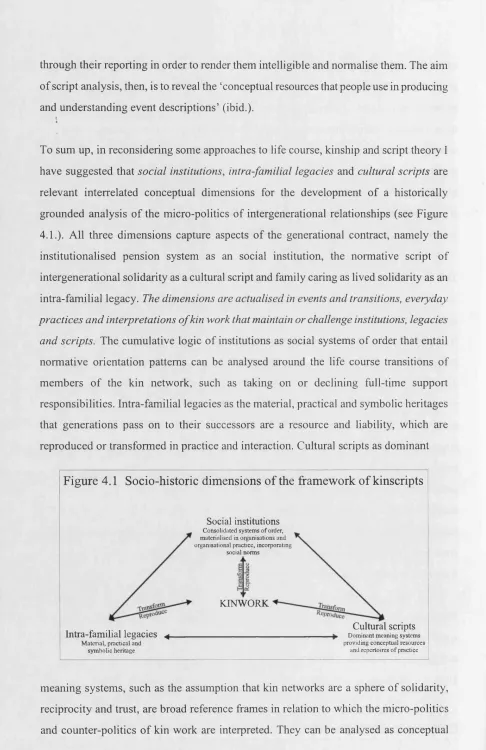
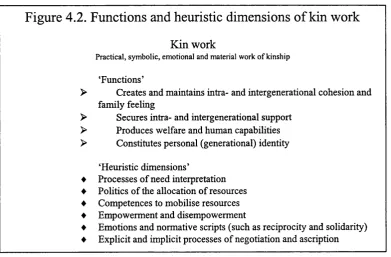
For this reason Chapter 4 develops a novel heuristic framework of kinscripts that
conceptualises the practical, symbolic, emotional and material work of maintaining
intergenerational relations as kin work. It suggests that kin work is a personal and
political activity and has to be analysed in relation to social institutions, cultural scripts
and intergenerational legacies. The framework of kinscripts guides the empirical
investigation of interpretation and orientation patterns of members of two family
generations, whilst held open to the possibility that further conceptual qualification might
emerge from the empirical accounts that inform the theoretical discussion. The design of
the study and a set of innovative methods, their possibilities and constraints are discussed
in Chapter 5. The remaining three chapters present empirical findings on
intergenerational practices and legacies of members of the two generations. Chapter 6
uncovers the significance and social logic of need related households of mothers and
daughters in post-war Germany from the perspective of women bom around 1930.
Chapter 7 analyses the kinscripts and ‘contracts of need’ of this group of women in later
life, particularly support given to their grandchildren and older relatives with its
underlying ambivalence between solidarity and constraint. Chapter 8 finally focuses on
the dealing of the women’s adult children with these intra-familial legacies, their
provision in West Germany.
Theoretically the text analyses are informed by theories that are often subsumed under the
label of post-structuralism. Post-structuralist theories focus on the domain of language
where the meaning of social reality is produced and negotiated, social organisation is
defined and contested and subjectivities are constructed (Weedon 1997). My own
understanding of language and discourse has been informed by reading some of the
works by the French psychoanalyst Jacques Lacan and the French philosopher Michel
Foucault. Although these bodies of thought are embedded in different contexts of
psychoanalysis, philosophy and history, they have certain points of connection in
attending to that which has been excluded from discourse or cannot be said. At the risk of
greatly simplifying their understanding of language I will briefly outline some aspects
that I have found productive in thinking about the representational systems of
generational contracts.
Trained as a psychologist, my first encounter with theories of language has been the
writings of Lacan. In a reinterpretation of the linguistic theories of Ferdinand de Saussure
and Roman Jacobson, Lacan (1966/1977, p. 154) has argued that signifiers are connected
with other signifiers in a ‘signifying chain’. Meaning, according to Lacan, ‘insists’ in the
signifying chain without ‘consisting’ in any one of its elements. At the same time
meaning always exceeds the concrete chain, as different con-texts are associated with
each of the elements. ‘There is in effect no signifying chain that does not have, as if
attached to the punctuation of each of its units, a whole articulation of relevant contexts
suspended ‘vertically’, as it were, from that point’ (ibid.).
Lacan argues that these horizontal and vertical axes of the signifying chain are constituted
by two operations of the signifier: metonymy and metaphor. Metonymy horizontally
constitutes the ‘word-to-word connection’ (Lacan op. cit., p. 156) of the signifying chain.
The fact that meaning is never consistent in the signifier is a consequence of and
presupposition for its continuous connection, the building of ‘communicative bridges’
that intend to fill the gap of a presence of meaning that they constitute. The vertical axis
p. 157). Meaning is produced in the brief moment when one signifier in the chain is
replaced by another (repressed) one. The substituted occulted signifier remains present
through its determined absence and its association with the chain. Through the horizontal
and vertical connections of metonymy and metaphor, contiguity and substitution,
intended meaning is articulated and displaced and subverted.
Without drawing on the psychoanalytic foundations and implications I take these (rather
metaphorical!) considerations to be a plea for a dual analytic focus: ‘horizontally’ the
analysis must specify the contexts in which the concept of the generational contract is
deployed and its connection with other concepts and meaning systems. ‘Vertically’ it has
to attend to the hidden legacies or ‘determined absences’ of the associated implications of
those concepts. At the same time Lacan suggests that any act of reading is an
interpretation through the reader or listener’s production of contexts. The same holds for
social-scientific interpretations, which may open up new layers of meaning, but
inevitably produce new exclusions, which continue to destabilise intended meaning.
Maija Keranen (1993, p. 35) has suggested conceiving social-scientific interpretations not
as ‘revealings’ but as ‘remaskings’.
I was introduced to the works of Michel Foucault during the social-scientific training I
undertook in London. His writings are informative particularly where they attach the
theoretical process of discourse analysis to the theoretical and material conditions of its
production. Foucault rejects the method of hermeneutic interpretation, which he calls
‘commentary’ (Foucault 1963/1973, p. xvi). Although he does not deny ‘that things said
say more than themselves’ (Foucault 1969/1972, p. 110), he holds that statements,
defined as ‘enunciative functions’ composed of sentences, propositions or tables, have a
literal (face value) meaning. This literal meaning can be separated from possible
ambiguities of sentences and utterances. The task of the discourse analyst is not to
interpret but to describe the statements in terms of their constituting specific discursive
formations. Foucault holds that this ‘archaeological’ analysis (Foucault 1972, p. 113) ‘is
concerned, in a sort of vertical dimension, with the conditions of existence of different
groups of signifiers’ (Foucault op. cit., p. 109). Its aim is to reconstruct locally and
Dreyfus and Rabinow (1982, p. 47-9) have argued that Foucault later agreed that face-
value understandings always draw on a taken-for-granted shared background of practices.
In what he calls genealogy attention is given to the effective formation and buttressing of
discourse by non-discursive practices and regimes of power/knowledge. Thus discourses
are not confined to speech acts or texts, but seen as bound up with material conditions
and social practices, which are localised on the body and in material institutions. In
discourse power and knowledge articulate themselves and produce historically specific
effects of truth that have normative and regulatory functions (Foucault 1978). These
discourses offer multiple and changing subject positions, which always are subverted in
what Foucault calls counter discourses.
Even though I think that Foucault unjustly devalued processes of interpretation that are
inevitably involved in reconstructing discursive formations and are necessary to
understand the resonances they can set up, his conception of power/knowledge informed
my considerations of the gendered politics of generational contracts and their effects on
and constitution by specific social actors and institutions. The interrogation of the
gendered politics of the generational contract thus does not presuppose that there is any
one coherent policy shaping contemporary intergenerational relations. Rather the
discursive field of generational contracts is seen as a dominant repertory of interpretation
in relation to which politics and practices are formulated and diverge.
Perhaps the most important aspect of the power/knowledge nexus is that it also pervades
the subject position of the social scientist and her conceptual apparatus (Butler 1997).
Feminist scholars have demanded that the questions ‘who speaks? who writes? when and
where? with or to whom? under what institutional and historic constraints?’ (Clifford
1986, p. 13) have also to be addressed to one’s own project. I suggest that to put this
demand of self-reflexivity into practice, that is, to reflect on precisely how one’s own
biography and positionality as well as the ‘micro-politics of the academy’ (Rabinow
1986), shape one’s reading and writing, is the greatest challenge in contemporary social
science. Some of these issues are addressed in Chapter 5.5. Inevitably reading and writing
will move between the poles of drawing on taken-for-granted background practices,
and authors and, where they do ‘succeed’, calling these into question.
Empirically my interest in enquiring into the gendered politics of generational contracts
was incited by the compelling contradictory narratives of older German women about
their intergenerational commitments, which confronted me with my own blind spots as to
the significance of intergenerational relationships in women’s (and men’s) life courses.
Receiving my sociological training-in-practice I was involved in a research project at the
University of Bremen that investigated the interweaving of paid and unpaid work in the
lives of a group of older women who underwent vocational training in two culturally
contrasting regions in West Germany directly after World War II, and later started a
family (see Appendix A). In the research the qualitative sample was theoretically based
on a larger survey. In order to assist the memory of both interviewers and research
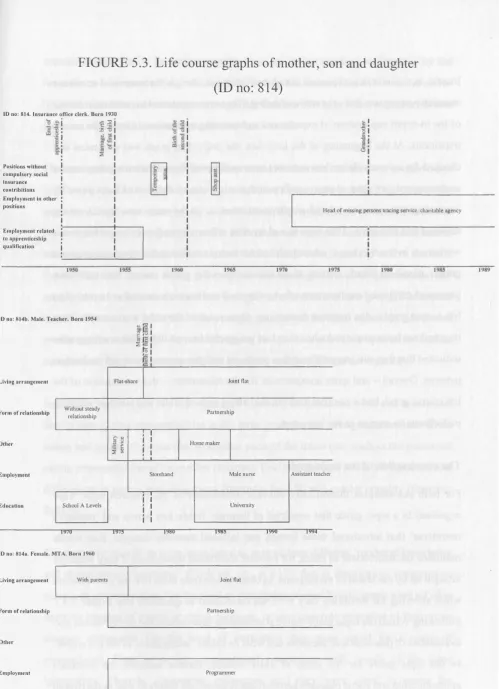
participants the researchers had produced individual ‘life course graphs’ on the basis of
the survey that were presented in the interview. The graphs marked individual periods of
employment and family events over a time span of more than forty years for each
research participant (Chapter 5.4.).
In the light of the women’s narratives it became apparent that the way in which the
researchers had visualised the life courses was useful to illustrate the often-
unacknowledged diverse employment sequences of older women over the life course. On
the other hand the markings of family events such as child birth(s), marriage(s), divorces
and grandmotherhood were only inadequate representations of the constitution and
dissolution of family ties, and they did not differentiate sequences of intra- and
intergenerational family work. Notably the graphs did not take into account the
substantial amount of time that the research participants had spent in supporting older
relatives and grandchildren. The reasons for this ‘de-representation’ first, were grounded
in the fact that we had not conceived these commitments as a normative and expectable
part of older women’s lives. Consequently they had not been addressed in the quantitative
questionnaires. Second, the visualisation of individual life courses made it impossible to
bring out ‘interlocking trajectories’ (Elder 1987, p. 180). Status passages that were
brought about by transition of another family member, such as the giving up of paid work
remained invisible.
However, even more sophisticated visualisations of interdependent life courses cannot
overcome the fact that unlike the labour market, the family and the social institutions
regulating it do not provide modes of ‘institutional stocktaking’ that differentiate and
certify obtained positions on the basis of individual performance (Geissler and Kruger
1992). On an interpretative level the women’s depictions and evaluations of what I then
started to conceive of as ‘the work of kinship’ (Di Leonardo 1987) were intriguing by
their apparent contradictions between the voluntary and compulsory nature of their
commitments, the stated presence and absence of symbolic and material remuneration.
It was only after the research project was officially completed that I came to realise that
what the researchers had ‘forgotten’ in the standardised design of women’s life course
analysis, and what in the social sciences is largely confined to the sub-field of family
sociology and ageing, constitutes a tacit and invisible part of generational contracts.2
With this ‘new’ discursive horizon I proceeded to reanalyse the women’s narratives on
intergenerational commitments and locate them in the context of family histories and the
broader socio-historical context. What was the stuff that the women’s intergenerational
obligations were made of? Would they change in the contemporary condition with its
emphasis on partnership and rights and an alleged shift from the ascription of
intergenerational responsibilities to negotiation and choice (Riley and Riley 1993)? Intra-
familial (caring) traditions as well as the practice of intergenerational commitments
became therefore the explicit focus of selecting and interviewing a group of the women’s
adult children in order to explore continuity and change in intergenerational practices. At
the same time the research participants’ narratives provoked a journey into western
repertoires of contract and generation, of freedom and obligation, duties and rights I had
known little about and which cast the narratives into a new light. I hope the reader will
enjoy this passage.
Chapter 1
REPERTOIRES AND LEGACIES OF ‘CONTRACT’
AND ‘GENERATION’
1.1. INTRODUCTION
I will begin the analysis of the generational contract by inquiring into the history of its
constitutive components, the notions of contract and generation. When and how were
these concepts applied and defined? What mechanisms of cohesion do the two concepts
imply or constitute? How were they marked and constituted by gender differences? The
underlying assumption of these questions is that concepts are produced in specific
historical and institutional discursive formations, emerge within modalities of power and
are a product of a marking of difference and exclusion, which are often signified by
gender difference (Scott 1988). Concepts are key repositories of cultural values and
meanings and can mobilize powerful feelings and emotions (Hall 1997b). They are a site
of contention, negotiation and strategic reuse by social actors.
The attempt to outline and contextualise some of the western repertoires and ‘folk myths’
of contract and generation, then, is not an attempt to rediscover the origins of those terms
but to unfold some of their discursive contexts, which may be evoked or obliterated in
their current usage. At the same time this contextualisation and the delineation of
dominant frames, particularly with reference to the patriarchal family as a site in which
contract and generation acquired meaning-in-practice, provides the grounds for a further
interrogation of the ways in which those concepts were combined in social contract
The source material for this exploration is not ‘primary’ legal or medical documents but
their descriptions and interpretations by philosophers, anthropologists and sociologists.
The problem ‘that we cannot get to the peasant except through the lord’ as the social
historian Sabean (1984a, p. 3) has put it with reference to the mediation of early modem
peasants’ testimonies by court officials and authorities, needs to be acknowledged. But it
should not be taken to suggest that any unmediated access to historical sources is
possible. Analysts have to bear in mind that a reading of texts is always a re
interpretation and construction that ‘passes’ through the commentator. Furthermore, legal
texts, for example, were always subject to continuous reformulation and commentary. In
any case, the emphasis in the following chapter is on the repertories of contract and
generation, not on questions such as whether ancient contracts ‘really’ followed the
procedures described.
For the contextualisation of contract, I will first look at the dominant ‘paradigm’ of the
commercial exchange contract, that is, the perception of a binding agreement secured by
law. I will then focus on how self-interested ‘purposive’ contracts have been defined
against so-called status contracts and what the gender implications have been. Status
contracts are said to constitute the ties of kinship and political associations and to change
the ‘universal position’ of an individual. The exploration of discursive contexts of the
notion of generation, usually understood as a position in a family lineage or membership
in age-based historical groups, goes in the opposite direction. Starting from its etymology
I will look at interpretations of generation in ancient biological texts and then look at the
legalization and ‘enactment’ of generational positions. The practical and symbolic role of
families in constructing their genealogies and cohesion will be further developed in
Chapter 4.
1.2. REPERTOIRES OF INTERPERSONAL CONTRACTS
The triumph of modern contract doctrine
In her ethnography of a community of Bedouins in the Western Desert of Egypt Lila
in contradistinction to the dominant Egyptians. According to the Bedouins the Egyptians’
lack of honour is shown in their use of contracts in transactions whereas for a Bedouin a
person’s word is sufficient. I will take this simple statement as a point of entry to ask why
in Western society the principle of contract, contrary to the view of the Bedouins, became
the embodiment of moral conduct and justice.
Although the British legal theorist Patrick Atiyah (1990b, p. 18) has argued convincingly
that from a juridical viewpoint ‘there is no such thing as a typical contract’ or even ‘one
central paradigmatic type of [contractual] conduct’ (1990a, p. 5), contract still is
associated with the paradigm of the commercial exchange contract. Its underlying idea of
an agreement (in the form of promise) between two or more parties that becomes legally
binding through the congruent expression of will came to (new) prominence in 19th
century political and economical liberalism with an increasing market orientation of
western societies. Created at least by an implicit expression of intentions, a contract
brings into existence and specifies duties and rights, or changes in existing ones.
The specific mark of contract is the creation of a right, not to a thing, but to another man’s conduct in the future. He who has given the promise is bound to him who accepts it, not merely because he had or expressed a certain intention, but because he so expressed himself as to entitle the other party to rely on his acting in a certain way.
(Winfield 1876/1950, p. 1)
The use of the male gender in this account is more then a grammatical convention.
Although there always have been exceptions and periods of relaxation, women in western
societies were by and large excluded from these kinds of binding agreement that secured
personal reliance on agreed transactions and were necessary to make the market system
work. Until 1935 English Common Law ruled that ‘a married woman has no power of
contracting. Any agreement she purports to make “is altogether void, and no action will
lie against her husband or herself for the breach of it’” (Winfield op. cit., p. 66). Similarly
the German Munt system for centuries legalised the conjugal ‘protection’ of the
‘unworldly legally incompetent’ married woman for her own good (Oekinghaus 1925, p.
38). Residuals of this gender tutelage were incorporated in the German Civil Code at the
The primary function of contract law was to encourage male citizens to comply with their
agreements. In the heyday of 19th century political and economic liberalism the historian
C.G. Addison (1847/1856, p. v), referring to his finding of a ‘surprising uniformity’ of
contract law, suggested triumphantly that
the law of contracts may justly indeed be said to be a universal law adapted to all times and races, and all places and circumstances, being founded upon those great and fundamental principles of right and wrong which are immutable and eternal.
(C.G. Addison op. cit., p. v)
Formulations such as these not only express the success of contract doctrine but also the
naturalness of the fundamental exclusion of women (and non-property owning men) from
contractual practice. This exclusion was tacitly understood to operate in ‘all places and
circumstances’ and was seen as perfectly compatible with principles of justice.
Ideologically, contractual obligation was considered superior to all other forms of
obligation because of the manner of its generation: the contracting parties did not merely
follow norms, conventions or laws but they were considered ‘to make the law which
governs their relationship’ (Downes 1993, p. 48, emphasis added). The possibility of this
(self-) law-giving quality rests on conceptions that individuals have a ‘free will’, that is
they have the moral and psychological autonomy necessary to make choices but also a
propensity to comply with their own laws, to be bound by their own will. Individuals can
give and keep promises. According to Charles Fried (1981, p. 1) contracts are based on
the promise principle ‘by which persons impose on themselves obligations where none
existed before’. ‘By promising’ he writes, ‘we transform a choice that was morally
neutral into one that is morally compelled’ (Fried op. cit., p. 8). Promises are conceived
as a ‘shared social institution that is intended to invoke the bonds of trust’ (Fried op. cit.,
p. 16). Atiyah (1990a) has suggested that a reference to the promise principle is therefore
a reference to another concept imbued with our moral and social ideas.
Even though the concept of contract thus relies on and makes use of a moral institution
(promising), in its more appealing form, it relies on the assumption of a ‘neutral choice’
situation (see Chapter 2). Contracts are generally seen as valid only if they are made
expected to enter into contractual agreements that make them worse off than they would
be without contractual cooperation. Thus the assumption of freedom and choice is the
condition sine qua non of contract, which gives obligation created by contract its superior
status. However, as Fried (op. cit., p. 5) points out, ‘if, as we must, we insist that there be
a fair choice to promise or not, we have imported external standards of fairness into the
very heart of obligation’.
The foundations of theories of the will have been elaborated by classical contract
theorists. Yet, if we look at the work of the founder of modem political theory, Thomas
Hobbes, there is much less emphasis on choice than the dominant paradigm of contract
theory suggests. In accordance with the foregoing discussion Hobbes defined contract as
‘ [t]he mutuall transferring of Right’ (1651/1997, p. 94), which results from freely willed
deliberation: ‘To convenant, is an act of the Will; that is to say an act, and the last act, of
deliberation’ (Hobbes op. cit., p. 97). Contracts usually rely on the ‘Keeping of promise’
‘being trusted’ (Hobbes op. cit., p. 94) and being motivated by self-interest. Transferring
a right ‘is either in consideration of some Right reciprocally transferred to himselfe; or
for some other good he hopeth for thereby. For it is a voluntary act: and of the voluntary
acts of every man, the object is some Good to himselfe’. To be ultimately binding
contractual performance has to be guaranteed by law for ‘the bonds of words are too
weak to bridle men’s ambition, avarice, anger, and other Passions, without the feare of
some coercive Power’ (ibid.). This of course is the argument of the social contract
(Chapter 2).
Importantly, the assumption that voluntary acts are based on self-interest is also taken to
mean that self-interested action (in the form of promise) in a coerced situation is
voluntary and contractually binding. Hobbes did not seem to be opposed to the idea that
for the overall purpose of keeping peace, contracts can be valid even if they are made
under force. ‘Because preservation of life being the end, for which one man becomes
subject to another, every man is supposed to promise obedience, to him, in whose power
it is to save, or destroy him’ (Hobbes op. cit., p. 140).3
As Carole Pateman (1988) has shown, questions of what may still count as a voluntary
entry into a contract and what kinds of agreements contract can legitimise (prostitution,
slavery etc.), are subject to continuing debate. Yet the conception of contract remained
enormously influential and productive because it assumed and created the autonomous
male individual as a rational self-interested agent. The freedom to contract appeared to
exemplify this individual freedom and autonomy.
Historically the unrestricted freedom of contract remained more an economic ideal than a
rule of law even in the 19th century. Only in the aftermath of the French Revolution was
the right to contract in Germany extended to all male individuals. In the Prussian General
State Law (Allgemeines Preuftisches Landrecht, APL) of 1791/94 that was in many ways
the precursor of the German Civil Code, parents and children were defined as a ‘house
community’, a term that was underpinned by the contract principle, even though married
women and children remained under tutelage. By stating that a person could not sell his
person, but only sell his time and labour, servants were transformed into legal subjects
who entered contracts with their former lords whilst their rights of self-determination
were de facto limited (Koselleck 1981).
So we see, by drawing on the moral principle of promise and fidelity to one’s word to
which the Bedouins referred, assumptions of freedom and individual sovereignty were
incorporated in, and at the same time seen as manifested in contractual practices.
Associated with the commercial exchange contract, the concept of contract remained
neutral and non-ethical with respect to morality and gender symbolism. Moreover, under
the assumption of free choice, contract brought obligations into existence.
The counter-model of status contracts
Even though quasi-feudal relationships, as Koselleck (1981) has argued, largely remained
in practice in the 19th century, the discourse of contract in a historical perspective was
defined against the idea of personal submission in feudal status relations. In Sir Henry
Maine’s famous phrase, relations based on contract mark the progressive pole in the
development ‘from Status to Contract’ (Maine 1861/1917, p. 100). In the order of status,
Maine held, rights and duties were determined by a person’s position in the patriarchal
family, characterised by absolute jurisdiction of the head of household over persons and
property. According to Maine ‘the tie between man and man which replaces by degrees
those forms of reciprocity in rights and duties... is Contract’ (Maine op. cit., p. 99). Max
Weber (1922/1978, p. 671) has argued that the ‘reciprocity in rights and duties’ in the
feudal order of status, too, ‘was in its innermost essence based upon contract, and the
expression “pactus” was applied with all seriousness’ to a range of statutory
codifications. In his Sociology o f Law Weber held that family relations just as political
associations were constituted by ‘status contracts’ (Weber op. cit., p. 672).
Status contracts would have to work within the legal institution of Munt analysed by one
of Weber’s students, the sociologist Emma Oekinghaus (1925). Etymologically the Old
High German expression Munt (shield) corresponds to the Latin manus (hand), which
Heusler (1885 as quoted in Oekinghaus 1925, p. 4) interpreted as the absolute power of
the head of household, the manus potestativa. In Roman law the term familia designated
everybody subjected to the patria potestas, the authority of the head of household,
including servants and farmhands. As Herlihy (1985, p. 2) notes the pater familias
thereby was excluded from the family, as he was not subject to his own authority.
According to old Germanic law Munt guaranteed the Hausvater (pater familias) power
and authority over free persons and serfs, humans and animals as jus in rem (law relating
to things) (Gerlach 1996). Only men could obtain ‘Selbstmunf, the right to fend for
themselves and regulate relations with other heads of households, which is related to the
right to carry a weapon, acquire property in land and to represent oneself in court.
From the 8th century onwards Munt regulated only power over family members and
servants who became legal subjects. Their legal capacities, however, remained at the
discretion of the Hausvater who legally represented those ‘commanded by M unf
(Muntbefohlene). In the 13th century Munt was further transformed from the power of the