Fixed Parameters Simulation Comparison of the Generic
Category Ad-hoc Protocols
Neha Arora
Electronics & Communication Engineering, Rayat Institute of Engineering and Information Technology, Railmajra PunjabVishal Walia
Electronics & Communication Engineering, Rayat Institute of Engineering and Information Technology, Railmajra Punjab
Sandip Vijay
Electronics & Communication Engineering, Dehradun Institute of
Technology, Dehradun
ABSTRACT
An ad hoc network has certain characteristics, which imposes new demands on the generic routing protocol. The most important characteristic is dynamic network topology, which is consequence of node mobility. Nodes can change position quite frequently, which means we need a routing protocol that quickly adapts to topology changes. Many Routing protocols have been developed for accomplishing this task. In this thesis we have simulated, analyzed and compared three homologous ad-hoc routing protocols DSDV, DYMO and ZRP at fixed scenarios. We have used Qualnet version 5.0.2 Simulator for the simulation of these routing protocols and compared them for throughput, average end to end delay, Average jitter, Mobility, Number of broadcast and query packets transmitted and received.
General Terms
Ad-hoc Networks, Routing Protocol.
Keywords
MANET, DSDV, DYMO and ZRP.
1.
INTRODUCTION
Mobile ad hoc networks are defined as category of wireless networks that are self organizing, self configuring and are able to detect the radio frequency for their dynamic operation without the support of any fixed infrastructure. A large variety of applications utilizing ad hoc networks will demand features such as real-time, high-availability, and even instantaneous high-bandwidth in some cases. For example, disaster positioning for real-time data transmission of mobile users, teleconferencing in which part of or all of the participants are mobile users in different wireless access networks, distributed games for mobile users, and large amount of multimedia data for the transmission of live video. This paper is organized as follows: After introduction in section 1, the problem statement for using generic DSDV, DYMO and ZRP ad hoc routing protocols is given in section 2, a brief overview of DSDV, DYMO & ZRP ad hoc routing protocols is given in section 3. Section 4 provides the details of the simulation environment & methodology used in analysis of the three routing protocols. Section 5 elucidates the various performance metrics used for carrying out the comparative analysis of the routing protocols. Results & discussion are presented in section 6 and finally the important conclusions drawn are summarized in section 7.
1.1
PROBLEM
STATEMENT
In ad hoc networks, the routing and the resource management are done in a distributed manner in which all the nodes coordinate to enable communication among themselves. The
issue of routing in a mobile ad hoc network becomes the challenging task as there is highly dynamic topology i.e. nodes are free to move and also the absence of any central coordinator or base station makes the routing a complex task and is in the need of a solution that not only works well with a small network, but also sustains efficiency and scalability as the network gets expanded and the application data gets transmitted faithfully and in larger volume. Since this work is related to simulation and performance evaluation of the homologous routing protocols and theoretical comparison of these protocols has been done in many books and in many research articles, but still nothing can be said sure about actual nature of working of these protocols. How these protocols behave under actual working conditions, which protocol will behave best in which condition and which fails under certain conditions, such issues remain undercover until and unless they are tested and verified. Different kind of metrics or characteristics may be used to analyze the performance of an ad hoc network. Different kind of approaches and methodology has also been used. Simulations are commonly utilized especially when analyzing the performance of a specific routing protocol. Analytical models have also been developed for use especially in analysis considering a specific performance issue of ad hoc networks in general.
1.1
ROUTING
PROTOCOLS
FOR
MANETS
DSDV Routing Algorithm
number which is always greater than the previous one. Upon receiving an updated table a node either updates its tables based on the received or holds it for some time to select the best metric received from multiple versions of the same information update from different neighbors. The availability of routes to all destinations at all times implies that much less delay is involved in the route setup process. The mechanism of incremental updates with sequence number tags makes the exiting wired network protocols adaptable to mobile ad hoc networks. Hence, an existing wired network protocol can be applied to mobile ad hoc networks with fewer modifications. DSDV suffers from excessive control overhead that is proportional to the number of nodes in the network and therefore is not scalable in mobile ad hoc networks. Another disadvantage is stale routing information at nodes.
1.2
Dynamic
MANET
On-Demand
Routing (DYMO)
The DYMO routing protocol is a recently proposed protocol currently defined in an IETF Internet-Draft and is thus, work in progress. It is currently in its sixth version. DYMO belongs to the category of MANET routing protocols called on-demand or reactive routing protocols. An on-on-demand protocol only tries to discover a route to a destination, when it is actually needed by an application. DYMO is a successor of the AODV routing protocol and is the current engineering focus for reactive routing in the IETF MANET working group. It operates similarly to AODV; DYMO does not add extra features or extend the AODV protocol, but rather simplifies it, while retaining the basic mode of operation. DYMO consists of two protocol operations: route discovery and route maintenance. Routes are discovered on-demand when a node needs to send a packet to a destination currently not in its routing table. A route request message is flooded in the network using broadcast and if the packet reaches its destination, a reply message is sent back containing the discovered, accumulated path. Each node maintains a routing table with information about nodes. Route discovery is the process of creating a route to a destination when a node needs a route to it. When a node S wishes to communicate with a node T, it initiates a Route Request (RREQ) message. The RREQ message and the Route Reply (RREP) message are collectively known as Routing Messages (RM) because they are used to distribute routing information. The sequence number maintained by the node is incremented before it is added to the RREQ. During route discovery; the originating node initiates dissemination of a route request (RREQ) throughout the network to find the target node. During this dissemination process, each intermediate node records a route to the originating node. When the target node receives the RREQ, it responds with a route reply (RREP) unicast toward the originating node. Each node that receives the RREP records a route to the target node, and then the RREP is unicast toward the originating node. When the originating node receives the RREP, routes have then been established between the originating node and the target node in both directions.
In order to react to changes in the network topology nodes maintain their routes and monitor their links. When a data packet is received for a route or link that is no longer available the source of packet is notified. A route Error (RERR) is sent to the packet source to indicate the current route is broken. Once the source receives the RERR, it can perform route discovery if it still has packets to deliver. DYMO uses sequence numbers as they have been proven to ensure loop freedom. Sequence numbers enable nodes to determine the
order of DYMO route discovery messages, thereby avoiding use of stale routing information.
1.3 Zone Routing Protocol (ZRP)
In a mobile ad-hoc network, it can be assumed that most of the communication takes place between nodes close to each other. The Zone Routing Protocol (ZRP) takes advantage of this fact and divides the entire network into overlapping zones of variable size. It uses proactive protocols for finding zone neighbors (instantly sending hello messages) as well as reactive protocols for routing purposes between different zones (a route is only established if needed). Each node may define its own zone size, whereby the zone size is defined as number of hops to the zone perimeter. For instance, the zone size may depend on signal strength, available power, reliability of different nodes etc. While ZRP is not a very distinct protocol, it provides a framework for other protocols. First of all, a node needs to discover its neighborhood in order to be able to build a zone and determine the perimeter nodes. The detection process is usually accomplished by using the Neighbor discovery protocol (NDP). Every node periodically sends some hello messages to its neighbors. If it receives an answer, a point-to-point connection to this node exists. Nodes may be selected by different criteria, be it signals strength, radio frequency, delay etc. The discovery messages are repeated from time to time to keep the map of the neighbors updated. The routing processes inside a zone are performed by the Intrazone Routing Protocol (IARP).This protocol is responsible for determining the routes to the peripheral nodes of a zone. It is generally a proactive protocol. Another type of protocol is used for the communication between different zones. It is called Interzone Routing Protocol (IERP) and is only responsible for routing between peripheral zones. A third protocol, the Bordercast Resolution Protocol (BRP) is used to optimize the routing process between perimeter nodes.
1.4
SIMULATION
ENVIRONMENT
The results reported in this paper are based on the study conducted on the basis of simulation tool Qualnet (version 5.0.2), that is a discrete event driven network simulator developed by scalable networks Such a simulator is based on an event scheduler, which contains any event that needs to be processed and stepped trough. The simulation time is increased in discrete steps to the time of the actual event whenever an event occurs. Every protocol starts with an initialization function, which reads external input and configures the protocol. The handling then is passed over to an event dispatcher. When an event for that layer occurs, QualNet Simulator first determines the event’s protocol and hands it to the dispatcher for that protocol. The event dispatcher now checks for the type of event and calls the appropriate event handler to process it. Finally, at the end of the simulation, a finalization function is called for every protocol, to print out the collected statistics.
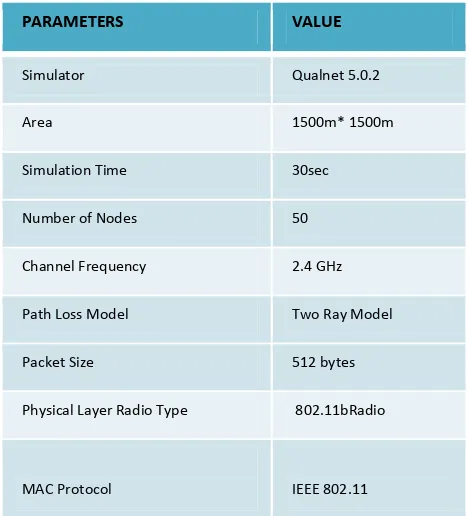
[image:2.595.51.572.79.758.2]Table 1. Simulation Parameters and Values
2.
PERFORMANCE
METRICS
2.1. End- to-End delay
This implies the delay a packet suffers between leaving the sender application and arriving at the receiver application. In Delay we are considering average end to end delay. This includes all possible delays caused by buffering during route discovery latency, queuing at the interface queue, retransmission delays at the MAC, and propagation and transfer times.
2.2. Average Jitter
It is the variation in time between packets caused by network congestion or route changes. It should be less for a routing protocol to perform better.
2.3. Throughput
It is the number of received packets per TIL (Time Interval Length). It is the measure of how soon an end user is able to receive data.
2.4.
Number of Broadcast and Query packets
Transmitted and Received
This metric considers which protocol is best suited for broadcast communication. Network wide broadcasting in mobile ad hoc networks provides important control and route functionality for a number of unicast and multicast protocols. The number of Query Packets accounts the number of control packets (RTS, CTS and ACK) transmitted by MAC layer.
2.5.
Number of Packets Dropped for No Route
It is the number of packets dropped for a route that is no longer available.
3.
RESULTS
&
DISCUSSION
3.1.
End to End Delay
[image:3.595.317.554.225.353.2]This parameter comprises all kind of delay i.e. delay that occurs when the packet is stored in a buffer before the node transmits it to other node, transmission delay etc. Figure 1 shows the results for average end-to-end delay for the three protocols DSDV, DYMO and ZRP.It is evident that delay is worst in case of DYMO, but it is comparatively less in DSDV as it is expected in proactive protocol due to availability of routes to all destinations at all time where as ZRP performs well as far as Delay is concerned.
Figure 1. Average End To End Delay
3.2
. Average Jitter
It is the variation in time between packets caused by network congestion or route changes. It should be less for a routing protocol to perform better. In Figure 2, it is observed that there is least jitter in case of ZRP, DSDV also performs fairy well as far as Jitter is concerned. There is high value of Jitter in DYMO.
Figure 2. Average Jitter
3.3 Throughput
It is the number of received packets per TIL (Time Interval Length). It is the measure of how soon an end user is able to receive data.
3.3.1. CBR Client Throughput
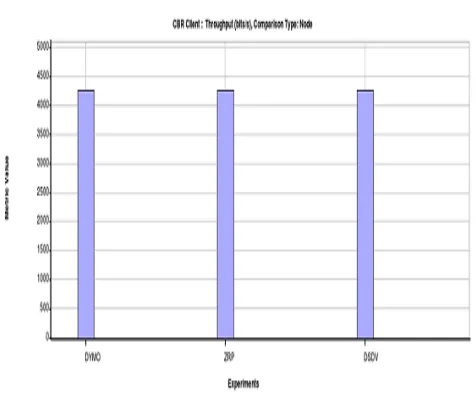
It was investigated from Figure 3, that the throughput of generated packets remains constant for the fixed number of CBR applications which is applied over four different source and destination nodes in three different protocols.
PARAMETERS VALUE
Simulator Qualnet 5.0.2
Area 1500m* 1500m
Simulation Time 30sec
Number of Nodes 50
Channel Frequency 2.4 GHz
Path Loss Model Two Ray Model
Packet Size 512 bytes
Physical Layer Radio Type 802.11bRadio
[image:3.595.318.557.458.629.2].
Figure 3. Throughput at CBR Client
3.3.2. CBR Server Throughput
[image:4.595.53.291.82.279.2]Figure 5 shows that the throughput of received packets doesn’t remain constant and even drops to more than 50% of its value in normal conditions in case of DSDV and ZRP. The best throughput is achieved in case of DYMO.
Figure 4. Throughput at CBR Server
3.4. Number of Broadcast and Query packets Transmitted and Received
This metric considers which protocol is best suited for unicast and broadcast communication. Network wide broadcasting in mobile ad hoc networks provides important control and route functionality for a number of unicast and multicast protocols.
Figure 5. Number of Broadcast packet sent
[image:4.595.319.566.270.398.2]
Figure 6. Number of Broadcast Packets Received
[image:4.595.56.289.383.554.2]It is observed from Figure 5 and Figure 6, that there is maximum broadcast packets received in case of ZRP according to the transmitting packets which provide important control and route establishment functionality, it is least in case of DYMO.
[image:4.595.320.552.489.643.2]Figure 8. Number of Query Packets Received
It is observed from the Figure 7. And Figure 8, ZRP reduces the control overhead compared to the route request, flooding mechanism used in DYMO and DSDV respectively. The query control must ensure that the redundant route request are not forwarded which is absent in DSDV and DYMO protocols.
3.5. Number of packets dropped for no route
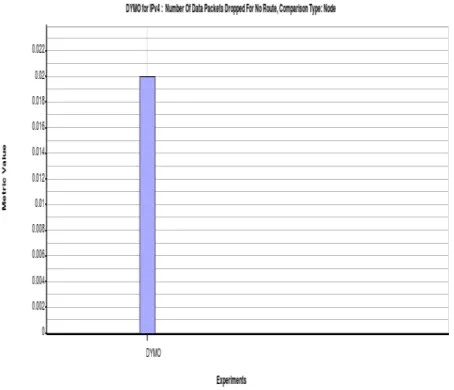
The number of packets dropped when the route is no longer available, is maximum in DYMO and it is negligible in case of DSDV and ZRP.
Figure9. Number of Packets dropped for no route
4.
CONCLUSIONS
In this review paper we provide an overview of the three homologous routing schemes DSDV, DYMO and ZRP proposed for ad hoc mobile networks. Also, Analysis of these three categories of routing protocols is provided, highlighting their features, differences, and characteristics using Qualnet 5.0.2. The performance depends on the fixed number of nodes and at fixed parameters. The performance is observed on the basis of End-To-End Delay, Average Jitter, Throughput,
Number of Broadcast and Query packets sent and received and number of packets dropped for no route using QualNet 5.0.2 simulator on Windows platform. While it is not clear that any particular algorithm or class of algorithm is the best for all scenarios, each protocol has definite advantages and disadvantages and is well suited for certain situations. The field of ad hoc mobile networks is rapidly growing while there are still many challenges need more attention of researchers, it is likely that such networks will see widespread use within the next few years.
ACKNOWLEDGEMENTS
I would like to thanks my guide who supported me in learning and explaining the Qualnet functionality and who has guided me to do this work successful. On a personal note, I would also like to thanks God, parents and friends for their support.
2.
REFERENCES
[1] C.C. Chiang, H. K. Wu, W. Liu, and M. Gerla, “Routing in Clustered Multihop, Mobile Wireless Networks with Fading Channel," Proceedings of IEEE SICON'97, pp. 197-211, April 1997.
[2] R. Dube, C. D. Rais, K.Y. Wang, and S.K. Tripathi, “Signal Stability based Adaptive Routing AD-Hoc Mobile Networks," IEEE Personal Communications, pp. 36-45, February1997.
[3] D. B. Johnson and D. A. Maltz, “Dynamic Source Routing in Ad-Hoc Wireless Networks,"Mobile Computing, ed. T. Imielinski and H. Korth, pp. 153-181, 1996.
[4] Narendra Singh Yadav, R.P.Yadav, “Performance Comparison and Analysis of Table-Driven and On-Demand Routing Protocols for Mobile Ad-hoc Networks”International Journal of Information Technology, pp.110- 118,2008.
[5] Md. Anisur Rahman, Md. Shohidul Islam, Alex Talevski, Performance Measurement of Various Routing Protocols in Ad-hoc Network” Proceedings of the International Multi Conference of Engineers and Computer Scientis, pp 978-988, march2009.
[6] C.E. Perkins and P. Bhagwat, “ Highly dynamic destination-sequenced distance-vector routing (DSDV) for mobile computers,” in ACM SIGCOMM’94, 1994, pp. 234-244.
[7] Khushboo Tripathi, Tulika Agarwal and S. D.Dixit, “Performance of DSDV Protocol over Sensor Networks” International Journal of Next Generation Networks (IJNGN) Vol.2, No.2, pp.53- 59,June 2010.