NEW COMPUTATION TECHNIQUE FOR ENCRYPTION AND
DECRYPTION BASED ON RSA AND ELGAMAL
CRYPTOSYSTEMS
ZULKARNAIN MD ALI1 AND JASSIM MOHAMMED AHMED2 School of Computer Science, Faculty of Information Science and Technology,
University Kebangsan Malaysia, 43600 Bangi, Selangor Darul Ehsan, Malaysia
Email: [email protected], [email protected]
Received September 2012
ABSTRACT
Cryptography addresses the necessary elements for secure communication that involved privacy, confidtiality, key exchange, authentication, and non-repudiation. This paper proposed a new computation of en-cryption and deen-cryption that was based on the computation of RSA and ElGamal Cryptosystems. The RSA is a public key encryption system that gets its security from the difficulty of factoring large numbers. Meanwhile, the security of ElGamal is depends upon the difficulty of a certain problem that was related to compute Discrete Logarithms. The proposed technique shows better computation time compared to both cryptosystems. All computation time for each algorithm also presented at the end of this paper. However, this paper did not present the security of the technique over the RSA and ElGamal.
Keywords: RSA, ElGamal, Encryption and Decryption
1.INTRODUCTION
Communication is the activity of conveying meaningful information. The communication pro-cess is complete once the receiver has understood the message of the sender. In today’s communica-tion, the security issues always been the top prior-ity. Cryptography is the most common necessary elements for secure communication based on pri-vacy, confidentiality, key exchange, authentica-tion, and non-repudiation but reveals the fact that communication is happening [7]. This paper in-troduces a new computation technique that satis-fies the security requirement for sending the con-fidential message.
The RSA cryptosystem is depend on the Integer Factorization Problem (IFP). The integer factoriza-tions or prime factorization is the decomposition of a composite number into smaller non-trivial divi-sors, which when multiplied together equals the original integer. The security of RSA is depends on the difficulty of the process of factorization. The prime factors must be kept secret. Anyone can use the public key to encrypt a message, but with currently published methods, if the public key is
large enough, only someone with knowledge of the prime factors can feasibly decode the message [5][9].
On the other hand, the ElGamal cryptosystem de-pend on Discrete Logarithm Problem (DLP). The security of the ElGamal scheme depends on the properties of the underlying group G as well as any padding scheme used on the messages [10]. The ElGamal encryption is unconditionally malleable, and therefore is not secure under chosen cipher text attack.
This paper manipulates both cryptosystems com-putation. A big size of keys is needed to give high level of security of these systems [1]. Using a large key size causes the system requires extensive and continuous computation and high processing capa-bilities. The larger the size the more difficult of encryption and decryption processes [4]. There-fore, this paper aims to use some of the properties in the RSA and ElGamal to produce a better tech-nique in terms of computation efficiency. In order to show the efficiency of the proposed scheme, the comparison of computation time between these three algorithms is included. Furthermore, the mathematical proof needed to show the similarities and differences between the new technique and the existing techniques.
2.REVIEW ON RSA AND ELGAMAL
CRYPTOSYSTEMS
The art of hiding messages in unreadable secret codes is called as cryptography. This technique concentrates on preventing messages from being reproduced, stolen and damaged [2]. The cryptosystem is pair of algorithms that take a key and convert plaintext to ciphertext and back. Both RSA and ElGamal cryptosystems are the most popular asymmetric cryptosystems, but it needs a relatively long time in the process of encryption and decryption.
2.1.RSA Cryptosystems
Rivest, Shamir and Adleman have introduced the RSA cryptosystem in 1978. It was first publicly known as a public-key cryptosystem. A detail dis-cussion on this cryptosystem can also be found in [5].
For the past 3 decades, the RSA has become the most common standard of encryption in the com-puter world. In fact, the RSA is now the most pub-lic-key system in wide use. The reason behind this is that the RSA now used in many web browsers such as Netscape to E-mail encryption programs, in another word RSA is now everywhere [6][8].
The RSA algorithm can be described as follows:
i. Key generation:
a. Choose two distinct prime numbers p and q.
b. Compute n = pq.
c. Compute φ(n) = (p – 1)(q – 1), where φ is Euler's totient function.
d. Choose an integer e such that 1 < e < φ(n)
and gcd(e,φ(n)) = 1, i.e. e and φ(n) are coprime.
e. Determine d = e–1 mod φ(n); i.e. d is the multiplicative inverse of e mod φ(n). ii. Encryption:
The sender computes C=Me mod n. A C is the encrypted messages.
iii. Decryption:
The receiver uses her private key to compute M = Cd mod n, where M is the original mes-sage [5] .
2.2.ElGamal Cryptosystems.
Meanwhile, the ElGamal Cryptosystem is a very successful implementation of Diffie-Hellman al-gorithm [9]. Taher ElGamal in 1985 proposed El-Gamel cryptosystem algorithm in a type of public-key cryptosystem algorithm which is used over finite fields and its security is based on the Discrete Logarithm Problem (DLP) [9]. The rea-son behind using DLP is due to the difficulty of finding discrete logarithm while the inverse opera-tion of exponentiaopera-tion can be compute in a straight-forward fashion.
The ElGamal public key system uses modular ex-ponentiation as the bases of a one way trap door function [11]. This is making ElGamal an attrac-tive alternaattrac-tive to the more well known RSA sys-tem. The ElGamal algorithm can be described as follows:
i. Key Generation:
a. Choose a random prime .
b. Compute a random multiplicative gener-ator element g of .
c. Choose a random number as the private key.
d. Compute the public key by
.
e. Make public, and keep as private key.
ii. Encryption:
The sender picks at random and computes a cipher text pair (c1,c2):
and
iii.Decryption:
To decrypt cipher text , the receiver
3.PROPOSED COMPUTATION TECH-NIQUE.
The proposed computation techniques merge the RSA and ElGamal computations. This computation technique makes use of some properties of RSA and ElGamal. As a result, this computation technique provides better and efficient computation time.
3.1 Initialization
i. Alice and Bob publicly choose prime q a fi-nite field Fq. They publicly choose a random base element g ∈ Fq.
ii. The receiver chooses two large prime num-bers P and Q. Compute n=P*Q. Publicly choose a random base.
iii. The key generation of the proposed method is as follows:
Step 1: Choose 1<e<∅(n), ∅(n)=(P-1)*(Q-1), with gcd (e,(P-1)* (Q-1))=1.
Step 2: Compute d=e–1mod (P-1)*(Q-1) Step 3: Make n, g, q and e public and
keep private key d secrets.
3.2 Encryption
i. The senders sends the message M to Bob where the message M as an integer element, M<q.
ii. Steps involved to convert plaintext to cipher text:
Step 1: Select random integer a such that 1<a<q
Step 2: Compute k= ga mod q. Step 3: Compute CM=M*k mod q and
also Ca= ae mod n Step 4: Transmit pair of ciphertext
(CM,Ca).
3.3 Decryption
The receiver does the following computations: Step 1: Compute a = cad mod n. Step 2: Compute k =ga mod q. Step 3: Compute k-1 =g– a mod q. Step 4: Compute M = CM * k-1 mod q.
Proof: Initialization:
a. n=P*Q
b. Choose e, where 1<e<∅(n), ∅(n)=(P-1)*(Q-1), with gcd(e,(P-1)* (Q-1))=1.
c. Compute: d= e–1 mod (P -1)*(Q -1) where n, g, q and e public and keep private key d secret.
Encryption a. M < q
b. k = ga (mod q)
c. C=M*k mod n =M*ga =M*ga mod n
Decryption
a. M = C*k-1 mod n b. k-1 = g– a (mod n)
c. k-1 = g-a (mod n) = C*g-a (mod n)
Therefore,
M = C*g-a mod n
= [M * (g a)] * (g –a) mod n = M * (g a) *( g a) -1 mod n = M.
■
4.EXAMPLE OF COMPUTATION
TECH-NIQUES FOR EACH ALGORITHM
4.1 Example For RSA. i. Initialization:
• Bob choose two large prime num-bers: P = 997 and Q=1171.
• N=P*Q
ii. Key generation:
• Bob compute n = P*Q = P*Q = 997*1171 = 1167487.
• Choose e, where 1 < e < ∅(n), with
∅(n)=(P-1)(Q-1) and
gcd(e,(P-1)(Q-1))=1
• Then, ∅(n) = (P-1)(Q-1) = 1165320
• Let e=383, 1 < 383 < 1165320
• Compute d = e-1 mod ∅(n) = 383-1 mod 1165320 = 54767
• Make n, e public and keep d secret.
iii.Encryption:
• Alice wants to send a message M to Bob.
• She do encryption as follow:
o Let M = 47964
o Compute C = Me mod n = 47964383 mod 1167487 = 966090
o Transmit 966090.
• Bob retrieves the message send by Alice by decryption as follows:
o Compute M = Cd mod n
o M = 96609054767 mod 1167487 = 47964
4.2 Example For ElGamal. i. Initialization:
• Alice and Bob publicly choose prime q a finite field Fq: q = 9369319.
• They publicly choose a random base element g ∈Fq : g = 1632.
• Choose b, where 1<= b <= q-2 , and compute yb= ga mod q
ii. Key generation:
• Choose b, where 1 <= b <= 9369317
• Let b=51
• Compute yb = ga mod p = 162351 mod 9369319 = 8121285
• Make yb and q public and keep d secret.
iii. Encryption:
• Alice wants to send a message M to Bob.
• She do encryption on message as follows
oLet M = 47964.
oLet k=10
oCompute ya = gk mod p = 162310 mod 9368319 = 8932195
oCompute ciphertext C = M*ybk mod q = 47964*812128510 mod 9369319 = 5057598
• Transmit the pair (8932195,5057598)
iv. Decryption:
• Bob retrieves the message send by Alice by decryption as follow:
• Bob actually retrieves (ya,C) as follows:
o ya-b mod q = 893219551 mod 9369319 = 2927139
o M = C*ya -b
mod q = (c*2927139) mod q = (5057598*2023) mod 9369319 = 47964
4.3 Example 1 For Proposed Technique. i. Initialization:
• Alice and Bob publicly choose prime q a finite field Fq: q = 9369319.
• They publicly choose a random base element g ∈Fq : g = 1632.
• Bob choose two large prime numbers: P=997 and Q= 1171.
ii. Key generation:
• Compute n = P*Q = 997*1171 = 1167487.
• Choose e, where 1 < e < ∅(n), with,
∅(n) = (P-1)(Q-1) and gcd(e, ∅(n)) = 1.
• ∅(n) = (P-1)*(Q-1) = 1165320.
• Let e=383, because 1 < 383 < 9369319
• Compute d = e-1 mod ∅(n) = 383-1 mod 1165320 = 54767
• Make n, e, q public and keep d secret.
iii. Encryption:
• Alice wants to send a message M to Bob.
• She do encryption on message as follows:
o Let M = 47964.
o Select random integer a = 51
o Compute k = ga mod q = 162351 mod 9369319 = 8121285
o Then compute ciphertext C, C = M*k mod n = 47964*689466 mod 9369319 = 9245634
o Also compute ac = ae mod n = 51383 mod 1167487 = 356885
• Transmit the pair points (356885,9245634).
iv. Decryption:
• Bob retrieves the message send by Alice by decryption as follow:
oCompute a = acd mod n = 35688554767 mod 1167487 = 51
oCompute k = ga mod q = 162351 mod 9369319 = 8121285
oCompute k-1 = g-a mod q = 689466-1 mod 9369319 = 1111728
oCompute M = C*k-1 mod n = 477949*1111728 mod 9369319 = 47964
4.4 Example 2 For Proposed Algorithm. i. Initialization:
• Alice and Bob publicly choose prime q a finite field Fq: q = 9369319.
• They publicly choose a random base element g ∈Fq : g = 1632.
• Bob choose two large prime numbers: P=997 and Q= 1171.
• Compute n = P*Q = 997*1171 = 1167487.
• Choose e, where 1 < e < ∅(n), with,
∅(n) = (P-1)(Q-1) and gcd(e, ∅(n)) = 1.
• ∅(n) = (P-1)*(Q-1) = 1165320.
• Let e=383, because 1 < 383 < 9369319
• Compute d = e-1 mod ∅(n) = 383-1 mod 1165320 = 54767
• Make n, e, q public and keep d secret.
iii. Encryption:
• Alice wants to send a message M to Bob.
• She do encryption on message as follows:
o Let M = 1976.
o Select random integer a = 97
o Compute k = ga mod q = 162397 mod 9369319 = 4282719
o Then compute ciphertext C, C = M*k mod n = 1976*4282719 mod 9369319 = 2157687
o Also compute ac = ae mod n = 97383 mod 1167487 = 618993
• Transmit the pair points (618993,2157687).
iv. Decryption:
• Bob retrieves the message send by Alice by decryption as follow:
oCompute a = acd mod n = 61899354767 mod 1167487 = 97
oCompute k = ga mod q = 162397 mod 9369319 = 4282719
oCompute k-1 = g-a mod q = 4282719 mod 9369319 = 7313836
oCompute M = C*k-1 mod n = 2157687*7317836 mod 9369319 = 1976
5.RESULTS AND DISCUSSION.
5.1.Computational Complexity.
a. RSA
The encryption scheme of RSA is C=Me mod n
Therefore, the complexity of encryption process takes: T(C)=O(log n) 3 bit operation.
Meanwhile, the decryption scheme of RSA is M=Cd mod n
Therefore, the complexity of decryption process takes: T(M)=O(log n) 3 bit operation.
b. ElGamal
Let the size of the input message unit is n. The encryption scheme of ElGamal is k=qa mod n and h=ga mod n, (that is sending to the receiver to compute k )
C=M*k .
T(k)=O(log n) multiplication operation, using fast exponential method, where each multiplication operation take O(log n) 2.
Computation of T(k)=O(log n) O(log n)2 bit op-eration. It is also applied to T(k)= O(log n)3 bit operation. T(h)= O(log n)3 bit operation. The multiplication of M*k take O(log n).
Therefore the complexity of ElGamal encryption process takes: T(C)=O(log n) + 2 O(log n)3 bit operation.
Meanwhile, the decryption scheme of ElGamal is: k=hb mod n
Compute: k -1mod n, M=C * k -1 mod n.
T(k)=O(log n) multiplication operation, using fast exponential metod, where each multiplication op-eration take O(log n)2. T(k)=O(log n) O(log n)2 bit operation. T(k)= O(log n)3 bit operation. The computation of k-1 take O(log n)3, by extend Eu-clid’s method. T(k-1) = O(log n)3, the multiplica-tion of C*k-1 take O(log n).
Therefore, the complexity of ElGamal decryption process takes: T(C)= O(log n) + 2O(log n)3 bit operation.
iv. The Proposed Technique.
The encryption scheme of the proposed method is: k = ga mod n
ac = ae mod n, (that is send to the reciever to compute k )
C=M*k .
Then: T(k)= O(log n)3 bit operation. T(ac)= O(log n)3 bit operation.
Therefore, the complexity of encryption process takes: T(C)= O(log n) + 2 O(log n)3 bit opera-tion.
a = ac d
mod n k = g a mod n k-1 mod n, M = C*k-1 mod n.
Then: T(ac)= O(log n)3 bit operation. T(k)= O(log n)3 bit operation. T(k-1)= O(log n)3 bit operation.
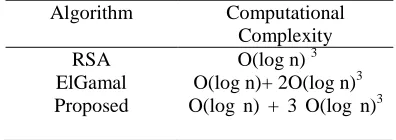
[image:6.612.93.291.237.307.2]Therefore, the complexity of decryption process takes: T(M)= O(log n) + 3O(log n)3 bit operation.
Table 1: Computational Complexity For Each Algorithm
Algorithm Computational Complexity
RSA O(log n) 3
ElGamal O(log n)+ 2O(log n)3 Proposed O(log n) + 3 O(log n)3
5.2.Computational Time.
All these algorithms have been implemented in MATLAB 7. The completed programs have been tested on PC computer with Windows Vista™ Home Premium. The PC has Intel® Core™ 2 Duo CPU T5750 @ 2000GHz 2000GHz. It also has RAM up to 3.00GB. The text data has been tested in various sizes.
The computation time for encryption and decryption on all algorithms are shown in Table 2 below. It is clearly shown that, the proposed algorithm shows slightly better computation time compare to RSA and ElGamal.
Messag e
) KB)Siz
es
Operati on
El Gamal
) sec (
RSA ) sec (
Proposed ) sec (
1 Encrypt 0.12 0.15 0.12
0 Decryp
t 0.12 0.12
0.12 0
2 Encrypt 0.25 0.292 0.24
0 Decryp
t 0.24 0.262
0.24 0
4 Encrypt 0.51 0.62 0.50
3 Decryp
t 0.50 0.57
0.49 4
10 Encrypt 1.45 1.78 1.45
4 Decryp
t 1.44 1.67
1.45 4
20 Encrypt 3.52 4.35 3.51
1 Decryp
t 3.50 4.25
3.50 3
40 Encrypt 11.81 17.32 11.7
4 Decryp
t 11.71 22.0
11.5 0
100 Encrypt 169 195 166
Decryp
t 168 250 165
6.CONCLUSION
The proposed method is a combination between RSA and ElGamal cryptosystem based on its problems. These algorithms give additional difficulties, because the employment of DLP and IFP in the proposed algorithm. The complexity and the execution time of the public-key cryptosystems are trade-off problem. The execution time of the proposed method doesn’t differ great than the original methods. As the RSA algorithm depends on the (DLP) and algorithm EIGamel depends on (IFB), the proposed system resulting from the merger between these algorithms is becoming more complicated than each algorithm operates to work independently. As a consequence, the preservation is done on the time of encryption and decryption gives the system more sophistication, and strength without any loss of time compared to that of RSA or ElGamal.
ACKNOWLEDGEMENTS
The authors would like to express gratitude to Kementerian Pengajian Tinggi Malaysia and Uni-versiti Kebangsaan Malaysia for a research grant FRGS/1/2012/SG05/UKM/02/1.
REFERENCES
[1] A. E. Cohen, "Architectures for Cryptog-raphy Accelerators," UNIVERSITY OF MINNESOTA, 2007.
[2] A. K. Ho, "Hybrid Cryptosystem Using Symmetric Algorithms and Public-key Algo-rithms," Lamar University., 1999.
[3] B. Allen, "Implementing several attacks on plain ElGamal encryption," Ames, Iowa, Io-wa 2008.
[5] Rivest, R.; A. Shamir; L. Adleman (1978). "A Method for Obtaining Digital Signatures and Public-Key Cryptosystems". Communi-cations of the ACM 21 (2): pp120–126. [6] S. Galbraith, et al., "Tunable balancing of
RSA. Information security and privacy," 2005, pp. 280–292.
[7] S. Inshi and A. Youssef, "Design and imple-mentation of an online anonymous feedback system," in Communications, 2008 24th Bi-ennial Symposium on, 2008, pp. 58-61. [8] S. Robinson, "Still guarding secrets after
years of attacks, rsa earns accolades for its founders," SIAM News, vol. 36, pp. 1-4, 2003.
[9] S. Upadhyay (2011), “Attack on RSA Cryptosystem”, International Journal of Sci-entific & Engineering Research (IJSER), Volume 2, Issue 9, September 2011. pp 1-4. [10] Taher ElGamal (1985). "A Public-Key
Cryp-tosystem and a Signature Scheme Based on Discrete Logarithms". IEEE Transactions on Information Theory 31 (4): pp 469–472. [11] W. Mao, Modern cryptography: theory and