477
AQUIFER THERMAL TRANSPORT COMPUTER
SIMULATION OF WINTER COMBINED SUMMER
GROUNDWATER SOURCE HEAT PUMP SYSTEM
HAN YAN-CHENG1, XING LI-TING2 , MA ZHEN-MIN3, JIAO YU-FEI3
1 School of Resources and Environment, University of Jinan, Jinan,250022, China 2 School of Resources and Environment, University of Jinan, Jinan,250022, China 3 School of Resources and Environment, University of Jinan, Jinan,250022, China E-mail: [email protected], 2 stu_xinglt @ujn.edu.cn , [email protected]
ABSTRACT
Groundwater source heat pump technology is an energy-saving method to use the groundwater heat energy resources for heating in winter and cooling in summer. It is important to comprehensive study the process of groundwater thermal transport of winter combined summer GWSHP under the continuous running condition. In this paper the simulation models have been proposed using winter-only and winter combined summer GWSHP respectively, and computer simulations were carried out. The results show that the temperature will decrease year by year if using winter-only GWSHP. The groundwater temperature change is smaller using combined GWSHP than using winter-only GWSHP. In summer, the winter combined summer GWSHP can use the cooling storage recharged last winter and in the winter it can use the heat storage recharged last summer. The winter combined summer GWSHP can improve thermal efficiency in the winter and enhance the cooling effect in summer.
Keyword:Groundwater Source Heat Pump , Winter Combined summer GWSHP, Temperature Field, Thermal Transport
1. INTRODUCTION
Groundwater source heat pump (GWSHP) technology is an energy-saving method of using groundwater heat resources for winter heating and summer cooling. Its thermal efficiency is higher compared with the ground source air conditioning
, coal-fired centralized boiler, gas centralized boiler, etc. So it has been supported by most governments in China (Wei Yang, Jin Zhou,2010[1]). In recent years, with the advanced groundwater source heat pump technology widely used around the world, a large number of water source heat pump works are emerging(Gerald W H
, 1997[2],Sanner B , 2003[3]). But most GWSHP works have been designed and used only for single-season (winter-only heating pump). Clearly, continuous recharging colder water to underground aquifers using winter-only GWSHP will drop the temperature of groundwater and reduce thermal efficiency of GWSHP year byyear. However this awareness is based on the experience for the most part. So it is important to study thetheory of the temperature change feature and
how improves the thermal efficiency for winter and summer combined GWSHP.
For GWSHP woks, it is important to know the process of groundwater thermal transport and forecast the thermal efficiency, but now the studies [3-7] have concentrated on the single-season GWSHP. The temperature field how to change if use continuous winter and summer combined GWSHP? The researches on continuous winter and summer combined GWSHP is lack. The process of groundwater thermal transport hasnot been studied under the continuous running condition.
478 transferring numerical model of two stage. Li Yue ( 2011[8]) used FlowHeat software to research the hydro-geological parameters of single well re-injection of underground water source heat pumping well which is influenced by the temperature field .
In this paper the groundwater thermal transport forecast computer simulation model of winter and summer combined GWSHP has been proposed, and the thermal transport process of groundwater have been simulated using computer.
2. COMPUTER SIMULATION MODEL OF
GROUNDWATER AND THERMAL
COUPLING
Considering convection and diffusion effect, assuming the aquifer medium as continuous medium, the three-dimensional unsteady water movement and thermal migration coupling equation of heterogeneous and anisotropic aquifer can be described as [5,6]
0 0
* *
( )
(1 )
( (1 ) )
o p o T b
p
p f T f b f
f x x b x x
f s H
f f
P T P
n n a
t t t
k
P g q
P T P
n c T n c T a c T
t t t
T P T
n c c Ta n c
t t t
nk n k I T nD T
n c vT q c T
ρ β ρ β ρ
ρ ρ ρ
µ
ρ β ρ β ρ
ρ ρ ρ
ρ ρ ∂ ∂ ∂ + + = ∂ ∂ ∂ ∇⋅ ∇ + − ∗ ∂ ∂ ∂ + + + ∂ ∂ ∂ ∂ ∂ ∂ − + − = ∂ ∂ ∂ ∇⋅ + − ∇ + ∇ ⋅ ∇ − ∇⋅ +
Above,
n
is effective porosity;ρ
0 is referencepressure
P
0 and the density of the fluid under thereference temperature
T
0 , kg/m3;β
p iscompression coefficient of water,
Pa
−1 ;P
is groundwater pressure,P
a ;T
is water andporous medium temperature ,
C
° ;β
T is coefficient of thermal expansion of the water,C
°-1;ρ
is fluid density,kg/m3;a
b is porous media compression factor,P
a−1;k
p is ability to penetrate tensor,m2;µ
is dynamic viscositycoefficient,kg/(m·s); g is acceleration of gravity
,m/s2;
ρ
*is density of the fluid source term (source point) ,kg/m3;
q
is intensity of sources and sinks, inflows as positive and outflows asnegative,m3/(m3·s);
t
is time,s;P
0 is initialpressure distribution, Pa ;
P
1 is pressure distribution known pressure boundary, Pa;c
f isFluid specific heat capacity,J/kg·℃ ;
c
x isporous media specific heat capacity,J/kg·℃;
ρ
sis porous medium density,kg/m3;
k
f is fluidthermal conductivity,W/m·℃ ;
k
s is thermalconductivity of the porous medium,W/m· ℃;
D
His Thermodynamic diffusion tensor,W/m· ℃;
I
is 3-order unit matrix;
v
is Seepage velocity,m/s; *
T
is Temperature, fluid source term, ℃。3. STUDY AREA HYDRO-GEOLOGICAL
AND BOUNDARY CONDITIONS
In order to fully analyze the variation of the temperature field of the groundwater under the cold and heat load, a new constructed groundwater source heat pump project has been selected and research in Weifang City of ShanDong Province in China. This project has one pumping wells (a# well), pumping capacity of 900m3 / d, one injection wells (b# well), recharge capacity is 900 m3 / d, The distance between the two wells is 50m. Two observation wells were drilled along the direction of the hydraulic gradient also, the space from 1# observation well to recharge well, is 25m, 2 # observation well is 65m, seeing Figure 1. In verification test, to prevent groundwater from being exposed to the air and affecting the observation accuracy in the observation process, high-precision digital thermometer is used. Temperature Sensor is connected to the computer through data cable. The boreholes were covered always in observation process. Figure 2 is the finite element mesh map of study area
479
[image:3.612.85.522.69.269.2]
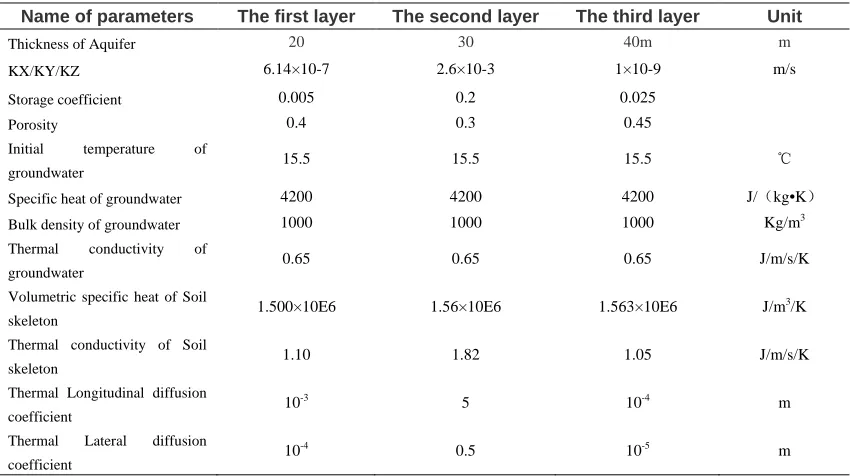
Table 1: Hydro-Geological And Soil Thermal Physical Parameters
Name of parameters The first layer The second layer The third layer Unit
Thickness of Aquifer 20 30 40m m
KX/KY/KZ 6.14×10⁻⁷ 2.6×10⁻³ 1×10⁻⁹ m/s Storage coefficient 0.005 0.2 0.025
Porosity 0.4 0.3 0.45
Initial temperature of
groundwater 15.5 15.5 15.5
℃
Specific heat of groundwater 4200 4200 4200 J/(kg•K) Bulk density of groundwater 1000 1000 1000 Kg/m3 Thermal conductivity of
groundwater 0.65 0.65 0.65 J/m/s/K Volumetric specific heat of Soil
skeleton 1.500×10E6 1.56×10E6 1.563×10E6 J/m 3/K
Thermal conductivity of Soil
skeleton 1.10 1.82 1.05 J/m/s/K
Thermal Longitudinal diffusion
coefficient 10
-3 5 10-4 m
Thermal Lateral diffusion
coefficient 10
-4 0.5 10-5 m
Boundary conditions: boundary conditions are hydraulic boundary and temperature boundary. The local Coordinate system was used in this study. The roof elevation is set 0m, groundwater level, -15m. Then four direction side boundaries were set fixed water level and fixed temperature boundary. According to the pumping test and temperature measurement, local groundwater temperature is 15.5 ℃ .
4. COMPUTER SIMULATION OF
CONTINUOUS WINTER-ONLY GWSHP
MODE
Heating in winter is the most adopted form of GWSHP. It is a technique of extraction the heat of groundwater, and recharges the colder groundwater to aquifers. The temperature field how to changes if use continuous winter-only GWSHP? In this study case, the recharge water temperature is 7 ° C. The GWSHP run from November 15 to January 15 of next year (total running time of 120 days) and stop at the remaining time. We use professional groundwater simulation software Feflow to simulate the temperature field changes with continuous running three year and 120 days.
a#:Pump well b#:Recharge well
1#: observation well
2#: observation well
Pump well
Recharge well
observation well
50m
65m
25m
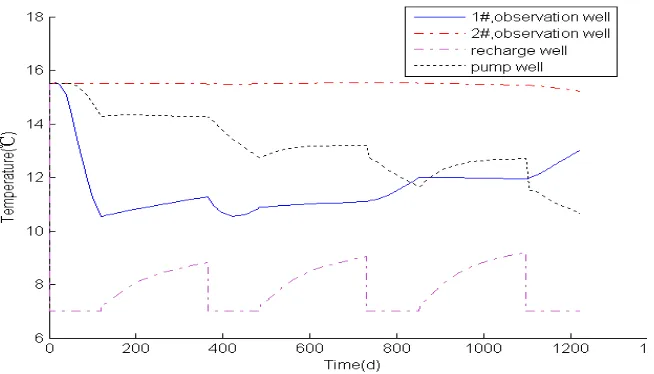
[image:3.612.86.511.317.555.2]480 Through simulation, the results have been attained. Figure 4 is the temperature change process lines at the points of pump well and recharge well. The results show that the temperature will decrease
[image:4.612.112.439.146.333.2]year by year if uses winter-only GWSHP. Figure 5 is the contour map of the temperature field after running 50d,120d, 365d,and 720d.
Figure 4: Temperature Change Process At The Points Of Pump,Recharge Well Using Winter-Only
a): The Temperature Field Of 50d b) :The Temperature Field Of 120d
c): The Temperature Field Of 365d d): The Temperature Field Of 720d Figure 5: the temperature field change with winter-only mode
5. COMPUTER SIMULATION OF
CONTINUOUS WINTER AND SUMMER COMBINED GWSHP
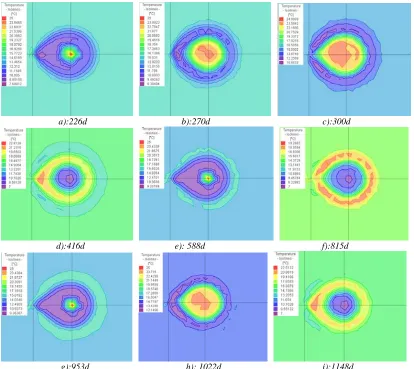
481 stop time scheme is set as table 2. Through simulation, the results have been attained. Figure 6 is the temperature field Contour map of different
time. Figure 7 is the temperature change process at the places of pump and recharge well using winter and summer combined mode.
a):226d b):270d c):300d
d):416d e): 588d f):815d
[image:5.612.101.515.145.514.2]g):953d h): 1022d i):1148d Figure 6: The Temperature Field Change With Winter And Summer Combined Mode
[image:5.612.176.443.541.679.2]482
6. THE COMPARISONS OF
WINTER-ONLY GWSHP AND WINTER AND SUMMER COMBINED MODE
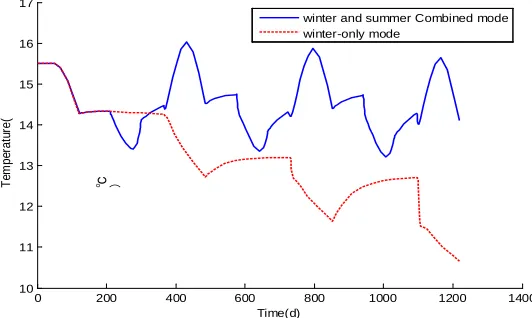
Figure 8 is the comparisons of temperature using winter-only GWSHP and winter and summer combined mode at the points of pump well. Results
show that the temperature of groundwater is decreasing year by year using former mode. The
max value is 15.5 ℃ and the min value
but using the later, the min value is 13.5 ℃, the max value 16.03 ℃ and the temperature is fluctuated
between 13.5 ℃ and 16.03℃. Obviously, the later mode can improve the thermal efficiency in the
winter and the Cooling effect in the summer.
0 200 400 600 800 1000 1200 1400 10
11 12 13 14 15 16 17
Time(d)
T
em
p
er
a
tur
e
(
℃ )
[image:6.612.160.426.212.371.2]winter and summer Combined mode winter-only mode
Figure 8: The Comparisons Of Winter-Only Mode And Winter And Summer Combined Mode
7. CONCLUSIONS
This paper established the computer simulation model of groundwater heat transfer of aquifer using winter-only mode and winter combined summer mode of GWSHP. The simulation results show that the temperature will decrease year by year if uses winter-only GWSHP at the place of flat slope. However, the average temperature of winter combined summer mode is higher than winter-only mode. The winter and summer combined mode can improve thermal efficiency in the winter and attain the goal of cooler effect in summer. Use winter and summer combined mode is better than winter-only mode, because in the summer we can use the cooling storage recharged last winter, in the winter can use the heat storage recharged last summer.
ACKNOWLEDGEMENT
It is a project supported by The “Five-twelfth” National Science and Technology Support Program of China(Name:The River-Channel-Lake- Reservoir System Operation and Control Key Technology Research of South-to-North Water Diversion Project), and supported by The National Natural Science Foundations of China (41172222)
REFERENCES
[1] Wei Yang, Jin Zhou, Wei Xu, Guoqiang Zhang, Current status of ground-source heat pumps, Energy Policy. Vol.38, No.1, 2010, pp.323-332
[2] Gerald W H.Geothermal heat pumps:an increasingly successful technology. Renewable Energy,Vol. 10, No. 2/3, 1997, pp. 481—488
.
[3] Sanner B,Karytsas C.Mendrinos D,et a1
.Current status of ground source heat pumps and underground thermal energy storage in Europe.Geothermics. Vol. 32, No. 4/6, 2003, pp. 579—588.
[4] Norio Tenma, Kasumi Yasukawa, George Zyvoloski. Model study of the thermal storage system by FEHM code. Geothermics , Vol. 32, NO. 4 /5 /6, 2003, pp. 603-607.
483 [6] WANG Hui-ling,WANG Feng,SUN
Bao-wei,WANG Wen-feng. Impact of position and production of injection wells on groundwater flow and temperature field with groundwater source heat pump. Hydrogeology And Engineering Geology. No.5, 2009, pp. 133-137
[7] Wang Mingyu,Ma Jie,Wan Manying. Research on a numerical model of twin-phase thermal transmission for aquifer thermal energy storage[J]. Journal of Jilin University: Earth Science Editio. Vol. 34, No. 40, 2004, pp. 576-580.
[8] Li Yue,Yuan Jianwei,Wang Ruixian. Hydro-Geologic Status on the Temperature of Water in Aquifer Surrounded by the Well of Standing Column Well Heat Pumps. Journal of Beijing University of Civil Engineering and Architectur. Vol.27, No. 4, 2011, pp. 32-36 [9] Tenma N, Yasukawa K, Zyvoloski G. Model
study of the thermal storage system by FEHM code . Geothermics. Vol. 32, No.4/5/6, 2003, pp. 603-607.