S T U D Y P R O T O C O L
Open Access
Effectiveness evaluation of an integrated
automatic termomechanic massage system
(SMATH
®
system) in nonspecific sub-acute and
chronic low back pain - a randomized
double-blinded controlled trial, comparing SMATH
therapy versus sham therapy: study protocol for a
randomized controlled trial
Paolo Buselli
1*, Roberto Bosoni
2, Gabriella Busè
2, Paola Fasoli
1, Elide La Scala
2, Rita Mazzolari
2, Federica Zanetti
2and Sara Messina
3Abstract
Background:Low back pain (LBP) is a major health problem in modern society, with 70-85% of the population
experiencing LBP at some time in their lives. Each year, 5-10% of the workforce misses work due to LBP, most for less than 7 days. Almost 10% of all patients are at risk of developing chronic pain and disability. Little clinical evidence is available for the majority of treatments used in LBP therapy. However, moderate evidence exists for interdisciplinary rehabilitation, exercise, acupuncture, spinal manipulation, and cognitive behavioral therapy for subacute and chronic LBP. The SMATH®system (system for automatic thermomechanic massage in health) is a new medical device (MD) that combines basic principles of mechanical massage, thermotherapy, acupressure, infrared therapy, and moxibustion. SMATH® is suitable for automatic multidisciplinary treatment on patients with non-specific sub-acute and chronic LBP.
Methods/design:This paper describes the protocol for a double-blinded, sham-controlled, randomized,
single-center short term clinical trial in patients with non-specific sub-acute and chronic LBP aged 18 to 70 years. The primary outcome will be the effectiveness of SMATH®versus sham therapy (medical device without active principles) determined by evaluating self perceived physical function with Roland Morris Disability Questionnaire (RMDQ) scores after 4 weeks of treatment (end of treatment). Major secondary outcome will be effectiveness of SMATH® determined by evaluating self perceived physical function comparing RMDQ scores between end of treatment and baseline. The trial part of the study will take 7 months while observational follow-up will take 11 months. The sample size will be 72 participants (36 for each arm). The project has been approved by the Ethical Committee of Cremona Hospital, Italy on 29 November 2010.
Discussion:Compared to other medical specialties, physical and rehabilitation medicine (PRM) has not yet
received the deserved recognition from clinicians and researchers in the scientific community, especially for medical devices. The best way to change this disadvantage is through well-conducted clinical research in
sham-* Correspondence: [email protected]
1Hospital“Istituti Ospitalieri di Cremona”Physical and Rehabilitation Medicine
Department, Cremona, Italy and Physiotherapy Faculty, University of Brescia, Italy
Full list of author information is available at the end of the article
controlled randomized trials. Sham treatment groups are essential for improving the level of evidence-based practice in PRM. The present trial will counter the general lack of evidence concerning medical devices used in LBP therapy.
Trial Registration:ISRCTN: ISRCTN08714168
Background
Low back pain (LBP) is a major health problem in mod-ern society; 70-85% of the population will experience LBP at some time in their lives [1]. Each year, 5-10% of the workforce misses work due to LBP, the majority for less than 7 days [2]. Almost 10% of all patients are at risk of developing chronic pain and disability, account-ing for more than 90% of the costs associated with back-related disability [3]. LBP incurs substantial treat-ment and productivity costs worldwide [4]. Healthcare and social costs for LBP are increasing rapidly. In the United States, healthcare costs among people with LBP increased 65% between 1997 and 2005, more rapidly than overall healthcare costs [5]. In the United States, chronic LBP is estimated to cost Americans over 70 bil-lion dollars per year in health care expenditures [6]. The total cost of treatment, lost work days, and disability due to chronic pain in 1995 and 1996 was estimated to be between 150 and 215 billion dollars [7]. In the UK, 1.3 million people receive physiotherapy for LBP each year, with a global cost of £150 million for the National Health System (NHS) [8]. In Italy, the global economic impact of LBP is approximately€24 billion per year, and patients pay almost all fees.
LBP has been difficult to treat solely using medical interventions due to the complex interplay of biological, psychological, and social factors in its onset and persis-tence. LBP is usually a benign and self-limiting condition, but many patients look for some type of therapy to relieve their symptoms and provide hope for a cure. For this reason, more than 50 potential therapies promise to relieve the pain [2,9], lessen the suffering, and offer a cure for this problem. However, sound evidence exists for a small number of these therapies [9]. For the inter-ventions with multiple reviews, conflicting conclusions have been reached about effectiveness due to the hetero-geneity and poor quality of the trials, but there are more qualitative systematic reviews than meta-analyses, and two-thirds of systematic review authors emphasize that more high quality trials are needed [10]. Despite advances in knowledge, technology, and procedures, no medical treatment has been demonstrated to consistently and completely alleviate LBP. Clinical evidence for the majority of treatments used in LBP therapy is also incon-sistent. However, moderate evidence exists for interdisci-plinary rehabilitation, exercise, acupuncture, spinal manipulation, and cognitive behavioral therapy for
sub-acute and chronic LBP [5,11]. In particular, multidisci-plinary interventions seem to be the most promising approach for patients with sub-acute and chronic LBP [12]. Intensive multidisciplinary biopsychosocial rehabili-tation with a functional restoration approach has been shown to reduce pain and improve function in patients with chronic LBP [13]. In addition, empirical evidence has shown the sort of information and advice that should be given to patients with back pain, confirming that such information and advice may be a potent element of the health care intervention [14]. Soft-tissue massage is thought to improve physiological and clinical outcomes by offering symptomatic pain relief through physical and mental relaxation and increasing the pain threshold via the release of endorphins [2,15]. The gate-control theory predicts that massaging a particular area stimulates large diameter nerve fibers. These fibers have an inhibitory electrical input to T cells, which are the first cells to pro-ject into the central nervous system within the spinal cord [2]. T-cell activity is likely depressed, whereas small diameter nerve fibers (nociceptive fibers) have an excita-tory input, and pain relief follows [16]. Massage therapy may provide benefits by shifting the autonomic nervous system from a state of sympathetic response to a state of parasympathetic response. Massage is similar or superior to other conservative therapies, such as exercises, mobili-zation, relaxation, physical therapy, acupuncture, and self-care education [2]. Massage is beneficial for patients with sub-acute and chronic nonspecific LBP in terms of improving symptoms and function, but the benefits of massage increase when combined with exercises and education [2]. Massage has powerful analgesic effects if applied to acupuncture points, a technique known as
“acupressure”[2]. Two studies that compared massage to inert treatment (sham therapies) showed that massage is superior for pain and function in both short and long-term follow-up [17,18]. No serious adverse events were reported by any patient in the studies reviewed [2]. Mas-sage alone is unlikely to be cost-effective [5]. Focusing on high-quality randomized controlled trials (RCTs) with a sufficient sample size to draw firm conclusions is particu-larly recommended for future research involving LBP therapies [12].
Trial Rationale
SMATH® is a new medical device that combines basic principles of mechanical massage, thermotherapy,
Buselliet al.Trials2011,12:216
http://www.trialsjournal.com/content/12/1/216
acupressure, infrared therapy, and moxibustion. SMATH® is included in the “conservative treatments” category [13]. This device is capable of releasing modu-lated and controlled thermomechanic energy on the patient following a programmable and fully reproducible automatic treatment program selected by the operator. Energy (thermomechanic and infrared) is released at the same time under the spine and legs of the patient. We think this system provides a true automatic multidisci-plinary treatment for patients with sub-acute and chronic LBP. The SMATH® system should theoretically be capable of combining the single clinical benefits of massage, thermotherapy, infrared, and acupressure, removing the dependency on operator capability, though obviously missing some elements of human touch, and providing maximum automaticity and reproducibility and producing a real clinical added value for patients. The literature involving different reviews show that little clinical evidence exists on the use of these endorsed therapies on their own. In particular, there is little evi-dence for massage performed by hands or a mechanical device, or and for superficial heat release [12]. No evi-dence is available for thermotherapy [13], or for moxi-bustion, infrared therapy, and acupressure. On the other hand, moderate evidence indicates the effectiveness of multidisciplinary treatment compared to other kinds of active treatment in regards to pain intensity at short-term follow-up [12]. The SMATH® system was devel-oped in an attempt to create an effectiveness advantage by combining different basic theoretical principles. The first clinical results, from the safety clinical study invol-ving 46 patients inside the process to obtain the Eur-opean Conformity (CE) mark for SMATH®, showed the following: RMDQ average score of 10.96 (sd = 3.04; p < 0.05) at baseline and 3.21 (sd = 2.99; p < 0.05) after 3 months, and the average quality adjusted life year (QALY) was 0.46 (sd = 0.13; p < 0.05) at baseline and 0.81 (sd = 0.12; p < 0.05) after 3 months. These data have not been published because they were not suitable for publication and represented the results obtained by one clinical study in which the primary outcome was the demonstration of clinical safety. The internal clinical report concerning this study has been delivered to the notified body in charge of the CE mark process. The SMATH®system obtained the CE mark on 20 Decem-ber 2010. The current RCT was designed to investigate and test the SMATH® system for use in LBP therapy.
The cost/effectiveness ratio for the SMATH®system may also be interesting and could play an important role in the Italian NHS strategy for LBP interventions. An HTA procedure has already been launched in Italy for this new therapy. Like all new technologies and interventions, the clinical effectiveness of the SMATH® system has to be proven by clinical studies in a PRM
context. Compared to other medical specialties, PRM has not yet received the recognition deserved from clini-cians and researchers in the scientific community, espe-cially for medical devices [19]. We think this unfavorable scenario is due to several reasons, one of which is the lack of high-quality clinical trials in the PRM field. Conducting double-blind placebo-controlled trials in the specialty is difficult; the majority of studies in PRM are practically based on clinical observation, uncontrolled observational studies, or clinical trials com-paring two different active therapies. Consequently, these studies are not suitable for providing sufficient proof of efficacy for these therapeutic modalities. The only scientifically recognized way to achieve this goal is to design and manage high-quality double-blind pla-cebo-controlled trials. Sham treatment groups in clinical trials are essential for improving the level of evidence-based practice in PRM. This trial was conceived to reduce the lack of evidence and quality for LBP therapy. No major and minor adverse events or adverse effects have been observed during the use SMATH® on patients with LBP. The SMATH® system has the CE mark as it has passed all tests concerning safety for the patient, operators, and environment. For this reason, no adverse events are expected during this clinical study. However, if adverse events occur, they will be reported to the regulatory authority and ethics committee in accordance with applicable regulations. Trial results will be used to inform HTA procedure already involving SMATH® therapy for health care policies regarding the treatment of LBP in Italy.
Methods Design
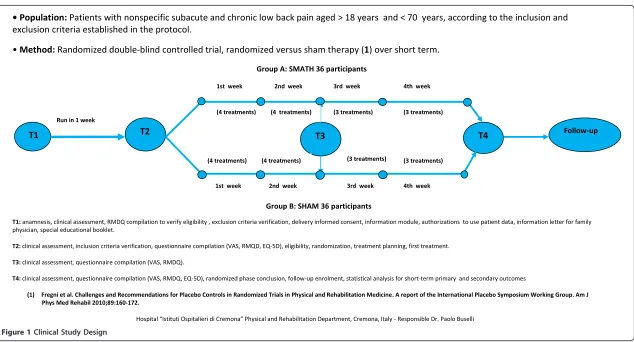
• Population: Patients with nonspecific subacute and chronic low back pain aged > 18 years and < 70 years, according to the inclusion and exclusion criteria established in the protocol.
• Method: Randomized double-blind controlled trial, randomized versus sham therapy (1) over short term.
T1: anamnesis, clinical assessment, RMDQ compilation to verify eligibility , exclusion criteria verification, delivery informed consent, information module, authorizations to use patient data, information letter for family physician, special educational booklet.
T2: clinical assessment, inclusion criteria verification, questionnaire compilation (VAS, RMQD, EQ-5D), eligibility, randomization, treatment planning, first treatment.
T3: clinical assessment, questionnaire compilation (VAS, RMDQ).
T4: clinical assessment, questionnaire compilation (VAS, RMDQ, EQ-5D), randomized phase conclusion, follow-up enrolment, statistical analysis for short-term primary and secondary outcomes
(1) Fregni et al. Challenges and Recommendations for Placebo Controls in Randomized Trials in Physical and Rehabilitation Medicine. A report of the International Placebo Symposium Working Group. Am J Phys Med Rehabil 2010;89:160-172.
Hospital “Istituti Ospitalieri di Cremona” Physical and Rehabilitation Department, Cremona, Italy - Responsible Dr. Paolo Buselli Group A: SMATH 36 participants
Group B: SHAM 36 participants
T1 T2
Run in 1 week
T3 T4 Follow-up
1st week 2nd week 3rd week 4th week
(4 treatments) (4 treatments) (3 treatments) (3 treatments)
(4 treatments) (4 treatments) (3 treatments) (3 treatments)
[image:4.794.70.704.123.465.2]1st week 2nd week 3rd week 4th week
Figure 1Clinical Study Design.
Buselli
et
al
.
Trials
2011,
12
:216
http://ww
w.trialsjournal
.com/conten
t/12/1/216
Page
4
of
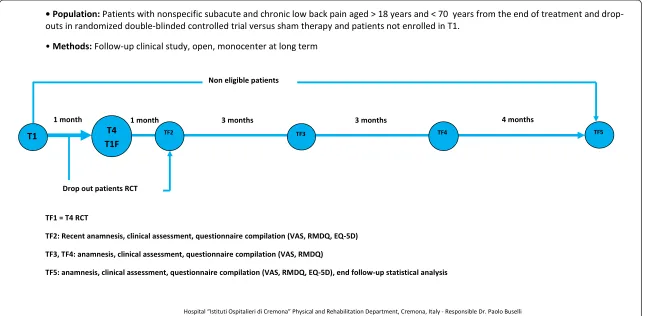
investigators, and enter the long-term observational fol-low-up phase, which will last 11 months. All participants will be followed starting at TF1 (same time as T4,) for 11 months and will attend clinic visits at 1 month (TF2), 4 months (TF3), 7 months (TF4), and 11 months (TF5) after TF1. The design of the observational follow-up period is depicted in Figure 2.
Eligibility
Subjects with sub-acute and chronic non-specific LBP diagnosed according to generally accepted scientific cri-teria [13] were enrolled. Inclusion cricri-teria were as fol-lows: aged between 18 and 70 years, ability to sign informed consent, ability to complete the study, ability to complete the questionnaires, RMDQ score≥4 at T2 [20], and negative answers on all exclusion questions at T1. The rationale for the inclusion criteria is provided in Table 1.
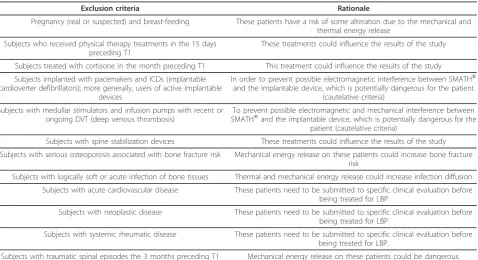
Exclusion criteria were as follows: pregnancy (real or suspected) or breast-feeding; receiving physical therapy treatments in the 15 days preceding T1; treatment with cortisone in the month preceding T1, implanted with pacemaker or implantable cardioverter defibrillators (ICD) or, more generally, a user of active implantable devices; use of medullar stimulators and infusion pumps; recent or ongoing deep venous thrombosis (DVT); use of spine stabilization devices; serious osteo-porosis associated with bone fracture risk, including soft or acutely infected bone tissues; acute cardiovascular disease; neoplastic disease; systemic rheumatic disease; or traumatic spinal episodes in the 3 months preceding T1. The rationale for the exclusion criteria is provided in Table 2.
Setting and locations where the data will be collected
A special area inside the Head Investigator’s office in the Hospital will be dedicated to data collection and storage. Case report forms (CRFs) for the enrolled sub-jects will be kept strictly inside this area. Treatment plan sheets on which the treatment plan for each ran-domized participant will be recorded will be delivered externally by the technician in charge of executing the treatment. Before randomization, randomization envel-opes will be held in this area by the Head Investigator and remain sealed, even after delivery, until used by the technician in charge of administering the treat-ment. Access to the CRFs by the investigators and monitor will be authorized by the Head Investigator. The technicians in charge of administering treatment will be responsible for storing the envelopes and treat-ment plan after randomization and treattreat-ment plan; they will have to practice maximum confidentiality about their contents as investigators will not have access to this information.
Randomization
A simple randomization process has been conceived through three different steps according to the Consoli-dated Standards of Reporting Trials (CONSORT) state-ment: sequence generation, allocation concealment, and implementation.
Sequence generation has been achieved through a
“congruential multiplier” statistical algorithm applica-tion, using IBM Statistical Package for Social Sciences (SPSS) Version 19 [21,22] and was stratified with 1:1 allocation random block size of 36. The randomization list reports a progressive randomization number for ran-domized participants (from 1 to 72), and the treatment (A or B) will be assigned for each of them.
For allocation concealment, the randomization list was produced in three numbered copies. The first copy was delivered to the Ethics Committee inside an envel-ope sealed with warm sealing wax. A second copy was delivered to the Head Investigator in a similar sealed envelope. The Head Investigator will save his copy in a locked box in his office. He can open the envelope in the case an emergency arises. A third copy has been kept by the monitor of the study who managed the sequence generation. The monitor also prepared 72 opa-que red envelopes containing randomization sheets. On each envelope is a number (from 1 to 72) and space for the patient’s name and date of birth. The randomization sheet (opaque red) reports the progressive randomiza-tion number and assigned treatment (A or B) based on the randomization list. All of the envelopes have been closed and sealed with warm sealing wax. The 72 rando-mization envelopes were delivered to the Head Investi-gator, who will keep them in a locked box in his office. At the time of randomization, the investigator who deci-des to randomize the participant will take the first of the envelopes from the box in order of sequence and write the participant’s name and date of birth on the envelope (to prevent subversion of the allocation sequence as suggested by Consort 2010, Item 9). Imme-diately after, the investigator will deliver the closed envelope and intervention plan to the technician in charge of administering the treatment. The technician will open the envelope to start the intervention, saving the envelope and randomization sheet in a locked box. The technicians involved in this phase of the study have been trained and educated to maintain maximum confi-dentiality concerning allocation concealment. This method will provide double-blinded conditions. Clinical investigators who enroll and evaluate participants will not know which treatment has been assigned to them.
• Population: Patients with nonspecific subacute and chronic low back pain aged > 18 years and < 70 years from the end of treatment and drop-outs in randomized double-blinded controlled trial versus sham therapy and patients not enrolled in T1.
• Methods: Follow-up clinical study, open, monocenter at long term
TF1 = T4 RCT
TF2: Recent anamnesis, clinical assessment, questionnaire compilation (VAS, RMDQ, EQ-5D)
TF3, TF4: anamnesis, clinical assessment, questionnaire compilation (VAS, RMDQ)
TF5: anamnesis, clinical assessment, questionnaire compilation (VAS, RMDQ, EQ-5D), end follow-up statistical analysis
Hospital “Istituti Ospitalieri di Cremona” Physical and Rehabilitation Department, Cremona, Italy - Responsible Dr. Paolo Buselli
1 month 3 months 3 months 4 months
T1 T4
T1F
TF2 TF3 TF4 TF5
Non eligible patients
1 month
[image:6.794.65.714.129.445.2]Drop out patients RCT
Figure 2Follow-up Design.
Buselli
et
al
.
Trials
2011,
12
:216
http://ww
w.trialsjournal
.com/conten
t/12/1/216
Page
6
of
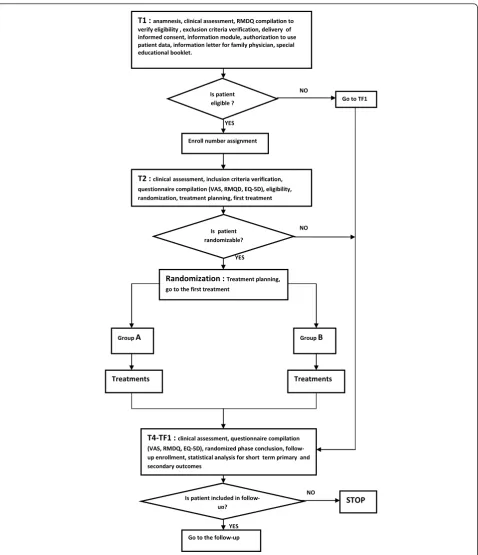
enrollment, treatment assignment, and data analysis to avoid any kind of bias. The implementation process is depicted in Figure 3.
Interventions for each group
Participants assigned to the SMATH®therapy group (A arm) will have 14 treatment sessions of 45 minutes over 4 weeks starting at T2. The treatment module is asso-ciated with a dedicated educational booklet for each patient that provides general and behavioral indications for preventing LBP. In this clinical study, the educa-tional booklet will be delivered to all enrolled partici-pants to help them correct their lifestyle during and after the intervention period. In this dedicated booklet, different sections explain to the participants spine anat-omy, LBP, LBP prevention, advantages of physical activ-ity, suggestions for positions for walking, sleeping, and to keep weight under control, and exercises to prevent LBP.
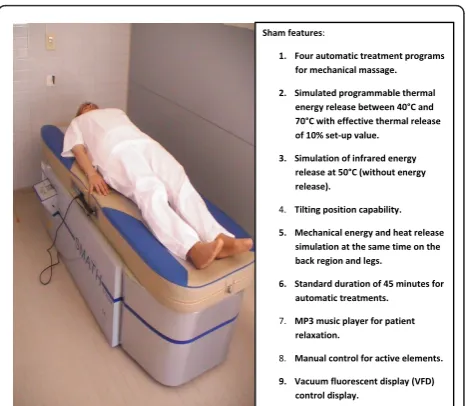
[image:7.595.57.533.99.192.2]During the first and second week (from T2 to T3), 4 sessions will be done per week, whereas 3 sessions per week will be planned for the third and fourth week (from T3 to T4). The SMATH® system will be set-up with treatment variables (warm-up time, automatic treatment program, active element temperature, infrared insertion) conforming to the scheduled treatment data sheet delivered to the technician after randomization. Sham therapy will be implemented using a dedicated SMATH® device. This medical device, which was con-ceived and manufactured exclusively for this clinical study, has the same external look and design of the SMATH®device. The active principles (thermomecha-nic and infrared energy release) have been fully blocked in the sham device, but the participants’perceptions will be more or less the same (warm, vibration, noise). The engineering department has made important efforts to create a device with the appearance of the active machine, inducing feelings similar to those of the real
Table 2 Rationale for exclusion criteria
Exclusion criteria Rationale
Pregnancy (real or suspected) and breast-feeding These patients have a risk of some alteration due to the mechanical and thermal energy release
Subjects who received physical therapy treatments in the 15 days preceding T1
These treatments could influence the results of the study
Subjects treated with cortisone in the month preceding T1 This treatment could influence the results of the study
Subjects implanted with pacemakers and ICDs (implantable cardioverter defibrillators); more generally, users of active implantable
devices
In order to prevent possible electromagnetic interference between SMATH® and the implantable device, which is potentially dangerous for the patient
(cautelative criteria)
Subjects with medullar stimulators and infusion pumps with recent or ongoing DVT (deep venous thrombosis)
To prevent possible electromagnetic and mechanical interference between SMATH®and the implantable device, which is potentially dangerous for the
patient (cautelative criteria)
Subjects with spine stabilization devices These treatments could influence the results of the study
Subjects with serious osteoporosis associated with bone fracture risk Mechanical energy release on these patients could increase bone fracture risk
Subjects with logically soft or acute infection of bone tissues Thermal and mechanical energy release could increase infection diffusion
Subjects with acute cardiovascular disease These patients need to be submitted to specific clinical evaluation before being treated for LBP
Subjects with neoplastic disease These patients need to be submitted to specific clinical evaluation before being treated for LBP
Subjects with systemic rheumatic disease These patients need to be submitted to specific clinical evaluation before being treated for LBP.
[image:7.595.61.540.466.726.2]Subjects with traumatic spinal episodes the 3 months preceding T1 Mechanical energy release on these patients could be dangerous. Table 1 Rationale for Inclusion Criteria
Inclusion criteria Rationale
Age between 18 and 70 years This age interval was chosen in accordance with actual main reviews in PRM [2,10,12]
Ability to sign informed consent Mandatory for participant inclusion in clinical studies (Helsinki Declaration article 22)
Ability to complete the study To prevent drop-outs
Ability to complete the questionnaire Mandatory for accurate data collection
RMDQ score≥4 at T2 From the literature [20]
device [19]. This effect has been obtained by applying some technical solutions without releasing any active energy. Thermal perception is generated using special lamps with different wavelengths than the real
SMATH® device with 90% less thermal power (just to induce the feeling of heat). Infrared emission has been removed, as well as the active rollers that release mechanical energy to the back and legs, replaced by an
T1 : anamnesis, clinical assessment, RMDQ compilation to verify eligibility , exclusion criteria verification, delivery of informed consent, information module, authorization to use patient data, information letter for family physician, special educational booklet.
NO
Go to TF1
YES
Enroll number assignment
T2 : clinicalassessment, inclusion criteria verification, questionnaire compilation (VAS, RMQD, EQ-5D), eligibility, randomization, treatment planning, first treatment
NO
YES
Randomization : Treatment planning, go to the first treatment
Group B
Group A
Treatments Treatments
T4-TF1 : clinical assessment, questionnaire compilation (VAS, RMDQ, EQ-5D), randomized phase conclusion, follow-up enrollment, statistical analysis for short term primary and secondary outcomes
NO
YES Go to the follow-up
STOP
Is patient eligible ?
Is patient randomizable?
[image:8.595.60.539.86.642.2]Is patient included in follow-up?
Figure 3Randomization Implementation Process. Buselliet al.Trials2011,12:216
http://www.trialsjournal.com/content/12/1/216
inert, flat wood plate. The sham device will be set-up with the same treatment variables as the SMATH® device. The noise and vibration generated by the sham device will be the same as that of the SMATH® system because the devices have the same mechanical config-uration, including the same motor and transmission equipment, operating in the same mode. Despite this similarity, a therapeutic placebo effect could be intro-duced by the sham device. This risk has been considered and accepted as a natural risk of the RCT with a sham control.
Participants assigned to the sham therapy arm will receive the same treatment module scheduled for the active SMATH®arm (14 sessions in four weeks from T2 to T4). The participants in the sham arm will also receive the edu-cational booklet. The SMATH® and sham devices are located inside two different therapy boxes and treatment will be given at separate times to prevent contact between participants in the different treatment arms. The operators managing treatments will be the same for the SMATH® and sham devices, and they have been trained to answer the participants’questions about the procedures. The same operators will also be trained and educated in keeping parti-cipants in the study, avoiding an increased drop-out rate. The main features of the SMATH®system and sham ver-sion are presented in Figures 4 and 5, respectively.
Discussion Outcomes
This clinical study was designed to include the following general outcome measures: pain, overall improvement, back-specific functional status, well being (quality of life), and disability. The questionnaires that will be used to col-lect data from the participants are: visual analog scale (VAS) for pain [12], Roland Morris Disability Questionnaire (RMDQ) for effectiveness, specifically back-specific
disability [12], and Euro Qol-5D questionnaire (EQ-5D) for quality of life, which is one of the most used and suitable questionnaires for QALY calculation [5]. These question-naires were chosen by considering the major systematic reviews regarding physical and rehabilitory interventions for sub-acute and chronic non-specific LBP [2,4,9,10,12,15]. Participants will complete the VAS at T2, T3, T4, TF1, TF2, TF3, TF4, and TF5; RMDQ at T1, T2, T3, T4, TF1, TF2, TF3, TF4, and TF5; and EQ-5D at T2, T4, TF1, TF2, and TF5.
Primary outcome
The primary outcome of the trial is represented by the clinical effectiveness of the SMATH® system versus sham therapy after 4 weeks of treatment in patients with sub-acute and chronic non-specific LBP, deter-mined by evaluating self perceived physical function with RMDQ scores. The status of physical function in participants treated with SMATH® interventions will be compared with the status achieved in participants in the sham control arm at the end of treatment (T4) [12].
Secondary outcomes
The secondary outcomes of the trial are: 1) Effectiveness of SMATH® determined by evaluating self perceived physical function comparing RMDQ scores between end of treatment and baseline. 2) Pain perception change from baseline (T2) to end-treatment (T4), evaluated by VAS scores. 3) Quality of life at different steps of the study (T2 and T4), evaluated by EQ-5D scores (QALY). 4) Verified general feasibility of the medical device com-pared to sham therapy in terms of methodology, sample size, and drop-out rate, among other measures, to con-stitute a real pilot study and act as a possible reference
Main features:
1.Four automatic treatment programs for mechanical massage.
2.Programmable thermal energy release between 40°C and 70°C.
3.Infrared energy release at 50°C.
4.Tilting position capability.
5.Mechanical energy and heat release at the same time on the back region and legs.
6.Standard duration of 45 minutes for automatic treatments.
7.MP3 music player for patient relaxation.
8.Manual control for active elements.
[image:9.595.306.540.87.290.2]9.Vacuum fluorescent display (VFD) control display.
Figure 4The SMATH®System.
Sham features:
1.Four automatic treatment programs for mechanical massage.
2.Simulated programmable thermal energy release between 40°C and 70°C with effective thermal release of 10% set-up value.
3.Simulation of infrared energy release at 50°C (without energy release).
4.Tilting position capability. 5.Mechanical energy and heat release
simulation at the same time on the back region and legs.
6.Standard duration of 45 minutes for automatic treatments.
7.MP3 music player for patient relaxation.
8.Manual control for active elements. 9.Vacuum fluorescent display (VFD)
[image:9.595.57.291.542.716.2]control display.
for future generations of RCTs involving the medical device, conforming to the evidence-based medicine (EBM) criteria for LBP therapy [13] according to the CONSORT statement based on new methodological evi-dence and to the International Placebo Symposium Working Group recommendations [19].
Observational follow-up and duration of the study
Observational follow-up will start at TF1 (T4) and cover 11 months. During this period, all of the participants will come to the treatment centre to attend clinic visits one month after TF1 (TF2), 3 months after TF2 (TF3), 3 months after TF3 (TF4), and 4 months after TF4 (TF5). Figure 2 shows the design of the observational follow-up period. The estimated study duration for enrollment, execution and observational follow-up will be 18 months.
Assessment of outcomes
Four steps of participant examination are planned in this RCT (T1, T2, T3, and T4); during which, general clinical data will be collected about the persistence of LBP symptoms, previous treatment, morphological data, patient activity, blood chemistry tests, anamnesis, and eventual clinically important imaging investigations that were recently done. The effectiveness of SMATH® ver-sus sham will be determined by evaluating self-perceived physical function with RMDQ scores at T4. The second-ary outcome of SMATH® therapy effectiveness will be determined by evaluating improvements in patients’ motion functionality between T2 and T4 using RMDQ scores. The evolution of pain perception during the study will be measured by VAS scores submitted by the participants at T2, T3, and T4. Quality of life for partici-pants will be estimated by the comparing the EQ-5D questionnaires submitted at the beginning and end of treatment (T2 and T4). During the observational follow-up period all participants will be examined at TF1, TF2, TF3, TF4, and TF5 for general patient status: anamnesis, blood pressure, heart rate in beats per minute, and mor-phological variables (height, weight, Body Mass Index [BMI]). The RMDQ and VAS questionnaires will be given on the participants at TF1, TF2, TF3, TF4, and TF5, and EQ-5D will be given at TF1, TF2, and TF5. All of the data collected during the study and follow-up will be reported to the CRF.
Sample size calculation
Due to the difficulty of finding solid references in the literature regarding the probability of success for differ-ent arms of RCTs comparing therapy with medical devices versus sham therapy [19], some basic statistical assumptions have been made in regards to the level of inhibition technically introduced into the SMATH®
active principles to obtain a sham device. The therapeu-tic effect induced by the sham device has been estimated to be 10% of the effect induced by the SMATH®system. Consequently, the probability of SMATH®therapy suc-cess has been fixed at 50% (P1) [2], whereas a probability
of 10% (P2) has been fixed for success with sham
ther-apy. Thus, the success difference between the two study arms (P1 - P2) is 40%. This important delta has been
fixed to be statistically significant also in the case of unexpected placebo effect of sham. The false-positive risk factor a (type I error rate) has been fixed at 0.05 (5%). The probability of discovering a difference between the two study arms has been fixed at 90% (study’s power). Based on the study’s power, (1 - b) = 0.9, the false-negative risk factor ratebis 0.1 (10%). The value of the function f(a,b) was calculated by Geigy’s tables [23]. Thus, the sample size in each arm of the study (n) should be n = 26. Drop-out has been consid-ered to prevent having an insufficient sample at the end of the study due at the high risk of drop-out of partici-pants in sham arm. A drop-out rate of 15% (0.15) has been estimated based on the literature concerning RCT versus sham in PRM [19]. The sample adjusting factorμ was calculated using the formulaμ= 1/(1 - R)2 [24-26], where R represents the drop-out rate. Therefore,μ= 1/ (1 - 0.15)2 = 1.3841, and the sample size after correcting for drop-out will be:n# = nμ = 36. The sample of each group will be 36 participants for a total study group of 72 subjects.
Statistics and quality
The accuracy and completeness of the collected and registered data will be checked daily by clinical investi-gators to provide a suitable level of quality for the study. The external monitor will be responsible for arranging random periodic tests of quality throughout the study. In particular, controls will involve the quality and com-pleteness of the CRFs, the treatment execution modal-ities, the drop-out rate, and correct respect of enrollment criteria application. Data analysis will be conducted using IBMSPSS 19 [21,22]. The morphologi-cal and clinimorphologi-cal status of participants will be analyzed statistically. Motion functionality, level of pain percep-tion, and quality of life will be evaluated through statisti-cal analysis of the questionnaire scores. Short-term results will be evaluated to elaborate VAS and RMDQ scores, and medium and long-term results will be evalu-ated by EQ-5D scores, which will also be used to calcu-late the QALY and incremental cost effectiveness ratio (ICER) index [5,22], which is the most used and suitable index for analyzing the cost/effectiveness of PRM thera-pies [5]. Pain perception measured by VAS in the differ-ent phases and its severity analysis will be evaluated by analysis of variance using SPSS 19. Event incidence
Buselliet al.Trials2011,12:216
http://www.trialsjournal.com/content/12/1/216
(SMATH® versus sham) will be estimated using Kaplan-Meier curves, which will be compared using the log-rank test. Multivariable analysis will be performed using the Cox model.
Patient information material
Correct involvement and informed participant processes are key issues for the success and credibility of the study. Clinical investigators will be responsible for informing participants and involving them in the most appropriate way. This goal will be pursued by discussing the study objectives, risks, benefits, and modalities with participants at T1. Each participant will make a decision as to whether they will participate in the study, which will have to be clearly checked by investigators and documented. In this study, clinical investigators will sub-mit and explain to each participant the following docu-ments: (1) signed informed consent, (2) information module, (3) authorization to use personal sensitive data based on privacy law, (4) information letter that will be delivered to the family physician, (5) the dedicated edu-cational booklet. This booklet must be considered a part of the SMATH® treatment module.
Adverse events
Adverse events will be managed to conform with good clinical practice and actual normative rules, listed in
additional file 1. All adverse events will be reported to the regulatory authority and ethics committee in accor-dance with applicable regulations. The report will spe-cify the types of events, and whether they were device related or non-device related, that shall be reported and the timing for such reporting.
Protocol changes
Eventual unplanned and important changes to the study protocol involving, for instance, eligibility criteria, inter-ventions, examination data collection, method of analy-sis, and outcomes, will be submitted to the ethics committee as amendments for approval. In the case of approval and application, they will be reported at the end of the study. All deviations from the protocol dur-ing its execution will have to be justified and documen-ted in CRFs for the participants.
Additional material
Additional file 1: List of the Italian and international laws and norms for clinical studies. This additional file contains a list of the italian and international laws and norms which have been respected for this randomized double-blinded controlled trial. This clinical study has been designed and will be managed to conform with the following Italian and international laws and norms listed in additional file 1.
List of abbreviations used
In this manuscript, the following abbreviations have been used: BMI: Body Mass Index; CRF: Case report form; CE: Conformité Européenne (European Conformity); CONSORT: Consolidated Standards of Reporting Trials; DVT: Deep venous thrombosis; EBM: Evidence-based medicine; EQ-5D: Euro Qol 5D questionnaire; HTA: Health technology assessment; ICD: Implantable cardioverter defibrillator; ICER: Incremental Cost Effectiveness Ratio; LBP: Low back pain; MD: Medical device; NHS: National Health System; PRM: Physical and rehabilitation medicine; QALY: Quality adjusted life year; RCT: Randomized controlled trial; RMDQ: Roland Morris Disability
Questionnaire; SMATH®®: System for automatic thermomechanic massage in health; VAS: Visual analog scale.
Acknowledgements
We are most grateful to the volunteers who will take part in the study and to our research staff in the Physical and Rehabilitation Medicine Department of Cremona Hospital, which will be instrumental in recruiting and managing patients. We are most grateful to the Engineering Department of Themesys Srl, the Company that designed and manufactured the SMATH®system and made special efforts to create the sham version of the device to be used in this clinical study. Themesys will provide supplies and technical support for one SMATH®system and one special sham version completely free of charge for the hospital department. Themesys will also provide training for technicians in charge of administering the treatment to ensure the safe use of both devices. These two systems will be exclusively used for clinical study. Themesys will provide the fees for publishing this paper.
Author details
1Hospital“Istituti Ospitalieri di Cremona”Physical and Rehabilitation Medicine
Department, Cremona, Italy and Physiotherapy Faculty, University of Brescia, Italy.2Hospital“Istituti Ospitalieri di Cremona”Physical and Rehabilitation Department, Cremona, Italy.3School of Specialities in Physical Medicine and Rehabilitation, University of Pavia, Pavia, Italy.
Authors’contributions
PB acts as guarantor of the data, he has designed the interventions and supervises research staff. PB and SM designed the study, which is funded by internal resources. GB, RB, PF, and ELS will be responsible for data collection and analysis, and they contributed to drafting the paper. PB, with SM, reviewed the manuscript critically. RM and FZ will manage the treatment of randomized participants after randomization. All authors reviewed and edited the draft version of the manuscript and approved the final version. All authors have approved the submission of the present paper toTrials.
Competing interests
The authors declare that they have no competing interests.
Received: 18 March 2011 Accepted: 4 October 2011 Published: 4 October 2011
References
1. Andersson GBJ:Epidemiological features of chronic low back pain.Lancet 1999,354:581-585.
2. Furlan AD, Inamura M, Dryden T, Irvin E:Massage for low back pain. An Updated Systematic Review Within the Framework of the Cochrane Back Review Group.Spine2009,34:1669-1684.
3. Waddel G:The Back Pain RevolutionEdimburgh, UK: Churchill-Livingstone; 1999.
4. Dagenais S, Caro J, Haldeman S:A systematic review of low back pain costs of illness studies in the United States and internationally.Spine J 2008,8(1):8-20.
5. Lin C, Haas M, Maher C, Machado L, van Tulder MW:Cost-effectiveness of guidelines-endorsed treatments for low back pain: a systematic review.
Eur Spine J2011,20(7):1024-38, Epub 2011 Jan 13.
6. American Academy of Pain Management:Proceedings of the 2003 Annual Meeting of the American Chronic Pain AssociationDenver, CO; 2003. 7. National Resource Council:Musculoskeletal Disorders and the Workplace.
Washington, DC; National Academy Press; 2001.
chronic low back pain disability. A pragmatic randomized trial with economic evaluation.Spine2007,32:1474-1481.
9. Van Tulder MW, Koes BW, Bouter LM:Conservative treatment of acute and chronic nonspecific low back pain. A systematic review of randomized controlled trials of the most common interventions.Spine 1997,22:2128-2156.
10. Furlan AD, Clarke J, Esmail R, Sinclair S, Irvin E, Bombardier C:A critical review of reviews on the treatment of chronic low back pain.Spine2001, 26(7):E155-E162.
11. Chou R, Huffman LH, American Pain Society, American College of Physicians:Nonpharmacologic therapies for acute and chronic low back pain: a review of the evidence for an American Pain Society/American College of Physicians Clinical Practice Guideline.Ann Intern Med2007, 147:492-504.
12. van Middelkoop M, Rubinstein SM, Kuijpers T, Verhagen AP, Ostelo R, Koes BW, van Tulder MW:A systematic review on the effectiveness of physical and rehabilitation interventions for chronic non-specific low back pain.Eur Spine J2011,20(1):19-39.
13. Airaksinen O, Brox JI, Cedraschi C, Hildebrandt J, Klaber-Moffett J, Kovacs F, Mannion AF, Reis S, Staal JB, Ursin H, Zanoli G, COST B13 Working Group on Guidelines for Chronic Low Back Pain:Chapter 4. European guidelines for the management of chronic nonspecific low back pain.Eur Spine J 2006,15(Suppl 2):S192-300.
14. Burton AK, Waddell G, Tillotson KM, Summerton N:Information and advice to patients with back pain can have a positive effect: A randomized controlled trial of a novel educational booklet in primary care.Spine 1999,24:2484-2491.
15. Furlan AD, Brosseau L, Welch V, Wong J:Massage for low back pain.
Cochrane Database Sys Rev2000,4:CD001929.
16. Melzack R, Wall PD:The Challenge of PainLondon UK: Penguin Books; 1996. 17. Farasyn A, Meeusen R, Nijs J:A pilot randomized placebo-controlled trial
of roptrotherapy in patients with sub acute non specific low back pain.
J Back Musculoskelet Rehabil2006,19:111-7.
18. Preyde M:Effectiveness of massage therapy for sub acute low back pain: a randomized controlled trial.CMAJ2000,162(13):1815-1820.
19. Fregni F, Imamura M, Chien HF, Lew HL, Boggio P, Kaptchuk TJ, Riberto M, Hsing WT, Battistella LR, Furlan A, International placebo symposium working group:Challenges and Recommendations for Placebo Controls in Randomized Trials in Physical and Rehabilitation Medicine - A Report of the International Placebo Symposium Working Group.Am J Phys Med Rehabil2010,89(2):160-172.
20. Werner EL, Storheim K, Lechting I, Grotle M:The COPE LBP trial: Cognitive Patient Education for Low Back Pain - a cluster randomized controlled trial in primary care.BMC Musculoskeletal Disorders2010,11:33. 21. Brazier J, Roberts J, Deverill M:The estimation of a preference-based
measure of health from SF-36.J Health Econ2002,22:700-711. 22. Rogerson MD, Gatchel RJ, Bierner SM:A cost utility analysis of
interdisciplinary early intervention versus treatment as usual for high-risk acute low back pain patients. World Institute of Pain 2010.Pain Practice2010,10(5):382-95.
23. Geigy: Scientific Tables. Basle: Geigy;, 7 1970.
24. Rosenberger WF, Lachin JM:Randomization in clinical trialsJ Wiley and sons Inc., New York NY; 2002.
25. Lachin JM:Statistical Properties of Randomization in Clinical Trials.
Controlled Clinical Trials1988,9(4):289-311.
26. Salinelli E, Tomarelli F:Discrete dynamic modelsSpringer, New York NY; 2008.
doi:10.1186/1745-6215-12-216
Cite this article as:Buselliet al.:Effectiveness evaluation of an integrated automatic termomechanic massage system (SMATH®® system) in nonspecific sub-acute and chronic low back pain - a randomized double-blinded controlled trial, comparing SMATH therapy versus sham therapy: study protocol for a randomized controlled trial. Trials201112:216.
Submit your next manuscript to BioMed Central and take full advantage of:
• Convenient online submission
• Thorough peer review
• No space constraints or color figure charges
• Immediate publication on acceptance
• Inclusion in PubMed, CAS, Scopus and Google Scholar
• Research which is freely available for redistribution
Submit your manuscript at www.biomedcentral.com/submit
Buselliet al.Trials2011,12:216
http://www.trialsjournal.com/content/12/1/216