warwick.ac.uk/lib-publications
A Thesis Submitted for the Degree of PhD at the University of Warwick
Permanent WRAP URL:
http://wrap.warwick.ac.uk/109425
Copyright and reuse:
This thesis is made available online and is protected by original copyright.
Please scroll down to view the document itself.
Please refer to the repository record for this item for information to help you to cite it.
Our policy information is available from the repository home page.
Prime orbit theorems for closed orbits and
knots in hyperbolic dynamical systems
by
Simon Waddington
Thesis submitted for the degree
o f Doctor of Philosophy at the
University of Warwick,
July, 1992.
Mathematics Institute,
University of Warwick,
Coventry, CV4 7AL,
Contents
Acknowledgements ( i )
Declaration ( i i )
Summary ( iii)
C h ap ter 0 : Introduction
1. Prime Orbit Theorems 0.1
2. Symbolic dynamics 0.3
3. Toral automorphisms 0.7
4. Lorenz knots 0.9
5. Geodesic flows 0.16
6. Differentiability 0.17
References 0.20
C hapter 1 : The Prime Orbit Theorem for Quasihyperbolic Toral
Automorphisms
0. Introduction 1.1
1. Uniform Distribution of Periodic Points 1.3
2. The Zeta Function for S 1.8
3. The Prime Orbit Theorem 1.11
Chapter 2 : Asymptotic form ulae for Lorenz and H orseshoe knots
0. Introduction 2.1
1. Peliminaries 2.3
2. Markov partitions 2.6
3. Asymptotics for Braid Index 2.8
4. Estimates fo r the genus of Lorenz knots 2.13
5. The Smale horseshoe template 2.19
6. An estimate on the genus of figure of eight knots 2.26
References 2.32
Chapter 3 : A Chebotarev Theorem for Group Extensions of
Negatively Curved Manifolds and an Application to
Twisted Orbits
0. Introduction 3.1
1. Background 3.3
2. L-functions and G-extensions 3.4
3. Analysis o f singularities 3.8
4. Singularities of L-functions 3.13
5. Proof o f theorem for cyclic H 3.21
6. Proof o f Proposition 5.1 3.24
7. Proof in general case 3.26
8. Some ideas for applications 3.29
( i )
Acknowledgements
I would like to thank my supervisor, Professor Bill Parry, for some helpful
suggestions throughout the course of this work.
( i i )
Declaration
The material in this thesis is original, except where stated otherwise. Chapter 1 has
been published in Monatshefte für Mathematik, 112 (1991), 235-248. Chapters 2
( iii)
Summary
This thesis consists of four chapters, each with its own notation and references.
Chapters 1, 2 and 3 are independent pieces of research.
Chapter 0 is an introduction which sets out the definitions and results needed in the
main part of the thesis.
In Chapter 1, we derive asymptotic formulae for the number of closed orbits of a toral
automorphism which is ergodic, but not necessarily hyperbolic. Previously, such formulae
were known only in the hyperbolic case. The proof uses an analogy with the Prime
Number Theorem. We also give a new proof of the uniform distribution of periodic points.
In Chapter 2, we derive various asymptotic formulae for the numbers of closed orbits
in the Lorenz and Smale horseshoe templates with given knot invariants, ( specifically braid
index and genus ). We indicate how these estimates can be applied to more complicated
flows by giving a bound for the genus of knotted periodic orbits in the ' figure o f eight
template'.
In Chapter 3, we prove a dynamical version of the Chebotarev density theorem for
group extensions of geodesic flows on compact manifolds of variable negative curvature.
Specifically, the group is taken to be the weak direct sum o f a finite abelian group. We
0.1
Introduction
SI Prime Orbit Theorems
The aim of this thesis is to study the asymptotic behaviour of closed orbits of
certain systems which are either hyperbolic, or have some hyperbolic structure. The
specific models we study are quasihyperbolic toral automorphisms, the Lorenz attractor
and geodesic flows on the unit tangent bundle of surfaces of ( variable) negative
curvature. The common theme in all our work is the use of ideas from analytic number
theory, and in particular the Prime Number Theorem. Results which exploit the analogy
between closed orbits of flows or diffeomorphisms, and prime numbers are known as
' prime orbit theorems '.
All our results have been motivated by a prime orbit theorem in [ PP1 ] which we
brieflydescribe.
Let tp, be a C1 flow on a compact C00 Riemannian manifold M. A compact
tp-invariant set A without fixed points is called hyperbolic if the tangent bundle of
M restricted to A has a continuous splitting as a Whitney sum of three Dtp-invariant
sub-bundles
TA M - E © E* © Eu
where E is the one-dimensional^tangent to the flow, and Eu and Es are respectively
exponentially expanded and contracted by Dtp, i.e. there exist positive constants C
and X such that
( a ) II Dtp, ( v ) II S C e"Xt II v I , for all v 6 E*, t * 0,
( b ) II Dtp_, ( v ) || £ C e- ^1 II v II , for all v e Eu , t £ 0.
A hyperbolic set A is called basic if
( i ) the periodic orbits of tp, I A are dense in A,
0.2
( iii ) there is an open neighbourhood U of A such that A =* O <pt ( U ).
The non-wanderine set Q of (p is defined by
i2 = { x 6 M : V open V a x , V tQ >0, 3 t > to such that <pt ( V ) r > V * f i} .
The flow tp satisfies Axiom A ( a definition due to Smale [ S I), if Q can be
written as the disjoint union of a finite number o f basic sets and hyperbolic fixed points.
Axiom A flows are generalisations of Anosov flows [ A ]. A flow tp on M is
called Anosov if M is hyperbolic set.
An Axiom A flow tp , restricted to a non-trivial basic set A , is topologically
weak mixing if there are no non-trivial solutions to F o <pt = e 'a 1 <pt ( all 16 IR ),
for a > 0 , F e C( A ). If this equation does have a non-trivial solution, then the value
of a is called an eigenfreouencv .
Let t denote a generic closed orbit of (p I A , of least period X( x ). Let h denote the topological entropy of <p I A.
Theorem 1.1 [ PP1 1
( i ) If <pt is topologically weak mixing then
# { t : l ( t ) S x }
h x e
h x as x —M».
( ii ) If <pt is not topologically weak mixing, with least positive eigenfrequency a,
then
2 nn h
# {t: X (t) £ x) I C a a
0 .3
# { t : X ( t ) £ x }
h
e c
X
as x —>oo through the positive integers.
The proof uses the analytic properties o f the Ruelle zeta function [ R1 ], defined
by
The Euler product converges for Re( s ) > h , and defines a function which is analytic
and non-zero in this half plane.
If <p is weak mixing then £( s ) is analytic in a neighbourhood of Re( s ) £ h,
with the exception of a simple pole at s « h. If cp is not weak mixing, with least
positive eigenfrequency a, then £( s ) is analytic in a neighbourhood of Re( s ) £ h,
with the exception of simple poles located at h + n i a, for each n e Z .
Theorem 1.1 follows by imitating the proof o f the Prime Number Theorem.
The contents of the remainder of the introduction are as follows. Section two
contains a description of symbolic dynamics for Axiom A flows and interval maps.
Sections three and four may be regarded as introductions the chapters one and two
respectively. Sections five and six contain some introductory material for chapter three.
§2
Symbolic dynamics
We begin by defining shifts of finite type. These were first introduced in a purely
mathematical context in [ P I ). Let A be a k x k , zero-one matrix and suppose that
A is irreducible, i.e. for each i, j , there exists n such that An( i, j ) > 0. Let
LA
-{
x -< xn )n„ E { 1,2...k }* :
A( x „ ,) - 1
, all n eZ),
;<«>0.4
and
V ( » - (*» W f o ) « n . 2 . . „ , k } “ ^ 0 ) : A( x„ . xn+1 ) - 1 , all n 2 0 ) .
If (1,2...k} is given the discrete topology then XA and £ A+ are compact
and zero dimensional with the Tychonoff product topology^The shift
a : ZA —* £a ( resp. a : £A+ —► ZA+ ) is defined by ( c x ) n ■* xn+1 for all n e Z, and is a homeomorphism ( resp. continuous bounded-to-one map ).
Let r : ZA —» IR+ be Holder continuous. Define the r-suspension space
£ / - { ( M ) e ï A « B :0S t S r ( x ) , ( x1r ( x ) ) - ( o x10) } ,
which inherits the product topology from ZA and IR. The suspension flow is
defined to be the flow a r, ( x, s ) = ( x, s + 1 ) , subject to the identifeation.
( A similar suspension semiflow can be constructed for o : £A+ —» £A+ ).
In [ B11, Bowen used suspensions of shifts of finite type to model the dynamics
of Axiom A flows. Again let 9 be an Axiom A flow restricted to a non-trivial basic
set.
For e> 0, one can construct disjoint (local) cross sections T j,... , Tfcc M
with diam ( Tj ) < e, a shift of finite type ( £A , a ) and a continuous suijection
rt : LA —♦ VJj Tj such that n( { x e ZA : x0 = i } ) » Tj. ( The Tj are called a
Markov partition for 9 1 A. See [B ll for further details ). Furthermore, if x e ï A
with Xq » i , Xj - j , then 9 ^ n( x ) = tt c( x ) 6 Tj , where r( x ) = inf { t > 0 : tp, n( x ) 6 Tj , some j }.
Bowen extended this construction to prove
Proposition 2.1 l B11 There is a suspended flow or, : £ Ar —» ZAr with Holder
continuous height function r : £A —► IR+, a Holder continuous, surjective, bounded-
to-one map n : ZAr —»M such that r io o rt - (p( <Il, Further, if m is the
measure of maximal entropy for o rt then II* m is the measure of maximal entropy
of tp,.
1 éicôe-K O ^ock' I ,
, y )
r
cc*
*
0.5
We now describe the symbolic dynamics for interval maps ( following roughly
the exposition in [ B21, chapter nine ). Let T : I —► I be a map. We will always
assume there is a partition 0 * c0 < < ... < cr - 1 o f I , so that
( i ) T | ( cs , ci+1) is C1 and strictly monotonic,
( i i ) The limits lim T( x ) and lim T( x ) exist
xtCj" xAcj+
00
Let Jj = ( Cj, ci+1) for 1 £ i £ r. Let B = U T"m ( { Cq , c , ...cr } ) c I, m-0
which is at most a countable set. Define Icq ( ^ ) — j if £ e B , and let let lq (%) * kg ( T> ^ ) , for e I \ B. Thus we have a well defined map
—> { 0 ,1 ... r ) “ “’«» given by (X $ ) « ( kj ( 5 ) )i6lM0>. Theimage
o f p is the set Z( T ) , defined by
T ) - { x = ( x,, e {1... r }*kJ(0l; x . p( f, ) , some % 6 I \ B }.
Again, Z (T ) inherits the Tychonoff product topology induced by the discrete
topology on { 1 ,..., r }. The shift map a : L( T ) —► L( T ) is the continuous,
bounded to one map ( ax )n « xn+j.
Parry [P 2] considered maps T which are locally onto, i.e. for each open
m
interval J c I, there exists m such that U T> J - I. In this case there is a well j-0
defined map p : £( T ) —► I given by
oo n
p( x ) = n n T-i J_
j
n-0 j-0
is continuous and conjugates o | £ ( T ) and T | I \ B . Parry used the map p to
show that, except for certain special cases, T is topologically conjugate to a piecewise
0.6
The natural order on I induces an order on Z( T ) as follows. Define
0( i ) = ( 1 if TI ( Cj_j , Cj) is increasing,
/ - 1 if TI ( Cj_ j , Cj) is decreasing.
Extend this to finite sequences by 0( xq Xj ... xm ) = 0( x0 ) 0( Xj ) ... 0( xm ). Define a total ordering on { 1, 2 ,.... r as follows. Given x + y, choose m
such that xm ^ ym but xj ■ yj for j < m. Let x £ y if
( ym " xm ) ®( *0 x, ... x * ., ) > 0 ,
( taking 0( 0 ) » 1 when m = 0 ). It is not difficult to show that the limits
exist. Then u® , v® g L( T ) and
« T ) - { x e { 1 ,2 ...ulXk> £ a k x £ vl' k> , all k i O ).
A particularly simple class of interval maps are the Markov maps. Let S be a
finite set of points in I with T( S ) c: S. Write S as S - {c0 , C j... ck },
where cQ < Cj < ... < ck. Again, we assume that T is strictly monotonic and
continuous on each interval ( cit ci+1). Then define a k x k matrix by
A ( i , j ) - C l if T( Cj, ci+1) 3 ( c j , c j+1),
( 0 if T( Cj, ci+j ) o ( C j,Cj+1).
( Our assumptions on T ensure these are the only possibilities). Then define
* :La—♦* by
lim p( ^ )
*tci-l+
and v®) = lim p( £ )
W»
7t ( X )
The map n is a semiconjugacy, n o =■ T n , and is one-to-one except for at
0.7
83
Toral Automorphisms
Let Tn = IRn / ZN denote the N-dimensional torus, and let S be an automorphism of TTN. Thus S e GL( N, Z ) , i.e. S is given by an N x N matrix
with integer entries, and further det S = ± 1. We suppose that S isergodic,
which is equivalent to assuming that S has no eigenvalues that are roots of unity.
A point x g TTn is periodic under S if and only if all its cordinates are rational. Thus the set of periodic points is countably infinite. Let Fixn = { x gTn : Sn x = x }, which is a finite set, and let jin be the probability measure equidistributed on Fixn.
The periodic points are uniformly distributed in YN if and only if |i.n —► |i in the
weak* topology on the space of S-invariant probability measures, where p. is Haar
measure.
The cardinality of Fixn can be computed from the following well known formula
card Fix„ - I det ( Sn - I ) I - FI I Xn - 1 I X
where the product is over all eigenvalues A. of S. The topological entropy h = h( S )
may be calculated from the formula
h = X log IX. I , \\T>1
where the sum is over all eigenvalues A. of S with I A. I > 1.
The following result is needed in the proof of Theorem 1.6 in chapter one.
Proposition 3.1 [H P l (Theorems 7 .1 ,7 .6 ). Let G be a compact topological
group and let N be the connected component of the identity e in G. Then N is a
closed subgroup of G and G / N is finite.
We now examine the hyperbolic structure of S. Considering S as a linear
0 .8
n N = Es © Eu 0 Ec ,
where Es is the eigenspace corresponding to the eigenvalues of S less than one in
modulus, Ec corresponds to those eigenvalues of modulus one and Eu to the rest.
The map S is called hyperbolic if S has no eigenvalues of modulus one. In this
case S is an Anosov diffeomorphism and we can apply the methods of §1 to study
the periodic orbits. The ergodic toral automorphisms are also refered to as
' quasihyperbolic ', a name invented by Lind [ L I ) to reflect their partial hyperbolic
behaviour. ( The impossibility of constructing Markov partitions for non-ergodic
toral automorphisms was shown in [ L 2 )).
Finally, we make some remarks about almost periodic functions. A useful
reference for this is [ Pe ].
Let T : X —► X be an ergodic isometry of a compact metric space ( X , d ) with
respect to a Borel probability measure p , which assigns positive measure to each
non-empty open subset of X.
Definition 3.2 A sequence { a„ : n € Z } in X is called almost periodic if for
each e > 0, the set of p 6 Z for which
SUP d<*n+p.«n> < E n
is relatively dense, i.e. there is a real number K such that each interval in IR of
length K contains at least one such p. ( These values o f p are called the e-periods ).
0.9
§4
Lorenz knots
The famous system of differential equations
X - - 10 x + 10 y
ÿ 28 - y - x z
z - - ( 8 /3 ) z + x y
o f E. N. Lorenz [ Lo ] has been extensively studied, ( see for example [ G ], [ R2) ) ,
as it is an important example of a " strange attractor " , in the sense of the Ruelle-
Takens definition [ RT ]. This model A , together with a flow y t was used by
experimentalists to study atmospheric convection. A geometric model L was
proposed for the Lorenz system by Williams in [ W1 ], which is generally accepted is
an accurate model of A, although this is still to be rigorously proved.
Briefly, it is hypothesised that there is a ( one-dimensional) strong stable
direction for A, which leads ( via the stable manifold theorem ) to a one
dimensional foliation 7 of an open neighbourhood N o f A by strong stable
manifolds W5 ( x ), for x e A. The connected components o f W s ( x ) n N are
collapsed, yielding a quotient N / ~ = H , which fits the commutative diagram
N't N ---► N
1
I
H --- ► H
*1
in which \jrt is the original flow, and <pt is a semiflow . This semiflow is well
defined for t £ 0 since \j/t leaves N invariant for t £ 0 , and f invariant for all t.
The geometric Lorenz attractor L, with its flow <pt is the ' inverse lim it' of <j5(. ( See
0.10
In particular, H is a two dimensional branched manifold , together with a
semiflow (¡5,. ( The pair ( H, <pt ) is known as a template ). We have sketched H in
figure 4.1. We parameterise the branch line I as [ 0 ,1 ] . A typical Poincari map
T : I —► I for <pt on I is illustrated in figure 4.2.
The map T has a single point of discontinuity at c e ( 0 ,1 ) , TI ( I \ c ) is C 1 and
strictly increasing , and T (c " ) = 1, T (c+ ) = 0. Thus we can reduce the dynamics
from three dimensions to two dimensions, using the strong stable foliation, to one
dimension by a Poincar6 section, and can continue to symbolic dynamics which is zero
dimensional. The most important observation is
Proposition 4.1 [ BW1 ] The periodic orbits of the three dimensional geometric
Lorenz attractor correspond one-to-one with those of the semiflow <pt on the
branched two manifold H. This correspondence is up to isotopy.
In the case of the Lorenz attractor, we modify the symbolic dynamics
o f §2 slightly as follows. Label the interval [ 0, c ) with ' x ' and ( c, 1 ] with ' y '.
Regard H T ) as a subset of { x, y }Nu{0} t and denote this set by Xj. We define
O C
0.11
the set B to be precisely those points £ , which satisfy T" ( %) = c for some n. The
kneading sequence of such a point then takes the form w 0 , where w is a word of
x's and y's of length n , and the sequence terminates with infinitely many 0's. Thus
the kneading sequences of points in B form a set X2 , where
oo m oo
x
2
c
o ( n {x,y} x n {0} ).
m»0 i- l j-m+1
The kneading space X is then defined by X = Xt u X2. As before there is a
w ell defined shift map o : X — ► X, and a projection 7t: X —► I such that
re a = T 7t. The orbits with kneading sequences in X2 are called saddle connections
and are not regarded as periodic orbits.
Suppose a periodic orbit x has kneading word w (x ) = x2 y x y 6 Xj. Then
w ( x ) determines the knot type of x as follows. Write down the cyclic permutations
o f the aperiodic word x2 y x y and order them lexicographically, taking x , y.
1 x2 y x y
3 x y x y x
5 y x y x 2
2 x y x 2 y
4 y x2 y x
0.12
One can see that the periodic orbit x is isotopic to the trefoil knot in S3.
To analyse the link of periodic orbits further, we introduce the idea of a braid. A
closed braid on n strands is a presentation of an ( oriented ) knot or link so that its
projection onto the plane passes in the same direction about the origin n times. The
braids on n strands form a group Bn ( called the Artin braid group [ Ar l ), with
generators Oj , a 2 , . . . , o n_ j , and relations
° i <Vi ° i - < v i °i+ i •
and
" “ j Oi • ¡f I i - j I £ 2.
The above examples are as follows
( a ) The braid Oj o 2'‘ 0 2 e B3 ,
( b ) The closure of the braid Oj o 2'* Oj o 2 e B3 ,
0.13
A theorem of Alexander in [ A t l , states that any knot in S3 can be presented as a
closed braid. The braid index o f a braid b is the smallest integer n such that the
closure ^ of b is isotopic to a closed braid on n strands. The braid index is a knot
invariant.
The eenus of a knot K in S3 is defined to be the minimal genus of any Seifert
surface spanning K.
A braid b e Bn is called positive if all the generators in its braid word occur
with positive exponent.
We require two basic results on postive braids.
Proposition 4.2 [ FW l If b is a positive braid on n strands, which contains a
full twist A2 e Bn , then n is the braid index of b.
Proposition 4.3 (BW1) Positive braids on n strands, whose closures are
knots, have genus g given by
2 g - c - n + 1,
where c is the number of crossings.
In chapter two, we show that all Lorenz knots can be represented as positive
braids.
In [ BW2 ], Birman and Williams show that one can construct a template
( H, <jit ) , ( i.e. a branched two manifold H , together with a semiflow on H ) ,
for any Axiom A ( no cycles ) flow on S3, essentially by collapsing along strong
stable manifolds ( c.f. the Lorenz attractor ).
Proposition 4.4 [ BW2 ] Given an Axiom A ( no cycles ) flow tp, on S3 ,
there is a template ( H , <¡5,) with H c S3 , such that, with one or two specified
exceptions, the periodic orbits o f <pt correspond one-to-one to those under $ t.
0.14
In [ W 2 ], W illiam s p roposed the f o llo w in g problem .
P r o b le m 4 .5 I W 2 1 L et <p, b e an A xiom A ( n o c y c le s ) flo w on S 3. S ay q>t has in fin itely m any periodic orb its { Tj , T2, . . . } w h ich w e regard as k nots. S in ce there are o n ly countably m any p o ssib le b asic s e t s , o n ly c ountably m any such sets o f p eriod ic orbits can occur. But the collection o f a ll in fin ite se ts { K j , K2 ...} o f knots h as the cardinality o f the continuum . T h u s o n ly s p ecial o n es occur for flo w s. W hich o n e s ?
0.15
( d )
The diagrams in figure 4.4 are as follows.
( a ) This illustates a Smale horeshoe map. The ' stadium ' is streched in the
horizontal direction and contracted in the vertical direction. It is then folded
back on itself as illustrated.
( b ) This illustrates a suspension of the horseshoe map.
( c ) The model is collapsed along the strong unstable manifolds.
( d ) After identifying the tops and bottoms in ( c ), we obtain the horseshoe
0.16
( e ) This illustrates a typical Poincard map on the branch line. In the classical
horseshoe studied by Smale, the return map T : I —► I takes the form
As for Lorenz knots, all Smale horeshoe knots can be presented as positive braids.
S5 Geodesic flows
Probably the most important example of an Axiom A flow is the ' geodesic
flow ' which we now describe.
Let S be a C00 compact surface of strictly negative sectional curvature with
respect to a Riemannian metric < . , . > . Let
Tt S = { ( x , v ) € T S : < v , v > x ■ 1 }
denote the unit tangent bundle. Define the geodesic flow (pt : Tj S —► Tj S as
follows. Given ( x, v ) e T j S , let y : !R —» S be the unique, unit speed geodesic
through x € S in the direction v, at time t = 0. ( i.e. y( 0 ) - x , Y( 0 ) ■ v ),
then set cpt ( x, v ) = ( Y( t ) , ? ( t ) ). ( Thus <pt moves the tangent vector from
Y( 0 ) to Y(1) along the geodesic determined by v ). The geodesic flow is Anosov,
and topologically weak mixing by [ AA J.
One can give a more precise description of the analytic domain o f the Ruelle zeta
function for geodesic flows than for arbitary Axiom A flows.
Theorem 5.1 [ P o ) There exists e > 0 such that £( s ) is analytic and non
zero for Re( s ) > h - e , except for a simple pole at s = h. Further, £( s ) is
meromorphic on <C.
2 5 . 0 S 5 S * ,
2 < i - 5 ) .
i < $ s i
0.17
Define an involution i : T j S —►TjS by i ( x , v ) =* ( x , - v ) . Then the
geodesic flow has the property that (pt o / = / o cp_,.
86
Differentiability
Throughout this section, B, Bt and B2 will denote complex ( or sometimes,
where specified, real) Banach spaces. References for the definitions and results that
follow are [ HP ] and [ Pa ].
Definition 6.1 A map f : C —► B is said to be analytic if l o f : C — ► C is
analytic in the usual sense, for any bounded linear functional l : B —► <C. A map g :
Bj —► B2 is said to be analytic if g o f : C —► B2 is analytic, for every analytic map
f : C —► B v
These definitions may be localised, and in particular, we may define real
analvticitv for maps of open subsets of real Banach spaces into real Banach spaces.
Definition 6.2 Let U c Bj be open in Bt and f : U —>B2 be a function. If
p € U, we say f is Frtchet differentiable at p if there exists a bounded linear
transformation dfp : U —► B2 such that
I f ( p + x ) - f ( p ) - df ( x ) I
--- is—,7--- --- ---- ♦ 0 , as x —* 0. II x II
It is not difficult to see that dfp is uniquely determined. If f is Fr6chet differentiable,
with continuous derivative, then say f is C1.
0.18
by pt—»dfp is well defined, where L( B2 , B2 ) denotes the space of bounded
linear operators Bj —► B2.
If df is again differentiable at p € U, then
d ( d f ) p - € U Bj. U B ^ Bj)) ,
where the latter space is identified with L2 ( B2 , B2 ) , i.e. the space of continuous,
bilinear maps Bj x B j—► B2. Then d2f can also be shown to be symmetric.
A linear map IR —► B is completely determined by its value on the basis element
1 e IR. So a differentiable function f : U —► B, where p e U e R , has derivative
f'( p ) defined by f'( p ) = dfp( 1 ), and by linearity, dfp( a ) = a f'( p ).
Definition 6.3 A map f : Bj —»B2 is Gateaux differentiable at p if there * (i)
as t —>0, for all x e B. .
The relationship between these various types of differentiability is described in the
following proposition.
Proposition 6.4
( i ) I f f : B j —»B2 is Frdchet differentiable at p then it is Gateaux differentiable at
p and dfp - 5fp.
( i i ) If f : Bj —► B2 is real analytic in a neighbourhood of p e Bj then f is
Frichet differentiable in U.
Finally, we define the gradient and Hessian operators. For this we need the notion
o f a Hilbert manifold.
Definition 6.5 The manifold M is called a C00 Hilbert manifold if M is a C“
0.19
let < . , . >p be an admissable inner product on TMp, i.e. a positive definite,
symmetric, bilinear form on TMp such that the norm
II
vII
p = < v , v >p idetermines the topology of TMp.
Let f : M —* IR be real valued and C*. Given p e M, dfp is a continuous
linear functional on TMp. So there exists a unique vector Vfp in the fibre Mp such
that dfp ( v ) = < v , Vfp > , for all v e Mp. Then the map p i—► Vfp is called
the gradient of f, and denote by Vf.
Similarly, if f is C2 the Hessian V2f is a map pi—► V2 fp , where V2 fp
is the symmertic bilinear form given by d2 fp ( v, w ) = < v , V2 fp w > .
A point p € M is called a critical point of f if Vfp = 0. A critical point
0.20
References
[ A ] D . A n o so v , G eo d esic f lo w s o n c losed Riem annian m an ifold s w ith n egative curvature, Proc. S tck lo v Inst. Math. 9 0 ( 1967 ) , 1 - 2 3 5 .
[ A A 1 V . A rnold and A . A v e z , E rgodic problem s o f classical mechanics. A ppendix 16, B en jam in , N ew Y ork, 1 9 6 8 .
[ A l 1 J. W . A lexander, A lem m a o n system s o f knotted c u rv es, Proc. Nat. Acad. ScL. U .S.A. 9 ( 1 9 2 3 ), 9 3 - 9 5 .
¥
[ B l l R. B o w en , S ym b o lic d y n a m ic s for h yperbolic flo w s . Amer. J. M ath. 9 5 ( 1 9 7 3 ). 4 2 9 -4 6 0 .
[ B 2 ] R. B o w en , O n A xio m A diffeom orphism s, R eg. C o n f. Series 3 5 , Am er. M ath. S o c ., 1977.
[ BW1 ) J. S. Birm an and R. F. W illia m s, Knotted p eriodic o rbits in d yn am ical system s I : L o ren z knots. T opolog y 2 2 ( 1983 ), 4 7 - 8 2 .
[ B W 2 1 J. S . B irm an and R. F. W illia m s, K notted p eriodic orb its in d yn am ical system s II : K not h olders for fib red knots, Contemp. Math. 2 0 ( 1983 ), 1 - 6 0 . [ FW ) J. Franks and R . F. W illia m s, Braids and the J on es p olynom ial, Trans.
A m er. M ath. Soc. 3 0 3 ( 1 9 8 7 ), 9 7 - 1 0 8 .
( G J J. G uckenheim er, A s tran ge, strange attractor. Lecture Notes in A p p l. Math. Set. 19 ( 1 9 7 6 ) , 3 6 8 - 3 9 1 .
[ H P 1 E . H ille and R. S. P h illip s, Functional analysis on semigroups, A . M . S . C ollo q u iu m Publ. N o 3 1 , 1 9 5 7 .
[ H R 1 E. H ew itt and K. A . R o s s , Abstract Harmonic A n a lysis : Vol I , S p rin g er-V erlag, B erlin, 1963.
[ L I 1 D . A . Lind, D ynam ical p roperties o f quasihyperbolic toral autom orphism s,
Ergod. Th. and Dyn. SysL 2 ( 1982 ), 4 9 - 8 2 .
t L 2 ] D . A . Lind, Ergodic g rou p automorphisms and specification, L .N .M . 7 2 9 , B e r lin -H e id e lb e r g -N e w Y ork, Springer, 1 978.
Ë . A r 'tin , TKeor«^ of- b r o . 'J s ( A * * c | O j - l i t .
0.21
[L o i E. N. Lorenz, Deterministic non-periodic flows, J. AtmosphericSci. 20
( 1963 ), 130-141.
[ Pa ] R. Palais, Morse theory on Hilbert manifolds, Topology 2 ( 1963 ),
299-340.
[ P l i W. Parry, Intrinsic Markov chains, Trans. Amer. Math. Soc. 112 (1 9 6 5 ),
55-65.
[ P 21 W. Parry, Symbolic dynamics and transformations of the unit interval, Trans.
Amer. Math Soc. 122 ( 1966 ), 368-378.
[ PP1 ] W. Parry and M. Pollicott, An analogue of the Prime Number Theorem for
closed orbits of Axiom A flows, Ann. o f Math. 118 ( 1983 ), 573-591.
[Pol M. Pollicott, Analytic extensions of zeta functions for surfaces of variable
negative curvature, /. Diff. Geom. 29 ( 1989 ), 699-706.
[P el K. Peterson, Ergodic theory, Cambridge University Press, 1983.
[ Rl 1 D. Ruelle, Thermodynamic formalism, Addison-Wesley, Reading, Mass.,
1978.
[ R2 ] D. Ruelle, The Lorenz attractor and a problem o f turbulence, in Turbulence
and Navier Stokes Equations, L. M. N. Vol. 565 , Springer, Berlin, 1976 .
[ RT 1 D. Ruelle and F. Takens, On the nature of turbulence, Comm. Math. Phys.
2 0 ( 1971 ), 167.
[SI S. Smale, Differentiable dynamical systems, Bull. Amer. Math. Soc., 73
( 1967 ), 747-811.
[ Wl ] R. F. Williams, The structure of Lorenz attractors, Pub!. Math. I.H.E.S. 50
( 1979 ), 321-347.
[ W 21 R. F. Williams, Geometric theory o f dynamical systems, in Workshop on
dynamical systems, eds. Z. Coelho and E. Shiels, Pitman Research Notes
Chapter 1
The Prime Orbit Theorem for
1.1
The Prime Orbit Theorem For Quasihyperbolic
Toral Automorphisms
BY
SIMON WADDINGTON
Abstract For a toral automorphism which is ergodic, but not neccessarily hyperbolic, w e derive asymptotic formulae for the number of closed orbits by analogy with the Prime Number Theorem. A new proof o f the uniform
distribution o f periodic points is also given.
§ 0 Introduction
In a paper of Parry and Pollicott [ 5 ), an analogy between the least periods of
closed orbits of Axiom A diffeomorphisms and prime numbers is used to derive an
analogue of the Prime Number Theorem. More precisely, if (p is an Axiom A
diffeomorphism restricted to a non-trivial basic set A with topological entropy
h = h( <p I A ), and x denotes a generic prime closed orbit of q> I A with least period
X(x) then
h ( x +1) card { x : \(x ) £ x } —
---<e - l ) x
as x —>oo through the positive integers.
In particular, this result holds for an important class of examples of Axiom A
diffeomorphisms, namely the hyperbolic automorphisms of the N-dimensional torus.
1 .2
Markov partitions and the associated symbolic dynamics play a crucial role in the proof.
The aim of this paper is to generalize this result to ergodic automorphisms of the
N-torus, without the hyperbolicity assumption. In [ 3 l, the term ' quasihyperbolic '
was used to describe the ergodic automorphisms.
non liijfVrHott«'
For ergodic^toral automorphisms, Lind [ 4 ] has shown that Markov partitions
never exist. However, we can still obtain the following result:
Theorem Let S be an ergodic automorphism of TN. Then
h ( x + 1 ) card { x : A.(x) £ x } — - — --- E( x )
as x —*oo through the positive integers, where E : IN —► IR+ is an explicit, almost
periodic function which is bounded away from zero and infinity.
Here x is a generic prime closed orbit of S, least period X(x), and h = h( S ) is
the topological entropy of S.
Our proof relies on the direct computation of the Artin Mazur zeta function for S.
It will be seen that its behaviour on the circle of convergence has a crucial influence of
the asymptotics.
We also define a notion of ' average order ' and show that card { x : X(x) £ x }
has average order
h ( x + l )
K -V—
( e - 1 ) xas x —> oo through the positive integers, where K is a constant, depending only on S.
In the first section, we give a new proof of the uniform distribution of periodic
points of an ergodic toral automorphism. We use the fact that the number of fixed
points of Sn tends to infinity as n tends to infinity. We first indicate how to prove this
1.3
8 1 Uniform Distribution of Periodic Points
Let S be an ergodic automorphism of TN. We will always regard S as an
element of GL( N,Z ) with det S = ± 1. Let Fixn = { x e TTN : Sn x = x } be the
set o f fixed points of Sn. We will require the following result of Gelfond mentioned in
the introduction:
Lemma 1.1 [21, Let X = e2 n ‘a be algebraic and not a root of unity, for some
0 < a < 1 . Then given e > 0, there is a number M such that if n £ M then
1 Xn - 1 1 > e- c n.
Using lemma 1.1, we can now deduce :
Proposition 1.2 card Fixn( S ) — * oo as n —► co.
P ro o f Let X be an arbitary eigenvalue of S. Suppose first that 1X1= 1. Let e > 0
be given. Then if M is given by lemma 1.1, and n £ max { M, e'1 log 2 } then p i t , TA.nr.
- e < — log I Xn - 1 1 < n
1 , — log 2 < e. n
So i log I Xn - 1 1 —.
n 0 as n —►oo.
Secondly, if IXI < 1 then — log I X" - 1 1 —► 0 as n —► oo. n
Finally, if I X I > 1 then
— log I Xn - 1 1 = — ( log I XI " + log 11 - Xn I ) —► log I XI as n —»oo.
n n
1.4
— log card Fix ( S ) = X — log I X* - 1 1 —► X log 1 XI = h( S ),
n n X e sp( S ) n IXT>1
and so in particular, card Fixn( S ) —► oo as n —» oo. □
The above proof really shows that card Fixn( S ) increases exponentially with n
which we do not require for our proof of uniform distribution. It would be interesting
to try to prove proposition 1.2 without recourse to Gelfond's Theorem.
We will require the following two basic results on maps of the torus:
Lemma 1.3 Let G be a closed, connected subgroup of TN and let A : G —» G
be a homomorphism. Then A is suijective if and only if ker A is finite.
Proof Assume first that ker A is finite and suppose, for a contradiction, that A is
not suijective. It follows that the dual homomorphism A : G —»G, defined by
Z' A
A( y ) = y° A is not injective. Since G is compact and connected, the dual G is oi> sc/-*** ■*'■/*•«... 4s** . So there is a character y e G of infinite order such that
A
A( Y ) « 1 , where 1 is the trivial character; that is 1( x ) - 1 for all x € G. Let
f be the subgroup generated by Y- Let K = r A- { x e G : a(x) = 1 for all a 6 f },
T U o /e /s < = ^ / Iter A « - d X - fa / L e r A ? tl+A c«
1 A / / ..
Conversely, suppose that A is suijective. Then A : G —► G is injective. Let
K » ker A which is a closed subgroup of G. Then if we let
A A A A
K A « { ye G : y(x) - 1 for all x e K }, it is easy to see that A"1 KA ■ G. Since G
A A A
is torsion free and A is injective, G / KA is finite. Thus by duality, K is finite, and
A A A
lu?/-
A is , r a n k K = ^^
ca-,
fr>J.cé>o.A A A
1.5
Lem m a 1.4 Let G be as in lemma 1.3 and let B : G —♦ G be an automorphism.
Then B is ergodic if and only if ker ( Bn - I ) is finite for all n i l .
P ro o f An automorphism B : G —» G is ergodic if and only if Bn - I is suijective
for all n i 1. But for any n i l , lemma 1.3 gives that Bn - I is surjective if and only
if ker ( Bn - I ) is finite. □
Using lemma 1.4 we can now deduce the following :
Proposition 1.5 Let S be an ergodic automorphism of TTN and let H be a
closed, connected subgroup of T N with S H = H. Then with respect to
Haar measure ,
( i ) S I H : H —► H is ergodic, and
( ii ) S I t n, H : TN / H —* Tn / H is ergodic. P ro o f
( i ) Assume that S I H is not ergodic. Then ker ( ( S n - I ) I H ) contains infinitely
many points by lemma 1.4. But therefore ker ( ( Sn - I ) I t n ) is also infinite. So again by lemma 1.4, S : TN —> TN is not ergodic, giving a contradiction.
( ii ) Suppose that for some y e TN / H and n > 0, we have y ° ( S I t n/ H )n = y.
By duality, TTN / H is isomorphic to the annihilator subgroup of H, so y can be
regarded as an element of TN with y( H ) - { 1 }. Thus y ° S n - y, and by the
ergodicity of S, y ■ 1 on TTN and therefore y - ljN y H . □
Now let p n be a probability measure which is equidistributed on Fixn( S ). Our
1.6
T h e o r e m 1 .6 Let S b e an erg o d ic autom orphism o f TTN. Then fo r a n y n on-trivial ch aracter y , f y d \ L n = 0 for a ll n su fficien tly large.
P r o o f L et Y b e a n o n -tr iv ia l character o f T N. S in c e p n is Haar m easure on the fin ite subgroup Fixn( S ),
Y (x) 0 or card F ix n( S ).
S o s u p p o se there is an in fin ite seq u en ce ( nk ) o f d istin c t p o sitiv e in tegers such that
X Y(y) = card FlV ( S )
y « Fix^i S ) k
S in c e Y restricts to a character o n the finite su b grou p F ixn([ s ) = { y : S k y = y } , w e h a v e y l F i x ^ S ) ■ 1. L et G be the c lo su re o f th e group generated by U F ix n ( S ). S in ce card F ix n ( S ) —» oo a s k — » oo, G is an in fin ite closed
k=i k k <J„
su b g ro u p o f Tn and its c o n n ected com ponent o f th e id e n tit^ is a subtorus with G / Gq finite. N o w G is a proper subgroup o f T N, fo r o th erw ise Y w ould be the tr iv ia l character o f Y N. M oreover, S G « G , S G 0 " Gq , y restricted to G is id e n tic a lly 1 and F i x ^ f S ) c G for a ll k S 1.
B y p roposition l . S , S restricts to an e rgod ic au tom orp h ism o f G 0 and induces an e r g o d ic autom orphism o f TTN / G 0. So
c a r £ F ix nk( S l TN / 0 o ) - card { y + G 0 : s" “ y + G 0 - y + G0 > - > o o a s k - » o o .
1.7
( S°k - I ) ( y - hk ) = 0 and so y - hk e G. That is, we have y e G. But
card { y + G0 : s " k y + G0 = y + G0 , y e G } is finite, giving a contradiction. □
Bj
tU
i ki t , J f
. J f
■l'“- a"a
f«cor-;
Cin’cc f Ccn k t c ** f f T O x , ¿ u + r d & r i •'4/-ori‘ij 6^
fi*,fcL lin e a r cokx 4« o*» j e>^ C^orRC-fez-j
Hence p n —► p in the the weak* topology on the space of S-invariant
probability measures. So we have:
Corollary 1.7 The periodic points of an ergodic automorphism o f TTN are
uniformly distributed with respect to Haar measure.
Finally we give a brief description of a stronger form of theorem 1.6 which has
been proved by Lind [ 3 ]. Let A : ZN —► ZN be the dual automorphism to
S : Tn — ► T n . It is not difficult to show that supp |in = ( An - I) Z N . By using
Gelfond's Theorem and a lemma of Katznelson, which was originally used to show that
ergodic toral automorphisms are Bernoulli, there exists r > 1 such that
( An - I ) ZN n B ( r " ) = { 0 },
for all n sufficiently large. Here B( r ) is a ball in IRN, radius r, centred on the
origin.
Using this, if a e ( 0,1 ) and f : TN —► tR is Holder continuous, that is there is
a constant C such that
I f( x ) - f( y ) I £ C d( x.y )° for all x,y € TN,
then ff d |in —» J f dp exponentially fast as n —► oo. Our methods do not seem to
1.8
8 2 The Zeta Function for S
Throughout this section, let S be an ergodic automorphism of TN and let 0n
denote the cardinality of Fixn( S ). It is easy to show that ([ 6 1)
8n - I d e t( I - Sn ) I - I I J ( 1 - X " ) I (2 .1 )
where the product is over all eigenvalues X o f S. Let a and b be the number of real
eigenvalues X of S with X >1 and X < - 1 respectively.
Lemma 2.1 sign det ( I - S " ) - ( -1 )* + >><n ♦ 1 )
Proof We will write this product in ( 2.1 ) as
r i d - x n ) = P j p2 p3
where P. = FT ( 1 - X" ) , P~ «* FT (1 - X" ) and
ImX
f
0 X « ( - l , l )p3 -
X € ( -00, -1 ) U ( 1, 00 )n
d-xn).
First, Pj is real and positive since its terms occur in complex conjugate pairs. The
term P2 is also clearly positive. In P3 , each eigenvalue X > 1 contributes a factor
( -1 ) to sign P3. Each eigenvalue X < -1 contributes ( -1 )n+1 to sign P3.
Hence sign P3 = ( -1 )* + h(n + 1 \ □
1.9
Cs < * > exp Z 7 - ®n
n - 1 n
The analytic domain of £s is described by the following theorem :
Theorem 2.2
( i ) Cs has radius of convergence e‘h.
( i i ) There is a finite set U c S 1 such that
( a ) 1 e U , and
( b ) if u e U then u e U,
and a real number R > 1 so that if I z I < R e"h then £s may be written as
cs ( z ) - A(z>
n
P «U ( l - c p z ) '
where A( z ) is analytic and non-zero. For p e U, K( p ) is an integer and
K( p ) = K( p ). Moreover, the function A( z ) extends to a rational function on
the entire complex plane.
( iii)
Cs c*>
Cs<*> p e U
X
eh P K (p )
( 1 - p e " z)
a ( z )
where a( z ) is analytic in { z : I z I < R e h } for some R > 1.
Proof
1.10
i_ jl
I z "
0
R I " - I z l e n - ► I z l eh <1
( i i ) By ( 2 . 1 ) and lemma 2.1,
( - 1 )
n
Substituting for 0n in the defining equation for £s gives
; s ( i ) . exp X - zn ( -1 )'1 n a + b ( n + l ) ) ( 2.2 )
write n<i-*n> = n d-^n) n (*-*■*> n a-*")
\
m<i
ixi-i
m>i
and collect the dominant terms in the product, that is 1 from f j ( 1 - X,” ) and Xn
IXI < 1 X
from TT ( 1 - X" ) , which occurs with sign ( -1 )b n + a + b Then from ( 2 .2 ) , IXl> 1
C s(*> A ( z ) exp X
n - 1
i i i
( l - X )= A( z ) exp X -T - enH T1 (1 - ) ( 2 .3 )
n - 1 n IXTI - 1
where A( z ) is rational and is analytic and non-zero in the disc { z : I z I < R e 'h ),
1 .11
< ! - * " ) - X K ( p ) p" (2 .4 )
where U is a finite collection o f points on the unit circle, and clearly we must always
Finally, part ( b ) follows since all roots of the characteristic polynomial of S in
C \ IR occur in complex conjugate pairs.
( iii) Logarithmically differentiate the formula for £s in part ( ii) . □
§ 3 The Prime Orbit Theorem
In this section, we give asymptotic formulae for the number of periodic orbits of a
quasihyperbolic toral automorphism using an analogy with the Prime Number
Theorem. The function £s will play the role of the Riemann zeta function in the proof.
Let x be a generic prime closed orbit of an ergodic automorphism S of TTN,
with least period X(x). Set
have 1 e U. The numbers K(p), where p e U, are just integers?" Substituting for
( 2.4 ) into ( 2.3 ) gives
Cs(z)
=A(z)^X
e"h X
K (p ) p" n - 1 n p gUA ( z )
7t( x ) = card { x : X( x ) £ x }.
Then our main result is
1 . 1 2
Theorem 3.1 7t( x ) e
h ( x + 1 )
x
as x —>oo through the positive integers.
Proof It is a straight forward exercise to rewrite £s as
Substituting this expression for Çs into theorem 2.2( iii ), and applying the formula
for a geometric progression gives
where a is analytic in the disc { z : I z I < R e-h } for some R > 1.
For computational purposes, it is convenient to introduce fictitious orbits. A
fictitious orbit x' is defined to by a formal product x '= xn for any n £ 1, where x is
a genuine orbit. For such an object, define A( x' ) = X( x ) and X( x ') = n X( x ).
Substituting into (3 .1 ) gives
X K ( p ) ( p e h )" ) z" = z a ( z )
1.13
n .
( £ A ( x ') - £ K ( p ) ( p c
"h W x ’ ) . n p € U
) ) —» 0 as n —>co.
Defining a function y : IR —» C by
V( X ) - y A( x' ) X(0 £ x
V ( x )
X < X
A i t * )- X
K ( p ) ( pn - 1 X(tT - n p g U e ) )
X
K ( p ,V
»1
P 8 u p c - 1
By rearranging the above expressions, we obtain
, h x + 1
V ( x ) - X K ( p )
---p c h - l
( 3 2 )
for a positive constant Cj.
We now want to relate y ( x ) to n ( x ) = A 1. Firstly, A.(x5sx
v ( x ) - X A (T,) ' £ V t ) IT T )
MxTs x turn s x L M ' J
1 .1 4
where [.) denotes 'integer part'.
To get an inequality in the other direction let x = y y for any y > 1.
Then
n (x ) M y ) +
y < £ x
s Jt( y ) + £ * £ > * „ ( y ) + V i l i
x(t) s x y y
X Jt( X )
h x
*( y ) y y
h y y
y y( * ) (3 .4 )
Combining ( 3.3 ) and ( 3.4 ) gives the inequality
x * ( x ) y ( x ) M y ) y y 0 £
h x h y y + ( v _ i ) V i £ 2h x (3 .5 )
To continue the proof we will require the following lemma :
Lemma 3.2 For any y > 1 , y ^ —» 0 as y —► oo.
h y y 7
Proof It is sufficient to show that
Cs<*>
M y )
remains bounded for all y > 1. Rewrite £s as
n<> -i*")4
where the product is over all closed orbits of S. We know that £s converges for
1.15
i s ( e h T >
n <>-
c h r w »•* n < f - * T*o>
n ( 1 + e " h1fy ) i ( 1 + c " hTy ) Jt(y ) *
Therefore ^ ^ ^ remains bounded as y —► oo. □
h yy 3
w( x )
Since —j ^ — <, C2 for some constant C2 , it follows from ( 3.5 ) and lemma 3.2 that
x * ( x ) _ V ( x )
h x h x
e e * ( Y - 1 ) C2
But y > 1 was chosen arbitarily, so x k(x) _ y ( x )
h x h x
e e
0 X — > 0 0 .
Therefore by ( 3.2),
x 7l( x ) h i
e p e UX K (p> x +1 h P_____c_
0 as x —>oo.
(3 .6 )
Now we use the elementary fact that if ( a ,,) and ( bn ) are sequences of complex
numbers such that I a„ - bn I —> 0 as n —> oo and ( bn ) is bounded away from
1.16
is bounded away from zero, then the theorem follows from ( 3.6 ) and our previous
observation.
Define T : T R —> I R by T( Zj . . . zR ) - ( Xj zt , . . . , XR zR ) ( where 1TR is
this time written multiplicatively ) . Define f : TTR —► C by
f( Zj . . . zR ) = ( 1 - Zj) . ( 1 - Zj ) .. . . ( 1 - zR). Then T is ergodic and
f € C( TR ), so the sequence ( f( T*^ 1,1,..., 1 ) ) ) is almost periodic, and hence
( p(m) ) is almost periodic.
Let L( e ) = { m e Z : p ( m ) > e ) . Since all eigenvalues of S of modulus
one occur in complex conjugate pairs, we have p( m ) > 0 for all m e Z. So we can
choose e > 0 so that L( 2 e ) £ / 0 }. Since p( m ) is almost periodic, there is a
relatively dense set of translation numbers Pc , with gaps of length at most Ke , so that
if r e Pe then for any m e Z, we have I p( m + r ) - p( m ) I < e. So if
m e L( 2 e ) and r e Pc then p (m + r ) > p ( m ) - e > e, and so m + r € L( e ).
But L( 2 e ) £ L( e ), so we conclude that L( e ) is relatively dense in Z with gaps
of length at most 1 ^ . Thus Now from (2 .4 ), / o r x t - W ,
( 3 .7 )
where p( m ) = O (1 - Xm ). Let Xj...Xr be the eigenvalues of S of modulus one.
.
V - n n
2 , e p ( n - x ) £ e 2 - c
1.17
But ( L ( e ) + x )r* (IK Iu {0} ) is relatively dense in W u {0} with gaps of length at
most Kg , and so
n e ( L(e) + x ^ n (
-nh v
e £ 2_, <
N u lO l) r - 1
r KE h - Ke h > e > 0 .
L
— n h " he p ( n - x ) > e e > 0 for all values of x in the positive integers .o
For our corollary of theorem 3.1, we make the following definition :
Definition 3.3 We say that f( x ) has average order g( x ) if
i y f<p >
* n - l «<"> 1 as x —> oo.
If this is the case write f * g.
Corollary 3.4 w( x ) * K( 1 ) —
C c - 1 ) x
Proof Consider the inequality
i V n n( n )
x n h
n - l e
K ( l )
^ TAis iS '<a i/ e r a j C o rJ&r ' d j
*» C l l , 2t>3. ( T A t/ r d e f t ' n i f ' . o-n J q j s
1.18
i I
n n( n )Z K ( p ) i - / —
p e U p c - 1
1 x
i
Z
I
x I n - 1 p e U \ { 1 }
K ( p ) ( 3 .8 )
p e - 1
The first term on the right hand side o f ( 3 .8 ) tends to 0 as x —> oo by
theorem 3.1. If p 6 U \ { 1 } is not a root of unity the we may apply uniform
distribution to deduce that
1 v ' n _
— / . Q —► 0 as x —>oo. x n - l
Now suppose p € U \ { 1 } is a k* root of unity. Consider the equation
The first term on the right hand side o f ( 3.7 ) equals 0 since pk - 1 . The second
term is a sum with at most k terms. Thus again we deduce that
1 x
1 V n «
— / . o —> 0 as x —>oo. x n - l
Combining the above observations, it follows that the second term on the right hand
1.19
Remarks
oo n
( 1 ) If we had substituted Cs ( z ) = exP — 6n
, . _ n h
o b ta in e d 0 n * e a s n — » oo.
( 2 ) When S is hyperbolic, we obtain
h h x
7t( x ) ~ ---- --- --- as x —» oo , ( e - 1 ) *
which coincides with the results of [ 5 ].
in ( 3.1 ) then we would have
References
[11 R. Bowen, Periodic points and measures for Axiom A diffeomorphisms,
Trans. Amer. Math. Soc., 154, (1971 ), P377-397.
[ 21 A. O. Gelfond, Transcendental and Algebraic Numbers, Dover, New York,
1960.
[31 D. A. Lind, Dynamical properties of quasihyperbolic toral automorphisms,
Ergod. Th. and Dyn. S yst, 2, ( 1982 ), P49-69.
[41 D. A. Lind, Ergodic group automorphisms and specification, L. M. N. 729,
Springer, Berlin, 1978.
[51 W. Parry and M. Pollicott, An analogue of the Prime Number Theorem for
closed orbits of Axiom A flows, Ann. o f Math., 118, ( 1983), P573-591.
[61 P. Walters, A n Introduction to Ergodic Theory, G. T. M. 79, Springer,
Berlin. 1982.
£ * J C M . M a r d j , & fV) U r
Chapter 2
Asymptotic formulae for Lorenz
2 .1
Asymptotic formulae for Lorenz and Horseshoe Knots
BY
SIMON WADDINGTON
Abstract W e derive various asymptotic formulae for the numbers o f closed orbits in the Lorenz and Smale horseshoe templates with given knot invariants, ( specifically braid index and genus ). W e indicate h ow these estimates can be applied to more complicated flow s by giving a bound for the genus o f knotted periodic orbits in the
'figure o f eight' template.
§0
Introduction
In this paper, we study the knotted periodic orbits o f expanding semiflows on
certain branched two-manifolds ( called templates ). This work is motivated by the
papers of Birman and Williams, [ BW1 ] and [ BW2 ].
In [ W 1 ), a branched two manifold model was proposed as a model for the full
Lorenz attractor. This branched two manifold ( together with an expanding semiflow )
preserved the knot types of all periodic orbits of the full Lorenz attractor. In [ BW1 ],
an effort was made to determine which families of knots actually occur as periodic
orbits in the case where the Poincar6 map T on the branch line had the form
T £ - 2 $ C mod 1 ).
Here we take a more quantitative approach, to give asymptotic formulae for the
numbers of closed orbits with given, well known, knot invariants. Specifically, we
give a precise formula for u { x : b( x ) £ m } and ( upper and lower) bounds for
# { t : g ( t ) S m ) . ( b( x ) denotes the braid index and g( x ) denotes the genus of a
2.2
fixed. Our results hold for a wide choice of Poincar6 maps. We make extensive use of
the kneading theory for the Lorenz attractor, developed in ( W1 ]. An essential
observation in all our results is that the link of knotted periodic orbits which exist on a
given template depends only on the kneading invariants. Alternatively, two Poincar6
maps with the same kneading invariants have essentially the same link of knotted
periodic orbits.
Next we consider a different embedding of the Lorenz template, called the Smale
horseshoe template. In the case that the Poincarfc map takes the form
T £ = 2 i; for 0 £ £ £ \ , and 2( 1 - ^ ) for £ < £ £ 1, this template has the same
link of periodic orbits as the suspension of the well known Smale horseshoe map. We
adapt the kneading theory for the Lorenz system, and modify our estimates to give
asymptotic bounds on # { x : g( x ) £ m }.
In [ BW2 1, Birman and Williams showed that, given an arbitary Axiom A - no
cycles flow on S 3, one can collapse along the local stable manifolds to obtain a
template, together with an expanding semiflow. This can be done so that the periodic
orbits correspond one-to-one and this correspondence is up to isotopy.
In a well defined sense, all these templates all these templates can be constructed
from Lorenz and horseshoe templates, and so estimates on Lorenz and horseshoe knots
can be used to study the knotted periodic orbits of more complicated flows. We
illustrate this last statement in §6. Using the fact that the ' figure of eight' template
( extensively studied in [ BW2 ) ) contains a composite o f two Lorenz templates, we
2.3
81 Preliminarie»
Let K be a knot in S3. B y a result of Artin, every knot in S3 can be presented
as a closed braid ■£, where b e B n for some n. The least such n is called the braid
index b( K ) of K, and is a knot invariant. Another important knot invariant is the
genus g( K ) of K, which is defined to be the minimal genus of any Seifert surface
spanning K.
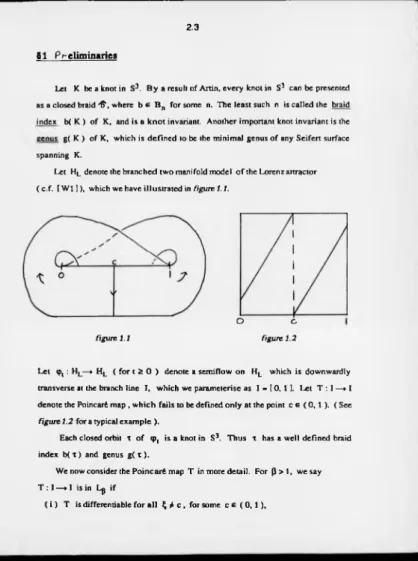
Let Hl denote the branched two manifold model o f the Lorenz attractor (c.f. [W l]), which we have illustrated in figure 1.1.
Let <pt : Hl —» Hl ( for t ^ 0 ) denote a semiflow on HL which is downwardly transverse at the branch line I, which we parameterise as I = [ 0,1 ]. Let T : I —► I
denote the Poincarfc map , which fails to be defined only at the point c g( 0 ,1 ) . (See figure 1.2 for a typical example ).
Each closed orbit x of <pt is a knot in S3. Thus x has a well defined braid
index b( x ) and genus g( x ).
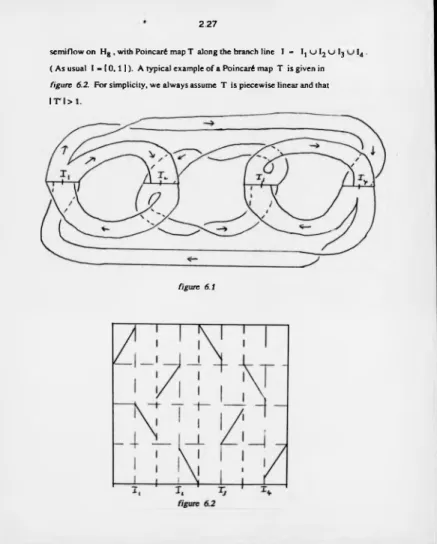
We now consider the Poincarfe map T in more detail. For P > 1 , we say
T : I —► I is in Lp if
( i ) T is differentiable for all £ £ c , for some c e ( 0 ,1 ) ,
O G
2 .4
( i i ) lim£t c T( £ ) - 1 , l i m ^ T( £ ) - 0. T (c ) - c , and
( iii) T ( $ ) £ P for all $ * c.
A map T : I —► I is called locally onto if for any open interval J, there exists
n
n > 0 such that KJ TJ J = I. This property was first introduced in [ PI ], and
and was subsequently employed in [ Pa ].
A particularly simple class of maps in Lp are the B - transformations, which take
the form
denote all finite sequences of x's and y's which terminate with infinitely many 0's.
Let X = X |U X 2 , and give X the topology induced by the metric
where u = ( un ), v - ( vn ) and un = -1 if un = x .and 1 if un = y.
Define the shift o : X—» X by ( a x )n = xn+1 . Let < denote the natural
lexicographic ordering on X . generated by the ordering x < 0 < y.
We say that k = ( k£ , k ,) e K if k£ , k , e X and ( A1 ) k£ < kj , and
( A2 ) k£ ^ o n k£ , o n kr ^ kj. for all n > 0.
Let K° denote all k = ( k£ , k,.) e K such that k£ 0 and ky jfc 1.
Kneading invariants arise in the following way. Let Tg Lp, and for £ € I, j-0
T $ " Tp .a( ^ ) ’ PS + a (m o d 1 )
for some 1 < (5 £ 2, a £ 0 and a + (3 £ 2 .
denote the space o f infinite, one-sided sequences of x's and y's
and let
^
( n {x,y>» n t o) )
d( u, v )
X
2"
2.5
define
i f £ < c k o ( ^ )
r
i f 4 * CL
y if £ > cand k i ( 4 ) = M tU ) .
The ( finite or infinite ) sequence k( % ) » kg( £ ) kj( £ ) k2( £ ) ... e X is
called the kneading sequence of £ € I. Moreover, the map ^ i—► k( £ ) is strictly
monotonic, and the shift a satisfies a ( k( £ ) ) - k( T( £ ) ).The kneading invariant
of T , k = k t■ ( k | , kp) € K is defined to be the pair ( k( 0 ) , k( 1 ) ) . A sequence k( ^ ) is T-admissable if and only if k( 0 ) < o m k( £ ) < k( 1 ) , and either
o m k ( £ ) « 0 or f o m k ( £ ) < k ( 1 ) ? for all m > 0 , (1 .2 ).
( o m k( £ ) > k( 0 ) J
Define the trip number T( w ) of a finite word w of x's and y's to be the number of
'xy' syllables in w. ( e.g. T( x2 y x y ) => 2 ). Suppose that a periodic orbit x has
kneading sequence w( x ). ( That is the finite, aperiodic word o f x's and y's, w( x ), is
repeated indefinately). Then define the trip number t ( x ) to be t ( x ) - T ( w ( x ) ) .
We say that K € K is linearly realisable if there exists a P-transformation with kneading invariant K.
A map T e Lp is called Markov if there exists a finite set { , ••• • ) c I
( containing c ) such that T( { ^ . . . ^ } ) c { ^ . Si . — . >•
( Strictly , we should write T( c+ ) - lim ^ T( 5 ) and T( c" ) « lim ^tc T( i j )).
Let A be a k x k matrix whose entries are 0 or 1 according to the rules
A ( i . j ) . f l if T ( i i .5 i+1) = < $ ,.( * ,,) (1 .3 )
[ o if T (5 i . t i+1) r . ( t j .5 j+1) - 0
I J f l ... k >- A (w „ .w n+1) 1 , for all n £ 0 }
2 . 6
and define a metric on EA by
The shift a : LA l—► EA is given by ( a w )n = wn+1 . We define a map 7C : SA —► I
by 7t( w ) = O T_n t , iL, 1. Then 7t is a semiconjugacy n a = T i t,
n n+1 n « 0
and 7t is Lipschitz ( by use of P in the definition of metric). The map n is one-to-
one except for a countable set of points, where it is two-to-one.
82
Markov Partitions
In this section, we derive conditions for the existence of a Markov P-
transformation realising a given kneading invariant. Our main result ( Proposition 2.2)
refines a result in [W2J.
Definition 2.1 [ G ] An element ke K is called renormalisable if there exist
finite words Wj , w2 of x's and y's respectively, with respective lengths N j , N2 with
Nj + N2 > 4 such that
i n. n, n, m. nij m-,
kt = w j w2 1 wj i w2 3 .... and 1^ = w2 Wj 1 w2 * Wj 3 ....
Let the shortest ( non-trivial) such choice be ( WjM , w2^ ) of lengths
( N2(D ). Then replacing wj^1^ by x and w2^ by y , w e obtain a
renormalised kneading invariant If this process can be repeated n tim es , but not
n+l times , ( using the shortest possible choice at each stage ), the kneading invariant
is called n-renormalisable. ( If T e Lp then n is finite, [ G 1 ). If K is not
2.7
Proposition 2.2 Let K = ( k e ,k r )G K and suppose that K is prime, and that
each of k£ , ky is finite or eventually periodic. Then K is linearly realisable by a map
T e Lp , and T is Markov.
The significance of Ky being prime is that it is a sufficient ( and necessary )
condition for T to be locally onto.
Lemma 2.3 [ G ] Let kt e K be the kneading invariant of T e Lp. If tcT is prime then T is locally onto.
Lemma 2.4 If T e Lp is locally onto and Markov then the transition matrix A is
irreducible.
P roof By hypothesis, T is locally onto, so for each interval Ji = ( ^ , £i+1) in the
"i
Markov partition, there exists n j> 0 such that t j T*Jj = I , for i = 1,.. ,k.
j - °
Thus in particular, for any 1 £ i, £ £ k, J£ n T> Jj ^ 0 . Hence j-0
"i "i
0 * T'"* ( Jf n U T jjj ) - T_ni( J £ ) n T"n j( U TJJj )
j-0 j-0
"i
- T-"' ( J£ ) n U T-i ( J | ) c T-"' ( J £ ) n J j , j-0
and hence T "' ( J£ ) o Jj ¿ 0 . Thus A (t , i ) £ 0 and , since i, £ were
arbitary, A is irreducible. □
Proof o f Proposition 2.2 Suppose that K is prime, and each of k£ , k, is finite
or eventually periodic. That is, each sequence is of the form w , w e X2 or u v
![figure 4.1. We parameterise the branch line I as [ 0 ,1 ] . A typical Poincari map](https://thumb-us.123doks.com/thumbv2/123dok_us/9869309.488127/18.504.64.471.25.588/figure-parameterise-branch-line-i-typical-poincari-map.webp)