An Analytical Account of Money as a Discursive Institution
in Light of the Practice of Complementary Currencies
Leander Bindewald, MSc. (Diplombiologe), M.A.
Thesis
submitted for the degree of
Doctor of Philosophy
Graduate School
University of Cumbria
and
Lancaster University
I declare that the research in this thesis is my own work. It has not been published or submitted for another degree elsewhere.
This thesis would neither have started or continued or been completed without the encouragement, support, friendship and love of many wonderful people near and far. Trying to leave notions of accounting and quantifying out for now, the following special few are mentioned in alphabetical disorder: Agnes, Dave, Geoff, Georgia, Jo, Josh, Kathrin, Katie, Osia, Patricia, Paula, Stephanie, and Tony.
Next to the guidance from my supervisors, Prof. Jem Bendell and Dr. Ian Chapman, my learning on methodology and social theory benefited greatly through the many timely pointers, explanations and challenges by Prof. Jérôme Blanc (Science Po Lyon), Dr. Georgina Gomez (ISS, The Hague), Dr. Bertie Kaal (Vrije Universiteit, Amsterdam), Rolf Schröder (RAMICS), Dr. Audrey Sleight (2nd supervisor of this thesis until September 2016), Dr. Kaz Stuart (University of Cumbria), and - distinctly enough to disrupt the alphabet - Visiting Professor Richard Little (University of Cumbria and Impact International).
During the years before I even considered to turn my zeal for the topic of money into a doctoral research project, it felt like I was standing on the shoulders of giants, and sometimes actually flying with them. My deep gratitude and respect goes to all the complementary currency and monetary reform practitioners and elders that shared their knowledge, time, hospitality, resources, and in many cases the most valuable gift of friendship with me. At the risk of forgetting some or many that also deserve a mention, here is explicitly to:
Andreas Bangemann, Annette Riggs,
Arie Ben David, Arthur Brock, Becky Booth,
Ben Dineen, Ben Dyson, Bernard Lietaer, Bruno Théret, Carlos de Freitas,
Declan Kennedy, Edgar Cahn, Edgar Kampers, Eric Harris-Brown, Etienne Hayem, Fernanda Ibarren, Frank Jansky,
Gaël Van Weyenbergh, Georgina Gómez, Graham Boyd, Henk van Arkel, Hugo Godschalk, Hugo Wanner, Igor Byttebier, Janelle Orsi, Jean-Francois Noubel, Jean-Luc Roux, Jens Martignoni, Jérôme Blanc, John Rogers, Josef Davies-Coates, Josh Ryan-Collins, Kathrin Latsch, Ludwig Schuster, Marc Brakken, Marco Sachy, Margrit Kennedy, Maria Scordialos, Mary Fee, Matthew Slater, Michael Linton, Michel Bauwens, Nigel Dodd, Norbert Rost, Otmar Donnerberg, Pat Conaty, Paul Gilbert, Paul Glover, Peter Krause, Philipp Degens, Richard Logie, Rob van Hilten, Rolf Schilling, Rolf Schroeder, Shann Turnbull, Simon Mont, Stephanie Rearick, Stephen DeMeulenaere, Susan Steed, Susan Witt,
Sybille Saint Girons, Thomas Greco, Tim Jenkins, Tom Salfield, Tomi Astikainen, Tony Greenham, Veronika Spielbichler, and Will Ruddick.
Last but not least, a very special thank you for the patience, understanding and countless catalytic conversations with which Katie Carr has accompanied me on the long and often steep road to completion. Also to Charlotte Mason for proofreading the final draft and Marcus Petz and Christophe Place for their thorough reading and suggested improvements thereof.
ABSTRACT...I
DECLARATION...II
ACKNOWLEDGEMENTS...IV
Part I – Theory
1 INTRODUCTION - THE ONLY CONSTANT IS CHANGE...1
1.1 WHYMONEYMATTERS...1
1.2 THEDIVERSIFICATIONOFMONEY...3
1.3 SITUATINGTHISINQUIRY...7
1.4 OVERVIEW...12
2 THEORETICAL BACKDROP - MONEY AS WE KNOW IT...19
2.1 TWOQUESTIONS: WHEREDOESMONEYCOME FROM?...19
2.2 SOCIALCONSTRUCTIVISM...26
2.3 CONVENTIONALACCOUNTSOF ‘MONEY’...31
3 CONCEPTUAL FRAMEWORK - MONEY AS A DISCURSIVE INSTITUTION...41
3.1 INSTITUTIONALTHEORIESOF ‘MONEY’...41
3.2 DISCURSIVEINSTITUTIONALISM...53
3.3 INAMANNEROFSPEAKING: MONEYANDCURRENCIES...58
4 METHODOLOGY- ANALYSING ‘MONEY’ AS A DISCURSIVE INSTITUTION...70
4.1 TRIANGULATIONANDTRANSDISCIPLINARITY...70
4.2 CRITICALDISCOURSEANALYSIS...73
4.3 PRACTICETHEORYANDCULTURALHISTORICAL ACTIVITYTHEORY...79
4.4 THEGRAMMAROFINSTITUTIONS...86
4.5 APPROACHTOLEGALANALYSIS...92
Part II – Analysis 5 DISCURSIVE CHALLENGERS - THE PRACTICE OF COMPLEMENTARY CURRENCIES...98
5.1 CHATANDTHETOPOLOGYOFAPRACTICE...98
5.2 CURRENCYINITIATIVESASACTIVITYSYSTEMS...103
5.3 ANALYSISOFINDIVIDUALACTIVITYSYSTEMS...109
5.3.1 BRIXTONPOUND (LONDON, UK)...109
5.3.2 SARDEX (SARDINIA, ITALY)...117
5.3.3 DANECOUNTYTIMEBANK (MADISON, WI, USA)...123
5.3.4 BITCOIN...130
5.3.5 SUMMATIVECOMPARISONOFSELECTEDFINDINGSFROMTHEFOUREXAMPLES...139
6.1 BANKTALK...146
6.2 BANKOFENGLANDCOMMUNICATIONS...151
6.3 GRAMMAROFINSTITUTIONS: PROCEDURE...152
6.4 GRAMMAROFINSTITUTIONS: FINDINGS...157
6.4.1 CONSTITUTIVESTATEMENTS...157
6.4.2 EXPLANANDA ANDCOLLOCATIONS...160
6.4.3 LOGICALFALLACIES...162
6.4.4 TOUCHINGTHEVOID: THEGOLDENMIRAGE...166
6.5 CONCLUSIONS: MONEYMADESIMPLE...169
7 MAPPING A BLINDSPOT- LAWFUL MONEY AND LAWLESS MONEY ...173
7.1 HISTORICALDEVELOPMENTSOF ‘MONEY’ ANDBANKS...174
7.2 ‘MONEY’ AND ‘CURRENCY’ INMODERNSTATUTES...182
7.3 SUMMARYANDCOMPARISONWITHEUROPE...194
Part III – Implications and Conclusions 8 IMPLICATIONS - FOR THEORY, POLICY AND RESEARCH...200
8.1 IMPLICATIONSFORMONETARYTHEORY...200
8.2 IMPLICATIONSFORPOLICY...210
8.3 IMPLICATIONSFORMETHODOLOGY...219
9 CONCLUSIONS - THE NOUVELLE VAGUE...227
BIBLIOGRAPHY...234
1 Introduction
-The only constant is change
When demonstrators broke through police lines and smashed the windows of the RBS, [...] it appeared that the revolution [...] might materialise. Once they had broken into the bank, however, the protesters did not quite know what to do.
Patrick Barkham (The Guardian): G20 Protests, April 2009
1.1 Why money matters
country during the recent decades of economic uplift. Even after the credit crunch following the financial crisis in 2008, they continued to provide productive loans to the ‘real economy’ whereas in other countries lending to small businesses came all but to a halt (Greenham and Prieg, 2015, chap. 4).
This example from the world of banking is just one illustration of how institutional elements of our financial system can have a more profound influence on the fabric of our economies and societies than is often recognised or acknowledged. That the arena of finance as a whole has a strong grip on our societies and democracies became apparent in the aftermath of the global financial crisis and it continues to make headlines with the continuing sovereign debt crises and quantitative easing programs in the UK, the USA and Europe. In fact, even before this recent crisis, the World Bank had identified 96 banking and 176 financial crises between the years 1971, the beginning of our current monetary regime, and 1996 alone (Caprio and Klingebiel, 1996). This number indicates that it could not simply be bad management, greedy individuals or inappropriate regulation that ails our financial systems, but that the issue is "systemic” (Lietaer et al., 2012).
However, that systemic issue and the topic of this thesis is not primarily to do with banking, finance, or what is commonly called the ‘financial system’ as a whole. Instead it is the most fundamental element common to all these: money. And, in contrast to how money is often discussed, it is not about how much or how little of it is available or what any individual or government ought to do with it. Instead it is the nature of money that is posed as the central issue here. As much as it might seem that financial or banking crises have nothing to do with the kind of money that is used to measure their effects, but rather depend on political or behavioural decisions made by the individuals and institutions that use it, it will be argued here that the two are intrinsically linked. Money is not a neutral given, but exists because of the way people think about, talk about, and use it.
implicated in inequalities locally and globally, as well as the environmental arena, where the need for climate mitigation runs against so called economic constraints (Lietaer, 2002, chap. 1).
The potential for an exponential increase in wealth is not only measured, but also facilitated by a monetary system that has emerged in step with the capitalist, shareholder oriented paradigm, for which inequalities and ecosystem destruction appear more as symptoms then independent issues. It is the “pathological growth imperative” (Kennedy, 2012) built into our current globalised monetary and financial systems that cannot be changed by calls for government intervention towards redistribution and a turn to conventional ‘green finance’ (Barkawi, 2017). A more fundamental change of our monetary and financial systems is needed to achieve social stability and environmental sustainability (Bendell and Greco, 2013). From natural ecosystems to technological and social complex flow systems, diversity is a necessary ingredient for systemic resilience (Ulanowicz et al., 2009). In the economic domain, this is relevant for the organisational set-up of national banking systems (Berry, Ryan-Collins and Greenham, 2015) as much as for the number of different exchange systems that facilitate economic activity in service to the provision of needs, rather than an increase in shareholder value (Goerner, Lietaer and Ulanowicz, 2009).
1.2 The diversification of money
It was not only the financial crisis which started in 2007/08 that brought up questions about the nature of today's monetary system and calls for it to change. A second factor that sparked discussion of change and showed how money can, in principle, be very different was the rise of Bitcoin1 since 2009, or actually the exponential increase of the market price of individual units that are transacted on the Bitcoin network. The media coverage about windfall gains for early bitcoin investors led to a widespread awareness that there are potential alternatives to the money we commonly use (Bholat, Grant and
Thomas, 2015). In addition, with the price of a bitcoin peaking at nearly 20,000 USD a the end of 2017 and a plethora of new cryptocurrencies contributing to, and benefiting from the hype, the topic even made headline news on main stream media and started an active field of research and practice. However, Bitcoin or the blockchain technology underlying it were not the first innovations in the field of ‘new money’. A much broader practice of non-governmental monetary systems has existed in parallel to mainstream money throughout large part of history (Martin, 2014, chap. 4) although for most parts, these have been thinly spread, fragmented and consequently marginal and continue to be hardly visible to the contemporary public. Advances in information technology in the 1980s have led to a faster spread of ideas and implementation tools, which ultimately coalesced under a unifying term ‘complementary currencies’ (hereafter abbreviated to CCs) used as a common identifier amongst practitioners and researchers around the world (Blanc, 2011; CCIA, 2015h, p. 33). Cryptocurrencies fall within this field, along with so-called ‘local currencies’, ‘time banks’, tradeable loyalty systems and business-to-business currencies. Not counting Bitcoin and other blockchain based currencies, three waves of innovations have already been identified in this field over the last 3 decades (Blanc, 2011), which have moved from sectoral or grassroots initiatives to systems that also involve or are even driven by the public sector (Amsterdam City Council, 2015). Even established academics like David Graeber have recognised CCs as an "essential element in any solution" (see in De Grave, 2013) to the financial and economic issues described above.
of all Members of Parliament still believe that money in the UK is only issued by the government via the Bank of England and the Royal Mint, and that over 62% stated that it was false to believe that commercial banks create money when they issue a loan (DODS, 2017). This ignorance amongst politicians can be assumed to be similar amongst the general public.3
On the other hand, many people who are enthusiastic about Bitcoin espouse misguided beliefs about what it actually is or what it is good for (Reynolds, 2017). If the hope for an easy windfall can be counted amongst the most obvious motivations to invest in cryptocurrencies, big and small, the potential for actual deep-rooted change in the monetary domain seems even further off. Under scrutiny Bitcoin appears not any more egalitarian or sustainable than conventional currencies. Even though it is ultimately impossible to know which person or organisation owns which or how many Bitcoin wallets and the bitcoins therein, it is assumed that on some indicators, such as wealth inequality, Bitcoin fares even worse than the global economy (Fung, 2014; Niel Kondor et al., 2014; Kharif, 2017).
While many complementary currencies are deliberately designed for the benefit of the disenfranchised, they are not only hampered by public ignorance about the concept and practice of money, but actually threatened by the ambiguity of what money is even in legal terms. For example, Will Ruddick, currency innovator in Kenya, and his collaborators found themselves imprisoned just ahead of the launch of the Bangla Pesa4, a currency designed to provide the small traders in an informal settlement near Mombasa with self-issued media of exchange to bridge the lack of liquidity in the local micro-economy (Ruddick, Richards and Bendell, 2015). The charges of forgery, which were based on the impression of local law enforcement that the private issuance of something akin to money must be illegal, were later dropped. The
3 This thesis will not dwell on explaining the process and problematique of most conventional money in circulation today being created by commercial banks when they extend a loan to an individual or business. For readers uncomfortable with this viewpoint, the reference to the bandwidth of publications mentioned both from heterodox and orthodox authors and institutions spanning from radical to conservative is expected to console, at least methodologically. For those unfamiliar with the process of money creation, a short
publication by KPMG for the Icelandic Government can serve as an ‘executive summary’ of the topic (KPMG, 2016).
group was released, and their model has since spread with endorsements of local governments to other localities in Kenya and South Africa. Other examples, none so dramatic but all hampering the implementation and adoption of currency innovations, will be discussed in later chapters.
Common to all these cases is that the dominant discourse of money, as established by the media, financial regulators, and the law, has direct effects on the implementation of CCs in terms of their compliance with law or illegality. This conceptual under-determination of money also appears in the different and sometimes conflicting framings of money and currency employed by different practitioners and approaches (CCIA, 2015b). Yet with no coherent theoretic frameworks to understand all kinds of complementary currencies along with conventional currencies such as the Pound Sterling, the US Dollar or the Euro, the contribution that novel monetary practices make to theory and as tools for systemic financial change and sustainable development remains underappreciated.
With the broader conceptual framework for money and currencies here proposed, there are other emergent social and economic phenomena which can be understood as part of this inquiry even if they seem to fall far outside the conventional definitions of money. Rachel Botsman, looking at new business models and collaboration platforms of what she called the ‘Sharing Economy’ (Botsman and Rogers, 2011), had started to use the term ‘reputation capital’, in concurrence with financial capital, and also described, along with other commentators, trust and reputation metrics as ‘currency’ (Birch, 2014; Schlegel, 2014; Burrus, 2016). As far removed from conventional currencies as those might seem, the latest developments of a state-mandated citizen reputation system currently being tested in China, links those two terms directly. This form of reputation is not only said to determine access to public services but also to bank credit (Botsman, 2017a, 2017b, chap. 7).
rating for vendors and buyers). However, considering those systems as ‘money’, in a broader sense, allows for a fundamental reappraisal of the kind of metrics we want to base our societal relations and collaborations on, which includes national currencies as much as private systems. In this sense, money will here be framed as “a social design that then designs the social” (Bendell and Slater, 2014, p. 29) and the phenomena of novel technologies and currencies of various forms serves as a starting point to better understand and conceptualise fundamental theories of money today. In the words of Jérôme Blanc as one of the preemminent scholars on the topic: “The empirics of contemporary, so-called community and complementary currencies display various links that help to understand this complexity: it constitutes a field of observation that contributes to the critical examination of both orthodox and heterodox economist approaches to money.” (Blanc, 2017, p. 256)
1.3 Situating this Inquiry
Before giving an overview of how this thesis will contribute to the understanding of complementary currencies and monetary theory a few points will be raised to position not only the topic and the findings of this thesis, but the research itself. For the duration of my PhD programme I was based at the Institute for Leadership and Sustainability (IFLAS)5 which is part of the University of Cumbria’s business school. Combined with an academic background in natural sciences (master-level degree (Diplombiologe) in Neuroscience, University of Freiburg, Germany 2007) and philosophy and business administration (Magister Artium at the same university in 2009) the methodological approach to the topic of money had been informed by various disciplines from the start of the learning journey that finds its conclusion with this thesis. In the years prior to the inception of this current study, I had been working on complementary currency, and for initiatives in that field, in several countries. This non-academic ‘on the ground’ engagement with the topic necessarily added a distinct practitioner’s perspective to the conceptual and methodological approach to this thesis.
Most relevant for the development of the final research question and the progression of the analysis however was a position as the principal researcher and project manager for the EU Interreg programme ‘Community Currencies in Action’6 (CCIA, 2012) at the New Economics Foundation7 in London. The aim of that project was to showcase complementary currencies of different kinds as policy delivery tools for local governments. With project partners including the City of Amsterdam, the public bank of the City of Nantes, the Borough of Lambeth in London and the public waste disposal company of the region of Limburg in Belgium, six different currencies in England, Wales, France, Belgium and the Netherlands were implemented or scaled up during the three year project, all of which continue today and one of which will be analysed in Chapter 5. The research and advocacy of the project included the impact assessment of complementary currencies (Steed and Bindewald, 2015), a robust implementation framework (CCIA, 2015h), the development of an online trading platform and the survey of legal and compliance issues for currency initiatives (CCIA, 2015b). The latter was also a precursor to the legal aspects of the research in this thesis, and the establishment of collaborations that were drawn upon for Chapter 7. During the lifetime of the project and beyond I was also called upon for expertise and commentary on novel currency phenomena, particularly Bitcoin, on national and international media.
Predicated in parts by this previous engagement with the topic, the research question that guided this inquiry was whether and to what extent the framings and presentations of money in financial regulatory discourses are consistent with modern monetary practices - particularly when broadening the scope of what is considered as money to include complementary currencies. This broad scope required the research to be not solely defined by existing theories and research programmes about money, neither from disciplines of economics nor sociology. They will be, however, integrated as a backdrop to this inquiry and will be supplemented and discussed in regard to a clear distinction between the two meanings of the word, the concept of money and the actual money we use. This in turn led to the development of an inclusive
theory of money, in both its meanings, as a ‘discursive institution’ or a system that regulates our ideas and behaviour, but is itself constituted and changed by these same ideas and behaviours. It also required the application of a transdisciplinary suite of methods to three varied sets of data. This approach consistently encompasses the conceptual as well as the concrete phenomena from Pound Sterling - in the form of paper notes, coins and electronic bank balances - to Bitcoin and all other forms of complementary currencies.
In this way, the analysis presented here amounts to an ontological account of money that aspires to be applicable to everything that is presented as such, across such diverse texts as the publications of the Bank of England, the law of the United States or the literature on complementary currencies. Apart from this conceptual work, the original contribution of this thesis is: to present complementary currencies as activity systems (Chapter 5) and to highlight the inconsistencies of what counts as money and currency in publications of the Bank of England (Chapter 6) and in the law of the USA (Chapter 7). The findings from this thesis are relevant for monetary theory in general and in particular for its relations to the emergent field of multidisciplinary research on complementary currencies. It also bears implications for policy and advocacy in regards to monetary reform and the implementation of and engagement with monetary innovations (Chapter 8).
With this relatively broad scope, any answer to the question of ‘What is money?’ cannot only rely upon economic or sociological perspectives, as it needs to consider how individual actors use, define and, particularly in the case of complementary currencies, issue money. This necessarily also encompasses organisational and political dimensions and it would seem impossible to arrive at conclusions that are entirely free from the influence of individual preferences, or socio-cultural ideologies, both in terms of the constituencies that use money in its different forms and the authors that write about it.
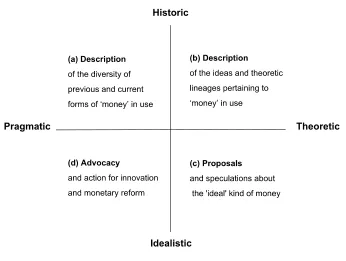
positioned on a scale from the purely descriptive (‘what is’) to the normative (‘what ought to be’), and the researcher’s disposition can be either theoretic or practice orientated in nature. To exemplify these different approaches to the topic of money as polar positions, the following matrix (Figure 1) has been adapted from one of my previous research papers (Bindewald, 2007). Pointing out these different ways of engaging with the topic of money comes without any claim that the positions marked in this matrix are exclusive to a particular methodological or disciplinary practice and without pretence that such strict separation is found in the existing literature on money, or this thesis. However, in light of the above epistemological question, this schema is helpful in discerning the underlying predispositions found in the studied literature and to help reflect on the thesis at hand.
Fig. 1: Ways of engaging with the topic of money.
Adapted from Bindewald (2007).
unusual forms of money like cowry shells, wampum belts (Szabo, 2005) and fei stones (Martin, 2014, chap. 1). A puristic inquiry in the historic-theoretic quadrant (b) however would not describe the actual money systems in use but the different ideas about or concepts of those systems, including their intellectual relationships and lineages as in ‘schools of ideas’. Continuing clockwise, the idealistic-theoretic quadrant (c) represents not descriptive but normative concepts of what an ideal money system should be like regardless of what system is or was in use. Naturally, the features and effects of a novel monetary system described from this position is based on the author’s perception of the shortcomings of historic or the present systems. Finally, the idealist-pragmatic approach (d) would not stop at the description of an ideal or better form of money but aim for its implementation through advocacy or direct action. This position can be ascribed to the various efforts for monetary reform emerging around the world (compare International Movement for Monetary Reform, 2018) and in the field of complementary currencies in which new ideas of money are tried out and put into practice often in disregard of conventional money and the theories and regulations it is based on.
currencies, conventional and complementary, also blends the historic-pragmatic with the historic-theoretic position. Moreover, much of the literature on complementary currencies is characterised by the fact that their authors are, as one academic reviewer described it, “enthusiasts seeking to attract support for their cause” (Cohen, 2004, p. 241) and thus often mixing all four positions.
However, with the social constructivist framework that is introduced from Chapter 2, and the explicit exposé of the author’s background above, a critical reflection on the epistemological limitations of the findings of this thesis and their implications can be offered in the concluding chapters. This critical reflection will also include an appraisal of how far the aspiration to provide an ontological concept of money (as here presented in Chapter 3), capable of encompassing all historic and present phenomena of money, has been achieved. In this sense it is hoped that the warning that money “is a term so frequently used and of such importance that one is apt to overlook its inherent difficulties” (Proctor, 2012, p. 6) is here treated with due and critical care.
1.4 Overview
For this, complementary theoretical elements and methodological approaches will be introduced in Part I (Chapters 2, 3 and 4). The historic and ongoing debates about the nature of money particularly within and across the disciplines of economics and sociology, will be reviewed in those chapters and a new unifying approach, that of “money as a discoursive institution” will be suggested and its theoretic foundations and methodological operationalisation for the analytical chapters explained.
The transdisciplinary analytical part (Chapters 5, 6 and 7) will then apply these methodologies to different phenomena of money, starting with the description of complementary currencies as a field of practice and then focusing on notions of conventional money in the texts of central banks and finally the law. In this, the analysis will review and extend the approaches to understand complementary currencies found in the contemporary literature and contribute to their conceptual commensurability with conventional money. It also provides a critical view of the theories of money found in the publications of the Bank of England, particularly since the year 2013, when the public awareness of complementary currencies (from so called local currencies to Bitcoin) challenged commonplace assumptions around the topic and elicited vigorous expert and non-expert engagement on the topic. The last of those analytical chapters scrutinises the legal frameworks of money and thus contributes to the ongoing debate about their appropriateness for modern banking practises and the emergence of complementary currencies as widely used means of payment.
The last two chapters will present the implications of the findings across all previous chapters for theory, policy and research and draw conclusions in light of the issues and current development mentioned above.
throughout the progression of the thesis. Some sets of the literature were selected throughout my eight year engagement with the topic in general, and my engagement in the academic community on complementary currencies and their international research association RAMICS8 and their interdisciplinary journal, the IJCCR9. Others, particularly on methodology, were identified through the courses taken at the University of Cumbria during this PhD programme and the feedback received on presentations of earlier stages of this research at specialist conferences like ‘Monetary Institutionalism in the French Speaking World’ (IMF, June 2016, Lyon10), the Summer School on Discourse Analysis (July 2016, Vrije Universiteit Amsterdam11) and the annual Critical Discourse Analysis conference (CADAAD, September 2016, Sicily12).
From the publications thus identified, an inductive literature search followed the mentioned concepts and references therein. Particularly for the broad scope of the overall topic and the number of particular interests that the research question touched upon, this process was deemed to lead to more coherently linked and insightful references than a database driven systemic search. The ‘objectivity’ that is otherwise associated with technology enabled systematic literature reviews was thus substituted with hands-on knowledge of experts and the insights from the leading edges of their respective disciplines (compare Jesson, Matheson and Lacey, 2011, p. 15).
Chapter 2 (Theoretical backdrop - Money as we know it) presents two foundational ideas that inform the engagement with the topic throughout the thesis and continues to gives an overview of dominant historic theories of money which both provide the backdrop to the next chapters. First the distinction between ‘money as a concept’, and the implementation of that concept in the form of ‘money that we use everyday’ is made. The second foundational idea is the philosophical framework of social constructivism and
8 Research Association on Monetary Innovation and Community and Complementary Currency Systems, see http://ramics.org [last accessed 05.01.2018]
9 International Journal of Community Currency Research, see http://ijccr.net [last accessed 05.01.2018]
10 See https://imf2016.sciencesconf.org [last accessed 05.01.2018] 11 See
its implications for the new theory of money that will be introduced in the following chapter. The third section of Chapter 2 traces concepts of ‘money’ in well known comprehensive accounts of the topic, with particular attention to the dichotomous comparison of metalism and chartalism in the 19th and 20th century.
Chapter 3 (Conceptual framework - Money as a discursive institution) then first reviews a third major theory of money, that of money as an institution, and the way in which different authors refer to this concept, including a review of the philosophical contributions of John Searle (2005, 2006, 2010) and his accounts of money as an example of what he calls ‘social facts’. Building on the idea of an institution as a system of rules that stem from and pattern social behaviour the second section will make the theory of ‘money as an institution’ more specific and operational by describing the concept of ‘discursive institutionalism’ (Schmidt, 2008, 2010, 2015). This relatively new branch of neo-institutional theories goes beyond the description of institutional phenomena by focussing on the discursive interactions through which rules and norms come about, persist and can change. This leads to the analytical framework here proposed which views money and currencies as discursive institutions.
other forms of unit systems that express certain shared values, but cannot be transacted.
Chapter 4 (Methodology- Analysing ‘money’ as a discursive institution), the last chapter in the theoretical Part I, has five sections, the latter three of which relate specifically to the three chapters in the analytical part of the thesis. The first section explains the transdisciplinary nature of the chosen methods and provides some general remarks on the analytical process that the second part of thesis is based on. Section two provides an introduction to critical discourse analysis (CDA) (Fairclough, 2010) in order to elucidate the nature and scope of what was introduced as discursive processes in Chapter 3. This completes the conceptual elaboration of the term ‘discursive institution’ and provides a common denominator for the following three distinct methodologies to be applied individually in the analytical Chapters 4, 5 and 6.
definitions of money and currency in the eye of the law that is necessary for this study.
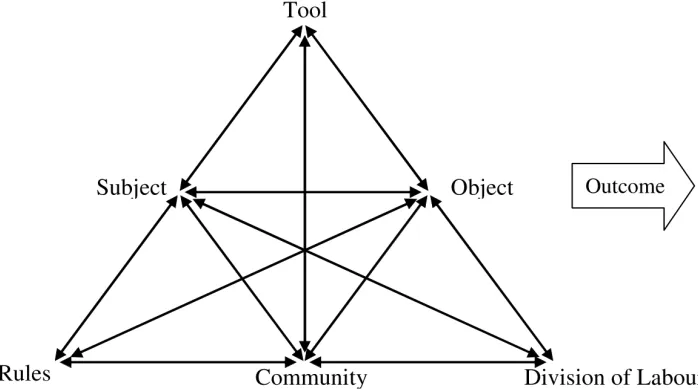
With Chapter 5 (Discursive challengers - The practice of complementary currencies)the threefold analytical part of the thesis begins. It will explore four different complementary currencies as unconventional implementations of the concept of Money and their relation to ‘money as we know it’. Section one will provide a brief overview of the field of complementary currencies and some of the emergent research strands that relate to it. Section two will explain how currency initiatives will be analysed as ‘activity systems’ according to Engström’s CHAT model and the framing of money as a discursive institution. The following sections will then give individual analytical accounts of the complementary currencies broken down by the six elements of the CHAT model. The examples chosen for this chapter are 1) the Brixton Pound (London) 2) the Sardex, (Italy) 3) the Dane County Time Bank (USA), and 4) Bitcoin. These initiatives were chosen for their heterogeneity and the unusual depth of data publicly available about them. A final section will consider the findings from this analysis in regard to the question if complementary currencies constitute a field of practice in relation to Money, and how this relates to their framing as discursive institutions.
Appendix. Subsequently, one peculiar aspect, the reference to gold, found across many of the publications parsed and other communications by the Bank of England, will be scrutinised. The final section in this chapter will summarise the findings and relate them to the progression of the thesis thus far.
Chapter 7 (Mapping a blindspot - Lawful money and lawless money) progresses from the findings of Chapter 6 in regard to the notion of ‘money’ espoused by the Bank of England and asks if there is a clear definition of money in the law. For circumstances explained earlier, previous research relations with lawyers in California provided the opportunity to study the law in the USA under the guidance of legal professionals. Because money is predominantly issued by commercial banks today, the history, development and legislation in regard to banks in the USA is also analysed in this section. In the second section, the definitions and descriptions of money in the contemporary codified statutes, state laws and rulings of the USA and California are researched, with the finding that money and currency are mostly ambiguous concepts that suffer from the overlapping meaning of the word ‘money’ for the concept and its implementations across the legislation in the US. A final section draws together the findings from this analysis and their relevance for the overarching inquiry of the thesis.
2 Theoretical backdrop - Money as we know it
The eye has never seen, nor the hand touched a dollar. All that we can touch or see is a promise to pay or satisfy a debt due for an amount called a dollar.
Alfred Mitchell-Innes: What is money?, 1913
2.1 Two questions: Where does money come from?
As was alluded to in the introduction, a critical engagement with money can take many forms and perspectives. In this chapter two points will be discussed to prepare the ground for the analytical parts of the thesis (Chapters 3 - 6): firstly, an overview of theories of money, and secondly the introduction of a novel way to describe money that will form the underlying understanding or ‘hypothesis’ for that analysis. This way of looking at money as a ‘discursive institution’ will implicitly be tried out and tested in the following chapters and reflected on in the concluding Chapters 8 and 9. However, before setting out with either of these, two more fundamental conceptual points will be made in regard to the way this thesis will discuss money.
The first of those two points concerns an ambiguity of the term ‘money’ that appears in most contexts but is particularly relevant when discussing novel and heterodox theories. The title of a seminal book written and published in 2011 by researchers at the New Economics Foundation13, the Positive Money14 campaign and the University of Southampton (Ryan-Collins et al., 2011) helps to illustrate that point: The question that the authors had chosen as the title of their book and which they set out to answer, namely “Where does money come from?”, can be read in two interconnected but distinct ways. To start with the more practical one, the question can simply refer to the
notes and coins we have in our pockets and the numbers shown in our bank accounts. “For many people 'money' means 'coin' and what [...] is really being asked is ‘How did coinage begin?‘” (Grierson, 1978, p. 2) In this more naive interpretation of the question, the contemporary answer would simply point towards the Royal Mint in Wales for coins and the Bank of England in London for banknotes. Also, much more relevant today than in the days when Grierson wrote the above quote, it is the computer terminals at any local bank branch which the electronic units in our bank accounts, that are commonly identified and used as money, originate from. However, that would only refer to the origin of those concrete units with which we count our personal wealth and use to pay for the necessities and niceties of life.
An extension of that same reading of the question would ask for the authorities and their rules or laws that govern the issuance, or the ‘putting-into-circulation’ of those same units. The answer in this case is likely to be more abstract as it includes power structures, legislative procedures, licences by the Financial Conduct Authority (FCA)15, the setting of capital and liquidity requirements, and the influence of rating agencies, central bank and monetary policies. It would also include concepts such as ‘quantitative easing’ and ultimately the question of democratic or public involvement in setting those rules versus the delegation of all those elements to expert committees. This extended reading of the question “Where does money come from?” looks at money not only as a material or digital ‘object’, but as a political, and by the natural extension of that term, a social phenomenon. It considers not only the object of money, but also the subjects and entities that spend, receive, create, allow, commission and ultimately ‘do’ money. A paraphrasing of this reading would be “How come we have, today, this kind of money and monetary system and no other? And how does it work in detail?”.
There is, however, a second completely different reading of the same question that leads to the point of ambiguity of ‘money’ that needs to be made explicit at the outset of this inquiry. This second reading refers to the concept or idea of money in general, independent from the current monetary regime
with its concrete units, material or virtual which we use as money and with which economists count and recount the world. A paraphrasing of this second reading would ask how it came to be that such a thing as ‘money’ exists in the world, and what the nature of it is and if we could not do without it. These are, ultimately, questions of ontology or the nature of money and it is this kind of inquiry that this thesis is concerned with. This reading does not look primarily at the practicalities of money, how it is put into circulation and subsequently used, but invokes the heuristics of philosophy, sociology, and the sub-disciplines of historic anthropology and economic history.
However, as distinct and deep as this reading of the question, “Where does money (as a concept) come from?” is, it also has bearings on the first reading of the question. This is because no actually existing money or monetary regime can do without a underlying, conceptual theory of money - at least implicitly. On the other hand, as will be illustrated further on, the interdependence between those two readings of the question and the two meanings of the term ‘money’, the concrete and the conceptual, is also relevant in reverse: the money we find in our pockets right now, influences the personal and collective ideas we have about money on a conceptual level. The concrete money we were first sent to the shop with when we were small children, to buy milk or sweets, gives form and, if never challenged, a limitation to our imagination as to what money could be in general. We develop a bias towards what Keynes called “money as we know it” (Keynes, 2003, p. 208). Even if most people will readily be able to name a few historic forms of money - like shells, gold coins, cigarettes etc. - that are so very different from today’s Pound Sterling, it is not only our concept of money that determines its possible implementations, but it is the commonly used implementations that in turn affect our collective conceptualisation.
are seen as ‘not like money’, because they do not resemble the forms and use cases of the money that the observers knew from their own cultural context (see for example Dodd (2014, p. 32) on Malinowski), the concrete forms of ‘money as we know it’ have set the limits of conceivability for the concept of money. Given this interaction between the concrete and the conceptual any straightforward answer to the question “What is money?” can hardly be expected to both empirically and theoretically robust. Depending on the motivation and intended audience most answers will fall somewhere between the trivial and the vague. If the way of viewing money that this chapter is building up to can offer any epistemological advantages and provide both universality on the conceptual level as well as operability in practice will be reviewed in the concluding chapters of this thesis.
The book that lent its title to this section (Ryan-Collins et al., 2011) is primarily lauded for the first comprehensive and systematic answers to the first readings of the question “Where does money come from?”. It describes in detail how the three predominant forms of money in the UK - bank deposits, cash (notes and coins) and electronic central bank money - enter circulation in what was later dubbed “the modern economy” (McLeay, Radia and Thomas, 2014a). However, as technical and revelatory as that process might be in and to itself, at least for most lay readers, neither that book nor the later publications by the Bank of England, that confirmed the contemporary process of money creation by commercial banks, do without excursions into the historical and philosophical territory that pertains to the second reading of the question as discussed above.
experiences in regard to money seem conducive to the acceptance of the argument with wider-than-expert audiences. They also shroud the presentation of the concrete in a cloud of what Dodd calls the semi-normative “origin myths” of money (Dodd, 2014, p. 47). This nexus of stories and framings in monetary theory will be discussed in more detail in Chapter 8.
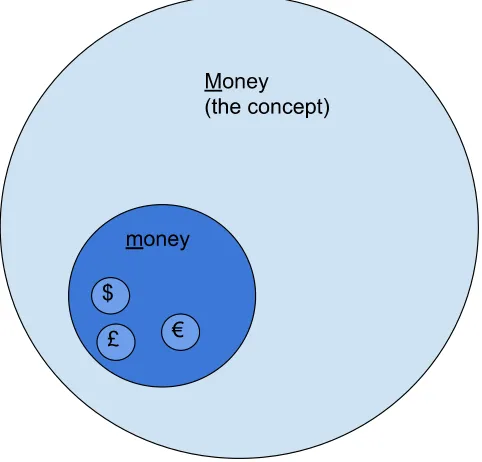
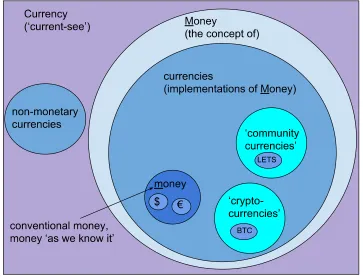
[image:32.595.198.439.384.615.2]For now, two meanings of the word ‘money’ will be submitted as the first foundational distinction of this thesis. On the one hand the word refers to ‘money as we know it’, the units we use every day and with which most of us will have been familiar since childhood. In the UK, that is Pound Sterling in its different forms, in other constituencies the same is known by different names like Euro, Dollar or Yen. On the other hand there is ‘money as a concept’, the wider and more elusive idea that seems as familiar and taken-for-granted and yet, if asked about, becomes strange and hard to describe.
Fig. 2: The relationship of the concept of Money and ‘money as we know it’.
To mark this distinction, the capitalisation of the word ‘Money’ will be used to refer to the ‘concept of Money’. This is in direct analogy to the use of capital letters in Platonic idealistic philosophy16 where a word written with a capital letter refers to the idealistic concept of something, an archetype. The word
Chair, for example, with a capital C means the general concept for all the everyday material objects that fall into this category. Written with a small c, the same word refers to any one of the particular instances or representations of that category, for example the chair one might be sitting on while writing or reading this paragraph. In this latter sense the word money with a small m will be used in this thesis to refer to the particular form or implementation of the general concept of Money that we carry around with us and which probably comes up in our minds when we are asked to picture ‘money’. This categorisation of Money and money is an original suggestion and should not be harder, in theory, to observe as with other analogous distinctions. It seems obvious, for example, not to speak of identity in general when we discuss national passports, or not to use the word transport as synonymous with cars. In practice however, steering clear of the ambiguous use of the two meanings of ‘money’ is difficult to achieve.
The relation of the two terms, money and Money, is here visually depicted as two concentric circles (see Figure 2). The way they have been presented so far clearly assigns the smaller circle to money, the particular and specific implementations that can never fully exhaust all the different forms that could theoretically be imagined in the scope of the big circle which represents the concept of Money. However, the graphical representation of this distinction raises the question why the different forms of money that people use in different countries are not depicted as individual subsets of Money. This is because of the contrast of all forms of ‘money as we know it’ with what will later be introduced as ‘complementary currencies’. Compared to these very different forms of money, all ‘national currencies’, the Euro, Pound Sterling, Dollar, Peso, etc., seem very much like the same kind of money. Thus they are here treated as the same implementation of the concept of Money, which in the following will also be called ‘conventional money’. This conceptual point is also consistent with the homogeneous way most of those ‘national currencies’ are issued today. Particularly since the Bretton Woods Conference at the end of the Second World War, the monetary and banking systems all around the world have converged on very similar modi operandi, with the US Dollar as their common ‘reference currency’ and various international institutions, like the World Bank17, the International Monetary Fund (IMF)18 and the Bank for international Settlements (BIS)19 contributing to the recognition and consolidation of this dominant monetary regime.
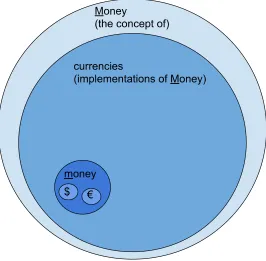
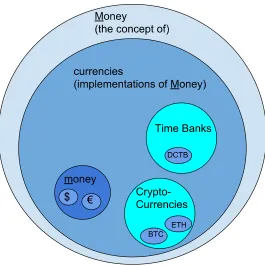
At the end of this chapter we will also come back to the relation of the term ‘currency’ - including and transcending its common use in ‘national currencies’ - in regard to the terms Money and money and elaborate on this in a more complete version of the graphic depiction of those terms. Before that, the second conceptual notion that was alluded to at the beginning of this section needs to be introduced.
2.2 Social constructivism
The theory of knowledge called social constructivism can be traced back to the 1970s when it emerged at the confluence of certain research questions in philosophy, psychology, cognitive theory and sociology. It posits that knowledge is only ever a property of, and constituted by, our perceiving and processing minds. According to this proposition, to ‘know’ something becomes a process, rather than a certainty, because the predisposition of the observer - physical, phsycological, emotional and mental - and his or her expression of what is being observed are of equal importance with the ‘nature’ of the object that is observed or talked about (Gergen, 2009). There is no ‘objectivity’ that requires us to talk about a certain phenomenon in a certain way. “Everything said is said by an observer to another observer that could be him- or herself.” (Maturana quoted in Riegler, 2005, p. 4)
What follows from this is a sceptical alertness about the subjective nature of all descriptions of the world, even when personal descriptions are joined into collective ideas. Notions of truth, reality and objectivity become less robust or self-evident and need to be equally reconsidered as socially constructed as the objects, statement or ‘facts’ that would commonly be described as true, real or objective. “Truth cannot be out there - cannot exist independently of the human mind - because sentences cannot so exist, or be out there. The world is out there, but descriptions of the world are not.” (Rorty, 1989, p. 5) Furthermore, for the radical social constructivist, this is even valid when talking about material objects of which our senses give us a very convincing impression of their ‘reality’. Even while we knock our hand on the table in front of us, nothing about that table can ever be expressed other than in words - and those very words and the concepts they express are always socially constructed (Edwards, Ashmore and Potter, 1995, p. 26). This creates the fundamental divide between what we can know about the world and what the world out there might ‘actually’ be like, including that table that we might even have bruised our insistently banging knuckles on.
and the way we can talk about them is known as the ‘linguistic turn’ in social sciences. The foundational work that enabled and demanded this turn, a long time before the idea of social constructivism emerged, were the later works of Ludwig Wittgenstein. In his concept of ‘language games’ (Wittgenstein, 1986) he unravelled how the words we use cannot so much be seen as representations of the world around us but rather as entities to themselves that are in principle independent from that which we employ them to describe. In this way he warned that the correspondence of our words with the phenomena outside of us purely depends on the way we use those words in our communication, be it written or verbal. No other relation can safely be assumed.
This does not only lead to many equally valid but potentially conflicting descriptions of the world, but also allows for a certain resolution or dissolution of those conflicts, at least on a meta-linguistic level. Because as long as we are aware of the social construction of everything we express, the encountered contradictions do not appear as insurmountable conflicts but simply as a rich diversity of expressions that can help us to explore the social world (Harré and Tissaw, 2005).
This idea is expressed in a theory called ‘critical realism’20, pioneered by Roy Bhaskar, which establishes a methodological middle-ground between radical idealism and crude positivist materialism (Collier, 1994). In his PhD thesis, University of Lancaster student Hidenori Suzuki has deemed this middle ground of critical realism to be the necessary starting point for any study of money (Suzuki, 2004, p. 34) in order to make sense of the material means of transactions found in everyday use: notes, coins, cheques, credit cards. However, for this present study, those material transaction media of ‘money as we know it’ are not the reason to call upon a critical realist standpoint as their materiality is not likely to pose particular epistemological difficulties for the analytical framework here proposed. Rather is it important that the critical realist stance reminds us as observers about the lifeworld relevance of the object we study (Fairclough, Jessop and Sayer, 2010). Therefore, even if the following portrays both Money and money as socially constructed, their effects will not play out in the world of ideas alone. Monetary theory sits at the heart of economics and finance and thus exercises a very real and visceral influence on the world including the material bodies therein. To view monetary phenomena “and their protocols as performative or as fictional is thus not to deny their force” (Karl, 2013, p. 75). Or poignantly expressed in the words of a remorseful ex-investment banker in the 2015 movie “The Big Short” (McKay and Lewis, 2015): “You know what I hate about fucking banking? It reduces people to numbers. Here's a number - every 1% unemployment goes up, 40,000 people die, did you know that?”
Some theories and concepts of ‘money’, discussed in the following, explicitly address its socially constructed nature. The implications of social constructivism and critical realism for other conceptualisations of the nature of ‘money’ will be discussed in the next chapter. In order to understand the scope of this philosophical framework for theories of ‘money’, one illustrative example is given here. It is chosen because it reappears explicitly or implicitly in the concepts of ‘money’ discussed and analysed throughout this thesis. It is also often used to represent the essence of material objectivity when it comes
to money: the so called ‘intrinsic’ value of gold. Not only are gold coins probably the most iconic representation of money, maybe rivaled only by the US dollar symbol, but for many they are also the quintessence of ‘good money’: stable in value, safe from manipulation or inflation of the monetary supply, independent from legitimizing authorities. The argument heard is that it carries its value within, what is called intrinsic value, by merit of its scarcity and its ultimate stainless nature (Bjerg, 2014, p. 92).
If value was deemed to be a social construct, that would make it the opposite of ‘intrinsic’ as it would depend on the observers, who construct it, and not the object itself. But how far could a claim of social construction be made in regard to the value of gold? Under the premises of critical realism, it remains straightforward to acknowledge that there exists such a thing - which is elsewhere called a chemical element, a metal - identified by the word ‘gold’. Its mere existence does not depend on us as observers. This is what is referred to as a ‘brute fact’, a term that will be explored further in the next chapter which considers the constructivist theory of philosopher John Searle (1996). Along with the material existence of gold come, in relation to other brute material realities, certain properties: it is, for example, non-corrosive even in presence of strong oxidizing agents and it is easily malleable even within the range of forces that can be exerted by the unaided human body. Those two properties mean it can be easily polished and will maintain its shine for a long time. But that shine also depends on such material realities of the literal eye of the beholder as the arrangements of light receptors therein.
are easier for consumers to handle when compared to ‘chip and pin’ or even ‘cashier’s cheque’ technologies. In this sense it seems more elucidating to talk about gold’s use value rather than its intrinsic value. The unique qualities of gold here mentioned also mean that it has a certain use value in the electronics and medical industries. Furthermore, another brute fact about gold is that it is a relatively scarce chemical element.
However, are those qualities taken together enough to uphold the idea that the value of gold is intrinsic and not a social construct? Does scarcity necessarily predicate value? At the time of writing, a fine ounce of gold was valued at about 1300 USD. The same quantity of the element silver trades at roughly one percent of that price (16 USD on December 27th 2017). To give another point of comparison, an ounce of aluminium can be purchased for about 5 cents. Is this difference justified by the use value of those metals, their scarcity or other factors? When looking at what the available amounts of those metals are used for, it turns out that silver seems to outstrip gold by far in its usefulness. For example, half of the total available silver in 2016 (1027 tons) went into industrial use whilst a fifth went into coins and silver bars (Statista, 2017b). Gold, on the other hand, was much more abundant that year, 4372 tons altogether. However, only 7% (320 tons) of that went into industrial use, a quarter of it (1029 tons) became bullion and coins and further purchases by central banks and other financial institutions accounted for another 25%. The rest, over 2000 tons, went into the single largest use of gold, fin 2017 and probably any other year: jewellery (Statista, 2017a).
do so. This realization might not be as much a striking dismantling of the appeal of gold as that of mystical King Midas who gained the power to turn all that was put before him to gold, and ultimately died from starvation due to this power, and that which the North American first peoples had warned the western settlers about - ‘one can’t eat it!’ - but at least for the following discussions of different theories of ‘money’ it will be useful to bear it in mind.
2.3 Conventional accounts of ‘money’
Whilst it might be assumed that money is an important element in the study of economics, Larry Meyer, Governor of the Federal Reserve Board, explained in 2002 that “money plays no explicit role in today’s consensus macro [economic] model, and it plays virtually no role in the conduct of monetary policy” (King, 2002, p. 162). Furthering this proposition, Silja Graupe, professor for economics and philosophy in Germany, found in her recent analysis of key academic textbooks that the whole discipline of economics from classical authors to contemporary lecturers and students alike is caught in a “prison of mental constraints (Denkgefängnis)” (Graupe, 2017b). The foundations of which are, according to Graupe, to be found in the theories of Walras, Schumpeter and Menger who all present ‘money’ as “a simple fact of experience, which is so self-evident, that it does not require any discussion” (my translation of Graupe, 2017a, p. 123). This crossing of the boundaries between the descriptive and the normative, from “real-type concepts to ideal-type concepts” as she puts it (Graupe, 2017a, p. 128), resonates with the Platonic differentiation between Money and money introduced above and leads to no more than a circular argument about the nature of ‘money’ which only preserves it as a self-reinforcing blind spot: we habitually know a certain money which informs our concept of Money - and this in turn determines how we theorise the implementation of money. Thus change seems neither conceivable nor necessary.
aggregate outcomes and involve cost-benefit analyses. In contrast, lawyers, whose discipline is derived from deontology, meaning some actions are intrinsically right or wrong according to accepted normative rules, would tell an entirely different ‘origin story’ of money (Bholat, Grant and Thomas, 2015). Where economists typically ponder how ‘money’ arose as a transaction cost-reducing and utility-enhancing device to overcome the double-coincidence-of-wants issue of traditional barter (as which gold coins can be easily identified as), lawyers and some institutionally minded economists would look for the origins of money in the statutes of the state.
Such departure points and assumptions predetermine what final theory of ‘money’ will be espoused by a particular discipline. Subsequent efforts often involve verbose pickings from the classical philosophical and sociological canons to find the origins of one or the other view on money, even back to the terminology used in ancient Greek texts (see for example Sgambati, 2013) without acknowledging how any searchlight skimming the breadth and depth of the historic record will be guided by some prior theoretic conviction and be biased towards the ‘evidence’ that support such conviction. Today, the literature on money appropriately encompasses many disciplines (Dodd, 2014, p. 7), from pure economics, to business studies, economic sociology, anthropology, political sciences, psychology and even the arts. Both methodologically and practically it might thus appear as a pardonable simplification that, “as a rule, a scholar projects his favourite definition of modern money into ancient history." (Alla Semenova quoted in Meier, 2017, p. 10). Those who gravitate to the idea of money being based on gold will easily be blinded, and misled (compare Brodbeck, 2013b, p. 5) by the shiny historic record displayed by numismatics and the common sense logic of the stories of barter as the starting point of monetary history. And those attracted to the equally current and ‘obvious’ idea that money is a ‘creature of the state’ always have plenty of written records to show how any state has always dealt in and with money.
epistemological fallacy. Only the explicit constructivist grounding of the arguments is here deemed to afford a critical distance from which the idealistic coherence and practical usefulness of the following can be scrutinised. This methodological caution goes along with a practical eclecticism. Many classic and even modern lineages of monetary thought and their respective proponents will not even be mentioned. However, as a backdrop and a reference for further inquiry, the following works from the past 20 years, which attempted a more complete look at the historic developments of ‘money’ than can here be provided, should at least be mentioned.
In 1994 Welsh economist Glyn Davies published his major book “A History of Money - From Ancient Times to Present Day” (1994) reviewing monetary and economic practice and thought from prehistoric periods to the inception of the Euro. This was followed in 2002 by the “Lost Science of Money”, an equally detailed (and large) account of the political and economic legacies of monetary regimes by Stephen Zarlenga, the founder and late director of the American Monetary Institute (2002). Perfectly timed with the financial crisis, historian Niall Ferguson's 2008 book and feature TV documentary “The Ascent of Money” (2008) brought the history of high finance and its political embeddedness back into popular reception. From 2011 London School of Economics (LSE) anthropologist David Graeber's book “Debt the first 5000 years” (2011) popularised heterodox ideas of money and brought the historic evidence from cultural anthropology to bear on common perceptions of money and finance (see Brodbeck and Graupe, 2017, p. 336). In addition, Felix Martin's more eclectic 2013 book “Money, the unauthorised biography” (2014) further established the idea that monetary history not only consists of many converging ideas but is strewn with marginalised and often forgotten innovation, aberration, and conflict.
incorporating monetary ideas from the founders of the sociological discipline of the late 19th century (particularly Georg Simmel) to the postmodernist commentators of the present day. His contribution will provide one of the main references for sociological theories of ‘money’ in the following chapter. And his approach did not only call for a multidisciplinary analysis of money but also for an inclusiveness towards the diversity of monetary phenomena, historic and novel at a time when the effects of financial deregulations of the 1970s and 80s became apparent, both in order to develop robust and universal theories. Published only three years later, this same notion, but with a different empirical focus, can also be observed in the work of American sociologist Viviana Zelizer. In contrast to Dodd, her seminal work in redescribing money as a diverse and fluid social phenomenon, focussed not on the unprecedented flows of virtual capital to offshore accounts, but the small everyday monetary practices like the “earmarking” of bills and coins to be saved for specific purposes. This led her to reconsider the concept of ‘money’ in light of its social embeddedness. (Zelizer, 2017, first published in 1997).
The idea common to Zelizer and Dodd, that money is plural phenomena, has been described by Blanc et al. as a “specter [...] haunting contemporary monetary theory” (2013, p. 1). However, from the outset of this thesis, describing ‘conventional money in the light of the practice of complementary currencies’ means plurality is not a spectre, but a given. With this in mind, no theory can be deemed satisfactory if the variety of phenomena found today, in the past, and, to the degree that such speculation is possible at all, in the future cannot be understood by its application. With this aspiration, what follows is a short walk through the history of monetary thought which will set the scene and highlight precursors for the conceptual basis of this thesis to be introduced in the next chapter.
proponents will be given before we turn to institutional theories of money as a unifying concept from which the novel stance of ‘Money (and money) as a discursive institution’ will be developed in Chapter 3.
Fig. 3: Simplified relations and scope of monetary theories discussed here (metalism and chartalism) and in the following chapter.
Aristotle and Plato are amongst the first references on theories of ‘money’ (Schumpeter, 2006, pp. 48–70; Menger, 2009, p. 16) in economic history, and interestingly, the seeds of both metalism and chartalism can be found in the writings of Aristotle. In Politics (ca 350 BC) he gives a short version of what was later called the “myth of barter” (Graeber, 2011, p. 21) about the origin of money: “they invented something to exchange with each other [...], that being really valuable itself, should have the additional advantage of being of easy conveyance, for the purposes of life, as iron and silver, or anything else of the same nature.” (Aristotle, 1981, v. 1257a) From this statement scholastic interpretations in the early middle ages have derived the ’5 criteria for good money’: durable, divisible, convenient, consistent, and have use value in and of itself (Langholm, 1998, p. 492), which became the “lynch-pin [sic] of medieval economic thought” (Fox, 2011, p. 146). The barter myth and these 5 characteristics of ‘good money’ wrongly attributed to Aristotle himself, continue to be the basis of the metalist argument and Aristotle is called upon as an authority in support of this theory (Bell, 1998, p. 2) particularly when an author defends gold as being the most sound basis for all money (compare Higgins, 2017).