764
Pretraining Sentiment Classifiers with Unlabeled Dialog Data
Toru Shimizu1, Hayato Kobayashi1,2, and Nobuyuki Shimizu1
1Yahoo Japan Corporation
2Riken AIP
{toshimiz,hakobaya,nobushim}@yahoo-corp.jp
Abstract
The huge cost of creating labeled train-ing data is a common problem for su-pervised learning tasks such as sentiment classification. Recent studies showed that pretraining with unlabeled data via a lan-guage model can improve the performance of classification models. In this paper, we take the concept a step further by using a conditional language model, instead of a language model. Specifically, we ad-dress a sentiment classification task for a tweet analysis service as a case study and propose a pretraining strategy with unla-beled dialog data (tweet-reply pairs) via an encoder-decoder model. Experimen-tal results show that our strategy can im-prove the performance of sentiment clas-sifiers and outperform several state-of-the-art strategies including language model pretraining.
1 Introduction
Sentiment classification is a task to predict a sen-timent label, such as positive/negative, for a given text and has been applied to many domains such as movie/product reviews, customer surveys, news comments, and social media. A common prob-lem of this task is the lack of labeled training data due to costly annotation work, especially for social media without explicit sentiment feedback such as review scores.
To overcome this problem, Dai and Le (2015) recently proposed a semi-supervised sequence learning framework, where a sentiment classifier based on recurrent neural networks (RNNs) is trained with labeled data after initializing it with the parameters of an RNN-based language model pretrained with a large amount of unlabeled data.
The concept of their framework is simple but ef-fective, and their work yielded many related stud-ies of semi-supervised training based on sequence modeling, as described in Section 4.
In this paper, we take their concept a step further by using a conditional language model with unla-beled dialog data (i.e., tweet-reply pairs) instead of a language model with unpaired data1. An impor-tant observation of the dialog data that underpins our strategy is that the sentiment or mood in a mes-sage often affects mesmes-sages in reply to it. People tend to write angry responses to angry messages, empathetic replies to sad remarks, or congratula-tory phrases to good news.
Our contributions are listed as follows.
• We propose a pretraining strategy with unla-beled dialog data (tweet-reply pairs) via an encoder-decoder model for sentiment classifiers (Section 2). To the best of our knowledge, our proposal is the first such proposal, as clarified in Section 4.
• We report on a case study based on a costly la-beled sentiment dataset of 99.5K items and a large-scale unlabeled dialog dataset of 22.3M, which were provided from a tweet analysis ser-vice (Section 3.1).
• Experimental results of sentiment classification show that our method outperforms the current semi-supervised methods based on a language model, autoencoder, and distant supervision, as well as linear classifiers (Section 3.4).
2 Proposed Method
Our pretraining strategy simply consists of the fol-lowing two steps:
1. Training a dialog (encoder-decoder) model us-ing unlabeled dialog data (tweet-reply pairs) as pretraining.
2. Training a sentiment classifier (encoder-labeler) model using labeled sentiment data (tweet-label pairs) after initializing its en-coder part with the enen-coder parameters of the encoder-decoder model.
The encoder-decoder model is a conditional lan-guage model that predicts a correct output se-quence from an input sese-quence (Sutskever et al., 2014). This model consists of two RNNs: an en-coder and deen-coder. The enen-coder extracts a context of the input sequence as a real-valued vector, and the decoder predicts the output sequences from the context individually.
Our classifier forms an encoder-labeler struc-ture, which consists of the above encoder and a la-beler that predicts a sentiment label from the con-text. Note that the encoder of the classifier is fine-tuned with labeled data, as in (Dai and Le, 2015). The main difference between their approach and ours is that we examine paired (dialog) data for pretraining, while they only showed the usefulness of pretraining with unpaired data.
3 Experiments
3.1 Datasets
We used two datasets, a dialog dataset for pre-training the encoder-decoder model and a timent dataset for training (fine-tuning) the sen-timent classifier, as shown in Table 1. Those datasets were provided by Yahoo! JAPAN, which is the largest portal site in Japan.
The dialog dataset contains about 22.3 million tweet-reply pairs extracted from Twitter Firehose data. In its preprocessing, we filtered out spam and bot posts by using user-level signals such as the follower count, the friend count, the favorite count, and whether a profile image is set or not. Also, we replaced all the URLs in the text with “[u]” and all the user mentions with “[m]”, consid-ering them as noise. The rest of the text was used
Train Valid Test
Dialog 22,300,000 10,000 50,000
Sentiment 80,591 4,000 15,000
Table 1: Details of dialog and sentiment datasets
as it was. On average, source and target (or re-ply) tweets after preprocessing were 31.5 and 27.8 characters long, respectively. While redistribution of tweets is prohibited, we are planning to publi-cize tweet IDs of this dataset for reproducibility.2
The sentiment dataset includes about 100K tweets with manually annotated three-class sen-timent labels: positive, negative, and
neutral. The breakdown of positive,
negative, andneutralin the training set was 15.0, 18.6, and 66.4%, respectively. Note that the tweets were sampled separately from those of the dialog dataset. The procedure for text preprocess-ing was the same with that of the dialog dataset. The average length of the tweets after preprocess-ing was 17 characters. Each tweet was judged by a majority vote of three experienced editors in the company providing the sentiment-analysis ser-vice. The inter-annotator agreement ratio assessed with Fleiss’κ was 0.495. The overall annotation work took roughly 300 person-days. This means that the cost is at least 24K dollars, 8 hours × 300 days×legal minimum wage in Japan 10 dol-lars/hour. Considering that the in-house annota-tors are well-educated, skilled proper employees, the actual cost would be much higher than this rough estimate and much more costly than collect-ing unlabeled dialog data. In addition, the annota-tors had gone through a few days of training to become able to appropriately judge the sentiment before they got down to actual annotation work, but the number, 300 person-days, does not include the time for this training.
3.2 Model and Training
The settings of the dialog (encoder-decoder) model are as follows. In both the encoder and decoder, the size of the word-embedding layer is 256 and that of the LSTM-RNN hidden layer is 1024. The size of the output layer is 4000, which is the same as the (character-based) vocabulary size.3. The encoder and decoder share these hyper-parameters as well as the hyper-parameters themselves (that is, with regard to the embedding layer and
2The tweet IDs will be provided from https://research-lab.yahoo.co.jp/en/software/ .
3
recurrent layer). The total number of parameters is 8.9 million.
The settings of the sentiment classifier (encoder-labeler) model are as follows. The encoder part has the same structure and hyper-parameters as that of the dialog model, making them compatible for transferring learned param-eters. We reused the dialog model’s dictionaries in the classifier model so that the two models could process tweet texts consistently. The labeler consists of a fully connected layer and soft max nonlinearity.
The models were trained with ADADELTA (Zeiler, 2012) with a mini-batch size of 64. The dialog model was trained in five epochs, and the classifier model was tuned with the early-stopping strategy, which stops training when the validation accuracy drops. For ADADELTA’s parameters, we fixed the learning rate to 1.0, decay rate ρ to 0.95, and smoothing constant ϵ to 10−6 for all training sessions. We evaluated validation costs ten times per epoch and selected the model with the lowest validation cost. The training took 15.9 days on 1 GPU with 7 TFLOPS computational power.
3.3 Compared Models
We compared the following eight models: non-pretrained (Default), proposed dialog pretrain-ing (Dial), current pretraining with unpaired data (Lang,SeqAE) and pseudo labeled data (Emo2M,
Emo6M), and classical linear learners (LogReg,
LinSVM). The details of these models are given below.
• Default: Trained without pretraining by exe-cuting only Step 2 in Section 2.
• Dial: Pretrained with the dialog model de-scribed in Section 2.
• Lang, SeqAE: Pretrained with the language model and autoencoder model proposed in (Dai and Le, 2015). The language model is the de-coder part of the ende-coder-dede-coder model using a zero vector as the initial hidden layer value, and the autoencoder model is the same structure of the encoder-decoder model, where input and output are the same. To make the comparison as fair as possible, we used the reply-side of the dialog dataset for pretrainingLangandSeqAE
so that the same supervision information on the
basis of the same tweet-reply pairs would be ap-plied toLang, SeqAE, andDial. The num-ber of their pretraining epochs was also equal to that ofDial.
• Emo2M, Emo6M: Pretrained with pseudo la-beled data (2M, 6M) based on manually col-lected emoticons, which consist of 120 posi-tive emoticons and 116 negaposi-tive ones. This technique is also known as distant-supervision. These pseudo labels were annotated by extract-ing tweets includextract-ing one of those emoticons from our dialog data and another 92M tweets. Pretraining was conducted via a two-class sen-timent classifier, which is a similar model to Default, since uncertain tweets without emoticons are not alwaysneutral. We con-firmed that this two-class classifier can reach more than 90% test accuracy on the emoticon-based test dataset. After pretraining, the param-eters of the encoder part were transfered to the final classifier model.
• LogReg, LinSVM: Logistic regression and linear support vector machine (SVM) models of LIBLINEAR (Fan et al., 2008) with bag-of-words features, which consist of 50K unigrams (w/o stopwords), 50K bigrams, and 233 emoti-cons. These features are based on a state-of-the-art system (Mohammad et al., 2013) that performed best in the SEMEVAL competition (Nakov et al., 2013) and was actually used in the tweet analysis service of the data-providing company. The best parameters were found through a grid-search on the validation set.
3.4 Results
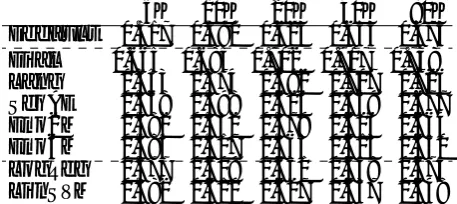
5K 10K 20K 40K 80K
Default 0.517 0.590 0.623 0.653 0.673
Dial 0.665† 0.685† 0.702† 0.717† 0.738†
Lang 0.653 0.674 0.692 0.707 0.726
SeqAE 0.568 0.598 0.626 0.649 0.677
Emo2M 0.482 0.532 0.579 0.626 0.664
Emo6M 0.484 0.517 0.565 0.613 0.650
LogReg 0.577 0.609 0.631 0.648 0.675
[image:4.595.71.300.61.163.2]LinSVM 0.582 0.610 0.627 0.637 0.648
Table 2: Macro-average F-measure of sentiment classification of each model versus labeled data size. Dial is our proposed method, and † in its row indicates statistically significant difference from the corresponding value of Lang (p <
0.05).
Comparing Dial with the other models, we can see that our pretraining strategy with dialog data consistently outperformed all the other mod-els: state-of-the-art pretraining strategies with un-paired unlabeled data (Lang,SeqAE) and pseudo labeled data (Emo2M, Emo6M), as well as linear learners (LogReg,LinSVM). This indicates that unlabeled dialog data (tweet-reply pairs) have use-ful information for sentiment classifiers, as ex-pected in Section 1. In fact, we observed that the pretrained encoder-decoder model seems to gener-ate an approprigener-ate reply, on which the sentiment on the input tweet is well reflected. For example, the reply “:(” was generated for the input tweet “I’m sorry to hear that” (see supplementary material for more examples).
Langalso outperformed well but did not over-take Dial. The differences between Dial and
Langare statistically significant4for all five train-ing dataset sizes. Interesttrain-ingly, SeqAE was not so effective likeDial, despite their model struc-tures are basically the same. This implies that it is practically important to find appropriate data for pretraining, such as dialog data for sentiment clas-sification.
As for the results of distant supervision with emoticons, both Emo2M and Emo6M performed worse thanDefault, and increasing the dataset size did not change the situation. The reason why these models did not perform as well as other pretraining-based models is considered to be noisy labels, especially in negative ones. We illustrate two instances in theEmo2Mtraining data that in-clude an emoticon that is usually negative
emoti-4Under the significance level of 0.05 with two-tailed t-test assuming unequal variances.
con but can be considered positive:
• 美人すぎるよ可愛い(; ;), “She is so beautiful,
cute (crying emoticon)”
• うらやましいです。おめでとうございます
orz, “I envy you. Congratulations (bow-the-knee emoticon)”
Comparing Default with LogReg and
LinSVM, we can see that the linear models per-formed better than the default RNN model without pretraining, when the labeled data size is less than or equal to 20K. However, looking at the results of
Dial, our method improvedDefault even for these cases (5K to 20K), and Dial clearly out-performed the linear models. This means that pre-training is useful especially on the situation where the labeled data size is limited.
4 Related Work
After Dai and Le (2015) proposed the framework of semi-supervised sequence learning, there have been several attempts to extend sequence learn-ing models for different tasks to semi-supervised settings. Cheng et al. (2016) and Ramachandran et al. (2017) studied semi-supervised training of machine translation models via an autoencoder model and language model, respectively. They also used paired data (parallel corpora), but un-supervised training was conducted with reason-able monolingual corpora to compensate for costly parallel corpora, which is opposite to our set-ting. Zhou et al. (2016a,b) proposed to use par-allel corpora for adapting the sentiment resources in a resource-rich language to a resource-poor lan-guage. Their purpose was completely different from ours, since making parallel corpora is also costly. The other studies include semi-supervised extensions for predicting the property values of Wikipedia (Hewlett et al., 2017), detecting medi-cal conditions from heart rate data (Ballinger et al., 2018), and morphological reinflection of inflected words (e.g., “playing” to “played”). They did not use paired-text data to leverage their tasks.
2014; Severyn and Moschitti, 2015; Deriu et al., 2016; M¨uller et al., 2017), but they basically fo-cused on how to use emoticons and hashtags to leverage performance. One exception is the study by (Pool and Nissim, 2016), in which Facebook reactions were used for distant supervision. Their approach is similar to ours using tweet-reply pairs, but our method is more general since they only used six reply categories (i.e., like, love, haha, wow, sad, and angry), not text replies.
There have been a few studies on sentiment classification in dialogue data (Bertero and Fung, 2016; Bertero et al., 2016). These studies involved sentiment classification based on dialog contexts, which means that they used labeled dialog data, while we used unlabeled dialog data. For tweet data, several studies used reply-features for senti-ment classification of tweets (Barbosa and Feng, 2010; Jiang et al., 2011; Vanzo et al., 2014; Bam-man and Smith, 2015; Ren et al., 2016; Castellucci et al., 2016). However, they used replies as la-beled data for sentiment classification, not unla-beled data for pretraining.
5 Conclusion
We proposed a pretraining strategy with dialog data for sentiment classifiers. The experimental results showed that our strategy clearly outper-formed the existing pretraining with unpaired un-labeled data via language modeling and pseudo labeled data via distant supervision, as well as linear classifiers. In the future, we will investi-gate whether or not we can use other paired data for pretraining of classification tasks. For exam-ple, we expect that news article-comment pairs are useful for predicting fake news detection and that question-answer pairs of Q&A sites are useful for recommending questions for answering.
References
Brandon Ballinger, Johnson Hsieh, Avesh Singh, Nimit Sohoni, Jack Wang, Geoffrey H. Tison, Gre-gory M. Marcus, Jose M. Sanchez, Carol Maguire, Jeffrey E. Olgin, and Mark J. Pletcher. 2018. DeepHeart: Semi-Supervised Sequence Learning for Cardiovascular Risk Prediction. In Proceed-ings of the Thirty-Second AAAI Conference on Artificial Intelligence (AAAI 2018). To appear. https://arxiv.org/abs/1802.02511.
David Bamman and Noah A. Smith. 2015. Contex-tualized Sarcasm Detection on Twitter. In Pro-ceedings of the Ninth International Conference on
Web and Social Media (ICWSM 2015). pages 574– 577. http://www.aaai.org/ocs/index.php/ICWSM/ ICWSM15/paper/view/10538.
Luciano Barbosa and Junlan Feng. 2010. Robust Sen-timent Detection on Twitter from Biased and Noisy Data. In Proceedings of the 21st International Conference on Computational Linguistics (COLING 2010). Coling 2010 Organizing Committee, pages 36–44. http://www.aclweb.org/anthology/C10-2005.
Dario Bertero and Pascale Fung. 2016. A Long Short-Term Memory Framework for Predicting Humor in Dialogues. In Proceedings of the 2016 Confer-ence of the North American Chapter of the Associ-ation for ComputAssoci-ational Linguistics: Human Lan-guage Technologies (NAACL-HLT 2016). Associa-tion for ComputaAssocia-tional Linguistics, pages 130–135. http://www.aclweb.org/anthology/N16-1016.
Dario Bertero, Farhad Bin Siddique, Chien-Sheng Wu, Yan Wan, Ricky Ho Yin Chan, and Pas-cale Fung. 2016. Real-Time Speech Emotion and Sentiment Recognition for Interactive Dia-logue Systems. In Proceedings of the 2016 Con-ference on Empirical Methods in Natural Lan-guage Processing (EMNLP 2016). Association for Computational Linguistics, pages 1042–1047. https://aclweb.org/anthology/D16-1110.
Giuseppe Castellucci, Danilo Croce, and Roberto Basili. 2016. Context-aware Convolutional Neu-ral Networks for Twitter Sentiment Analysis in Italian. In Proceedings of Third Italian Confer-ence on Computational Linguistics (CLiC-it 2016) & Fifth Evaluation Campaign of Natural Language Processing and Speech Tools for Italian. Final Workshop (EVALITA 2016). http://ceur-ws.org/Vol-1749/paper 029.pdf.
Yong Cheng, Wei Xu, Zhongjun He, Wei He, Hua Wu, Maosong Sun, and Yang Liu. 2016. Semi-Supervised Learning for Neural Machine Translation. In Proceedings of the 54th An-nual Meeting of the Association for Computa-tional Linguistics (ACL 2016). Association for Computational Linguistics, pages 1965–1974. http://www.aclweb.org/anthology/P16-1185.
Andrew M Dai and Quoc V Le. 2015. Semi-supervised Sequence Learning. In Advances in Neural Information Processing Systems 28 (NIPS 2015), Curran Associates, Inc., pages 3079–3087. http://papers.nips.cc/paper/5949-semi-supervised-sequence-learning.pdf.
Jan Deriu, Maurice Gonzenbach, Fatih Uzdilli, Au-relien Lucchi, Valeria De Luca, and Martin Jaggi. 2016. SwissCheese at SemEval-2016 Task 4: Sen-timent Classification Using an Ensemble of Convo-lutional Neural Networks with Distant Supervision. In Proceedings of the 10th International Workshop on Semantic Evaluation (SemEval 2016). Associ-ation for ComputAssoci-ational Linguistics, pages 1124– 1128. http://www.aclweb.org/anthology/S16-1173.
Cicero dos Santos and Maira Gatti. 2014. Deep Con-volutional Neural Networks for Sentiment Analysis of Short Texts. In Proceedings of the 25th Inter-national Conference on Computational Linguistics (COLING 2014). Dublin City University and Asso-ciation for Computational Linguistics, pages 69–78. http://www.aclweb.org/anthology/C14-1008.
Rong-En Fan, Kai-Wei Chang, Cho-Jui Hsieh, Xiang-Rui Wang, and Chih-Jen Lin. 2008. LIBLINEAR: A Library for Large Linear Classification. Journal of Machine Learning Research9:1871–1874.
Alec Go, Richa Bhayani, and Lei Huang. 2009. Twitter Sentiment Classification using Dis-tant Supervision. Technical report, Stan-ford Digital Library Technologies Project. https://cs.stanford.edu/people/alecmgo/papers/ TwitterDistantSupervision09.pdf.
Daniel Hewlett, Llion Jones, Alexandre Lacoste, and izzeddin gur. 2017. Accurate Supervised and Semi-Supervised Machine Reading for Long Documents. In Proceedings of the 2017 Con-ference on Empirical Methods in Natural Lan-guage Processing (EMNLP 2017). Association for Computational Linguistics, pages 2011–2020. https://www.aclweb.org/anthology/D17-1214.
Long Jiang, Mo Yu, Ming Zhou, Xiaohua Liu, and Tiejun Zhao. 2011. Target-dependent Twit-ter Sentiment Classification. In Proceedings of the 49th Annual Meeting of the Associa-tion for ComputaAssocia-tional Linguistics: Human Lan-guage Technologies (ACL-HLT 2011). Associa-tion for ComputaAssocia-tional Linguistics, pages 151–160. http://www.aclweb.org/anthology/P11-1016.
Saif Mohammad, Svetlana Kiritchenko, and Xiaodan Zhu. 2013. NRC-Canada: Building the State-of-the-Art in Sentiment Analysis of Tweets. In Proceedings of the Seventh International Workshop on Semantic Evaluation (SemEval 2013). Associa-tion for ComputaAssocia-tional Linguistics, pages 321–327. http://www.aclweb.org/anthology/S13-2053.
Simon M¨uller, Tobias Huonder, Jan Deriu, and Mark Cieliebak. 2017. TopicThunder at SemEval-2017 Task 4: Sentiment Classification Using a Convo-lutional Neural Network with Distant Supervision. In Proceedings of the 11th International Workshop on Semantic Evaluation (SemEval 2017). Associa-tion for ComputaAssocia-tional Linguistics, pages 766–770. http://www.aclweb.org/anthology/S17-2129.
Preslav Nakov, Sara Rosenthal, Zornitsa Kozareva, Veselin Stoyanov, Alan Ritter, and Theresa Wilson. 2013. SemEval-2013 Task 2: Sentiment Analysis in Twitter. InProceedings of the Seventh International Workshop on Semantic Evaluation (SemEval 2013). Association for Computational Linguistics, pages 312–320. http://www.aclweb.org/anthology/S13-2052.
Chris Pool and Malvina Nissim. 2016. Distant super-vision for emotion detection using facebook reac-tions. InProceedings of the Workshop on Compu-tational Modeling of People’s Opinions, Personal-ity, and Emotions in Social Media (PEOPLES). The COLING 2016 Organizing Committee, pages 30– 39. http://aclweb.org/anthology/W16-4304.
Matthew Purver and Stuart Battersby. 2012. Ex-perimenting with Distant Supervision for Emotion Classification. InProceedings of the 13th Confer-ence of the European Chapter of the Association for Computational Linguistics (ACL 2012). Associa-tion for ComputaAssocia-tional Linguistics, pages 482–491. http://www.aclweb.org/anthology/E12-1049.
Prajit Ramachandran, Peter Liu, and Quoc Le. 2017. Unsupervised Pretraining for Sequence to Sequence Learning. In Proceedings of the 2017 Conference on Empirical Methods in Natu-ral Language Processing (EMNLP 2017). Associa-tion for ComputaAssocia-tional Linguistics, pages 383–391. https://www.aclweb.org/anthology/D17-1039.
Jonathon Read. 2005. Using Emoticons to Re-duce Dependency in Machine Learning Techniques for Sentiment Classification. In Proceedings of the ACL Student Research Workshop. Associa-tion for ComputaAssocia-tional Linguistics, pages 43–48. http://www.aclweb.org/anthology/P/P05/P05-2008.
Yafeng Ren, Yue Zhang, Meishan Zhang, and Donghong Ji. 2016. Context-sensitive Twit-ter Sentiment Classification Using Neural Network. In Proceedings of the Thirtieth AAAI Conference on Artificial Intelligence
(AAAI 2016). AAAI Press, pages 215–221.
http://dl.acm.org/citation.cfm?id=3015812.3015844.
Aliaksei Severyn and Alessandro Moschitti. 2015. UNITN: Training Deep Convolutional Neural Net-work for Twitter Sentiment Classification. In Proceedings of the 9th International Workshop on Semantic Evaluation (SemEval 2015). Associa-tion for ComputaAssocia-tional Linguistics, pages 464–469. http://www.aclweb.org/anthology/S15-2079.
Ilya Sutskever, Oriol Vinyals, and Quoc V Le. 2014. Sequence to sequence learning with neural networks. In Advances in Neural In-formation Processing Systems 27 (NIPS 2014), Curran Associates, Inc., pages 3104–3112. http://papers.nips.cc/paper/5346-sequence-to-sequence-learning-with-neural-networks.pdf.
Sentiment-Specific Word Embedding for Twitter Sentiment Classification. In Proceedings of the 52nd Annual Meeting of the Association for Com-putational Linguistics (ACL 2014). Association for Computational Linguistics, pages 1555–1565. http://www.aclweb.org/anthology/P14-1146.
Andrea Vanzo, Danilo Croce, and Roberto Basili. 2014. A context-based model for Sentiment Analysis in Twitter. In Proceedings of the 25th International Conference on Computational Linguistics (COL-ING 2014). Dublin City University and Association for Computational Linguistics, pages 2345–2354. http://www.aclweb.org/anthology/C14-1221.
Matthew D. Zeiler. 2012. ADADELTA: An Adaptive Learning Rate Method. CoRRabs/1212.5701.
Xinjie Zhou, Xiaojun Wan, and Jianguo Xiao. 2016a. Attention-based LSTM Network for Cross-Lingual Sentiment Classification. In Proceedings of the 2016 Conference on Empirical Methods in Natural Language Processing (EMNLP 2016). Association for Computational Linguistics, Austin, Texas, pages 247–256. https://aclweb.org/anthology/D16-1024.