Munich Personal RePEc Archive
Islanded Microgrid Operation Based on
the Chaotic Crow Search Algorithm
Khazaei, Ehsan and Jamaledini, Ashkan
Electrical and Computer Engineering Department, Sazeh Sazan
Power Company, Iran
2 June 2019
Online at
https://mpra.ub.uni-muenchen.de/94278/
Islanded Microgrid Operation Based on the
Chaotic Crow Search Algorithm
Ehsan Khazaei, Ashkan Jamaledini
Electrical and Computer Engineering Department, Sazeh Sazan Power Company, Iran
Abstract: This paper investigates the optimal operation of the islanded microgrid. In
order to find the optimal solution and also provide a fast response, a new heuristic
method, which is known as the chaotic crow search optimization algorithm is developed.
To show the merit of the model, it is tested on the IEEE 30 bus test network.
I. INTRODUCTION
ICROGRID is one of the most interesting research among the researchers with the
past ten years, because of both economic and technical advantages [1-5]. Microgrid
is a very small electricity grid that can produce power for the consumers within its network.
That means the electricity power producers and consumers are inside each other. Hence,
the less transmission line is required, that can lead to less expansion planning cost. Also,
as there are beside each other, the reliability, voltage profile, and power quality of the
network can increase a lot.
As mentioned above, microgrid has lots of advantages, but many problems with the
microgrid are not solved completely yet. For instance, the protection and optimal operation
have not been addressed completely yet. Therefore, this paper will investigate the optimal
scheduling of islanded microgrid. The word islanded means the microgrid is disconnected
from the main grid. Also as mentioned, the dispatchable generators of the microgrid should
meet the required load. Also, when we say the connected mode, means conventional
power grids, where the microgrid is connecting to the main grid and can exchange power.
It should be noted that in this paper, only the islanded operation of microgrid is
investigated.
Islanded microgrid control is studied in [6]. Designing a DC/DC boost converter, which is
applicable for microgrid operation is studied in [7]. Solving the microgrid operation by the
heuristic algorithms such as CDOA, GA, PSO, TLABO, etc. is studied in many literatures
such as [8-11]. Develop an effective control for microgrid operation is also studied in
[12-15]. Investigating on adding the electric vehicles, superconductivity of the microgrid, and
security of the microgrid has been studied in [16- 19]. This paper investigates the optimal
operation of an islanded microgrid by adopting a new heuristic method known as chaotic
crow search optimization algorithm [20].
II. PROBLEM FORMULATIONS
The proposed problem includes an objective function that tries to minimize the operation
cost of the islanded microgrid and some constraints as follows:
A. Objective function
The objective function is defined as
𝑚𝑖𝑛 ∑ [𝐶∀𝑖 𝑖𝑃𝑖𝑡𝐼𝑖𝑡+ 𝑆𝑈𝑖𝑡 + 𝑆𝐷𝑖𝑡] (1)
where I is a binary variable that can be zero or one and determine the status of unit i at
time t. Also, SU and SD are the startup and shutdown costs of the ith unit at time t.
The proposed problem includes some constraints as follows:
The capacity of the generators as limited. That means at any time, the output power (P) of
each DG should be within a limit as
𝑃𝑖𝑡,𝑚𝑖𝑛 ≤ 𝑃𝑖𝑡 ≤ 𝑃𝑖𝑡,𝑚𝑎𝑥 (2)
The generators have a limitation on the ramp up and down as
𝑃𝑖𝑡 − 𝑃𝑖(𝑡−1) ≤ 𝑅𝑈𝑖 (3)
𝑃𝑖(𝑡−1)− 𝑃𝑖𝑡 ≤ 𝑅𝐷𝑖 (4)
where 𝑅𝑈𝑖 and 𝑅𝑈𝑖 are the ramp up and ramp down rates of the ith generation units, respectively.
The last but not least constraint is the minimum up and down limits that can be calculated
as
𝑇(𝑜𝑛)𝑖𝑡 ≥ 𝑈𝑇𝑖(𝐼𝑖𝑡− 𝐼𝑖(𝑡−1) (5)
𝑇(𝑜𝑓𝑓)𝑖𝑡 ≥ 𝐷𝑇𝑖(𝐼𝑖(𝑡−1)− 𝐼𝑖𝑡 (6)
where 𝑈𝑇𝑖 and 𝐷𝑇𝑖 are minimum up and down rates of the ith unit. Also, 𝑇(𝑜𝑛) and 𝑇(𝑜𝑓𝑓) denotes the number of successive on and off hours.
III. CHAOTIC CROW SEARCH ALGORITHM
The Islanded microgrid is a mixed integer programming (MILP) problem. To solve this
MILP problem, this paper developed a new heuristic method known as the chaotic crow
search algorithm. This algorithm inspires from the crow search apparatus for hiding the
food. More explanations of this algorithm is in [20]. Figure 1 shows the chaotic crow
has been attracted lots of attentions because of fast and accurate response [21-24].
[image:5.612.203.424.128.536.2]These algorithms have been developed in many papers in different field of science.
Fig. 1. Flowchart of the proposed method [20].
IV. RESULTS
In this section, a modified IEEE 30 bus test network is selected to test the merit of the
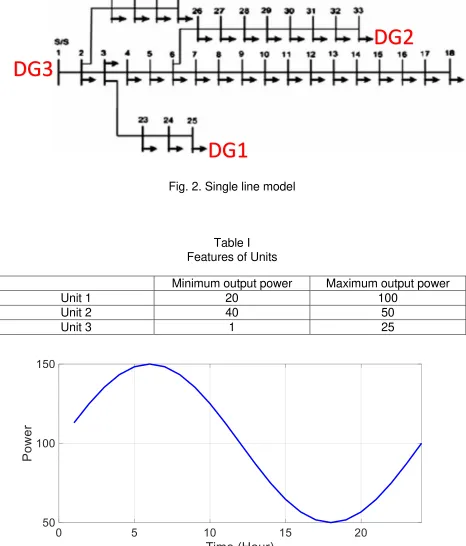
proposed model. The network contains three generation units, as shown in Fig. 2. Also,
the features of the units have been shown in Table I. The day-ahead load demand is
Fig. 2. Single line model
Table I Features of Units
Minimum output power Maximum output power
Unit 1 20 100
Unit 2 40 50
Unit 3 1 25
Fig. 3. Day-ahead load demand
DG1
DG2
Fig. 4 shows the output power of units. Based on this figure, the cheap unit has participated
[image:7.612.97.501.137.332.2]more than others that can lead to less operation cost.
Fig. 4. The output power of Units
Table II shows the operation cost of the proposed method and it is compared with the
[image:7.612.78.531.501.564.2]particle swarm optimization (PSO) and genetic algorithm (GA) methods.
Table II Operation cost
Operation cost ($) Computational Time (second)
PSO 5432.1 14.2
GA 5532.5 11.8
Proposed method 5334.2 9.2
V. CONCLUSION
This paper developed a new heuristic method for the optimal operation of the islanded
microgrid. The results demonstrate the fast response and optimality of the proposed
method. Also, based on the results, the status of this method is completely different from
Reference
[1] Dabbaghjamanesh, M., A. Moeini, M. Ashkaboosi, P. Khazaei, and K. Mirzapalangi. "High Performance Control of Grid Connected Cascaded H-Bridge Active Rectifier Based on Type II-Fuzzy Logic Controller with Low Frequency Modulation Technique." International Journal of Electrical & Computer Engineering (2088-8708) 6, no. 2 (2016).
[2] Ashkaboosi, Maryam, Seyed Mehdi Nourani, Peyman Khazaei, Morteza Dabbaghjamanesh, and Amirhossein Moeini. "An optimization technique based on profit of investment and market clearing in wind power systems." American Journal of Electrical and Electronic Engineering 4, no. 3 (2016): 85-91.
[3] Zhang, Yan, Fanlin Meng, Rui Wang, Behzad Kazemtabrizi, and Jianmai Shi. "Uncertainty-resistant Stochastic MPC Approach for Optimal Operation of CHP Microgrid." Energy(2019).
[4] Chen, Yahong, Changhong Deng, Weiwei Yao, Ning Liang, Pei Xia, Peng Cao, Yiwang Dong et al. "Impacts of stochastic forecast errors of renewable energy generation and load demands on microgrid operation." Renewable Energy 133 (2019): 442-461.
[5] Pourbehzadi, Motahareh, Taher Niknam, Jamshid Aghaei, Geev Mokryani, Miadreza Shafie-khah, and João PS Catalão. "Optimal operation of hybrid AC/DC microgrids under uncertainty of renewable energy resources: A comprehensive review." International Journal of Electrical Power & Energy Systems 109 (2019): 139-159.
[6] Rakhshan, Mohsen, Navid Vafamand, Mokhtar Shasadeghi, Morteza Dabbaghjamanesh, and Amirhossein Moeini. "Design of networked polynomial control systems with random delays: sum of squares approach." International Journal of Automation and Control 10, no. 1 (2016): 73-86.
[7] Khazaei, P., S. M. Modares, M. Dabbaghjamanesh, M. Almousa, and A. Moeini. "A high efficiency DC/DC boost converter for photovoltaic applications." International Journal of Soft Computing and Engineering (IJSCE) 6, no. 2 (2016): 2231-2307. [8] Khazaei, Peyman, Morteza Dabbaghjamanesh, Ali Kalantarzadeh, and Hasan
Mousavi. "Applying the modified TLBO algorithm to solve the unit commitment problem." In 2016 World Automation Congress (WAC), pp. 1-6. IEEE, 2016.
[10] Dabbaghjamanesh, Morteza, Shahab Mehraeen, Abdollah Kavousifard, and Mosayeb Afshari Igder. "Effective scheduling operation of coordinated and uncoordinated wind-hydro and pumped-storage in generation units with modified JAYA algorithm." In 2017 IEEE Industry Applications Society Annual Meeting, pp. 1-8. IEEE, 2017.
[11] Dabbaghjamanesh, Morteza, Shahab Mehraeen, Abdollah Kavousi-Fard, and Farzad Ferdowsi. "A New Efficient Stochastic Energy Management Technique for Interconnected AC Microgrids." In 2018 IEEE Power & Energy Society General Meeting (PESGM), pp. 1-5. IEEE, 2018.
[12] Tsikalakis, Antonis G., and Nikos D. Hatziargyriou. "Centralized control for optimizing microgrids operation." In 2011 IEEE power and energy society general meeting, pp. 1-8. IEEE, 2011.
[13] Dimeas, Aris L., and Nikos D. Hatziargyriou. "Operation of a multiagent system for microgrid control." IEEE Transactions on Power systems 20, no. 3 (2005): 1447-1455. [14] Olivares, Daniel E., Ali Mehrizi-Sani, Amir H. Etemadi, Claudio A. Cañizares, Reza Iravani, Mehrdad Kazerani, Amir H. Hajimiragha et al. "Trends in microgrid control." IEEE Transactions on smart grid 5, no. 4 (2014): 1905-1919.
[15] Basak, Prasenjit, A. K. Saha, S. Chowdhury, and S. P. Chowdhury. "Microgrid: Control techniques and modeling." In 2009 44th International Universities Power Engineering Conference (UPEC), pp. 1-5. IEEE, 2009.
[16] Taherzadeh, Erfan, Morteza Dabbaghjamanesh, Mohsen Gitizadeh, and Akbar Rahideh. "A new efficient fuel optimization in blended charge depletion/charge sustenance control strategy for plug-in hybrid electric vehicles." IEEE Transactions on Intelligent Vehicles 3, no. 3 (2018): 374-383.
[17] Tajalli, Seyede Zahra, Seyed Ali Mohammad Tajalli, Abdollah Kavousi-Fard, Taher Niknam, Morteza Dabbaghjamanesh, and Shahab Mehraeen. "A Secure Distributed Cloud-Fog Based Framework for Economic Operation of Microgrids." In 2019 IEEE Texas Power and Energy Conference (TPEC), pp. 1-6. IEEE, 2019.
[18] Dabbaghjamanesh, Morteza. "Stochastic Energy Management of Reconfigurable Power Grids in the Presence of Renewable Energy by Considering Practical Limitations." (2019).
[19] Taherzadeh, Erfan, Shahram Javadi, and Morteza Dabbaghjamanesh. "New Optimal Power Management Strategy for Series Plug-In Hybrid Electric Vehicles." International Journal of Automotive Technology 19, no. 6 (2018): 1061-1069.
[21] Razavi Arab, Azadeh, S. Abbas Haghshenas, and Farzin Samsami. "Sediment transport and morphodynamic changes in Ziarat Estuary and Mond River Delta, the Persian Gulf." In EGU General Assembly Conference Abstracts, vol. 16. 2014.
[22] HAGHSHENAS, SEYED ABBAS, and ARAB AZADEH RAZAVI. "APPLICATION OF SEDIMENT CONSTITUENT ANALYSIS FOR CHARACTERIZING LONGSHORE SEDIMENT TRANSPORT, CASE STUDY OF RAMIN PORT-IRANIAN COASTLINE OF THE OMAN SEA." (2014).
[23] Arab, Azadeh Razavi, Afshin Danehkar, S. Abbas Haghshenas, and Gita B. Ebrahimi. "ASSESSMENT OF COASTAL DEVELOPMENT IMPACTS ON CORAL ECOSYSTEMS IN NAIBAND BAY, THE PERSIAN GULF." Coastal Engineering Proceedings 1, no. 33 (2012): 31.
[24] Haghshenas, S. Abbas, Azadeh Razavi Arab, Arash Bakhtiari, Morteza Jedari Attari, and Michael John Risk. "Decadal Evolution of Mond River Delta, the Persian Gulf." Journal of Coastal Research 75, no. sp1 (2016): 805-810.
[25] Kavousi-Fard, Abdollah, Haidar Samet, and Fatemeh Marzbani. "A new hybrid modified firefly algorithm and support vector regression model for accurate short term load forecasting." Expert systems with applications 41, no. 13 (2014): 6047-6056. [26] Dabbaghjamanesh, Morteza, Abdollah Kavousi-Fard, Shahab Mehraeen, Jie Zhang,
and Zhao Yang Dong. "Sensitivity Analysis of Renewable Energy Integration on Stochastic Energy Management of Automated Reconfigurable Hybrid AC-DC Microgrid Considering DLR Security Constraint."
[27] Kamali, Rahim, Peyman Khazaei, Pouya Banizamani, and Salar Saadatian. "Stochastic Unit Generation Maintenance Scheduling Considering Renewable Energy and Network Constraints." In 2018 World Automation Congress (WAC), pp. 1-6. IEEE, 2018.
[28] Azadeh, Razavi Arab, S. Abbas Haghshenas, Farzin Samsami, and Michael John Risk. "Traces of sediment origin in rheological behaviour of mud samples taken from the North-Western Persian Gulf." In BOOK OF ABSTRACTS. 2015.
[29] Razavi Arab, Azadeh, S. Abbas Haghshenas, and Homayoun Zaker. "Deep water current velocity data in the Persian Gulf." In EGU General Assembly Conference Abstracts, vol. 17. 2015.
[30] Ghaffari, Saeed, and Maryam Ashkaboosi. "Applying Hidden Markov Model Baby Cry Signal Recognition Based on Cybernetic Theory." IJEIR 5: 243-247.
![Fig. 1. Flowchart of the proposed method [20].](https://thumb-us.123doks.com/thumbv2/123dok_us/71338.507712/5.612.203.424.128.536/fig-flowchart-proposed-method.webp)