ISSN Online: 2162-5344 ISSN Print: 2162-5336
DOI: 10.4236/ojn.2019.97052 Jul. 23, 2019 676 Open Journal of Nursing
The Acquisition of Ethical Competence in Basic
Education and the Present State of Ethics
Education
Emi Yoshioka
*, Sayuri Kaneko
Nagano College of Nursing, Komagane City, Japan
Abstract
The aim of this study was to reveal the level of ethical competence acquired through basic nursing education, to report on the present state of ethics edu-cation, and to consider future directions for ethics education. The medical databases ICHUSHI, MEDLINE, and CINAHL were searched using the search terms “nursing ethics,” “nursing practice,” “ethics education,” and “nursing students.” Of the total results, 25 research articles (original papers, research reports, practical reports, documents) were used for this study. Eth-ical competence covered in basic nursing education corresponded to points 1 - 11 of the Code of Ethics, and the competencies acquired included cogniz-ance and judgement. Ethics education included methods such as case studies in Japan and blended learning in other countries. At present, ethical compe-tence education does not comprehensively cover the Code of Ethics, and the judgement level of competence is not acquired during basic nursing educa-tion. It is thus necessary henceforth to progressively put an educational pro-gram in place to develop ethics education that persists from basic nursing education through to continuing nursing education.
Keywords
Nursing Ethics, Ethics Education, Ethical Competence, Nursing Students
1. Introduction
Nurses are required to respond to ethical problems every day since they work in a healthcare environment characterized by rapid medical progress and diversi-fying ethical problems. Thus, organizations around the world, such as the Inter-national Council of Nurses (ICN), are creating codes of ethics to serve as beha-vioral guidelines for nurses. Each country revises their own code of ethics based How to cite this paper: Yoshioka, E. and
Kaneko, S. (2019) The Acquisition of Ethi-cal Competence in Basic Education and the Present State of Ethics Education. Open Journal of Nursing, 9, 676-686.
https://doi.org/10.4236/ojn.2019.97052
Received: June 19, 2019 Accepted: July 20, 2019 Published: July 23, 2019
Copyright © 2019 by author(s) and Scientific Research Publishing Inc. This work is licensed under the Creative Commons Attribution International License (CC BY 4.0).
DOI: 10.4236/ojn.2019.97052 677 Open Journal of Nursing on healthcare and societal changes, or on revisions to the code of ethics for ICN nurses.
The ICN Code of Ethics for Nurses was created in 1953. It is a set of behavior-al guidelines for nurses based on socibehavior-al vbehavior-alues and needs; therefore, nurses must understand, master, and apply these guidelines to all job-related situations. It is said that, in a changing society, a code of ethics becomes a living document only after it is applied to the realities of healthcare and must undergo various revi-sions to meet the current needs [1].
In Japan, the Japanese Nursing Association’s Code of Ethics for Nurses (Table 1) specifies the behavioral guidelines for nurses and the scope of responsibility that nurses assume [2]. The 15 articles that constitute the Code of Ethics for Nurses are organized into three sections: Articles 1 - 6, Articles 7 - 11, and Ar-ticles 12 - 15. ArAr-ticles 1 - 6 relate to the ethical values and duties that a nurse should observe when providing care. Articles 7 - 11 relate to the importance of “effort” on the part of nurses in practice. Lastly, Articles 12 - 15 relate to the
Table 1. Nurses’ code of ethics—Japanese nursing association (2003).
Article on the ethical values and obligations that nurses should protect while providing nursing care
1) Nurses shall respect all human lives and the dignity and rights of all human beings. 2) Regardless of nationality, race, ethnicity, religion, creed, age, sex, sexual orientation, social status, economic status, lifestyle, and the nature of their health problems, nurses shall equally provide nursing care to their patients.
3) Nurses should do their best to establish a trustworthy relationship with their patients and to provide nursing based on that relationship.
4) Nurses must respect the patient’s right to know, and to make self-determinations and defend those rights.
5) Nurses must strictly adhere to their obligations regarding confidentiality and the protection of personal information, and if they share such information with others, it must be after making the proper judgment to do so.
6) Nurses need to protect their patients and secure their safety, including when caring for these people is being hindered or they are in dangerous situations.
Article on the efforts of nursing staff important for practice
7) Nurses should be well aware of their responsibilities and abilities as they provide care as individuals.
8) It is a nurse’s responsibility to always try to maintain and develop his/her abilities through continual learning.
9) Nurses should cooperate with other nurses and other health and medical welfare workers to provide nursing care.
10) To perform the highest quality nursing care, nurses should set and implement helpful criteria for nursing practice, nursing management, nursing education, and nursing research.
11) Through research and practice, nurses always strive to create and develop specialized knowledge and techniques and contribute to the development of nursing science. Article on basic personal virtues and organizational effort
12) Nurses must try to maintain and improve their own physical and mental health to perform the highest quality nursing care.
13) Nurses must always conduct themselves as individuals worthy of the trust of society. 14) Nurses share responsibility with society regarding environmental issues to promote overall better health.
DOI: 10.4236/ojn.2019.97052 678 Open Journal of Nursing foundations of personal moral consciousness and organizational effort. To re-spond to ethical problems, the Code of Ethics for Nurses recommends that stu-dents learn all aspects from the time of basic nursing education. However, the capacity to make ethical competence during continuous nursing education cor-responds to Article 1 through 11 of the Code of Ethics from the Japanese Nurs-ing Association but no reports on Articles 12 to 15. And the competencies ac-quired included cognizance, judgment, and action [3]. It is thus necessary to synthesize nursing ethics education into basic nursing education so that nurses can understand the Code of Ethics for Nurses and apply the code in decisions concerning judgement and conduct.
For basic nursing education in Japan, five competency areas that comprise nursing practice are outlined in the “Core Practical Competencies for Nursing Practice during the Bachelor Program and Objectives to be Accomplished by Graduation [4].” “Section 1: Practical competencies related to the basics of hu-man care,” specifies competencies related to ethics, including “the ability to pro-tect the dignity and rights of those receiving care,” and “the ability to explain the treatment being given and obtain consent.” The necessity for nursing ethics education to be covered in basic nursing education in Japan is thus specified; however, the required ethical competencies are described abstractly, and con-crete educational contents and methods are entrusted to each educational insti-tution or facility. Consequently, nursing educators cannot determine the thought processes that lead students to ethical conduct and are thus left to assess stu-dents’ ethical conduct amidst lingering ambiguities. Furthermore, students can-not receive ethical training in a timely manner and thus feel a need to further develop their own level of ethical conduct.
By providing an overview of previous research related to ethics education in basic nursing education, this study outlines the ethical competencies acquired through basic nursing education and the present state of ethics education and its challenges. Finally, future directions for ethics education are explored.
Definition of Terms
1) Ethical CompetenceEthical competence is based on the framework of Articles 1 - 15 of the Code of Ethics for Nurses [2]. “Cognizance” refers to the ability to recognize feelings of ethical unease in everyday nursing practice, based on knowledge of the ethical standards and concepts necessary for ethical conduct. “Judgement” refers to the ability to collect information related to the feeling of unease, identify the ethical problem, and devise a plan of conduct. “Conduct” refers to the ability to address the ethical problem by providing care while protecting the worth and responsi-bility of the patient.
2) Basic Nursing Education
DOI: 10.4236/ojn.2019.97052 679 Open Journal of Nursing Labour and Welfare at an educational institution for public health nurses, mid-wives, or registered nurses prior to becoming licensed in those fields [5].
2. Method
2.1. Literature Search
The databases used for the research were ICHUSHI, MEDLINE, and CINAHL. The search terms used were “nursing ethics” AND “nursing practice” or “ethics education” AND “nursing students.” Of the total results, 25 research articles (original papers, research reports, practical reports, documents) were used for this study.
2.2. Analysis Method
The ethical competencies of nursing students were sorted according to the Code of Ethics for Nurses [2], which forms the basis of nursing conduct policy. The level of ethical competence acquired was evaluated according to cognizance, judgement, and conduct. Next, materials regarding the nursing ethics education covered during basic nursing education were read carefully, and the present state and of nursing ethics education and its challenges were considered. By examin-ing these issues considerexamin-ing research that had already been conducted by scho-lars specializing in nursing ethics and/or nursing administration, we ensured content reliability and validity.
Concerning ethical considerations, we took care to represent the originals faith-fully and to observe copyright when quoting source materials.
3. Results
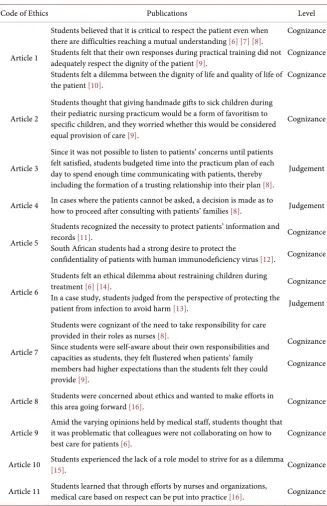
3.1. Ethical Competence of Nursing Students (Table 2)
DOI: 10.4236/ojn.2019.97052 680 Open Journal of Nursing
Table 2. Levels of ethical competence acquired in basic nursing education.
Code of Ethics Publications Level
Article 1
Students believed that it is critical to respect the patient even when there are difficulties reaching a mutual understanding [6] [7] [8]. Students felt that their own responses during practical training did not adequately respect the dignity of the patient [9].
Students felt a dilemma between the dignity of life and quality of life of the patient [10].
Cognizance
Cognizance
Cognizance
Article 2
Students thought that giving handmade gifts to sick children during their pediatric nursing practicum would be a form of favoritism to specific children, and they worried whether this would be considered equal provision of care [9].
Cognizance
Article 3
Since it was not possible to listen to patients’ concerns until patients felt satisfied, students budgeted time into the practicum plan of each day to spend enough time communicating with patients, thereby including the formation of a trusting relationship into their plan [8].
Judgement
Article 4 In cases where the patients cannot be asked, a decision is made as to how to proceed after consulting with patients’ families [8]. Judgement
Article 5
Students recognized the necessity to protect patients’ information and records [11].
South African students had a strong desire to protect the
confidentiality of patients with human immunodeficiency virus [12].
Cognizance
Cognizance
Article 6
Students felt an ethical dilemma about restraining children during treatment [6] [14].
In a case study, students judged from the perspective of protecting the patient from infection to avoid harm [13].
Cognizance
Judgement
Article 7
Students were cognizant of the need to take responsibility for care provided in their roles as nurses [8].
Since students were self-aware about their own responsibilities and capacities as students, they felt flustered when patients’ family members had higher expectations than the students felt they could provide [9].
Cognizance
Cognizance
Article 8 Students were concerned about ethics and wanted to make efforts in this area going forward [16]. Cognizance
Article 9 Amid the varying opinions held by medical staff, students thought that it was problematic that colleagues were not collaborating on how to
best care for patients [6]. Cognizance
Article 10 Students experienced the lack of a role model to strive for as a dilemma [15]. Cognizance
Article 11 Students learned that through efforts by nurses and organizations, medical care based on respect can be put into practice [16]. Cognizance
DOI: 10.4236/ojn.2019.97052 681 Open Journal of Nursing the necessity to take appropriate actions to protect patient information and medical records [11]. It was also reported that the desire to protect patients’ con-fidentiality regarding human immunodeficiency virus was much higher for stu-dents in South Africa than it was in the United States [12].
For Article 6, which relates to the duty to protect and safeguard patients, in one case, where a patient wanted to see his/her child at a time when his/her im-munity was low, the student thought that the visit should be avoided because it could harm the patient and thus judged from the perspective of protecting the patient from infection [13]. It was also reported that students felt ethical dilem-mas about restraining children during treatment [6] [14]. For Article 10, which relates to the setting of desirable standards for nursing practice, students cited the lack of appropriate role models as the most common problem they face, and they experienced this lack of a model to strive for as a dilemma [15]. For Article 8, which regards the maintenance and development of competence by conti-nuous learning, students’ awareness of nursing ethics was raised through ethics education, and they expressed a desire to move forward while maintaining their concern for ethics [16]. These acquired ethical competencies corresponded to the levels of “cognizance” and “judgement.”
3.2. The Present State of Ethics Education in Basic Nursing
Education
There are many case studies of nursing ethics education in Japan, and it has been reported that students can deepen their understanding of the rights and dignity of the patient through group work [17] [18]. This understanding led to an in-crease in ethical awareness and motivation [19]. Regarding the nursing ethics education covered in each school year, the objective for first-year students was to gain motivation concerning nursing ethics by performing case studies. As an ef-fect of the training, students with no practical experience could raise their awareness of nursing ethics by applying a case where an ethical situation could be imagined [19].
For second-year students, case studies were provided through lectures, also with the aim of raising students’ ethical sensitivity. Reports showed that the training gave students the opportunity to think about and recognize ethical problems [6], and to consider the rights and dignity of a child by imagining a sick child [17]. In addition, during practical training, discussing a clinical inci-dent at a conference became an opportunity to share information, discuss pre-ventative measures, reflect on conduct, and think about patient safety [20].
For third-year students, in a course on pediatric nursing, group work was conducted for students to learn how to relate to children while protecting their rights. Because of the training, students could imagine the anxiety that children may experience regarding their care, tests, and treatment; and thereby try to re-late to their feelings and think about the rights and dignity of the child [17].
DOI: 10.4236/ojn.2019.97052 682 Open Journal of Nursing changes in medical environments and global developments, nurses are also adopting simulation trainings to respond to new ethical problems [21]. These various educational methods have been conducted with the aim of improving ethical competence concerning cognizance and judgement.
In nursing ethics education abroad, joint conferences, blended learning [22] [23] [24], problem-solving training [25], and peer tutoring [26] have been used for students to work through ethical issues together. Furthermore, with the aim of improving the cognizance aspect of ethical competence, education related to concepts, such as ethical principles, ethical problems in healthcare, and codes of ethics were conducted through lectures, discussions, case studies, group discus-sions, and demonstrations [27]. Analyzing case studies by means of ethical prin-ciples also led to an improvement in decision-making abilities [28]. With the aim of improving the judgement aspect of ethical competence, education in solving ethical problems was also conducted by making use of ethical deci-sion-making models (such as the revised 4-step model), blended learning [29], and active simulations using role playing, wherein students could come up with solutions and grasp the reasons for them [29] [30].
4. Discussion
4.1. The Present State of Ethical Competence
It is necessary for students to gain competence with the entire Code of Ethics for Nurses during their basic education. However, while the present study showed that Articles 1 - 11 of the Code of Ethics for Nurses had been covered exhaus-tively, no articles were found that referred to the foundational issues of individ-ual moral consciousness and organizational effort. One reason for this may be the difficulty in teaching individual moral consciousness. Nurses perform their duties through a complex negotiation of their own individual moral conscious-ness and the values sought by their profession through the Code of Ethics. Since individual differences are a matter of personal identity, there is a risk that educa-tional interventions that seek to make rectifications may go against a person’s individual character. Teaching in this area can therefore pose difficulties. Another reason is that many nursing students may feel that organizational efforts, such as establishing a system for quality nursing care, is the job of those in management positions. However, managing care as an organization and managing the envi-ronment through the systems and policies of a specialized profession include elements of nursing management. Therefore, competencies in these areas should be achieved not only by management, but by students as well.
DOI: 10.4236/ojn.2019.97052 683 Open Journal of Nursing ethical problems that they face in case studies and on-site training, and for stu-dents to master the judgement skills necessary to respond to ethical problems in a variety of situations.
4.2. Ethics Education for the Acquisition of Ethical Competence
Educators believe that, at present, education aimed at the development of judg-ment competence, starting in basic nursing education, has not been linked to the acquisition of judgment competence. Davis [32] suggested that teaching critical thinking through lectures has limits and that dialogue and discussion are also necessary, and simulations and blended learning have also been adopted in countries abroad [22] [23] [24]. For nurses to respond to increasingly complex ethical problems, it is necessary to consider how to deliver an ethics education that trains students to respond to ethical problems that are more in tune with current realities, using educational methods beyond only the lectures and case studies that have been employed thus far.Furthermore, ethical competence in judgement acquired in basic nursing education should be used to respond to increasingly complex ethical problems in continuing nursing education; therefore, it is necessary for a nursing ethics edu-cation program to be established that is suitable for each stage of basic nursing education through continuing nursing education, aimed at the acquisition of competence at the level of conduct.
5. Conclusions
The ethical competence observed in basic nursing education fell under Articles 1 - 11 of The Code of Ethics for Nurses. However, no scholarly articles were found that related to Articles 12 - 15. Furthermore, the levels of ethical competence acquired corresponded to cognizance and judgment but not to conduct. A future challenge for nursing ethics education will be for a nursing ethics education program to be established that comprehensively covers the Code of Ethics. It is necessary for students to learn The Code of Ethics from the time of basic nursing education. Since Articles 12 - 15 relate to individual moral consciousness, this may be difficult to teach. Furthermore, many nursing students and nurses see organizational efforts, such as the establishment of a system for quality nursing care, as the duty of those in management. This suggests that it is necessary to es-tablish a nursing ethics educational program that comprehensively covers the Code of Ethics starting in basic nursing education.
stu-DOI: 10.4236/ojn.2019.97052 684 Open Journal of Nursing dents to gain experience at the level of conduct during basic nursing education.
The issue of ethics education in basic nursing education is the urgent need of education to acquire the judgment level of the student's ethical competence, and the education considering the issue of continuity between basic nursing educa-tion and continuing nursing educaeduca-tion.
Acknowledgements
This study forms a part of the research conducted with the support of Grants-in- Aid for Scientific Research (Basic Research C, General; No. 17K12134). A portion of this paper was presented at the 37th conference of the Japan Academy of Nursing Science. The authors declare that they have no competing interests.
Conflicts of Interest
The authors declare no conflicts of interest regarding the publication of this pa-per.
References
[1] International Council of Nurses (2012) The ICN Code of Ethics for Nurses.
https://www.icn.ch/sites/default/files/inline-files/2012_ICN_Codeofethicsfornurses _%20eng.pdf
[2] Japanese Nursing Association (2003) The Code of Ethics for Nurses.
https://www.nurse.or,jp/home/publication/pdf/rinri/code_of_ethics.pdf
[3] Yoshioka, E. and Kaneko, S. (2019) The Current Status of Ethical Judgment Capac-ity and Ethical Training Regarding Continuous Nursing Education. International of Journal of Nursing & Clinical Practices, 6, 305.
https://doi.org/10.15344/2394-4978/2019/305
[4] Ministry of Education, Culture, Sports, Science and Technology (2011) Core Prac-tical Competencies for Nursing Practice during the Bachelor Program and Objec-tives to Be Accomplished by Graduation.
http://www.mext.go.jp/b_menu/shingi/chousa/koutou/47/siryo/__icsFiles/afieldfile/
2011/11/04/1312488_5.pdf
[5] Ministry of Health, Labour and Welfare (2007) Conference Report on Elements of a Complete Basic Nursing Education.
https://www.mhlw.go.jp/shingi/2007/04/dl/s0420-13.pdf
[6] Namba, N. (2016) Student Learning through Group Discussion of Ethical Case Stu-dies in Pediatric Nursing. Tokyo Medical University School of Nursing Bulletin,25, 35-44.
[7] Konno, H. (2012) The Implementation of Ethics Education to Ensure Yhe Dignity of Bedridden Patients and Elderly Patients with Severe Dementia. Tōhoku Bunka Gakuen University School of Nursing Bulletin,1, 25-33.
[8] Ohata, M. and Hara, S. (2007) Students’ Ethical Dilemmas during Practical Training for Geriatric Nursing. Shimane University Faculty of Medicine Bulletin,30, 1-9. [9] Miyazato, T., Ohkawa, M., Kakazu, I., et al. (2016) Students’ Experiences with
Nursing Ethics on Site. Okinawa Prefectural College of Nursing Bulletin, 17, 79-87. [10] Shiomi, K., Isomoto, A., Tsugeno, H., et al. (2011) Nursing Students’ Understanding
Fu-DOI: 10.4236/ojn.2019.97052 685 Open Journal of Nursing
ture Educational Challenges. International Nursing Care Research, 10, 89-98. [11] Er, R.A., Ersoy, N. and Celik, S. (2014) The Nursing Students’ Views about the
Pa-tient’s Rights at the West Black Sea Universities in Turkey. Nursing and Midwifery Studies, 3, e19136.https://doi.org/10.17795/nmsjournal19136
[12] Relf, M.V., Laverriere, K. and Devlin, C. and Salerno, T. (2009) Ethical Beliefs Re-lated to HIV and AIDS among Nursing Students in South Africa and the United Stated: A Cross-Sectional Analysis. International Journal of Nursing Studies, 46, 1448-1456.https://doi.org/10.1016/j.ijnurstu.2009.05.001
[13] Yoshimoto, N. and Yatsushiro, R. (2011) What First Year Students at Nursing Col-leges Feel to Be the Grounds for Their Ethical Judgments. Japan Nursing Ethics As-sociation Newsletter, 3, 58-63.
[14] Tachibana, N., Miyagi, Y. and Yoshikawa, M. (2011) Caregiving Methods that Nursing Students Learned in Pediatric Nursing Practicum to Respect the Rights of the Child. Fukuoka Prefectural University Nursing Science Research Bulletin, 8, 19-25.
[15] Yeh, M.Y., Wu, S.M. and Che, H.L. (2010) Cultural and Hierarchical Influences: Ethical Issues Faced by Taiwanese Nursing Students. Medical Education, 44, 475-484.https://doi.org/10.1111/j.1365-2923.2009.03589.x
[16] Kitamura, S. and Sekiya, Y. (2016) A Consideration of the Ethics Education Pro-gram at Red Cross Nursing Schools: An Analysis of Nursing Students’ Self-Assessment of the Learning Objectives in a Nursing Ethics Course, and Their Reactions to the Course. Japanese Red Cross Society of Nursing Science Journal,16, 25-31.
[17] Shimada, M., Murakami, H. and Nishikawa, Y. (2014) A Study of Teaching Activi-ties for Ethics Education in Pediatric Nursing. Kanagawa Rehabilitation Center At-sugi Nursing School Bulletin, 4, 29-32.
[18] Yamakawa, Y., Morimoto, T., Sato, M., et al. (2010) The Ethics Education Project at this School and Its Outcomes: Was the Ethics Education Project Useful for Students to Advance Their Sense of Ethics? Osaka Medical College Faculty of Nursing Bulle-tin, 16, 33-41.
[19] Yoshikawa, Y., Shiba, M. and Tawara, K. (2010) Assessment of Nursing Ethics Edu-cation during Basic Nursing EduEdu-cation Using Case Studies. International Nursing Care Research, 99, 83-89.
[20] Oshita, M., Miyazono, M., Murase, K., et al. (2005) An Experiment in Raising Ethi-cal Sensitivity: Student Learning at a Conference Regarding Incident Reports. Kyu-shu Welfare Pension School of Nursing Bulletin, 6, 61-76.
[21] Wonder, A.H. (2016) Mock Hospital Ethics Committee: An Innovative Simulation to Teach Pre-Licensure Nursing Students the Complexities of Ethics in Practice.
Nursing Education, 42, 77-80. https://doi.org/10.1097/NNE.0000000000000320
[22] Hsu, L.L. (2011) Blended Learning in Ethics Education: A Survey of Nursing Stu-dents. Nursing Ethics, 18, 418-430. https://doi.org/10.1177/0969733011398097
[23] Hsu, L.L. (2012) Qualitative Assessment of a Blended Learning Intervention in an Undergraduate Nursing Course. Journal of Nursing Research, 20, 291-299. https://doi.org/10.1097/jnr.0b013e31827363bc
[24] Hsu, L.L. and Hsieh, S.I. (2011) Effects of a Blended Learning Module on Self-Re- ported Learning Performances in Baccalaureate Nursing Students. Nursing Ethics, 67, 2435-2444. https://doi.org/10.1111/j.1365-2648.2011.05684.x
DOI: 10.4236/ojn.2019.97052 686 Open Journal of Nursing
Students. Nursing Ethics.https://doi.org/10.1177/0969733018767246
[26] Lin, C.F., Lu, M.S., Chung, C.C. and Yang, C.M. (2010) A Comparison of Prob-lem-Based Learning and Conventional Teaching in Nursing Ethics Education. Nurs-ing Ethics,17, 373-382. https://doi.org/10.1177/0969733009355380
[27] Görgülü, R.S. and Dinç, L. (2007) Ethics in Turkish Nursing Education Programs.
Nursing Ethics, 14, 741-752.https://doi.org/10.1177/0969733007082114
[28] Dinç, L. and Görgülü, R.S. (2002) Teaching Ethics in Nursing. Nursing Ethics, 9, 259-268. https://doi.org/10.1177/096973300200900305
[29] Cameron, M.E., Schaffer, M. and Park, H.A. (2001) Nursing Students’ Experience of Ethical Problems and Use of Ethical Decision-Making Models. Nursing Ethics, 8, 432-437. https://doi.org/10.1191/096973301680195364
[30] Gropelli, T.M. (2014) Using Active Simulation to Enhance Learning of Nursing Ethics. The Journal of Continuing Education in Nursing,41, 104-105.
https://doi.org/10.3928/00220124-20100224-09
[31] Ministry of Education, Culture, Sports, Science and Technology (2017) Model Core Curriculum for Medical Education.
http://www.mext.go.jp/component/a_menu/education/detail/__icsFiles/afieldfile/20
17/10/31/1217788_3.pdf