Copyright © 2011 SciRes. DOI:10.4236/ce.2011.23033
Influence of E-Learning Environment Program on Pupils’
Instructional Approaches in Physics Measurement
Lessons in Kenyan Secondary Schools
Joel K. Kiboss
Department of Curriculum and Instruction and Educational Management, Egerton University, Egerton, Kenya.
Email: [email protected]
Received March 17th, 2011; revised April 17th, 2011; accepted April 30th, 2011.
This article explores the pupils’ approaches and development of measurement concepts in an innovation that in-volved an e-learning environment in school physics conducted in a developing country, namely Kenya. A total of 118 randomly pupils enrolled in schools that could be visited conveniently in Nakuru district, Kenya were exposed to an e-learning environment program (ELEP) in physics for a period of six weeks. The ELEP physics module was developed from a physics course dealing with the concept of measurement. It was chosen because the majority of teachers viewed it as a topic that is difficult to teach through the regular method. The content was based on the Kenya Institute of Education (KIE) approved syllabus for science education, science textbooks and other relevant materials. Part of the investigation was to gain insight on the pupils’ approaches and reactions to having to learn measurement concepts through ELEP. In order to achieve this, they were interviewed and other information captured during the physics course to understand what really transpired when they were learning measurement concepts using the ELEP lessonware. The participants’ classroom behaviors were captured using the Physics Practical Lessons Analysis System (PPLAS) and Classroom Practical Work Assessment (CPWA). A selected group of pupils’ were also interviewed to gain insight into their own expressions using the Pupils’ In-terview Guide (PIG). The results showed effective approaches and reactions that the pupils exposed to the com-puter-augmented lessons used to learn physics that differed remarkably from those denied this program. For, the pupils in the experimental condition depended more on their peers and the program while their counterparts in the traditional class were solely dependent on the teacher. The study concludes that the use of ELEP to support conventional physics instruction can have substantial advantages over other instructional methods. Moreover, it proved that the use of ELEP enabled the learners not only to actively participate in the learning process and to engage fully in the instructional process but to under build a deeper understanding of measurement and proce-dural skills.
Keywords: Measurement, E-Learning, Environment, Lessonware, Conventional, Understanding, Conceptual, Procedural
Introduction
Measurement skills are the tools and processes that students utilize to quantify the phenomena around them and thereby develop the necessary measurement knowledge, attitudes and skills. As such, they need to develop a good foundation of measurement skills if they are to carry out their investigations in physics and other related subjects (Roth & Roychoudhury, 1992; Talsma, 1997; Smith, Carey, & Wiser, 1985, Linder, 1992; Kiboss & Ogunniyi, 2002). The secondary level syllabus emphasizes the following sub-topics as necessary to build a good foundation for the concept of measurement in secondary school physics: 1) estimation and measurement of mass, length, and time; 2) standard form and significant figures; 3) determi-nation of area, volume, and density (Kenya Institute of Educa-tion [KIE], 1992). It is through them that the physics teachers are expected to assist learners to develop the following meas-urement knowledge and skills: 1) accurate use of measmeas-urement instruments; 2) selection of appropriate measurement instru-ment; 3) appropriate use of units; 4) correct application of
nota-tions and symbols; 5) explanation of concepts of area, volume, and density; 6) estimation of various quantities and expression of their values in standard form (KIE, 11992).
em-ploying highly interactive programs such as e-learning (Andre & Veldhuis, 1991; Schar & Kruefler, 2000; Park & Hopkins, 1993; Mayer & Moreno, 2003).
The underlying assumption for the incorporation of e-learn- ing in science instruction is that the use of the computer might transform the science teaching-learning discourse from the usual dull teacher-dominated activity of dishing out factual knowl-edge to that of an interactive learner-centred process that nur-tures confidence, initiative and enhancement of cognitive, psy-chomotor and affective behaviours (Schar & Kruefler, 2000; Park & Hopkins, 1993; Mayer & Moreno, 200). Moreover e- learning environments are capable of serving various functions in the science classroom (Schar & Kruefler, 2000; Hudson, 1999) which include serving as:
1) An interactive teaching tool to perform and direct such in-structional approaches e.g. computer simulations, tutorials, drill and practice, testing and games;
2) A laboratory tool for collecting data; 3) An information manager with databases;
4) An interactive teaching tool which the science teachers may use to complement and enhance science objectives in the science classroom.
From the foregoing, there are reasons to claim that the use of e-learning programs may contribute to the development of stu-dents understanding of science concepts (Smith et al., 1985; Kiboss, 2000; Park & Hopkins, 1993; Mayer & Moreno, 2003).
The Problem
As alluded to above, great expectations have been raised about the impact of e-learning intervention on physics educa-tion especially as an aid in making the reasoning of children more explicit and in visualizing the consequences of their thinking in individual or small group settings (Kiboss, 2000; Andre & Veldhuis, 1991; Hudson, 1999; BenJacob, Levin, & BenJacob, 2000). While graphical animations in e-learning environments have proved effective in explicitly representing highly abstract and/or dynamic concepts in physical science (Kiboss, 2000; Park & Hopkins, 1993; Wekesa, Kiboss, & Ndi- rangu, 2006), most of these interventions have not investigated the impact or otherwise of e-learning environments on pupils’ approaches to the development of practical skills and other classroom interactions in secondary physics. Therefore, this study is an effort to contribute in this regard by developing an electronic learning environment program (ELEP) based on measurement in school physics and investigating its influence on students’ conceptual understanding and procedural skills.
Research Objectives
The main objective of the study was to investigate the influ-ence of ELEP on students’ conceptual and procedural under-stand of measurement in school physics. This is a physics foundation course which is compulsory for all beginning sec-ondary education students in Kenya. In order to achieve this, the following specific objectives guided the study:
1) To establish the influence of ELEP on students’ concep-tual understanding of measurement and procedural skills in school physics.
2) To explore what actually transpired during the classroom discourse that may contribute to the effectiveness of the ELEP on students’ understanding of measurement concepts.
Method
Participants
Initially a total of 120 first year secondary school students from three secondary schools situated along the Nakuru-Mari- gat and Njoro-Rongai roads served as the participants of the present study. These students were randomly selected from a population of 3000 students (aged between 12- and 17-years- old) who had qualified to enroll in secondary education in Na-kuru district, Kenya. All primary school students in Kenya qualify by successfully passing a public examination—the Kenya Certificate of Primary Education (KCPE)—at the end of their primary school year (Standard 8). The participants (65 males and 53 females) were randomly selected from three classrooms situated in three schools easily accessible to the Nakuru-Marigat and Njoro-Rongai roads. This study adhered to the Kenyan secondary school requirement of 40 students per class stream (i.e., 22 males and 18 females). However, only 118 subjects (i.e., E1 = 22 males and 18 females while C and E2 each had 22 males and 17 females) completed the study.
Research Design
The experimental design chosen for the present study is the Solomon-Three group design that is considered rigorous enough for experimental and quasi-experimental studies (Ogunniyi, 1992). The Solomon-Three group design is robust in eliminating variations that might arise due to differences of experiences and thus compromise the internal validity of the study (Ogunniyi, 1992). It involves a random assignment of subjects to the three groups with two groups being administered the pre-test and one not. One pre-tested group and another that is denied the pre-test are normally exposed to the experimental treatment. The three groups are all post-tested after the experimental treatment is completed.
Materials
The instruction materials used in the study were developed from a physics course dealing with the concept of measurement. The content of the course was based on the KIE approved syl-labus for science education, teacher’s guide, students’ textbook and other relevant materials. The ELEP lessons employed dy-namic video displays (DVD) of verbal and non-verbal informa-tion, which were presented on the computer. These were de-veloped using the QUEST authoring system. QUEST is an inte-grated set of programs useful for creating, presenting and man-aging computer-based training (CBT) courseware. It is a two- level authoring system that has both interactive authoring capa-bility and an authoring language. Its interactive authoring pro-gram called AUTHOR uses dialogue boxes or prompt windows to interface with the user thus making it easy to learn and use.
modified version was again subjected to another review by six educational technology and science education experts (two educational technology lecturers, two secondary science de-partment heads and two secondary school physics teachers) knowledgeable in science education at the secondary level in Kenya. This was meant to solicit comments and feedback on the quality of the ELEP before it was finally piloted on a group of secondary school student-helpers who did not participate in the actual study.
The ELEP Physics lessons began with the presentation of the topic of the lesson. The computer screen would display the topic of the lesson and the appropriate key sign. The computer displayed the appropriate key sign to direct or guide the sub-jects’ leader on the correct function key to press in order to let the ELEP relay the statements unto the screen that explained the lesson content text and the animated graphic pictures. The teacher was present throughout the lesson to offer guidance and help as need arose. In other words, the teacher played the role of a facilitator.
The conduct of the lessons was interactive in that the subjects were required to read and follow the content, respond to ques-tions by computing the answers using solar-powered pocket calculators and typing the answer at the keyboard. Also, there were other practical activities adjunct to learning where at some point, the subjects were required to apply the knowledge re-ceived by physically finding measurements of certain objects in and out of the classroom/laboratory i.e., they were expected to manipulate the measuring instruments.
During the implementation of ELEP, the present researcher and his two research assistants observed all the lessons (N = 12) to insure that the teacher implemented the given package. Also, the teacher kept a log to indicate the areas he covered during the lesson(s).
Instruments
Two instruments namely 1) the Classroom Practical Work Assessment (CPWA) and 2) the Physics Practical Lesson Analy-sis System (PPLAS) were used to assess the laboratory class-room behaviours and practical activities. They were borrowed from the Kenya Institute of Education (KIE) syllabus KIE (1992) and modified to suit the research needs of this study. The CPWA contained 5 items related to the practical measure-ment skills emphasized in secondary physics education while the PPLAS consisted of 10 items related to the process skills also emphasized by the science education syllabus. These in-struments were reviewed by five experts and tried on three practical lessons. The observer’s ratings were analyzed using Spearman rank correlation which yielded average inter-rater reliability coefficient of 0.74 for CPWA and 0.82 for PPLAS which demonstrate satisfactory measures of reliability.
Interviews
The necessary information was collected from the participat-ing teacher and a selected group of pupils durparticipat-ing and after the physics lesson. The interview period lasted approximately 20 minutes. The pupils were interviewed to gain insight into their participation in the teaching and learning of the physics course on the concept of measurement. To eliminate researcher and research assistants’ biases, the information from the interviews were reviewed by the researcher and copies given back to the
teacher or pupils concerned to confirm the data. This was done in order to increase the investigator’s confidence in the reliabil-ity and validreliabil-ity of the results (Miles & Huberman, 1984; Patton, 1991).
Formal semi-structured interviews were undertaken to collect data from the participating teacher regarding his perception of the benefits of ELE to pupils’ development of measurement skills in secondary physics. Additional information was also gathered through further probing as deemed necessary by the researcher. Similarly, the information generated from these probings were reviewed by the researcher and returned to the teacher to verify and confirm the accuracy and validity of the data (Kiboss, 2000; Miles & Huberman, 1984; Wragg, 2000).
The teacher and his pupils were interviewed on site, gener-ally after the lesson and whenever possible, during the lesson. Throughout the interview sessions, the investigator and re-search assistants were able to collect sufficient descriptive de-tails on how the new method influenced the pupils’ approaches on science concepts and specifically the development of meas-urement skills.
The Conduct of the Actual Study
Before the ELEP was implemented, the subjects and the teachers in the experimental treatments (E1 and E2) were in-structed for one week on how the basic computer operational skills to enable them easy access and/or navigation of the ELEP courseware. On week was deemed sufficient to familiarize those in the experimental groups with the ELEP lessonware (Kiboss, 2000). This was essential because not all the teachers and students in the research schools were computer literate.
The ELEP Physics module developed for this study consisted of six measurement concepts taught over a period of four weeks as recommended by the KIE (1992) syllabus. The basic lessons contained instruction on length, area, volume, mass, density, and time. Prior to the physics instruction, the teacher and learn-ers assembled in the laboratory and with the assistance of the teacher organized themselves into groups. The teacher had been instructed to familiarize and guide the pupils on the basic op-eration skills (e.g. how to turn on the computer and proceed in an ELEP lesson) before exposing them to the physics lesson. The teacher and the learners were issued with a course manual, which served as a reference guide.
Access into the ELEP lessonware was gained by clicking
aphysx sign on the computer screen which takes them to the main menu. The computer then began the ELEP lesson with the presentation of the course title page, objectives and directions and a MENU from which the course sub-topic could be chosen. The lesson began with the presentation of the topic, with verbal (textual) or nonverbal (graphic pictorial) information relayed unto the computer screen. In each lesson, the learners were presented with a task, which required them to respond either directly via the keyboard or through the manipulation of the measurement instruments.
laboratory classroom setting. In the regular mode, the teacher gave instruction using the conventional or usual teaching me- thods suggested by the KIE syllabus to cover the same content on measurement as those in the ELEP classrooms.
Results and Discussion
The main feature of the present study was to explore the ways in which the new innovation –ELEP helped the students in achieving conceptual understanding of measurement and procedural skills. In other words, it sought to gain insight into the instructional approaches responsible for the students’ de-velopment of the necessary understanding of measurement and procedural skills (Roth & Roychoudhury, 1992; Smith et al., 1985; Linder, 1992; Kiboss, 2000; Duggan & Gott, 1995; White & Gunstone, 1992). The proceeding sections contains presenta-tions of what was observed from both the students and the teachers regarding the way the students’ learning was enhanced by the use of e-learning in school physics.
Pupils’ Interaction during the Physics Classroom
Practical Work
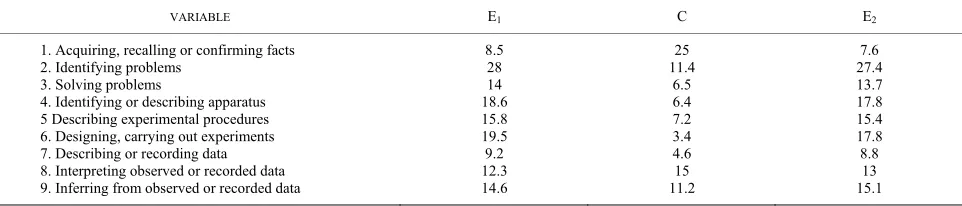
Classroom instructional approaches during physics practical work were coded using the Classroom Practical Work Assess-ment (CPWA) and the Physics Practical Lesson Analysis Sys-tem (PPLAS). The results for the CPWA and PPLAS are ana-lyzed and reported in Tables 1 and 2 respectively and elabo-rated further in the paragraphs that follow.
An examination of Table 1 indicates high percentages of mean ratings on laboratory classroom behaviours and skills in favour of the subjects in the experimental group (E1 and E2). These data seem to imply that during classroom practical tasks, the subjects in the ELEP treatment displayed better measure-ment process skills than their counterparts in the true control group. For instance, the subjects in the experimental conditions had better skills in the accurate use of measuring instruments
(18.2% and 17.8% for the E1 and the E2 groups respectively) as compared to (7.4%) portrayed by their counterparts in the true control group (C). Similarly, their application of correct meth-ods of measurement scores (22.4% for the E group and 22.8% for the E2 group) were the same but twice as higher than that (11.6%) of the C group. Their use of appropriate units of meas-urement scores (13.8%) and (14.4%) for the E1 and C2 groups respectively was higher than that (5.7%) of the control group (C). A similar observation was also evident in their application of correct notations and symbols where the E1 group score (15.6%) and the E2 score (17.2%) were almost equal but much higher than that of (6.4%) of the C group. The scores of the subjects on estimation and expression of values of various quantities in standard form were similar for E1 (14.9%) and C2 (14.1%) but much lower (7.2%) in the case of the true control group. The scores portrayed a clear picture that the learners in the experimental conditions performed equally well as com-pared to those in the controlled condition. This is a clear indica-tion that the use of ELEP had similar effect on the experimental subjects and their performance can be attributed to use of the ELE program.
Considering that this is true for many schools in Kenya, it is not surprising then that earlier studies by KIE (1999), Ndirangu (2000), Okere (1988), Ndirangu, Kathuri and Mungai (2003) and Wekesa (2003) which reported low achievement by pupils in process and manipulative skills may be arrested by applying the modern electronic media programs. This is supported by the findings presented above which proved that the use of the ELEP was modestly effective in enhancing the pupils' acquisi-tion of measurement and/or skills. A similar pattern is also observable from the data presented in Table 2 because the pu-pils in the regular tend to do tasks that require recall or confir-mation of facts and/or scientific concepts.
The data presented in Table 2 shows the students mean rat-ings score on their practical skills. Again, a similar pattern as the one observed in Table 1 where the subjects in the experi-mental treatments recorded higher but similar scores as com-
Table 1.
Percentage of mean ratings of pupils’ practical work.
VARIABLE E1 C E2
1. Uses measuring instruments accurately 2. Shows correct methods of measurement 3. Uses appropriate units
4. Applies correct notations and symbols
5. Estimates various quantities and expresses their values in standard form
18.2 22.4 13.8 15.6 14.9
7.4 11.6
5.7 6.4 7.2
17.8 22.8 14.4 17.2 14.1
Table 2.
Percentage of mean ratings of pupils’ practical skills.
VARIABLE E1 C E2
1. Acquiring, recalling or confirming facts 2. Identifying problems
3. Solving problems
4. Identifying or describing apparatus 5 Describing experimental procedures 6. Designing, carrying out experiments 7. Describing or recording data 8. Interpreting observed or recorded data 9. Inferring from observed or recorded data
8.5 28 14 18.6 15.8 19.5 9.2 12.3 14.6
25 11.4
6.5 6.4 7.2 3.4 4.6 15 11.2
7.6 27.4 13.7 17.8 15.4 17.8 8.8 13 15.1
[image:4.595.57.536.511.581.2] [image:4.595.57.538.618.721.2]
pared to the lower scores of those in the traditional laboratory classroom. A close observation of the results indicates that students in the true control group tend to rely more on informa-tion mostly supplied to them by their teacher. But in contrast, their counterparts in the e-learning laboratory classroom seem to engage more in tasks that require manipulative and process skills. The findings give a clear implication that the use of the ELEP not only engaged the learners actively in the develop-ment of practical skills but also removed them away for the tendency to rely on the teacher as is the case of those in the control condition. Moreover, the findings seem to corroborate earlier studies which revealed that the use of electronic learning environment programs improves students’ cognitive and psy-chomotor skills as well as their laboratory classroom instruc-tional approaches (Kiboss, 2000; Wekesa, 2003; Kiboss & Ogunniyi, 2005).
Effects of ELEP on the Pupils’ Content Knowledge
and Lesson Ownership
Part of the objective of this study was to explore what actu-ally transpired during the classroom discourse that may con-tribute to the effectiveness of the ELEP program on students’ understanding of measurement concepts. The findings reported above are supported by the observed episodes of classroom instructional approaches. The anecdotes reported in this section provide informed descriptions of episodes from class tasks that further give insights of how far the subjects captured the es-sence of group’s approaches to learning. An interview emanat-ing from an observation of what transpired in this 40-minute lesson seem to show a hive of activity, with the pupils appear-ing to be engaged in interactive and purposeful endeavours which might have contributed to their conceptual understanding of measurement. It is an example of a probe that was aimed at gaining insight into the students’ development of content knowledge and conceptual understanding.
Excerpt 1
Researcher: What would happen if the figures were reversed and how would you express it in standard form?
Class: [The group seemed puzzled by the question. But a girl in the group quickly looked at the example on the ELEP pro-gram and said].
Issah: I think I know how to do it. [Explains] If in the normal way we count the decimal place to the left, then here, I think the opposite case applies.
Chepkurui: I see what you mean. We count to the right. Issah: Yes.
Kosi: But how do you express the answer?
Issah: By placing a minus sign before the power of ten like this [she wrote on her book: 1.49−8].
Kosi: A ah... Now I understand what the computer meant when it said `if the figures begin with a zero point something, then the integer is expressed as negative power of ten’.
Kibet: Sir... Is that the right way to do it sir? Researcher: What do you think?
Kibet: I dunno.
Dan: I think they (girls) are right sir because the opposite of plus is minus and it (method) is what is stated in our textbook (Interview Notes, School B: E2 Group).
This incident illustrates a contextual development of the
stu-dents’ content knowledge in measurement and the subsequent student ownership of the lesson content (self-actualized under-standing of both measurement knowledge and skill). For exam-ple the following pupils’ remarks are indicative of this:
“A ah! I now understand what the computer mean when it said if figures begin with a zero point something, then the inte-ger is expressed as negative power of ten” and “I think they [girls] are right sir because the opposite of plus is minus and it [method] is what is stated in our textbook”.
It is apparent from the foregoing that the ELEP was not solely responsible for enhancing the students’ procedural know- ledge. A close examination of the classroom discourse anecdote cited in Excerpt 1 shows that the human-machine interactions were complemented by the student-student verbal and non- verbal interactions (Kiboss, 2000). As can be seen from the same anecdotes, the pupils did not just sit at the computer and absorbed the information relayed by the ELEP unto the screen. Rather they engaged themselves in serious intellectual debates and negotiations of meaning, which eventually resulted in their self-actualization. This is perhaps a further evidence that the ELEP per se does not in itself influence learning but rather it is the correlation of variables e.g. the teacher, pupils, the envi-ronment, instructional material etc., working together to bring about the desired learning.
Excerpt 2
Researcher: Why are you adding the two measurements? Martha: Cos when I measured I got the width as 5 m and the length as 12 m. I think you take the length and the width and add them together.
Researcher: Are you sure about that?
Martha: I dunno... Should I times them. No. I think I should multiply them to get area because when you add them you get the perimeter (Student Interview School A: C Group).
The information shown in Excerpt 2 indicates that some pu-pils in regular physics classroom misunderstand measurement concepts (Talsma, 1997; Smith et al., 1985). For instance, the interviewee’s response shows that she confuses area and pe-rimeter concepts. Perhaps this problem is related to the early courses at the primary school level (KIE, 1999). In Kenya, pupils learn about area in both mathematics and integrated sci-ence. However, perimeter is taught in mathematics only. It is most probable that this particular student has not realized that the additive rule is only used to calculate perimeter in mathe-matics and that perimeter and area are totally different concepts (Kiboss & Ogunniyi, 2002; KIE, 1999).
Students’ Approaches and Experiences with ELEP in
the Physics Laboratory Classroom
One of the unique qualities of ELEP is that the teacher or-ganized the lessons such that they allowed the students some freedom to interact with one another and to work cooperatively. The underlying assumption of ELEP was knowledge utilization. Its emphasis was not just to engage them in obedient execution of the instructions for a canned product. Rather, the students were required to apply what they had learnt in practical situa-tions. A good example is shown by episodes presented below.
Excerpt 3
Kim: This is interesting. Peter look... are you watching? Did you see how it lowered the ruler down and placed it on top of the block of wood?
Peter: Yeah. It placed the zero mark right against the end of the block of wood... I mean here (pointing at the example on the screen).
Owuor: Look it lowered the ruler like this (demonstrating with his 30-cm ruler) and made it to lie flat on top of the wooden block like so (laying his ruler flat on the table).
Excerpt 4
In this 40-minute lesson, the students payed raft attention to the stimulus conditions as though they did not want to miss anything. This investigator was struck by the fact that the stu-dents were enthralled with the lesson presentation and attended to the computer screen and interactively processed the informa-tion i.e., acting and reacting or responding by pressing a key or typing the answer on the keyboard. Although this was not timed, it was not long before one student moved aside to let another take the turn to operate the keyboard.
All across the room, several students were mimicking the animated illustration they watched on the screen. The teacher seemed to admire what was going on. He never interrupted them but moved closer to a group in the back of the class and joined them to discuss about the units on the ruler and how to read them correctly (Lesson Observation Notes, School B: Group E2).
From the foregoing, it seems that measurement learning in the ELEP classes was mediated by several other factors in addi-tion to the new program. For instance: 1) the students’ atten-tiveness to the stimulus attention; 2) their active and reactive responding via the keyboard; 3) the mimicking of graphic illus-tration to facilitate their comprehension; 4) their cooperation which allowed the smooth running of the program; 5) their verbal communication and negotiation of meanings and 6) the teacher’s facilitative role that allowed free interactions in the classroom. All these factors certainly played some significant role in the enhancement of the students’ ability to demonstrate factual, conceptual and procedural knowledge of measurement skills normally associated with secondary level physics cur-riculum.
Pupils’ Views about How the ELEP Improved Their
Manipulative and Practical Skills
During the course of the study, the pupils were interviewed to get the impact of their real experience with the lesson mate-rial and how they influence their understanding of measurement concepts. Excerpts 5-7 illustrate the pupils’ own thoughts and
explanations about how the ELE enhanced their conceptual understanding of measurement.
Excerpt 5
Issah: Since I learnt using the computer I feel like I have learnt more about measurement than when I first started the course.
Researcher: Can you explain that?
Issah: Yes sir. Before, I did not know about how to deter-mine the volume of an irregular object like a rough stone. I thought all volumes are determined by measuring length, breath and height and then apply the formula l × b × h. But in this
course, I learnt that the volume of an irregularly shaped object can be measured or determined by using a measuring cylinder or an Eureka can and water. The examples shown by the com-puter were easy to comprehend. For example when using an eureka can like the one we made from old cans. We also used them to measure volumes of objects. But this method is a little bit different from the one you directly use the measuring cylin-der. It is different because you don’t have to take the first read-ing. No. All you must do is simply fill the eureka can with wa-ter to the sprout and then place a calibrated beaker below the sprout so that the water don’t drop or pour on the table. The only thing which is like that of a measuring cylinder is tying the object with a string before you lower it gently into the can (Student Interview School B: E2 Group).
Excerpt 6
Ahmed: Yes because I had a chance to make an eureka can with my friends using old tins and straws. After we made them we measured the volume of an irregularly shaped object. This was very exciting and fun to see the water flow from our own eureka can into the beaker we calibrated using the ruler and markers when the object was inserted. It was exciting too to find that the volume of the object we got using our apparatus was the same with that of the calibrated laboratory beaker. The computer made it very easy for me to learn all these (Student Interview School C: E1 Group).
Excerpt 7
Nduta: The computer made calculation very easy for me. I liked the way it explained to me about how to solve problems in measurement. All I needed to do was just press or type something at the keyboard... it was fun to see it demonstrating about how to measure or read the scale and so on.
Lily: When I joined this course, I did not know anything about standard form or s.f. but after learning from the computer, I can now measure things, calculate the answer and even write very large or small numbers in standard form. The computer was very clear for me and they helped me learn alot about how to measure and record measurements of objects more accu-rately.
Issah: As I typed the answer and press enter... it responded back to me because the answer was lining with mine. Because my answer was right I knew my calculation was also right. I also understood more about measurement because when I actu-ally measured and calculated the density of objects, my answers were always right because I followed the method I learnt from the computer. I could not have gotten them right had it not been for the ease of the computer lessons (Group Interview, School C: E1 Group).
seem to show that the pupils in the ELEP treatment groups engaged themselves in practical activities that helped them to develop deeper understanding of measurement skills. It is in-teresting to note from these examples clearly shows that the pupils attributed their success of learning measurement skills to the use of ELEP. This is particularly so because the picture emerging from what they said about what transpired during their classroom discourse indicates that during the lesson proc-esses, they were involved in tasks that engaged them in active participation and negotiation of meanings (Kiboss, 2010; Ki-boss & Ogunniyi, 2003). Although the ELEP may not appear to be totally responsible in the enhancement of the pupils’ meas-urement skills, it nonetheless facilitated the learning process.
Teacher’s Views about How ELEP Improved His
Pupils’ Manipulative and Practical Skills
In this study, comments from the teacher were also consid-ered to gain more insight of their views regarding the use of the ELEP. From the teacher’s verbatim depicted in Excerpt 8, there appears to be a general feeling that the pupils in the treatment groups (E1 and E2) exhibited better measurement skills than there counterparts in the true control group (C). This was evi-dent in an interview in which the teacher was asked to share his feeling regarding the development of the pupils’ understanding of measurement skills.
Excerpt 8
Teacher: The concept of measurement is a topic that is diffi-cult to teach because the pupils must learn and practice with the measurement tools in the classroom or labs and we don’t al-ways have enough laboratory apparatus for every student. But for me, the ELE has been a good supplement. I have also noted that my relationship with the pupils and among themselves has improved tremendously. I must admit that the ELE programme has been very helpful and already, I may reconsider changing my current teaching practice. For I feel that if I must maintain their interest and motivation to learn physics, then I need to keep up with this new method (Teacher Interview, School C: E1 Group).
Excerpt 9
Teacher: I feel that the computer lessons help the pupils de-velop a deeper understanding of measurement procedures be-cause they could make use of the measurement tools and work out problems with minimal difficulty right from the time they are issued with the apparatuses. I noted that whenever they encounter difficulties, they sort of make reference to the ELE information. I know that most of them had not really seen a pair of callipers before this course. No. But after learning about them from the computer they were able to use them to measure inner and outer diameters of spherical objects (Teacher Inter-view, School B: E2).
A further analysis of these episodes indicates that there seems to be a strong relationship between the nature of a con-ducive classroom environment and the acquisition of the nec-essary measurement skills. The extent of active student partici-pation in the learning process and application of new knowl-edge to practical situations observed in the ELE classes is a theme that emerged in support of the ELEP’s strength to im-prove pupils’ conceptual and procedural understanding of measurement. The example illustrated in Excerpt 9 echoes the
teacher’s own expressions about how the use of ELEP im-proved both the pupils’ understanding of measurement concepts and skills, and other problem solving and manipulative skills e.g. calculation and computer operational skills. This is in line with earlier studies that supported the notion that the use of modern instructional media such as e-learning has the potential of enhancing students; understanding in science (Kiboss & Ogunniyi, 2003; Kiboss, 2000; Andre & Veldhuis, 2000; Park & Hopkins, 1993; Ndirangu et al., 2003; Kiboss, 2010).
Conclusion
The findings of this study lend support to the general hy-pothesis that ELEP positively influenced the development of the learners’ conceptual and procedural understanding of meas-urement in school physics. For on the basis of the data and the comments from both the teacher and the learners, it appears that the ELEP did enhance the pupils’ cognitive and manipulative skills. However, it should not be assumed that the ELEP as a medium was solely responsible for the achievement observed in the study. Rather, a number of other mediating variables con-stituting the classroom environment (e.g. peer interaction and active participation) in the course also played a part (Kiboss, 2000; Schar & Kruefler, 2000; Mayer & Moreno, 2003; Zum-bach, 2006; Hudson, 1999; Kiboss, 2010).
Considering the results of the descriptive data and the quali-tative anecdotes cited, there is considerable evidence to suggest that the ELEP was relatively effective in influencing the pupils’ conceptual and procedural understanding of measurement. But what was the main variable(s) driving this success? Looking at the qualitative evidence, it appears that the use of ELEP pro-vided a conducive classroom environment that allowed mutual human-machine interactions that must have exerted a positive influence on the outcomes reported in the study. This is in line with earlier (Kiboss, 2010; Robinson, 1994) claims that the effective use of modern classroom instruction systems such as electronic learning environments do not just only engage learn-ers vicariously in the learning process but tend to also empower them and transform their classroom learning approaches, hence making them to develop the necessary knowledge and skills.
In light of this, the findings have nevertheless reaffirmed previous studies that concluded that:
1) the use of electronic mediated instructional programs have the potential of boosting the students’ development of factual knowledge as well as their conceptual understanding and pro-cedural skills (Kiboss, 2010; Wekesa et al., 2006);
2) the traditional mode due to lack of adequate resources of-ten make the learning of basic science concepts a dogma to be committed to memory but ELEP has made the teaching of measurement that is considered by most teachers as difficult to teach and learn modestly effective;
3) ELEP can open new channels of communication and ex-periences for pupils in ways that are not possible with tradi-tional methods (Kiboss & Ogunniyi, 2005).
meas-urement concepts and methods associated with school science. It also proved that although teachers tend to resist change, they nevertheless as a result of some impasse they feel they have reached in their teaching may gravitate out of necessity towards that change. Apparently, it has become clear that the teacher’s pre-existing conceptions of instructional practice are critically important to the understanding of what teachers do with com-puters in the classroom milieu. In effect the findings have demonstrated that the resources must be understood in relation to the curriculum within which learning occurs. This is because the teacher’s practice and its history may allow us to understand how they may be incorporated into the teaching and learning culture (Zumbach, 2006; Keller, 2005; Lemke, 1995). However, future studies are necessary to ascertain whether these findings are incidental of genuine.
References
Andre, T., & Veldhuis, G. H. (1991). Use of computers by physics and physical science teachers. Journal of Computer-Based Instruction, 18, 113-117.
BenJacob, M. G., Levin, D. S., & BenJacob, T. K. (2000). The learning environment of the 21st century. Educational Technology Review, 13, 812.
Duggan, S., & Gott, R. (1995) The place of investigations in practical work in the UK National Curriculum for Science. International Journal of Science Education, 17, 137-147.
doi:10.1080/0950069950170201
Hudson, B. (1997). Group work with multi-media in mathematics: The role of the technology and of the teacher. British Journal of Educa-tional Technology, 28, 257-270. doi:10.1111/1467-8535.00033
Jonassen, D. H., Peck, K. L., & Wilson, B. G. (1999). Learning with computer technology: A constructivist approach. Princeton, New Jersey: Merrill.
Keller, C. (2005). Virtual learning environment: Three implementation perspectives. Learning, media and technology, 30, 299-311. Kiboss, J. K. (2000). An evaluation of teacher/student verbal and
non-verbal behaviors in computer-augmented physics laboratory classrooms in Kenya. Journal of Information Technology and Teacher Education, 9, 199-213.
Kiboss, J. K. (2010). Pupils’ perceptions of the teacher’s changing role in e-learning physics classroom instruction. Creative Education, 1, 33-38. doi:10.4236/ce.2010.11006
Kiboss, J. K., & Ogunniyi, M. B. (2003). Influence of a computer-based intervention on students’ conceptions of measurement in secondary school physics. Themes in Education, 4, 203-217.
Kiboss, J. K., & Ogunniyi, M. B. (2005). Learning outcomes of first year secondary students in a computer-augmented physics program on measurement. Learning, Media and Technology, 30, 313-326. Kenya Institute of Education [KIE] (1992). Ministry of Education
sec-ondary education syllabus (Vol. 7). Nairobi: Kenya Literature Bu-reau.
Kenya Institute of Education [KIE] (1999). Formative evaluation of the secondary education curriculum. Research Report Series, 22, 27.
Lemke, J. L. (1995). Textual politics:discourse and social dynamics. London: Taylor and Francis Ltd.
Linder, C. (1992). Is teacher-reflected epistemology a source of con-ceptual difficulty in Physics? International Journal of Science Edu-cation, 14, 11-121. doi:10.1080/0950069920140110
Mayer, R. E., & Moreno, R. (2003). Nine ways to reduce cognitive load in multimedia learning. Educational Psychologist, 38, 43-52.
doi:10.1207/S15326985EP3801_6
Miles, M. B., & Huberman, A. M. (1984). Qualitative data analysis. London: Sage.
Ndirangu, M. (2000). A study of the perception of the influence of teaching practice projects on the teaching of science in selected sec-ondary schools in Kenya. Unpublished Ph.D. thesis, Njoro, Kenya: Egerton University.
Ndirangu, M., Kathuri, N. J., & Mungai, C. (2003). Improvisation as a strategy for providing science teaching resources: An experience from Kenya. International Journal of Education Development, 23, 75-84. doi:10.1016/S0738-0593(01)00054-2
Ogunniyi, M. B. (1992). Understanding research in social science. Ibadan: University Press.
Okere, M. I. O. (1988). Meanings and measures of creativity for phys-ics education. Kenya Journal of Education, 4, 162-168.
Park, O. C., & Hopkins, R. (1993). Instructional conditions for using dynamic visual displays: A review. Instructional Science, 21, 427- 449. doi:10.1007/BF00118557
Patton, M. Q. (1991). Qualitative evaluation methods. Beverly Hills, CA: Sage Publications.
Robinson, H. A. (1994). The ethnography of empowerment: The trans-formative power of classroom interaction. Bristol: The Palmer Press. Roth, W. M., & Roychoudhury, A. (1992). The social construction of
scientific concepts or the concept map as a conscription device and tool for the social thinking in high school science. Science Education, 76, 531-557. doi:10.1002/sce.3730760507
Schar, G. S., & Kruefler, H. (2000). Empirical research on the effect of dynamic media for information presentation. Zurich: Swiss Federal Institute of Technology.
Smith, C., Carey, S., & Wiser, M. (1985). On differentiation: A case study of the development of the concepts of size, weight, and density. Cognition, 21, 177-237. doi:10.1016/0010-0277(85)90025-3
Talsma, V. L. (1997). How can we measure student understandings in science? Ann Arbor, MI: School of Education, University of Michi-gan.
Wekesa, E. (2003). Effects of a computer-based instruction simulation module on students’ achievement, perception of the classroom envi-ronment and attitude towards school biology in Nakuru district, Kenya. Unpublished Master’s Thesis, Njoro: Egerton University. Wekesa, E., Kiboss, J. K., & Ndirangu, M. (2006). Improving students’
understanding and perception of cell theory in School Biology using a computer-based instruction simulation program. Journal of Educa-tional Multimedia and Hypermedia, 15, 397-410.
White, R., & Gunstone, R. (1992). Probing understanding. New York: The Falmer Press.
Wragg, E. C. (2000). An introduction to classroom observation. Lon-don: Routledge.