Ahmednagar, Maharastra, India
Copyright to IJIRSET www.ijirset.com 282
Speaking Gloves for Speechless Persons
Abjhijt Auti, V. G. Puranik, Dr. A. K. Kureshi
Dept. of E & TC, Vishwabharti Academy`s College of Engineering, Ahmednagar, Maharastra, India Dept. of E & TC., Vishwabharti Academy`s College of Engineering, Ahmednagar, Maharastra, India Dept. of E & TC., Vishwabharti Academy`s College of Engineering, Ahmednagar, Maharastra, India
Abstract: The main aim of the paper is to develop Electronic Speaking Glove, designed to facilitate an easy communication through synthesized speech for the benefit of speechless patients. Generally, a speechless person communicates through sign language which is not understood by the majority of people. The proposed system is designed to solve this problem. Gestures of fingers of a user of this glove will be converted into synthesized speech to convey an audible message to others, for example in a critical communication with doctors. The glove is internally equipped with multiple flex sensors that are made up of “bend-sensitive resistance elements”. For each specific gesture, internal flex sensors produce a proportional change in resistance of various elements. The processing of this information sends a unique set of signals to the PIC microcontroller and speaks jet IC which is pre-programmed to speak desired sentences. In recent years, researchers have been focusing on hand gestures detections and been popular for developing applications in the field of robotics and extended in the area of artificial or prosthetic hands that can mimic the behaviour of a natural human hand.
Keywords: Fully embedded, Portable, Less weight, Single Li-ion battery for longer operation, Low power consumption, less hardware, Robust
I. INTRODUCTION
How frequently do we meet a speechless patient in normal life? How visible are they in offices or behind shop counters? The truth is that there is often little room for these people in the workplaces. In recent years, researchers have been focusing on hand gestures detections and been popular for developing applications in the field of robotics and extended in the area of artificial or prosthetic hands that can mimic the behaviour of a natural human hand. This paper although utilizes a similar approach for the detection of the movement of fingers, however I have tried to extrapolate the idea in a slightly different perspective and have come up with a small yet significant application in the field of bioengineering. This paper is useful for the deaf and dumb, it can also be used for the (speechless) patients with half of their bodies paralysed and who are not able to speak but are able to move their fingers.
The aims and objectives of this research work include [1]:
• Basic object of this paper is to design a portable embedded system
• Developing an economical and simple solution for the detection of finger gestures • Cost effective, reliable data acquiring method and signal conditioning
II. DATA ACQUISITION METHODS
To start with our research, on obtaining a bio-signal from the fingers, which require obtaining a signal proportional to the movement of the fingers? Fingers are able to interpret different hand gestures, research showed that many haptic devices used in prosthesis utilized the conventional method of using EMG signals.
Following is the list of possible methods which could be used to sense the hand's movements [2]: (discussing each one of them in detail will be beyond the scope of this paper)
Ahmednagar, Maharastra, India
Copyright to IJIRSET www.ijirset.com 283
• Wearable conductive fiber • Deterioration of fiber optic cable • Sliding fiber optic cable • Strain gauge tactile sensor • Flex Sensor
After analysing all of the above methods for signal acquisition the best solution to use flex sensor in this paper as it is comparatively reliable and a cost effective solution.
A. FLEX SENSORS
Fig.2.1. Flex Sensors [1]
Flex sensors [3] change in resistance depending upon the amount of bend on the sensor as shown in Fig.2.1 They convert the change in bend to electrical resistance - the more the bend, the more will be the resistance value. They are usually in the form of a thin strip from 1 "-5" long that vary in resistance from approximately 10KΩ to 50KΩ. They are
frequently used in gloves to sense finger movement. The flex sensors are used as input and are placed inside the glove that is to be worn. The sensor is so flexible that it bends easily even with a small bend. As it is very thin and light weight so it is also very comfortable.
Inside the flex sensor are carbon resistive elements within a thin flexible substrate. When the substrate is bent the sensor produces a resistance output relative to the bend radius. Pragmatically deflection of 00, 200, 400, 450, 500, 700 and 900 will give 10KΩ, 14.5 KΩ, 18.8 KΩ, 20 KΩ, 21.1 KΩ, 25.5 KΩ and 30 KΩ of resistances respectively. Its
relation is shown in Fig. 2.2
Resistance vs. Degree
Ahmednagar, Maharastra, India
Copyright to IJIRSET www.ijirset.com 284 III. SYSTEM MODELLING
A. SYSTEM BLOCK DIAGRAM AND FLOWCHART:
Fig. 3.1.1 System Block Diagram [1][8]
FLEX
SENSOR
SIGNAL
CONDITIONING
PIC
MICROCONTROLLER
aIVR341N
Ahmednagar, Maharastra, India
Copyright to IJIRSET www.ijirset.com 285
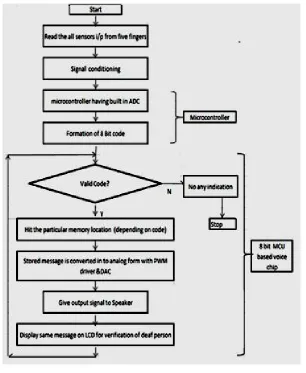
Fig. 3.1.2 System flowchart
B. SIGNAL CONDITIONING
It has been done by the circuit shown in Fig.3.2.1 Supply voltage is applied on the divider circuit having 51 KΩ
Ahmednagar, Maharastra, India
Copyright to IJIRSET www.ijirset.com 286
Fig. 3.2.1 Flex Sensor Signal Conditioning Circuit [I]
Fig. 3.2.1 Flex Sensor Signal Conditioning Circuit [1]
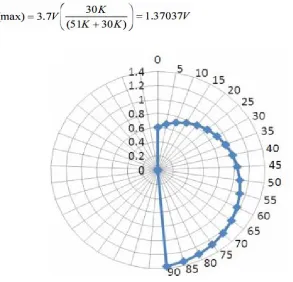
The corresponding values of graph which is output of Fig. 3.2.2 Calculations are as following:
Formula for voltage divider circuit:
For Vo minimum when sensor deflection is 00 Rl=51KΩ, R2=10KΩ and Vcc= 3.7V
Ahmednagar, Maharastra, India
Copyright to IJIRSET www.ijirset.com 287
For Vo maximum when sensor deflection is 900 Rl=51KΩ, R2=30KΩ and Vcc= 3.7V
Fig. 3.2.2 Signal Conditioning Graph (Deflection vs. Voltage)
C. PIC18F4620
The output of the signal conditioning block is fed to PIC18F4620 (Operating Voltage range 4.2 - 5.5V) on PORTA and PORTE/PORTB that is used as analog input for built-in ADC (Analog to Digital Converter).. It has 10-bit built-in ADC which convert it into digital form i.e. (binary data). Similarly, it takes data from each finger and accumulates all five fingers data in five 8-bit registers, another bit-addressable register is used to store cumulative data in five bits dedicated for five fingers which consequently gives 32 combinations. Every number which is detected by hand gestures that can be seen in Table II has predefined meaning a certain 8-bit code for particular message is sent to aIVR341N block. This block can be seen in Fig. 3.1
D. aIVR341N
Ahmednagar, Maharastra, India
Copyright to IJIRSET www.ijirset.com 288
resistor controlled oscillator, 9-bit resolution current mode D/A output and PWM direct speaker driving minimize the number of external components. Volume control for both DAC and VOUT output is available.
E. SIGNAL AMPLIFICATION
The recorded voice output from aIVR341N is not much audible to human ears therefore; it is fed to an amplifier (LM386 Y,1/4 W) that enhances its volume. It is configured at the gain of 200 that makes it quite natural to human ears; an 8Ω speaker is used to get the final output.
Ahmednagar, Maharastra, India
Copyright to IJIRSET www.ijirset.com 289
So far thirty two messages have been programmed for thirty two gestures; maximum 243 messages can be programmed as we have three bends sequence and it can be applied to five fingers but will be difficult for user to use it precisely.
IV. CONCLUSIONS
1.
This paper is a useful tool for speech impaired and partially paralysed patients which fill the communication gap between patients, doctors and relatives.Ahmednagar, Maharastra, India
Copyright to IJIRSET www.ijirset.com 290
3.
As it is portable, requires low power operating on a single lithium-ion rechargeable battery and having lessweight and robust give patient liberty to carry it anywhere at their will.
ACKNOWLEDGMENT
This investigation was supported by the department of Electronics & Telecommunication Engineering of Vishwabharti Academy`s College Of Engineering, Ahmednagar, University of Pune, India.
REFERENCES
B. Ali, S. Munawwar, B. Nadeem, "Electroni Speaking Glove for Speechless Patients", August 2010, Bachelor of Electronic Engineering FYP Report, FEST, HIIT, Hamdard University, Karachi, Pakistan
N. P. Bhatti, A. Baqai, B. S. Chowdhry, M. A. Unar, "Electronic Hand Glove for Speech Impaired and Paralyzed Patients", EIR Magazine, May 2009, pp. 59-63, Karachi, Pakistan
B. B. Edin, L. Ascari, L. Beccai, S. Roccella, J. J. Cabibihan, M. C. Carrozza, "Bio-Inspired Sensorization of a Biomechatronic Robot Hand for the Grasp-and-Lift Task", Brain Research Bulletin, Volume 75, Issue 6, 15 April 2008, pp. 785-795
[CrossRef]
M. Wald, "Captioning for Deaf and Hard of Hearing People by Editing Automatic Speech Recognition in Real Time", Proceedings of 10th International Conference on Computers Helping People with Special Needs ICCHP 2006, LNCS 4061, pp. 683-690
L. K. Simone, E. Elovic, U. Kalambur, D. Kamper, "A Low Cost Method to Measure Finger Flexion in Individuals with Reduced Hand and Finger Range of
Motion", 26th Annual International Conference of the IEEE Engineering in Medicine and Biology Society 2004 (IEMBS '04), Volume 2, 2004, pp. 4791-4794 Jingdong Zhao, Li Jiang, Shicai Shi, Hegao Cai, Hong Liu, G. Hirzinger, "A Five-fingered Underactuated Prosthetic Hand System", Proceedings of the 2006 IEEE International Conference on Mechatronics and Automation, June 2006, pp. 1453-1458
Flex Point Inc. USA, "http://www.flexpoint.com", Last Accessed on September 06, 2010
Magnevation SpeakJet Inc. USA, "http://www.speakjet.com", Last Accessed on September 06, 2010 BIOGRAPHY
Prof. A.H. Auti is currently working as Assistant professor in Vishwabharati Academy’s College of Engineering, Ahmednagar Pune University. He received [BE] degree from Pune University & [ME] degree from Dehli University, India.
His area of interest includes embedded system.
Prof. V.G. Puranik is currently working as Assistant professor in Vishwabharati Academy’s College of Engineering, Ahmednagar Pune University. He received [BE] degree from MBES College of engineering Ambajogai & [ME] degree from Govt. college of Engineering, Aurangabad (M.S.), India.
![Fig.2.1. Flex Sensors [1]](https://thumb-us.123doks.com/thumbv2/123dok_us/1535888.1188347/2.612.250.362.515.643/fig-flex-sensors.webp)
![Fig. 3.1.1 System Block Diagram [1][8]](https://thumb-us.123doks.com/thumbv2/123dok_us/1535888.1188347/3.612.96.505.238.392/fig-system-block-diagram.webp)
![Fig. 3.2.1 Flex Sensor Signal Conditioning Circuit [I]](https://thumb-us.123doks.com/thumbv2/123dok_us/1535888.1188347/5.612.165.468.179.471/fig-flex-sensor-signal-conditioning-circuit.webp)