Apparent Viscosity of a Skim Milk Based Dessert:
Optimization through Response Surface
Methodology
Felipe Richter Reis1*, Adaucto Bellarmino de Pereira-Netto2, Joana Lea Meira Silveira3, Charles Windson Isidoro Haminiuk4, Lys Mary Bileski Cândido5
1Graduate Program of Food Technology, Department of Chemical Engineering, Universidade Federal do Paraná, Curitiba, Brazil; 2Department of Botany, Universidade Federal do Paraná, Curitiba, Brazil; 3Department of Biochemistry and Molecular Biology, Universidade Federal do Paraná, Curitiba, Brazil; 4Department of Food Engineering, Universidade Tecnológica Federal do Paraná, Campo Mourão, Brazil; 5Department of Food Technology, Universidade Tecnológica Federal do Paraná, Francisco Beltrão, Brazil. E-mail: [email protected]
Received January 12th, 2011; revised February 1st, 2011; accepted February 15th, 2011.
ABSTRACT
In this study, the apparent viscosity of a skim milk based dessert was optimized through the use of a 5-level Central Composite Design. The effect of carrageenan, guar gum, sucrose and pH on the dessert’s apparent viscosity was esti-mated. The dessert’s flow behavior was also analyzed. A rotational viscometer was used for the apparent viscosity measurements. All formulations presented a non-Newtonian, shear-thinning behavior. Except for carrageenan concen-tration, all of the design factors affected apparent viscosity, being the effects better described by second order polynomial models. The following combinations of the variable ingredients yielded the best apparent viscosity: guar gum concen-tration:0.0% - 0.315%(w/w) and sucrose concentration:5.000% - 8.615%(w/w); or guar gum concentration:0.109% -
0.315%(w/w) and sucrose concentration: 5.000% - 11.000%(w/w); in both cases, carrageenan and pH were kept at
0.020% (w/w) and 6.50, respectively.
Keywords: Viscosity, Milk, Guar, Carrageenan, Dairy Dessert
1. Introduction
Consumption of foods containing saturated fat is consid-ered to contribute to the development of heart diseases and colon cancer [1,2]. In addition, reduction in the re-lease of flavors, a severe technological limitation, has been associated with the presence of high fat contents in foods such as ice creams and custards, which are semi-solid, typically whole or semi-skimmed milk dairy desserts [3-5]. Therefore, new food systems presenting lower saturated fat content have been proposed [6-8]. Semi-solid dairy desserts are foods with high sensory appeal, usually containing fat milk, thickeners, sucrose and a flavoring agent [9,10].
Recent studies have investigated the rheological be-havior of combinations of semi-solid polysaccharide mix-tures and dairy products. For example, the addition of λ- carrageenan resulted in an increment in viscosity of semi-solid dairy desserts, and, most of the resulting pro- ducts presented a clear gel-like behavior [11].
Creaminess, a sensory feature also known as creamy mouthfeel, is a very important attribute of semi-solid dairy desserts [12]. And, for model caramel creams con-taining various levels of dairy fat and xanthan gum, a positive quadratic relationship between creaminess and apparent viscosity was demonstrated [13]. In addition, in starch-based custard desserts, creaminess has been dem-onstrated to be determined by its lubricant properties, homogeneity and apparent viscosity [14].Furthermore, a sensory panel aimed at evaluating butter-in-water emul-sions confirmed that apparent viscosity strongly influ-ences the consumer perception of creaminess. When seen together, data from rheological and sensory analysis sug-gest that the viscosity of the continuous phase is the dominating attribute controlling the perceived creaminess [15]. These findings demonstrated that rheological pa-rameters might be useful for initial screening of custards for better texture [16].
semi-solid skim milk-based dessert, aiming to improve creaminess, a key-sensory attribute of dairy desserts.
2. Materials and Methods
2.1. Materials
The following ingredients were used for the preparation of the semi-solid dairy dessert: UHT (Ultra High Tempera-ture) skim milk (Parmalat, Carazinho, Brazil); sucrose, (Copersucar, São Paulo, Brazil); cross-linked waxy maize starch (Amysol® 700, Corn Products International, West- chester, IL, USA), κ-carrageenan and guar gum (Doce Aroma Comercial Ltda, São Paulo, Brazil). Citric acid and sodium bicarbonate (Labsynth, Diadema, Brazil) were used for pH adjustment and potassium sorbate (Sigma- Aldrich, Saint Louis, MO, USA) was used as a food pre-servative.
2.2. Methods
2.2.1. Dessert Preparation
Carrageenan, guar gum, sucrose, citric acid and sodium bicarbonate (for pH adjustment) were used according to the experimental design, reported below. Modified starch and potassium sorbate concentrations were set, for all formulations, at 3.25% (w/w) and 0.04% (w/w), respec-tively [11]. After stirring the ingredients until complete homogeneity, citric acid or sodium bicarbonate was added to the mixture in order to reach the desired pH. The for-mulations were individually pasteurized at 74 ± 2˚C for 15 s. Then, the desserts were stored at 4 ± 1˚C, for six hours, before the apparent viscosity measurements.
2.2.2. Apparent Viscosity Measurements
The apparent viscosity of the desserts was measured at 4 ± 1˚C through the use of a rotational viscometer (DV II + LV, Brookfield, Middleboro, MA, USA), equipped with a LV4 spindle. Measurements were carried out at fourteen angular speeds of the viscometer spindle, ranging from 1.5 to 100.0 rpm.
The angular speeds of 2.5, 5.0, 10.0, 20.0, 50.0 and 100.0 rpm were used together with the correspondent apparent viscosity measurements in order to generate the values of shear rate, shear stress and flow behavior index of the formulations. A fixed volume (300 mL) of each sample was used for the apparent viscosity measurements in a 600 mL beaker [17].
2.2.3. Experimental Design
A four factors-five levels response surface Central Com- posite Design, which resulted in twenty six formulations, was used in this trial. The response surface methodology was chosen in order to optimize the levels of the inde-pendent variables (factors) that provided the desired val-ues for the dependent variable (response) [18]. The chosen factors were carrageenan, guar gum and sucrose
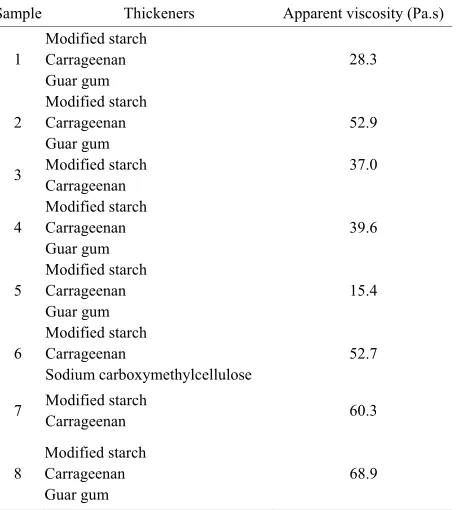
[image:2.595.307.538.294.408.2]concen-tration, and pH. The levels of the factors were chosen according to the recommendations of the manufacturers, in the case of the two gums, and according to previously reported studies on dairy desserts, in the case of sucrose and pH [19,11,4]. The average apparent viscosity found in this study for regular (whole or semi-skimmed milk-based) commercially available semi-solid dairy desserts (Table 2) was used as a target to be achieved for our dairy dessert. Table 1 shows the five levels chosen for each of the four independent variables of the Central Composite Design.
The effect of the factors used in this work on the ap-parent viscosity were fitted by polynomial models. In order to describe the effects of the several factors on the apparent viscosity, response surfaces were developed
Table 1. Description of the factors used in this work, along with their respective levels.
Factor Level
–2 –1 0 +1 +2
Carrageenan (g/100 g
of dessert) 0.000 0.010 0.020 0.030 0.040 Guar
(g/100 g of dessert) 0.000 0.125 0.250 0.375 0.500 Sucrose
[image:2.595.312.540.460.715.2](g/100 g of dessert) 5.000 6.500 8.000 9.500 11.000 pH 5.500 6.000 6.500 7.000 7.500
Table 2. Apparent viscosity and thickeners used in com-mercial samples used as a reference for the optimization of the apparent viscosity of the formulated dessert.
Sample Thickeners Apparent viscosity (Pa.s)
1
Modified starch Carrageenan Guar gum
28.3
2
Modified starch Carrageenan Guar gum
52.9
3 Modified starch Carrageenan
37.0
4
Modified starch Carrageenan Guar gum
39.6
5
Modified starch Carrageenan Guar gum
15.4
6
Modified starch Carrageenan
Sodium carboxymethylcellulose
52.7
7 Modified starch
Carrageenan 60.3
8
Modified starch Carrageenan Guar gum
considering two of the independent variables constant at the central level of the central composite design. The generated mathematical model was submitted to analysis of variance and effects estimation using a 5% confidence level (Statistica version 7.0, Statsoft, Tulsa, OK, USA).
3. Results and Discussion
[image:3.595.308.534.85.283.2]The apparent viscosities of eight commercially available semi-solid dairy desserts and their respective thickening agents were evaluated (Table 2). The apparent viscosity of these desserts ranged from 15.4 to 68.9 Pa.s, with an average of 44.4 ± 17.6 Pa.s. This average value was used as target for apparent viscosity for our dessert. Five out of eight of the commercially available semi-solid dairy desserts evaluated were gelified/thickened by a com- bination of modified starch, carrageenan and guar gum. The addition of modified starches to semi-solid foods, in combination with other types of thickeners, has been widely used because the enzymatic breakdown of starch by salivary amylase has been demonstrated to reduce creaminess of semi-solid foods [20,12]. Guar gum is a cheap, broadly used source of food thickener. It consists of a commercial hydrophilic polymer, structurally de-scribed as l-4-linked β-D-mannopyranosyl backbone partially substituted at O-6 with α-D-galactopyranosyl side groups, obtained from seeds of Cyamopsis tetra-gonolobus L. Taub. Guar gum is essentially a galacto-mannan with a mannose/galactose ratio of 1.6:1 [21]. Carrageenan, another hydrocolloid, is typically used as a thickener in dairy desserts, in combination with starch. Carrageenan consists of a linear sulphated polysaccharide, namely O-β-D-galactopyranosyl-4-sulfate-(1-4)-O- 3,6-anhydro-α-D-galactopyranosyl-(1-3), obtained fr- om red seaweeds [9,11,4,5]. Upon heating and subsequent cooling, κ-carrageenan forms thermoreversible gels in the presence of gel-promoting cations [22]. In dairy desserts, κ-carrageenans complex with κ-casein micelles of milk generating a thickening effect of 5 to 10 times greater than its effect in water. Carrageenan is a good substitute for fat in dairy products, once it maintains softness in these food systems [23,24].
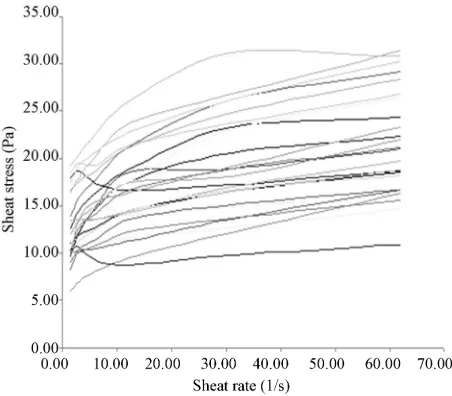
Figure 1 shows the relationship between the calculated shear rate and shear stress for the twenty six desserts formulated in this work. All of the formulations prepared in this trial presented behavior typical of non-Newtonian fluids, i.e., the relationship between shear rate and shear stress was not linear [25]. This finding agrees with pre-viously reported studies in which whey-enriched [26] and semi-solid [27] dairy desserts showed features of non-Newtonian fluids. In addition, our desserts presented a shear-thinning or pseudoplastic nature, as it had been previously observed for corn starch-galactomannan com-binations, where the observed pseudoplasticity was at
Figure 1. Shear rate versus shear stress for the 26 formu-lated desserts.
tributed to the waxy nature of the employed starch [28]. Recently, the apparent viscosity of combinations of starch and fenugreek, another source of galactomannan, was also shown to present shear-thinning behavior [29].
In this work, the response surface methodology was used to predict the effects of the four studied factors, namely carrageenan, guar gum and sucrose concentra-tions, and pH on the apparent viscosity of the skim milk dessert. The general form of the second-order mathe-matical model that provided the best fit, based on the R2 value, was
0 1 1 2 2 3 3 4 4 5 1
6 2 7 3 8 4 9 1 2
10 1 3 11 1 4 12 2 3 13 2 4
14 3 4
Y ^ 2
^ 2 ^ 2 ^ 2
X X X X X
X X X X X
X X X X X X X X
X X
where Yis the dependent variable; β0is a constant value;
X1, X2, X3 and X4 represent the levels of the factors; β1-β14 represent the estimated coefficients; and ε is a random error. The model was associated with an R2 of 0.784. The best fit for the influence of the factors on the response was observed for the apparent viscosity measured at the an-gular speed of the viscometer spindle of 4 rpm. Analysis of variance for the model is shown on Table 3. Except for the carrageenan concentration, all of the factors investi-gated were found to be significant at p = 0.05, i.e., guar gum and sucrose concentration and pH, all affected the apparent viscosity of the dessert.
Table 3. Analysis of variance for the model used to describe the effect of carrageenan, guar gum and sucrose concentra-tions, and pH on the apparent viscosity of the skim milk dessert.
Factor SS DF MS F p
Guar gum (L) 4511.261 1 4511.261 104.8959 0.000512
Sucrose (Q) 820.252 1 820.252 19.0725 0.011994
pH (L) 422.028 1 422.028 9.8130 0.035098
Interaction guar gum (L) × sucrose (L)
652.160 1 652.160 15.1640 0.017629
Lack of Fit 1534.081 17 90.240 2.0983 0.25
Pure Error 172.028 4 43.007
[image:4.595.57.288.128.455.2]Total SS 7906.090 25
Figure 2. Pareto chart for the influence of carrageenan, guar gum and sucrose concentrations, and pH on the apparent viscosity of the skim milk based desserts.
gum concentration is likely due to the thickening capac-ity of the guar and also to the significant influence of the guar gum on the pasting properties of corn starch [28]. The negative relationship found for apparent viscosity and pH in this work is similar to what has been previ-ously reported for modified starch pastes, where the ap-parent viscosity can be controlled by changing pH [23]. A decrease in pH has been reported to increase the initial stiffness (G’ at 1 Hz) in β-lactoglobulin/κ-carrageenan mixed gels, and initial stiffness has been shown to be positively correlated with creaminess in commercial cus-tards [30,12].
Figure 3 shows the response surface of the apparent viscosity values as influenced by guar gum and sucrose concentrations. The carrageenan concentration and pH were kept at their respective center points (0.02% w/w and 6.50, respectively). Under these conditions, the op-timal viscosity range (26.8 to 62.0 Pa.s) is achieved when
Figure 3. Effects of guar gum and sucrose concentration on the apparent viscosity of the skim milk based desserts.
[image:4.595.58.287.133.455.2]guar gum is used at concentrations between 0.0 and 0.315% (w/w) in combination with sucrose at concentra-tions within the 5.000 to 8.615% (w/w) range. The same figure shows that adding guar gum at concentrations be-tween 0.109% - 0.315% (w/w) and sucrose ranging from 5.000 to 11.000% (w/w) also yields optimal apparent viscosity. Even though the presence of guar gum, a low cost food additive [23], in the formulation is not a re-quirement to achieve the optimal viscosity, its incorpora-tion into starch pastes causes a synergistic increase in viscosity [28], improving creaminess in the dessert.
4. Conclusions
Data in this work demonstrate that the response surface methodology can be effectively used to optimize the ap-parent viscosity of formulated semi-solid skim milk-based desserts through the management of the carrageenan, guar gum and sucrose concentrations, along with the pH of the desserts. According to the fitted mathematical model, the optimal apparent viscosity range found for commercially available semi-solid dairy desserts (26.8 to 62.0 Pa.s) can be achieved in our formulated dessert when: guar gum is used at the 0.0 to 0.315% (w/w) range; sucrose is used at the 5.000 to 8.615% w/w range; carrageenan is used at a concentration of 0.02% (w/w) and pH is 6.50. In addition, the optimal apparent viscosity can also be achieved when: guar gum is used at the 0.109 and 0.315% (w/w) range; sucrose is used at the 5.000 to 11.000% (w/w) range; carrageenan at 0.02% (w/w) and pH at 6.50.
studies are under way in order to provide a proper flavor to the various possible formulations for the skim milk des-sert described in this report and also to analyze their sensory features.
5. Acknowledgements
We would like to thank the Brazilian Government (CA- PES) for providing a fellowship to the senior author and to Corn Products International and Doce Aroma Ltda for providing part of the ingredients used in this work.
REFERENCES
[1] F. B. Hu, J. E. Manson and W. C. Willett, “Types of Die-tary Fat and Risk of Coronary Heart Disease: A Critical Review,” Journal of the American College of Nutrition, Vol. 20, No. 1, 2001, pp. 5-19.
[2] World Cancer Research Fund/American Institute for Cancer Research, “Food, Nutrition, Physical Activity, and the Prevention of Cancer: A Global Perspective,” AICR, 2007.
[3] E. A. Prindiville, R. T. Marshall and H. Heymann, “Ef-fect of Milk Fat on the Sensory Properties of Chocolate Ice Cream,” Journal of Dairy Science, Vol. 82, No. 7, 1999, pp. 1425-1432.
doi:10.3168/jds.S0022-0302(99)75369-5
[4] M. Keršienė, A. Adams, A. Dubra, N. de Kimpe and D. Leskauskaitė, “Interactions between Flavour Release and Rheological Properties in Model Custard Desserts: Effect of Starch Concentration and Milk Fat,” Food Chemistry, Vol. 108, 2008, pp. 1183-1191.
doi:10.1016/j.foodchem.2007.11.011
[5] M. Martuscelli, G. Savary, P. Pittia and N. Cayot, “Va-pour Partition of Aroma Compounds in Strawberry Fla-vored Custard Cream and Effect of Fat Content,” Food Chemistry, Vol. 108, No. 4, 2008, pp. 1200-1207. doi:10.1016/j.foodchem.2007.05.083
[6] J. U. McGregor and C. H. White, “Optimizing Ultrafiltra-tion Parameters for the Development of a Lowfat Ched-dar Cheese,” Journal of Dairy Science, Vol. 73, No. 2, 1990, pp. 314-318.
doi:10.3168/jds.S0022-0302(90)78675-4
[7] W. L. Kerr, X. Wang and S. G. Choi, “Physical and Sen-sory Characteristics of Low-Fat Italian Sausage Prepared with Hydrated Oat,” Journal of Food Quality, Vol. 28, No. 1, 2005, pp. 62-77.
doi:10.1111/j.1745-4557.2005.00010.x
[8] F. R. Reis, M. L. Masson and N. Waszczynskyj, “Influ-ence of a Blanching Pretreatment on Color, Oil Uptake and Water Activity of Potato Sticks, and Its Optimiza-tion,” Journal of Food Process Engineering, Vol. 31, No. 6, 2008, pp. 833-852.
doi:10.1111/j.1745-4530.2007.00193.x
[9] G. A. El-Garawany and M. H. Abd el Salam, “Prepara-tion and Rheological Properties of a Dairy Dessert Based on Whey Protein/Potato Starch,” Food Chemistry, Vol. 91, No. 3, 2005, pp. 261-267.
doi:10.1016/j.foodchem.2004.01.073
[10] A.-M. Seuvre, C. Turci and A. Voilley, “Effect of the Temperature on the Release of Aroma Compounds and on the Rheological Behaviour of Model Dairy Custard,” Food Chemistry, Vol. 108, No. 4, 2008, pp. 1176-1182. doi:10.1016/j.foodchem.2007.04.031
[11] A. Tárrega and E. Costell, “Effect of Composition on the Rheological Behaviour and Sensory Properties of Semi-solid Dairy Dessert,” Food Hydrocolloids, Vol. 20, No. 6, 2006, pp. 914-922.
[12] R. A. de Wijk, M. E. J. Terpstra, A .M. Janssen and J. F. Prinz, “Perceived Creaminess of Semi-solid Foods,” Trends in Food Science and Technology, Vol. 17, No. 8, 2006, pp. 412-422. doi:10.1016/j.tifs.2006.02.005 [13] N. Daget, M. Joerg and M. Bourne, “Creamy Perception I:
in Model Dessert Creams,” Journal of Texture Studies, Vol. 18, No. 4, 1987, pp. 367-388.
doi:10.1111/j.1745-4603.1987.tb00913.x
[14] R. A. de WIJK, J. F. Prinz and A. M. Janssen, “Explain-ing Perceived Oral Texture of Starch-based Custard Des-serts from Standard and Novel Instrumental Tests,” Food Hydrocolloids, Vol. 20, No. 1, 2006, pp. 24-34.
[15] M. Akhtar, J. Stenzel, B. S. Murray and E. Dickinson, “Factors Affecting the Perception of Creaminess of Oil- in-water Emulsions,” Food Hydrocolloids, Vol. 19, 2005, pp. 521-526.doi:10.1016/j.foodhyd.2004.10.017
[16] R. H. Jellema, A. M. Janssen, M. E. J. Terpstra, R. A. de Wijk and A. K. Smilde, “Relating the Sensory Sensation ‘Creamy Mouthfeel’ in Custards to Rheological Meas-urements,” Journal of Chemometrics, Vol. 19, No. 3, 2005, pp. 191-200. doi:10.1002/cem.922
[17] P. Mitschka, “Simple Conversion of Brookfield R.V.T. Readings into Viscosity Functions,” Rheologica Acta, Vol. 21, No. 2, 1982, pp. 207-209.
doi:10.1007/BF01736420
[18] NIST/SEMATECH, “What are the objectives”, 2003. Internet Available:
http://www.itl.nist.gov/div898/handbook/pri/section3/pri3 1.htm.
[19] P. H. L. Nikaedo, F. F. Amaral and A. L. B. Penna, “Technological Characterization of Creamy Chocolate Dairy Desserts Prepared with Whey Protein Concentrate and a Mixture of Carrageenan and Guar Gum,” Brazilian Journal of Pharmaceutical Sciences, Vol. 40, 2004, pp. 397-404.
[20] R. A. de Wijk, J. F. Prinz, L. Engelen and H. Weenen, “The Role of Alfa-amylase in Oral Texture Perception,” Physiology & Behavior, Vol. 83, 2004, pp. 81-91. [21] C. M. Dea, and A. Morrison, “Chemistry and Interaction
of Seed Galactomannans,” Advances in Carbohydrate Chemistry and Biochemistry, Vol. 31, 1975, pp. 241-312. doi:10.1016/S0065-2318(08)60298-X
[22] F. Depypere, D. Verbeken, J. D. Torres and K. Dewet-tinck, “Rheological Properties of Dairy Desserts Prepared in an Indirect UHT Pilot Plant,” Journal of Food Engi-neering, Vol. 91, No. 1, 2009, pp. 140-145.
[23] N. Bemiller and R. L. Whistler, “Carbohydrates,” In: O. R. Fennema, Ed., Food Chemistry, Marcel Dekker, New York, 1996, pp. 157-225.
[24] H. Weenen, R. H. Jellema and R. A. de Wijk, “Sensory Sub-attributes of Creamy Mouthfeel in Commercial May- onnaises, Custard Desserts and Sauces,” Food Quality and Preference, Vol. 16, 2005, pp. 163-170.
doi:10.1016/j.foodqual.2004.04.008
[25] J. F. Steffe, “Rheological Methods in Food Process En-gineering,” Freeman Press, 1996.
[26] S. Mleko and W. Gustaw, “Rheological Changes due to Substitution of Total Milk Proteins by Whey Proteins in Dairy Desserts,” Journal of Food Science and Technol-ogy-Mysore, Vol. 39, 2002, pp. 170-172.
[27] A. Tárrega and E. Costell, “Colour and Consistency of
Semi- solid Dairy Desserts: Instrumental and Sensory Measurements,” Journal Food Engineering, Vol. 78, No. 2, 2007, pp. 655-661.
[28] V. Sudhakar, R. S. Singhal and P. R. Kulkarni, “Starch- Galactomannan Interactions: Functionality and Rheologi-cal Aspects,” Food Chemistry, Vol. 55, No. 3, 1996, pp. 259-264.doi:10.1016/0308-8146(95)00127-1
[29] G. Ravindran and L. Matia-Merino, “Starch-Fenugreek (Trigonella foenum-graecum L.) Polysaccharide Interac-tions in Pure and Soup Systems,” Food Hydrocolloids, Vol. 23, No. 3, 2009, pp. 1047-1053.
doi:10.1016/j.foodhyd.2008.08.010