INFLUENCE OF INSTITUTIONAL FACILITIES ON STUDENTS’ ACADEMIC ACHIEVEMENT IN
ENGINEERING COURSES IN NATIONAL POLYTECHNICS IN KENYA: ANALYTICAL
STUDY ACROSS ENGINEERING COURSES
*1
Enose M.W. Simatwa
1
Department of Education Policy and Management, Tom Mboya University College, (A Constituent College of
2
Department of Educational Management and Foundat
ARTICLE INFO ABSTRACT
Engineering is the creative application of scientific principles that are put in practice to invent, design, build, maintain and improve structures, machines, devices, systems, materials and processes. This means that engineering requires infrastructure or
variables. This includes human resource and materials. They are all key to successful engineering education. Infrastructure for Engineering courses offered at Diploma level in polytechnics play a critical
worldwide.
industries. However, performance of students in engineering courses in National Polytechnics was unsatisfactory. For instance A sample of 645 candidates who sat diploma examination in engi courses between 2010 and 2014 in National Polytechnics, only 40 (6.2%) earned credits, 143(22.2%) passes, 247(38.3%) were referred and 215(33.3%) failed compared to their counterparts in non engineering courses in which 22(1%) attained distinctions
400(18.3%) were referred and 106(4.8%) failed. In another sample from another national polytechnic, 831 candidates during the same period for diploma examination in engineering courses, 110 (13.3%) attained credits, 28
compared to their counterparts in non
672(34.62%) credits, 744(38.33%) passes, 393(20.3%) were referred and 101(5.2%) failed. The purpose of this study therefore was to determine the influence of institutional facilities on students’ academic achievement in engineering courses in National Polytechnics. The study established that institutional facilities accounted for 4.2% of the vari
engineering courses. This means that the influence was low. The reason for being low was that from descriptive statistics, it was clear that the students hardly utilized the institutional facilities to the optimum
achievement in these courses can only be guaranteed by optimum frequent use of institutional facilities besides other factors. The study concluded that institutiona
influence on students’ academic achievement. These findings are significant to the management of National Polytechnics in engineering courses that needs to be improved to enhance students’ academic achievement. Institut
performance.
Copyright©2019, Enose Simatwa and Khajeha Hariet.
unrestricted use, distribution, and reproduction in any medium,
INTRODUCTION
Engineering is the discipline and profession of applying scientific knowledge and utilizing natural laws and physical resources in order to design and implement materials, structures, machines, devices, systems and processes that realize a desired objective and meet specified criteria. Fields of engineering include but not limited to; mechanical engineering, electrical and electronic engineering, civil engineering,
ISSN: 0975-833X
Article History:
Received 20th March, 2019 Received in revised form 24th April, 2019 Accepted 15th May, 2019 Published online 30th June, 2019
Citation: Enose M.W. Simatwa and Khajeha Hariet, 2019.
polytechnics in kenya: analytical study across engineering courses
Key Words:
Institutional Facilities, Students’ Academic Achievement, Engineering Courses, National Polytechnics, Kenya: Analytical Study across Engineering Courses.
*Corresponding author: Enose M.W. Simatwa
RESEARCH ARTICLE
OF INSTITUTIONAL FACILITIES ON STUDENTS’ ACADEMIC ACHIEVEMENT IN
ENGINEERING COURSES IN NATIONAL POLYTECHNICS IN KENYA: ANALYTICAL
STUDY ACROSS ENGINEERING COURSES
Enose M.W. Simatwa and
2Khajeha Hariet
Department of Education Policy and Management, Tom Mboya University College, (A Constituent College of
Maseno University), Kenya
Department of Educational Management and Foundations, Maseno University, Kenya
ABSTRACT
Engineering is the creative application of scientific principles that are put in practice to invent, design, build, maintain and improve structures, machines, devices, systems, materials and processes. This means that engineering requires infrastructure or institutional facilities in addition to other key variables. This includes human resource and materials. They are all key to successful engineering education. Infrastructure for Engineering courses offered at Diploma level in polytechnics play a critical role in acquisition of practical skills and knowledge relating to industrial development worldwide. Through engineering education, countries build competence based workforce for key industries. However, performance of students in engineering courses in National Polytechnics was unsatisfactory. For instance A sample of 645 candidates who sat diploma examination in engi courses between 2010 and 2014 in National Polytechnics, only 40 (6.2%) earned credits, 143(22.2%) passes, 247(38.3%) were referred and 215(33.3%) failed compared to their counterparts in non engineering courses in which 22(1%) attained distinctions, 963(44%) credits 720 (33%) passes, 400(18.3%) were referred and 106(4.8%) failed. In another sample from another national polytechnic, 831 candidates during the same period for diploma examination in engineering courses, 110 (13.3%) attained credits, 283(34.1%) pass, 309(37.2%) were referred and 129 (15.5%) failed; compared to their counterparts in non-engineering courses in which 31(1.59%) earned distinctions, 672(34.62%) credits, 744(38.33%) passes, 393(20.3%) were referred and 101(5.2%) failed. The rpose of this study therefore was to determine the influence of institutional facilities on students’ academic achievement in engineering courses in National Polytechnics. The study established that institutional facilities accounted for 4.2% of the variation in students’ academic achievement in engineering courses. This means that the influence was low. The reason for being low was that from descriptive statistics, it was clear that the students hardly utilized the institutional facilities to the optimum. Engineering courses are competence based and highly practical in nature, which means that achievement in these courses can only be guaranteed by optimum frequent use of institutional facilities besides other factors. The study concluded that institutiona
influence on students’ academic achievement. These findings are significant to the management of National Polytechnics in engineering courses that needs to be improved to enhance students’ academic achievement. Institutional facilities should be provided and adequately used to enhance performance.
This is an open access article distributed under the Creative Commons medium, provided the original work is properly cited.
Engineering is the discipline and profession of applying scientific knowledge and utilizing natural laws and physical resources in order to design and implement materials, structures, machines, devices, systems and processes that e and meet specified criteria. Fields of engineering include but not limited to; mechanical engineering, electrical and electronic engineering, civil engineering,
chemical engineering and automotive engineering (UNESCO, 2010). Polytechnics and institutes of technology train the technicians and technologists in engineering who are the most needed middle level manpower. An engineer therefore is a problem solver who combines t
mathematic and economics to solve technical problems that confront society. Engineering education stimulates a country’s economic development by building the technical capacity of the workforce. A competent technical workforce base International Journal of Current Research
Vol. 11, Issue, 06, pp.4800-4809, June, 2019
DOI: https://doi.org/10.24941/ijcr.35689.06.2019
2019. “Influence of institutional facilities on students’ academic achievement in engineering courses in national
polytechnics in kenya: analytical study across engineering courses”, International Journal of Current Research, 11, (06), 4800-4809
OF INSTITUTIONAL FACILITIES ON STUDENTS’ ACADEMIC ACHIEVEMENT IN
ENGINEERING COURSES IN NATIONAL POLYTECHNICS IN KENYA: ANALYTICAL
Department of Education Policy and Management, Tom Mboya University College, (A Constituent College of
ions, Maseno University, Kenya
Engineering is the creative application of scientific principles that are put in practice to invent, design, build, maintain and improve structures, machines, devices, systems, materials and processes. institutional facilities in addition to other key variables. This includes human resource and materials. They are all key to successful engineering education. Infrastructure for Engineering courses offered at Diploma level in polytechnics play a role in acquisition of practical skills and knowledge relating to industrial development ering education, countries build competence based workforce for key industries. However, performance of students in engineering courses in National Polytechnics was unsatisfactory. For instance A sample of 645 candidates who sat diploma examination in engineering courses between 2010 and 2014 in National Polytechnics, only 40 (6.2%) earned credits, 143(22.2%) passes, 247(38.3%) were referred and 215(33.3%) failed compared to their counterparts in
non-, 963(44%) credits 720 (33%) passesnon-, 400(18.3%) were referred and 106(4.8%) failed. In another sample from another national polytechnic, 831 candidates during the same period for diploma examination in engineering courses, 3(34.1%) pass, 309(37.2%) were referred and 129 (15.5%) failed; engineering courses in which 31(1.59%) earned distinctions, 672(34.62%) credits, 744(38.33%) passes, 393(20.3%) were referred and 101(5.2%) failed. The rpose of this study therefore was to determine the influence of institutional facilities on students’ academic achievement in engineering courses in National Polytechnics. The study established that ation in students’ academic achievement in engineering courses. This means that the influence was low. The reason for being low was that from descriptive statistics, it was clear that the students hardly utilized the institutional facilities to the . Engineering courses are competence based and highly practical in nature, which means that achievement in these courses can only be guaranteed by optimum frequent use of institutional facilities besides other factors. The study concluded that institutional facilities had low but significant influence on students’ academic achievement. These findings are significant to the management of National Polytechnics in engineering courses that needs to be improved to enhance students’ ional facilities should be provided and adequately used to enhance
Commons Attribution License, which permits
engineering and automotive engineering (UNESCO, 2010). Polytechnics and institutes of technology train the technicians and technologists in engineering who are the most needed middle level manpower. An engineer therefore is a problem solver who combines the knowledge of science mathematic and economics to solve technical problems that confront society. Engineering education stimulates a country’s economic development by building the technical capacity of the workforce. A competent technical workforce base boosts
INTERNATIONAL JOURNAL OFCURRENTRESEARCH
development by; enabling a country to engage in global economy through - direct foreign investment by technically oriented multi-national companies, effective utilization of foreign funds and providing a legacy of appropriate infrastructure projects and technically competent staff to operate and maintain them, and stimulate job formation through small business startup by technically competent entrepreneurs (Russel, 2010). Studies have shown that students’ academic achievement is dependent on certain factors; Hofstein and Lunetta, (2004) identified school facilities, Michele, (2003) identified the library, (Lucke, 2012, Ojera, Simatwa and Ayodo, 2013) cited the laboratory, (Thomas, Hunderson & Goldfinch, 2013 & Loo & Choy, 2013) identified students entry scores, (Joshua 2014, Kgaile and Morrison, 2006) identified lecturer characteristics as factors influencing students’ performance. This is the literature that informed the choice of institutional facilities. Despite the presence of these Factors in National Polytechnics, academic achievement of students in engineering courses has been unsatisfactory compared to social sciences.
Adebola and Atanda (2011) found that the library had an insignificant influence on students’ achievement. In contrast Michele, (2003) found a significant influence of the school library on students’ achievement. These studies reviewed had contradicting views on the contribution of text books and library to student’s performance. The present study used both descriptive and correlational designs with interview and document analysis guide to establish the influence of the library and text books on students’ achievement. The study was conducted in one institution using a sample of 283. The study measured the influence of the library in terms of utility- the number of times a student visited the library. On the other hand, Adebola and Atanda (2011) investigated school quality factors that are likely to influence students’ achievement. They used descriptive and ex post facto designs. A sample size of 1014 respondents was used. 25 institutions were used. The study used questionnaires to collect data. According to Lucke (2012) the laboratory learning improved final grades for students in engineering statics and mechanics, similarly, Ionescu (2014) noted that the integration of laboratory experiments enhanced students understanding of the module and their academic performance in mechanical engineering in South Africa. Lyle and Albert (2005), Romanas and Jonas (2007) observed that the laboratory learning developed students’ technical skills by promoting active learning and not necessarily their academic performance.
Lyle and Albert (2005) suggested a further research on the effectiveness of laboratory on students’ performance. Romanas and Jonas (2007) did a literature analysis of existing data in South Africa to investigate the importance of working integrated learning and laboratory experiment in engineering teaching. Lucke (2012) developed a practical model and used a survey to collect data. The previous studies did not find a relationship between academic performance and the laboratory but instead found that the laboratory helped develop technical skills. The number of students enrolled in class relates to the way teachers approach their teaching. When teachers perceive a class to be too large they adopt teacher centered approaches than student focused approaches (Trigwell, Prosser and Waterhouse, 1999). In a study on factors affecting students’ experiences and performance in engineering, Rafael, Markauskaite and Trigwell (2013) found a negative significant relationship between students’ scores and class size in
engineering courses in the University of Sydney. A sample of 45,467 students were selected, standardized questionnaire was used as an instrument to gather data. Similar finding was recorded by Jack and Peter (2012). Larger classes do not allow students to benefit from laboratory sessions while small classes encourage students to participate in laboratory work there by increasing performance. Jack and Peter (2012) used document analysis to test the hypotheses there is an inverse relationship between class size and student achievement in Watson University School of engineering. The research design was not mentioned. Rafael, et al (2013) studied the factors that affect students’ experiences and satisfaction quality in engineering in University they used a quasi -experimental longitudinal study. The present study used both descriptive and correlational design with a sample of 241 students from mechanical, electrical and automotive engineering departments in national polytechnics in Kenya. The reviewed studies focused on the relationship between class size and students’ academic achievement.
Research Objective: The research objective was: To establish
the influence of institutional facilities on students’ academic achievement in engineering courses in national polytechnics in
Kenya.
Synthesis of literature on influence of institutional facilities
on academic achievement of students: Institutional inputs
that influence student’s academic achievement include library and text books and laboratory facilities. Research has shown that textbooks availability has a positive effect on school achievement. Jamison (1982) found a positive correlation between undergraduate academic achievement and use of library facilities. A world bank poverty survey in Kenya (1995) revealed that in Kwale District, most people interviewed revealed that academic decline in the district was mainly due to lack of text books among others facilities. According to UNESCO (2007) report the provision of textbooks is an effective way of improving results and whether or not pupils have textbooks is one of the criteria by which quality of education can be judged. Herb (2014) in a survey report concluded that the rising costs of college text books put students at the risk of undermining their education, it was found that 65% of the students decided against buying the text books, 48% said the high cost of books had an impact on what classes they took and 94% of those who did not buy the books said that doing this would hurt their grades in their course. Elsewhere, in a World Bank staff working paper, Stephen, Joseph and Manuel (1978) reported that availability of text books was the single most consistent positive factor in predicting students’ academic achievement. The above reviewed studies concentrated on primary schools and university institutions and tertiary colleges, and not in polytechnics. Herb used survey whereas Jamison did a descriptive study. They also did not study their distribution, equity and the library as a whole a gap this study attempted to fill using a correlational study with questionnaires and interview as methods of collecting data.
achievement. Students often lack clear understanding of the purpose and goals of their work in the laboratories. Frequently experiments do not match their teacher’s goals for the same lessons this in turn leads to negative consequences of learning. Hofstein and Lunetta (2004) using literature review in their study in USA on the influences of laboratory activities have initiative appeal as a way of allowing students to learn with understanding and at the same time engage in the process of constructing knowledge by doing science. Kamila and Daudi (2012) found out that laboratory experiments help students gain skills and experience and practice and not necessarily an improvement in examinations. This was in agreement with Althea and Erick (2015) that laboratory helped students develop technical skills as future employees. In contrast, Lucke (2012) found that laboratory improved final grades for students in engineering statics and mechanics.
Ojera, Simatwa and Ayodo (2013) studied the contribution of science laboratory facilities to students’ performance and found that lack of appropriate equipment hindered practical experiments which actually contributed negatively to student’s performance. These studies reviewed focused on the relationship between science laboratories the teacher and student learning, they mainly used literature analysis questionnaires and document as methodologies in addition, the studies focused on mathematics and mostly elementary schools and institutes of technology. Ojera used a descriptive survey design with a sample of 120 students, 18 lecturers and 3 principals while Lunetta used observation and interview and his study investigated the role of laboratory science in general. Lucke (2012) developed a practical model for students’ research where he recorded observation on a standard course evaluation instrument alongside a student survey to collect data in engineering statics and mechanics in University. Kamila and Daudi (2012) similarly developed a model for an experiment at the end of semester to assess practical skills in basic electronic laboratory. The present study focused on laboratories contribution to student achievement in engineering courses in polytechnics using descriptive and correlational design with questionnaires and interviews employed to collect data. Class sizes are a very important component that influences students’ academic achievement. Small class sizes create a more intimate settings and therefore can increase teacher student bonding which has also been shown to have a positive effect on student performance. Rafael, Rafael, Makauskaite and Trigwell (2013) found a negative significant relationship between students’ scores and class size in engineering courses in the University of Sydney. In a different study (Muganda, 2008) in a study found that schools which had the highest number of candidates in 2008 Kenya Certificate of Primary education had the best mean score while schools with the least number of candidates had the best score in Kenya. The number of pupil in a class determines the teacher student ratio. The recommended instructor- trainee ratio is 1:7 according to UNESCO (1996) Technical Vocational Education and Training Classes, 1:40 for primary schools in Kenya (Republic of Kenya, 2005).
Atkinson’s (1983) study in Britain found that smaller classes led to a higher educational attainment. Grisay and Mahlek (1991) in a study carried out in Malaysia found a significant relationship between low pupil – teacher ratio and pupil performance. Lewin (1987) noted that the quality of education declines as pupil teacher ratio rises. From the various studies reviewed above, there existed a contradiction on influence of
class size and academic achievement of students. The reviewed studies focused on the relationship between class size and students’ achievement. They did not address the influence of classroom as a facility on students’ academic achievement.
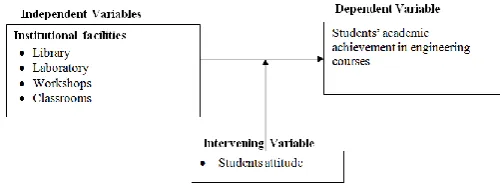
Conceptual Framework: A conceptual framework (Figure 1)
[image:3.595.307.559.159.253.2]postulates that institutional facilities have an influence on students academic achievement in engineering courses.
Figure 1. A Conceptual Framework showing Influence of Institutional Facilities on Students’ Academic Achievement in
Engineering Courses in National Polytechnics
Institutional facilities include libraries, workshops,
laboratories, classrooms and tutorial rooms among others. These facilities are a requirement for conducting lectures. This means that definitely they influence academic achievement of students in both theoretical and practical competencies. The lecturers cannot effectively teach without them. It was however not clear the extent to which institutional facilities influenced students’ academic achievement in engineering courses and therefore this formed the basis of the research. To actualize the influence of institutional facilities on students academic achievement in engineering courses, data on library use, laboratory use and classroom use was collected and computed together with students academic achievement in engineering courses. The intervening variable was conceived to be students’ attitude.
RESEARCH METHODOLOGY
The study adopted descriptive and correlational research designs. Study population was 645 students, 41 lecturers, 1 librarian, 3 technicians and 1 principal. Fisher’s formula (Mugenda & Mugenda, 2003) was used to determine sample sizes. Simple random was used to select 241 students and 37 lecturers while 1 principal, 3 technicians and 1 librarian were selected by saturated sampling. Questionnaires, interviews and document analysis guide were used to collect data. Face and content validity was determined by experts in Educational Administration. Reliability was established using test-retest technique whereby Pearson’s r coefficient for lecturers’ questionnaire was 0.82 at p-value of .05. Quantitative data were analyzed using frequency counts, percentages, means and regression analysis. Qualitative data from interviews and open ended items of questionnaires were reported in emergent themes and sub themes.
RESULTS
Students Demographic Characteristics
Table 3. Students’ Gender
Gender Frequency Percentage
Male 211 87.55
Female 30 12.45
Total 241 100
Source: Field Data, 2016.
Table 3 indicates that there were more male students 211(87.55%) for engineering courses as compared to females 30 (12.45%). This implies that either females do not qualify for these courses or they have a negative attitude towards sciences.
Table 4. Age Category of Students
Age category in years Frequency Percentage
17-19 19 7.88
20-22 130 53.94
23-25 82 34.02
Above 25 20 4.16
Total 241 100
Source; Field Data, 2016
From Table 4 it is indicated that largest number of students 130 (53.94%) had age 20-22, followed by age 23-25 with 82 (34.02%), age 17-19 had 19(7.88%) and above age 25 had the lowest number of students 20 (4.16%). This implies that majority of students join the institution immediately after their form four results are released. These students still need counselling as they are young and their attention can easily be diverted a factor that can hinder performance.
Null hypothesis: The null hypothesis respondent to was:
“Institutional facilities have no statistically significant influence on students’ academic achievement in engineering courses in national polytechnics.” To respond to this hypothesis data obtained from the students’ class attendance register on the frequencies of use of the laboratory and classrooms was computed as shown in Tables 5 to 7. Data from student alumni telephone interview on the library was computed as shown in Table 5.
Table 5. Frequency of use of Library by Students
Source: Field Data, 2016
Table 5, indicates that majority of the students 122 (50.62%) visited the library 1 -20 times the period of their study at the institution while only 5 (2.07%) visited the library 61-80 times. This shows that students did not use the library frequently.
Table 6. Frequency of use of the Laboratory/ Workshops
Source: Field Data, 2016
Table 6 shows that 107 (70.53%) of the students used the laboratory 41 – 60 times during their study period at the institution. Only 9 (3.73%) of the students used the laboratory 121 - 140 times.
Table 7. Frequency of use of the classroom for 3 years period
Frequency of use Frequency Percentage
41-60 7 2.90
61-80 8 3.32
80 -100 7 2.90
101-120 4 1.66
121-140 14 5.81
141-160 62 25.73
161-180 54 22.41
181-200 45 18.67
201-220 18 7.47
221-240 15 6.22
241-260 7 2.90
Total 241 100
Source: Field Data, 2016
Table 7 indicates that the classroom was the most frequently used facility with frequencies ranging 41 - 260. Majority of the students 62 (25.73%) used the classroom 141 -160 times, 54(22.41%) used the classroom 161 – 180 times and 45 (18.67%) used the classroom 181 – 200 times during their study period at the institution. Only 7 (2.90%) used the classroom 241 – 260 times.
Table 8. Cumulative Academic Performance of Students in Engineering Courses 2010 to 2014
Kenya National Examination Council mean scores in engineering Diploma examinations
Frequency Percentage
Distinction 1 (1 point) 0 0
Distinction 2 (2 points) 0 0
Credit 3 (3 points) 12 1.4 Credit 4 (4 points) 28 3.4 Pass 5 (5 points) 53 6.3 Pass 6 (6 points) 90 10.8 Referral 7 (7 points) 183 22.1 Fail 8 (8 points) 462 56.0
Total 828 100
From Table 8, it can be observed that the performance was generally unsatisfactory because majority of the students had very low achievement as signified by the mean grades in Kenya National Examination Council examinations results.
To establish the influence of the institutional facilities, regression analysis was performed. The result was shown in Table 9. Table 9 indicated that institutional facilities influenced students’ academic achievement in engineering courses. Therefore, the null hypothesis that “institutional facilities have no statistically significant influence on academic achievement of students in engineering courses in national polytechnics” was rejected. Institutional facilities had a significant influence on academic achievement as indicated by p= .001 Institutional facilities accounted for 4.2% of students’ academic achievement as signified by the coefficient .042, the other 95.8% was due to other factors not investigated in this study. Institutional facilities were found to be significant predictor of students’ academic achievement indicated by (F (1,239) = 11.537, p<.05) as shown in Table 9. From Table 10 it can be observed that institutional facilities are significant predictors of students’ academic achievement in engineering courses. (F (1, 39) = 11.537, P>.05).
Frequency of Use Frequency Percentage
1-20 122 50.62
21-40 87 36.10
41-60 27 11.20
61-80 5 2.07
Total 241 100
Frequency of Use Frequency Percentage
1-20 17 7.05
21-40 8 3.32
41-60 107 70.53
61-80 56 23.24
81-100 22 9.13
101-120 22 9.13
121-140 9 3.73
A regression analysis was computed to determine the actual influence and prediction; the result was shown in Table 11. Table 11 indicates that an increase of one unit in institutional facilities will have little influence on students’ academic
achievement. Regression equation Y=.197+.000X1. This
implies that institutional facilities contribute very little to students’ performance. Other factors may be working against institutional facilities.
Influence of Institutional facilities on Student Academic
Achievement in Automotive Engineering: A model
summary was carried out to establish the influence of institutional facilities on academic achievement of students in automotive engineering, the result was shown in Table 11. Table 12 shows that institutional facilities did not influence students’ academic achievement in automotive engineering. This is signified by p>.05. Document analysis showed that automotive had a book ratio of 1: 1(138) hard copies and e-books in the library. This shows that the students are not making good use of the books. This was supported by a correspondent who said on further probing in an interview that majority of the students only visited the library towards examination period, lacked good study habits and did not make good use of the library. Though the library has adequate e- books, the internet facilities were limited. There were only 11 computers with internet facility in the library against the institutions population a factor that might have contributed to the poor performance.
The library also could only accommodate 150 students at ago which limited the number of students that could use the library. From Table 13 it can be observed that institutional facilities were not significant predictors of students’ academic achievement in automotive engineering course (F (1, 28) = 2.095, P>.05)
Influence of Institutional Facilities on Students’ academic
achievement in Electrical and Electronics: A model
[image:5.595.39.559.70.108.2]summary from regression was performed to establish suitability of the model to account for variation in students’ performance Table 14. From Table 14 it is indicated that Institutional facilities had significant influence on students’ academic achievement given by p=.037 and accounted for 2.5% of the variations in academic achievement as signified by the coefficient .025. The other 97.5% could be due to other factors. ANOVA was computed to confirm whether institutional facilities was a significant predictor of students’ academic performance. The result was shown in Table 15. The result shown in Table 15 indicates that institutional facilities was a significant predictor of students ‘academic achievement (F (1,132) =4.423, P<.05). To determine the actual influence and prediction of institutional facilities, simple regression analysis was computed. The results were shown in Table 16. From Table 17, it can be noted that an increase of one unit in institutional facilities will reduce students’ performance by -.001 units.
Table 9. Model Summary on the influence of Institutional Facilities on Students’ Academic Achievement in Engineering Courses
Model R R Square Adjusted
R Square
Std. Error of the Estimate
Change Statistics
R Square Change F Change df1 df2 Sig. F Change
1 .215 .046 .042 .04008 .046 11.537 1 239 .001
[image:5.595.37.559.141.184.2]Predictor: (Constant), Institutional Facilities
Table 10. Analysis of variance for the influence of Institutional Facilities on Students’ Academic Achievement
Model Sum of Squares df Mean Square F Sig.
1 Regression .019 1 .019 11.537 .001b
Residual .384 239 .002
Total .402 240
[image:5.595.32.565.233.276.2]Dependent Variable: Students academic achievement in engineering courses Predictor: (Constant), Institutional Facilities
Table 11. Regression analysis for the influence of Institutional Facilities on Students’ Academic Performance
Model Unstandardized Coefficients Standardized Coefficients t Sig. 95.0% Confidence Interval for B
B Std. Error Beta Lower Bound Upper Bound
1 (Constant) .197 .003 56.817 .000 .190 .204
Institutional Facility .000 .000 .215 3.397 .001 .000 .000
[image:5.595.36.559.326.360.2]Dependent Variable: Students academic achievement in engineering courses. Regression Equation: Y= β0 + β1X1 + ---ε
Table 12. Model summary on Influence of Institutional facilities on student performance in automotive engineering
Model R R Square Adjusted R
Square
Std. Error of the Estimate
Change Statistics
R Square Change F Change df1 df2 Sig. F Change
1 .264 .070 .036 .02967 .070 2.095 1 28 .159
[image:5.595.37.561.408.456.2]Predictor: (Constant), Institutional Facilities
Table 13. Analysis of variance for the influence of Institutional Facilities on Students’ Academic Achievement in Automotive Engineering
Model Sum of Squares df Mean Square F Sig.
1 Regression .002 1 .002 2.095 .159b
Residual .025 28 .001
Total .026 29
a.Dependent Variable: Students Academic achievement in Automotive Engineering
This relationship can be represented by a regression equation:
Y=. 229 -.001X1. This results implies that institutional
facilities are detractors not contributing positively to performance. This can be attributed to inadequacy of the facilities.
Influence of Institutional Facilities on Students’ Academic
Achievement in Mechanical Engineering: To estimate the
influence, coefficient of determination was computed and results shown in Table 18. The results indicated that institutional facilities had a significant influence on students’ academic achievement as signified by p=.006. Institutional facilities accounted for 8.5% of variation in students’ academic achievement as given by the coefficient .085 and was a significant predictor of students’ academic achievement as indicated by (F (1.75) = 8.078, P<.05) – Table 19.
The result from Table 18 indicates that an increase of 1 unit in
institutional facilities increased students’ academic
achievement by .001 units. Hence the regression equation
Y=.173+.001X1.
DISCUSSION
From the study findings, it is worth noting that majority of the students did not attend the maximum number of lessons. This
could affect the students’ achievement negatively.
[image:6.595.38.562.81.115.2]Furthermore, for institutional facilities to contribute positively to students’ academic achievement in engineering courses, the students should optimumly use them. This means that institutional facilities are a necessary condition but not a sufficient condition for engineering students’ success. This is supported by research findings world over. For instance, this
Table 14. Model summary for the influence of Institutional Facilities on Students’ Performance in Electrical and Electronics
Model R R Square Adjusted R Square
Std. Error of the Estimate
Change Statistics
R Square Change F Change df1 df2 Sig. F Change
1 .180 .032 .025 .04735 .032 4.423 1 132 .037
[image:6.595.34.559.164.206.2]Predictor: (Constant), Institutional Facilities
Table 15. Analysis of variance for the influence of Institutional Facilities on Students’ Academic Performance in Electrical and Electronics Engineering
Model Sum of Squares df Mean Square F Sig.
1 Regression .010 1 .010 4.423 .037
Residual .296 132 .002
Total .306 133
[image:6.595.49.557.267.310.2]Dependent Variable: Students academic achievement in Electrical and Electronics Engineering Predictor: (Constant), Institutional Facilities
Table 16. Regression analysis on the influence of Institutional Facilities on Students’ Academic Achievement in Electrical and Electronics Engineering
Model Unstandardized Coefficients Standardized Coefficients t Sig.
B Std. Error Beta
1 (Constant) .229 .009 24.430 .000
Institutional facility -.001 .000 -.180 -2.103 .037
Dependent Variable: Students academic achievement in Electrical and Electronics Engineering. Regression Equation: Y= β0 + β1X1
Table 18. Model summary for influence of Institutional Facilities on Students’ Performance in Mechanical Engineering
Model R R Square Adjusted R Square Std. Error of the Estimate Change Statistics
R Square Change F Change df1 df2 Sig. F Change
1 .312 .097 .085 .02494 .097 8.078 1 75 .006
Predictor: (Constant), Institutional Facilities
Table 19. Analysis of Variance for the influence of Institutional Facilities on Students’ Academic Performance in Mechanical Engineering
Model Sum of Squares df Mean Square F Sig.
Regression .005 1 .005 8.078 .006b
Residual .047 75 .001
Total .052 76
a) Dependent Variable: Student academic achievement in mechanical engineering b) Predictors: (Constant), Institutional facilities
Table 20. Regression analysis for the influence of Institutional Facilities on Students’ Academic Achievement in Mechanical Engineering
Model Unstandardized Coefficients Standardized Coefficients t Sig.
B Std. Error Beta
1 (Constant) .173 .007 23.804 .000
Institutional facility .001 .000 .312 2.842 .006
[image:6.595.36.561.361.393.2] [image:6.595.38.553.445.485.2] [image:6.595.46.560.546.590.2]finding agrees with Lucke (2012) and Ionescu (2012) that laboratory positively influences students’ final grades in mechanic and electronics engineering. Lucke (2012) developed a module for teaching engineering, used a survey with 40 second year students in their first semester to collect data. His finding showed that the pass rates for students improved substantially. The finding that institutional facilities influences students’ academic achievement in engineering courses disagrees with (Romanas & Jonas, 2007) findings that laboratory work did not necessarily influence academic achievement of students. They used a survey among 40 second year students in their second semester in electronic circuit engineering, students were asked to rank lecturers, tutorials and laboratories in decreasing order of importance. Students ranked the attendance and attractiveness of the laboratory high. Laboratory was an ideal place for learning. A laboratory equipped with modern instrumentation provides students with first hands –on experience. They found that students’ performance in the laboratory was better than performance in examination. They cited lack of motivation for students to study engineering. The findings that institutional facilities influence students’ academic achievement in engineering courses further agrees with (White & Stone, 2010) findings that established that the library had a high influence on students’ academic achievement in university.
Their study hypothesis was ‘there is a statistically significant correlation between library activity data and students’ attainment.’ Their study design was a survey of library access systems at the University of Hudders field for over 4 academic years in 5 different courses at the institution. They were majorly looking at the e-resources access, number of book loans and number of access to the university library. This differs with the current study where the researcher was interested only in engineering courses at the polytechnic, used both descriptive and correlation design with a sample of 241 students and focused majorly on the number of access to the library by the students. Through observation and interview for the technicians it was found that automotive had 1 workshop, mechanical 4 and electrical had 3workshops for conducting practical. This limited the number of practical especially for automotive engineering as was stated by the lecturers in their response. From observation and interviews for the technicians it was established that there was student: tool ratios - automotive had a ratio of 1:18 basic toolsand1:20 basic equipment, mechanical had1:15 basic tools and 1:25 equipment while electrical and electronics had 1:17 tools and 1:30 basic equipment.
This is against the policy requirement of 1:4. The researcher was informed by the respondents on further interrogation that students had to share some of the basic tools and equipment thereby limiting the number of practical lessons. The principal and lecturers cited inadequacy of tools and equipment as a factor that hindered students’ performance. This was in agreement with Ojera, Simatwa and Ayodo (2011) that lack of
appropriate tools and equipment hindered practical
experiments which contributed negatively to students’ performance. The workshop space determines the number of students that can carry out a practical at ago. It was observed that automotive had a ratio 1:15 working benches (4), mechanical had 1:33 (5) and electrical and electronics had 1:98 working benches (5) and 1:49 (8) station boards. The researcher was informed that students were grouped for practical and that it could take one week for a lecturer to
complete practical session on one topic. In this regard one respondent stated this made it difficult for the lecturers to carry out practical in all the topics. This hinders academic achievement. The researcher found that both automotive and mechanical departments had 3 while electrical had 4 workshop practical lessons. However, it is worth noting that in some instances all the lessons in a week could be used to cover one topic because of the limited tools and equipment or due to large student population, a factor that might have hindered academic achievement. Reading space in the library determines the number of students that can use the library at ago. It also helps students read without feeling squeezed and suffocated. From observation it was found that the library had 150 desks that are used by students at ago. The number was not sufficient enough to accommodate all the students as was noted by the librarian during an interview and the lecturers’ response.
This was also stated by some alumni as a factor that made them not frequent the library. It was also noticed that the library did not have a provision for access by students and staffs with disabilities. During observation, the library had 11 computers connected with internet. These were insufficient as the librarian reported in an interview and therefore students were requested to own personal computers or any other means of accessing the internet while at the institution as was reported by both the librarian and the principal during an interview. Students were only allowed 40 minutes on net during high demand and up to one hour when the library was not on high demand. This time may not be enough for students or lecturers to carry out research effectively as was the views of both the alumni and the lectures. It is worth noting that the library did not have photocopy facility for students or lecturers to copy relevant materials. Internet facilities enables students access online learning materials thus exposing them to wide reading as opposed to the limited number of textbooks and teachers notes.
student who uses only the classroom and not the library and the laboratory cannot perform better, similarly a student who only attends classroom lessons without attending practical lessons and using the library cannot perform better. This finding is a true representation of Table 4.3 which shows the frequency of use of the facilities. It was clear that students do not use the library frequently which implies that they do not do extra study apart from the class work and this could have been the reason for the decimal performance. The workshop tools and equipment were inadequate according to the technicians. This was evidenced by high tool to student ratios. Students were expected to share some of the tools in the class room at the same time. This limited the number of practical lessons students were exposed to. The technician reported that some students missed practical sessions or did not take their time in the workshops seriously, grouping of students made some not working during class time and that students only considered the workshop lesson important when working on projects. Students’ time in the workshop was not properly managed and that students were allowed to do extra work in the workshop near examination period.
The facilities may be there but not adequate so that only very active students have an upper hand in class. This finding disagrees with Kamila et al (2012) findings that laboratory experiments helped students gain skills, experience and practice and not necessarily an improvement in examination. The current study differs with Kamila and Daudi (2012) study in that they developed a model for teaching an experiment at the end of semester one to assess practical skills in basic electronic laboratory. They were only assessing laboratory skills unlike the current study which sought to establish the contribution of laboratory on students’ performance in examinations. From the interview with the technician, it was found that most students had the habit of missing practical lessons and only showed concern near examination period. Most students were sent away from practical for lack of proper attires, tools and equipment were few therefore shared among students and that those machines that where available were old models. The principal cited inadequate facilities and negative attitudes among students as factors hindering performance.
Conclusion
The study also concluded that institutional facilities significantly influence students’ academic achievement in Engineering courses. The more frequent the students use them the higher the academic achievement. This is because acquisition of knowledge and mastery of engineering skills are enhanced accordingly. The study also concluded that institutional facilities had statistically little influence on students’ academic achievement in engineering courses. It accounted for 4.2% of the variation in students’ academic achievement. The practical significance is amazing and this should be pursued further.
Recommendations
The management of polytechnics should make a deliberate effort to acquire more classrooms, laboratory tools and equipment. Allow students to use available tools and equipment during normal and arranged lessons so that they can familiarise and also come up with measures to make the students responsible for the tools and equipment. The institutional Boards of Management should make deliberate
efforts to enhance students’ use of the existing facilities to the optimum. The institutional facilities should be modernized in line with the reviewed curricula. This will motivate students’ use in enhancement of academic achievement. Institutional management should also work on the students’ attitude towards the role of institutional facilities in enhancement of academic achievement. The positive attitude will help them to improve on frequency of use in the facilities. The investment in institutional facilities should be increased. This is because without the infrastructure, no engineering program can succeed. Since investment in infrastructure is quite expensive, it should be done in phases.
REFERENCES
Adebola, O.J., & Atanda, A.I. 2011. School Quality Factors and Secondary school students’ achievement in Mathematics in South Western and North Central Nigeria.
Adewale P. O. & Adhuze, B. O. 2013. Entry Qualification and academic Performance of Architecture Students in Nigerian polytechnics. Are the admission requirements still relevant?
Frontiers of architectural research Vol. 3 issue 1March 2014 pp. 69-75.
Alan, B. 2012. Social Research Methods. New York. University
Press.
Althea, R., & Erick, B. 2015. Understanding practical engagement; perspectives of undergraduate civil engineering
students who engage actively in practical. Caribbean
Teaching Scholar Vol. 5 No.1 April 2015.
Atkinson, G. 1983. The Economics of education; London, flooder and Stoughton.
Best, J.W. 1977. Introduction to Educational Research; London, Oxford University press.
Bryce, E., Juan, C., Hurtado, S., & Eagan, K. 2013. Examining the
Tracks that Cause Derailment; Institutional Context and Engineering Degree Attainments. A paper presented at the American Research Association Annual Forum May 2013. Calvo, R., Markauskaite, L., & Trigwell, K. 2007. Factors
affecting students’ experiences and satisfaction about teaching quality in engineering.
Chunghwa, W.B. 2000. Technology education and world development: challenge Opportunity for education in Africa.
The Journal of Education Administration. Vol. 5(1): 439-460. Cole, D., & Espinoza, A. 2008. Examining Academic success of
Latino Students in STEM Majors. Online www.redorbit.com retrieved 2/16/15 17; 50hrs.
Creswell, J. W. 2014. Research Design, Qualitative, Quantitative
and Mixed Methods. Singapore. SAGE.
De Jager, K. 2002. Successful students; does the library make a difference in the Performance measurements and merits.
Journal of educating administration. 3(1): 140-144.
Eshiwani, G.S. 1988. Determination of school achievement in
Kajiado district Nairobi. Bureau of education research Kenyatta University.
Fraenkel, R., & Wallen, N. 2003. How to design and evaluate
research in education. McGraw-Hill, USA.
Gall, M.D., Borg,W. & Gall, P. 2007. Educational Research- An Introduction. Longman, USA.
Gichira, R. 2002. Ensuring relevance and quality in TIVET
education. Nairobi.
Grisay, A., & Mahleck, E. 1991. Issues and methodologies in
educational development: A help series for orientation and training. Paris HEP.
Gunderson, M. 2004. A Study on the Influence Vocational
Education has on Students Ultimate Academic Success. Online http//www...Mwlun DgCbw retrieved on 2/16/15. Hallack, P., & Poisson, M. 2007. Corrupt schools, corrupt
Hannushek, E. 1999. Some findings from an independent investigation of the Tennessee. STAR experiment and from
other investigations of class size effects. Educational
Evaluation and Policy Analysis, Vol. 21(2): 143-164.
Herb, C. 2014. College books costs more outrageous than ever. Retrieved from www.today.com April 5 2014.1450hrs. Hofstein, A., & Lunetta, V. 2004. The Laboratory in Science
Education. Formulations for the 21st Century,
https://doi.org/10.1002/sce.10106. Scientific Education journal. Vol. 88 Issue 1.
Ionescu, D. 2014. The importance of working integrated learning and relevant laboratory experiment in engineering teaching.
Journal of behavioral sciences 174 2015 2825-2830.
Jack, K., & Peter, J. 2012. Effect of class size on Engineering student performance at Bingham University. Available on
www.classsizematters.org 29th May, 2015 13.30hrs.
Jamison, D. 1982. Reduce class size and other alternatives for
improving school. AnEconomist view class (Eds) school size and other alternatives for improving schools. California, Beverly Hills.
Kamila, S., & Daudi, M. 2012. Assessing students’ practical skills in basic electronic laboratory psychomotor domain model.
Social behavioral sciences 56 (2012) 546-555.
Kgaile, A. & Morrison, K. 2006. Measuring and Targeting Internal conditions for school Effectiveness in the Free State of South Africa.
Lassa, P. 2000. Teacher Production-; a focus on Nigeria. The state
of education in Nigeria. (70-83).UNESCO, Abuja.
Lewin, K. 1987. Key issues in Educational Development: Oxford
Studies in comparative education Vol.3 (2). 1993: Triangle
Journal Ltd.
Lockheed, K. 1989. Teaching quality and student achievement in
Africa: The case of Nigeria and Swaziland. Teaching and
Teacher Education.5:93-113.
Loo, C.W., & Choy, J.L.F. 2013. Sources of self-efficacy influencing academic performance of engineering students.
American journal of education research vol1. No3 86-92.
Louis, C., & Lawrence, M. 1997. Research Methods in Education;
London, Routledge.
Lucke, T. 2012. Using hands –on to engage students in
engineering mechanics. Paper presented at the 40thannual
conference 23-26thSeptember 2012.
Lyle, D., & Albert, J. 2005.The role of the laboratory in
undergraduate engineering education. Journal of engineering
education.
Mckenzie, K. 2001.Who succeeds at the university? Factors predicting academic performance in first year Australian
university students. Higher education research and
development, 20: 21-33.
Michele, L. 2003. Impact of school libraries on student
Achievement-Review of research. ACER, Australia.
Ministry of Education. 2006. Technical Education Programs.
Syllabi regulation KIE, Kenya.
Ministry of Education. 2012. Taskforce on the realignment of the
education sector to the Constitution of Kenya. Nairobi: Government printer.
Muganda, A. 2008. Relationship between school performances in primary schools in Butula Division, Unpublished Masters’ Proposal, Maseno University.
Mugenda, A.G., & Mugenda, O.M. 2003. Research Methods.
Quantitative and Qualitative approaches. Nairobi: Acts press.
Mugenda, O.M, & Mugenda, A.G. 2007. Research Methods:
Quantitative and Qualitative Approaches. Nairobi: Acts Press.
Mwangi, D. 1983. Factors influencing the performance and learning of mathematics among Secondary schools in Kenya. Unpublished MA thesis, University of Nairobi.
Odiembo, J.A.E. 2013. Relationship between selected secondary school teacher characteristics and students’ academic achievement in mathematics in Muhoroni District. Kenya. An unpublished thesis Maseno University.
Ojera, D.A., Simatwa, E.M.W., & Ayodo, T.M.O. 2013. Perception of Staff and Students on Factors that Influence Performance in Science Laboratory Technology in Institutes of Technology in Southern Nyanza Region, Kenya.
International Journal of Academic Research In Business and Social Science Nov 2013 Vol. 3 No11.
Rafael, A., Markanuskaite, C.L. & Trigwel, K. 2013. Course
Evaluation /Postgraduate education. Retrieved from
http://plscrbed.com>document>10-AJ...
Republic of Kenya. (July-2005) Kenya education sector support
program 2005-2010. Nairobi. Government printer.
Republic of Kenya. 1998. Ministry of education and human resource development results of 1995 primary census. Nairobi: Government printer.
Republic of Kenya. 2002. Kisumu District Development Plan
2002 -2011: Effective Management for Sustainable Economic
Growth and Poverty Reduction Nairobi: Government Printer.
Republic of Kenya. 2005. Kenya educational sector support
program 2005-2010: Delivering Quality education and training to all Kenyans. Nairobi: Government printer. Rivkins, S.G., Hannushek, E.A., & Kain, J.F. 2005.Teacher
Schools and Academic Achievement. Online Available http:/www.utdallas.edu/research Publications.htm.April 10 2014.
Romanas, V.K., & Jonas, K. 2007. Laboratory instruction in
engineering education. Global journal of engineering
education Vol 11.No 2
Russel, C.J. 2010. Engineering capacity building in developing
countries. Available www.worldexpertise.com May 23rd 2015
11.30hrs.
Shrestha, N. 2008. A study on students use of library resources and self-efficacy. Available on line eprints.r clis.org retrieved on 18/10/2016 at 4.05pm.
Stephen, P.H., Joseph, P. & Manuel, A. S. 1978. Text books and achievement: What we know. World Bank staff working paper No. 298.Available www.vanderbilt.edu.April 3 2014 1400hrs.
UNESCO & ILO 2002. Technical and Vocational Education and
training 21stCenturyParis.
UNESCO, 2010. United Nations, Educational, Scientific and Cultural Organization Science Report. Paris. UNESCO.
UNESCO. 1996. Financing technical and vocational education,
modalities and Experience.
UNESCO. 2004. Developing technical and vocational education
in sub-Saharan Africa.
UNESCO. 2007. Textbook and quality learning for all; some lessons learned from international experiences. UNESCO. White, S. & Stone, G. 2010. Maximizing the use of library
resources at the University of Huddersfield. A paper
presented at the UK 33rd Annual conference and exhibition.
Edinburgh. 12-14th April 2010. Available at
http://eprints.hud.ac.uk/7248/.
Williams, J., Lloyd, M., &Spengler, J. 2005.The case for
sustainable laboratories. First Steps at Harvard University.
International journal on sustainability in higher education 6 (4): 363-383.
World Bank. 2000. Higher education in developing countries.
Task force on Higher education and society. World Bank
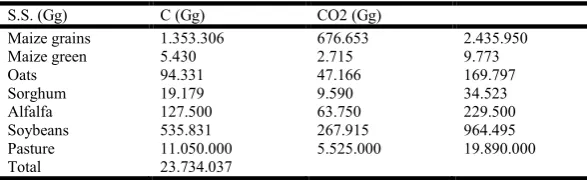
Table 1. Quantity of dry matter (S.S.), amount of carbon (C) contained and consequently quantity of carbon dioxide (CO2) fixed by the main plant species for animal feed in the world in 2016
S.S. (Gg) C (Gg) CO2 (Gg)
Maize grains 1.353.306 676.653 2.435.950
Maize green 5.430 2.715 9.773
Oats 94.331 47.166 169.797
Sorghum 19.179 9.590 34.523
Alfalfa 127.500 63.750 229.500
Soybeans 535.831 267.915 964.495
Pasture 11.050.000 5.525.000 19.890.000
[image:10.595.146.459.207.296.2]Total 23.734.037
Table 2. Emissions due to land processing, production of fertilizers and pesticides, electricity, fuels and machines
S.S (Gg) CO2eq/S.S. (Gg) CO2eq (Gg)
Maize grains 1.353.306 0,70 947.314
Maize green 5.430 0,70 3.801
Oats 94.331 0,75 70.749
Sorghum 19.179 0,90 17.261
Alfalfa 127.500 0,35 44.625
Soybeans 535.831 1,60 857.329
Pasture 11.050.000 - -
[image:10.595.144.460.335.459.2]Total 1.941.078
Table 3. Amounts of greenhouse gases emitted (converted into CO2 eq) due to the storage of manure, the spreading on agricultural land and the one left to pasture
Storage Spreading Pasture Total
Cattle 156.086 77.256 525.439 758.781
Buffaloes 27.755 12.572 42.474 82.801
Sheep 7.322 8.835 96.975 113.132
Goats 4.747 3.682 101.481 109.910
Minor Camelids 239 12 1.258 1.509
Camels 1.426 156 7.101 8.683
Pigs 115.689 39.465 - 155.154
Chickens, Hens 27.842 39.579 44.955 112.376
Turkeys 2.488 4.980 1.481 8.949
Geese, Ducks 1.776 4.030 4.997 10.803
Horses, Donkeys 3.182 851 23.656 27.689
[image:10.595.188.415.488.568.2]Total CO2 eq (Gg) 1.389.787
Table 4. Ruminal methane emissions related to the year 2016 of the various ruminants and conversion in CO2 eq
Species CH4 (Gg) CO2 eq (Gg)
Cattle 71.910 1.725.836
Buffaloes 10.960 263.050
Sheep 6.564 157.531
Goats 5.014 120.337
Camels 1.309 31.415
Minor camelids 268 6.437
[image:10.595.84.517.601.769.2]Total ruminant 96.025 2.304.607
Table 5. Comparing the emissions of greenhouse gases produced by farmed animals and the rbon dioxide fixed by the crops of the various plants used for their feeding
CO2 eq emitted into the atmosphere (Gg) CO2 subtracted from the atmosphere (Gg)
5.700.000 23.700.000
Figure 1. Comparing the emissions of greenhouse gases produced by farmed animals and the carbon dioxide fixed by the various plants used for their feeding