Thinking Falls- Taking Action: development of a Guide to Action for Falls Prevention Tool (GtA)
Kate Robertson1*, Phillipa A Logan2, Simon Conroy3, Verity Dods4, Adam Gordon2, Linda Challands1, Sue Smith5, Sally Humpage6, Ann Burn7on behalf of the Rushcliffe Falls Prevention and Research Group
1Nottinghamshire Community Health
2Division of Rehabilitation and Ageing, University of Nottingham 3University of Leicester School of Medicine
4Surrey Community Health 5Nottingham CitiHealth 6Charter Housing Association
*Address for Correspondence
Kate Robertson, Falls Clinical Specialist, Nottingham Community Health, Lings Bar Hospital, Nottingham. NG2 6PR. UK. Email: [email protected]
Abstract
Clinical guidelines and research papers help clinicians measure and understand the risk of falling in their older clients but very few provide the assessor with recommendations as to which interventions they can use to reduce the risk of a fall.
The Guide to Action for Falls Prevention tool (GtA) was developed to help professionals from a broad range of organisations to recognise factors that might increase falls risk and know which actions to take to lessen that risk.
Twenty four professionals tested the GtA in a clinical setting and found it quick (15 mins) and easy to complete. The GtA needs further evaluation to test whether it is a practical way of delivering a falls prevention intervention.
Word Count: 117
Key words:
Key Points:
Falls in older people are due to an interaction of multiple risk factors and events
Identifying risk factors significant for an individual older person, and taking action to reduce or reverse those risk factors, can reduce falls
Many opportunities to reduce falls are overlooked
A quick and simple checklist of risk factors known to contribute to falls in older people, with suggested actions to take to reduce those factors, has been shown to be useable across health, social care and partner organisations
Background
Falls are a major cause of disability and mortality in people over 75 (Scuffham P, Chaplin S et al. 2003). They are a consequence of multiple and diverse risk factors, many of which can be prevented and corrected (National Institute for Health and Clinical Excellence 2004). Yet frequently older people are not aware of their risk of falling and opportunities to intervene to prevent falls are overlooked, with risk factors only becoming evident after an injury has occurred (American Geriatrics Society, British Geriatrics Society et al. 2010).
Multi–agency, multi-factorial interventions have been shown to be most effective in reducing the incidence of falls in older people (Gillespie LD, Robertson MC et al. 2009) and the provision of fall prevention interventions has been recommended by the National Institute for Health and Clinical Excellence (NICE) (National Institute for Health and Clinical Excellence 2004) and in the National Service Framework for Older People (Department of Health 2001). Although there is research evidence and clinical guidelines to help clinicians deliver the appropriate treatments, there are concerns that the time and energy has not been forthcoming to embed the evidence in clinical practice (Close 2005). This is made more challenging by clinicians not knowing who to target with the interventions.
although there are concerns about the impact in clinical practice (Oliver 2008). Using a risk factor check list to identify an individual’s risk factors for falling and then taking targeted action to reduce or reverse those risk factors is key (Oliver and Healey 2009).
The Rushcliffe Falls Prevention and Research Group is a multi-agency inter-professional forum working within South Nottinghamshire, UK that shares and disseminates good practice and develops initiatives to raise awareness of falls. There are 24 members including health care professionals, a carers support worker, representatives from social services, the fire service, the voluntary sector, University of Nottingham, the borough council, home alarm service, preventative adaptation service, housing agencies and a local forum of older people who act as service user representatives. One aim of the group was to develop a community-based risk factor checklist that could be used across various disciplines and clinical settings as a guide to implementing proven falls prevention techniques. This paper describes how this tool was developed.
Development of the Guide to Action for Falls Prevention Tool (GtA)
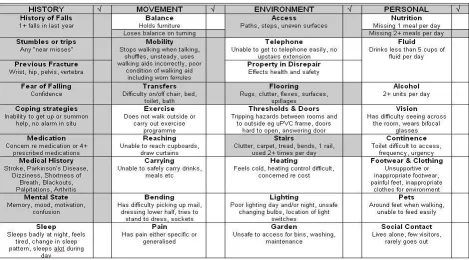
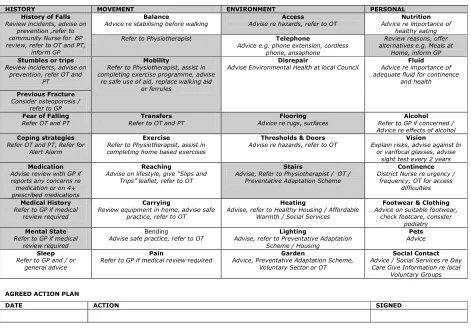
reported that they were missing two meals a day on page 1, then on page 2 the suggested interventions would be: ‘Provide advice re importance of healthy eating, encourage client to eat meals, review reasons for poor appetite, discuss with GP’. The advice sheet would advise the client or carer about the use of small meals, nutritious snacks, supplementary foods, easy menus and local meal delivery services, potentially reducing the need to refer on to more specialist services for those at less risk. The tool delivers immediate and targeted information to older people at risk of falls, as recommended by the NICE (2004) in the Falls Clinical Guidelines (National Institute for Health and Clinical Excellence 2004).
Figure 2: Guide to Action for Falls Prevention (GtA) page 2
HISTORY MOVEMENT ENVIRONMENT PERSONAL
History of Falls
Review incidents, advise on prevention ,refer to community Nurse for BP review, refer to OT and PT,
inform GP
Balance
Advice re stabilising before walking Advise re hazards, refer to OTAccess Advice re importance ofNutrition healthy eating Refer to Physiotherapist Telephone
Advice e.g. phone extension, cordless phone, ansaphone
Review reasons, offer alternatives e.g. Meals at
Home, inform GP
Stumbles or trips
Review incidents, advise on prevention, refer OT and
PT
Mobility
Refer to Physiotherapist, assist in completing exercise programme, advise
re safe use of aid, replace walking aid or ferrules
Disrepair
Advise Environmental Health at local Council Advice re importance ofFluid adequate fluid for continence
and health
Previous Fracture
Consider osteoporosis / refer to GP
Fear of Falling
Refer OT and PT Refer to OT and PTTransfers Advice re rugs, surfacesFlooring Refer to GP if concerned /Alcohol Advice re effects of alcohol
Coping strategies
Refer OT and PT, Refer for Alert Alarm
Exercise
Refer to Physiotherapist, assist in completing home based exercises
Thresholds & Doors
Advise re hazards, refer to OT Explain risks, advise against biVision or varifocal glasses, advise
sight test every 2 years
Medication
Advise review with GP if reports any concerns re medication or on 4+ prescribed medications
Reaching
Advise on lifestyle, give “Slips and Trips” leaflet, refer to OT
Stairs
Advise, Refer to Physiotherapist / OT / Preventative Adaptation Scheme
Continence
District Nurse re urgency / frequency; OT for access
difficulties
Medical History
Refer to GP if medical review required
Carrying
Review equipment in home, advise safe practice, refer to OT
Heating
Advise, refer to Healthy Housing / Affordable Warmth / Social Services
Footwear & Clothing
Advice on suitable footwear, check footcare, consider
podiatry
Mental State
Refer to GP if medical review required
Bending
Advise safe practice, refer to OT Advise, refer to Preventative AdaptationLighting Scheme / Housing
Pets
Advice
Sleep
Refer to GP and / or general advice
Pain
Refer to GP if medical review required Advice, Preventative Adaptation Scheme,Garden Voluntary Sector or OT
Social Contact
Advice / Social Services re Day Care Give Information re local
Voluntary Groups
AGREED ACTION PLAN
DATE ACTION SIGNED
Piloting the GtA Tool
Members of the falls research group piloted the GtA tool in their respective workplaces for ease of use and face validity. They reported their experiences back to the group and found the tool easy to use, taking approximately 15 minutes to complete with each client and then an additional 15 minutes to discuss each action. The group felt that the tool’s content was appropriate for their clients and that the suggested interventions were acceptable within their local environments. The GtA was then presented to local NHS organisations and ratified through Clinical Governance for use across South Nottinghamshire with a population of 660,000. Over a period of 12 months in 2006, 186 people from 12 different organisations undertook the training.
Audit of the GtA Tool
At the end of 2006, the NHS Clinical Audit Service completed an audit of the GtA. The audit questionnaire was sent to nurses, therapists or managers of older people’s services in health and social services, Rushclifffe Borough Council and Sheltered Housing complexes. Respondents were asked to complete the audit if they had day to day contact with older people as clients. A stamped addressed envelope was included for return of the anonymised replies.
The aims of the audit were:
to establish whether the GtA was being used in practice to understand barriers to using the GtA
Results
Seventy four percent (112/150) of participants returned questionnaires. The professions of respondents are summarised in Table 1.
Profession Number (%) replies received n=112
Community Nursing (Matron, District Nurse, Staff
Nurse, Healthcare assistants) 68 (60.7%) Therapy (Physiotherapist, Occupational Therapist,
Assistant Practitioner, Rehabilitation Support Worker) 25 (22.3%)
Pharmacist 4 (3.6%) Other (e.g. Dietician, Care Assistant) 5 (4.5%) Table 1 Profession of participants
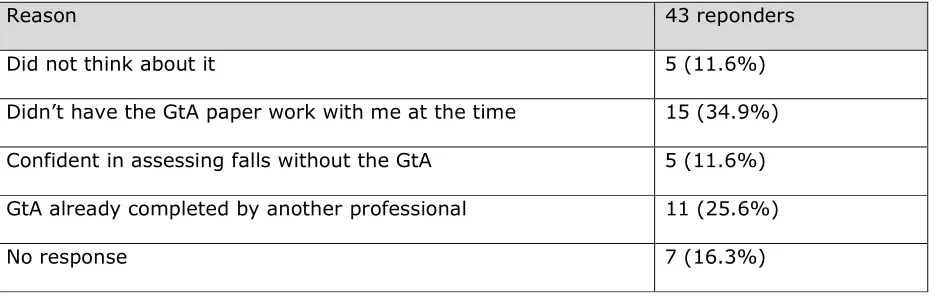
One hundred and six (95%) of the respondents were aware of the GtA tool. Eighty four (75%) were aware that GtA training was available, of whom 63/84 (75%) had attended the training. Reasons for non-attendance were lack of time and staff shortages. Although 71/112 (63%) people reported that they felt the GtA could be useful, only 62/112 (55%) had completed the assessment with an older person. Table 2 shows why people did not use the tool.
Reason 43 reponders
Did not think about it 5 (11.6%)
Didn’t have the GtA paper work with me at the time 15 (34.9%)
Confident in assessing falls without the GtA 5 (11.6%) GtA already completed by another professional 11 (25.6%)
[image:8.595.67.535.308.456.2]No response 7 (16.3%)
Table 2 Reasons for not using the GtA
Nine out of sixty two (14%) respondents reported using the tool with every older person, 11/62 (18%) used it with those in whom they were unsure of the reason for falling and 17 (27%) used it with clients deemed to be at risk of falling. Fifty four out of hundred and twelve (48%) respondents had used the information pack to accompany the tool.
Discussion
planning, yet it is not clear that simply stratifying risk provides a clear prompt to action and that, when professionals do act, that they do so in line with best evidence The GtA may potentially bridge this gap by connecting the falls risk assessment with evidence-based practice guidelines. It may also act as a resource for professionals not normally undertaking falls risk assessment, such as wardens in supported housing schemes and social care staff, and may also augment assessments completed by health care staff including community nurses.
The GtA was developed in collaboration with staff from a wide range of agencies and service users and accepted as useful by professionals across multiple disciplines and acceptable to older people. The audit results provide evidence that the tool is easy and quick to complete, is perceived as relevant to the population and suitable for use in a community setting. We were encouraged that a high proportion of respondents were aware of the GtA tool but were concerned that many did not have the paper work to hand to use the assessment and were not aware of the supporting information. This problem has been addressed through a change to the training programme which now uses case studies with which to practice completing the tool. In addition the tool is now included within the community nursing documentation. Since this work was completed the GtA has been included as a first line assessment within the Nottinghamshire Falls Guidelines for use across health and social care and will be included in an analysis of performance data by NHS commissioners in 2010. This process will allow us to continue to appraise the GtA.
further research needs to be completed to assess whether the GtA is an effective way to implement falls prevention interventions. The GtA has not been tested for use by family members, care homes or paramedics. These are areas that need exploring as, over time and in different settings, the actions that could be taken may be very different. We would suggest caution is taken when using the GtA in these settings.
Conclusion
The diversity and number of people and agencies involved in the development of the Guide to Action for Falls Prevention Tool has resulted in the production of a user friendly, quick, evidence based risk screening and action checklist, that can be used within health, social care and partner organizations.
Copies of the GtA Tool are available upon request from Kate Robertson at:
Word count including abstract, key points 2,535
Word count including abstract, key points, authors 2,745
References