DOI 10.1007/s10182-016-0287-7
O R I G I NA L PA P E R
From distance sampling to spatial capture–recapture
David L. Borchers1 · Tiago A. Marques1,2
Received: 1 November 2015 / Accepted: 20 December 2016
© The Author(s) 2016. This article is published with open access at Springerlink.com
Abstract Distance sampling and capture–recapture are the two most widely used wildlife abundance estimation methods. capture–recapture methods have only recently incorporated models for spatial distribution and there is an increasing tendency for distance sampling methods to incorporated spatial models rather than to rely on partly design-based spatial inference. In this overview we show how spatial models are cen-tral to modern distance sampling and that spatial capture–recapture models arise as an extension of distance sampling methods. Depending on the type of data recorded, they can be viewed as particular kinds of hierarchical binary regression, Poisson regres-sion, survival or time-to-event models, with individuals’ locations as latent variables and a spatial model as the latent variable distribution. Incorporation of spatial mod-els in these two methods provides new opportunities for drawing explicitly spatial inferences. Areas of likely future development include more sophisticated spatial and spatio-temporal modelling of individuals’ locations and movements, new methods for integrating spatial capture–recapture and other kinds of ecological survey data, and methods for dealing with the recapture uncertainty that often arise when “capture” consists of detection by a remote device like a camera trap or microphone.
Keywords Distance sampling·Spatial capture–recapture·Hierarchical model· Poisson process·Survival model·Binary regression
B
David L. Borchers [email protected] Tiago A. Marques1 Centre for Research into Ecological and Environmental Modelling, The Observatory, University
of St Andrews, St Andrews KY16 9LZ, Scotland, UK
2 Centro de Estatística e Aplicações da Universidade de Lisboa, Faculdade de Ciências da
1 Introduction
The need to account for imperfect detection in wildlife surveys has long been rec-ognized. The best way to do this, and the effects of not accounting for it, are often discussed in the ecological literature (Kellner and Swihart 2014). Distance sampling (DS) and capture–recapture (CR) methods are the most commonly used methods of estimating abundance (seeBuckland et al. 2001;Williams et al. 2002for overviews of DS and CR, respectively).
The two main types of distance sampling are line transect (in which observers tra-verse lines while searching, and the line is the “sampler”) and point transect (in which observers search from a point, and the point is the “sampler”). As their name suggests, DS methods use distances to detected individuals to draw inferences about detection probability. If the distribution of individuals in the vicinity of samplers (i.e., close to the lines or points) is known, changes in detection frequency as a function of distance from sampler can be used to estimate the relative detectability of individuals as a function of distance. And if all individuals at distance zero are detected, estimates of relative detectability can be converted into estimates of absolute detection probability. This is what DS methods do. Because detection probability is modelled as a func-tion of distance, individuals’ inclusion probabilities (the probability of an individual appearing in the sample) can be estimated as a function of their locations.
By contrast, capture–recapture methods took no account of the location of indi-viduals before the advent of spatial capture–recapture. Classical CR methods were classified byOtis et al.(1978) according to the form of dependence of capture proba-bility on explanatory variables: M0for none, Mtfor occasion (time), Mbfor individual
trap-response (behaviouravoidance or attraction after being captured) and Mhfor
indi-vidual heterogeneity. None of these models include anything to do with indiindi-viduals’ locations. As a result classical CR methods can not draw inferences about detection probability as a function of location, and so, unlike distance sampling methods, are not able to draw inferences about detection (or capture) range. And a consequence of this is that they are not able to draw inferences about density, only about abundance in some unknown region. The region is unknown because CR data contain no spatial information and so no information on how far away individuals are detectable. A vari-ety of methods using data external to the CR survey and/or additional assumptions about detection range have been used to try to get density estimates out of non-spatial CR data, but these do not in general perform well (seeEfford and Fewster 2013).
Spatial capture–recapture (SCR) methods rectified this situation by incorporating distance sampling detection functions in CR methods. Actually, that is not quite true, distance sampling detection functions had been used with CR survey methods for at least two decades prior to the advent of SCR, in the form of “mark-recapture dis-tance sampling” (MRDS) methods (seeBorchers et al. 1998, and references therein). What SCR added to MRDS was the ability to deal with unobserved individual loca-tions.
typically) or conduct inference without an explicit spatial model. With the advent of SCR models, this situation is rapidly changing in the case of CR, and there is a parallel tendency for DS models to incorporate an explicit model for the spatial distribution of animals in the region of interest. That said, the kinds of spatial models used in DS and SCR tend to be very simple compared to those used in the field of spatial modelling itself. In particular, they tend to neglect spatial correlation—something that is so central to the field of spatial modelling that many in that field would say that the model is not a spatial model unless it incorporates spatial correlation.
Spatial modelling in a DS and SCR context presents new challenges because the probability of including individuals in the sample depends on their location relative to the samplers and this probability is unknown and must be estimated from the same data used to estimate the parameters of the spatial model. As a result, spatial modelling in DS, and SCR in particular, is in its infancy and there is much scope for methodological development. Development of realistically complex spatial and spatio-temporal models for use with DS and SCR could provide new ways of address-ing questions of a fundamentally spatial nature, such as species distribution, habitat preference, movement patterns, spatial connectivity and spatial aspects of population dynamics.
We do not develop such models here, but by formulating DS and SCR models as thinned point process models with unknown thinning probabilities in this paper, we provide a framework that unites the two methods and can serve as a basis for the development of realistically complex spatial models for these two most widely used methods in ecological sampling.
The remainder of this review is organized as follows: We build on a description of the modeling framework (Sect.2) with sections placing conventional distance sampling (Sect.3) and mark-recapture distance sampling (Sect.4) within that framework. We then move to spatial capture recapture models (Sect.5) and some of their extensions (Sect.6). We conclude in Sect.7with a brief discussion noting relevant topics that we neglected for the sake of brevity and the key areas that we anticipate will be the focus of future research effort.
2 Modelling framework
We use the terms capture or detection interchangeably, depending on context. Unless we say otherwise, we assume that animals are, or can be, uniquely marked, and that they are identified as marked when recaptured. Any feature that uniquely identifies an animal, allowing previous captured animals to be recognized, can be used to “mark” the animal. Examples of such “natural” marks include DNA fingerprinting (Puechmaille and Petit 2007), dorsal fin contours (Currey et al. 2008), fur patterns (Rich et al. 2014) or distinctive scars or other marks. We use “traps” and “detectors” somewhat interchangeably, preferring “detectors” to convey the idea that animals do not need to be physically trapped.
2.1 The meaning of “location”
We denote the location of individualiin a population of interest bysi, and the locations
of all individuals in the population byS=(s1, . . . ,sN).
The meaning of “location” is survey dependent. “Location” may be an abstract thing and need not have any biological relevance. On a distance sampling survey in which animals are detected by eye, “location” is the point in the plane that the animal is at when it is first detected. For a tiger that is detected by moving in front of a camera trap, “location” for the purposes of SCR is the centre of its movements over the duration of the survey (its “activity centre”), not its location at time of detection. In this case detection comes about as a consequence of the tiger’s movement. For a frog sitting still and making sounds that are detected by microphones, “location” is the position of the frog. In this case detection comes about as a consequence of the frog’s vocalization, not its movement. For a bird moving about and making calls that are detected by microphones, “location” is its activity centre over the period that microphones operated. In this case detection comes about as a consequence of both the bird’s movement and its vocalization. We use the words “location” and “activity centre” interchangeably.
2.2 The model hierarchy
Distance sampling and spatial capture–recapture models are hierarchical. The low-est level of the hierarchy is a point process model for the locations of individuals in the population. On top of this is a detection probability model for individuals that is conditional on the individuals’ locations. Because CR surveys involve repeat detections, the basic observation for the ith individual on a CR survey is a “cap-ture history”, ωi = (ωi1, . . . , ωi J), being a vector of J binary random variables
for a survey with J occasions, in which ωi j = 1 if individual i was detected
on occasion j and ωi j = 0 otherwise. And since SCR surveys involve
multi-ple detectors per occasion, SCR capture histories are slightly more commulti-plex, being
ωi =(ωi11, . . . , ωi J1, . . . , ωi1K, . . . , ωi J K)for a survey with K detectors on each
occasion. We denote the full set of capture historiesΩ =(ω1, . . . ,ωN).
The basic SCR hierarchy is therefore
fS(S;φ) This is a point process model for the number (N) and locationsSof
the N individuals in the population. Hereφis a vector of (typically unknown) parameters of this model.
fΩ(Ω|S;θ) This is a probability model for the capture histories, given individuals’ locations,S. Hereθis a vector of (typically unknown) parameters of the spatial detection probability model.
2.3 The point process model
fS(S;φ)=eE(N;φ) N
i=1
D(si;φ) (1)
whereD(s;φ)is the density of individuals at locationsandE(N;φ)=AD(s;φ)ds, with integration being over the survey regionA.
It is not uncommon for DS and SCR models to condition on N, i.e. to treat the number of individuals in the survey region as a fixed (but unknown) number, not a random variable, in a frequentist context. In this case the locations of theNindividuals in the population follows a non-homogeneous binomial point process: fS(SN;φ)=
D(si;φ)/
AD(s;φ)ds, where theNsubscript onSNindicates thatNis fixed in this
case (whereas withS,Nis a random variable). In this review we use the Poisson point process model rather than the binomial point process model. We can factorise Eq. (1) as the product of a Poisson distribution forN(the first term in square brackets below) and a binomial point process model forS, givenN(the second term in square brackets below):
fS(S;φ)=
E(N;φ)NeE(N;φ)
N! N!
N
i=1
D(si;φ)
E(N;φ)
. (2)
2.4 The observation model
It is convenient to separate the observation process into the probability of observing an individual at all, and the probability of obtaining a capture history, given observation or not. We define a random vectorΔ=(δ1, . . . , δN)such thatδi =1 if individuali
was observed at all on the survey, andδi =0 otherwise (i =1, . . . ,N). In the case
of unobserved individuals there is only one possible capture history, comprisingK J
zeros, so there is no random process operating for capture histories of unobserved indi-viduals. In the case of observed individuals, we do have a random process operating. We useΩnto denote the capture histories of detected individuals.
It is useful to construct a hierarchy of random processes within the observation process, thus:
fΔ(Δ|S;θ) This is the detection probability model, conditional on S, in which theδis are typically assumed to be independent so that fΔ(Δ|S;θ) =
i fδ(δi|si;θ), and fδ(δi|si;θ)is a binary regression model with
param-eter vectorθand explanatory variables. (Typically there would also be other explanatory variables, but we omit these for simplicity.)
fΩn(Ωn|Δ,S;θ) This is a probability model for the capture histories of detected
individuals, given detection or not (Δ) and locationsS.
3 Conventional distance sampling models
Let di k = di k(si) be the distance of individual i, located at si, from detector k,
and let p(d)be the probability that an individual at distance d from detectork is detected. Conventional distance sampling (CDS) models assume thatp(0)=1. (The CDS literature usually refers to this probability asg(0), not p(0). We use p(0)for consistency with CR literature.) A common form for p(d)is the half-normal:
p(d;θ)=exp −
d2
2σ2
(3)
whereθ≡σ2. Another common form is the hazard rate form ofHayes and Buckland
(1983). Additional flexibility can be obtained by adding “adjustment terms”, which involves adding scaled cosine or polynomial basis functions to the half-normal, hazard-rate or uniform p(d)model (seeBuckland 1992).
CDS surveys typically involve only one distance per detected individual (d(si)for
individuali), so that
fΔ(Δ|S;θ)=
N
i=1
fδ(δi|si;θ)
=
N
i=1
p(d(si);θ)δi[1−p(d(si);θ)]1−δi. (4)
3.1 Distance sampling as a latent variable regression model
The above looks like a binary regression model, with explanatory variabled(si)and a
non-standard form for the binary “success” probability p(d(si);θ)(namely one that
has p(0;θ)=1). Unfortunately, it can not be implemented as such—because we do not observe the “failures” (whenδi =0) and as a consequence we do not know how
many binary “trials” there were.
The way DS methods deal with this is by treating the number of trials (Nhere) as a latent variable, or unknown parameter. More specifically, the spatial nonhomogeneous Poisson process (NHPP) of the previous section provides a probability mass function for the latent variable N, namely N ∼Po(E(N;φ)), as per the first term in square brackets in Eq. (2), and forSgivenN, as per the second term in square brackets in Eq. (2). So one can think of distance sampling models as binary regression models with a random number of trials, governed by a probability density forN, and partially observed latent variablesS(observed only for detected individuals).
about N is only possible because the value of p(dk(si);θ)is known for somed(s),
namely p(0;θ)=1 (see below too).
3.2 Distance sampling as a thinned point process
Although most distance sampling methods are not fully model-based (i.e based on a model of the sort outlined above), there is an increasing trend towards fully model-based inference (seeBuckland et al. 2016) and that is what we focus on here.Johnson et al.(2010) is a recent example of this approach. Like Johnson et al. (2010), we assume that[S;φ]is a nonhomogeneous Poisson process (NHPP), as in Eq. (1). As a consequence, the locationsSnof then observed individuals (those withδi =1) is a
thinned NHPP, thinned according to Eq. (4), i.e.
fSn(Sn;θ, φ)=e
E(n;θ,φ) n
i=1
p(d(si);θ)D(si;φ) (5)
withE(n;θ), φ=Ap(d(s);θ)D(s;φ)ds. Note that on DS surveys,Snis observed.
This kind of thinning is called “p(x)-thinning” byIllian et al. (2009), because the thinning depends on some covariatex(d(s)in our case). A notable feature of thinning in a distance sampling context is that the thinning functionp(d(s);θ)is unknown.
When considered as a function ofθandφ, given the observationsSnobtained on
a survey, Eq. (5) is a distance sampling likelihood function.
Notice that multiplying p(d(s);θ)by any constant and dividing D(s;φ)by this constant gives the same likelihood. As a consequence, p(d(s);θ)andD(s;φ)cannot be separately estimated from distance sampling data. Distance sampling methods avoid this problem by assuming that p(0;θ)= 1 (as in Eq. (3), example) and modelling
D(s;φ)as a smooth function of function of spatial covariates. Providing that samplers span a range of these covariate values, separate estimation of andD(s;φ)is possible , although confounding of the two functions is still possible. Confounding will manifest itself in analysis as a ridge in the likelihood. In conventional distance sampling,(s;φ) is assumed constant and in this case there is no confounding.
We can rewrite Eq. (5) as
fSn(Sn;θ, φ)=
E(n;θ, φ)neE(n;θ,φ) n!
n!
n
i=1
p(d(si);θ)D(si;φ)
E(n;θ, φ)
= f(n)n!
n
i=1
f(si|δi =1) ∝ f(n) n
i=1
f(si|, δi =1) (6)
where f(n)is a Poisson distribution and f(si|δi =1)is the conditional distribution
of the observed locationsi, given that individuali was detected. This is the form in
3.3 Distance sampling hybrid model
Most CDS estimators are not fully model-based, in that they do not involve a spatial point process model for the whole survey region. They typically assume uniform distribution in the vicinity of the samplers, i.e. within some specified distanceW such that p(W;θ) > 0 (typically 0.1 ≤ p(W;θ) ≤ 0.15) and then use design-based inference to estimate density and abundance in the whole survey region, conditional on estimates within distanceW of samplers.Buckland et al.(2004) refer to this as a “hybrid” model; seeBuckland et al.(2001,2004) for details.
4 Mark-recapture distance sampling
Mark-recapture distance sampling (MRDS) is distance sampling with more than one detector, with detectors acting independently. The logistic constraints imposed by having more than one detector at the same location (which usually means on the same survey boat, plane or other survey platform) are such that no more than two detectors are used (i.e.,K =2) although in principle more could be used. “Recap-tures” are detections of the same individual by both detectors. (They are usually called “duplicates” in the context of MRDS surveys.) Viewed from a CR perspective, MRDS surveys are two-occasion surveys, with detectors playing the role of occasion, indi-viduals’ locations are individual random effects that affect capture probability, and
D(s;φ)/AD(s;φ)ds is the random effect distribution. The random effect is par-tially observed, insofar as individuals’ locations are observed for detected individuals but not undetected individuals. (This is also true for CDS models.)
MRDS surveys generate capture history dataΩn(ωi ∈ {(1,0), (0,1), (1,1)}with
K = 2 detectors;i = 1, . . . ,n). We assume that individuals are detected indepen-dently and we write the probability of observing capture historyωi asP(ωi;θ). A
MRDS likelihood function is obtained by multiplying the CDS likelihood Eq. (5) by a capture–recapture probability component:
fΩn(Ωn|Δ,S;θ)= n
i=1
P(ωi|si, δi =1;θ)
=
n
i=1
P(ωi|si;θ)
p(d(si);θ).
(7)
The MRDS likelihood is then as follows (for readability we usually omit the parameter vectorsφandθfrom the equations from now on):
fSn,Ωn(Sn,Ωn)=eE(n;θ) n
i=1
p(d(si))D(si)P(ωi|si, δi =1)
=eE(n;θ)
n
i=1
If we also assume (as is commonly done) that detection of an individual by one observer is independent of its detection by another, and we letpk(d(si))be the
prob-ability that observerk(k=1,2)detects individuali, then the probability of detecting individuali at all is p(d(si)) = 1−
2
k=1[1−pk(d(si))] and the capture history
probability is
P(ωi|si)=
2
k=1
pk(d(si))ωi k[1−pk(d(si))]1−ωi k (9)
In this case, Eq. (7) is the conditional capture–recapture model ofAlho(1990) and
Huggins(1989), withd(s)as an explanatory variable. Unlike CDS detection functions, MRDS and CR models typically use standard binary regression model forms for
pk(d(s))(most often logistic) and do not assume thatpk(0)=1. Unlike CDS models,
this does not result in confounding between D(si)(or N) and pk(d(s)), because
pk(d(s))is estimable from the conditional capture history likelihood Eq. (7) alone, as
demonstrated byAlho(1990) andHuggins(1989).
By similar arguments to those used to show that CDS models are latent variable binary regression models, MRDS models are latent variable binary regression models, but with each subject havingK =2 regressions with the same explanatory variable (sifor subjecti).
5 Spatial capture–recapture methods
SCR surveys typically involve K >2 detectors placed at different locations (unlike MRDS surveys which usually have K =2 detectors at the same location, although the location can move over time). This might, for example, be an array of camera traps (which photograph animals as they pass), an array of microphones or hydrophones, or an array of traps of some sort. It is assumed that individuals can be recognised (by natural markings, acoustic signature, DNA, attached tag, or some other means) so that recaptures are identified as such. Like MRDS surveys, SCR surveys generate capture histories of length K, indicating detection or not at each detector. Unlike MRDS surveys, they most often also have capture histories through time at each detector. The capture history for individuali isωi =(ωi11, . . . , ωi1K, ωi21, . . . , ωi J K), with
ωi j k =1 if the individual was detected on occasion j(of Joccasions) by detectork
(ofK detectors), andωi j k =0 otherwise. Here j indexes discrete times (occasions).
SCR models that use continuous time have also been developed (Borchers et al. 2014). We cover these briefly below, but begin by dealing with discrete occasions.
Having more detectors and more occasions than MRDS surveys, as SCR surveys do, requires only very minor extension of the MRDS survey models described above. When detections by each detector are independent, as with MRDS, Eq. (8) still applies, but with the following equation replacing Eq. (9):
P(ωi|si)= J
j=1
K
k=1
pj k(d(si))ωi j k
1−pj k(d(si))
1−ωi j k
where pj k(d(si))is the probability of individuali being detected by detectorkon
occasion j.
The feature that really distinguishes SCR models from MRDS models is that on SCR surveys no locations of individuals are observed (remembering that when ani-mals are detected wholly or partly because of their movement into the proximity of a detector, “location” refers to their activity centre, not the location at which they were detected):s1, . . . ,snare unknown. This makes inference a bit more difficult. From a
Bayesian perspective, it adds s1, . . . ,snto the vector of parameters to be estimated
(withD(s)/AD(s)dsbeing regarded as an independent prior for each ofs1, . . . ,sn,
givenn). From a frequentist perspective, it requires Sn to be integrated out of the
likelihood:
fΩn(Sn,Ωn)=
A. . .
A fSn,Ωn(Sn,Ωn)ds1. . .sn
=eE(n;θ)
n
i=1
AD(si)P(ωi|si)dsi (11)
The density functionD(s)is typically quite smooth in space, so that fast and accurate numerical integration is usually quite feasible.
5.1 SCR detection hazards and detection functions
Consider a point process in time in which the hazard of detection by detectork of an individual at sat time t on occasion j ishj k(t,s), and the integrated hazard is
Hj k(s)=
Tj
0 hj k(t,s)dt, whereTjis the length of occasionj. Assuming independent
detections over time, the mi j k times that individuali is detected at detector k on
occasion j (contained in the vectorti j k =(ti j k1, . . . ,ti j kmi j k)) can be modelled as a temporal Poisson process:
fti j k(ti j k|si)=e−
Hi j k(s)
mi j k
m=1
hj k(ti j km,si)
=
Hj k(si)mi j ke−Hj k(si)
mi j k!
mi j k mi j k
m=1
!hj k(ti j km,si)
Hj k(si)
= fm(mi j k|si)ft|m(ti j k|mi j k,si). (12)
from which it follows that the probability that individualiis detected at all by detector
kon the occasion is 1− fm(0|si), where0represents a zero capture history, i.e. the
capture history of an individual that is missed altogether, and for whichmi j k =0):
IfHj k(si)is modelled as a half-normal function ofd(si): Hj k(si)=eθ0j k−θd j kd(si)
2
(withθd j k =1/(2σ2j k)), then Eq. (13) has complimentary log–log form with linear
predictorθ0j k−θd j kd(si)2.
The probability of detectorknot detecting individualion occasion jis the survival functionSi j k(s)=e−Hi j k(s).
Not all SCR detection function models are formulated in terms of detection hazards, but formulating them in this way does provide a versatile framework for dealing with all kinds of SCR data, as we will see in the next section. And any detection function can be reformulated in terms of integrated hazards. For example, the half-normal detection function of Eq. (3) is quite commonly used in SCR models, albeit with an intercept term,g0, that may be less than 1: pj k(d(si)) =g0exp
−d2/2σ2. If we define a cumulative hazard asHj k(si)= −log(1−g0exp
−d2/2σ2), then Eq. (13) isg0exp
−d2/2σ2.
5.2 SCR detection and capture models
Binary capture histories of the sort dealt with thus far are not the only possible kind of capture histories that arise from SCR surveys. Some kinds of detector (camera traps being an example) record not only whether or not an individual is detected on an occasion, but also how many times it is detected. In this case, the response variable is a count: the number of times individuali is detected on occasion j by detectork. Some kinds of detector (camera traps again being a good example), record not only the number of times that an individual is detected on each occasion but the times of each detection. And when detectors are actual traps that detain individuals until the surveyor releases them, the response is binary and the appropriate probability model depends on whether or not traps are taken out of action when they catch an individual. We consider each of these cases below:
Binary detection data This is the case in which the response is the binary ran-dom variableωi j kand detection does not involve catching the individual, so that
detections by different detectors within occasions are independent.P(ωi|si)is as
in Eq. (10). Detection of individuals by hair snags (Efford et al. 2008for exam-ple) is an example of detectors that necessarily generate binary data. In this case, individual identification is by DNA matching.
Binary capture data The response is again the binary random variableωi j k but
because detection involves trapping and holding the individual, detections by dif-ferent detectors within occasions are not independent: when an individual is caught in one trap on any occasion, it cannot be caught in any other trap within that occa-sion. We need to distinguish further between “single-catch” traps and “multi-catch” traps. The former are taken out of action as soon as an individual is caught (snap traps are an example) (seeEfford et al. 2008), the latter have nominally infinite capacity (mist nets are an example, seeBorchers and Efford 2008).
P(ωi|si)= J
j=1
Sj(si)1−
kωi j k
K
k=1
Hj k(si)
Hj·(si)
pj(d(si))
ωi j k
, (14)
whereHj k(si)is the integrated hazard of detection (see Sect.5.1) and Hj·(si)=
K
k=1Hj k(si). (Note that only one ofωi j1, . . . , ωi j Kcan be non-zero because an
individual can only be caught in one trap on any one occasion.)
Unlike SCR models with binary detection data or MRDS models, the SCR model for multi-catch trap data can not be viewed as a binary regression model with latent variables, because Eq. (14) is not a binary regression model. It could be viewed as a survival model with latent variablesSn, an unknown number of right-censored
subjects (the undetected individuals) and unknown times of death (capture times). And if the integrated hazard is modelled using a half-normal shape, as in Eq. (13), it is a survival model with complimentary log–log link function.
In the case of single-catch traps, traps “compete” to catch individuals and as soon as a trap does catch an individual, it is taken out of action. A computationally tractable expression for the probability of the observations from single-catch traps remains to be developed.Efford(2004) developed a simulation-based inverse prediction method that is currently the only method that is able to deal explicitly with this case. Multi-catch estimation methods have been shown to perform well when used with single-catch traps, providing that trap saturation (the proportion of traps taken out of action by catching individuals) is not very high (seeEfford et al. 2008).
Count detection data This is the case in which the response variable is a count:
mi j k ∈ {0,1, . . . ,∞}is the number of times individuali was detected on
occa-sion j by detectork. Detection does not involve catching the individual, so that detections by different detectors within occasions are independent (givens). The Poisson distribution, fm(mi j k)of Eq. (12) was proposed byRoyle et al.(2009)
for modellingmi j k, and it is to date the only model that has been used, although
overdispersed count models have been suggested. With this model,P(ωi|si)in
Eq. (11) is replaced by
P(mi|si)= J
j=1
K
k=1
Hi j k(s)mi j ke−Hi j k(s)
mi j k! ,
(15)
where mi = (mi11, . . . ,mi1K,mi21, . . . ,mi J K). This is a Poisson regression
model in which the number of subjects (n) is itself a Poisson random variable and subjects have latent random variables Sn that are governed by the spatial
NHPP.
Time of detection data SCR models with detection time as response were proposed by Borchers et al. (2014). In this case, the response is a vector of detection times ti = (ti11, . . . ,ti1K,ti21, . . . ,ti J K) for individual i, where
fti(ti|si)=
J
j=1
K
k=1
fti j k(ti j k|si)
=
J
j=1
K
k=1
e−Hj k(si)
R
m=1
hj k(ti j km,si)
(16)
where fti j k(ti|si)is given by Eq. (12). This is a temporal Poisson process regression model with latent regressor variablesifor processi, and the numbernof processes
is a Poisson random variable.
6 More complex SCR models
The above development covers the basic DS, MRDS and SCR models for closed pop-ulations (i.e. without birth, death, immigration or emigration). These methods can be extended in a number of ways (see below), including incorporating additional covari-ates in the spatial model, incorporating covaricovari-ates and random effects in the observation model, incorporating additional data on individuals’ locations, dealing with situations in which not all individuals are identifiable, and incorporating population dynamics and movement.
6.1 Extending the point process model
AlthoughBorchers and Efford(2008) developed the analytic framework for modelling locations using a NHPP, almost all published analyses use a homogeneous Poisson process model (or if treatingNas a parameter, a homogeneous binomial point process model) for locations, largely because it was not obvious how to implement a NHPP model with a sufficiently flexible intensity functionD(s).Borchers and Kidney(2014) proposed using regression splines to modelD(s)in a flexible way and this method is implemented inEfford(2010). It allows spatial covariates to be included as explana-tory variables in the intensity function (as well as covariates that are not spatially referenced).
Reich and Gardner(2014) developed a point process model applicable with terri-torial animals using a Strauss process (in which points tend to repel one another), but with a constant intensity throughout the survey region.
6.2 Extending the observation model
detection time models (see Sect.5.2) can be made to depend on covariates through a log link function. If the detection function is not formulated using detection hazards, theg0parameter (see Sect.5.1) or the range or scale parameter (σwith a half-normal detection function form) can be made to depend on covariates (the former with a logit link function, the latter with a log link function).
Unobserved latent variables or random effects other than s can be included in similar ways. For example,Borchers and Efford(2008) incorporated the finite mixture model ofPledger(2000) in SCR models. Probability density or mass functions for the latent variables or random effects must obviously be introduced for all latent variables. Frequentist inference methods require marginalising over the latent variables or random effects, which can become difficult. Bayesian methods deal with additional latent variables and random effects seamlessly.
In some cases latent variables are partially observed. The sex of individuals is an example.Royle et al.(2015) andEfford(2010) developed methods for this case.
While not strictly an extension of the basic methods described above, being rather an illustration of the utility of the detection hazard formulation,Efford et al.(2013) demonstrate how detection function models parameterised in terms of detection haz-ards can accommodate covariates quantifying detection effort. By doing so they are able to explicitly and parsimoniously model detection probability on surveys in which detectors operate for different lengths of time.
6.2.1 Modelling movement
In applications using detectors such as camera traps, in which individuals are detected by virtue of movement that results in encounters with detectors, data from time series of observed locations from telemetry data obtained from a sample of tagged animals can be used to inform the detection probability model (seeSollmann et al. 2013a,b, for example).
Royle et al.(2013b) proposed a model that incorporates both telemetry and camera trap data. Aspects of the model relating to inferences about resource selection (rather than incorporation of the telemetry data per se) were criticized by Efford(2014) because the detection function model and resource selection models used were not consistent with one another.
Royle et al.(2013b) andSutherland et al.(2014) developed a detection function model that allows detection probability to depend on a least-cost distance (“ecological distance”) rather than the more usual Euclidian distance from individuals’ locations to detectors. The cost is parameterised as a function of habitat (some habitats having lower costs for movement of individuals than others) and allows the cost function to be estimated simultaneously with other SCR model parameters. In addition to providing a flexible way of modelling habitat-dependent movement, the model is useful for drawing inferences about how individuals move through heterogeneous habitats, and hence about landscape connectivity. An example of an application of the ecological distance detection probability model can be found inFuller et al.(2016).
in this case but that detection function parameters were biased, and cautioned against over-interpretation of detection function parameters.
6.2.2 Alternative p(s)forms
Efford and Mowat (2014) and Efford et al. (2015) suggest two forms of re-parameterised half-normal detection function models, motivated in the first case by the fact that the range and the intercept of detection functions tend to be negatively correlated when individuals are detected by virtue of their movement (if they move a lot, the range increases and the intercept decreases, and vice-versa) and in the second case by the fact that individuals’ territory sizes tend to be smaller when density is higher.
Efford et al.(2009) andStevenson et al.(2015) proposed detection function forms specifically for acoustic surveys, which implicity model the loss in acoustic signal strength with distance from source.
6.3 Supplementary location data
Received signal strength on an acoustic SCR survey is an example of supplementary data (i.e. an observed response other than capture history) that is informative about location: the weaker the received signal strength, the farther away the source is likely to be.Efford et al.(2009),Borchers et al.(2015) andStevenson et al.(2015) develop SCR models that use received signal strength to improve inference.
There are other supplementary location data sources on acoustic surveys too. These include exact times of arrival of acoustic signals at detectors (the signal arrives earlier at those closer to the source) and estimates of angles to source and/or distance to source when human listeners or sonobuoyes are the detectors.Borchers et al.(2015) andStevenson et al.(2015) showed that these can reduce bias and increase precision substantially on acoustic SCR surveys.
A common problem with acoustic SCR data is uncertain recapture identification. A similar problem arises with non-invasive genetic data when there is partial identity or in camera trapping data when recapture is difficult to ascertain if only one side of an individual is detected on the camera initially and the opposite side for the recapture. While in the case of acoustic surveys, it may not be difficult to identify received signals at different detectors as the same vocalization, it is often difficult to identify different vocalizations from the same individual as such. Supplementary location data should help resolve this problem (as the more we know about the location of the sound source, the less uncertainty there is about recapture identity) but as yet no method has been developed to do this.
6.4 Unmarked individuals
inference. This method is likely to be very useful for many camera trap datasets in which a fraction of a population of individuals that are otherwise not individually identifiable, can be marked. Sollmann et al. (2013a) andSollmann et al. (2013b) extended this method to accommodate a tagged sample with telemetry data.
6.5 Open population models
Two kinds of open population model with SCR have been developed. The first involves estimation of population trajectory by modelling temporal trend in D(s)using some smooth function, without explicitly modelling demographic parameters driving the trend. This approach with monotonic temporal trend was developed byBorchers and Efford(2008) and extended to model trend using regression splines byBorchers and Kidney(2014).
Open population models in which birth, death and movement are modelled at the individual level have been developed byGardner et al.(2010),Royle et al.(2013a),
Ergon and Gardner (2014) and Sollmann et al. (2015).Schaub and Royle (2013) develop a similar model to that ofErgon and Gardner(2014) but estimate only move-ment and survival of a marked subset of the population. Aside fromErgon and Gardner
(2014) andSchaub and Royle(2013), these models assume either that individuals’ activity centres do not change over time, or that they are independently located across time.Ergon and Gardner(2014) andSchaub and Royle(2013) model individual move-ment over time as a dispersal process.
7 Discussion
We have tried to present an overview of SCR methods for statisticians who are unfa-miliar with methods in statistical ecology, starting from distance sampling methods (a spatial sampling method in which individuals are observed) and showing how the addition of capture–recapture data and then the loss of observed locations leads to SCR methods. In doing this we have focussed on SCR models and how they relate to some models in mainstream (non-ecological) statistics, and this has been at the cost of not describing of how SCR is applied in practice.
For example, we have not covered survey design issues, which is an important area in which relatively little research has been done. And the only detectors we have mentioned are detectors like camera traps, snap traps, microphones and other detectors that are effectively points in space, but SCR methods also accommodate detectors that span areas or transects (seeRoyle and Young 2008;Royle et al. 2011;Efford 2011). We have also not had space to illustrate the many and various applications of SCR to wildlife populations
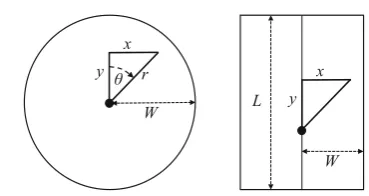
r x y
W
W x y L
Fig. 1 Point transect (left) and line transect (right) survey schematics. With point transects, acircleof radius
Wis searched, while with line transects arectangleof widthWand lengthLis searched by transiting the line up its centre. The coordinate system iscentredon the observer, at thesolid circle. The figures show coordinates for an individual detected at Cartesian coordinates(x,y)
inference tends to be faster, because the data augmentation Markov chain Monte Carlo methods implemented for Bayesian inference can be much more computationally demanding. This may change with the advent of a more efficient Bayesian method by
King et al.(2016). Bayesian methods are more easily able to deal with open population models in which there is temporal dependence in the state of the population, with situations in which only a fraction of the population is marked, and in which there is spatial correlation in individuals’ locations. Indeed the only current methods for dealing with these cases are Bayesian.
SCR methods are relatively new and growing fast (seeRoyle et al. 2013a). We are only beginning to appreciate and explore the possibilities that the extension of capture–recapture into spatial dimensions provides, and this is a field of research ripe for innovative method development by applied statisticians. Areas of likely future development include more sophisticated spatial and spatio-temporal modelling of indi-viduals’ locations for closed and open populations, new methods for integrating spatial capture–recapture and other kinds of ecological survey data, and methods of dealing with recapture uncertainty.
Acknowledgements TAM thanks support by CEAUL (funded by FCT—Fundação para a Ciência e a Tecnologia, Portugal, through the Project UID/MAT/00006/2013).
Open Access This article is distributed under the terms of the Creative Commons Attribution 4.0 Interna-tional License (http://creativecommons.org/licenses/by/4.0/), which permits unrestricted use, distribution, and reproduction in any medium, provided you give appropriate credit to the original author(s) and the source, provide a link to the Creative Commons license, and indicate if changes were made.
Appendix: Distance sampling models
As noted in Sect.3.3, DS methods are usually model-based only within distanceW of samplers, relying on design-based methods to draw inferences beyondW. And most DS methods assume uniform distribution of individuals with distanceW. In this case, the pdf of individuals’ locations within the searched region isD(s;φ)= 1/(πW2)
for point transect surveys (when a circle of radiusW is searched—see Fig.1) and
[image:17.439.122.307.49.147.2]If we writesin terms of Cartesian coordinates(x,y)and transform from Cartesian to polar coordinates for the point transect case:r =x2+y2, θ =tan−1(y/x)and
x=rsin(θ),y=rcos(θ), with Jacobian =−1, and then marginalise overθ, we get
D(r)=2r/W2.
In the case of point transect surveys, detection probability is modelled as a function of radial distance only, so that p(d(si);θ) = p(ri;θ). In the case of line transect
surveys, detection probability is modelled as a function of perpendicular distance only, so thatp(d(si);θ)=p(xi;θ). Inference is usually based only onrifor point transects
andxi for line transects (i =1, . . . ,n), so that we use f(ri|, δi =1)and f(xi|, δi =
1)in place of f(si|, δi = 1). These are obtained using D(s;φ) = 1/(πW2)and
integrating outθfor point transects and using D(s;φ) =1/(2W L)and integrating outyfor line transects, as follows:
f(ri|δi =1)=
2π
0
p(d(si);θ)D(si;φ)
E(n;θ, φ) dθ
= p(ri;θ) 2r W2 W
0 p(r;θ) 2r W2 dr
= p(ri;θ)r
W
0 p(r;θ)rdr
and (17)
f(xi|δi =1)=
L
0
p(d(si);θ)D(si;φ)
E(n;θ, φ) dy
= p(xi;θ) 1 2W
W
0 p(x;θ) 1 2W dx
= p(xi;θ)
W
0 p(x;θ)dx
(18)
These are the forms found in the conventional distance sampling literature.
References
Alho, J.M.: Logistic regression in capture–recapture models. Biometrics46, 623–635 (1990)
Borchers, D.L., Efford, M.G.: Spatially explicit maximum likelihood methods for capture–recapture studies. Biometrics64, 377–385 (2008)
Borchers, D.L., Kidney, D.: Flexible density surface estimation for spatially explicit capture–recapture surveys. Technical report, University of St Andrews (2014)
Borchers, D.L., Zucchini, W., Fewster, R.: Mark-recapture models for line transect surveys. Biometrics54, 1207–1220 (1998)
Borchers, D.L., Distiller, G., Foster, R., Harmsen, B., Milazzo, L.: Continuous-time spatially explicit capture–recapture models, with an application to a jaguar camera-trap survey. Methods Ecol. Evol.5, 656–665 (2014)
Borchers, D.L., Stevenson, B.C., Kidney, D., Thomas, L., Marques, T.A.: A unifying model for capture– recapture and distance sampling. J. Am. Stat. Assoc.201, 195–204 (2015)
Buckland, S., Oedekoven, C., Borchers, D.: Model-based distance sampling. J. Agric. Biol. Environ. Stat.
21, 58–75 (2016)
Buckland, S.T.: Fitting density functions with polynomials. Appl. Stat.41, 63–76 (1992)
Buckland, S.T., Anderson, D.R., Burnham, K.P., Laake, J.L., Borchers, D.L., Thomas, L.: Introduction to Distance Sampling: Estimating Abundance of Biological Populations. Oxford University Press, Oxford (2001)
Buckland, S.T., Anderson, D.R., Burnham, K.P., Laake, J.L., Borchers, D.L., Thomas, L.: Advanced Dis-tance Sampling. Oxford University Press, Oxford (2004)
Currey, R.J.C., Rowe, L.E., Dawson, S.M.: Abundance and demography of bottlenose dolphins in Dusky Sound, New Zealand, inferred from dorsal fin photographs. N. Z. J. Mar. Freshw. Res.42, 439–449 (2008)
Efford, M.: secr: Spatially Explicit Capture–Recapture in R. R package version, vol. 1, no. (4) (2010) Efford, M.: Estimation of population density by spatially explicit capture–recapture analysis of data from
area searches. Ecology92, 2202–2207 (2011)
Efford, M., Borchers, D., Mowat, G.: Varying effort in capture–recapture studies. Methods Ecol. Evol.4, 629–636 (2013)
Efford, M., Dawson, D.K., Jhala, Y., Qureshi, Q.: Density-dependent home-range size revealed by spatially explicit capture–recapture. Ecography38, 1–13 (2015)
Efford, M.G.: Density estimation in live-trapping studies. Oikos106, 598–610 (2004)
Efford, M.G.: Bias from heterogeneous usage of space in spatially explicit capture–recapture analyses. Methods Ecol. Evol.5, 599–602 (2014)
Efford, M.G., Fewster, R.M.: Estimating population size by spatially explicit capture–recapture. Oikos122, 918–928 (2013)
Efford, M.G., Mowat, G.: Compensatory heterogeneity in spatially explicit capture–recapture data. Ecology
95, 1341–1348 (2014)
Efford, M.G., Borchers, D.L., Byrom, A.E.: Modeling Demographic Processes in Marked Populations, chapter Density estimation by spatially explicit capture-recapture: likelihood-based methods. Envi-ronmental and Ecological Statistics. Springer, New York (2008)
Efford, M.G., Dawson, D.K., Borchers, D.L.: Population density estimated from locations of individuals on a passive detector array. Ecology90, 2676–2682 (2009)
Ergon, T., Gardner, B.: Separating mortality and emigration: modelling space use, dispersal and survival with robust-design spatial capture-recapture data. Methods Ecol. Evol.5, 1327–1336 (2014) Fuller, A.K., Sutherland, C.S., Royle, A.J., Hare, M.P.: Estimating population density and connectivity of
American mink using spatial capture–recapture. Ecol. Appl.26, 1125–1135 (2016)
Gardner, B., Reppucci, J., Lucherini, M., Royle, J.A.: Spatially explicit inference for open populations: estimating demographic parameters from camera-trap studies. Ecology91, 3376–3383 (2010) Hayes, R.J., Buckland, S.T.: Radial-distance models for the line-transect method. Biometrics39, 29–42
(1983)
Huggins, R.M.: On the statistical analysis of capture experiments. Biometrika76, 133–140 (1989) Illian, J., Penttinen, A., Stoyan, H., Stoyan, D.: Statistical Analysis and Modelling of Spatial Point Patterns.
Wiley, New York (2009)
Johnson, D.S., Laake, J.L., Ver Hoef, J.M.: A model-based approach for making ecological inference from distance sampling data. Biometrics66, 310–318 (2010)
Kellner, K.F., Swihart, R.K.: Accounting for imperfect detection in ecology: a quantitative review. PLoS One9, e111436 (2014)
King, R., McClintock, B., Kidney, D., Borchers, D.: Capture-recapture abundance estimation using a semi-complete data likelihood approach. Ann. Appl. Stat.10, 264–285 (2016)
Otis, D.L., Burnham, K.P., White, G.C., Anderson, D.R.: Statistical inference from capture data on closed animal populations. Wildl. Monogr.62, 1–135 (1978)
Pledger, S.: Unified maximum likelihood estimates for closed capture-recapture models using mixtures. Biometrics56, 434–442 (2000)
Puechmaille, S.J., Petit, E.J.: Empirical evaluation of non-invasive capture-mark–recapture estimation of population size based on a single sampling session. J. Appl. Ecol.44, 843–852 (2007)
Reich, B., Gardner, B.: A spatial capture–recapture model for territorial species. Environmetrics25, 630–637 (2014)
Rich, L.N., Kelly, M.J., Sollmann, R., Noss, A.J., Maffei, L., Arispe, R.L., Paviolo, A., De Angelo, C.D., Di Blanco, Y.E., Di Bitetti, M.S.: Comparing capture–recapture, mark-resight, and spatial mark-resight models for estimating puma densities via camera traps. J. Mammal.95, 382–391 (2014)
Royle, J.A., Young, K.V.: A hierarchical model for spatial capture–recapture data. Ecology89, 2281–2289 (2008)
Royle, J.A., Karanth, K.U., Gopalaswamy, A.M., Kumar, N.S.: Bayesian inference in camera trapping studies for a class of spatial capture–recapture models. Ecology90, 3233–3244 (2009)
Royle, J.A., Chandler, R.B., Sollmann, R., Gardner, B.: Spatial Capture–Recapture. Academic Press, Oxford (2013a)
Royle, J.A., Chandler, R.B., Gazenski, K.D., Graves, T.A.: Spatial capture–recapture models for jointly estimating population density and landscape connectivity. Ecology94, 287–294 (2013b)
Royle, J.A., Sutherland, C., Fuller, A.K., Sun, C.C.: Likelihood analysis of spatial capture–recapture models for stratified or class structured populations. Ecosphere6, 1–11 (2015)
Royle, J.A., Fuller, A.K., Sutherland, C.: Spatial capture–recapture models allowing Markovian transience or dispersal. Popul. Ecol.58, 53–62 (2016)
Schaub, M., Royle, J.A.: Estimating true instead of apparent survival using spatial Cormack–Jolly–Seber models. Methods Ecol. Evol.5, 1316–1326 (2013)
Sollmann, R., Gardner, B., Parsons, A.W., Stocking, J.J., McClintock, B.T., Simons, T.R., Pollock, K.H., O’Connell, A.F.: A spatial mark-resight model augmented with telemetry data. Ecology94, 553–559 (2013a)
Sollmann, R., Gardner, B., Chandler, R.B., Shindle, D.B., Onorato, D.P., Royle, J.A., O’Connell, A.F.: Using multiple data sources provides density estimates for endangered Florida panther. J. Appl. Ecol.
50, 961–968 (2013b)
Sollmann, R., Gardner, B., Chandler, R.B., Royle, J.A., Sillett, T.S.: An open population hierarchical distance sampling model. Ecology96, 325–331 (2015)
Stevenson, B.C., Borchers, D.L., Altwegg, R., Swift, R.J., Gillespie, D.M., Measey, G.J.: A general frame-work for animal density estimation from acoustic detections across a fixed microphone array. Methods Ecol. Evol.6, 38–48 (2015)
Sutherland, C., Fuller, A.K., Royle, J.A.: Modelling non-Euclidean movement and landscape connectivity in highly structured ecological networks. Methods Ecol, Evol (2014)