Evolution of Helping and Harming in Viscous Populations When Group Size Varies.
Author(s): António M. M. Rodrigues and Andy Gardner
Source: The American Naturalist, Vol. 181, No. 5 (May 2013), pp. 609-622
Published by:
The University of Chicago Pressfor
The American Society of NaturalistsStable URL:
http://www.jstor.org/stable/10.1086/670031
.
Accessed: 04/08/2014 11:16
Your use of the JSTOR archive indicates your acceptance of the Terms & Conditions of Use, available at
.
http://www.jstor.org/page/info/about/policies/terms.jsp
.
JSTOR is a not-for-profit service that helps scholars, researchers, and students discover, use, and build upon a wide range of content in a trusted digital archive. We use information technology and tools to increase productivity and facilitate new forms of scholarship. For more information about JSTOR, please contact [email protected].
.
vol. 181, no. 5 the american naturalist may 2013
Evolution of Helping and Harming in Viscous Populations
When Group Size Varies
Anto´nio M. M. Rodrigues
1,* and Andy Gardner
1,21. Department of Zoology, University of Oxford, South Parks Road, Oxford OX1 3PS, United Kingdom; 2. Balliol College, University of Oxford, Broad Street, Oxford OX1 3BJ, United Kingdom
Submitted July 3, 2012; Accepted January 25, 2013; Electronically published March 14, 2013
Online enhancement: appendix.
abstract: Recent years have seen huge interest in understanding
how demographic factors mediate the evolution of social behavior in viscous populations. Here we study the impact of variation in group size on the evolution of helping and harming behavior. Al-though variation in group size influences the degree of relatedness and the degree of competition between groupmates, we find that these effects often exactly cancel, so as to give no net impact of variation in group size on the evolution of helping and harming. Specifically, (1) obligate helping and harming are never mediated by variation in group size, (2) facultative helping and harming are not mediated by variation in group size when this variation is spatial only, (3) facultative helping and harming are mediated by variation in group size only when this variation is temporal or both spatial and temporal, and (4) when there is an effect of variation in group size, facultative helping is favored in big groups and facultative harm-ing is favored in little groups. Moreover, we find that spatial and temporal heterogeneity in individual fecundity may interact with patch-size heterogeneity to change these predictions, promoting the evolution of harming in big patches and of helping in little patches.
Keywords: class structure, conditional behavior, inclusive fitness, kin selection, phenotypic plasticity, reproductive value.
Introduction
Explaining cooperative behavior has been a central chal-lenge to evolutionary biologists over the past few decades (Maynard Smith and Szathma´ry 1995; Hamilton 1996; West et al. 2007a; Bourke 2011). Natural selection favors those individuals who achieve higher relative fitness (Dar-win 1859; Fisher 1930; Price 1970). But cooperative be-haviors that improve the fitness of others will, all else being equal, decrease the relative fitness of the actor. This prob-lem can be solved if the actor receives a direct fitness benefit as a consequence of her cooperative behavior. For example, the immediate cost of the actor’s behavior may
* Corresponding author; e-mail: [email protected].
Am. Nat. 2013. Vol. 181, pp. 609–622.䉷2013 by The University of Chicago. 0003-0147/2013/18105-53962$15.00. All rights reserved.
DOI: 10.1086/670031
be compensated for later in her life by reciprocation from others (Trivers 1971). Such cooperation is termed “mu-tually beneficial” (West et al. 2007b). Alternatively, the problem can be solved if the actor receives an indirect fitness benefit, through her genetic relatives benefiting from her cooperative behavior (Hamilton 1963, 1964). Such cooperation is termed “altruistic” (Hamilton 1964; West et al. 2007b).
Altruistic cooperation requires that interacting individ-uals have genes in common. Hamilton (1964, 1971b) sug-gested three general mechanisms by which this can occur. First, individuals might be able to identify which of their social partners are genealogically close kin and preferen-tially direct their altruism to these individuals. Second, a “greenbeard” gene may provide its bearer the ability to directly identify which of their social partners also carry the same gene, independently of their genealogical rela-tionship (Hamilton 1964; Dawkins 1976; Gardner and West 2010). Third, if dispersal is limited, then neighboring individuals are likely to be genealogically close kin, such that even indiscriminate cooperation will tend to occur between individuals who have genes in common. As this third mechanism does not require any discrimination mechanism, it could represent a very general principle that explains the evolution of cooperation at all levels of bi-ological organization (Maynard Smith and Szathma´ry 1995; Bourke 2011).
ef-fects of limited dispersal, so that indiscriminate helping may be favored in viscous populations. Some of these factors include population elasticity (Taylor 1992b), over-lapping generations (Taylor and Irwin 2000; Irwin and Taylor 2001), budding dispersal (Gardner and West 2006; Lehmann et al. 2006b; Ku¨mmerli et al. 2009), an organ-ism’s life cycle and timing of social behavior (Taylor 1992a; Lehmann and Rousset 2010), behaviors mediating patch-extinction probabilities (Lehmann et al. 2006b), trans-generational altruism (Lehmann 2007, 2010), dispersal-dependent social behavior (El Mouden and Gardner 2008), empty sites (Alizon and Taylor 2008), sex-biased dispersal (Johnstone and Cant 2008; Gardner 2010), reproductive skew (Johnstone 2008), age structure (Johnstone and Cant 2010), and heterogeneity in resource availability (Rod-rigues and Gardner 2012).
All this work has concerned populations in which the size of viable groups is fixed. However, natural populations commonly exhibit some degree of group-size heteroge-neity, and the impact of this variation has been of great interest to ecologists and evolutionary biologists (Levins 1968; McPeek and Holt 1992; Begon et al. 2006). This is important to the evolution of kin-selected traits because patch size is likely to have an impact not only on the relatedness among social partners but also on local com-petition, two important factors that jointly mediate the evolution of social traits in viscous populations.
Here we investigate the impact of heterogeneity in group size on the evolution of indiscriminate helping and harm-ing in viscous populations. Specifically, we consider sce-narios in which different groups have different sizes at any given time (spatial heterogeneity) and/or the same group has different sizes at different times (temporal heteroge-neity), where group size is extrinsically controlled and not driven by the group’s past or present social behavior. We first consider cases where fecundity is equal across all patch types, and we then relax this assumption by considering cases where fecundity depends on patch type. Moreover, we consider scenarios where individuals obligately express their social behavior independently of their patch type and scenarios where individuals may facultatively adjust their social behavior according to their patch type. We deter-mine the impact of this heterogeneity on the genetic re-latedness and intensity of competition between group-mates and examine how these interact and affect the evolution of helping and harming behaviors.
Model and Analysis
Model
We assume an infinite island population (Wright 1931) with two types of patches: big patches with nB breeding
sites and little patches with nLbreeding sites (without loss of generality, we assume nB≥nL). We consider that in-dividuals are haploid and asexual, that each individual breeding in a big patch has a very high fecundity FBp
, and that each individual breeding in a little patch f(x, y)
has a very high fecundity FLpjf(x, y), where x is the individual’s investment in the social behavior, y is the av-erage level of investment among the individual’s group-mates, and0!j!⬁is the “reproductive factor” describ-ing fecundity differences between individuals breeddescrib-ing in little versus big patches. Note that if jp1, individuals breeding in little patches have the same fecundity as those breeding in big patches; ifj!1, individuals breeding in little patches have less fecundity than those breeding in big patches; and if j11, individuals breeding in little patches have greater fecundity than those breeding in big patches. The average investment strategy in the population is represented by z. After reproduction, a fraction 1⫺m of the offspring stay in their natal patch, while the re-maining fraction m disperse to random patches in the population. After dispersal, patches may undergo changes in their size according to a Markov process: big patches remain big with probabilityaand become little with prob-ability1⫺a, whereas little patches remain little with prob-ability b and become big with probability 1⫺b (see “Patch Dynamics,” available online, for details). Subse-quently, offspring compete for breeding places, with all nonbreeding individuals perishing. Table 1 provides a summary of model notation.
Helping and Harming
We classify social behaviors according to their impact on fecundity. The impact on the actor’s fecundity is ⫺C{
, and the impact on the patchmates’ fecundity ⭸f(x, y)/⭸x
isB{⭸f(x, y)/⭸y, where, assuming vanishing variation in investment strategies, we evaluate derivatives at xp
(Taylor and Frank 1996). Helping behaviors are ypz
Group-Size Heterogeneity and Social Behavior 611
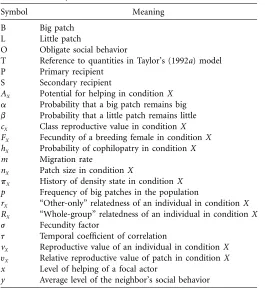
Table 1: Summary of model notation
Symbol Meaning
B Big patch L Little patch
O Obligate social behavior
T Reference to quantities in Taylor’s (1992a) model P Primary recipient
S Secondary recipient
AX Potential for helping in condition X
a Probability that a big patch remains big b Probability that a little patch remains little cX Class reproductive value in condition X
FX Fecundity of a breeding female in condition X
hX Probability of cophilopatry in condition X
m Migration rate
nX Patch size in condition X
pX History of density state in condition X
p Frequency of big patches in the population
rX “Other-only” relatedness of an individual in condition X
RX “Whole-group” relatedness of an individual in condition X
j Fecundity factor
t Temporal coefficient of correlation
vX Reproductive value of an individual in condition X
uX Relative reproductive value of patch in condition X
x Level of helping of a focal actor
y Average level of the neighbor’s social behavior
c [B⫺C⫹rPFBB⫺(B⫺C)rSFB SuFB]
⫹c [⫺C⫹r B⫺(B⫺C)r u ]10, (1) L PFL SFL SFL
where cB and cLare the class reproductive values of indi-viduals breeding within big and little patches, respectively (Fisher 1930; Taylor 1990; Grafen 2006); rPFBand rPFLare the relatednesses of the actor to her groupmates—“pri-mary recipients”—in big patches and little patches, re-spectively; rSFB and rSFL are the relatednesses of the actor
to those offspring competing for breeding sites with the offspring born in her patch—“secondary recipients”—in big patches and little patches, respectively; and uSFB and
uSFL are the reproductive values of secondary recipients, relative to those of primary recipients, in big patches and little patches, respectively (see “Relatedness” and “Repro-ductive Value,” available online, for details). Note that we are defining actor, primary recipients, and secondary re-cipients in terms of the three selection pressures that arise from the actor’s social behavior, namely, the cost to the actor, the benefit to groupmates, and the kin-competition effect. Also note that a focal individual may experience, either directly or through her offspring, more than one of these selection pressures during her lifetime. The condi-tions for natural selection to favor the evolution of fac-ultative social behavior are given by
⫺C⫹r B⫺(B⫺C)r u 10 (2) PFB SFB SFB
and
⫺C⫹r B⫺(B⫺C)r u 10 (3) PFL SFL SFL
for actors in big patches and little patches, respectively. The left-hand side (LHS) of conditions (1)–(3) can be interpreted as the inclusive fitness effect of the social be-havior (Hamilton 1963, 1964, 1970). First, the bebe-havior imposes a cost C on the actor’s own fecundity. Second, it provides a benefit B to the fecundity of the actor’s group-mates, and this benefit is weighted by the relatedness of these primary recipients rP. Finally, the behavior leads to an increase ofB⫺Cin the number of offspring born in the patch, and hence it excludes an equal number of sec-ondary recipients who compete with these extra offspring for breeding opportunities. Moreover, this effect is weighted by the relatedness of secondary recipients rSand also by the relative reproductive value of secondary recip-ients uS.
Table 2: Summary of model results
Group-size heterogeneity with homogeneous fecundity
Group-size heterogeneity with variable fecundity
Spatial Temporal Spatial and temporal Spatial Temporal Spatial and temporal
Obligate Cancel Cancel Cancel ⫺ ⫺ ⫺
Facultative (big patches) Cancel Helping Helping ⫺ ⫺ ⫹ Facultative (little patches) Cancel Harming Harming ⫺ ⫺ ⫹
Note: Results for group-size heterogeneity with homogeneous fecundity (jp1) for obligate and facultative behavior and for different group-size heterogeneity assumptions (spatial only, temporal only, and spatial and temporal) and impact of variable fecundity on the results derived for group-size heterogeneity with homogeneous fecundity (minus sign: has no impact; plus sign: has an impact). Obligate trait expression and spatial heterogeneity always lead to the cancellation result. Variable fecundity plays a role in the evolution of social behavior only when populations are spatially and temporally heterogeneous, in which case it can change the predictions of the homogeneous-fecundity model.
favored to help her patchmates, provided that the personal cost to herself is sufficiently small, whereas ifA!0, the actor is selectively favored to harm her patchmates, pro-vided that the personal cost to herself is sufficiently small. We may define the additive inverse of the potential for helping (i.e.,⫺A) as the “potential for harming” (Rod-rigues and Gardner 2012).
From inequality (1), the potential for obligate helping is given by
c (rB PFB⫺rSFB SuFB)⫹c (rL PFL⫺rSFL SuFL)
AOp . (4)
c (1B ⫺rSFB SuFB)⫹c (1L ⫺rSFL SuFL)
From inequalities (2) and (3), the potential for facultative helping is given by
rPFB⫺rSFB SuFB
ABp (5)
1⫺rSFB SuFB
and
rPFL⫺rSFL SuFL
ALp (6)
1⫺rSFL SuFL
for big patches and little patches, respectively.
Results and Analysis
In the next two sections, we derive the main results of our model. We begin by considering that the fecundity of in-dividuals is independent of patch size (jp1). We then relax this assumption to consider cases where the individ-uals’ fecundity depends on the patch they are in (0!
; see table 2 for a summary of the results).
j!⬁
Group-Size Heterogeneity
Spatial Heterogeneity. We first consider a population in which group size varies between patches within generations but not within patches between generations (i.e., spatial heterogeneity only). We derive the following results:
Result 1. Spatial heterogeneity in group size has no
im-pact on the evolution of obligate social behavior (AOp
), irrespective of parameter values (see “Relatedness” for 0
details). This extends Taylor’s (1992a) result for homo-geneous populations to populations with spatial hetero-geneity in group size.
Result 2. Spatial heterogeneity in group size has no im-pact on the evolution of facultative social behavior (ABpALp0), irrespective of parameter values (see “Re-latedness” for details). This extends result 1 for obligate social behavior to facultative social behavior.
In Taylor’s (1992a) model, the relatedness of primary recipients is given byrPFTph RT T, where hTis the prob-ability that two offspring chosen at random from a patch are both philopatric to that patch after the dispersal phase and RT is the relatedness of these two offspring. The re-latedness of secondary recipients is also given by rSFTp
. As a consequence, the relatedness of primary recip-h RT T
ients is equal to that of secondary recipients,rPFTprSFT. Moreover, because Taylor’s (1992a) model is of a ho-mogeneous population, all recipients have the same re-productive value in a neutral population, and hence . Since actors place the same value on primary
uSFTp1
and secondary recipients irrespective of population vis-cosity (rPFTprSFT SuFT; fig. 1), selection acting on the social behavior is null (ATp0).
A
B
[image:6.594.75.539.123.600.2]C
D
on the social behavior is null (ABp0). The same argu-ment can be made in relation to little patches (namely,
, , , ,
rPFLph RL L rSFLph RL L rPFLprSFL uSFLp1 rPFLp
, and ; fig. 1). Finally, selection acting on rSFL SuFL ALp0
obligate social behavior is determined by selection acting on each size-type patch weighted by the respective class reproductive values (see the LHS of inequality [1]). As we have just seen, selection acting on each size-type patch is null (ABp0andALp0). Therefore, selection acting on obligate social behavior is also null (AOp0). Full math-ematical details are given in “Cancellation of Obligate Helping and Harming,” available online.
Temporal Heterogeneity. We next consider a population in which group size varies within patches between genera-tions but not between patches within generagenera-tions (i.e., temporal heterogeneity only). In particular, we assume that all patches in the population become big with probability p or little with probability1⫺p in every generation. We derive the following results:
Result 3. Temporal heterogeneity in group size has no impact on the evolution of obligate social behavior (AOp0), irrespective of parameter values (see “Temporal Heterogeneity” in the appendix, available online, for de-tails). This extends Taylor’s (1992a) cancellation result for homogeneous populations to populations with temporal heterogeneity in group size.
Result 4. Temporal heterogeneity in group size does have an impact on the evolution of facultative social behavior (AB(0andAL(0). Specifically, selection favors helping in patches with more breeders (AB≥0) and harming in patches with fewer breeders (AL≤0; see “Temporal Het-erogeneity” in the appendix for details).
Why does Taylor’s (1992a) result no longer hold for facultative social behavior in temporally heterogeneous populations? Focusing on helping in big patches only, we find that the relatedness of primary recipients is given by , where p is the probability rPFBpph RB B⫹(1⫺p)h RL L
that the patch was big in the previous generation, hB is the probability that two offspring chosen at random from a big patch are both philopatric to that patch after the dispersal phase, RBis the relatedness of these two offspring, is the probability that the patch was little in the 1⫺p
previous generation, hLis the probability that two offspring chosen at random from a little patch are both philopatric to that patch after the dispersal phase, and RL is the re-latedness of these two offspring. The rere-latedness of sec-ondary recipients is rSFBph RB B. Note that hBphLp
and that because there are more breeders in big 2
(1⫺m)
patches than in little patches, relatedness is higher among the offspring born in the former and lower among the offspring born in the latter patch type; that is,R !R.
B L
Consequently, the relatedness of primary recipients is
greater than the relatedness of secondary recipients; that is,r 1r . In addition, because within each generation
PFB SFB
all individuals are identical, the reproductive value of pri-mary recipients is equal to the reproductive value of sec-ondary recipients; that is, uPFBpuSFB. Since actors place more value on primary recipients than on secondary re-cipients, selection favors helping behavior in big patches (A 10; fig. 2). A similar argument can be made in relation
B
to little patches. However, because primary recipients are now less valuable than secondary recipients for actors, selection favors harming behavior in little patches:
, ,
rPFLpph RB B⫹(1⫺p)h RL L rSFLph RL L hBphLp
, , , and (fig. 2; see “Tem-2
(1⫺m) R !R u p1 A !0
B L SFL L
poral Heterogeneity” in the appendix for details). In other words, when patches increase in size (i.e., after a bottle-neck), helping is favored; by contrast, when patches de-crease in size, harming is favored.
When we turn to obligate social behavior, relatednesses are averaged over patch types, weighted by the corre-sponding class reproductive values; that is, rPFOp
. Because the relatedness of primary recipi-c rB PFB⫹c rL PFL
ents in big patches is equal to that of primary recipients in little patches (rPFBprPFL) and the class reproductive values sum to unity (cB⫹cLp1), the relatedness of pri-mary recipients is given by rPFOprPFBprPFLp
. The relatedness of secondary recip-ph RB B⫹(1⫺p)h RL L
ients is given by rSFOpc h RB B B⫹c h RL L L. Because class reproductive values are given bycBppandcLp1⫺p, we find that the relatedness of primary recipients is equal to that of secondary recipients (rPFOprSFO). Consequently, selection acting on obligate social behavior is null (AOp0; see “Temporal Heterogeneity” in the appendix for details).
Spatial and Temporal Heterogeneity. Finally, we consider a population characterized by heterogeneity in group size both between patches within generations and within patches between generations (i.e., spatial and temporal heterogeneity). We derive the following results:
Result 5. Spatial and temporal heterogeneity in group size has no impact on the evolution of obligate social behavior (AOp0), irrespective of parameter values (see “Cancellation of Obligate Helping and Harming” for de-tails). This extends Taylor’s (1992a) cancellation result for homogeneous populations to obligate social behaviors in spatially and temporally heterogeneous populations.
Result 6. Spatial and temporal heterogeneity in group size does influence the evolution of facultative social be-haviors (AB(0andAL(0). Specifically, selection favors helping in patches with more breeders (AB≥0) and harm-ing in patches with fewer breeders (AL≤0; see “Cancel-lation of Obligate Helping and Harming” for details).
A
B
[image:8.594.73.540.110.579.2]C
D
C
D
Figure 3: Impact of spatial and temporal heterogeneity in group size on relatedness, reproductive value, and potential for helping. A, Relatedness of primary (1⬚) recipients (rP) as a function of the frequency of big patches (p) for big patches (rPFB; solid black line), little patches (rPFL; dashed black line), and Taylor’s (1992a) reference model (rPFT; gray lines). The relatedness of primary recipients is higher in big patches, because of higher cophilopatry, and lower in little patches, because of lower cophilopatry, than that of the reference model with equivalent group sizes (rPFB1rPFTandrPFL!rPFT). B, Relatedness of secondary (2⬚) recipients (rS) as a function of the frequency of big patches (p). The relatedness of secondary recipients is higher in big patches, because of higher cophilopatry, and lower in little patches, because of lower cophilopatry, than that of the reference model with equivalent group sizes (r 1r andr !r ). Importantly, in big
SFB SFT SFL SFT
patches primary recipients are less related to the actor than are secondary recipients, while in little patches primary recipients are more related to the actor than are secondary recipients (rPFB!rSFBandrPFL1rSFL). C, Relative reproductive value (RV) of secondary recipients (uS) as a function of the frequency of big patches (p). In big patches the relative reproductive value of secondary recipients is less than or equal to that of the reference model, and in little patches the relative reproductive value is greater than or equal to that of the reference model (uSFB≤uSFTanduSFT≤uSFL). D, Potential for facultative helping (ABand AL) as a function of the frequency of big patches (p). In big patches there is potential for helping (A 10), while in little patches there is potential for harming (A !0). By numerical analysis, these results
B L
were confirmed to hold over the entire range of possible parameter state space. In all plots, numerical examples are given fornBp40,
, , and .
Group-Size Heterogeneity and Social Behavior 617
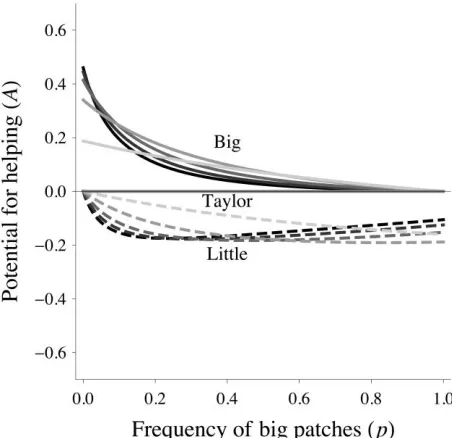
Figure 4: Impact of spatial and temporal heterogeneity in group size on the potential for helping: potential for facultative helping (ABand AL) as a function of the frequency of high-quality patches (p), for varying sizes of big patches (nBp40, 30, 20, 10, and 4). Darker lines represent larger patch sizes, while lighter lines represent smaller patch sizes. There is always potential for helping in big patches, while there is always potential for harming in little patches. Parameter values:
, , and .
nLp2 mp0.1 tp1/2
we consider facultative helping and harming in popula-tions that are both spatially and temporally heterogeneous with respect to group size? Focusing our attention on fac-ultative helping in big patches, we find that the potential for this to be favored is given by equation (5); that is, . If patch quality is het-ABp(rPFB⫺rSFB SuFB)/(1⫺rSFB SuFB)
erogeneous in space and time, then the actor’s big patch may have been either big or little in the previous gener-ation, and so her relatedness to primary recipients rPFBis a weighted average of the product of the probability of cophilopatry hB and whole-group relatedness RB for big patches and the product of the probability of cophilopatry hL and whole-group relatedness RL for little patches (see “Relatedness” for details). In contrast, her relatedness rSFB to the secondary recipients is the product of the probability of cophilopatry hBand whole-group relatedness RBfor her big patch (see “Relatedness” for details). Moreover, the reproductive value of her secondary recipients—that is, adults in her patch in the next generation—need not be equal to her own reproductive value. While she has the reproductive value of an individual in a big patch, theirs is a weighted average of the reproductive values for in-dividuals in big and little patches. Hence, u !1 (see
SFB “Reproductive Value” for details).
Consequently, the actor may place different values on her primary and secondary recipients:rPFB(rSFB SuFB(fig. 3; see “Cancellation of Obligate Helping and Harming” for details). Hence, the potential for facultative helping in big patches may be nonzero, AB(0. The same is true for facultative helping in little patches: rPFL(rSFL and , so and (fig. 3; see
“Can-u 11 r (r u A (0
SFL PFL SFL SFL L
cellation of Obligate Helping and Harming” for details). We find that there is potential for helping in big patches and potential for harming in little patches (A 10 and
B ; fig. 4).
A !0 L
Although actors in big patches place different values on their primary and secondary recipients and this is also true of actors in little patches, we find that, on average over both patch types, actors place equal value on their primary and secondary recipients. This owes to the properties of the ecological dynamics that determines how patch size changes across generations. Specifically, this is character-ized by a time-homogeneous Markov chain, such that the backward processes that determine the value of primary recipients are identical to the forward processes that de-termine the value of secondary recipients (see “Cancel-lation of Obligate Helping and Harming” for details). Hence, while there is nonzero potential for facultative helping and harming in big and little patches (AB(0and ), there is zero potential for obligate helping and AL(0
harming (AOp0) in populations characterized by both spatial and temporal heterogeneity.
Group-Size Heterogeneity with Variable Fecundity
Here we consider that a group’s size may affect its con-stituents’ fecundity (0!j!⬁). This enables us to study how the interaction between patch-size heterogeneity and variable fecundity mediates the evolution of obligate and facultative helping and harming. For example, several studies have shown that increasing a group’s size may decrease the fitness of its constituent members, for ex-ample, because of infectious diseases (e.g., Rifkin et al. 2012). By contrast, other studies have shown that increas-ing a group’s size may increase the fitness of its constituent members, for example, because of a decrease in predation rates or more efficient foraging (e.g., Hamilton 1971a). We derive the following results:
Result 7. We find that introducing patch productivity heterogeneity has no impact on the results derived for patch-size heterogeneity when (1) individuals express ob-ligate behavior and/or (2) there is spatial heterogeneity only or (3) there is temporal heterogeneity only.
C
D
Figure 5: Impact of spatial and temporal heterogeneity in group size and variable fecundity on relatedness, reproductive value, and potential for helping. A, Relatedness of primary (1⬚) recipients (rP) as a function of the reproductive factor (j) for big patches (rPFB; solid black line), little patches (rPFL; dashed black line), and Taylor’s (1992a) reference model (rPFT; gray lines). In big patches, for lower values of the reproductive factor, the relatedness of primary recipients is less than that of the reference model (r !r ), while for higher values of the
PFB PFT
reproductive factor, the relatedness of primary recipients is greater than that of the reference model (r 1r ). In little patches, the PFB PFT
relatedness of primary recipients is always less than that of the reference model (rPFL!rPFT). B, Relatedness of secondary (2⬚) recipients (rS) as a function of the reproductive factor (j). In big patches, for lower values of the reproductive factor, the relatedness of secondary recipients is less than that of the reference model (r !r ), while for higher values of the reproductive factor, the relatedness of secondary recipients
SFB SFT
is greater than that of the reference model (r 1r ). In little patches, the relatedness of secondary recipients is less than that of the SFB SFT
reference model for a wide range of the reproductive factor (rSFL!rSFT). Importantly, in big patches and for lower values of the reproductive factor, primary recipients are less related to the actor than are secondary recipients (rPFB!rSFB), while for higher values of the reproductive factor, primary recipients are more related to the actor than are secondary recipients (rPFB1rSFB); by contrast, in little patches, primary recipients are more related to the actor than are secondary recipients for smaller values of the reproductive factor (rPFL1rSFL), while for higher values of the reproductive factor, primary recipients are less related to the actor than are secondary recipients (r !r ). C, Relative
PFL SFL
reproductive value (RV) of secondary recipients (uS) as a function of the reproductive factor (j). In big patches, the relative reproductive value of secondary recipients is less than that of the reference model for smaller values of the reproductive factor (u !u ), while it is
SFB SFT
Group-Size Heterogeneity and Social Behavior 619
reproductive value is greater than that of the reference model for lower values of the reproductive factor (uSFT!uSFL), while it is less than that of the reference model for higher values of the reproductive factor (uSFT1uSFL). D, Potential for facultative helping (ABand AL) as a function of the reproductive factor (j). In big patches there is potential for harming for lower values of the reproductive factor (A !0),
B while there is potential for helping for higher values of the reproductive factor (A 10). In little patches there is potential for helping for
B
lower values of the reproductive factor (A 10), while there is potential for harming for higher values of the reproductive factor (A !0).
L L
In all plots, numerical examples are given fornBp40 n, Lp2 m, p0.1 p, p0.6, andtp1/2. Why does variable fecundity have no impact on the
results obtained for the evolution of helping and harming in a group-size-heterogeneous population with homoge-neous fecundity when we assume (1) obligate behavior and/or (2) group-size spatial heterogeneity only or (3) group-size temporal heterogeneity only? We find that the cancellation result obtained for a group-size-heteroge-neous population (i.e., our results 1–3 and 5) continues to hold, for the same reason, irrespective of variation in fecundity. This is because, while variable fecundity alters both the relatedness coefficient and the reproductive value of each recipient, the relationship between the overall value (i.e., life-for-life relatedness) of primary and secondary recipients remains unaltered, and therefore the cancella-tion result continues to hold.
Why does variable fecundity influence the consequences of group-size heterogeneity in the model with both spatial and temporal heterogeneity? We find that if breeders in little patches have low fecundity (lowj), then facultative helping can be favored. This is because secondary recip-ients are usually unrelated immigrants, and therefore the relatedness of secondary recipients is close to 0, making the kin-competition effect negligible. By contrast, facul-tative harming is favored in big patches. This is because secondary recipients are usually philopatric to the patch, which intensifies the kin-competition effect, favoring harming behavior. By contrast, if breeders in little patches have high fecundity (highj), then we recover the same qualitative result derived for patch-size heterogeneity with homogeneous fecundity, namely, that helping is favored in big patches and harming is favored in little patches (fig. 5).
Discussion
Population viscosity has been proposed as a general mech-anism that promotes interactions between closely related individuals and may therefore favor the evolution of kin-selected traits such as altruistic cooperation (Hamilton 1964, 1971b). However, it is now well recognized that pop-ulation viscosity also promotes competition between kin. Here we have shown that Taylor’s (1992a) seminal result, that the relatedness and competition effects of viscosity exactly cancel in homogeneous populations, extends to populations where groups vary in size because of extrinsic
factors. Specifically, population viscosity has no impact on the evolution of obligate helping or harming in popula-tions characterized by spatial and/or temporal heteroge-neity in group size. Moreover, if individuals can faculta-tively adjust their behavior conditionally on their group’s size, then there is no selection for either helping or harm-ing when there is only spatial heterogeneity in group size. However, we have shown that facultative helping is favored in big groups and that facultative harming is favored in little groups when there is either only temporal or both temporal and spatial heterogeneity in group size. More generally, we have shown that Taylor’s (1992a) cancellation result for obligate behavior is robust across a wide range of ecologically realistic scenarios, and we have clarified why this cancellation occurs. Specifically, the proper weights of each selection pressure are the life-for-life relatedness co-efficients, which are given in terms of recipients’ relat-ednesses and reproductive values, both of which emerge from the specific demographic dynamics of the population (see “Cancellation of Obligate Helping and Harming” for details).
importance of understanding how ecological and genetic factors affect life-for-life coefficients of relatedness.
Grafen (2007) also studied the evolution of obligate helping in a population characterized by heterogeneity in group size and limited dispersal. However, his model as-sumed global competition for reproductive resources and hence the absence of kin competition. Consequently, he found that obligate helping readily evolved in the context of his model. Here we have considered that limited dis-persal determines both the genetic structure of the pop-ulation and the scale of competition. This emphasizes the importance of demography for mediating the costs and benefits of social behavior as well as the genetic relatedness of social partners. Lehmann et al. (2006b) studied the evolution of social traits in a metapopulation characterized by patch extinctions, and we recover a similar scenario by considering that there are no breeders in little patches (nLp0). In this special case of our model, it is mean-ingless to distinguish obligate from facultative behavior, as all breeders are in big patches, and consequently there is no avenue for helping or harming to be favored in this scenario. The Lehmann et al. model considered that tran-sitions between occupied and empty patches are governed by social interaction, allowing helping behaviors to be fa-vored. This contrasts with our results, which do not require this mechanism for helping and harming to be favored. Our results also show that environmental heterogeneity favors plastic social responses to local environments and therefore support the idea that plasticity and varying eco-logical factors can play a role in promoting social behavior in viscous populations (e.g., Kelly 1992; Queller 1992). More generally, future work should explore how extrinsic factors (e.g., climate change) and intrinsic factors (e.g., social behavior) interact to drive patch heterogeneity and mediate the evolution of helping and harming.
Our model also relates to the “bottleneck” hypothesis in the evolution of multicellularity, which suggests that a unicellular bottleneck, followed by a growth cycle in the absence of migration, has been fundamental for the evo-lution of multicellular organisms (Dawkins 1982; Maynard Smith 1988; Maynard Smith and Szathma´ry 1995; Gros-berg and Strathmann 1998, 2007; Bourke 2011). These characteristics of the life cycle already assume preadap-tations, which can be social traits themselves. Our model predicts that facultative helping is favored among group-mates after the group has passed through a bottleneck and has grown to full size, and it also predicts that facultative harming is favored before the group has grown to full size (see result 4). Therefore, less stringent bottlenecks may have been important to produce preadaptations before the full onset of highly complex cooperative societies (e.g., multicellular organisms or eusocial insects). Although some empirical work has been done in this area
(Brock-hurst 2007; Brock(Brock-hurst et al. 2007), the kin-competition effects of population viscosity in the context of bottlenecks have so far been neglected. Experimental protocols that test the effect of population viscosity in social evolution are already available (Griffin et al. 2004; Ku¨mmerli et al. 2009), and these could be extended to incorporate the effects of spatial and temporal patch-size heterogeneity.
Our results show that heterogeneity in patch size and individual fecundity affects the value of each selective force in populations characterized by some degree of viscosity. This happens because (1) it changes the genetic structure of the population and consequently the relatedness of each recipient and (2) it changes the reproductive value of each recipient. Therefore, heterogeneity in patch size and in-dividual fecundity is likely to mediate the evolution of social traits other than those considered here. For example, sex ratio (i.e., the fraction of offspring that are male) is a classic social trait (Hamilton 1967; Charnov 1982; West 2009). Selection pressures acting on sex ratio—including those relating to kin competition—depend on both the relatedness and the reproductive value of the different re-cipients (males vs. females). Thus, extending our frame-work to study sex ratio evolution is a promising line of future research.
Acknowledgments
We thank A. Grafen and S. West for helpful discussion. A.M.M.R. is supported by the PhD Program in Compu-tational Biology of the Instituto Gulbenkian de Cieˆncia and funded by the Fundac¸a˜o para a Cieˆncia e a Tecnologia (SFRH/BD/33851/2009), and A.G. is supported by re-search fellowships from Balliol College and the Royal Society.
Literature Cited
Alizon, S., and P. D. Taylor. 2008. Empty sites can promote altruistic behavior. Evolution 62:1335–1344.
Begon, M., J. L. Harper, and C. R. Townsend. 2006. Ecology: indi-viduals, populations and communities. Blackwell, Oxford. Bourke, A. F. G. 2011. Principles of social evolution. Oxford
Uni-versity Press, Oxford.
Brockhurst, M. A. 2007. Population bottlenecks promote cooperation in bacterial biofilms. PLoS ONE 2(7):e634.
Brockhurst, M. A., A. Buckling, and A. Gardner. 2007. Cooperation peaks at intermediate disturbance. Current Biology 17:761–765. Charnov, E. L. 1982. The theory of sex allocation. Princeton
Uni-versity Press, Princeton, NJ.
Darwin, C. R. 1859. On the origin of species by means of natural selection. J. Murray, London.
Group-Size Heterogeneity and Social Behavior 621
———. 1982. The extended phenotype. Oxford University Press, Oxford.
El Mouden, C., and A. Gardner. 2008. Nice natives and mean mi-grants: the evolution of dispersal-dependent social behaviour in viscous populations. Journal of Evolutionary Biology 21:1480– 1491.
Fisher, R. A. 1930. The genetical theory of natural selection. Clar-endon, Oxford.
Frank, S. A. 1997. Multivariate analysis of correlated selection and kin selection, with an ESS maximization method. Journal of The-oretical Biology 189:307–316.
———. 1998. Foundations of social evolution. Princeton University Press, Princeton, NJ.
Gardner, A. 2010. Sex-biased dispersal of adults mediates the evo-lution of altruism among juveniles. Journal of Theoretical Biology 262:339–345.
Gardner, A., and S. A. West. 2006. Demography, altruism, and the benefits of budding. Journal of Evolutionary Biology 19:1707– 1716.
———. 2010. Greenbeards. Evolution 64:25–38.
Grafen, A. 2006. A theory of Fisher’s reproductive value. Journal of Mathematical Biology 53:15–60.
———. 2007. Detecting kin selection at work using inclusive fitness. Proceedings of the Royal Society B: Biological Sciences 274:713– 719.
Griffin, A. S., S. A. West, and A. Buckling. 2004. Cooperation and competition in pathogenic bacteria. Nature 430:1024–1027. Grosberg, R. K., and R. R. Strathmann. 1998. One cell, two cell, red
cell, blue cell: the persistence of a unicellular stage in multicellular life histories. Trends in Ecology and Evolution 13:112–116. ———. 2007. The evolution of multicellularity: a minor major
tran-sition? Annual Review of Ecology, Evolution, and Systematics 38: 621–654.
Hamilton, W. D. 1963. The evolution of altruistic behavior. American Naturalist 97:354–356.
———. 1964. The genetical evolution of social behaviour. I, II. Jour-nal of Theoretical Biology 7:1–16, 17–52.
———. 1967. Extraordinary sex ratios. Science 156:477–488. ———. 1970. Selfish and spiteful behaviour in an evolutionary
model. Nature 228:1218–1220.
———. 1971a. Geometry for the selfish herd. Journal of Theoretical Biology 31:295–311.
———. 1971b. Selection of selfish and altruistic behavior in some extreme models. Pages 57–91 in J. F. Eisenberg and W. S. Wilson, eds. Man and beast: comparative social behavior. Smithsonian Institution, Washington, DC.
———. 1996. Narrow roads of gene land. Vol. 1. Evolution of social behaviour. W. H. Freeman Spektrum, Oxford.
Irwin, A., and P. D. Taylor. 2001. The evolution of altruism in a stepping-stone population with overlapping generations. Theo-retical Population Biology 60:315–325.
Johnstone, R. A. 2008. Kin selection, local competition, and repro-ductive skew. Evolution 62:2592–2599.
Johnstone, R. A., and M. A. Cant. 2008. Sex differences in dispersal and the evolution of helping and harming. American Naturalist 172:318–330.
———. 2010. The evolution of menopause in cetaceans and humans: the role of demography. Proceedings of the Royal Society B: Bi-ological Sciences 277:3765–3771.
Kelly, J. K. 1992. Kin selection in density regulated populations. Journal of Theoretical Biology 157:447–461.
Ku¨mmerli, R., A. Gardner, S. A. West, and A. S. Griffin. 2009. Limited dispersal, budding dispersal, and cooperation: an experimental study. Evolution 63:939–949.
Lehmann, L. 2007. The evolution of trans-generational altruism: kin selection meets niche construction. Journal of Evolutionary Bi-ology 20:181–189.
———. 2010. Space-time relatedness and Hamilton’s rule for long-lasting behaviors in viscous populations. American Naturalist 175: 136–143.
Lehmann, L., K. Bargum, and M. Reuter. 2006a. An evolutionary analysis of the relationship between spite and altruism. Journal of Evolutionary Biology 19:1507–1516.
Lehmann, L., N. Perrin, and F. Rousset. 2006b. Population demog-raphy and the evolution of helping behaviors. Evolution 60:1137– 1151.
Lehmann, L., and F. Rousset. 2010. How life history and demography promote or inhibit the evolution of helping behaviours. Philo-sophical Transactions of the Royal Society B: Biological Sciences 365:1–19.
Levins, R. 1968. Evolution in changing environments: some theo-retical explorations. Princeton University Press, Princeton, NJ. Maynard Smith, J. 1988. Evolutionary progress and levels of selection.
Pages 219–230 in M. H. Nitecki, ed. Evolutionary progress. Uni-versity of Chicago Press, Chicago.
Maynard Smith, J., and E. Szathma´ry. 1995. The major transitions in evolution. Oxford University Press, Oxford.
McPeek, M. A., and D. H. Holt. 1992. The evolution of dispersal in spatially and temporally varying environments. American Natu-ralist 140:1010–1027.
Price, G. R. 1970. Selection and covariance. Nature 227:520–521. Queller, D. C. 1992. Does population viscosity promote kin selection?
Trends in Ecology and Evolution 7:322–324.
Rifkin, J. L., C. L. Nunn, and L. S. Garamszegi. 2012. Do animals living in larger groups experience greater parasitism? a meta-anal-ysis. American Naturalist 180:70–82.
Rodrigues, A. M. M., and A. Gardner. 2012. Evolution of helping and harming in heterogeneous populations. Evolution 66:2065– 2079.
Rousset, F. 2004. Genetic structure and selection in subdivided pop-ulations. Princeton University Press, Princeton, NJ.
Taylor, P. D. 1990. Allele-frequency change in a class-structured pop-ulation. American Naturalist 135:95–106.
———. 1992a. Altruism in viscous populations: an inclusive fitness model. Evolutionary Ecology 6:352–356.
———. 1992b. Inclusive fitness in a homogeneous environment. Proceedings of the Royal Society B: Biological Sciences 249:299– 302.
———. 1996. Inclusive fitness arguments in genetic models of be-haviour. Journal of Mathematical Biology 34:654–674.
Taylor, P. D., and S. A. Frank. 1996. How to make a kin selection model. Journal of Theoretical Biology 180:27–37.
Taylor, P. D., and A. J. Irwin. 2000. Overlapping generations can promote altruistic behavior. Evolution 54:1135–1141.
Taylor, P. D., G. Wild, and A. Gardner. 2007. Direct fitness or inclusive fitness: how shall we model kin selection? Journal of Evolutionary Biology 20:296–304.
West, S. A. 2009. Sex allocation. Princeton University Press, Prince-ton, NJ.
West, S. A., and A. Gardner. 2010. Altruism, spite, and greenbeards. Science 327:1341–1344.
West, S. A., A. S. Griffin, and A. Gardner. 2007a. Evolutionary ex-planations for cooperation. Current Biology 17:661–672. ———. 2007b. Social semantics: altruism, cooperation, mutualism,
strong reciprocity and group selection. Journal of Evolutionary Biology 20:415–432.
West, S. A., I. Pen, and A. S. Griffin. 2002. Cooperation and com-petition between relatives. Science 296:72–75.
Wright, S. 1931. Evolution in Mendelian populations. Genetics 16: 97–159.
Associate Editor: Sean H. Rice Editor: Mark A. McPeek