/ /
c
ESO 2010
Astrophysics
&
Thermal conduction effects on the kink instability in coronal loops
G. J. J. Botha
1, T. D. Arber
1, and A. W. Hood
21 Centre for Fusion, Space and Astrophysics, Department of Physics, University of Warwick, Coventry CV4 7AL, UK
e-mail:[G.J.J.Botha;T.D.Arber]@warwick.ac.uk
2 School of Mathematics and Statistics, St Andrews University, St Andrews, KY16 9SS, UK
e-mail:[email protected]
Received 5 August 2010/Accepted 20 October 2010
ABSTRACT
Context.Heating of the solar corona by nanoflares, which are small transient events in which stored magnetic energy is dissipated by magnetic reconnection, may occur as the result of the nonlinear phase of the kink instability (Hood et al. 2009). Because of the high temperatures reached through these reconnection events, thermal conduction cannot be ignored in the evolution of the kink instability. Aims.To study the effect of thermal conduction on the nonlinear evolution of the kink instability of a coronal loop. To assess the efficiency of loop heating and the role of thermal conduction, both during the kink instability and for the long time evolution of the loop.
Methods.Numerically solve the 3D nonlinear magnetohydrodynamic equations to simulate the evolution of a coronal loop that is initially in an unstable equilibrium. The initial state has zero net current. A comparison is made of the time evolution of the loop with thermal conduction and without thermal conduction.
Results.Thermal conduction along magnetic field lines reduces the local temperature. This leads to temperatures that are an order of magnitude lower than those obtained in the absence of thermal conductivity. Consequently, different spectral lines are activated with and without the inclusion of thermal conduction, which have consequences for observations of solar corona loops. The conduction process is also important on the timescale of the fast magnetohydrodynamic phenomena. It reduces the kinetic energy released by an order of magnitude.
Conclusions.Thermal conduction plays an essential role in the kink instability of coronal loops and cannot be ignored in the forward modelling of such loops.
Key words.Sun: corona – Sun: flares – magnetohydrodynamics (MHD) – magnetic fields – plasmas – magnetic reconnection
1. Introduction
Nanoflares are thought to play a significant role in the heating of the solar corona (Parker1988). The proposal is that they pro-vide many small events that are distributed across the corona, releasing magnetic energy and maintaining the temperature of the X-ray corona. Evidence suggests that large flares are trig-gered by reconnection events (Schrijver2009). Given the uni-versal scaling laws for the physical parameters of flare-like pro-cesses (Aschwanden & Parnell2002), it is reasonable to assume that reconnection events are also the trigger for microflares and nanoflares (Jess et al.2010).
The magnetic field must be twisted for the ideal magneto-hydrodynamic (MHD) kink instability to occur. It is usually as-sumed that the magnetic energy of coronal loops is increased through footpoint motion, where the magnetic fields are line-tied in the denser photosphere (Gerrard et al.2004). It is known that for slow photospheric motion the line-tied approximation may break down (Hood et al.1989; Grappin et al. 2008), so that highly stressed magnetic fields need additional processes to obtain high magnetic energy levels. Such processes include flux emergence (Arber et al.2007; Lites2009) or submergence (Kálmán2001; Iida et al.2010). In this paper the initial state of the coronal loop is an unstable equilibrium and we do not con-sider the process by which the magnetic field became twisted.
A reconnection event occurs when the magnetic field re-laxes to a lower energy state by a realignment of field lines. Browning et al. (2008) showed that the trigger for such a
relaxation event can be the onset of an ideal kink instability. For a typical coronal plasma, the timescales for heat conduction are normally much longer than those for ideal MHD instabili-ties (Hood1990). Hence analytical and numerical studies of the ideal kink instability in the low-βplasma of the solar corona have omitted thermal conductivity, where the plasmaβis the ratio of gas pressure to magnetic pressure. It is generally acknowledged that when the long time evolution of coronal loops is investi-gated, thermal conductivity should be included to investigate the loop behaviour after the ideal MHD instabilities have relaxed the magnetic field configuration to a lower energy state (Torricelli-Ciamoni et al.1987; Van der Linden & Goossens1991; Soler et al.2008).
The timescale of MHD processes, including the kink in-stability, can be roughly estimated as the Alfvén transit time along the loop. For a loop with an average magnetic field of B0=50 G, an electron density ofne=1014m−3and loop length
ofL0 =40 Mm this gives the MHD timescale asτMHD 2 s.
From Eqs. (4) and (9) below, the thermal conduction timescale (in SI units) is τκ L2
0nekB1011/T 5/2
0 , where T0 is the loop
plasma temperature. ForT0 =1 MK this givesτκ80 s. Thus
for such coronal loops the MHD timescale is of the order of sec-onds while that for thermal conduction is of the order of minutes. It is estimates of these timescales that have lead to the widely held view that for the kink instability it is safe to ignore ther-mal conduction, which is only needed for the longer timescale evolution of the loop. Recent numerical simulations of the ideal
kink instability (Hood et al.2009) showed that magnetic recon-nection events, occurring during the nonlinear phase of the ideal kink instability, lead to heating. Strong current sheets form at the reconnection sites, which drives temperatures up to values of 100 MK by means of Ohmic heating. These high temperatures are also on scales less than the whole loop length. ThusL0is
re-duced andT0increased in the estimation ofτκandτκ< τMHD. In
this case thermal conduction may also be important during the initial MHD driven kink instability.
The structure of the paper starts with a description of the model used, which includes the physics incorporated into the model, the initial state of the coronal loop and the numerical procedures. It then continues by presenting the simulation re-sults by comparing the energy budget, temperature and magnetic field configuration of a simulation where thermal conduction is included with a simulation where it is omitted. The paper con-cludes by summarising these results and their implications for observations of the kink instability in the corona.
2. Numerical model and procedure
2.1. Physical model
The time evolution of a coronal loop is studied, with its foot-points in the photosphere. Nonlinear three-dimensional simu-lations are performed using the MHD Lagrangian-remap code, Lare3d, as described by Arber et al. (2001). It solves the resis-tive MHD equations
∂ρ
∂t +∇ ·(ρu) = 0, (1)
ρDu
Dt −j×B+∇P = 0, (2)
∂B
∂t +∇ ×E = 0, (3)
ρD
Dt − ∇ ·q+P∇ ·u−ηj
2 =
0, (4)
E+u×B = ηj, (5)
μ0j = ∇ ×B. (6)
Here D/Dtis the advective derivative,ρthe mass density, P= ρkBT
μm
(7) the pressure, withkBthe Boltzmann constant,Tthe temperature,
andμm=m¯/2 the reduced mass where ¯mis the average mass of an ion in the plasma.
= ρ P
(γ−1) (8)
is the specific internal energy density,γ=5/3 the ratio of spe-cific heats,u the bulk velocity of the plasma, B the magnetic field, j the current density andμ0 is the vacuum permeability.
The heat flux vectorqis
q=κnˆ· ∇Tnˆ (9) with ˆn = B/B and κ = κ0T5/2, where κ0 = 10−11. Thus
the thermal conduction along the magnetic field is the classical Spitzer-Härm (1953), or Braginskii, conductivity with logΛ = 18.4. This is a common coronal approximation. Note that this form of thermal conduction assumes that the mean free path of the hot electrons remains small compared to the macroscopic
scale lengths. It also assumes that the dominant energy release is thermal and hence the results in this paper cannot be simply applied to large flares where significant non-thermal electron en-ergies are generated. Thus the model presented here can only be valid for nanoflares and microflares, where the energy released is likely to be thermal and there is no direct evidence of signifi-cant electron acceleration. Assessing the validity of the Spitzer-Härm conductivity would require a kinetic treatment and is be-yond the scope of these fluid simulations. Bell et al. (1981) have shown that the Spitzer-Härm thermal conductivity may begin to break down when the mean free path of electrons is greater than just one percent of the temperature scale length. In more recent coronal studies West et al. (2008) looked at the effect of non-local electrons on thermal conduction. They showed that these electrons lengthen cooling times considerably. However, they also showed that in the parameter space discussed in this paper, the Spitzer-Härm formalism is a very good approximation even when nonlocal effects are considered.
Equations (2) and (4) use a single isotropic pressure, which is most easily justified if the ions and electrons are the same tem-perature. For the densities and temperatures considered here, the temperature equilibration time may be of order minutes, suggest-ing the need for a two fluid approach. However, since only low-β plasmas will be considered, the overall dynamics, i.e. magnetic field and electron temperature, are expected to be well repre-sented by a single-fluid model.
Shock viscosity is included as a heating term in these sim-ulations, as described in Arber et al. (2001), as is Ohmic heat-ing. The only energy transport included is thermal conduction. For the coronal temperatures considered here, the thermal con-duction will dominate over optically thin radiative losses. In the transition region such radiative losses will become impor-tant but this is outside of our computational domain. We are, therefore, assuming that the thermal conduction out of our com-putational domain will lead to radiation from the transition re-gion/chromosphere but that this will not significantly feedback on to our coronal solution.
The equations are made dimensionless by using the normal-isation coefficients
0=
B2 0
μ0ρ0
, T0=
¯ mB2
0
kBμ0ρ0
, v0=
B0
μ0L0
, E0=v0B0,
j0=
B0
μ0L0
, t0=
L0
v0
, P0=
B2 0
μ0
·
(10)
Here L0 is a characteristic length, B0 the characteristic
mag-netic field strength andρ0the characteristic mass density. In the
absence of thermal conductivity, the normalised equations are given by (1) to (6) and (8) withμ0 =1 and the resistivity is
re-placed byη → η/(μ0L0v0), i.e. the resistivity is replaced by the
inverse Lundquist number.
With this choice of normalisation the heat flux still has the form given in Eq. (9) but the normalised thermal conductivity is now given by
κ= κ0T
7/2 0
L0ρ0v30
T5/2, (11)
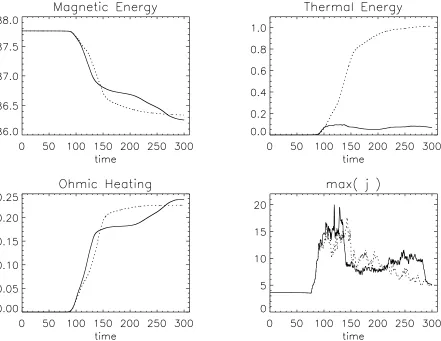
Fig. 1.Plots of the magnetic energy, thermal energy, Ohmic heating and the maximum current density as functions of time. The solid line is with thermal conduction and the dotted line is without conduction. The final dimensional values with thermal conductivity are 10.3 PJ for magnetic energy, 8.1 TJ for thermal energy, 28.3 TJ for Ohmic heating and 20 mA for max(j).
The resistivity is of the form η=ηb+
η0, |j| ≥ jc,
0, |j|< jc, (12)
whereηbis the uniform background resistivity andη0an
anoma-lous resistivity that comes into play only when the magnitude of the current exceeds the critical value jc = 5. Figure1 gives
the time evolution of max(j) in the simulation. It shows that at around time 80,η0switches on in the regions where|j| ≥ jcand
stays on for the duration of the simulation. This means thatη0is
activated as soon as the kink instability occurs in the simulation. Unless otherwise statedηb=0, so that only anomalous
resistiv-ity is applied. Gravresistiv-ity is set to zero and we ignore radiation.
2.2. Initial conditions
As in Hood et al. (2009), the initial state is chosen to be a force-free equilibrium unstable to an ideal MHD kink instability. Hence the magnetic field satisfies the equation
∇ ×B=α(r)B. (13)
The equilibrium is a modification of the model described by Browning and Van der Linden (2003) and consists of two re-gions. Forr<1 we have
Bθ = λr(1−r2)3,
Bz =
1−λ
2
7 + λ2
7 (1−r
2)7−λ2r2(1−r2)6, (14)
α = 2λ Bz (1−r
2)2(1−4r2),
and forr≥1 Bθ = 0, Bz =
1−λ
2
7 , (15)
α = 0. (16)
This magnetic field ensures thatαhas a sign change atr=0.5. The requirement thatB2
z > 0 restricts the values of λ, so that
λ <64/965√1351=2.438. The simulation results presented in this paper were obtained with a value ofλ=1.8. The initial den-sity and temperature are chosen to be constant. The normalised density equals 1, while the normalised temperature correspond to 104K. Hence the initial coronal atmosphere is assumed cold
and fixed at a temperature corresponding to the upper chromo-sphere or low transition region.
2.3. Numerical procedure
yboundaries are reflective, while line-tied boundaries are em-ployed at thezboundaries. This means that at the loop ends the velocity is held zero and the temperature is fixed at 104K, the
value of the initial background temperature, while the tempera-ture gradient is allowed to vary. Hence, there will be a heat flux across the ends of the loop. Ideally a transition region should be included at thezboundaries, with the boundary temperature fixed to chromospheric values. However, the 3D model used here would not be able to resolve the temperature gradients with real-istic optically thin radiation. Also, this paper considers the heat-ing process through nanoflares and relaxation, which result in a smaller heat flux through the boundary than is the case for large flares.
The initial equilibrium condition is a loop of normalised ra-dius 1, so that the aspect ratio of the initial cylinder is 20, similar to Browning & Van der Linden (2003), Browning et al. (2008) and Hood et al. (2009). Each simulation was run with grid reso-lutions 1282×256 and 2562×512. Similar results are obtained
with the two resolutions, with more fine structure shown in the higher resolution. We have tested the numerical result by using a lower resolution, which also gave qualitatively similar results. The thermal conduction term in Eq. (4) is treated implicitly. This is done by a parallel, red-black ordered, SOR scheme with an over-relaxation parameter of 1.6. Iteration is stopped when the mean fractional error in the temperature is 10−3. The largest
local temperature errors are of order 1%. Since the plasma re-mains predominantly lowβ, increasing the accuracy of the SOR routine through more iterations has little effect on the solution. A maximum allowable error of 1% in temperature was chosen to balance runtime with accuracy.
3. Simulation results
The results presented in this paper were obtained by using the normalisationL0 =106m,B0 =5×10⁻³ T, i.e. 50 Gauss, and
ρ0=1014×1.6726×10−27=1.6726×10⁻¹³kg m−3. This leads
to a time normalisation oft0=0.09 s and a temperature
normal-isation ofT0 = 1.44×10¹⁰ K. When another normalisation is
used, it will be clearly stated.
3.1. Global energy budget
The overall picture of heating due to the kink instability in a coronal loop is that the kink instability drives magnetic field into a current sheet. Here it reconnects releasing energy until the kink instability, and subsequent motion, relaxes the loop to a stable configuration. Since the drive for the magnetic energy release is an unstable magnetic field configuration and the plasmaβis low in the corona, the plasma thermal pressure is not expected to play a dominant role in the magnetic energy release. This is con-firmed in Fig.1which shows the magnetic energy released both with and without thermal conduction. The coronal plasma has a low plasmaβ, so that magnetic processes dominate the physics. The current density is calculated from the deformation of the magnetic field through Eq. (6), so that its evolution is similar with and without thermal conductivity. As a result, the Ohmic heating in the coronal loop is not very sensitive to the inclusion of thermal conductivity.
Figure1shows that the magnetic energy of the simulations with and without thermal conductivity do not have the same value at the end of the simulations. The final magnetic field will depend on the final thermal pressure and, if the thermal pressure is non-uniform, the resulting magnetic field will not be
potential. Since the final thermal pressure is higher for the case without thermal conduction, the final magnetic energy will be subsequently larger. Obviously, if the magnetic field configura-tions tend to a potential final state, then both cases will converge to the same value, but this only happens after a much longer time.
Thermal energy is almost an order of magnitude lower when thermal conduction is included. The heat is transported along the magnetic field lines away from the points where magnetic reconnection heats the plasma. The field lines are tied to the top and bottomzboundaries, which means that energy escapes the numerical domain through these two planes.
It is instructive to separate the total kinetic energy into com-ponents parallel and perpendicular to the local magnetic field: m
2 u·u= m 2
v2
+v2⊥
. (17)
The total kinetic energy is lower when thermal conduction is included. Figure2 shows that this is because the contribution of parallel kinetic energy is reduced while the perpendicular ki-netic energy remains of comparable size to that without thermal conduction. Without thermal conductivity a reconnection event increases the local temperature, which means the local pressure increases. This drives parallel flows. The dominant source of the perpendicular kinetic energy is from the kink instability itself and is thus driven by the unstable magnetic field. When parallel thermal conductivity is included, thermal energy is transported away from the reconnection site along field lines. This has the effect of reducing both the maximum pressure and the pressure scale length along a field line. This reduces the parallel flow, which leads to lower parallel kinetic energy. In contrast, since the plasma is lowβthere is little change in the MHD instabil-ity, so that the kinetic energy perpendicular to the magnetic field lines stay of the same order.
3.2. Temperature evolution
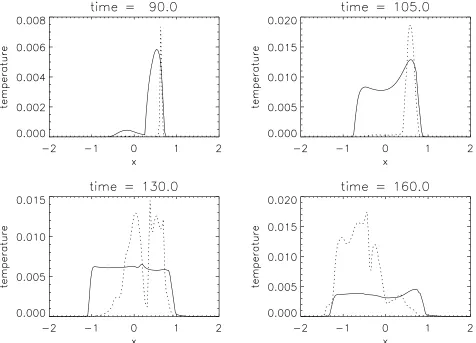
Figure3 shows profiles of the temperature along a line across the middle of the coronal loop. Plotted are the results with and without conduction. Note that the results with thermal conduc-tion have been multiplied by 10 to fit on the same scale. The results with conduction have a peak temperature that is an or-der of magnitude lower than when thermal conduction is not included. The reason for this is the more effective temperature transport along magnetic field lines when thermal conductivity is included. Figure4shows the temperature profile along mag-netic field lines. At time 100 the kink instability has triggered reconnection and the temperature has risen at the reconnection sites. In the simulation without thermal conductivity the temper-ature rise is extremely localised, while for the case with thermal conductivity the high temperature has spread along the magnetic field lines that pass through the reconnection site. At time 125, both cases show that the higher temperature has spread along the magnetic field lines passing through the reconnection site. However, in the case without thermal conductivity the high tem-perature is still much more localised than is the case with thermal conductivity.
Fig. 2.Plots of the total kinetic energy, as well as its parallel and per-pendicular components. These are calculated usingu = u⊥+u. The solid line is with thermal conduction and the dotted line is without con-duction. With thermal conductivity, the maximum value of the dimen-sional kinetic energy is 5.828 TJ for the total kinetic energy at time 118, 0.299 TJ for the parallel and 5.542 TJ for the perpendicular components.
plasma will have a higher pressure that will drive flows, reducing the temperature.
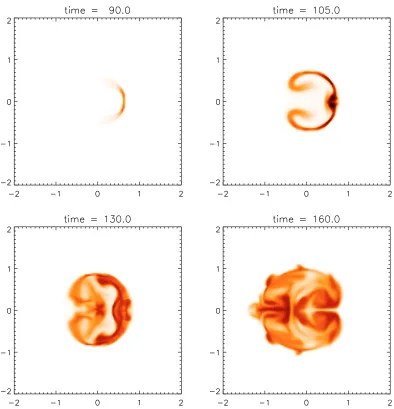
The temperature profile is also more diffuse when thermal conduction is included. This can be seen more clearly in the filled contour plots of Figs.5and6. The reduction in the peak
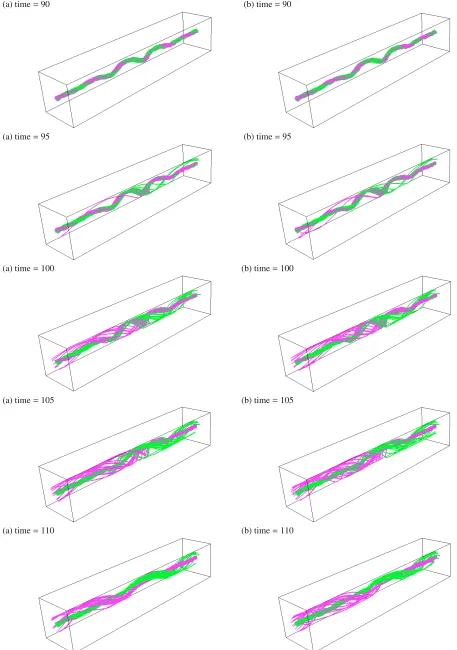
temperature is easily explained due to thermal conduction along field lines. It is important to note that the spreading of tem-perature across the loop cross-section is not due to cross-field thermal diffusion. In the central plane of the loop cross-section the magnetic field is predominantly perpendicular to this plane, so parallel thermal conduction is also predominantly out of the plane presented in Figs.5and6. This apparent cross-field ther-mal diffusion is a result of the combination of parallel thermal conduction and reconnection. As shown in Fig.7, reconnection untwists the unstable initial field configuration. Reconnection occurs along the loop length and not just in thez = 0 plane. Thus att = 105, for example, the primary reconnection site in thez=0 plane is atr0.6, as can be seen from the results with-out thermal conduction (Fig.5). Att=105, Fig.7shows that as a result of reconnection, points insider0.6 in thez=0 plane are now connected by field lines to ther0.6 reconnection sites at other locations along the loop. Since thermal conduction en-hances energy transport along magnetic field lines, the heating at other axial locations at aroundr 0.6 is conducted to posi-tions of radius less than 0.6 in thez=0 plane. Thus the apparent cross-field thermal diffusion in Figs.5and6is actually the re-sult of parallel thermal conduction from other locations along the loop.
Figure7shows that magnetic reconnection occurs with and without the inclusion of thermal conduction. Individual field lines may be traced to different locations, but overall there is little difference between the results with or without thermal con-duction. This is expected, given that the plasmaβis very low and magnetic field evolution is therefore largely insensitive to the thermal structure of the loop.
The relaxation of magnetic field lines by the end of the sim-ulations do not exactly match the final state predicted by relax-ation theory (also seen in Hood et al.2009), which can be helical, but the energy released during the kink instability is very close to that predicted by the theory. Given time, the plasma would reach the final relaxed state, but only very slowly.
With the difference in temperature, there is also a difference in the plasmaβbetween the two cases. Without conduction the higher localised heating leads to a maximum plasmaβof 0.1 (at time 105). With thermal conduction the maximum plasmaβis 8×10⁻³.
3.3. Temperature isosurfaces
Figure 3 shows that the temperature maxima decreases when thermal conductivity is included. This has observational conse-quences in that different spectral lines are activated at different temperatures. The predictable observational signatures of for-ward models (Arber et al. 1999; Haynes & Arber 2007) are highly dependent on whether thermal conductivity is included or not. In order to obtain observational signatures, the tempera-ture and density must be fed through the instrumental response functions of the various observational platforms. This is beyond the scope of the present paper.
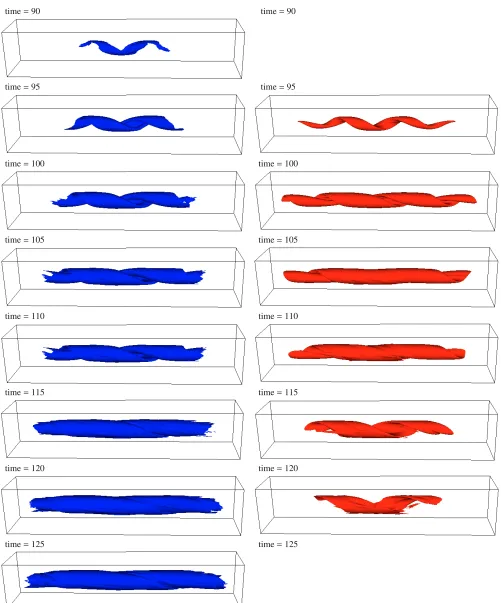
When parallel thermal conduction is included, the heat is conducted along the magnetic field lines away from the local heating source, so that the plasma takes longer to reach high temperatures. This is illustrated in Fig.8, where isosurfaces for a normalised temperature of 7.5×10⁻⁴are presented. The thermal
[image:5.595.52.283.73.632.2]Fig. 3.Normalised temperature profiles along thexdirection at positiony=0 andz=0. The solid line is with thermal conduction and the dotted line is without conduction. The temperature obtained with conduction has been multiplied by 10.0 to fit on the same scale as the dotted line. The dimensional values of the maximum temperature with thermal conduction are 8.42 MK at time 90, 18.39 MK at time 105, 9.49 MK at time 130, and 6.73 MK at time 160.
(a) time=100 (b) time=100
[image:6.595.47.554.494.629.2](a) time=125 (b) time=125
Fig. 4.Magnetic field lines showing the temperature along them in colour. Results without thermal conduction are labelled (a) and with thermal conduction (b). Note that the colour scale is different for the two cases: red denotes a normalised temperature of 0.02 for (a) and 0.008 for (b). These represent dimensional temperature values of 288.2 MK and 115.3 MK respectively. In both cases blue denotes a normalised temperature of values below 10−5, or equivalently 0.1 MK.
during which this temperature isosurface exists, as is evident at time 120 in Fig.8.
Table 1 shows the lifetime of different isosurfaces for the simulations with thermal conduction included. Here the life-times are presented in units of normalised time. The tem-peratures of each isosurface are all reached at approximately the same time (t 80). Without thermal conduction these
Fig. 5.Temperature in the plane perpendicular to thez axis at positionz = 0. The temperature was measured for the case without thermal conduction. The colour scale gives white as the initial temperature and dark as max(T) =2.55×10⁻² (dimensional temperature 367.42 MK),
[image:7.595.75.256.558.648.2]which is obtained at time 105. The dotted line in Fig.3shows the data along a cut through the centre of the plane along thexdirection.
Table 1.Duration of temperature isosurface visibility.
Normalised temperature Normalised time (dimensional temperature)
1.1×10⁻³ (15.8 MK) 13
7.5×10⁻⁴ (10.8 MK) 31
5.0×10⁻⁴ (7.2 MK) 55
4.0×10⁻⁴ (5.8 MK) 76
2.0×10⁻⁴ (2.9 MK) Visible at 300
1.0×10⁻⁴ (1.4 MK) Visible at 300
Notes.Time during which temperature isosurfaces are visible for sim-ulations with thermal conductivity. The time normalisation is t0 =
0.09 s. The isosurfaces of temperature 7.5×10⁻⁴ (dimensional value
of 10.8 MK ) are presented in Fig.8. In all cases the isosurface is first visible at normalised time80. The simulations ended att=300. For the simulation without thermal conduction all these isosurfaces are vis-ible up tot=300.
3.4. The influence of the normalisation
The choice of normalisation parametersB0,ρ0andL0are
unim-portant for resistive MHD, i.e. the equations can be solved in
normalised form and values for B0, ρ0 and L0 specified
ar-bitrarily. This is not true for simulations that include thermal conductivity, as this uses the real, physical value for parallel thermal conductivity, as shown in (11). Therefore, testing the effect of thermal conductivity on other loops involves new sim-ulations with different choices forB0,ρ0andL0. For this test we
have deliberately chosen values to minimise the effect of ther-mal conductivity. By reducingB0the magnetic energy released
is reduced and by increasingρ0 the heat input from the
mag-netic energy release generates a lower temperature. Specifically, we have chosen L0 = 106 m, B0 = 2 ×10⁻³ T and ρ0 =
1.67×10⁻¹²kg m−3. The results are presented in Fig.9. In this
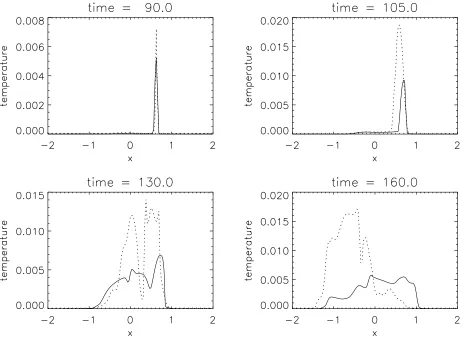
case the temperature with thermal conduction is half that which is obtained without thermal conduction. Even in this extreme case, in the sense of weak field and high density, one can see the effect of thermal conduction.
Fig. 6.Temperature on the plane perpendicular to thezaxis at positionz=0. The temperature was measured for the case with thermal conduction. The colour scale is the same as in Fig.5. The solid line in Fig.3shows the data along a cut through the centre of the plane along thexdirection. As in Fig.3, the temperature was multiplied by 10.0 to fit on the same scale as Fig.5.
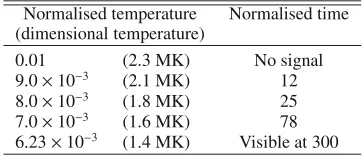
Table 2.Table1with the normalisation of Sect.3.4.
Normalised temperature Normalised time (dimensional temperature)
0.01 (2.3 MK) No signal 9.0×10⁻³ (2.1 MK) 12
8.0×10⁻³ (1.8 MK) 25
7.0×10⁻³ (1.6 MK) 78
6.23×10⁻³ (1.4 MK) Visible at 300
Notes. Repetition of results in Table1, but for normalisation L0 =
106 m,B
0 = 2×10⁻³ T andρ0 = 1.67×10⁻¹²kg m−3. In this case
the time normalisation ist0 = 0.7 s. This normalisation is discussed
in Sect.3.4. No signal exists at temperature 0.01 (dimensional tempera-ture 2.31 MK) or hotter. In all other cases the isosurface is first visible at normalised time100. For the simulation without thermal conduction all these isosurfaces are visible up tot=300.
4. Conclusions
This paper presents results assessing the importance of thermal conduction in simulations, and hence forward modelling, of kink unstable coronal loops. Since the real thermal conductivity is
used, the results are sensitive to the physical parameters of the loop and two loops have been tested. The first assumed a typical magnetic field strength of 50 G and an electron number density ofne = 1014 m−3. To minimise the effects of conduction, the
second loop had a magnetic field strength of 20 G and an electron number density ofne =1015 m−3. These loops will be referred
to as the high field and low field loops respectively. From these simulations the main conclusions are:
– For the high field loop thermal conduction reduces the max-imum temperature by an order of magnitude compared to simulations with no conduction. For the low field loop the reduction is by a factor of two.
– For both loops there are clear differences in the time history of temperature isosurfaces when thermal conduction is in-cluded, which affect temperature sensitive observations. – Thermal conduction affects the evolution even during the
rapid MHD timescale of the kink instability. It reduces the parallel kinetic energy, i.e.v2
[image:8.595.74.255.556.634.2](a) time=90 (b) time=90
(a) time=95 (b) time=95
(a) time=100 (b) time=100
(a) time=105 (b) time=105
[image:9.595.71.528.76.726.2](a) time=110 (b) time=110
time=90 time=90
time=95 time=95
time=100 time=100
time=105 time=105
time=110 time=110
time=115 time=115
time=120 time=120
[image:10.595.46.547.69.672.2]time=125 time=125
Fig. 8.Isosurfaces of the normalised temperatureT=7.5×10⁻⁴, with the blue isosurfaces (left hand column) obtained without thermal conduction
and the red isosurfaces (right hand column) with thermal conduction. At times 90 and 125 for the case with thermal conduction there is no plasma at this temperature and hence no isosurface is shown.
pressure gradient along the field and hence lead to a reduc-tion of sound wave generareduc-tion and flows along the field.
Fig. 9.Temperature profiles along thexdirection at positiony =0 andz =0. The solid line is with thermal conduction and the dotted line is without conduction. These results were obtained with the normalisationL0=106m,B0=2×10⁻³T andρ0=1.67×10⁻¹²kg m−3. This leads to
a time normalisation oft0=0.7 s and a temperature normalisation ofT0=2.31×10⁸K. Without thermal conduction the result is independent of
the normalisation used, as can be seen when compared to Fig.3. The dimensional values of max(T) with thermal conduction are 1.92 MK at time 90, 2.12 MK at time 105, 1.57 MK at time 130, and 1.46 MK at time 160.
signatures of kink unstable coronal loops must include parallel thermal conduction. This will be true for all MHD phenomena in the corona where magnetic energy is converted into thermal energy. Note however, that our model uses the Braginskii paral-lel thermal conduction, which is only valid for short mean free paths, compared to macroscopic lengths and near Maxwellian distributions. These results cannot therefore be directly applied to large flares where significant non-thermal electron popula-tions are generated.
Acknowledgements. This work was funded in part by the Science and Technology Facilities Council. The computational work was supported by re-sources made available through Warwick University’s Centre for Scientific Computing.
References
Arber, T. D., Longbottom, A. W., & Van der Linden, R. A. M. 1999, ApJ, 517, 990
Arber, T. D., Longbottom, A. W., Gerrard, C. L., & Milne, A. M. 2001, J. Comput. Phys., 171, 151
Arber, T. D., Haynes, M., & Leake, J. E. 2007, ApJ, 666, 541 Aschwanden, M. J., & Parnell, C. E. 2002, ApJ, 572, 1048
Bell, A. R., Evans, R. G., & Nicholas, D. J. 1981, Phys. Rev. Lett., 46, 243 Browning, P. K., & Van der Linden, R. A. M. 2003, A&A, 400, 355
Browning, P. K., Gerrard, C., Hood, A. W., Kevis, R., & Van der Linden, R. A. M. 2008, A&A, 485, 837
Gerrard, C. L., Hood, A. W., & Brown, D. S. 2004, Sol. Phys., 222, 79 Grappin, R., Aulanier, G., & Pinto, R. 2008, A&A, 490, 353 Haynes, M., & Arber, T. D. 2007, A&A, 467, 327
Hood, A. W. 1990, Comp. Phys. Rep., 12, 177
Hood, A. W., Van der Linden, R. A. M., & Goossens, M. 1989, Sol. Phys., 120, 261
Hood, A. W., Browning, P. K., & Van der Linden, R. A. M. 2009, A&A, 506, 913
Iida, Y., Yokoyama, T., & Ichimoto, K. 2010, ApJ, 713, 325
Jess, D. B., Mathioudakis, M., Browning, P. K., Crockett, P. J., & Keenan, F. P. 2010, ApJ, 712, L111
Kálmán, B. 2001, A&A, 371, 731 Lites, B. W. 2009, Space Sci. Rev., 144, 197 Parker, E. N. 1988, ApJ, 330, 474
Schrijver, C. J. 2009, Adv. Space Res., 43, 739
Soler, R., Oliver, R., & Ballester, J. L. 2008, ApJ, 684, 725 Spitzer, L., & Härm, R. 1953, Phys. Rev., 89, 977
Torricelli-Ciamponi, G., Ciampolini, V., & Chiuderi, C. 1987, J. Plasma Phys., 37, 175