Bioelectronic Medicine
Electrochemically Stimulating Developments in Bioelectronic Medicine
--Manuscript
Draft--Manuscript Number: BEME-D-18-00001
Full Title: Electrochemically Stimulating Developments in Bioelectronic Medicine
Article Type: Review
Funding Information: Engineering and Physical Sciences Research Council
(EP/K005138/1)
Dr. Richard J M Hague
Abstract: Cellular homeostasis is in part controlled by biological generated electrical activity. By interfacing biology with electronic devices this electrical activity can be modulated to actuate cellular behaviour. There are current limitations in merging electronics with biology sufficiently well to target and sense specific electrically active components of cells. By addressing this limitation, researchers give rise to new capabilities for facilitating the two-way transduction signalling mechanisms between the electronic and cellular components. This is required to allow significant advancement of bioelectronic technology which offers new ways of treating and diagnosing diseases. Most of the progress that has been achieved to date in developing bioelectronic therapeutics stimulate neural communication, which ultimately orchestrates organ function back to a healthy state. Some devices used in therapeutics include cochlear and retinal implants and vagus nerve stimulators. However, all cells can be effected by electrical inputs which gives rise to the opportunity to broaden the use of bioelectronic medicine for treating disease. Electronic actuation of non-excitable cells has been shown to lead to 'programmed' cell behaviour via application of electronic input which alter key biological processes. A neglected form of cellular electrical communication which has not yet been considered when developing bioelectronic therapeutics is faradaic currents. These are generated during redox reactions. A precedent of electrochemical
technology being used to modulate these reactions thereby controlling cell behaviour has already been set. In this mini review we highlight the current state of the art of electronic routes to modulating cell behaviour and identify new ways in which
electrochemistry could be used to contribute to the new field of bioelectronic medicine.
Corresponding Author: Frankie J Rawson
University of Nottingham School of Pharmacy UNITED KINGDOM
Corresponding Author Secondary Information:
Corresponding Author's Institution: University of Nottingham School of Pharmacy Corresponding Author's Secondary
Institution:
First Author: Paola Sanjuan-Alberte
First Author Secondary Information:
Order of Authors: Paola Sanjuan-Alberte
Morgan R Alexander Richard J M Hague Frankie J Rawson Order of Authors Secondary Information:
Electrochemically Stimulating Developments in
Bioelectronic Medicine
Paola Sanjuan-Alberte,a,b Morgan R. Alexander,c Richard J. M. Hague,b Frankie J. Rawson*,a
a Regenerative Medicine and Cellular Therapies, School of Pharmacy, University of Nottingham, NG7 2QL, UK b Centre for Additive Manufacturing, School of Engineering, University of Nottingham, Nottingham, NG7 2QL, UK
c Advanced Materials and Healthcare Technologies, School of Pharmacy, University of Nottingham, Nottingham, NG7 2QL, UK
*Email: [email protected]
Abstract
Cellular homeostasis is in part controlled by biological generated electrical activity. By
interfacing biology with electronic devices this electrical activity can be modulated to
actuate cellular behaviour. There are current limitations in merging electronics with biology
sufficiently well to target and sense specific electrically active components of cells. By
addressing this limitation, researchers give rise to new capabilities for facilitating the
two-way transduction signalling mechanisms between the electronic and cellular components.
This is required to allow significant advancement of bioelectronic technology which offers
new ways of treating and diagnosing diseases. Most of the progress that has been achieved
to date in developing bioelectronic therapeutics stimulate neural communication, which
ultimately orchestrates organ function back to a healthy state. Some devices used in
therapeutics include cochlear and retinal implants and vagus nerve stimulators. However,
all cells can be effected by electrical inputs which gives rise to the opportunity to broaden
the use of bioelectronic medicine for treating disease. Electronic actuation of non-excitable
cells has been shown to lead to ‘programmed’ cell behaviour via application of electronic
input which alter key biological processes. A neglected form of cellular electrical
communication which has not yet been considered when developing bioelectronic
therapeutics is faradaic currents. These are generated during redox reactions. A precedent
of electrochemical technology being used to modulate these reactions thereby controlling
cell behaviour has already been set. In this mini review we highlight the current state of
Manuscript Click here to download Manuscript Bioelectronic Medicine
final_fjr4.docx Click here to view linked References
the art of electronic routes to modulating cell behaviour and identify new ways in which
electrochemistry could be used to contribute to the new field of bioelectronic medicine.
Keywords: bioelectronic interfaces, bioelectrochemistry, nanobioelectronics, cellular
signalling
The biological impact of cellular electrical activity
Bioelectronic medicine is classically conceptualised as electronic technology that merges
with neurons enabling control of cellular electrical communication and the underlying
organ function. Electrical communication that is mediated by neurons is the body’s
universal fast electrical communication system that orchestrates organ function at a macro
level. The underlying principles of the body’s electrical communication system, from a
traditional point of view, originates from the controlled bulk movement of ions across the
plasma membrane of cells. This enables the establishment and modulation of membrane
potentials and in doing so, produces an electrochemical potential gradient that can drive
bulk charge movement. The movement of charges across the membrane lead to action
potentials, which represent a major electrical communication route in muscle cells,
neurons and endocrine cells (1). Other function of the membrane potential is the transport
of molecules across it induced by the translocation of charges, or electrogenic transport.
This includes the transport of molecules such as glucose, ATP and small peptides involved
in a plethora of physiological roles (2-5).
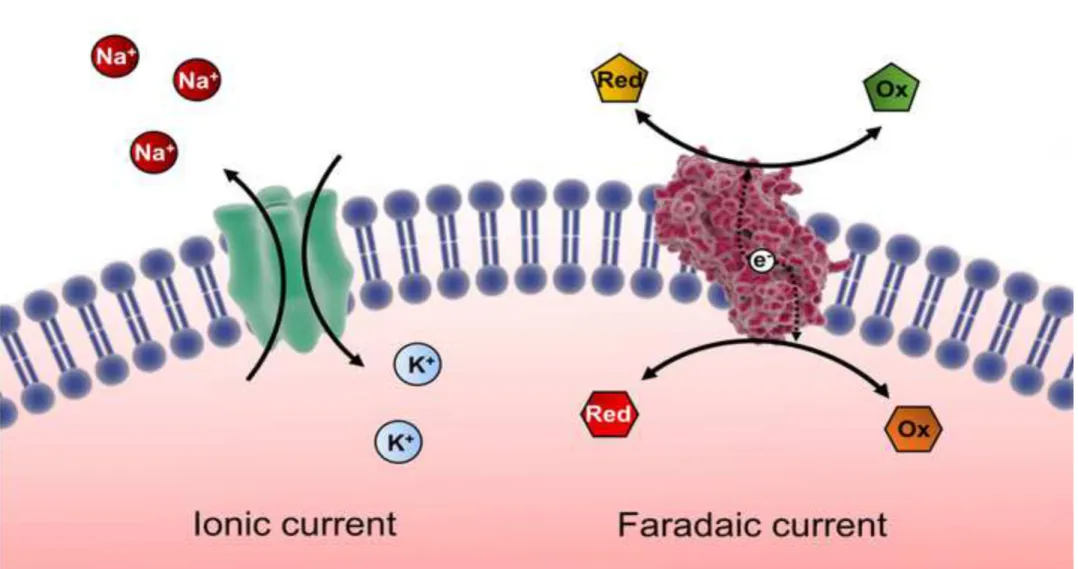
Importantly, all cells also use faradaic currents among other communication routes (6) to
communicate with one another and are vital for maintaining homeostasis. Biochemical
processes that result in the production of faradaic current, which is defined as the
movement of electrons, are generated in redox reactions. In order for redox reactions to
happen, an exchange of electrons between two biochemical entities, an electron donor and
an electron acceptor, needs to be produced (Figure 1). Faradaic currents are reliant on 1
naturally occurring biological electrochemical mediators, which are defined as molecules
that readily accept or donate an electron(s), and some of the most well known and most
abundant are NADH, NADPH, GSH, Ascorbic acid, ubiquinone. Additionally,
bio-macromolecule such as enzymes (for example oxido-reductase) can also act as electron
shuttles.. Examples of faradaic signalling include the generation of oxidant sources within
the mitochondrial respiratory chain in response to bacterial infection or inflammation (7).
Additionally, all cells useframembrane electron transport systems to shuttle electrons
across membranes for a wide range of purposes. The electron transport via membrane
bound systems have been implicated in cell signalling, nutrient metabolism, cell redox
maintenance and can play an important role in disease such as cancer. Opportunities arise
when we substitute a biological electrochemical mediator, involved in generating electrical
faradaic current, with electrodes. This yields the ability to control redox events when
interfacing cells with electronics by modulating the electron flow in a specific biochemical
event via applied electrical potential stimulus, as a result leading to modulation of the
underlying biochemistry.
Despite their extensive use in cellular sensing, faradaic processes have been largely
neglected when considering bioelectronic methods of disease intervention. This largely
unexplored view of cellular electrical communication, from the perspective of developing
new bioelectronic devices, offers new opportunities in modulating cell state and therefore
underlying cells, tissues and organ function. The aim of this mini-review is to place into
context how this faradaic form of cellular electrical communication could be used to
develop bioelectronic medicine. In addition to detailing the early examples of such
technology that can interface with cells to both sense and modulate cell behaviour. 1
Development of bioelectronic therapies
The concept of bioelectronic medicine consists of merging biological systems with
electronic devices, allowing for the modulation of underlying cells, tissue and ultimately
organ function by regulating electrical communication. In order to achieve efficient
communication between biological and electronic systems, transduction of signals at the
cellular-electronic interface must be achieved (8). This has become a key challenge in
developing bioelectronics and is currently being explored to advance the development of
bioelectronic devices with therapeutic interest (9). An obstacle to this is that the building
blocks of cellular structures differ from those that can be found when constructing
electronics, meaning that the seamless integration of electronics with biology is not yet
possible. In addition, the plasticity of young nervous systems and tissues present a key
obstacle as implantable electronics cannot adapt and therefore need regularly servicing.
Advancement in manufacturing technology will aid solve this problem. For example,
additive manufacturing techniques are particularly appealing for the production of novel
three-dimensional bioelectronic tools, allowing a synergistic integration of electronic
components with the biological building blocks (10). This is due to their capability of
combining conductive materials and living cells in unique architectures, resulting in
functional devices (11, 12). Therefore, there are technical challenges which require
solutions, from physicists, chemists, engineers and biologists.
However, significant progress has been made with several electronic devices successfully
introduced as therapeutics aimed to palliate disabilities, and consequently become good
examples of an effective transduction of signals. Examples include known cochlear or
retinal implants where sound and light, respectively, are converted into electrical signals
that can be transmitted to the nervous system and interpreted by the patient’s brain (13,
14). 1
Stimulation of nerve fibres based on direct vagus nerve stimulation is also gaining interest
as a treatment of rheumatoid arthritis and metabolic syndrome (15-17) (Figure 2). This
therapeutic strategy demonstrates the influence of the nervous system over the different
biological functions and disease state. Further investigation in this regard can possibly
decode the neural circuits and how nerve stimulation correlates to the homeostatic state
of an organism, leading to new means of treating and diagnosing disease. Similar devices
based on the depolarisation of the sinus node to induce action potentials can be found for
excitation of cardiac cells in the therapy of heart failure and atrial fibrillation (18).
Currently electrical stimulation with these devices is unable to target cells individually,
inducing the excitation of the whole tissue. Due to the highly compact state of the nervous
and cardiac systems, indiscriminate stimulation can lead to undesirable effects or mire the
clinical outcomes. Application of inputs on specific cells would be beneficial to achieve a
fine degree of regulation. Advances in nanotechnology have contributed to the
development of structures such as nano-field effect transistors (nano-FETs) or nanowires
(NWs) capable of stimulate and record signals from individual cells, increasing the
prospects of targeting intracellular components (19, 20). It is therefore envisaged that
future advancements in this technology will aid in the development of bioelectronic
therapeutics aimed at increasing the selectivity and specificity of cellular control.
Reaching non-excitable cells
Cells that are unable to propagate action potentials, known as non-excitable cells, also
possess electrical properties and endogenous electric fields to direct growth or healing
(21). Interfacing these cells with electronic devices gives rise to new opportunities that 1
should allow for the control of cellular function. This natural bioelectric behaviour can be
organised and stimulated by applying electric currents that control the polarisation of the
membrane potential. This induced transmembrane potential can regulate the passage of
molecules and ions across it by, for instance, controlling Ca2+ and epidermal growth factor
receptor (EGFR) channels (22). Defective ion and molecular transport have implications
on diverse diseases such as cancer or pulmonary oedema (23, 24). Therefore, achieving
good degree of control of transport across the cellular membrane could have great
repercussions in the treatment of these diseases. Application of exogenous electric fields
has been demonstrated to be effective in both single cells and tissues, triggering a wide
range of biological actions (25) (Figure 3).
Due to the high resistance of the cellular membrane to current flow, ionic currents induced
by artificial external electric fields are forced to surround the cells, imposing a potential
gradient across the membrane surface. This potential gradient induces changes in function
and/or orientation of membrane proteins and opening of ionic channels, leading to
stimulation of intracellular signalling pathways (26). The signalling cascade alters
expression of genes which code for proteins involved in several biological functions
including cell division, migration, proliferation and embryogenesis.
The gap junctions between cells, which are channels connecting cellular cytoplasms, also
have an important role when applying electric fields in order to generate a response at a
tissue level. This slow communication route can amplify the intracellular signalling cascade
produced in response to the changes in the potential (21). Signals propagate through the
tissue, triggering a coordinated cellular response, for example to wound healing or tissue
regeneration. This approach has been introduced in the therapy of bone fracture healing 1
and osteoarthritis, stimulating the chondrocyte and osteoblast regeneration. As a result,
osteogenesis and increases on bone mineral density can be observed (27).
Cancer therapy can also be benefited from the use of electric fields. There have been many
studies reporting the differences in resting membrane potentials between tumour and
non-tumour cells. Generally it can be established that cells with a high proliferative activity
such as embryonic, stem and metastatic cells possess a depolarised membrane (28).
Metastatic phenotypes can be induced in healthy cells by depolarisation of their membrane
and conversely, the activity in a metastatic cell induced by oncogenes can be supressed
by preventing its depolarisation (21).
Additional research in this area will allow a deeper understanding of the precise
mechanisms involved, which may make it possible to program cellular activity via use of
electric fields. Importantly this broadens the prospective applications of bioelectronic
medicine beyond neural control.
Improving electronic targeting: an electrochemical approach
In order to create bioelectronic tools with such capabilities in cell programming, further
specificity on the cellular outputs is desirable. Biomolecular entities, including redox
biomolecules, are known to be highly specific as they represent a transfer system of
biological information. Therefore, controlling faradaic currents involved in cellular redox
reactions offers opportunities for the electrochemical mediated induced control of cells,
tissues and organ function.
The faradaic processes can be hijacked by modulation of polarity or by using
electrochemically active molecules. Electronic inputs are transduced into redox active 1
mediators that ultimately activate a biological mechanism (Figure 4). Biological
responses often correlates with the magnitude, frequency, and/or type of electronic input
applied (29), indicating that a fine degree of control can be achieved. For this reason, the
authors believe that bioelectrochemical devices with ability to control cell function and
disease state can be included in the field of bioelectronic medicine (30).
Figure 4. Transduction of signals on a bioelectrochemical system. An electronic input in
the form of potential modulates the redox state of naturally occurring electrochemical
mediators, from an inactive state to an active state or vice versa, and are communicated
to a cellular system triggering biological response (41).
Formation of effective interfaces between electrodes and cells is possible by engineering
the electrode surface at the nanoscale. This gives rise to potential for sensing and
controlling faradic processes and has been reviewed recently (31, 32). In general,
approaches to electrically ‘wire’ cell redox components rely on electrode modification with
conducting polymers (33), nanowires based on carbon nanofibers (34), carbon nanotubes
(35, 36) and electrocatalysts (37). This wiring can also be achieved via modification of
electrode surfaces with chemical entities that bond to the saccharide groups of the
eukaryotic cells that facilitate electron transfer (38). In addition, structures integrated with
biological components such as enzymes, lipid bilayers or antibodies are used to transduce
ions into electrical currents and vice-versa for recording and stimulation of biological
reactions in both intracellular and extracellular environments (39). For instance, electrodes
can be conjugated with neurotransmitters to induce neural excitability (40) or regulate pH
using protonic devices to control enzymatic function, and acid sensitive ion channels (39). 1
Future opportunities in directing cell behaviour electrochemically
Reactive oxygen species (ROS) may be used to direct cell function. ROS are involved in
signalling pathways that take part in several biological events associated to bacterial
infection and cancer. The production of ROS can be controlled by electrochemical
generation (37). Gene transcription can be induced in response to oxidative stress,
inducing cell motility or cell-to-cell communication (41). Therefore electrochemical control
of ROS generation may prove fruitful for directing cell behaviour.
Further development of bioelectrochemical devices may have great implications in future
cancer therapy by individually controlling plasma membrane electron transport systems
(tPMETs). The system of tPMET ferri-reductase is upregulated and it is thought to enable
faster rates of metabolism in cancer cells (30). Therefore, electrochemical tools with
capacity to control such systems may regulate metabolism and cellular development.
Conclusions
Bioelectronic medicine is a growing field where major advancements in treatment and
diagnosing of diseases are being achieved. Therapies based on neural stimulation and
application of electric fields are currently used to improve patient’s quality of life, but
additional control of the effects is still required.
The main challenges include creation of effective biological-electrical interfaces and
transduction of signals. In order to modulate the electron transfer events, an intimate
contact of the electronic component with the active sites is required. Therefore,
technological advancements in the interfacing of electronics with such active sites are
necessary to fully integrate biological systems and electronic devices. 1
Further specificity can also be achieved by controlling redox biomolecules and the
biological output with great precision, adding new proportions to the bioelectronic medicine
field. However, bioelectrochemical therapies still require a multidisciplinary approach to
produce less invasive techniques, e.g. using wireless systems. In order to achieve this,
development of nanotechnology, materials and new methodologies will greatly contribute
to this field offering new therapeutic tools.
A more thorough understanding and controlled targeted stimulation of vagus nerve, in
addition to ROS production could be used to control of inflammatory mediators that take
part in diseases such as artherosclerosis, pulmonary fibrosis, Parkinson’s disease and
Alzheimer’s disease. Cancer therapy can also be impacted by development of
bioelectrochemical systems to direct tPMET activity, regulating cellular behaviour.
It can thus be concluded that this field has many open paths and offers many exciting
approaches and research opportunities that will contribute to create great impact over the
future medicine and pharmacology.
Declarations
Ethics approval and consent to participate
Not applicable.
Consent for publication
Not applicable.
Availability or data and material 1
Data sharing is not applicable to this article as no datasets were generated or analysed
during the current study.
Competing interests
The authors declare that they have no competing interests
Funding
This work was supported by the Engineering and Physical Sciences Research Council
(EP/K005138/1).
Authors’ contributions
PSA and FJR wrote the manuscript. All authors read, commented and approved the final
manuscript.
Authors’ information
Not applicable
Acknowledgements
The University of Nottingham is thanked for funding Dr. Rawson’s Nottingham Research
Fellowship.
References
1.
Loewenstein WR:
Junctional intercellular communication: the cell-to-cell membrane
channel
.
Physiol Rev
1981,
61
(4):829-913.
2.
Sundelacruz S, Levin M, Kaplan DL:
Role of Membrane Potential in the Regulation of Cell
Proliferation and Differentiation
.
Stem Cell Rev Rep
2009,
5
(3):231-246.
3.
Rothbard JB, Jessop TC, Lewis RS, Murray BA, Wender PA:
Role of membrane potential and
hydrogen bonding in the mechanism of translocation of guanidinium-rich peptides into
cells
.
J Am Chem Soc
2004,
126
(31):9506-9507.
4.
van Horssen J, Bo L, Vos CM, Virtanen I, de Vries HE:
Basement membrane proteins in
multiple sclerosis-associated inflammatory cuffs: potential role in influx and transport of
leukocytes
.
J Neuropathol Exp Neurol
2005,
64
(8):722-729.
5.
Franco R, Bortner CD, Cidlowski JA:
Potential roles of electrogenic ion transport and plasma
membrane depolarization in apoptosis
.
J Membr Biol
2006,
209
(1):43-58.
6.
Boyd AW, Bartlett PF, Lackmann M:
Therapeutic targeting of EPH receptors and their
ligands
.
Nat Rev Drug Discov
2014,
13
(1):39.
7.
Holmstrom KM, Finkel T:
Cellular mechanisms and physiological consequences of
redox-dependent signalling
.
Nat Rev Mol Cell Biol
2014,
15
(6):411-421.
8.
Carrad DJ, Mostert AB, Ullah AR, Burke AM, Joyce HJ, Tan HH, Jagadish C, Krogstrup P,
Nygård J, Meredith P:
Hybrid nanowire ion-to-electron transducers for integrated
bioelectronic circuitry
.
Nano Lett
2016.
9.
Zhang A, Lieber CM:
Nano-Bioelectronics
.
Chem Rev
2016,
116
(1):215-257.
10.
Kong YL, Gupta MK, Johnson BN, McAlpine MC:
3D Printed Bionic Nanodevices
.
Nano Today
2016,
11
(3):330-350.
11.
Ladd C, So J, Muth J, Dickey MD:
3D printing of free standing liquid metal microstructures
.
Adv Mater
2013,
25
(36):5081-5085.
12.
Mannoor MS, Jiang Z, James T, Kong YL, Malatesta KA, Soboyejo WO, Verma N, Gracias DH,
McAlpine MC:
3D printed bionic ears
.
Nano Lett
2013,
13
(6):2634-2639.
13.
Heiduschka P, Thanos S:
Implantable bioelectronic interfaces for lost nerve functions
.
Prog
Neurobiol
1998,
55
(5):433-461.
14.
Humayun MS, de Juan E, Jr., Dagnelie G:
The Bionic Eye: A Quarter Century of Retinal
Prosthesis Research and Development
.
Ophthalmology
2016,
123
(10S):S89-S97.
15.
Pavlov VA, Tracey KJ:
The vagus nerve and the inflammatory reflex--linking immunity and
metabolism
.
Nat Rev Endocrinol
2012,
8
(12):743-754.
16.
Koopman FA, Chavan SS, Miljko S, Grazio S, Sokolovic S, Schuurman PR, Mehta AD, Levine
YA, Faltys M, Zitnik RJ:
Vagus nerve stimulation inhibits cytokine production and
attenuates disease severity in rheumatoid arthritis
.
Proc Natl Acad Sci
2016,
113
(29):8284-8289.
17.
Famm K, Litt B, Tracey KJ, Boyden ES, Slaoui M:
Drug discovery: A jump-start for
electroceuticals
.
Nature
2013,
496
(7444):159-161.
18.
Dobrzynski H, Boyett MR, Anderson RH:
New insights into pacemaker activity
.
Circulation
2007,
115
(14):1921-1932.
19.
Xie C, Liu J, Fu T, Dai X, Zhou W, Lieber CM:
Three-dimensional macroporous nanoelectronic
networks as minimally invasive brain probes
.
Nat Mater
2015,
14
(12):1286-1292.
20.
Gao R, Strehle S, Tian B, Cohen-Karni T, Xie P, Duan X, Qing Q, Lieber CM:
Outside looking in:
Nanotube transistor intracellular sensors
.
Nano Lett
2012,
12
(6):3329-3333.
21.
Levin M:
Molecular bioelectricity: how endogenous voltage potentials control cell behavior
and instruct pattern regulation in vivo
.
Mol Biol Cell
2014,
25
(24):3835-3850.
22.
Li Y, Xu T, Chen X, Lin S, Cho M, Sun D, Yang M:
Effects of direct current electric fields on
lung cancer cell electrotaxis in a PMMA-based microfluidic device
.
Anal Bioanal Chem
2017,
409
(8):2163-2178.
23.
Prevarskaya N, Skryma R, Shuba Y:
Ion channels and the hallmarks of cancer
.
Trends Mol
Med
2010,
16
(3):107-121.
24.
Hollenhorst MI, Richter K, Fronius M:
Ion transport by pulmonary epithelia
.
J Biomed
Biotechnol
2011,
2011
:174306.
25.
Chang F, Minc N:
Electrochemical control of cell and tissue polarity
.
Annu Rev Cell Dev Biol
2014,
30
:317-336.
26.
Yao L, Li Y:
The role of direct current electric field-guided stem cell migration in neural
regeneration
.
Stem Cell Rev Rep
2016,
12
(3):365-375.
27.
Maziarz A, Kocan B, Bester M, Budzik S, Cholewa M, Ochiya T, Banas A:
How
electromagnetic fields can influence adult stem cells: positive and negative impacts
.
Stem
Cell Res Ther
2016,
7
(1):54.
28.
Binggeli R, Weinstein RC:
Membrane potentials and sodium channels: hypotheses for
growth regulation and cancer formation based on changes in sodium channels and gap
junctions
.
J Theor Biol
1986,
123
(4):377-401.
30.
Rawson FJ:
New dimensions in controlling cellular function with electroceutics
.
Ther Deliv
2015,
6
(1):5-8.
31.
Du J, Catania C, Bazan GC:
Modification of abiotic–biotic interfaces with small molecules
and nanomaterials for improved bioelectronics
.
Chem Mater
2013,
26
(1):686-697.
32.
Ajo‐Franklin CM, Noy A:
Crossing over: nanostructures that move electrons and ions across
cellular membranes
.
Adv Mater
2015,
27
(38):5797-5804.
33.
Saboe PO, Conte E, Chan S, Feroz H, Ferlez B, Farell M, Poyton MF, Sines IT, Yan H, Bazan GC:
Biomimetic wiring and stabilization of photosynthetic membrane proteins with block
copolymer interfaces
.
J Mater Chem A
2016,
4
(40):15457-15463.
34.
Rawson FJ, Cole MT, Hicks JM, Aylott JW, Milne WI, Collins CM, Jackson SK, Silman NJ,
Mendes PM:
Electrochemical communication with the inside of cells using micro-patterned
vertical carbon nanofibre electrodes
.
Sci Rep
2016,
6
:37672.
35.
Rawson FJ, Yeung CL, Jackson SK, Mendes PM:
Tailoring 3D single-walled carbon nanotubes
anchored to indium tin oxide for natural cellular uptake and intracellular sensing
.
Nano
Lett
2012,
13
(1):1-8.
36.
Gooding JJ, Wibowo R, Liu J, Yang W, Losic D, Orbons S, Mearns FJ, Shapter JG, Hibbert DB:
Protein electrochemistry using aligned carbon nanotube arrays
.
J Am Chem Soc
2003,
125
(30):9006-9007.
37.
Rawson FJ, Hicks J, Dodd N, Abate W, Garrett DJ, Yip N, Fejer G, Downard AJ, Baronian KHR,
Jackson SK:
Fast, ultrasensitive detection of reactive oxygen species using a carbon
nanotube based-electrocatalytic intracellular sensor
.
ACS Appl Mater Inter
2015,
7
(42):23527-23537.
38.
Stephenson-Brown A, Yong S, Mansor MH, Hussein Z, Yip NC, Mendes PM, Fossey JS,
Rawson FJ:
Electronic communication of cells with a surface mediated by boronic acid
saccharide interactions
.
Chem Comm
2015,
51
(97):17213-17216.
39.
Strakosas X, Selberg J, Hemmatian Z, Rolandi M:
Taking Electrons out of Bioelectronics:
From Bioprotonic Transistors to Ion Channels
.
Adv Sci
2017.
40.
Simon DT, Kurup S, Larsson KC, Hori R, Tybrandt K, Goiny M, Jager EW, Berggren M, Canlon
B, Richter-Dahlfors A:
Organic electronics for precise delivery of neurotransmitters to
modulate mammalian sensory function
.
Nat Mater
2009,
8
(9):742-746.
41.
Tschirhart T, Kim E, McKay R, Ueda H, Wu H, Pottash AE, Zargar A, Negrete A, Shiloach J,
Payne GF:
Electronic control of gene expression and cell behaviour in Escherichia coli
through redox signalling
.
Nat Comm
2017,
8
:14030.
Figure 1. Bulk ion vs faradaic conductance across the cell plasma membrane. Ionic
currents are produced by the movement of charges across the membrane through the
ionic channels, whereas faradaic currents are produced by the movement of electrons
between electrochemical mediators.
Figure 2. Schematic representation of a bioelectronic approach targeting the vagus nerve
to control inflammation. Vagus nerve signalling interacts with the splenic nerve that
reaches splenic T cells that produce acetylcholine, which reduces inflammation.
Figure 3. Different biological functions can be triggered by the application of electric fields
and these include actuating cell movement, modulating the cell cycle which benefits wound
healing and tissue regeneration. Currents can polarise a) single cells and b) tissues. Black
arrows indicate the direction of the electrical currents whereas red arrows indicate the
direction of the resulting polarised behaviour (25).
Figure 4. Transduction of signals on a bioelectrochemical system. An electronic input in
the form of potential modulates the redox state of naturally occurring electrochemical
mediators, from an inactive state to an active state or vice versa, and are communicated
to a cellular system triggering biological response (41). 1