
A moduli interpretation for the non-split Cartan modular curve
Marusia Rebolledo and Christian Wuthrich
19th June 2017
Abstract
Modular curves like X0(N) andX1(N) appear very frequently in arithmetic geometry. While their complex points are obtained as a quotient of the upper half plane by some subgroups of SL2(Z),
they allow for a more arithmetic description as a solution to a moduli problem. We wish to give such a moduli description for two other modular curves, denoted here byXnsp(p) andX+
nsp(p) associated
to non-split Cartan subgroups and their normaliser in GL2(Fp). These modular curves appear for
instance in Serre’s problem of classifying all possible Galois structures ofp-torsion points on elliptic curves over number fields. We give then a moduli-theoretic interpretation and a new proof of a result of Chen [Che98, Che00].
1
Introduction
Let pbe an odd prime. Let Y(p) be the affine modular curve classifying elliptic curves with full level p structure. The completed modular curve X(p) classifies generalised elliptic curves with full level p structure. Those two curves admit integral models over the ring of integers of the cyclotomic fieldQ(ζp).
See [DR73] and [KM85]. The modular curve X(p) comes equipped with a natural action by GL2(Fp).
For any subgroup H of GL2(Fp) the quotient X(p)/Hdefines an algebraic curve XH over Q(ζp)det(H).
Hence the points onXH over an algebraically closed field ¯kof characteristic different frompareH-orbits
of ¯k-points of X(p). However in some interesting cases, there is a nice description of a moduli problem forXH too.
As an example, we explain the case when His the Borel subgroup B=(∗ ∗0∗) in GL2(Fp). First,
the points in Y(p)(¯k) are ¯k-isomorphism classes of pairs E,(P, Q)
where E/k¯ is an elliptic curve and (P, Q) form a basis of E[p]. For a fixed E, all the pairs (P0, Q0) in the B-orbit of (P, Q) are such that P0 is in the subgroupC generated byP. Hence the ¯k-points on the quotient curve YB can be identified
with ¯k-isomorphism classes of pairs (E, C) withE again an elliptic curve defined over ¯kand C a cyclic subgroup of order pinE[p]. The latter description is now independent of the initial choice of the Borel subgroupBin GL2(Fp) and only uses the geometry of E. The curveXB is usually denoted by X0(p).
Another example is the quotient by the split Cartan subgroup which consists of diagonal matrices in GL2(Fp). The corresponding curve, denoted here by Xsp(p), parametrises ¯k-isomorphism classes
E,(A, B) of generalised elliptic curves E endowed with two distinct cyclic subgroups A and B of order p in E. For its normaliserS, the corresponding curveXS =Xsp+(p) classifies generalised elliptic curves with an unordered pair{A, B}of cyclic subgroupsAandB of orderp. All these cases are easy to describe because the subgroupsHcan be defined as the stabiliser of some object under a natural action of GL E[p]
.
In view of Serre’s problem to classify the possible Galois module structure of the p-torsion of an elliptic curve over a number field, there are two further modular curves of importance. The aim of this paper is to give a good moduli description for those, namely whenHis a non-split Cartan subgroup or a normaliser of a non-split Cartan subgroup in GL2(Fp). We will denote the corresponding modular curves
by Xnsp(p) and X+
nsp(p) respectively. See the start of Section 2 for detailed definitions. These curves have been studied for instance by Ligozat [Lig77], Halberstadt [Hal98], Chen [Che98, Che00], Merel and Darmon [Mer99, DM97] and Baran [Bar10].
are all cyclic subgroups of orderpin E and such that there is an element in PGL E[p]that turns this necklace by one pearl. This will not depend on the choice of a non-split Cartan subgroup.
In Section 2, we define these necklaces and give our moduli description in detail (as well as an alternative and more geometric description using the cross-ratio in P E[p]
). We also compare this to other moduli descriptions in the literature. In this article, we exclude the case where the base field is of characteristicp. In other words, we are treating the modular curves only overZ[1p]. We expect however that the moduli problem given here will help to understand the special fibre atp, too.
Section 3 shows how classical results about the geometry ofXnsp(p) can be proven using this moduli interpretation. For instance, we can count the number of elliptic points, describe the cusps and the degeneracy maps.
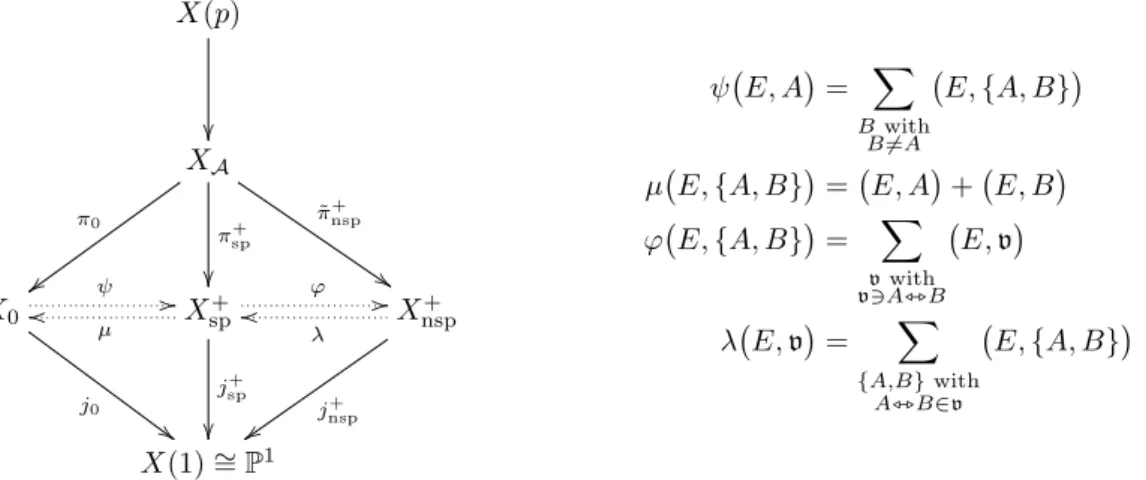
In [Che98, Che00], Chen showed that there is an isogeny between the Jacobian of X+
sp(p) and the product of the Jacobians ofX0(p) andXnsp+ (p). In Section 4, we give a new proof of this theorem using necklaces. This gives an explicit and geometric vision of the maps involved. We conclude the paper with some numerical data related to Chen’s Theorem.
Since the primepis fixed throughout the paper, we will now omit it from the notations and only write XnspandXnsp+ . It is to note that there should be no real difficulty in generalising our moduli description to composite levels N. With view on the problem of Serre to classify the Galois structure ofp-torsion subgroups of elliptic curves overQ, prime levels are maybe the most interesting.
Notations
The following is a list of modular curves that appear in this paper and the notations we frequently use. The definitions will be given later. See also Sections 3.1 and 4.1 for degeneracy maps and correspondences between them.
Symbol Description ofH<GL2(Fp) Level structure
X(p) Full level structure, H={1} Basis (P, Q) ofE[p]
XA Scalar matricesA Distinct triple (A, B, C) in P E[p] X0 A Borel subgroupB SubgroupC∈P E[p]
Xsp A split Cartan Distinct pair (A, B) inP E[p] Xsp+ Normaliser of a split CartanS Non-ordered pair{A, B} ⊂P E[p]
Xnsp A non-split Cartan Oriented necklacev
Xnsp+ Normaliser of a non-split CartanN Necklacev
Matrices in GL2(Fp) will be written as · ·· ·
, while their class in PGL2(Fp) will be represented by· ·· ·
. As in the introduction, we will denote the action of GL2(Fp) over X(p) on the right. Instead, if V is a
two-dimensionalFp-vector space, the action on V of GL(V) or, after a choice of basis, of GL2(Fp), will
be considered on the left.
2
The moduli problem of necklaces
2.1
Non-split Cartan subgroups and their modular curves
We refer to [Ser97] for definitions and results about non-split Cartan subgroups and Dixon’s classification of maximal subgroups of GL2(Fp) and just briefly recall some facts. The group GL2(Fp) acts on the right
on P1(
Fp2) by (x : y) a bc d = (ax+cy : bx+dy). Any non-split Cartan subgroup of GL2(Fp) can be
defined as the stabiliserHαof (1 :α) inP1(Fp2)\P1(Fp) for a choice ofα∈Fp2\Fp. We see thatHαhas
orderp2−1 as the action of GL2(
Fp) is transitive onP1(Fp2)\P1(Fp).
Alternatively, we can consider the basis (1, α) of Fp2 as aFp-vector space. Then we claim that Hα
is equal to the image of the map iα: Fp×2 → GL2(Fp) sending β to the matrix which represents the
multiplication by β on Fp2 written in basis (1, α).Indeed, let β = x+yα ∈ Fp×2 with x, y ∈ Fp. If
X2−tX+nis the minimal polynomial ofαover
Fp, then
iα(β) =
x −ny y x+ty
and so (1 :α)iα(β) = (x+yα:−ny+ (x+ty)α) = (β :βα) = (1 :α). So the image ofiα is contained in
Hαand they are equal because they are of the same size.
Given a choice of a non-split Cartan subgroupH, we define the modular curveXnsp as the quotient XH. Note that the quotient does not depend on the choice ofH as these subgroups are all conjugate.
However the description of points onXnsp asH-orbits do.
The normaliserN of a non-split Cartan subgroupHin GL2(Fp) containsHwith index 2. It can be
viewed as adding the image under iα of the conjugation map in Gal(Fp2/Fp) onFp×2. The corresponding quotientXN will be denoted byXnsp+ .
2.2
Necklaces
Letγbe a multiplicative generator ofFp×2. For any 2-dimensionalFp-vector spaceV, we defineCγ to be the
conjugacy class in PGL(V) of all elementshwhich have a representative in GL(V) whose characteristic polynomial is equal to the minimal polynomial ofγ. In other words, all representatives ofh∈ Cγ have an
eigenvalue inFp×·γ. The setCγ depends only onFp×.γ. If ¯γ is the conjugate ofγ overFp, thenC¯γ =Cγ.
If a basis of V is chosen thenCγ consist of all classes of matricesiα(γ) as αruns throughFp2\Fp. Note that the class of iα(¯γ) =i¯α(γ) = N(γ)−1iα(γ)−1 is equal to the inverse of class of iα(γ). In particular,
in any non-split Cartan subgroup in PGL(V), there are exactly two generatorshandh−1that belong to Cγ. Asγvaries, we obtain the 12ϕ(p+ 1) conjugacy classes of elements of orderp+ 1.
Let ¯kbe an algebraically closed field of characteristic 0 or different from pand letE/¯kbe an elliptic curve. We know that there existsp+ 1 cyclic subgroups of order p in E[p]. We will consider lists (C0, C1, . . . , Cp) of
those cyclic subgroups and will say that two such lists are equivalent if we can obtain one from the other by a cyclic permutation; so (C0, C1, . . . , Cp)
and (C1, C2, . . . , Cp, C0) are equivalent.
Recall that we will denote on the left the action by homography of PGL(E[p]) onP(E[p]).
Definition. An equivalence class (C0, C1, . . . , Cp) is called anorientedγ-necklace ofE if there exists an
element h∈ Cγ ⊂PGL(E[p]) such thath(Ci) =Ci+1 for alli= 0, . . . , p−1.
Ifh is such an element, then we must also have h(Cp) =C0 as his of order p+ 1. Note also that
if (C0, C1, . . . , Cp) is an oriented necklace with a certain h∈ Cγ, then so is (Cp, Cp−1, . . . , C0) because
h−1∈ C
γ.
Let us consider the dependence on the choice ofγ.
Lemma 1.Let γ and γ0 be two generators of Fp×2. There is a canonical bijection between oriented
γ-necklaces and orientedγ0-necklaces.
Proof. Since Fp×2 is cyclic, there exists an integer k ∈ [0, p2−1] such that γ0 = γk and such that k is coprime top+ 1. In particularCγ0 is the set of allhk withh∈ Cγ. So the requested bijection is given by
{orientedγ-necklaces} → {orientedγ0-necklaces} (C0, C1, . . . , Cp)7→(C0, Ck, C2k, . . .)
with the index taken modulo p+ 1.
As a consequence, we may now fix a choice of γ for the rest of the paper and call the oriented γ-necklaces simplyoriented necklaces.
In a picture, we arrange the subgroupsC0, . . . ,Cplike pearls on a necklace that can be turned around
the neck using the automorphism hofP(E[p]). If we allow the necklace to be worn in both directions, we get the notion of a necklace without orientation:
Definition. Letwdenote the involution defined by
which changes the orientation of an oriented necklace. A necklace is a w-orbit of oriented necklaces {v, w(v)}.
Lemma 2. Fix a generatorγ ofFp×2. LetC0,C1, andC2 be three distinct cyclic subgroups of orderpin
E[p]. Then there exists a unique elementh∈ Cγ inPGL(E[p])such that h(C0) =C1 andh(C1) =C2.
Proof. Choose generators P0 andP1 in C0 and C1 respectively and consider the basis (P0, P1) of E[p]. Write t and n for the trace and the norm of γ. The elements h of Cγ which verify h(C0) = C1 are of
the form [−ny0−1yt] with y ∈ Fp×. Moreover, as y varies, the points yP0+tP1 form an affine line and hence there is a unique y∈Fp× such thatyP0+tP1belongs to C2. Indeed, note thatt6= 0 because if it
were,γ would be of order dividing 2(p−1). Hence, there is a uniqueh∈ Cγ such that h(C0) =C1 and h(C1) =C2.
This lemma implies that for any triple (C0, C1, C2) of distinct cyclic subgroups of E[p], there is a unique oriented necklace of the form (C0, C1, C2, . . .). We will denote it by C0 → C1 → C2. Similarly there is a unique necklace with consecutive pearlsC0, C1, C2, which we denote byC0−C1−C2.
There is a natural action of PGL(E[p]) on the set of oriented necklaces by settingg·(C0, . . . Cp) =
g(C0), . . . , g(Cp)forgin PGL(E[p]). Ifh∈ Cγ is such thath(Ci) =Ci+1thenghg−1∈ Cγ can be used
to show that g(C0), . . . , g(Cp)
is indeed an oriented necklace. Since the action of PGL(E[p]) onP(E[p]) is simply 3-transitive, Lemma 2 implies that the action of PGL(E[p]) on oriented necklaces is transitive. By definition, for every oriented necklacev, there exists h∈ Cγ fixing it. Therefore, the group generated
by h, which is a non-split Cartan subgroup in PGL(E[p]) will belong to the stabiliser ofv. It is clear that this is equal to the stabiliser of v. We have shown:
Corollary 3. Let G = PGL(E[p]). The set of oriented γ-necklaces is isomorphic as a G-set to G/H where H is any non-split Cartan group in G. Similarly, the set of γ-necklaces is G-isomorphic to G/N for the normaliser of a non-split Cartan group N inG. In particular, there are exactlyp(p−1)oriented necklaces andp(p−1)/2 necklaces.
2.3
Moduli description
Let H be a non-split Cartan subgroup in G = GL2(Fp) and write N for its normaliser. Let ¯k be an
algebraically closed field of characteristic different fromp. Recall thatY(p)(¯k) classifies the ¯k-isomorphism classes of pairs E,(P, Q)
whereEis an elliptic curve over ¯kand (P, Q) is anFp-basis ofE[p]. The group
GL2(Fp) acts on a pair on the right as usual E,(P, Q)
· a b
c d
= E,(aP +cQ, bP+dQ)
. A point in YH(¯k) is an orbit under this action by the non-split Cartan subgroupH. For a given elliptic curveE/k,¯
the H-orbits of triples is aG-set isomorphic to G/H. Corollary 3 has shown us that the set of oriented necklaces onE is also isomorphic toG/H. Hence we have:
Proposition 4. LetHbe a non-split Cartan subgroup inGL2(Fp). There is a bijection between the points inYH(¯k)and the set of¯k-isomorphism classes of pairs(E,v)composed of an elliptic curveE/¯ktogether with an oriented necklace vinE. Similarly YN(¯k)consists of pairs(E,v) wherevis a necklace inE.
In Section 3.3, we will give the description ofk-rational points for fieldskwhich are not algebraically closed. We will from now on informally say thatY+
nsp andYnsp are coarse moduli spaces for the moduli problem of elliptic curves endowed with a necklace and an oriented necklace respectively.
For anyZp1
-schemeS and elliptic curveE/S, we could define aγ-necklace onE/Sto be a complete list of allp+1 cyclicS-subgroup schemes (C0, . . . , Cp) of orderpinE[p] up to cyclic permutation verifying
the condition with respect to γ as in Section 2.2. Consider the moduli problem given by the functorF associating to a Z1
p
-scheme S, the set of S-isomorphism classes of (E/S,v) where E/S is an elliptic curve andvsuch aγ-necklace onE/S. Then, essentially by the above Proposition, the schemeY+
nsp over Z1p
is a coarse moduli scheme for this functorF.
However, contrarily to what happens for the coarse moduli schemeY0and a fortiori for the fine moduli scheme Y1, the morphism of functors F →Ynsp+ does not necessarily give a surjection F(k) →Ynsp+ (k) when k is a field that is not algebraically closed: For instanceF(Q) is empty for all odd primesp, yet Ynsp+ (Q) will contain points for many primesp. Since we wish to describe all points ofYnsp+ , this functorF is not the best choice. An option would be to write down a different functor, but that turns out to be cumbersome. In this article, we prefer to view points in Y+
nsp(k) for a fieldk as points inYnsp+ (¯k) which are fixed by the absolute Galois group ofk. They will be described in Section 3.3 in term of necklaces.
The above problem is also present for the split Cartan subgroup. The description of the ¯k-rational points using non-ordered pairs of cyclic subgroups together with the Galois action has nevertheless been used extensively (see for instance [Mom84]). The aim of this article is, in a similar spirit, to obtain basic properties of Xnsp andX+
nsp via our description.
Now, it is very natural to ask about the fibre atpof a good model ofXnspandX+
nspoverZ. The naive extension of the above definition of necklace for elliptic curves over Z-schemes cannot work as elliptic curves in characteristicphave either one or two distinct cyclic (in the sense of [KM85]) subgroup schemes of orderp. To find an appropriate definition of necklaces that would also work for characteristicpshould be the topic of a future investigation.
2.4
The cross-ratio
As before, the action by homography of PGL E[p]
on the projective space P E[p]
is denoted on the left. We denote the elements ofP1(Fp) by∞= (1 : 0) anda= (a: 1) fora∈Fp.
Let A, B, C be three distinct points in P E[p] and D ∈ P E[p]. Recall that the cross-ratio of A, B, C, D is defined by [A, B;C, D] = f(D) where f : P E[p]
−→ P1(Fp) is the unique isomorphism
such that f(A) = ∞, f(B) = 0 and f(C) = 1. After a choice of basis of E[p] identifying P E[p] withP1(Fp), we get
[A, B;C, D] = A−C B−C ·
B−D A−D.
The last formula is independent of the choice of basis since the cross-ratio is PGL E[p]-invariant. If
v= (C0, C1, . . . , Cp) is an oriented necklace, then [C0, C1;C2, C3] = [Ci, Ci+1;Ci+2, Ci+3] for all 06i6p with the index taken modulop+1. Hence we can attach a cross-ratio to each necklace. As described above, the action of PGL E[p]
on oriented necklaces is transitive and hence this cross-ratio [C0, C1;C2, C3] is the same for all orientedγ-necklaces.
Proposition 5. Let γ be a generator of Fp×2 of trace t and norm n. Set ξγ =t2/(t2−n). Then a list (C0, C1, . . . , Cp) of all distinct cyclic subgroups of order p in E represents a γ-necklace if and only if [Ci, Ci+1;Ci+2, Ci+3] =ξγ for all06i6pwith the index taken modulop+ 1.
This provides a new possibility of defining necklaces by-passing completely the use of the automorph-ism group ofE[p], but only relying on the projective geometry ofP(E[p]).
Proof. We only need to compute the cross-ratio for one necklace. We take the basis such thath= [01−nt ] is in Cγ. The necklace now contains the consecutive pearls ∞, 0, −n/tand −nt/(−n+t2) from which
we obtain the above cross-ratioξγ.
Since to each triple (C0, C1, C2) there is a uniqueC3such that [C0, C1;C2, C3] =ξγ, we have a second
2.5
Relation to other descriptions
We recall a different description of the Hα-orbits of points in X(p) where α is a choice in Fp2 \Fp.
See [Mer99]. LetE/¯kbe an elliptic curve. Choose a basisP0,P1 ofE[p] and identify E[p] with Fp2 via P0 7→1 and P1 7→ α. Any basis (P, Q) of E[p] is equal to (P0, P1)g for some g ∈ GL2(Fp). Consider
the GL2(Fp)-equivariant map which sends (P0, P1) to (1 :α)∈P1(Fp2)\P1(Fp). Since the action ofHα
is now just the multiplication onFp2, it induces a well defined GL2(Fp)-equivariant map from the set of
Hα-orbits of basis (P, Q) toP1(Fp2)\P1(Fp). This is a GL2(Fp)-equivariant bijection.
This leads now to a moduli problem description ofXnsp. Each point inYnsp(¯k) with ¯kan algebraically closed field of characteristic different from pis a ¯k-isomorphism class of (E,C) where E/k¯ is an elliptic curve andCis an element inP E[p]⊗Fp2\P E[p]. The group PGL E[p]acts on the left onP E[p]⊗Fp2 by its action onE[p].
We will now give an explicit PGL E[p]
-equivariant bijection between the set of orientedγ-necklaces of E and P E[p]⊗Fp2\P E[p]. Write n andt for the norm and trace of the fixed element γ in Fp2. Consider the map
{γ-necklaces} −→ P E[p]⊗Fp2
(C0, C1, C2, . . .) 7→ hP⊗(−γ) +Q⊗1i (1) where (P, Q) is a basis of E[p] such that C0 =hPi, C1=hQiand C2 =h−nP+tQi. Note that such a basis exists because neither n nort could be zero whenγ is a multiplicative generator of Fp×2. We have to show that this map is well-defined. Lethbe a generator in the stabiliser ofvwhich belongs to Cγ. In
the basis (P, Q) this elementhis represented by the matrix0−n
1 t
. Now
hP⊗(−γ) +Q⊗1=Q⊗(−γ) + (−nP+tQ)⊗1 = (t−γ)·P⊗(−γ) +Q⊗1
as (t−γ)(−γ) =γ2−tγ=−n. This shows that the line in
P E[p]⊗Fp2does not depend on the choices made in the construction. It also is evident from this that the stabiliser ofvis equal to the stabiliser of the image. From the construction we see that the map is PGL E[p]
-equivariant. Since the actions are transitive, it follows that it is surjective and hence bijective.
Since we have no geometric object linked to E which can be thought of directly as an element in E[p]⊗Fp2, we believe that the moduli problem of necklaces has its advantages.
While finalising this article, we learnt of yet another moduli interpretation given by Kohen and Pacetti in [KP16]: Fix a choice of a quadratic non-residueε modulop. They represent each point inY+
nsp(¯k) by a ¯k-isomorphism class of (E, φ) whereE/k¯is an elliptic curve andφ∈GL E[p]
is an element such that φ2 is the multiplication by ε. See Proposition 1.1 and Remark 1.3 in [KP16]. The following defines a PGL E[p]
-equivariant bijection between the set of such endomorphismsφand the set of necklaces onE. The endomorphismφdefines an element of order two in PGL E[p]
without fixed point; so it belongs to a unique non-split Cartan subgroupHwhose normaliser is the stabiliser of a necklacev. Conversely, every stabiliser of a necklace contains a unique element in PGL E[p]
that lifts to an element φ∈GL E[p] withφ2=ε.
3
Describing the geometry and arithmetic with necklaces
3.1
Degeneracy maps
Let A be the group of scalars in GL2(Fp) and consider the associated modular curve XA. Because
the group PGL2(Fp) acts sharply 3-transitive on P1(Fp), the curve XA represents the moduli problem
associating to each elliptic curveEa triple of distinct cyclic subgroups (C0, C1, C2) of orderpinE, which is also called a projective frame inP(E[p]).
The mapπA:X(p)→XA can be chosen to be the following. Letnand tbe the norm and trace of
our fixed generatorγinFp2. To each basis (P, Q) of thep-torsion of an elliptic curveE, we associate the
triple hPi,hQi,h−n P +t Qi
. From the fact that t6= 0, it is clear that this gives a mapX(p)→XA.
Next we describe the mapπnsp:XA→Xnsp. We have a natural choice to send the triple (C0, C1, C2) to
The advantage of our choices is that πnsp ◦πA provides an explicit bijection between the set of
orbits of isomorphism classes (E,(P, Q)) under a particular non-split Cartan subgroup H0 and the set of isomorphism classes (E,v) of elliptic curves endowed with an oriented necklace. Let H0 be the non-split Cartan subgroup in GL2(Fp) generated by the matrix h0 = 01−nt
=iγ(γ), which is an element
in our chosen class Cγ for V =Fp2. Let E be an elliptic curve and (P, Q) a basis of E[p]. Denote by
h∈PGL(E[p]) the element of orderp+1 defining the necklacev=πnsp◦πA(P, Q). Then, by construction
ofπA,
πA (P, Q)·h0=h·πA(P, Q).
This insures that the map which sends an orbit (E,(P, Q))H0to (E,v) wherev=πnsp◦πA(P, Q) is well
defined and it gives the expected bijection.
Under the map (1) in Section 2.5, identifying necklaces with elements in P E[p]⊗Fp2
\P E[p], the degeneracy map above can also be described as sending the basis (P, Q) of E[p] to the projective line hP ⊗(−γ) +Q⊗1i in E[p]⊗Fp2. This provides an explicit bijection between the set of orbits of isomorphism classes (E,(P, Q)) under H0 and the set of isomorphism classes (E,C) of elliptic curves endowed with an elementCinP E[p]⊗Fp2\P E[p].
We will see later in Section 4.7 another naturally defined degeneracy map ˜π+
nsp:XA→Xnsp+ .
3.2
Cusps
The following proposition, quoted (but not proved) in [Ser97] Appendix A.5, can be proved using neck-laces:
Proposition 6. The modular curveXnsp has p−1cusps, each ramified of degree pover the cusp∞ in X(1).
Proof. In order to determine the structure of the cusps, we use the Tate curveEq overQ((q)). Formally, one can deduce the proposition using Theorem 10.9.1 in [KM85] from the fact that a non-split Cartan subgroup of PGL2(Fp) acts transitively on P1(Fp) and that it contains no non-trivial element from any
Borel subgroup. In particular, the formal completion of Xnsp along the cusps is the formal spectrum of Q(ζ)[[α]], whereαp=qandζ is a p-th root of unity.
However, we can also view it on the necklaces of Eq. The Tate curve has a distinguished cyclic
subgroup µp of order p. Any oriented necklacev can be turned in such a way thatC0 =µp. The two
following pearlsC1andC2 have each a generator which is ap-th root ofq, sayαζiandαζj, respectively,
where 06i6=j < p. From the action of the inertia group of the extensionQ((q))[α, ζ] overQ((q)), we see that all thepnecklaces with a giveni−j ∈Fp× meet at the same cusp in the special fibre at (q).
The cusps are not defined overQbut over the cyclotomic fieldQ(µp) only, forming one orbit under
the action of the Galois group, despite the fact thatXnspis defined overQ. See Appendix A.5 in [Ser97]. As a consequence there are p−1 choices of embeddingsXnsp,→Jac(Xnsp), all defined overQ(µp) only
and none of them is a canonical choice. With the same proof we show thatX+
nsphas (p−1)/2 cusps defined over the maximal real subfield of Q(µp).
3.3
Galois action
Let k be a field of characteristic different from pand write Gk for its absolute Galois group. For any
σ in Gk and point x ∈ Ynsp(¯k), represented by the pair (E,v), we define σ(x) in the obvious way as
the ¯k-isomorphism class of the pair Eσ, σ(v). Hereσ (C0, C1, . . .)is the necklace σ(C0), σ(C1), . . .. WriteYnsp(k) for the elements inYnsp(¯k) fixed byGk.
Proposition 7. Let x∈Ynsp(k). Then there exists a pair (E,v) representing xsuch that E is defined overk. Ifj(E)6∈ {0,1728} then the oriented necklacevis also defined overk, in the sense thatσ(v) =v
for all σ∈Gk. In particular, the image of the residual Galois representationρ¯p(E) :Gk →GL E[p]has
Proof. Let (E,v) be a representation ofx. SoEσis ¯k-isomorphic toE. As usualσ j(E)=j(Eσ) =j(E), shows that j(E)∈k and hence we may assume thatEis defined overk.
For everyσ∈Gkthere is an automorphism Ψσ ∈Aut¯k(E) such that Ψσ(v) =σ(v). Ifj(E)6∈ {0,1728}
then there are no additional automorphisms besides [±1]. Therefore they all act by scalars on E[p] and thus they act trivially onP E[p]
. It follows thatv=σ(v). So the image of ¯ρp(E) lands in the stabiliser
ofv, which is a non-split Cartan subgroup.
Ifv is defined overk then there exists a cyclic extension L/k of degree dividingp+ 1 such that all cyclic subgroupsC ofE[p] are defined overL.
The analogous statement holds forY+
nsp(k): Every point inYnsp+ (k) can be represented by a pair (E,v) withEbeing defined overk. Ifj(E)6∈ {0,1728}, then the necklacevhas also to be defined overkand the residual Galois representation takes values in the normaliser of a non-split Cartan subgroup of GL E[p]. The fibres inYnsp and Ynsp+ above the points j = 0 orj = 1728, contain ramified points and elliptic points. We will discuss the elliptic points in detail in Section 3.5. A ramified pointxin one of those fibres can still be represented by (E,v) with E defined overQ. However we will show now that the field of definition ofxis not equal to the field of definition ofvifp >3: In both cases, the curveE has complex multiplication and by a general result (see Corollary 5.20 in Rubin’s part in [CGRR99]), the image of the Galois representation ρ:GQ →GL E[p]
contains the image of all the automorphisms ofE. Since xis ramified, there is an automorphism g such that g(v)6=v. Hence there is an element σ∈GQ that sends
vtog(v). Nowσdoes not fixv, but it fixesx, which is also represented by E, g(v) .
3.4
A lemma on antipodal pearls and cross-ratios
LetEan elliptic curve over an algebraically closed field ¯kof characteristic different fromp. The following definition and lemma will be used in many places later on.
Definition. Letv= (C0, C1, . . . , Cp) be a necklace inE. Two pearlsCi andCj
are called antipodal in vifi≡j+p+12 (mod p+ 1). In other words if they are diametrically opposed when we represent the necklace as a regular (p+ 1)-gon. IfAandB are antipodal inv, we write A]B∈v.
Lemma 8. LetA,B,C,D be four distinct cyclic subgroups of orderpin an elliptic curveE. There are
(p−1)/2 necklaces in which A]B. If the cross-ratio[A, B;C, D] is a square in F ×
p , then there is no
necklace v such that A ]B ∈ vand C ]D ∈ v. If instead [A, B;C, D] is a non-square in F× p , then
there is exactly one necklace vsuch thatA]B∈vandC]D∈v.
Proof. We may choose a basis ofE[p] identifying P(E[p]) withP1(Fp) in such a way thatA=∞,B= 0
andC= 1. ThenD=dfor somed∈Fp×\ {1}. Now [A, B;C, D] =d.
If dis a non-square, then the matrix g = [0d
1 0] is an element of order two without a fixed point in P1(Fp). Hence it belongs to a unique non-split Cartan subgroupH. Then the necklacevwhose stabiliser
is the normaliser ofHis a necklace such thatA]B∈vandC]D∈vasg(A) =B andg(C) =D. Conversely, if we have such a necklacev forA, B, C, D, then the unique element of order 2 which preserves the orientation onv, must sendAtoB andC toD. Hence it is of the formg= [0d
1 0]. However if it has no fixed points inP1(
Fp), thendhas to be a non-square inFp×.
Finally, we have to count how many necklaces haveA]B∈v. By the above proof, this is the same as to count how many matrices g = [0d
1 0] belong to a non-split Cartan subgroup. That is
p−1
2 as there are that many non-squaresdinFp×.
3.5
Elliptic points
Consider the canonical coverings Xnsp −→X(1) and Xnsp+ −→ X(1). An elliptic point onXnsp or X+
nsp is a point in the fibre of a point in X(1) represented by an elliptic curve E with Aut(E)6={±1}. Hence, an elliptic point onXnsp can be represented by a pair (E,v) such that there is an automorphism onE that induces a non-trivial elementg∈PGL E[p]
which fixesv. Consider the involutionwonXnsp which reverses the orientation of the oriented necklaces. An elliptic point onX+
nspcan be viewed as a pair (E,{v, wv}) with an automorphismg∈PGL E[p]
and an oriented necklacevsuch that eitherg(v) =v
or g(v) =w(v). In the latter case, we say thatvand its necklace{v, w(v)} isflipped byg.
First note that if (E,·) is an elliptic point then j(E) = 1728 and g is of order two or j(E) = 0 and g is of order three. These are elliptic curves with complex multiplication andE[p] becomes a free End(E)/pEnd(E)-module of rank 1. So if g is of order 2 and p≡3 (mod 4) or if g is of order 3 and p≡2 (mod 3), then End(E)/pEnd(E)∼=Fp2and hencegbelongs to a unique non-split Cartan subgroup of PGL E[p]. Instead, ifg is of order 2 andp≡1 (mod 4) or ifg is of order 3 andp≡1 (mod 3) then End(E)/pEnd(E)∼=Fp⊕Fp and thereforeg belongs to a unique split Cartan subgroup as it will have
exactly two fixed points.
3.5.1 Fixed oriented necklaces
Let (E,v) be an elliptic point onXnspwith the oriented necklacevfixed byg. Thengis in the non-split Cartan subgroup stabilising v. Hence by the above,p≡3 (mod 4) if g has order 2 andp≡2 (mod 3) if g has order 3. Conversely, if these congruence conditions are satisfied theng is in a unique non-split Cartan subgroup which is the stabiliser of exactly two oriented necklaces, namely vandwv. This gives the following result:
Proposition 9. Forr= 2and3, leter be the number of elliptic points inXnspwith g of orderr. Then
e2= 1−
−1
p
=
(
0 ifp≡1 (mod 4),
2 ifp≡3 (mod 4), and e3= 1−
−3
p
=
(
0 ifp≡1 (mod 3),
2 ifp≡2 (mod 3).
In the cases where er= 2the two corresponding oriented necklaces are in the same w-orbit.
3.5.2 Flipped necklaces
Let (E,v) be an elliptic point onX+
nsp where the necklacev={~v, w~v}is flipped byg. Ifgwere of order 3, we would have~v=g3(~v) =w(~v). Henceg is of order 2. The involutiongis in a split Cartan subgroup ifp≡1 (mod 4) and in a non-split Cartan subgroup if p≡3 (mod 4).
Lemma 10. Suppose that p≡1 (mod 4) and let A, A0 denote the two fixed points of g in P(E[p]). A necklacevis flipped bygif and only ifAandA0 are antipodal inv. Consequently, there are p−21 necklaces flipped by g.
Proof. Let~v = (C0, C1, C2, . . . , Cp) be a flipped oriented necklace
with C0 =A. From g(~v) =w(~v), we getg(Ck) =Cp+1−k for allk,
where the indices are taken modulop+ 1. It follows that ifA0 =Ck
then A0 = g(A0) = Cp+1−k, so k = (p+ 1)/2 and A and A0 are
antipodals inv={~v, w~v}. Moreover from g(Ck) =Cp+1−k, we see
that g will act on v, represented as a regular (p+ 1)-gon, as the reflection through the axis passing through AandA0.
Conversely, letvbe a necklace in whichA]A0. LetB
]B
0 be
two other antipodal pearls in v. Let hbe the element of order 2 in the normaliser of the non-split Cartan subgroup stabilisingv. As it exchanges antipodal pairs in v, we haveh(A) =A0 andh(B) =B0.
Since hgh−1 is also an involution that fixesA and A0, it follows that hgh−1 = g as there is a unique involution fixing two given points. Thereforehg(B) =gh(B) =g(B0) which implies thatg(B)]g(B0)∈
Asgsends antipodal pairs invto antipodal pairs ing(v), we also haveA]A
0 andg(B)
]g(B
0) in
g(v). Hence, by Lemma 8, either g(~v) =~vor g(~v) =w~vwhere {~v, w~v} =v. The first case is excluded because gdoes not belong to a non-split Cartan subgroup if p≡1 (mod 4).
The end of the proof follows from the fact that there are (p−1)/2 necklaces such that AandA0 are antipodal, again by Lemma 8.
Lemma 11. Suppose thatp≡3 (mod 4). Let A∈P E[p]. Consider the map sending a necklace vto the pearl antipodal to A in v. This is a bijection between necklaces v flipped by g and the set of pearls B 6∈ {A, g(A)} such that
A, B;g(A), g(B)
is a non-square inFp.
Proof. Letvbe a necklace flipped byg. As above, fromg(~v) =w(~v) we get g(Ck) =Cp+1−k for all k and one can see that, sincep≡3
(mod 4),gwill act onvas a reflection through an axis that does not pass through a corner of the regular (p+ 1)-gon. LetBbe antipodal toAinv. SoB6=A. IfB were equal tog(A), thenAandB would be on the line orthogonal to the axis of reflection of g. But this would imply thatp+ 1≡2 (mod 4), and henceB6=g(A). Finally, sincegflipsv, we see thatg(A)]g(B)∈v. By Lemma 8, it follows that
A, B;g(A), g(B)
is a non-square modulop. The same lemma also shows that our mapv7→B is injective.
Conversely, suppose thatB 6∈ {A, g(A)} is such that the cross-ratio
A, B;g(A), g(B)
is a non-square modulop. SinceA,B,g(A) and g(B) are all distinct, Lemma 8 applies to show that there is a
necklace v with A ] B and g(A) ] g(B). Now g(v) has alsog(A) ] g(B) and A ] B. The same lemma now shows thatg(v) =v. If the orientation ofvwere fixed rather than flipped, theng(A) would be B. Hence our map is surjective, too.
Proposition 12.Forr= 2 or3, let e+
r be the number of elliptic points withg of orderrin Xnsp+ . Then
e+2 =p+ 1
2 −
−1
p
=
(p−1
2 if p≡1 (mod 4),
p+3
2 if p≡3 (mod 4),
and
e+3 =1 2 −
1 2
−3
p
=
(
0 if p≡1 (mod 3),
1 if p≡2 (mod 3).
Proof. The number of elliptic points forX+
nspis the sum of the number of fixed and the number of flipped necklaces. In Proposition 9 we counted the fixed ones. We have already counted the flipped necklaces for p≡1 (mod 4) in Lemma 10. Now supposep≡3 (mod 4) and letA∈P E[p]. By Lemma 11, we must count how many pearls B there are such that B 6∈ {A, g(A)} and
A, B;g(A), g(B)
is a non-square in Fp.
Let us choose a basis ofE[p] such thatA=∞and g(A) = 0. Letb ∈F×
p such thatB = 1/b. Then
g=0−1 1 0
andg(B) =−b. Hence
A, B;g(A), g(B)
= 1 +b2. So we have to count the number ofb∈ Fp×
such that 1 +b2is a non-square. One finds that there are p+1
2 suchb by counting the cases when 1 +b 2
is a square using that there arep+ 1 points on a projective conica2+b2=c2.
3.6
Genus
From the above, we can now proceed to compute the genus of our modular curves. Of course, we find the well-known formulae, as for instance in Appendix A.5 to [Ser97], [Bar10] or [Che98]. The reader can also find tables for the genus ofXnspandX+
nspfor small primes pin [Bar10].
The Riemann-Hurwitz formula applied to the modular curve XH associated to a subgroup of finite
for the genusg(XH) ofXH:
g(XH) = 1 +
d 12− e2 4 − e3 3 − e∞ 2
where er is the number of elliptic points inXH of orderr ande∞is the number of cusps.
With the results of Sections 3.5 and 3.2, a straightforward computation gives the following.
Proposition 13. The genera ofXnsp andXnsp+ are
g(Xnsp) =
1 12
p2−7p+ 11 + 3 −1 p + 4 −3 p and
g(Xnsp+ ) =
1 24
p2−10p+ 23 + 6 −1 p + 4 −3 p .
With the same method, one can compute the genus of other modular curves, for instanceX0andXsp+. The classical results (see for instance [Shi94] and [Che98]) for their genus are
g Xsp+ = 1
24
p2−8p+ 11−4
−3 p
and g X0
= 1 12
p−6−3 −1 p −4 −3 p .
Then one can verify easily the relation noticed by Birch following Chen’s calculation of genus and con-firmed by Chen’s isogeny
g Xnsp+
+g X0
=g Xsp+
. (2)
3.7
Hecke operators
Let ` be any prime distinct from p. Denote by X0+,nsp(`, p) = X0(`)×X(1) Xnsp+ (p). We recall how the Hecke correspondence T` is defined through the following two natural degeneracy maps ρ and
ρ0:X0+,nsp(`, p)−→Xnsp+ (p). The modular curveX +
0,nsp(`, p) parametrises isomorphism classes E,(f,v)
of elliptic curvesEendowed with an`-isogenyf:E→E0and a necklacev. Letρbe the map obtained by forgetting the `-structure and ρ0 the map which sends (E,(f,v)) to E0, f(v)
. The image f(v), defined as f(C0), f(C1), . . . , f(Cp)whenv= (C0, . . . , Cp), is indeed a necklace onE0=f(E) since`6=p.
The correspondenceT`onXnsp+ is now defined as ρ∗◦ρ0∗. It induces an endomorphism on Pic(Xnsp+ ) by Picard functoriality. On the divisor (z) with the pointzinXnsp+ represented by (E,v), it is defined as
T`(z) =
X
f:E→E0
degf=`
E0, f(v)
where the sum runs over all isogenies f from E of degree`.
We will now verify that this moduli-theoretic description of T` via these correspondences coincide
with the Hecke operators defined by double coset.
Let us denote byN a normaliser of a non-split Cartan in GL2(Fp), by Γ the congruence subgroup of
matrices in SL2(Z) with image inN modulop, and by ∆ the set of integral matrices whose determinant is positive and coprime to pand which reduce to a matrix in N modulop. ThenT` as a double coset is
defined by ΓαΓ for anyα∈∆ of determinant`. Since such an elementαreduces modulo`to a non-zero matrix of determinant 0, there existγ andγ0 in Γ such thatγαγ0 is of the form a b`
c` d`
with integers a, b, c, and d. (Note that we can impose conditions modulo pon γ, γ0 because pand ` are coprime.) In other words, ΓαΓ contains an element of the formβ(1 0
0`) withβ ∈Γ0(`), so we may now suppose that
α=β(1 0
0`), withβ ∈Γ0(`).
We will then prove that Γ∩α−1Γα= Γ∩Γ0(`), where we denote by Γ0(`) the matrices in SL 2(Z) with right upper entry equal to 0 modulo `: Since β ∈ SL2(Z), we have β−1Γβ ⊂ SL2(Z), hence
1 0 0`
−1
β−1Γβ 1 0 0`
are matrices of the form c/` da b`
Similarly, one can show that Γ∩αΓα−1= Γ∩Γ0(`). Now, from the fact that Γ∩α−1Γα= Γ∩Γ0(`) or Γ∩αΓα−1 = Γ∩Γ
0(`), we deduce in a classical manner, as explained for instance in Section 6.3 in [DS05] taking Γ1= Γ2= Γ, that the double coset description ofT` coincide with the moduli-theoretic
description we gave above. Compare with Theorem 1.11 in [KP16] for a different proof.
3.8
A pairing
Given two necklaces vandwinE, we set
hv,wi= #n{A, B}
A]B ∈vandA]B∈w o
.
It is the number of antipodal pearls thatvandwhave in common. We can extend it linearly toL allvZv regarded as an abelian group with an action by PGL E[p].
Proposition 14. The pairingh·,·iis a positive non-degenerate symmetricPGL E[p]
-equivariant bilinear form on L
vZv. We havehv,vi=
p+1
2 andhv,wi ∈ {0,1} for all necklacesv6=w.
First, we note that we are left to prove that the pairing is positive, takes value 0 or 1 on distinct necklaces, and is non-degenerate. In this section, we only give the proof of the two first facts. The proof of non-degeneracy will be given in Section 4.5 and numerical examples are in Section 5. We will see that this pairing gives a more conceptual understanding of the eigenvalues computed by Chen [Che00] in his table 2.
Proof. The statement that hv,wi ∈ {0,1} forv6=wis a direct consequence of Lemma 8: Ifhv,wi>2, then there are four distinct A, B, C, D with both A] B and C ] D in vand w, contradicting the lemma.
Letu=Pa
vvbe an element inLZv. We have
hu, ui=X v
X
w
avawhv,wi= X
{A,B}
X
vwith
A]B∈v
X
wwith
A]B∈w
avaw = X
{A,B}
X
vwith
A]B∈v
av 2
>0,
where P
{A,B} is the sum running over all unordered pairs of distinct cyclic subgroups of E[p]. Hence
the pairing is positive. The non-degeneracy of the pairing will be shown in Section 4.5.
4
Chen’s isogeny
4.1
Definitions and statement
In [Che98], Chen proved that Jac(X+
nsp) = Jac(X +
0(p2))new. Edixhoven and de Smit [dSE00, Edi96] found a different and rather elegant proof. Finally Chen gave in [Che00] an explicit description of his morphism
Jac(Xsp+)→Jac(Xnsp+ )×Jac(X0).
With our new moduli description this morphism can be described yet in another manner. Let ¯k be an algebraically closed field of characteristic different from p. In Section 3.6, we have given the definitions of the modular curvesX0andXsp+. The points inXsp+(¯k) can be represented as ¯k-isomorphism classes of the form E,{A, B}
where{A, B} is a unordered pair of distinct cyclic subgroups of orderpin E. Let y = E,{A, B}
be a point in Xsp+. We define ϕ(y) on the divisor (y) to be the sum of (E,v) wherev runs over all necklaces in which the pearlsAandB are antipodal. This extends linearly to a map on the Jacobians.
Further we define the maps ψ, µ, and λ in the diagram on the right as follows. If y is the point E,{A, B}
as above, thenµ(y) is the sum of the points (E, A) and (E, B) inX0. Ifx= (E, A) withAa cyclic subgroup of orderpinE is a point onX0, then we setψ(x) equal to the sum of E,{A, B}
Xnspfor some necklacev, thenλ(z) is the sum of all E,{A, B}
whereAandBrun through all pairs of antipodal pearls in the necklacev. All these three correspondences extend linearly to the corresponding Jacobians. As explained in Section 4.7, those correspondences comes from degeneracy maps (where we replaceπ+
nspby ˜πnsp+ which will be defined in Section 4.7).
To recapitulate, we list in Figure 1 the definitions for future reference next to a diagram involving all relevant maps. X(p) XA π0 { {
π+sp
˜ π+ nsp $ $ X0
ψ //
j0
#
#
X+ sp
ϕ //
µ o o j+ sp X+ nsp
j+nsp
z
z
λ
o
o
X(1)∼=P1
ψ E, A
= X
Bwith
B6=A
E,{A, B}
µ E,{A, B}
= E, A
+ E, B ϕ E,{A, B}
= X
vwith v3A]B
E,v
λ E,v= X
{A,B}with
A]B∈v
E,{A, B}
Figure 1: The various maps in Chen’s theorem
We proceed to give a new proof of Chen’s result. Even if we believe that our proof is simpler and conceptually better visualised than the original proof in [Che00], we have to emphasise that it is mostly a reformulation or translation of Chen’s proof into our new language: As we explore it in detail in Subsection 4.7, the main argument is of the same nature as in Chen’s proof.
Theorem 15 (Chen-Edixhoven).There are two complexes of abelian varieties overQ
0 //Jac X0 ψ //
Jac X+ sp
ϕ //
Jac X+ nsp
// 0
0 Jac X0
o
o Jac X+
sp
µ
o
o Jac X+
nsp
λ
o
o oo 0
whose cohomologies are finite groups.
We could also reformulate the theorem by saying that
Jac X0
⊕Jac X+ nsp
ψ+λ //
Jac X+ sp
µ⊕ϕ
o
o
are isogenies defined overQ; however they are not dual to each other.
4.2
The easier part of the proof
Lemma 16. The two sequences in Theorem 15 are complexes andµ◦ψ= [p−1]on the Jacobian ofX0.
Proof. Letx= (E, A) be a point inX0. Then
ϕ◦ψ(x) =ϕ X
B6=A
E,{A, B}
= X
B6=A
X
v3A]B
where the last sum runs over all necklacesvin whichAandB are antipodal. NowAwill appear in each necklace once and for each necklace there is a uniqueB which is antipodal to Ain v. Henceϕ◦ψ(x) is equal to the sum over all possible necklaces ofE. But
ϕ◦ψ(x) =X v
(E,v) =jnsp∗ (E)
is the pullback of a divisor (E) onX(1) by the natural projectionjnsp+ : Xnsp+ →X(1). Since X(1)∼=P1 has trivial Jacobian, we find ϕ◦ψ = 0 on the Jacobians. This proof was already noted by Merel on page 189 in [Mer99].
Next, for a pointz= (E,v) inXnsp+ , we have
µ◦λ(z) =µ1 2
X
A
E,{A, B} = 1
2 X
A
(E, A) + (E, B)=X
A
(E, A) =j0∗(E)
where B in the sums denotes the unique pearl which is antipodal to Ain vand wherej0:X0 →X(1). Hence µ◦λ= 0 on the Jacobians.
Finally, we obtain
µ◦ψ(x) =µ X
B6=A
E,{A, B}
= X
B6=A
(E, A) + (E, B)
= (p−1)·(E, A) +X
B
(E, B) = (p−1)·x+j0∗(E)
and henceµ◦ψ= [p−1] on the Jacobian ofX0.
Corollary 17.The kernelkerψ⊂Jac(X0)[p−1]and the cokernelcoker(µ) = 0 are finite.
4.3
Making use of antipodal pearls
We deduce from the earlier Lemma 8 the following result:
Corollary 18.For every E,{A, B}
∈Xsp+, we have
λ◦ϕ E,{A, B}
=p−1
2 · E,{A, B}
+ X
{C,D}with
[A,B;C,D]6∈
E,{C, D}
with the sum running over all {C, D} disjoint from {A, B} such that the cross-ratio [A, B;C, D] is a non-square in Fp×.
Proof. Since
λ◦ϕ E,{A, B}
= X
vwith
A]B∈v
X
{C,D}with
C]D∈v
E,{C, D}
we are asked to count how many necklaces have both{A, B}and{C, D} as antipodal pairs in common. If the four pearls are distinct, Lemma 8 gives the answer. IfA=B, butC6=D, then there are no such
vand if {A, B}={C, D}, then we have to count how many necklaces haveA]B ∈v, this is p−21 by Lemma 8 again.
We now define yet another map α: Jac Xsp+
→ Jac Xsp+
. For a point y = (E,{A, B}), we define α E,{A, B}
to be the sumP
Lemma 19. We have
α◦α E,{A, B}
=p−1
2 · E,{A, B}
+ X
{C,D}with
[A,B;C,D]∈
E,{C, D}
where the second sum runs over all unordered pairs {C, D} such that the cross-ratio [A, B;C, D] is a square in Fp×.
Proof. By definition, we have
α◦α E,{A, B}
= X
{X,Y}with [A,B;X,Y]=−1
X
{C,D}with [X,Y;C,D]=−1
{C, D}.
Given {C, D}, we wish to determine how many {X, Y} exist with [A, B;X, Y] = [X, Y;C, D] = −1. Assume first that A,B,C,D are all distinct. It follows thatX andY are distinct from any of the four. Then we choose a basis, identifyingP(E[p]) withP1(Fp), such that A=∞, B= 0 andC= 1. Through
this identification, we writeD=d, X=xandY =y. The two equations give −1 = [A, B;X, Y] =x/y
−1 = [X, Y;C, D] = x−1 y−1 ·
y−d x−d.
They simplify to x=−y and x2 = d= [A, B;C, D]. Hence if [A, B;C, D] is a non-square in
Fp, then
there are no{X, Y} and if it is a square then there is exactly one pair{X, Y}.
Finally, suppose they are not all distinct, sayC=A. IfD 6=B, then there can not be any {X, Y}. If {A, B}={C, D}, then all pairs{X, Y}with [A, B;X, Y] =−1 will contribute to the sum, and there are p−21 such pairs.
Proposition 20. Letjsp:X+
sp→X(1)be the natural projection. The relation
λ◦ϕ+α◦α+ψ◦µ E,{A, B}
=p· E,{A, B}
+jsp∗(E) (3)
holds for all E,{A, B}
∈X+ sp.
Proof. This is just the combination of Corollary 18, Lemma 19, the equality
ψ◦µ E,{A, B}
= 2· E,{A, B}
+ X
C6=A,B
E,{A, C}
+ E,{B, C} ,
and counting how often E,{A, B}
appears on both sides.
4.4
Representation theoretic argument
The main argument in [Edi96, dSE00] that an isogeny must exist between the Jacobians, and even some information about its degree, is directly deduced from the Brauer relation between certain permutation representation. Denote by B, S, andN a Borel subgroup, a normaliser of a split Cartan subgroup and a normaliser of a non-split Cartan subgroup of a group G isomorphic to PGL2(Fp), respectively. Then
(see [Edi96, dSE00])
Q[G/S]⊕Q[G/G]∼=Q[G/N]⊕Q[G/B].
We fix an elliptic curveE over an algebraically closed field of characteristic different fromp. Write G = PGL E[p]
. We consider theQ[G]-modulesU =L
vQ(E,v), which is isomorphic to Q[G/N], and V =L
{A,B}Q E,{A, B}
∼
λ◦ϕ+α◦α+ψ◦µ= [p] +j, where we still denote byψ, ϕ, α, λ, µthe morphisms induced onQ[G]-modules and where j:V →V sends E,{A, B}
to the sum over all E,{C, D} .
From the fact that the middle line (forT0) in table 2.2 in [Edi96] only contains 0 and 1, we see that V ⊗Cdecomposes into a sum ofdistinct irreducibleC[G]-modules. We denote byχW the character and
eW = 1/|G| ·Pg∈GχW(g)g−1 the idempotent associated to such an irreducible C[G]-submodule W of V. For f aQ[G]-endomorphism ofV, Schur’s Lemma implies thatf|W is the multiplication by a scalar
cW(f) ∈ C. Let K be the cyclotomic field Q(ζp−1, ζp+1). A look at the character table (for instance
table 2.1 in [Edi96]) of G ∼= PGL2(Fp) shows that all values of characters are contained in K. Since
cW(f) = 1/dim(W)·tr(eW ◦f), we see thatcW(f) belongs toQ(χW)⊂K.
We will now consider these scaling factors for theQ[G]-endomorphisms in equation (3). LetW be an irreducible complex representation which appears in the decomposition ofV ⊗Cbut not in the image of ψ⊗C: LAC(E, A)→V⊗C. ThencW(ψ◦µ) = 0. By the Brauer relation, sinceLAQ(E, A)∼=Q[G/B],
the representationW also appears in the decomposition ofU⊗C. Then similarlycW(j) = 0. Hence the
equation (3) gives
cW(λ◦ϕ) =cW([p])−cW(α◦α) =p−cW(α)2.
However, sincecW(α)∈K, it can not be equal to±
√
p. This shows thatcW(λ◦ϕ)6= 0 for all irreducible
W which do not appear in the image ofψ.
Therefore the mapϕis aG-isomorphism fromV /imψinto the non-trivial part ofU. Moreover, the map ϕ◦λ:U →U has the same scalar factorscW(ϕ◦λ) =cW(λ◦ϕ)6= 0 and on the trivial part it is
the scalar multiplication by (p2−1)/46= 0. It follows thatϕ◦λis a G-automorphism ofU.
4.5
End of proof of Proposition 14
We compute
ϕ◦λ(v) =ϕ X
{A,B}with
A]B∈v
{A, B}= X
{A,B}with
A]B∈v
X
wwith
A]B∈w
w=X w
hv,wi ·w.
We deduce from the above representation theoretic input that the pairing in Section 3.8 is non-degenerate. This concludes the proof of Proposition 14. It is to note that the non-degeneracy of the pairing is equivalent to the difficult part of the proof of Chen’s isogeny in Theorem 15. It would be nice to find a purely combinatorial proof of the non-degeneracy of this pairing.
4.6
End of proof of Theorem 15
In Section 4.4, we have shown that the map ϕ◦λ: L
vZ(E,v) → L
vZ(E,v) has finite kernel and cokernel. In other words the map
ϕ◦λ: Div(Xnsp+ )→Div(Xnsp+ )
has finite kernel and cokernel in each fibre. Since the size of them is independent of the fibre, the above map has kernel and cokernel of finite exponent. Now consider the induced map
ϕ◦λ: Jac(Xnsp+ )→Jac(Xnsp+ ) on the Jacobian. If [D] is a divisor class in Jac(X+
nsp), then there is a multiple [mD] which is in the image of ϕ◦λ. Therefore the map ϕ◦λ has finite cokernel on the Jacobians. Comparing the dimensions it follows that it has finite kernel, too. This implies thatϕhas finite cokernel andλhas finite kernel in the sequences in Theorem 15.
4.7
Relation to Chen’s computations
In this subsection, we relate our proof to the previous proof in [Che00] by establishing a translation. The first difference is that we work with PGL2(Fp) rather than with GL2(Fp), but that does not make any
real difference.
Fix an elliptic curveE over an algebraically closed field of characteristic different from p. Let us fix two distinct subgroups A0 and B0 in E. Further we choose a necklace v0 in which A0 is antipodal to B0. LetBbe the stabiliser of A0inG= PGL E[p], which is a Borel subgroup, letS be the stabiliser of {A0, B0}, which is the normaliser of a split Cartan subgroup, and letN be the stabiliser ofv0, which is the normaliser of a non-split Cartan. Then we define threeG-isomorphisms
ι0:QG/B−→ M
A
QA , ιsp:QG/S−→ M
{A,B}
Q{A, B}, ιnsp:QG/N−→ M
v Qv
byι0(B) =A0,ιsp(S) ={A0, B0}andιnsp(N) =v0. The importance of the exact choices here is that N ∩ S contains 4 elements. Had we taken “adjacent” rather than “antipodal” pearls in the necklace, we would only have 2 elements. Compare with remarque 3 in [dSE00].
Recall from [Che00] that for each double coset HgH0 for some subgroups H and H0 of G and g ∈
G, there is a G-morphism Θ(HgH0) :
Q[G/H] → Q[G/H0] sending H to the sum Ps∈ΩsH0 such that S
s∈ΩsH0=HgH0 is a disjoint union.
Lemma 21. We have
ψ=ιsp◦Θ(B1S)◦ι−01, µ=ι0◦Θ(S1B)◦ι−sp1, ϕ=ιnsp◦Θ(S1N)◦ι−sp1, and λ=ιsp◦Θ(N1S)◦ι−nsp1.
Further we have α=ιsp◦Θ(SgS)◦ι−sp1 withg= [1 11−1].
Proof. We only illustrate the first equality as the proof is very similar for all of the first four equalities. The map Θ(B1S) sendsB=ι−01(A0) to the sum ofsS wheresruns over a system Ω of representatives of B/(B ∩ S). The quotient group is the group of elements inGfixingA0modulo the subgroup of elements also fixingB0. So
ιsp◦Θ(B1S)(B) =X
s∈Ω
{A0, sB0}.
Since Bacts transitively onP E[p]\ {A0}, each{A0, B} withB 6=A0will appear exactly once in this sum. Hence
ιsp◦Θ(B1S)(B) = X
B6=A0
{A0, B}=ψ(A0).
To prove the last equality, note that with C0 =gA0 and D0 =gB0, we get [A0, B0;C0, D0] = −1 and gSg−1 is the stabiliser in G of{C0, D0}. So the quotientS/(S ∩gSg−1) is the group of elements fixing {A0, B0} modulo elements also fixing{C0, D0}. It follows that
ιsp◦Θ(SgS)(S) = X
s∈Ω0
sg{A0, B0}= X
s∈Ω0
{sC0, sD0}
where Ω0 is a system of representatives of S/(S ∩gSg−1). This is exactly the sum of all{C, D} with [A0, B0;C, D] =−1, because the action of S on the set of pairs {C, D} is transitive and fors ∈Ω, we have [A0, B0;sC0, sD0] = [sA0, sB0;sC0, sD0] = [A0, B0;C0, D0] =−1.
Now it is clear that equation (3) is exactly what Chen proves in Proposition 8.6 and Proposition 8.7 in[Che00]. His proof is a computation in double coset operators. He then goes on to give formulae for the values ofcW(λ◦ϕ) in terms of character sums. However, his final argument that they are non-zero
can be shortened as we did in Section 4.4 without making the values more explicit.
defined by (E,(A, B, C))7→(E, A) and π+sp :XA−→Xsp+ defined by (E,(A, B, C)7→(E,{A, B}), it is easy to see from our definitions that
(p−1)·ψ= (π+sp)∗◦(π0)∗ and (p−1)·µ= (π0)∗◦(π+sp)
∗
hold as maps on divisors. To explain ϕandλ, we have to replaceπ+
nsp by another degeneracy map. Let εbe a non-square inFp. We define ˜πnsp+ :XA→Xnsp+ by sending E,(A, B, C)
to the following necklace
v in E. First there exist a unique D distinct from A, B, and C such that [A, B;C, D] = ε. Then, by Lemma 8 there is a uniquevsuch that A]B ∈vand C]D∈v. It is also this lemma which shows that this map is PGL E[p]-equivariant.
Lemma 22. We have
4·ϕ= (˜π+nsp)∗◦(πsp+)∗ and 4·λ= (π +
sp)∗◦(˜πnsp+ )∗.
Proof. LetA andB be two distinct cyclic subgroups of order pof some elliptic curve E. By definition, we have
(˜πnsp+ )∗◦(πsp+)
∗ E,{A, B}
= X
C6∈{A,B}
˜
π+nsp E,(A, B, C)
+ X
D6∈{A,B}
˜
πnsp+ E,(B, A, D)
= 2 X
X6∈{A,B}
˜
π+nsp E,(A, B, X)
since [A, B;C, D] = [B, A;D, C] for allC, D. Each necklace in this sum will haveA andB as antipodal pearls. Let vbe a necklace withA ]B ∈v. We wish to determine how often vappears in the above sum, that is to say how many X 6∈ {A, B} are there such thatv= ˜πnsp+ E,(A, B, X). In other words, we wish to count theX such that [A, B;X, X0] =εwhere X0 is the antipodal pearl toX in v. We can choose a basis of E[p] such thatA =∞,B = 0 and the subgroupsX 6∈ {A, B} areX = 1/a for some a∈Fp×. The involution in the stabiliser ofvis then represented by a matrixg= [01 0d] withdnon-square and the antipodal pearl to X in v is X0 = da. It follows that [A, B;X, X0] = da2. Since ε and d are non-squares, the equationda2=εhas two solutions in
Fp×. Hence there are two pearlsX 6∈ {A, B}such
that v= ˜π+
nsp E,(A, B, X)
and consequently
(˜πnsp+ )∗◦(πsp+)∗ E,{A, B}
= 4 X
vwith
A]B∈v
v.
The second equality follows from an analogous argument.
5
Examples
We add some numerical examples for small primes, mainly on the eigenvalues of the pairing in Section 3.8.
5.1
Necklaces for
p
= 5
There is a unique conjugacy class Cγ in PGL2(F5). We have t = 1 and n = 2. We spell out the 10 necklaces below by giving them as a list of all points in P1(
F5):
0,1,2,4,∞,3
, 0,1,3,∞,2,4
, 0,1,4,2,3,∞
, 0,1,∞,3,4,2
, 0,2,1,∞,4,3 ,
0,3,1,2,∞,4
, 0,3,2,1,4,∞
, 0,2,3,4,1,∞
, 0,2,∞,1,3,4
, 0,4,1,3,2,∞ .
It is now easy to read off the pairingh·,·idefined in Section 3.8. Letvbe the first necklace in the list. Of course, we have hv,vi= 3. On the one hand, we have hv,wi= 0 forwbeing any of the necklaces from the second to the seventh and, on the other hand,hv,wi= 1 whenwis any of the last three necklaces.
5.2
Necklaces for
p
= 7
Forp= 7, we have two choices forγ. We taket= 1 andn= 3, here. 0,∞,2,3,5,1,4,6
, 0,6,3,5,∞,2,4,1
, 0,∞,3,1,4,5,6,2
, 0,∞,1,5,6,4,2,3 ,
0,3,∞,2,5,4,6,1
, 0,3,4,5,1,6,∞,2
, 0,2,1,4,∞,3,6,5
, 0,2,3,∞,5,6,1,4 ,
0,5,4,∞,2,1,6,3
, 0,5,∞,1,6,2,3,4
, 0,3,5,6,∞,1,2,4
, 0,5,1,2,3,6,4,∞ ,
0,3,1,∞,4,2,5,6
, 0,1,∞,3,4,6,2,5
, 0,∞,5,4,2,6,3,1
, 0,2,4,3,6,∞,5,1 ,
0,6,2,∞,1,4,3,5
, 0,4,∞,5,2,3,1,6
, 0,∞,6,2,1,3,5,4
, 0,4,6,∞,3,5,2,1 ,
0,6,∞,4,3,1,5,2 .
Again the pairing is degenerate with eigenvalues 12, six times 4 + 2√2, six times 4−2√2, and eight times 3.
5.3
Larger primes
We list the characteristic polynomial of the matrix (hv,wi)v,w for the next few primes. p char. polynomial ofh·,·i
11 (X−30)·(X−2)10·(X−8)20·(X2−10X+ 5)12
13 (X−42)·(X3−19X2+ 83X−1)12·(X−12)14·(X−4)27 17 (X−72)·(X−1)16·(X3−27X2+ 195X−361)16·(X−16)17·
·(X−8)18·(X2−16X+ 32)18
19 (X−90)·(X−18)18·(X4−32X3+ 304X2−768X+ 256)18· ·(X−3)20·(X3−33X2+ 315X−867)20
These values for the eigenvaluescW(ϕ◦λ) coincide with Chen’s computation in his table 2 in [Che00].
References
[Bar10] Burcu Baran,Normalizers of non-split Cartan subgroups, modular curves, and the class num-ber one problem, J. Number Theory130(2010), no. 12, 2753–2772.
[CGRR99] John Coates, Ralph Greenberg, Kenneth A. Ribet, and Karl Rubin, Arithmetic theory of elliptic curves, Lecture Notes in Mathematics, vol. 1716, Springer-Verlag, Berlin; Centro Internazionale Matematico Estivo (C.I.M.E.), Florence, 1999, Lectures from the 3rd C.I.M.E. Session held in Cetraro, July 12–19, 1997, Edited by C. Viola.
[Che98] Imin Chen,The Jacobians of non-split Cartan modular curves, Proc. London Math. Soc. (3)
77(1998), no. 1, 1–38.
[Che00] , On relations between Jacobians of certain modular curves, J. Algebra 231 (2000), no. 1, 414–448.
[DM97] Henri Darmon and Lo¨ıc Merel,Winding quotients and some variants of Fermat’s last theorem, J. Reine Angew. Math.490(1997), 81–100.
[DR73] Pierre Deligne and Michael Rapoport,Les sch´emas de modules de courbes elliptiques, Modular functions of one variable, II (Proc. Internat. Summer School, Univ. Antwerp, Antwerp, 1972), Springer, Berlin, 1973, pp. 143–316. Lecture Notes in Math., Vol. 349.
[dSE00] Bart de Smit and Bas Edixhoven, Sur un r´esultat d’Imin Chen, Math. Res. Lett. 7(2000), no. 2-3, 147–153.
[Edi96] Bas Edixhoven,On a result of Imin Chen, unpublished preprint, available athttp://arxiv. org/abs/alg-geom/9604008, 1996.
[Hal98] Emmanuel Halberstadt, Sur la courbe modulaire Xnd´ep(11), Experiment. Math. 7 (1998),
no. 2, 163–174.
[KM85] Nicholas M. Katz and Barry Mazur,Arithmetic moduli of elliptic curves, Annals of Mathem-atics Studies, vol. 108, Princeton University Press, Princeton, NJ, 1985.
[KP16] Daniel Kohen and Ariel Pacetti,Heegner points on Cartan non-split curves, Canad. J. Math.
68(2016), no. 2, 422–444.
[Lig77] G´erard Ligozat,Courbes modulaires de niveau11, Modular functions of one variable, V (Proc. Second Internat. Conf., Univ. Bonn, Bonn, 1976), Springer, Berlin, 1977, pp. 149–237. Lecture Notes in Math., Vol. 601.
[Mer99] Lo¨ıc Merel,Arithmetic of elliptic curves and Diophantine equations, J. Th´eor. Nombres Bor-deaux11(1999), no. 1, 173–200, Les XX`emes Journ´ees Arithm´etiques (Limoges, 1997). [Mom84] Fumiyuki Momose, Rational points on the modular curves Xsplit(p), Compositio Math. 52
(1984), no. 1, 115–137.
[Ser97] Jean-Pierre Serre,Lectures on the Mordell-Weil theorem, third ed., Aspects of Mathematics, Friedr. Vieweg & Sohn, Braunschweig, 1997, Translated from the French and edited by Martin Brown from notes by Michel Waldschmidt, With a foreword by Brown and Serre.
![table 2.1 in [Edi96]) of G ∼ = PGL 2 (F p ) shows that all values of characters are contained in K](https://thumb-us.123doks.com/thumbv2/123dok_us/8561342.365730/16.892.215.683.554.611/table-edi-g-pgl-shows-values-characters-contained.webp)
