1
Block Copolymer Synthesis by Controlled/Living Radical Polymerisation
in Heterogeneous Systems
J. Jennings,
1,2,* G. He,
1S. M. Howdle,
1P. B. Zetterlund
31School of Chemistry, University of Nottingham, University Park, Nottingham, UK
2 Department of Chemistry, University of Wisconsin—Madison, Madison, Wisconsin, 53706,
United States
3 Centre for Advanced Macromolecular Design (CAMD), School of Chemical Engineering,
The University of New South Wales, Sydney, NSW 2052, Australia
Abstract
Nanostructured soft materials open up new opportunities in material design and application,
and block copolymer self-assembly is one particularly powerful phenomenon that can be
exploited for their synthesis. The advent of controlled/living radical polymerisation (CLRP)
has greatly simplified block copolymer synthesis, and versatility towards monomer types and
polymer architectures across the different forms of CLRP has vastly expanded the range of
functional materials accessible. CLRP-controlled synthesis of block copolymers has been
applied in heterogeneous systems, motivated by the numerous process advantages and the
position of emulsion polymerisation at the forefront of industrial latex synthesis. In addition to
the inherent environmental advantages of heterogeneous routes, the incidence of block
copolymer self-assembly within dispersed particles during polymerisation leads to novel
nanostructured materials that offer enticing prospects for entirely new applications of block
copolymers. Here, we review the range of block copolymers prepared by heterogeneous CLRP
techniques, evaluate the methods applied to maximise purity of the products, and summarise
2 List of abbreviations
4AM 4-Acrylomorpholine
4VP 4-Vinyl pyridine
AA Acrylic acid
AAEMA Acetoacetoxyethyl methacrylate
AAm Acrylamide
AGET Activator generated by electron transfer
AIBN α-Azobisisobutyronitrile
ATRP Atom transfer radical polymerisation
Bd Butadiene
BCP Block copolymer
nBuMA n-Butyl methacrylate
tBuA tert-Butyl acrylate
tBuMA tert-Butyl methacrylate
BzMA Benzyl methacrylate
CLRP Controlled/living radical polymerisation CMRP Cobalt-mediated radical polymerisation
CTA Chain transfer agent
CTAB Cetyltrimethylammonium bromide
Ctr Chain transfer constant
Đ Dispersity
DEAA N,N’-diethylacrylamide
DEGMA Di(ethylene glycol) methyl ether methacrylate
DMA N,N-dimethyl acrylamide
DEAEMA N,N-diethylaminoethyl methacrylate DMAEMA N,N-dimethylaminoethyl methacrylate
DP Degree of polymerisation
DTB Dithiobenzoate
DVB Divinylbenzene
EEMA 2-ethoxyethyl methacrylate
EGDMA Ethylene glycol dimethacrylate
EISA Evaporation-induced self-assembly
FMA 2,2,2-trifluoroethyl methacrylate
GlMA Glycidyl methacrylate
GMA Glycerol monomethacrylate
GPC Gel permeation chromatography
GPEC Gradient polymer elution chromatography
nHA n-hexyl acrylate
HEAA N-hydroxyethyl acrylamide
HEMA Hydroxyethyl methacrylate
HPLC High performance liquid chromatography
HPMA 2-hydroxypropyl methacrylate
iBuMA iso-Butyl methacrylate
LAC Liquid adsorption chromatography
LCST Lower critical solution temperature
MA Methyl acrylate
MAA Methacrylic acid
3
MBA N,N’-methylenebisacrylamide
MEA 2-methoxyethyl acrylate
MMA Methyl methacrylate
MW Molecular weight
MWD Molecular weight distribution
NaMA Sodium methacrylate
NIPAM N-isopropyl acrylamide
NMP Nitroxide mediated radical polymerisation
NMR Nuclear magnetic resonance
OEGMA Oligo(ethylene glycol) methyl ether methacrylate PDMS-MA Poly(dimethylsiloxane) monomethacrylate
PEG Polyethylene glycol
PEGA poly(ethylene glycol) methyl ether acrylate PEGMA poly(ethylene glycol) methyl ether methacrylate
PISA Polymerisation-induced self-assembly
PMPC Poly(2-(methacryloyloxy)ethyl phosphorylcholine)
PNaA Polysodium acrylate
QD Quantum dot
RAFT Reversible addition-fragmentation chain transfer
RI Refractive index
RITP Reverse iodine transfer polymerisation
RTCP Reversible chain transfer catalysed polymerisation
SAN Styrene-co-acrylonitrile
SARA-ATRP Supplemental activator and reducing agent atom transfer radical polymerisation
SBAS Styrene-butyl acrylate-styrene triblock copolymer SBS Styrene-butadiene-styrene triblock copolymer scCO2 Supercritical carbon dioxide
SDS Sodium dodecyl sulfate
SET-LRP Single-electron transfer living radical polymerisation
SMA Styrene-alt-maleic anhydride copolymer
SORP Self-organised reprecipitation
SS Styrene sulfonate
St Styrene
TEDETA Tetraethyldiethylenetriamine
TEM Transmission electron microscopy
TERP Organotellurium-mediated living radical polymerisation
THF Tetrahydrofuran
Tg Glass Transition Temperature
TLC Thin Layer Chromatography
TPE Thermoplastic elastomer
TTAB n-tetradecyltrimethylammonium bromide
TTC Trithiocarbonate
VDC Vinylidene chloride
VOC Volatile organic compound
4 1. Introduction
1.a. Heterogeneous polymerisation classes
The simplest way, conceptually, to conduct a radical polymerisation is as a
homogeneous system in bulk or solution. However, for reasons that will be explained in Section
1b, it is very advantageous to conduct radical polymerisation in heterogeneous systems. These
systems typically constitute a dispersed phase surrounded by a continuous medium which is
most commonly, but not always, water. The various types of heterogeneous polymerisation
systems are: emulsion,1, 2 miniemulsion,3-5 microemulsion,6, 7 precipitation,8 dispersion9-11 and
suspension12 polymerisations. Systems where the continuous phase is organic (hydrophobic)
and the dispersed phase is hydrophilic are referred to as inverse systems, e.g. inverse miniemulsion polymerisation.13 In dispersion polymerisations, the continuous phase is
typically comprised of water/alcohol mixtures, and supercritical CO2 (scCO2) can also be used
in both precipitation and dispersion polymerisations.14-16 In what follows, brief descriptions of
the different types of heterogeneous systems will be provided. It should be pointed out that the
features outlined below typically apply to conventional radical polymerisation, and some of
these characteristics may be different in case of controlled/living radical polymerisation
(CLRP), which is discussed in Section 1d. This is illustrated by, for example, considering how
non-living dispersion polymerisations normally yield close to monodisperse particles, whereas
dispersion CLRP typically gives broad particle size distributions (unless specific approaches
are employed).17 Although IUPAC recommends the term “reversible deactivation radical
polymerisation” (RDRP),18 the older term CLRP is employed in this review to minimise
confusion.
An emulsion polymerisation (often referred to as ab initio emulsion) is attractive in its simplicity of preparation – one simply stirs a mixture of water, initiator (most frequently
water-soluble), monomer and surfactant at elevated temperature. From a mechanistic perspective, the
polymerisation is divided into three well-defined intervals depending on monomer conversion:
Interval I (approx. 0-10% conv.): Polymer particles are formed in the aqueous phase via
micellar or homogeneous nucleation; Interval II (approx. 10-40% conv.): Monomer droplets
and monomer-swollen particles coexist, and diffusion from droplets to particles occurs as
monomer reacts in the particles by polymerisation; Interval III (approx. conv. > 40%): The
monomer droplets have now been consumed, and the system comprises monomer-swollen
5
diameters d 80-600 nm with relatively narrow particle size distributions. A miniemulsion
polymerisation is mechanistically very different from an emulsion polymerisation – in the former, polymer particles are formed via monomer droplet nucleation (polymerisation in
monomer droplets). Ideally, each monomer droplet is converted to its corresponding polymer
particle. To make monomer droplet nucleation possible, it is a requirement that the droplet size
is sufficiently small to ensure the droplets can capture all aqueous radicals (in case of
water-soluble initiators). The surfactant concentration should be high enough to provide adequate
monomer droplet stabilization, but sufficiently low such that surfactant micelles are not present.
A typical recipe consists of water, surfactant, monomer, water- or oil-soluble initiator, and
usually a hydrophobe (e.g. hexadecane) to minimise Ostwald ripening.19 The initial mixture is subjected to external shear forces via ultrasonication or microfluidisation, resulting in
thermodynamically unstable but kinetically stable monomer droplets. Miniemulsion
polymerisation typically generates relatively broad particle size distributions with d 60-300
nm. In a microemulsion polymerisation, polymerisation occurs inside monomer-swollen micelles. A microemulsion is a thermodynamically stable and transparent or translucent
emulsion that forms spontaneously on mixing of an aqueous surfactant solution with monomer
and sometimes a cosurfactant (e.g. 1-pentanol). The surfactant content in a microemulsion
polymerisation is much higher than in all other systems described in this section, and typically
results in particles with d 10-60 nm. In a precipitation polymerisation, all components are
initially soluble in the continuous phase, which normally comprises an alcohol/water mixture.
As polymer chains grow, a critical chain-length is eventually reached at which solubility
diminishes and precipitation occurs, resulting in particle formation with d 100-600 nm. A
dispersion polymerisation is essentially the same as a precipitation polymerisation, but with the addition of a stabiliser. Normally, steric stabilisers such as poly(vinylpyrrolidone) or
diblock copolymers are employed. Precipitation occurs as the critical chain-length is reached,
leading to formation of unstable precursor particles, which then coalesce and adsorb stabilisers
yielding stable polymer particles. Dispersion polymerisations often result in narrower particle
size distributions than precipitation polymerisations and d 1µm. A suspension polymerisation
is conceptually similar to a miniemulsion polymerisation in that polymerisation occurs in
pre-formed monomer droplets. However, the stirring applied is not high energy (i.e. not
ultrasonication) and as such the monomer droplets are very large. Initiation occurs via
oil-soluble initiators inside the monomer droplets, yielding very large polymer particles with d
6 1.b. Why heterogeneous polymerisation?
Dispersed systems, in particular emulsion polymerisations, are preferred for industrial
polymer synthesis due to ease of large scale implementation; advantages include low
environmental impact (usually an aqueous continuous phase), good heat transfer and low
viscosity. Direct use of the final latex is often possible, and the ability to create polymeric
particles of various morphologies is desirable for a wide range of potential applications.
Furthermore, in an emulsion polymerisation, the system can be taken to very high monomer
conversion without any concomitant increase in the overall viscosity. On the contrary,
polymerisation in bulk or in high monomer concentration solutions leads to solidification of
the polymerisation mixture, and additional processing steps are required to recover the polymer.
Moreover, emulsion polymerisation often affords high molecular weight polymers in short
reaction times due to effects of compartmentalisation, whilst in homogeneous systems such as
bulk and solution, an increased initiator concentration is required to achieve high
polymerisation rate, which inevitably leads to lower molecular weight polymer.1, 2 This is a
considerable drawback, because obtaining polymers of high molecular weight is usually
advantageous from a materials properties viewpoint. A vast number of polymeric products are
produced industrially via emulsion polymerisation, e.g. various rubbers such as styrene-butadiene rubber, certain grades of polystyrene and poly(methyl methacrylate), as well as
poly(vinyl chloride) and poly(vinylidene chloride). The ability to produce polymeric
nano/microparticles using the “bottom-up” approach of a one-pot heterogeneous
polymerisation is arguably the key to their widespread industrial success. Furthermore, the
importance of polymeric particles for various high-tech applications cannot be overstated –
such applications embody diverse areas in material science, health care products and
7 1.c. Block copolymer synthesis by CLRP
In a conventional “non-living” radical polymerisation, the time that passes between
initiation of a given chain and its chain-end forming event (bimolecular termination or chain
transfer) is typically of the order of 1 second. Different chains are initiated and undergo
chain-end forming events throughout the polymerisation process – under such conditions it is
impossible to precisely control macromolecular architecture and create distinct sequences of
monomers (i.e. block copolymers). However in CLRP, the lifetime of a growing chain is extended to last throughout the polymerisation process (typically the order of hours).
Importantly, the dormant or “living” chain ends can be re-activated, thus enabling chain
extension with a different monomer to create well-defined block copolymers. The fundamental
principles of CLRP are most elegantly explained in the introduction of the excellent review by
Goto and Fukuda in 2004.20 The three most common CLRP methods are nitroxide-mediated
radical polymerisation (NMP),21 atom transfer radical polymerisation (ATRP)22 and reversible
addition-fragmentation chain transfer (RAFT) polymerisation.23 NMP and ATRP operate via
the so called persistent radical effect, whereas RAFT (and the closely related
organotellurium-mediated living radical polymerisation, TERP) is based on degenerative transfer to obtain
control/livingness.
Prior to the advent of CLRP, block copolymers based on vinyl monomers could only
be prepared via living anionic polymerisation.24 Although anionic systems offer high levels of control over chain architecture, the process is demanding experimentally in that it requires
stringent conditions, is highly intolerant to impurities and various functionalities that may be
present in the monomer, and offers very limited flexibility. CLRP is thus extremely attractive
since it features the robust nature, tolerance and flexibility of radical polymerisation combined
with precision and control similar to living anionic polymerisation. In recent years, increasing
efforts have been directed towards exact control of the monomer sequence distribution in
synthetic polymers.25 As a step towards this elusive goal, iterative CLRP approaches have been
developed for synthesis of high-order multiblock copolymers, whereby each polymerisation
step (i.e. each block) is taken to near full conversion, followed by simple addition of monomer
for the next block in one pot. These approaches are based on maintaining a very high degree
of livingness (i.e. high blocking efficiency) throughout the polymerisation either by using Cu(0)-mediated radical polymerisation26-28 (known as SARA-ATRP29 or SET-LRP30) or by
employing RAFT polymerisation under carefully optimised conditions such that the number of
8 1.d. CLRP in dispersed systems
CLRP was first developed in homogeneous systems (bulk, solution)21, 23, 37, 38 and
demonstrated for the synthesis of various structurally advanced and well-defined
macromolecules such as block copolymers, star (co)polymers and other more complex
architectures.26, 31, 36, 39 However, it was soon realised that in order for its full potential to be
reached, it was crucial to make CLRP compatible with heterogeneous (dispersed) systems.
There are numerous reviews on CLRP in dispersed systems,3, 40-49 and notably Zetterlund et
al.50, 51 published a comprehensive updated review in 2015. Cunningham and Monteiro
published a review in 2012 with a focus on the prospects of commercial development of CLRP
in dispersed systems.52
It is now possible to conduct CLRP in a very wide range of dispersed systems, including
ab initio (and seeded) emulsion, miniemulsion, microemulsion, dispersion, precipitation and suspension polymerisation.17 The continuous phase for heterogeneous CLRP is typically water,
but there exists a significant body of work using organic solvents and supercritical CO214, 15,
respectively, as well as various inverse systems where the continuous phase is a non-polar
organic solvent and the dispersed phase is aqueous.53-55 It was proposed early on that of all the
dispersed phase polymerisation techniques, miniemulsion polymerisation3, 4, 56 is most suitable
for implementation of the CLRP mechanism. The reason for this is that in a miniemulsion
polymerisation, polymer particles are generated directly from pre-formed submicron-size
monomer droplets, thus circumventing the issue of phase transfer of the CLRP agent (nitroxide,
RAFT agent, Cu(II) complex etc.) through the aqueous phase. However, for CLRP in
miniemulsion, one of the main issues initially encountered was superswelling57, which leads to
colloidal instability and phase separation, particularly in the case of RAFT-controlled
polymerisations. This issue can be overcome by careful choice of polymerisation conditions.58
The major process drawback of miniemulsion polymerisation is the associated high
energy input required to prepare the initial miniemulsion (although low energy systems have
been reported59-61), and as such it is more industrially-viable to conduct CLRP in an ab initio
emulsion. However, in an ab initio emulsion polymerisation, the control agent must diffuse
from the monomer phase (micron-size droplets) through the aqueous phase to reach the main
polymerisation locus of the polymer particle. When implementing CLRP into ab initio
emulsion polymerisation systems, it is essential to avoid monomer droplet nucleation by careful
9
result. Typically, this is achieved by avoiding the presence of monomer droplets during the
nucleation stage by use of monomer feed techniques, or a pre-synthesised amphiphilic
macro-RAFT that initially forms micelles.17 Several recent papers report successful results using a
batch process with amphiphilic macro-RAFT agents formed in situ in the presence of monomer droplets.63-66 In particular, the development of systems where the nucleation step is based on
self-assembly of block copolymers67-71 require no low molecular weight surfactant, as that
function is fulfilled by the amphiphilic block copolymer.
Phase transfer (as touched upon above) and partitioning of the CLRP agent can also
cause problems for CLRP in dispersed systems. Although phase transfer is not an issue in
miniemulsions, partitioning must be considered – for example, if the ligand is too hydrophilic
in miniemulsion ATRP, the Cu(II) complex will partition extensively to the aqueous phase,
leading to poor control/livingness.72, 73 An intrinsic feature of all CLRP in dispersed systems is
the fact that within small particle sizes, such as in microemulsions, there can be an intrinsic
broadening effect on the molecular weight distribution due to a statistical variation in the
number of control agents between particles.74 This is closely related to the phenomenon of
compartmentalisation,75, 76 which refers to the physical confinement of reactants to nano-size
spaces, and is typically observed for particles with d <100 nm. Compartmentalisation can cause problems depending on the specific conditions/system, but may also lead to improvements in
both control and livingness. In some cases, there can also be effects of the oil-water interface
on the polymerisation, as specifically reported for NMP.77, 78
Dispersion polymerisation is often the method of choice when narrow particle size
distributions are of importance. For narrow particle size distributions to be obtained, it is a
requirement that the particle nucleation stage is completed at low conversion. However, the
nucleation stage is prolonged in dispersion CLRP because high molecular weight polymer
(which precipitates and leads to particle formation) is not formed instantaneously as in a
non-CLRP system, thus yielding broad particle size distributions. This problem can be overcome
by use of the so called “two-stage” approach, whereby the control agent (e.g. RAFT agent) is
added once the nucleation step has been completed (after a few percent monomer
conversion).79
We split the review into sections detailing heterogeneous synthesis of block copolymers
with different block solubility characteristics: where two or more of the blocks are insoluble in
10
blocks are soluble in the continuous phase, termed amphiphilic block copolymer synthesis. These two processes are related in some mechanistic details, and have common strategies
involved to ensure successful CLRP. However, the in situ block copolymer self-assembly processes taking place fundamentally differ, as do the size, structure, properties and potential
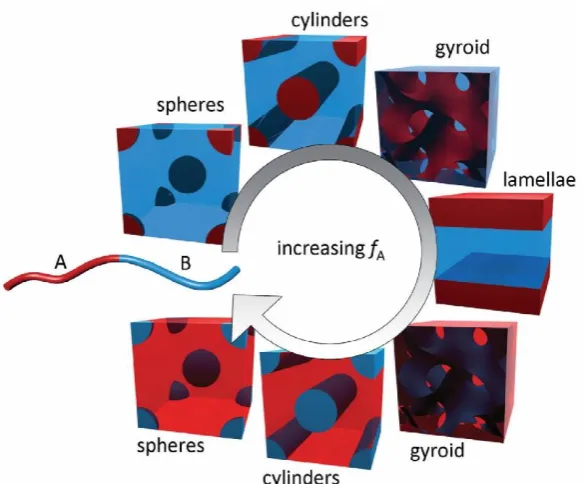
applications of resulting particulate materials. Within particles comprising two or more blocks
that are insoluble in the continuous phase, self-assembly is driven by polymer-polymer phase
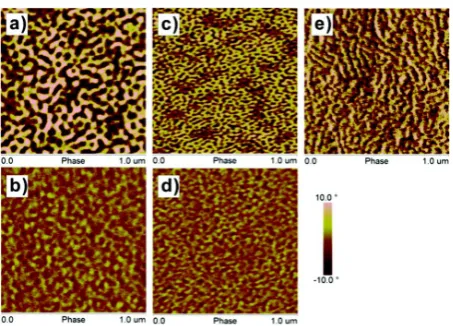
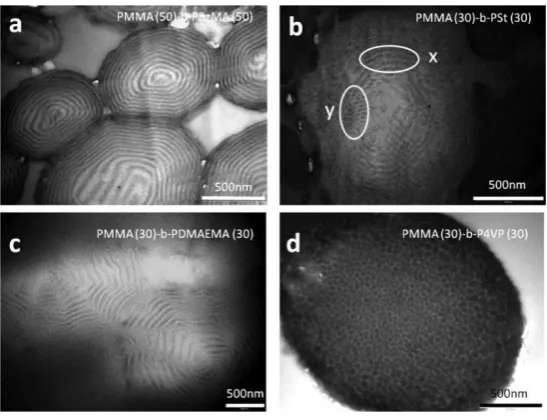
separation, leading to nanostructured particles of varying morphologies (Fig. 1). These systems
will be reviewed in Section 2. In amphiphilic block copolymer synthesis,
polymerisation-induced self-assembly (PISA)80-84 occurs, driven by the different solubility of the blocks in the
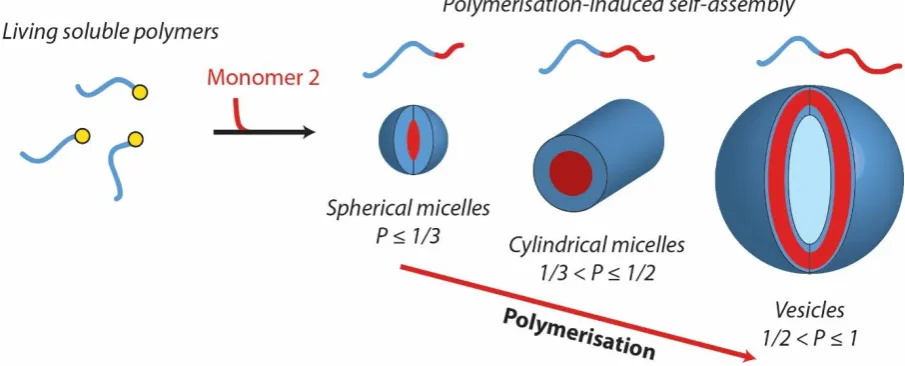
continuous phase, leading to a range of nano-objects such as spherical micelles, cylindrical
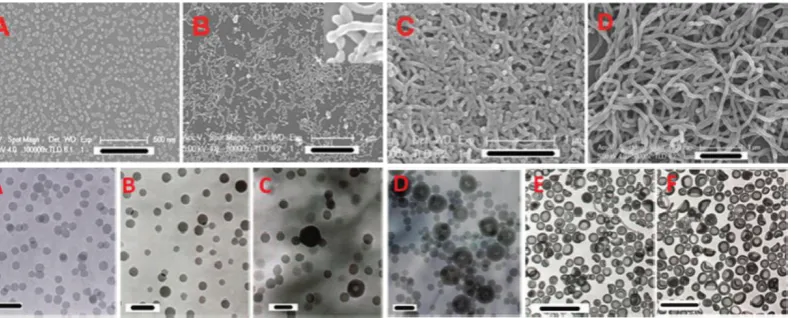
micelles, and vesicles (Fig. 2). PISA is an extension of ab initio emulsion (and more recently dispersion) CLRP in which synthesis and self-assembly of amphiphilic diblock copolymers
takes place in situ.67-69 This body of work will be reviewed in Section 3.
Figure 1: Schematic of a solvophobic block copolymer synthesis, in which two or more blocks
are insoluble in the continuous phase. The scheme depicts polymer-polymer microphase
separation taking place within block copolymer particles during polymerisation, above the
11
Figure 2: Schematic of the polymerisation-induced self-assembly (PISA) of amphiphilic block
copolymers upon polymerisation in a selective solvent. The final morphology depends on
numerous parameters, primarily the relative lengths of the solvophilic and solvophobic blocks,
which can be quantitatively estimated through the packing parameter, P = v / al, where v is the volume of the hydrophobic block and l its length, and a is the effective interfacial area of the block junction.
2. Synthesis and self-assembly of solvophobic block copolymers
As outlined in Section 1b, polymerisation in heterogeneous media maintains low
viscosity and good heat transfer throughout the polymerisation, such that sequential monomer
addition can be employed in one pot without purification steps: a truly advantageous aspect for
block copolymer synthesis over solution or bulk processes. The solvophobic route can produce
block copolymer particles with sizes ranging from 50 nm to 10 µm, usually much larger than
the length scale of a single block copolymer chain, and within which microphase separation
can occur (see discussion in Section 2e) leading to unique material properties and potentially
diverse applications. There are examples employing anionic dispersion polymerisation for the
synthesis block copolymers using alkanes as the continuous phase,85, 86 but we focus on the
studies adopting ATRP (and its analogues), RAFT/xanthate, NMP, and other CLRP methods,
which primarily use water or supercritical CO2 (scCO2) as the continuous phase.
Although a one-pot CLRP reaction is highly coveted from an industrial perspective,
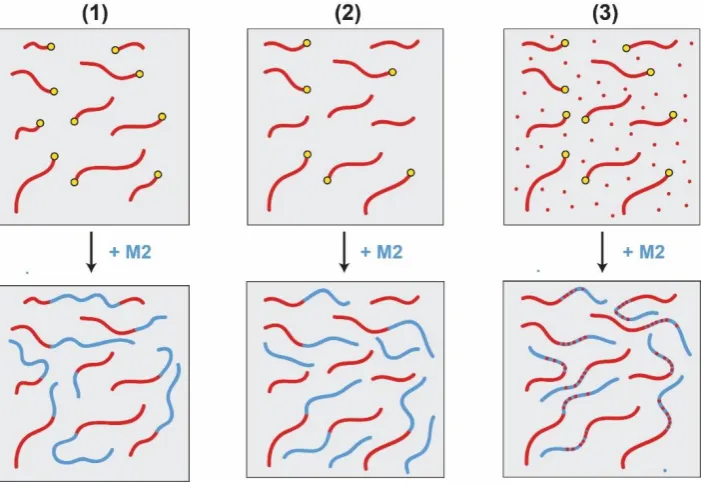
there are three main mechanistic limitations (Fig. 3): (1) The pseudo-living nature of CLRP
12
anionic routes; (2) radical-radical termination and chain transfer processes lead to the formation
of dead chains or initiation of new polymer chains that are not incorporated into the block
copolymer, which leads to loss of “blocking efficiency”; (3) unreacted monomers remaining at
each step copolymerise with subsequently added monomers, leading to block sequence impurity. Đ is determined by Gel Permeation Chromatography (GPC) and block purity can be
quantified through nuclear magnetic resonance (NMR) analysis, whilst there are numerous
chromatographic methods for quantifying blocking efficiency (which is usually defined as the
percentage of block copolymer chains against the total number of the polymer chains). These
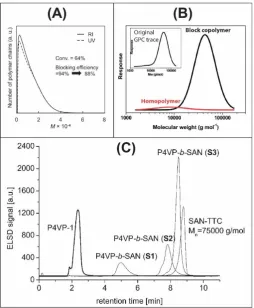
include dual detection modes during GPC analysis (Fig. 4A), deconvolution and integration of
different populations of chains in GPC traces (Fig. 4B), and HPLC-based separations (gradient
polymer elution chromatography (GPEC) and Liquid Adsorption Chromatography (LAC), Fig
4C). In the former, one block is invisible to the UV detector at a particular wavelength (e.g.
polybutadiene in polystyrene-block-polybutadiene, PSt-b-PBd), such that only the block
copolymer PSt-b-PBd is detected, while both PSt-b-PBd and homo-PS are detected by
refractive index (RI). The area of the UV peak relative to the RI peak in the number distribution
plots (number of chains vs molecular weight) can then be used to estimate the blocking
efficiency in terms of the number fraction (not mass fraction) of living chains.87 In addition,
2-dimensional approaches coupling LC and GPC have been developed as methods of detecting
different homopolymer and block copolymer species.88 Each method has its own assumptions
and drawbacks,89 and although we report values obtained from the different techniques in this
review, quantitative comparison between different studies should be treated with caution. It is
widely accepted that there is an intrinsic trade-off between the 3 types of purity from a one-pot
process, since reaching a higher conversion of monomer to increase block sequence purity leads to an increased propensity of the propagating radicals to undergo termination or chain transfer
reactions that lead to an increase in dispersity, the loss of livingness, and a lowering of blocking efficiency.
In this section, we review the range of conditions and techniques employed in
solvophobic block copolymer syntheses with a particular focus on strategies that maximise
purity (Sections 2a-2d), followed by a discussion of the consequences of impurities on resulting
block copolymer properties and applications (Section 2e). Table 1 summarises some
experimental results from the key papers in which block copolymers were synthesised under
solvophobic conditions using CLRP methods, mostly in one-pot procedures. As in the table,
13
Figure 3: Schematic depicting impurities that can arise from one-pot CLRP diblock copolymer
synthesis, in which second monomer (M2) addition takes place in situ: (1) a dispersity of chain lengths (Đ) caused by inhomogeneous chain growth and radical side reactions, (2) loss of
chain-end functionality, and growth of new chains leading to low blocking efficiency and (3) the presence of unreacted first monomer resulting in block sequence impurity in the second block. The yellow circles depict the living chain end afforded by CLRP techniques, which
14
[image:14.595.108.363.73.382.2]
Figure 4:Exemplary data from the most common chromatographic methods used to determine
blocking efficiency: (A) GPC dual detection, where only the block copolymer is visible by UV
detection, while both the block copolymer and homopolymer are visible by RI detection
(reproduced with permission from reference87, copyright RSC, 2012); (B) GPC deconvolution,
in which the GPC trace is split into multiple peaks comprising homopolymer and copolymer
(adapted with permission from reference90, copyright RSC, 2014); and (C) HPLC, GPEC or
LAC, in which homopolymers and copolymer are separated based on their different retention
times in gradient solvent mixtures (reproduced with permission from reference91, copyright
15
Table 1: Summary of conditions adopted for block copolymer syntheses conducted by CLRP under solvophobic conditions and resulting polymer characteristics.
Block copolymer Heterogeneous system CLRP method
Monomer Cv % (step 1, step 2
etc.) Final MW /kg mol-1 Final Đ Blockin g efficienc y
Dispersant ref
PnBuA-b-PSt Microemulsion/ab initio AGET ATRP 50, 63 26 1.3 n/r Brij 98 92
PiBMA-b-PSt Miniemulsion + seeded ATRP 99, 40 30 1.1 n/r Tween 80 93
PiBMA-b-PSt Miniemulsion + seeded ATRP 97, 90 52 1.26 n/r Tween 80 94
PiBMA-b-PSt Microsuspension AGET ATRP 71, 94 76 2.4 61 Brij 98 95
PiBMA-b-PSt Microsuspension AGET ATRP 80, 95 75 2.4 62 Brij 98 96
PFMA-b-PSt Microemulsion AGET ATRP 89, 73 14 1.19 n/r OP-10 97
PSt-b-PnBuA-b-PSt Ab initio emulsion AGET ATRP ~50, n/r 74 2.8 n/r CTAB 98 PSt-b-PnHA-b-PSt Ab initio emulsion AGET ATRP ~50, n/r 45 2.0 n/r CTAB 98 POEG300MA-b-POEG475MA Miniemulsionx AGET ATRP n/r, 85 69 1.30 n/r Span 80 99
PMMA-b-PFMA Dispersion* ATRP 90, 32 65 1.40 n/r PFMA-co-TEDETA 100
PAA-b-PSt Precipitation* ATRP 86, 60 68 8.21 25 None 101
PSt-b-(PBuA-co-PAAEMA) Ab initio emulsion RAFT >95, n/r n/r n/r 76 SDS 89
PBuA-b-PSt Ab initio emulsion RAFT >95, >95 n/r n/r 90 SDS 102
PSt-b-PnBuA Seeded emulsion RAFT 96, >95 20 1.3 90 SDS 103
PSt-b-PnBuA Microemulsion RAFT 95, 96 99 2.02 n/r SDS 104
PSt-b-PnBuA Miniemulsion RAFT 80, n/r 40 1.7 n/r SDS 105
PSt-b-PBuA Miniemulsion RAFT 90, 80 80 2.16 n/r Igapal® CO-990 106
PBuA-b-PSt Miniemulsion RAFT 88, 88 100 2.07 n/r Brij 98® 106
PSt-b-PnBuA-b-PSt Ab initio emulsion RAFT 92,95,96 131 2.36 >90‡ PAA-b-PSt-TTC 107
PSt-b-PnBuA Ab initio emulsion RAFT n/r, 91 139 2.17 >90‡ PAA-b-PSt-TTC 107
PSt-b-PnBuA-b-PSt Ab initio emulsion RAFT 95, 95, 97 95 1.54 n/r PAA-b-PSt-TTC 108
PSt-grad-PnBuA Ab initio emulsion RAFT 98, 97 91 1.58 >89‡ PAA-b-PSt-TTC 109
PSt-b-PnBuA-b-PSt Miniemulsion RAFT >95, >95 81 2.49 n/r PSt-b-PMA-DTB 110
PnBuA-b-PSt Miniemulsion RAFT >98, 97 75 2.0 n/r SDS 111
PVDC-b-PSt Ab initio emulsion RAFT 78, n/r 76 1.6 n/r PAA-b-PSt-TTC 112
PSt-b-PBd Miniemulsion RAFT 81, 24 63 2.84 >95‡ SDS 113
PBd-b-PSt Ab initio emulsion RAFT 76, 71 26 1.62 n/r PAA-b-PSt-TTC 114
PSt-b-PBd-b-PSt Miniemulsion RAFT 80, 30,30 90 2.73 >90‡ SDS 115
PSt-b-(PSt-co-PBd)-b-PBd Miniemulsion RAFT 53, 73 77 2.7 >>95 Potassium oleate 116
PMMA-b-PnBuA Ab initio emulsion RAFT 97, 100 116 3.26 n/r PMAA-b-PMMA-TTC 117
16
PMMA-b-P4VP Dispersion* RAFT >90, >90 68 1.98 n/r PDMS-MA 119
PMMA-b-PDMAEMA Dispersion* RAFT >90, 86 44 1.33 n/r PDMS-MA 119
PMMA-b-PDMA Dispersion* RAFT >90, >90 94 1.69 n/r PDMS-MA 119
PMMA-b-PSt Dispersion* RAFT >98, >90 55 1.40 57 PDMS-MA 120
PMMA-b-PBzMA Dispersion* RAFT >98, >90 92 1.24 76 PDMS-MA 120
PEEMA-b-PDMA Seeded precipitation* RAFT n/r, 40 15 1.27 n/r None 121
PEEMA-b-P4AM Seeded precipitation* RAFT n/r, 87 35 1.35 n/r None 121
PSt-b-PnBuA-b-PSt Miniemulsion NMP 89, 90 59 3.95 n/r Dowfax 8390 122
PSt-b-PnBuA-b-PSt Ab initio emulsion NMP 71, 85 51 1.64 >99 Dowfax 8390 122
PMMA-b-PnBuA-b-PMMA Ab initio emulsion NMP 60, 45 143 2.00 >95 Dowfax 8390 122
PSt-b-PnBuA Continuous miniemulsion NMP 99, 92 39 2.02 n/r SDBS 123
PSt-b-PnBuA-b-PSt Continuous miniemulsion NMP 99, 80, 90 58 2.30 n/r SDBS 123
PDMA-b-PNIPAM Precipitation/suspension* NMP n/r 31 1.63 n/r none 124
PtBuA-b-PNIPAM Precipitation/suspension* NMP n/r 35 1.31 n/r none 124
PSt-b-PNIPAM Precipitation/suspension* NMP 24, 51 31 1.63 n/r none 124
PMMA-b-PBzMA Miniemulsion RTCP 64, 64 12 1.4 88 TTAB 87
PnBuA-b-PtBuA Suspension Fe(II) 94, 92 25 1.41 n/r None 125
PnBuA-b-PSt Suspension Fe(II) 92, 80 28 1.22 n/r None 125
PtBuA-b-PSt Suspension Fe(II) 97, 63 35 1.40 n/r None 125
PnBuA-b-PSt Ab initio emulsion RITP 75, 52 16 1.8 n/r SHS 126
PnBuA-b-PSt Ab initio emulsion TERP 80, n/r 140 1.74 76 PMAA-TeMe 127
PSt-b-PMMA Dispersion* RTCP n/r, 70 12.5 2.05 75 PDMS-Azo 128
PVAc-b-PAN Precipitation/dispersion* CMRP 13, 77 48 2.01 n/r None 129
All polymerisations conducted with an aqueous medium as the continuous phase, except where specified; n/r = value not reported; *polymerisation conducted in scCO2; †polymerisation conducted in hexanes; xpolymerisation conducted in cyclohexane; ‡blocking efficiency value not measured experimentally but
17 2.a. ATRP
Min et al. were the first to employ Activators Generated by Electron Transfer (AGET) ATRP for the synthesis of poly(n-butyl acrylate)-b-polystyrene (PnBuA-b-PSt) in a two-step
ab initio emulsion.92 A small quantity of nBuA, ATRP initiator and catalyst were first formed into microemulsion micelles, and after initiation further nBuA was added to form droplets and
set up a traditional emulsion system. This strategy ensured that catalyst remained at the locus
of polymerisation within micelles (i.e. partitioning across the aqueous phase into monomer
droplets was minimised), and enabled the nBuA polymerisation to proceed with controlled
kinetics. After in situ St addition and resumption of polymerisation, a block copolymer with low Đ (1.3) and a high blocking efficiency (not quantified) was obtained. However, St was
added after low conversion of nBuA (50%), leading to low PSt block sequence purity since
nBuA and St formed a random copolymer. The group also had success in emulsion-based block
copolymer synthesis by preparing a macroinitiator in bulk polymerisation and chain extending
in dispersed conditions, but these multistep procedures will not be discussed here.130, 131
The Okubo group published multiple reports on poly(iso-butyl methacrylate)-b-PSt
(PiBuMA-b-PSt) synthesis using various forms of ATRP in aqueous emulsion.93-96 In their first
report, PiBuMA synthesis was controlled using copper bromide in a miniemulsion
polymerisation, before an emulsion of St was added to afford a seeded mechanism by swelling
of the particles generated in the first step.93 The PiBuMA-b-PSt MW agreed well with the
expected value, Đ was low (1.1) and blocking efficiency thought to be high based on qualitative
thin layer chromatography (TLC) analysis, but St conversion was low (40%). This issue was
addressed in their following study by optimising emulsifier (Tween 80) concentration used
during iBuMA polymerisation.94 At lower emulsifier concentration, large particles formed as a
result of coagulation, which led to poor monomer absorption into particles and low conversion,
whilst at high emulsifier concentration, the large interfacial area lead to escape of copper-ligand
complexes from the particles and low conversion. At an optimum 6-10 wt% emulsifier
concentration range, St conversion was high (>80%) whilst Đ remained low (ca. 1.25).
However, the slow St propagation by the ATRP route required excessive reaction time, which
was later addressed by adopting AGET ATRP miniemulsion.95 St polymerisation rate was
significantly enhanced in miniemulsion conditions, but block copolymer Đ was high (2.4) due
to a significant quantity of homo-PiBuMA and low blocking efficiency (<50%). By measuring
the fraction of living chains at different stages of polymerisation (using a GPC dual detection
18
stages of St polymerisation. Blocking efficiency was improved by reducing the ascorbic acid
concentration (which lowers radical concentration), and introducing St as an aqueous emulsion
rather than the monomer alone. In addition, the mixture of PiBuMA seed and St was stirred at
40 °C prior to heating to the final polymerisation temperature (70 °C), which was thought to
expedite the reinitiation step and lower the radical concentration in the early stage of
polymerisation. Integrating these steps increased the blocking efficiency to 61%, although St
was added after 71% iBuMA conversion, effecting low block sequence purity. The effect of St
polymerisation temperature on blocking efficiency in PiBuMA-b-PSt was studied in a
follow-up report,96 with values of 62, 58 and 51% resulting from 70, 90 and 110 °C, respectively. A
larger proportion of living chains to be reinitiated existed at lower temperature due to a reduced
termination rate. This series of studies from the Okubo group highlights that the conditions
during chain extension of the first block can influence blocking efficiency. Shu et al. also
adopted AGET ATRP with an aqueous continuous phase, to synthesise partially fluorinated
copolymers including poly(2,2,2-trifluoroethyl methacrylate-b-PSt (PFMA-b-PSt).97
Fluorinated monomers were polymerised in a microemulsion stabilised by an anionic
surface-active AGET ATRP initiator and chain extension with St took place in situ. The resulting block copolymers had low Đ (>1.15) and high block sequence purity (St added at 89% FMA
conversion). The high purity copolymer, superior to the above results by the Okubo group, may
be a result of the surface-active AGET ATRP initiator, or the use of a microemulsionsystem.
A rigorous study into a range of ligands and surfactants for AGET ATRP was performed
by Xue et al for the synthesis of PSt-b-PnBuA-b-PSt using a difunctional ATRP initiator.98 The
authors concluded that the most hydrophobic ligand (BPMODA), which partitioned less into
the aqueous phase, controlled polymerisation best (lower Đ). The surfactant
cetyltrimethylammonium bromide (CTAB) provided optimal colloidal stability without
interfering with polymerisation control due to its superior stability at higher temperature. The
group also found that control over n-hexyl acrylate (nHA) exceeded nBuA, which was again
ascribed to lower partitioning to the aqueous phase of the more hydrophobic monomer.
There are also reports of ATRP-controlled solvophobic block copolymer synthesis in
non-aqueous solvents. The research group of Matyjaszewski prepared POEG300MA-b-POEG475MA
(where OEGxMA is oligoethylene glycol methacrylate with monomer molar mass of x)
controlled by AGET ATRP in an inverse miniemulsion in cyclohexane at ambient temperature
(30 °C).99 PEG-Br or PEG-OH (end-functional polyethylene glycols) acted as cosurfactants to
19
(Đ <1.3) hydrophilic block copolymer particles were obtained. However, the synthesis was not
conducted in one pot, as POEG300MA was synthesised within an inverse emulsion, then
purified and re-emulsified in the presence of OEG475MA prior to chain extension.
Grignard et al. adopted scCO2 as the medium for AGET ATRP-controlled synthesis of
partially-fluorinated block copolymer poly(methyl methacrylate)-block-PFMA
(PMMA-b-PFMA).100 The dispersion polymerisation was stabilised by a fluorinated polyacrylate
containing triamine comonomer units (tetraethyldiethylenetriamine, TEDETA), which ligated
copper and enhanced the catalyst concentration at the polymerisation locus. With an optimal
number of TEDETA-functional units in the stabiliser (3), simultaneous control over
polymerisation kinetics and stabilisation of a PMMA dispersion was achieved. After addition
of FMA at high pressure and resumption of polymerisation, the resulting block copolymer
possessed low Đ (1.4). However, blocking efficiency was fairly low (as indicated by a low MW
homo-PMMA shoulder in the GPC trace), and the final MW deviated from the targeted value
in both PMMA and PMMA-b-PFMA, hinting that control and livingness were lower than in
RAFT-controlled block copolymer synthesis in scCO2 dispersion (vide infra). Minami et al.
also used scCO2, as a medium for reverse ATRP synthesis of poly(acrylic acid)-b-PSt
(PAA-b-PSt) in a precipitation polymerisation. This system enabled the use of a less air sensitive
copper (II) complex that was reduced by initiator to the corresponding copper (I) complex.101
The non-linear polymerisation kinetics and high Đ PAA (2) strongly suggested an uncontrolled
process. After depressurisation of the reactor, St was added and polymerised by a seeded direct
ATRP mechanism under scCO2 conditions. Block copolymer formation was evidenced by an
increase in molecular weight, but Đ was very high (8.2, analysed after methylation), and
blocking efficiency estimated to be 25%. The amphiphilic structure of the block copolymer
was demonstrated by emulsifying oil in water, which suggests that even these very low purity
block copolymers can yield useable materials.
2.b. RAFT
In contrast to ATRP, RAFT proceeds via a degenerative transfer mechanism in which the chain transfer agent (CTA) remains chemically bound to the growing polymer chain throughout
the polymerisation, thus potentially minimising detrimental effects of reagent partitioning. This
may explain why, to date, solvophobic block copolymer syntheses under RAFT control are
20
copolymers in aqueous conditions, although the recent expansion to non-aqueous systems
(hexanes, supercritical CO2) has widened the range of polymers accessible by solvophobic
RAFT-controlled synthesis.
Monteiro and coworkers pioneered solvophobic synthesis of block copolymers under
aqueous emulsion conditions, using low reactivity xanthates as control agents for the Pn
BuA-b-PSt system.89, 102-104 In their first study,102 PnBuA latexes with controlled MW and fairly low
Đ (1.6) were synthesised to high monomer conversion (95%) and swollen with an aliquot of St
overnight before polymerisation was reinitiated. The swelling step ensured time for diffusion
and homogeneous distribution of St throughout the PnBuA latex. The remaining volume of St
was added either in one batch or as a “starved feed” at a rate of 0.2 ml min-1, after which
resulting blocking efficiency was measured to be 70 or 90%, respectively (determined by GPC
dual detection). Following this, the group synthesised PSt-b-(PBuA-co-PAAEMA), (where
PAAEMA is polyacetoacetoxyethyl methacrylate) in an ab initio emulsion.89 BuA and PAAEMA were introduced to PSt particles as a pre-formed miniemulsion under batch or
starved feed conditions, which led to 65 and 76% blocking efficiency, respectively (as analysed
by GPEC). These dramatic differences in the blocking efficiency between batch and
feed conditions were attributed to lower radical entry efficiency into particles during
starved-feed, leading to fewer terminations and a greater proportion of living chains,102 and/or the
formation of more secondary particles under batch conditions.89 In a follow up study, the
authors reversed the block order and employed PMMA particles (d = 57 nm) to seed the
polymerisation of St, which overcame the colloidal instability of the ab initio emulsion and improved control over the particle size distribution.103 After synthesis of a PSt block with high
dispersity (Đ = 2, which was predicted for this xanthate-controlled St polymerisation),
unreacted St was extracted by dialysis and the particles were swollen overnight with a portion
of nBuA. The remaining nBuA was added by starved-feed at variable feed rates, and it was
found that block copolymer Đ decreased as feed rate decreased, to a minimum of ~1.3. High
blocking efficiency (>90%, determined by HPLC) was reported at low feed rate, even after
high St conversion (96%). The studies conducted by the Monteiro group emphasised that
processing conditions can be tailored to enhance control over polymerisation: simply lowering
the second monomer feed rate encourages simultaneous growth of all polymer chains. The
amphiphilic character of the xanthate CTAs was also reasoned to be beneficial to the control
and high blocking efficiency in these studies, reaffirming that CTA solubility is a non-trivial
21
An industrially-attractive continuous miniemulsion was employed by Smulders et al. for synthesis of PSt-b-PnBuA using a dithiocarbonate RAFT agent.105 By employing continuous
stirred tank reactors, and beginning with a St miniemulsion, flow rates between reactors could
be controlled in order to synthesise sophisticated polymers with multiple random copolymer
(PSt-co-PnBuA) blocks of variable composition. Residence times within the 4 reactors were
varied in order to control the conversion of St before addition to a nBuA macroemulsion. Initial
experiments afforded block copolymers with bimodal molecular weight distribution (MWD),
but lower Đ (down to 1.7) was achieved by taking St polymerisation to higher conversion (up
to 80%). The bimodal traces were attributed to secondary nucleation of nBuA particles and
subsequent polymerisation controlled by unreacted RAFT agent. This study hints at another
detrimental factor of unreacted monomer, not only in affecting the block sequence purity, but
also potentially the overall colloidal stability within the process.
A study by Bowes and coworkers highlighted the importance of monomer polymerisation
order and RAFT agent functionality under aqueous miniemulsion conditions, by comparing
synthesis of PnBuA-b-PSt, PSt-b-PnBuA and ABA triblock analogues (from the analogous
difunctional trithiocarbonates).106 In all cases, living chain growth was observed in the first
step, but deviations from theoretical MW were observed upon chain extension, and final block
copolymer Đ was high (2-2.5). Notably, blocking efficiency (measured by GPC dual detection)
was higher in PnBuA-b-PSt than PSt-b-PnBuA. The authors proposed that the slower nucleation
of PSt resulted in lower livingness than PnBuA, even though the polystyryl radical is a better
leaving group from a trithiocarbonate RAFT agent than the polyacrylate radical, which
suggests that a compromise between radical chemistry and colloidal stability must be
considered when selecting the order of polymerisation. Furthermore, higher Đ and lower
blocking efficiency were found in both ABA copolymers synthesised from a difunctional
RAFT agent, which was attributed to a mixture of polymers containing one or two RAFT
functionalities resulting from the first step of polymerisation.
There are a number of reports adopting continuous phase-soluble polymeric CTAs for
RAFT-controlled solvophobic block copolymer synthesis. The research group of Hawkett
employed a hydrophilic macro-RAFT agent (trithiocarbonate-functional PAA, PAA-TTC) to
overcome the earlier-discussed issues associated with particle nucleation in the ab initio
emulsion synthesis of PnBuA-b-PSt.132 After achieving >99% nBuA conversion, chain
extension with St led to block copolymer with qualitatively high blocking efficiency. Following
22
amphiphilicity into the CTA and to prevent the initial formation of droplets.133 The group
prepared PAA-b-PnBuA-b-PSt-b-PnBuA and PAA-b-PSt-b-P(nBuA-co-MMA) from
PAA-b-PnBuA-TTC and PAA-b-PSt-TTC macro-RAFT agents, respectively, although no
macromolecular characterisation was provided to compare to their earlier study. Luo et al. also adopted PAA-b-PSt-TTC as a macro-RAFT agent and surfactant in a sequential aqueous
emulsion route to PSt-b-PnBuA-b-PSt (SBAS).107 The controlled synthesis of PSt resulted in
lower Đ (1.2-1.5) than in the RAFT studies discussed above, suggesting that colloidal
instability and nucleation issues were minimised by using an amphiphilic macro-RAFT agent.
Đ increased significantly (up to 3) upon polymerisation of nBuA, which was ascribed to the
onset of phase separation within the particles, attendant with a lower mobility and chain transfer
constant of the polymeric RAFT agent. Despite this high Đ, controlled polymerisation was
resumed upon addition of further St to afford SBAS copolymers with Đ mostly >2 (and
dependent on total molecular weight). Each block proceeded to high conversion (>90%), and
the authors estimated a high blocking efficiency (>93% by theoretical calculation), which was
qualitatively supported by GPC dual detection analysis. In a following study, the factors
leading to large Đ values in SBAS were investigated.108 Decreasing the charge on the PAA
segment of the macro-RAFT agent led to lower block copolymer Đ (down to 1.4), which was
attributed to a higher entry efficiency of radicals from the aqueous phase increasing termination
of midchain radicals that would otherwise lead to branches. The Luo research group expanded
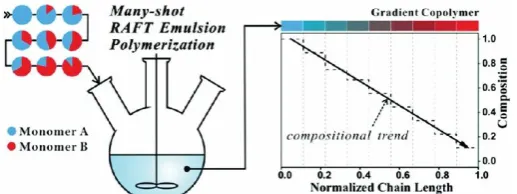
on the amphiphilic macro-RAFT agent strategy to synthesise gradient SBAS copolymers using
a “many-shot” approach.109 After polymerisation of the initial St emulsion, 8 different ratios of
St/nBuA were added at different time intervals, with increasing nBuA fractions. High monomer
conversion (>95%) was allowed before addition of subsequent shots, which afforded
PSt-grad-PnBuA and PSt-grad-PnBuA-grad-PSt copolymers with low Đ (1.3-1.6) and block-like
character. The short reaction times required in each step facilitated high blocking efficiency,
23
Figure 5: Schematic of the “many-shot approach” to the synthesis of gradient copolymers in a
one-pot RAFT emulsion polymerisation. Reproduced with permission from reference109,
copyright RSC, 2014.
Zhan et al. used polymeric RAFT agents comprising thio-ester functional hydrophilic St-alt-maleic anhydride (SMA) copolymers to control the synthesis of SBAS under miniemulsion
conditions by sequential monomer addition.110, 134 A dramatic increase in Đ was observed
during nBuA polymerisation, and attributed to the increasing viscosity within the particle. The
final block copolymer Đ varied from 2.5 up to 3.75 as a function of SMA-RAFT MW (2 to 15
kg mol-1), which was explained by the more embedded RAFT functionality leading to a lower
transfer constant and an increased number of dead chains formed (calculated to be <10% at
each step). Yang et al. exploited both strategies of an amphiphilic polymeric RAFT agent (PDMA-b-(PnBuA-co-PGlMA), where GlMA is glycidyl methacrylate) and starved feed
addition of monomers in the miniemulsion RAFT synthesis of PnBuA-b-PSt.111 Whilst control
over MW was good in all stages, Đ increased to ca. 2-3 during St polymerisation. The studies
also disclosed a significant effect of target molecular weight on purity: much higher Đ was
obtained when targeting higher MW polymers, perhaps an effect of the block copolymer phase
separation that was observed within the particles (vide infra).
A number of studies have focussed on the synthesis of St-butadiene block copolymers
(known as SBS in their triblock form), which are benchmark thermoplastic elastomer materials
that are commercially synthesised by solution-phase anionic polymerisation.135 Wei et al.
demonstrated aqueous miniemulsion synthesis of PSt-b-PBd controlled by a dithioacetate.113
After well-controlled St polymerisation, the resulting PSt latex was swollen in Bd for 2 h before
polymerisation was resumed. With increasing Bd conversion, Đ rapidly increased until the
polymer became cross-linked, due to the inevitable side reactions of PBd. However, based on
the rapid St polymerisation, it was hypothesised that livingness and therefore blocking
24
ab initio emulsion polymerisation, with the aim of averting cross-linking.114 Using a series of PAA-b-PSt-TTC macro-RAFT agents, it was determined that an optimum PAA length (27
units) provided good colloidal stabilisation whilst minimising the inhibition period in Bd
polymerisation. PBd with low MW was targeted to avoid cross-linking, from which chain
extension with St afforded reasonably well controlled PAA-b-PSt-bPBd-b-PSt (Đ = 1.62),
although GPC data suggested blocking efficiency was not high. Authors from the same group
later exploited miniemulsion RAFT to synthesise PSt-b-PBd-b-PSt with high MW (ca. 100 kg
mol-1), and avoided cross-linking by arresting the Bd polymerisation at 30% conversion.115
Although they calculated dead chain fraction to be low (>10%), block sequence purity was
lower and branching of PBd led to high Đ (2.7-2.8). Froimowicz et al. developed a “non-stop” miniemulsion RAFT route to the triblock PBd-b-PSt-b-PBd from a difunctional
trithiocarbonate, thus reducing the number of polymerisation steps.116 Bd was added before
polymerisation of the central St block was complete, and polymerisation immediately resumed.
The resulting block copolymers had very high blocking efficiency (no homopolymer detectable
by HPLC), but at the expense of low block sequence purity. However, above ~53% St
conversion, the presence of homo-PSt became measureable by HPLC. In addition, the authors
avoided cross-linking until 70% Bd conversion, which hints at a more controlled
polymerisation than by Wei et al,113 who encountered a gel point at 25% Bd conversion at
comparable MW. This may be the result of the trithiocarbonate RAFT agent (which is more
commonly employed to control Bd polymerisation than dithioacetates136) or the
copolymerisation of St and Bd averting cross-linking. A more recent study by Wang et al.
supports this latter conclusion, where cross-linking was avoided by adding a mixture of St and
Bd monomers to a PSt miniemulsion, affording PSt-b-(PSt-co-PBd) copolymer with low Đ
(1.5) from a dithioacetate-controlled process.137
Some groups have investigated monomers beyond the most common styrene-butyl acrylate
and styrene-butadiene-based polymers. Yanget al prepared the tetrablock copolymer PAA-b-PSt-b-PVDC-b-PSt by chain extending PAA-b-PSt-TTC macro-RAFT with vinylidene
chloride (VDC) and St.112 Deprotonating PAA by adding NaOH during polymerisation of VDC
(but not before initiation) was found to be a key step to ensuring emulsion stability and
polymerisation control, as it was thought to prevent desorption of initiating radicals. The final
block copolymer had fairly low Đ (1.6), although the appearance of a shoulder in GPC traces
25
initio emulsion polymerisation starting from a PMAA-b-PMMA-TTC macro-RAFT agent. MMA was rapidly polymerised to high conversion, and PMMA Đ (1.5) was found to be higher
than from macro-RAFT agents containing PSt or PnBuA blocks in the reports discussed above,
which was attributed to a non-uniform distribution of RAFT agents between particles. Block
copolymer Đ was very high (>3.2) due to PnBuA branching, but blocking efficiency appeared
to be good based on GPC dual detection.
Studies adopting non-aqueous systems for RAFT-controlled synthesis of solvophobic
block copolymers are fewer in number, but demonstrate extension of the concept to a wider
range of polymer structures. For example, Sogabe et al. established an inverse microemulsion route to a dimethyl acrylamide (DMA)-diethylacrylamide (DEAA) triblock copolymer
(PDMA-b-PDEAA-b-PDMA) from a difunctional trithiocarbonate in hexanes.118 A low
concentration of dispersed aqueous phase was necessary to achieve good colloidal stability of
the initial microemulsion, but this resulted in a long induction period and loss of control. By
increasing the number of RAFT agents per particle, low MW copolymer (<20 kg mol-1) with
high block sequence purity (DMA conversion 95% upon DEAA addition) and very low Đ (1.07)
was produced, but MW deviated from theoretical values, which was explained by partitioning
of the RAFT agent.
The research group of Howdle conducted RAFT-controlled block copolymer synthesis in
scCO2 using a CO2-soluble trithiocarbonate to synthesise PSt,
PMMA-b-poly(benzyl methacrylate) (PMMA-b-PBzMA), PMMA-b-poly(N,N-dimethylaminoethyl
methacrylate) (PMMA-b-PDMAEMA), PMMA-b-poly(4-vinylpyridine) (PMMA-b-P4VP)
and PMMA-b-PDMA.119, 120, 138 PMMA particles were synthesised in a dispersion
polymerisation stabilised by monomethacrylate-functional polydimethylsiloxane (PDMS-MA),
before the second monomer was added under pressure (with or without additional initiator) and
the polymerisation immediately resumed. Block copolymer Đ was low for PMMA-b-PBzMA
and PMMA-b-PDMAEMA (1.2-1.5) but higher for PMMA-b-PSt, PMMA-b-P4VP and
PMMA-b-PDMA (1.5-2.5). The latter observation could be explained by the tendency for
termination by combination in St, 4VP and DMA polymerisations, resulting in a population of
high MW chains. Blocking efficiency was estimated using a number of chromatographic
methods, and found to be highly sensitive to RAFT:initiator ratio used in PMMA synthesis,
block copolymer target MW and the identity of the second block. With the lowest initiator
concentration, and at lower target MW (60 kg mol-1), the highest blocking efficiency was
26
compared favourably with theoretical calculations based on estimates for the fraction of
RAFT-functional PMMA chains.120 PMMA-b-PSt copolymers had lower blocking efficiencies (<59%)
due to a significant quantity of homo-PSt chains formed as a result of high initiator
concentrations that were adopted in St polymerisations to enable full conversion from the
slower propagating monomer. These blocking efficiencies were relatively high, considering
the near-quantitative conversion of the PMMA block (>90%) and high block sequence purity
(proven by 1H NMR analysis). The efficiency of the process was attributed to the plasticisation
of polymer particles and high diffusivity afforded by scCO2, which would facilitate monomer
access to the living chain ends. Hawkins et al. exploited scCO2 in a precipitation
polymerisation during the second step of block copolymer synthesis.121 DTB-functional
poly(2-ethoxyethyl methacrylate) (PEEMA) was first prepared in solution then dissolved in
monomer (DMA or 4-acrylomorpholine, 4AM). CO2 was added and the mixture heated into
the supercritical state, upon which the monomer swollen macro-RAFT particles precipitated
from solution and polymerisation began. The resulting block copolymers displayed relatively
low Đ (<1.38), and blocking efficiency was equivalent to when conducting the chain extension
in solution. The high pressure of scCO2 was exploited to flush the reactor post-polymerisation,
and as with most optimised syntheses in scCO2, polymers were monomer-free powders
requiring no further purification.
2.c. NMP
The group of Charleux first reported block copolymer synthesis via NMP in aqueous
miniemulsion.139, 140 In their first study, an alkoxyamine-functional poly(methylacrylate)
initiator (PMA-SG1, where SG1 is N-tert-butyl-N-(1-diethylphosphono-2,2-dimethylpropyl) nitroxide) was employed to control nBuA polymerisation (up to 80% conversion), and high
MW PSt and hexadecane were included to prevent Ostwald ripening. The emulsion was
swollen overnight with St before reinitiation, and the resulting PnBuA-b-PSt had near
quantitative blocking efficiency (measured by LAC analysis) and low Đ (1.27). The authors
noted that the reverse block copolymer (PSt-b-PnBuA) prepared by the same method had higher
Đ and lower blocking efficiency. The group later developed a more industrially-relevant ab
27
block and either PSt or PMMA outer blocks (using a difunctional initiator).122 The influence
of nBuA conversion before St addition was evident in ab initio synthesis of PnBuA-b-PSt, with enhanced blocking efficiency and lower Đ being achieved when St was added at lower nBuA
conversion (55% vs. 81%), but at the expense of block sequence purity. PSt-b-PnBuA-b-PSt prepared under ab initio conditions displayed lower block copolymer Đ than miniemulsion (1.64 vs. 3.95) and a high blocking efficiency (no detectable homo-PnBuA by LAC), although block sequence purity was lower. PMMA-b-PnBuA-b-PMMA prepared under ab initio
conditions had a higher Đ than PSt-b-PnBuA-b-PSt (2 vs. 1.64) and a comparable high blocking
efficiency (95%), even though SG1-controlled polymerisation of MMA alone is not usually
well-controlled.141 In contrast to the study by Bowes et al. that compared monofunctional and difunctional RAFT agents,106 the difunctional alkoxyamine permitted an overall higher
blocking efficiency than the monofunctional analogue (and comparable Đ). Furthermore,
miniemulsion polymerisation permitted a more living process leading to higher blocking
efficiencies than ab initio, although with very high Đ, which highlights that control within the different classes of emulsion polymerisation varies.
In an effort towards more industrially-viable aqueous NMP-controlled solvophobic block
copolymer syntheses, Enright et al. conducted miniemulsion NMP in a continuous tubular reactor to synthesise PSt-b-PnBuA and PSt-b-PnBuA-b-PSt.123 To accelerate polymerisation
and ensure high conversion, ascorbic acid was added to consume free nitroxide. However,
diblock and triblock Đ was high (~2), and there appeared to be significant dead homopolymer
contamination. Blocking efficiency could be improved by decreasing the reaction time and
monomer conversion at each step.
O’Connor et al. utilised scCO2 as an alternative medium for a two-pot NMP-controlled
synthesis of PDMA-b-PNIPAM, PAA-b-PNIPAM and PSt-b-PNIPAM.124 Polymerisation of
DMA, tert-butyl acrylate (tBuA) or St by SG-controlled precipitation NMP in scCO
2 led to
polymers with Đ ranging from 1.13-1.23. After being purified by precipitation into hexane,
chain extension with NIPAM was conducted in a suspension polymerisation in scCO2, which
proceeded in a controlled manner. Block copolymer Đ (measured after purification) was lowest
in PtBuA-b-PNIPAM and highest in PDMA-b-PNIPAM (from 1.3 to 2.1). Additional SG1
agent was a key component in the polymerisation, and served to counteract reagent partitioning
into the continuous phase and loss of control. This study reaffirms the versatility of scCO2 as