A bias-corrected exploratory and confirmatory factor analysis of right-wing authoritarianism: Support for a three-factor structure
Kenneth I. Mavor
The Australian National University email: [email protected],
Winnifred R. Louis The University of Queensland
Chris G. Sibley University of Auckland
This is the final submitted manuscript version. The full citation of the work is:
Mavor, K. I., Louis, W. R., & Sibley, C. G. (2010). A bias-corrected exploratory and confirmatory factor analysis of right-wing authoritarianism: Support for a three-factor structure. Personality and Individual Differences, 48(1), 28-33.
The version of record can be found at the following address:
http://www.sciencedirect.com/science/article/pii/S0191886909003547 OR
A bias-corrected exploratory and confirmatory factor analysis of right-wing authoritarianism: Support for a three-factor structure
Abstract
The factor structure of Right-Wing Authoritarianism (RWA) remains a contentious issue. Although designed to measure three underlying attitude clusters, aggression, submission and conventionalism, many items are deliberately double- or triple-barrelled, to capture the covariation of the three clusters in a unidimensional scale. Additionally, although the scale is balanced, there is an item-direction bias in the clusters; aggression items are pro-trait, and conventionalism items are con-trait. Subscale structure is therefore potentially confounded with acquiescence bias. Although RWA as a unitary construct has been an effective tool for exploring prejudice, it would be useful in many cases to measure its underlying components directly. Proposed solutions to this problem include creating short-form scales as subsets of the original scale, or modifying items to simplify and un-confound the structure. We present convergent evidence of an underlying factor structure by considering one-, two- and three-factor solutions to the uncorrected scale and then using an indirect method to correct for acquiescence bias. Before and after correction, factor analysis supported a three-factor solution. Confirmatory factor analyses also support a three-factor solution compared to a one-factor solution.
A bias corrected exploratory and confirmatory factor analysis of right-wing authoritarianism: Support for a three-factor structure
Right-Wing Authoritarianism (RWA; Altemeyer, 1981, 1988, 1996) has been shown to be an important predictor of political and social attitudes (e.g., Altemeyer, 1996, 2004; Crowson, DeBacker, & Thoma, 2005; Heaven & St. Quintin, 2003; Mirisola, Sibley, Boca, & Duckitt, 2007) and represents a measure of political
conservatism focusing on resistance to change (Jost, Glaser, Kruglanski, & Sulloway, 2003; Ray, 1985). A major conceptual issue currently facing researchers in this area is the underlying dimensionality of the construct. RWA is conceptualised and measured as a unidimensional scale representing the covariation of three underlying
components: authoritarian aggression, authoritarian submission, and conventionalism. There are a number of situations however in which it is useful or necessary to be able to consider the components separately.
Research on the relationship between authoritarianism and attitudes to: homosexuality, women’s equality, and conservative attitudes to sexuality, for
example, may be distorted by inclusion of these issues within the construct definition and measurement of authoritarianism. Researchers have noted possible consequences ranging from simple inflation of correlations (Whitley & Lee, 2000) to spurious regression coefficients (Mavor, Macleod, Boal, & Louis, 2009).
Together, these issues have made it very difficult to show the underlying structure of the scale using either exploratory or confirmatory factor analysis methods (Funke, 2005). While some researchers have tackled the issue of the complex item structure (e.g., Funke, 2005; Manganelli Rattazzi, Bobbio, & Canova, 2007), our main goal will be to complement these other approaches by addressing the confound due to item wording direction. We believe that this will provide convergent evidence of the underlying structure of the scale and encourage more researchers to explore authoritarianism at the component level of analysis.
Given that Altemeyer (1981) conceptualised the scale as uni-dimensional, it initially seemed sufficient to balance the overall scale with pro-trait (positively worded) and con-trait (negatively worded, reverse-scored) items. However, in that process, items that primarily tap the aggression component ended up being worded in a pro-trait direction, and items representing the conventionalism component were worded in a con-trait direction. Submission items are both positively and negatively worded, but are mostly double-barrelled items also capturing some of the other components (Duckitt & Fisher, 2003; Funke, 2005).
Summated rating scales can be susceptible to distortions in responding such as acquiescence bias (Ferrando, Lorenzo-Seva, & Chico, 2003); the tendency for
nonetheless tend to ignore factor solutions where the items heavily divided into pro-trait and con-pro-trait factors. This is the interpretation that Altemeyer has given to two-factor solutions of the RWA scale:
I have a definite hypothesis about the factor structure of the RWA scale, namely, that it is essentially uni-dimensional. So I can take advantage of common factor analysis' ability to tell me if I am wrong.
Over the years, my common factor analyses have sometimes produced just one factor on which most of the items have appreciable loadings, or else two factors that correlate .40 - .70 when oblique rotations are performed. … The one factor, or two factors together, account for about 25-35% of the total variance of the RWA scale. …
Two factors seemingly disconfirm my hypothesis that the RWA scale measures basically one thing. But the two factors were well correlated. Furthermore, … all the protrait items (save one) loaded higher on one factor, and all the contraits had their higher loading on the other. … when we pull the common variance apart, the best we can do is get the portrait and contrait items into largely separate piles. (Altemeyer, 1996, pp. 53-54).
However, given that there are three clusters theorised within RWA, it makes sense to consider a three-factor solution. If the scale is really unidimensional, and the second factor is due to acquiescence bias, then a third factor should not show any particular meaningful pattern. An interpretable three-factor solution however would support the contention that the two-factor pattern was due to a meaningful
aggression/conventionalism distinction rather than merely pro- versus con-trait items. Funke (2005) modelled a method factor in a confirmatory factor analysis of the RWA scale, as well as trying to deal with the multi-barrelled nature of many items. The combination of these two issues made it impossible to obtain satisfactory models using the original items, and Funke instead designed new items that were less
dimensionally complex, and balanced within each component. Other researchers have used short-form component scales based on the original RWA items (e.g., Duncan, Peterson, & Winter, 1997; Smith & Winter, 2002).
The approach we have taken is to analyse the original RWA scale to address the alternative factor-analysis hypothesis directly, and then attempt to control for
and the RWA items can be corrected accordingly. Exploratory factor analyses on the corrected item correlations should then be a better test of the dimensionality of the scale. If the emergence of two or more factors in RWA were based only on
acquiescence bias then a single clear factor should emerge from the corrected matrix. If the scale does have a real underlying multi-factor structure then this should emerge clearly in the corrected correlation matrix.
Method
Participants
Participants were 545 New Zealand undergraduates (258 men, 287 women; Mage = 27.9, SDage = 17.0). Four hundred and two participants, self-identified as New Zealand European, 40 as Asian, and 32 as Maori (61 identified as other/unreported).
Materials and Procedure
Participants completed the 16-item version of the SDO scale (Pratto, et al., 1994), and the full 30-item version of the RWA scale (Altemeyer, 1996) as part of a mass testing session. All items were rated on a scale ranging from -3 (strongly disagree) to 3 (strongly agree).
Results
Overview of Analyses
examine factor analyses on the corrected matrices. We then constructed item parcels for RWA to test confirmatory factor models for one versus three factor solutions.
Factor analysis of the uncorrected RWA scale
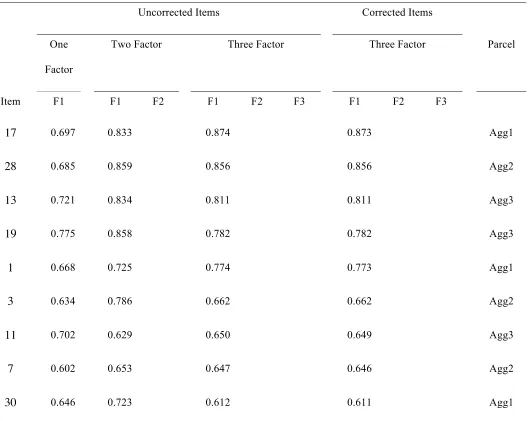
To consider Altemeyer’s (1996) argument about the factor solution of the scale, we report the one, two, and three-factor solutions in Table 1. (Item numbering comes from the Altemeyer [1996] scale, after removing the first four practice items.
Therefore add four to identify the appropriate item in Altemeyer [1996].) We used a principal axis factoring method of factor extraction, and a Promax rotation method (Tabachnick & Fidell, 2001). The first four eigenvalues were 11.03, 3.17, 1.40, and 1.15. The first eigenvalue represents a large proportion of the variance and is consistent with a one-factor solution, but also with a higher-order factor with correlated sub-scales. The two-factor solution replicates the ambiguous common pattern with pro-trait (aggression) items loading on one factor, and con-trait (conventionalism) items on the other.
(Conventionalism); and “Obedience and respect for authority are the most important virtues children should learn” (Submission).
For completeness we extended the analysis one step beyond the theorised three-factor structure. In the four-three-factor solution, the submission three-factor splits into two as a result of the many items with complex loadings. Since the complex structure of submission was already captured in the three-factor solution in a theoretically coherent way, we did not consider the four-factor solution further.
This analysis suggests that the two and three factor solutions have a substantive interpretation. The third (submission) factor is less well defined because few items are simple submission items. The scale contains a number of items that mix
submission with aggression or conventionalism, and some of these items have higher loadings with the more heavily represented aggression and conventionalism
components. Nonetheless, the existence of the interpretable three-factor solution provides preliminary evidence that real differences in the components of RWA are a more likely explanation of the factor results than acquiescence bias.
Measuring acquiescence bias in the SDO scale
We tested the hypothesis that acquiescence bias was responsible for the two-factor configuration by measuring acquiescence bias in the SDO scale and statistically removing it from the RWA items. Exploratory factor analysis of the 16 SDO items showed a two-factor solution interpretable as a result of acquiescence bias, with con-trait items appearing on the first factor, pro-con-trait items appearing on the second, and a correlation of .48 between the factors. This provides a good basis from which to estimate any acquiescence effect in this sample.1
All 16 SDO items were rescaled as z-scores. The SDO scale score was computed by taking the mean of the 8 pro-trait items, and the 8 reverse-scored con-trait items. The acquiescence bias score was computed by taking the mean of all 16 items (i.e., without reversing the con-trait items). This measures the extent to which participants tended to consistently agree (or disagree) with all items irrespective of item direction. The measure of bias was uncorrelated with the SDO scale (r= .044, n.s.). A composite RWA score, computed from all 30 RWA items (reverse scoring as appropriate), correlated significantly with the SDO scale (r=.367, p<.001) but not with the acquiescence bias measure (r=.035, n.s.).
Factor analysis of the bias-corrected RWA scale
Nonetheless, the 30 residual variables were treated as bias-corrected RWA items and were used for the subsequent factor analysis, using principal axis factoring and a promax rotation. The first four eigenvalues remain essentially the same after correction (11.03, 3.16, 1.40, 1.15). Since the analyses remained essentially the same, we present only the three-factor solution for the corrected items (Table 1). As before, the three factors represent aggression, conventionalism, and submission.
In summary, exploratory factor analyses were consistent with a three-factor interpretation of the RWA scale. Our data show the common two-factor
configuration reported by Altemeyer (1996) but three patterns argue against
Altemeyer’s interpretation: (1) The single factor solution is not balanced across the three components, but is dominated by Aggression items; (2) The three-factor solution is clearly interpretable; (3) After correcting for an estimate of acquiescence bias based on a similar balanced construct in the same sample, the factor analyses do not change.
Taken together these findings clearly indicate that the commonly found two-factor solution should be interpreted as a substantive solution and not a measurement artefact due to acquiescence bias (see also Duckitt & Fisher, 2003). As a final test, we combined RWA items based on the three-factor solution to create item parcels and compared two confirmatory factor analysis models using SEM.
Confirmatory factor analysis of one versus three factor solutions
Item parcelling was used in the confirmatory models in order to focus our attention on the higher order structure rather than on trivial patterns based on
4 items respectively) consisting of a mixture of strongly and weakly loading items. Many other items demonstrated complex loading on two dimensions, and in particular items on the submission factor often showed complex loadings. We constructed a 3-item parcel of 3-items with simple loadings on the submission factor, and three
additional parcels representing complex loading combinations of Submission (2 items), Conventionalism-Submission (3 items), and Aggression-Conventionalism (1 items). The allocation to items to parcels that we used is shown in Table 1.
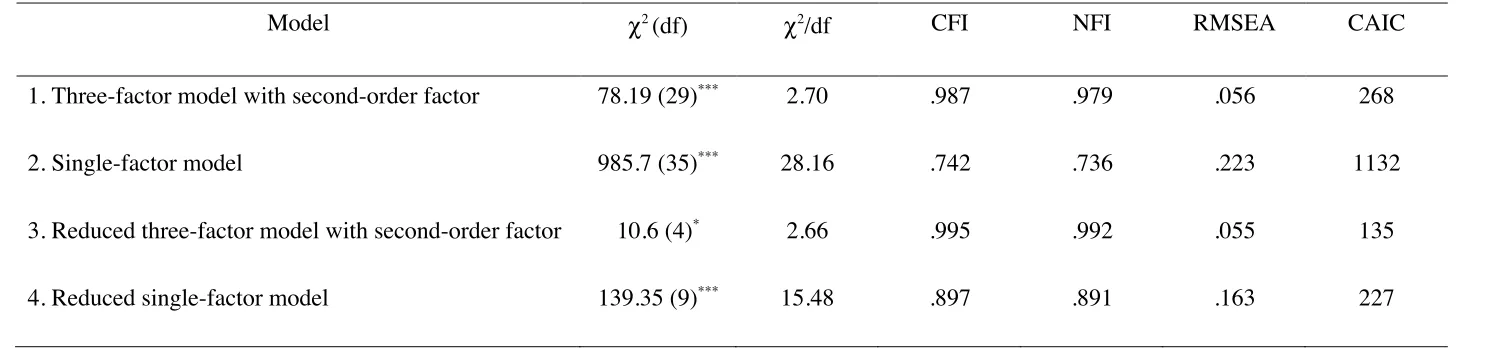
The resulting 10 parcels were used to test the confirmatory factor models. This number of parcels allows each potential factor to be identified, and allows sufficient degrees of freedom in the model to test the two crucial configurations: a hierarchical model with three sub-scales and a single higher-order factor (Model 1, see Figure 1), and a simple single factor model (Model 2, see Figure 2). Model fit statistics are shown in Table 2. Model 1 and 2 both have significant χ2
values, but Model 1 shows generally acceptable fit statistics (CFI and NFI > .95 and RMSEA close to .05). The CAIC statistic is particularly useful for comparing non-nested models, with lower values representing more parsimonious fit. The single factor solution is clearly not supported, with a χ2
value an order of magnitude higher than the three-factor model. and very poor fit statistics.
only one simple parcel representing each of the three factors, and three complex-loading parcels (mixtures of aggression, conventionalism and submission).
Using these parcels, a one-factor solution is quite plausible (Model 4, see Figure 2). If the underlying RWA construct were unidimensional then these would all share the same common variance. At the same time, the three-factor solution is
undermined, since each factor has only one pure indicator and they share the
remaining three complex indicators (Model 3, see Figure 1). Indeed to fit this model, the loadings to the complex indicator of submission and conventionalism had to be fixed to be equal in order to obtain a stable solution, further handicapping this model. In spite of this attempt to create the optimal context to find support for a single-factor solution, the three-factor model remained clearly superior (See Table 2).
Discussion
There is growing support for the idea that RWA is best understood as a
composite of three underlying factors rather than as a unidimensional measure. Some researchers have simply assumed this tridimensionality and created face-valid short-forms with subscales (e.g., Smith & Winter, 2002). Other researchers have created short-form subscales by changing the original RWA items to eliminate the complex-loading items and balancing item direction within each subscale to avoid
These prior approaches require creating or using a shorter form of the RWA scale and/or rewording items. The methods used to create these scales may, however, be subject to some distortion. Face valid item choice may inadvertently include items that we found empirically to cross-load, or which may not be optimal to distinguish the separate components. Statistical methods removing items with residual
correlations may also arbitrarily remove items that may be good indicators of the separate constructs. Our goal was to complement these approaches and findings by testing a three-factor solution on the full 30-item scale; tackling the acquiescence bias issue directly to remove any such effect from the items using multiple regression; and finally using confirmatory factor models to test the one-factor and three-factor
hypotheses.
items and conventionalism items. This real difference is likely to overwhelm what is typically a very small bias based on item directionality. The weight of past evidence together with our current analysis shows that acquiescence bias is a trivial influence in the responses to the RWA scale (Nunnally, 1978; Rorer, 1965).
Our results support an argument in favor of a three-dimensional model of RWA. On their own, each of the studies that have taken different approaches to the
dimensionality issue can be argued to be incomplete in some way. However, when considered together, with our analyses complementing those previously published, we believe that the evidence is now conclusive in favor of RWA as a higher-order
construct representing three conceptually and empirically distinct dimensions. With that in mind, the next step is to develop a new version of the RWA scale that is more balanced at all levels, with both pro- and con-trait items within each of the sub-scales, and a better representation of items from each dimension. Funke (2005) has made a start in this direction, but further work is needed. In current RWA scales, the
submission dimension is under-represented both overall, and in items that load simply on that one factor. It is still plausible to have complex-loading items to try to capture Altemeyer’s original interest in the covariation of the dimensions, since modern CFA and SEM methods can acceptably model complex item loadings as we have shown here.
Notes
References
Altemeyer, B. (1981). Right-wing authoritarianism. Winnipeg, Canada: University of
Manitoba Press.
Altemeyer, B. (1988). Enemies of Freedom: Understanding Right-Wing
Authoritarianism. San Francisco: Jossey-Bass.
Altemeyer, B. (1996). The Authoritarian Specter. Cambridge, Massachusetts: Harvard
University Press.
Altemeyer, B. (2004). Highly dominating, highly authoritarian personalities. The
Journal of Social Psychology, 144(4), 421-447.
Crowson, H., DeBacker, T. K., & Thoma, S. J. (2005). Does authoritarianism predict
post-9/11 attitudes? Personality and Individual Differences, 39(7), 1273-1283.
Duckitt, J. (2001). A dual-process cognitive-motivational theory of ideology and
prejudice. In M. P. Zanna (Ed.), Advances in experimental social psychology
(Vol. 33, pp. 41-113). New York: Academic Press.
Duckitt, J., & Fisher, K. (2003). The impact of social threat on worldview and
ideological attitudes. Political Psychology, 24, 199-222.
Duncan, L. E., Peterson, B. E., & Winter, D. G. (1997). Authoritarianism and gender
roles: Toward a psychological analysis of hegemonic relationships.
Personality & Social Psychology Bulletin, 23, 41-49.
Ferrando, P. J., Lorenzo-Seva, U., & Chico, E. (2003). Unrestricted Factor Analytic
Unidimensional Personality Scales. Multivariate Behavioral Research Vol
38(3) Jul 2003, 353-374.
Funke, F. (2005). The Dimensionality of Right-Wing Authoritarianism: Lessons from
the Dilemma between Theory and Measurement. Political Psychology, 26(2),
195-218.
Heaven, P. C., & St. Quintin, D. (2003). Personality factors predict racial prejudice.
Personality and Individual Differences, 34(4), 625-634.
Jost, J. T., Glaser, J., Kruglanski, A. W., & Sulloway, F. J. (2003). Political
conservatism as motivated social cognition. Psychological Bulletin, 129(3),
339-375.
Jost, J. T., & Thompson, E. P. (2000). Group-based dominance and opposition to
equality as independent predictors of self-esteem, ethnocentrism, and social
policy attitudes among African Americans and European Americans. Journal
of Experimental Social Psychology, 36, 209-232.
Levin, S., Federico, C., M., Sidanius, J., & Rabinowitz, J., L. (2002). Social
dominance orientation and intergroup bias: The legitimation of favoritism for
high-status groups. Personality and Social Psychology Bulletin, 28(2),
144-157.
Little, T. D., Cunningham, W. A., Shahar, G., & Widaman, K., F. (2002). To parcel or
not to parcel: Exploring the question, weighing the merits. Structural Equation
Modeling, 9(2), 151-173.
Manganelli Rattazzi, A. M., Bobbio, A., & Canova, L. (2007). A short version of the
Right-Wing Authoritarianism (RWA) Scale. Personality and Individual
Mavor, K. I., Macleod, C. J., Boal, M. J., & Louis, W. R. (2009). Right-wing
authoritarianism, fundamentalism and prejudice revisited: Removing
suppression and statistical artefact. Personality and Individual Differences, 46,
592-597.
Mirisola, A., Sibley, C. G., Boca, S., & Duckitt, J. (2007). On the ideological
consistency between right-wing authoritarianism and social dominance
orientation. Personality and Individual Differences, 43(7), 1851-1862.
Nunnally, J. C. (1978). Psychometric theory (2nd ed.). New York: McGraw Hill.
Pratto, F., Sidanius, J., Stallworth, L. M., & Malle, B. F. (1994). Social dominance
orientation: A personality variable predicting social and political attitudes.
Journal of Personality & Social Psychology, 67(4), 741-763.
Ray, J. J. (1985). Defective validity in the Altemeyer Authoritarianism scale. The
Journal of Social Psychology, 125(2), 271-272.
Rorer, L. G. (1965). The great response-style myth. Psychological Bulletin, 63(3),
129-156.
Smith, A., G., & Winter, D. G. (2002). Right-wing authoritarianism, party
identification, and attitudes toward feminism in student evaluations of the
Clinton-Lewinsky story. Political Psychology, 23(2), 355-383.
Tabachnick, B. G., & Fidell, L. S. (2001). Using multivariate statistics (4th ed.).
Boston: Allyn and Bacon.
Whitley, B. E., Jr., & Lee, S. E. (2000). The relationship of Authoritarianism and
related constructs to attitudes toward homosexuality. Journal of Applied Social
Table 1: RWA factor loadings for items uncorrected, and corrected for acquiescence bias.
Uncorrected Items Corrected Items
One
Factor
Two Factor Three Factor Three Factor Parcel
Item F1 F1 F2 F1 F2 F3 F1 F2 F3
17 0.697 0.833 0.874 0.873 Agg1
28 0.685 0.859 0.856 0.856 Agg2
13 0.721 0.834 0.811 0.811 Agg3
19 0.775 0.858 0.782 0.782 Agg3
1 0.668 0.725 0.774 0.773 Agg1
3 0.634 0.786 0.662 0.662 Agg2
11 0.702 0.629 0.650 0.649 Agg3
7 0.602 0.653 0.647 0.646 Agg2
24 0.701 0.710 0.489 0.403 0.488 0.404 AS
22 0.557 0.371 0.253 0.462 0.307 0.461 0.311 AC
8 0.600 0.562 0.370 0.353 0.366 0.352 AS
21r 0.598 0.746 0.784 0.786 Conv1
15r 0.563 0.792 0.781 0.78 Conv2
10r 0.468 0.728 0.728 0.726 Conv3
2r 0.660 0.674 0.641 0.642 Conv2
18r 0.525 0.676 0.625 0.631 Conv3
16r 0.455 0.623 0.605 0.603 Conv1
12r 0.541 0.650 0.572 0.201 0.574 Conv3
6r 0.580 0.554 0.563 0.56 Conv1
27r 0.388 0.599 0.519 0.522 Conv2
9r 0.530 0.456 0.448 0.446 Conv2
4r 0.596 0.229 0.457 0.222 0.438 0.219 0.444 Conv1
26 0.485 0.583 0.288 -0.21 0.543 0.286 -0.21 0.542 Sub1
25r 0.472 0.464 0.307 0.536 0.308 0.536 SC
29r 0.537 0.201 0.417 0.291 0.430 0.286 0.436 SC
5 0.507 0.375 0.393 0.393 Sub1
20r 0.603 0.279 0.411 0.302 0.376 0.298 0.381 SC
14 0.462 0.422 0.219 0.375 0.219 0.375 Sub1
Table 2. Model comparisons for confirmatory factor models using item parcels
Model χ2
(df) χ2
/df CFI NFI RMSEA CAIC
1. Three-factor model with second-order factor 78.19 (29)***
2.70 .987 .979 .056 268
2. Single-factor model 985.7 (35)***
28.16 .742 .736 .223 1132
3. Reduced three-factor model with second-order factor 10.6 (4)*
2.66 .995 .992 .055 135
4. Reduced single-factor model 139.35 (9)***
15.48 .897 .891 .163 227
Notes:
* p<.05; *** p<.001
Model fit is indicated by non-significant χ2 ; χ2
Figure Captions
Figure 1: Three-factor model with second-order RWA factor (Model 1). Solid lines
and second figures apply to reduced model (Model 3).
Figure 2: Single-factor model (Model 2). Solid lines and second figures apply to