Calculating Correct Compilers
PATRICK BAHR
Department of Computer Science, University of Copenhagen, Denmark
GRAHAM HUTTON
School of Computer Science, University of Nottingham, UK
Abstract
In this article we present a new approach to the problem of calculating compilers. In particular, we develop a simple but general technique that allows us to derive correct compilers from high-level semantics by systematic calculation, with all details of the implementation of the compilers falling naturally out of the calculation process. Our approach is based upon the use of standard equational reasoning techniques, and has been applied to calculate compilers for a wide range of language features and their combination, including arithmetic expressions, exceptions, state, various forms of lambda calculi, bounded and unbounded loops, non-determinism, and interrupts. All the calculations in the article have been formalised using the Coq proof assistant, which serves as a convenient interactive tool for developing and verifying the calculations.
1 Introduction
The ability tocalculate compilershas been a key objective in the field of program transfor-mation since its earliest days. Starting from a high-level semantics for a source language, the aim is to transform the semantics into acompilerthat translates source programs into a lower-leveltarget language, together with avirtual machinethat executes the resulting tar-get programs. There are two important advantages of this approach. Firstly, the definitions for the compiler, target language and virtual machine are systematically derivedduring the transformation process, rather than having to be manually defined by the user. And secondly, the resulting compiler and virtual machine do not usually require subsequent proofs of correctness, as they arecorrect by construction(Backhouse, 2003).
The idea of calculating compilers in this manner has been explored by a number of authors; for example, see Wand (1982a); Meijer (1992); Ageret al.(2003b). However, it has traditionally been viewed as an advanced topic that requires considerable knowledge and experience with concepts such as continuations and defunctionalisation (Reynolds, 1972). In this article, we show that compilers can in fact be calculated in a simple and straightforward manner, without the need for such techniques, using standard equational reasoning. Our new approach builds upon previous work in the area, and focuses specifi-cally on compilers that target stack-based virtual machines.
of the compiler and the virtual machine byconstructive induction(Backhouse, 2003), using the desire to apply the induction hypotheses as the driving force for the calculation process. While our approach avoids direct use of continuations and defunctionalisation, these con-cepts are nonetheless useful for explaining the underlying ideas, and for comparing to other work in the literature. Therefore, we present our approach in two stages, firstly introducing the basic ideas in a series of transformation steps that include the use of continuations and defunctionalisation, and then showing how these steps can be combined into a single step that calculates directly from the compiler specification.
The techniques that we use are all well-known. Our contribution is to show how they can be applied in a novel manner to give a new approach to calculating compilers that is both simple and generally applicable. It has been used to calculate compilers for a wide range of language features and their combination, including arithmetic expressions, exceptions, local and global state, various forms of lambda calculi, bounded and unbounded loops, non-determinism and interrupts. A key ingredient for the scalability of our approach is the use ofpartial specificationsto avoid predetermining implementation decisions. For example, the specification of a compiler for a language with exceptions may not stipulate how the compiler should behave when the result is an uncaught exception, as this requires up-front knowledge about how exceptions are to be implemented. Rather, the details of this behaviour are determined during the calculation process itself.
We develop our approach gradually. We introduce the basic methodology using a simple expression language, starting with a stepwise calculation, which we then combine into a single calculation (section 2). Subsequently, we refine the methodology as we apply it to languages of increasing complexity: the use of partial specifications is demonstrated on a language with exceptions (section 3); the use of configurations is demonstrated on a language with state (section 4); and finally the use of rule induction for dealing with non-compositional semantics is demonstrated on a lambda calculus (section 5).
All our programs and calculations are written in Haskell, but we only use the basic concepts of recursive types, recursive functions, and inductive proofs. Whereas in many articles calculations are often omitted or compressed for brevity, in this article they are the central focus, so they are presented in detail. All the calculations have also been mechanically verified using the Coq proof assistant, and the proof scripts are available as online supplementary material at dx.doi.org/xxxx, together with all Haskell code and an appendix that covers an additional example.
2 Arithmetic Expressions
To introduce our approach, we begin by considering a simple language of arithmetic ex-pressions comprising integer values and an addition operator:
dataExpr=Val Int|Add Expr Expr
2.1 Step 1 – Define the semantics
The semantics for our expression language is most naturally given by defining a function that simply evaluates an expression to an integer value:
eval ::Expr→Int eval(Val n) =n
eval(Add x y) =eval x+eval y
Note that the definition for evalis compositional, in the sense that the semantics of addition is given purely in terms of the semantics of its two argument expressions. With a view to using simple inductive proof methods, we will typically aim to define our semantics in such a compositional manner. However, this may not always be possible, and in section 5 we will see an example that uses a non-compositional semantics.
2.2 Step 2 – Transform into a stack transformer
The next step is to transform the evaluation function into a version that utilises a stack, in order to make the manipulation of argument values explicit. In particular, rather than returning a single value of typeInt, we seek to derive a more general evaluation function, evalS, that takes a stack of integers as an additional argument, and returns a modified stack given by pushing the value of the expression onto the top of the stack. More precisely, if we represent a stack as a list of integers (where the head is the top element)
typeStack= [Int]
then we seek to derive a function
evalS::Expr→Stack→Stack
such that:
evalSx s = eval x:s (1)
The operator : is the list constructor in Haskell, which associates to the right. For example, m:n:sis the list obtained by prepending two elementsmandnto the lists.
Rather than first defining the functionevalS and then separately proving by induction that it satisfies the above equation, we aim tocalculatea definition forevalSthat satisfies the equation byconstructive induction(Backhouse, 2003) on the expressionx, using the desire to apply the induction hypotheses as the driving force for the calculation process.
Specifically, we will start with the termevalSx sand gradually transform it by equational reasoning. The goal is to arrive at a termtsuch that we can takeevalSx s=tas a defining equation for evalS. We do this by induction on the expression x, so we have to do a calculation for each case ofx. In the base case,Val n, the calculation is easy:
evalS(Val n)s
= {specification (1)} eval(Val n):s
= {define:pushSn s=n:s} pushSn s
Note that in the final step we defined an auxiliary function,pushS, that captures the idea of pushing a number onto the stack. With the above calculation we have discovered the definition ofevalSfor expressions of the formVal n, namely:
evalS(Val n)s=pushSn s
In the inductive case,Add x y, we proceed as follows:
evalS(Add x y)s
= {specification (1)} eval(Add x y):s
= {definition ofeval}
(eval x+eval y):s
Now we appear to be stuck, as no further definitions can be applied. However, as we are performing an inductive calculation, we can make use of the induction hypotheses for the two argument expressionsxandy, namely:
evalSx s0=eval x:s0 evalSy s0=eval y:s0
In order to use these hypotheses, it is clear that we must push the valueseval xandeval y onto the stack, which can readily be achieved by introducing another auxiliary function, addS, that captures the idea of adding together the top two numbers on the stack. The remainder of the calculation is then straightforward:
(eval x+eval y):s
= {define:addS(n:m:s) = (m+n):s} addS(eval y:eval x:s)
= {induction hypothesis fory} addS(evalSy(eval x:s))
= {induction hypothesis forx} addS(evalSy(evalSx s))
Note that pushingeval xonto the stack beforeeval yin this calculation corresponds to the addition operator evaluating its arguments from left-to-right. It would be perfectly valid to push the values in the opposite order, which would correspond to right-to-left evaluation. In conclusion, we have calculated the following definition
evalS ::Expr→Stack→Stack evalS(Val n)s =pushSn s
evalS(Add x y)s=addS(evalSy(evalSx s))
where
addS ::Stack→Stack addS(n:m:s) = (m+n):s
Finally, our original evaluation functionevalcan now be recovered from our new func-tion by substituting the empty stack into equafunc-tion (1) from whichevalSwas constructed, and selecting the unique value in the resulting singleton stack:
eval :: Expr→Int eval x=head(evalSx[ ])
We conclude by noting that introducingpushSandaddSmay seem rather unnecessary at this point, and indeed, the above calculation can be performed without them. But we will see that subsequent steps are based on being able to encapsulate such operations as functions. However, the issue of when we need to introduce new definitions will become clear when the separate steps are combined together in section 2.5.
2.3 Step 3 – Transform into continuation-passing style
The next step is to transform the new functionevalSintocontinuation-passing style(CPS) (Reynolds, 1972), in order to make the flow of control explicit. In particular, we seek to derive a more general evaluation function,evalC, that takes a function from stacks to stacks (the continuation) as an additional argument, which is used to process the stack that results from evaluating the expression. More precisely, if we define a type for continuations
typeCont=Stack→Stack
then we seek to derive a function
evalC::Expr→Cont→Cont
such that:
evalCx c s = c(evalSx s) (2)
We calculate the definition forevalCdirectly from this equation by constructive induction on the expressionx. The base case is once again easy,
evalC(Val n)c s
= {specification (2)} c(evalS(Val n)s)
= {definition ofevalS} c(pushSn s)
while for the inductive case we calculate as follows:
evalC(Add x y)c s
= {specification (2)} c(evalS(Add x y)s)
= {definition ofevalS} c(addS(evalSy(evalSx s)))
(c◦addS) (evalSy(evalSx s))
= {induction hypothesis fory} evalCy(c◦addS) (evalSx s)
= {induction hypothesis forx} evalCx(evalCy(c◦addS))s
In conclusion, we have calculated the following definition:
evalC ::Expr→Cont→Cont evalC(Val n)c s =c(pushSn s)
evalC(Add x y)c s=evalCx(evalCy(c◦addS))s
Our previous evaluation functionevalScan then be recovered by substituting the identity continuation into equation (2) from whichevalCwas constructed:
evalS ::Expr→Cont evalSx=evalCx(λs→s)
The notationλx→eis Haskell syntax for a lambda abstraction, in whichxis the name of the bound variable and the expressioneis the body.
2.4 Step 4 – Transform back to first-order style
The final step is to transform the evaluation function back into first-order style, using the technique of defunctionalisation (Reynolds, 1972). In particular, rather than using functions of typeCont=Stack→Stackfor continuations passed as arguments and returned as results, we define a datatype that represents the specific forms of continuations that we actually need for the purposes of our evaluation function.
Within the definitions forevalS andevalC, there are only three forms of continuations that are used, namely one to invoke the evaluator, one to push an integer onto the stack, and one to add the top two values on the stack. We begin by separating out these three forms, by giving them names and abstracting over their free variables. That is, we define three combinators for constructing the required forms of continuations:
haltC ::Cont haltC =λs→s
pushC ::Int→Cont→Cont pushCn c=c◦pushSn
addC ::Cont→Cont addCc =c◦addS
Using these combinators, our evaluation functions can now be rewritten as follows:
evalS ::Expr→Cont evalSx =evalCx haltC
evalC ::Expr→Cont→Cont evalC(Val n)c =pushCn c
It is easy to check by unfolding definitions that these definitions are equivalent to the pre-vious versions. The next stage in applying defunctionalisation is to define a new datatype, Code, whose constructors represent the three combinators. We write the definition in gen-eralised algebraic datatype (GADT) style to highlight the correspondence:
dataCodewhere HALT::Code
PUSH::Int→Code→Code ADD ::Code→Code
The types for the constructors in this definition are obtained simply by replacing occur-rences of Contin the types for the combinators byCode. The use of the nameCodefor the type reflects the fact that its values represent code for a virtual machine that evaluates arithmetic expressions using a stack. For example,PUSH1(PUSH2(ADD HALT))is the code that corresponds to the expressionAdd(Val1) (Val2).
The fact that values of typeCoderepresent continuations of typeContis formalised by the functionexec, which maps the former to the latter:
exec ::Code→Cont
exec HALT =haltC
exec(PUSH n c) =pushCn(exec c)
exec(ADD c) =addC(exec c)
By expanding out the definitions for the typeContand its three combinators, we see that execis a first-order, tail recursive function that executes code using an initial stack to give a final stack. That is,execis a virtual machine for executing code:
exec ::Code→Stack→Stack
exec HALT s =s
exec(PUSH n c)s =exec c(n:s)
exec(ADD c) (n:m:s) =exec c((m+n):s)
Finally, defunctionalisation itself proceeds by replacing occurrences of the combinators pushC, addC and haltC in the evaluation functions evalS and evalC by their respective counterparts from the datatypeCode, which results in the following two definitions:
comp :: Expr→Code
comp x =comp0x HALT
comp0 :: Expr→Code→Code comp0(Val n)c =PUSH n c
comp0(Add x y)c=comp0x(comp0y(ADD c))
Note that the code produced by our compiler is not a sequence of instructions, the form that one would typically associate with machine code. Rather, the code is in a form called continuation-passing style notation(Appel, 1991). This representation of code was first used in early compilers for Scheme (Steele, 1978; Adamset al., 1986), and has proved to be beneficial for implementing optimising compilers (Appel, 1991). Despite sharing the same name, one should not confuse code represented in this style with the continuation-passing style semantics in section 2.3. In the former, continuations are represented symbolically, whereas in the latter continuations are functions.
The correctness of the compilation functionscompandcomp0is captured by the follow-ing two equations, which are consequences of defunctionalisation, or can be verified by simple inductive proofs on the expression argument:
exec(comp x)s=evalSx s
exec(comp0x c)s=evalCx(exec c)s
In order to understand these equations, we expand their right-hand sides using the original specifications (1) and (2) for the new evaluation functions, to give:
exec(comp x)s=eval x:s
exec(comp0x c)s=exec c(eval x:s)
The first equation now states that executing the compiled code for an expression produces the same result as pushing the value of the expression onto the stack, which establishes the correctness ofcomp. In turn, the second equation states that compiling an expression and then executing the resulting code together with additional code gives the same result as executing the additional code with the value of the expression on top of the stack, which establishes the correctness ofcomp0. These are the same correctness conditions as used by Hutton (2007, Chapter 13), except that they are now satisfiedby construction.
2.5 Combining the transformation steps
We have now shown how a compiler for simple arithmetic expressions can be developed using a systematic four-step process, which is summarised below:
1. Define an evaluation function in a compositional manner;
2. Calculate a generalised version that uses a stack;
3. Calculate a further generalised version that uses continuations;
4. Defunctionalise to produce a compiler and a virtual machine.
In order to simplify the above stepwise process, let us first consider the types and functions that are involved in more detail. We started off by defining a datatypeExprthat represents the syntax of the source language, together with a functioneval::Expr→Int that provides a semantics for the language, and a datatypeStackthat corresponds to a stack of integer values. Then we derived four additional components:
• A datatypeCodethat represents the code for the virtual machine;
• A functioncomp::Expr→Codethat compiles expressions to code;
• A functioncomp0::Expr→Code→Codethat also takes a code continuation; • A functionexec::Code→Stack→Stackthat provides a semantics for code.
Moreover, the relationships between the semantics, compilers and virtual machine were captured by the following two correctness equations:
exec(comp x)s=eval x:s (3)
exec(comp0x c)s=exec c(eval x:s) (4) The key to combining the transformation steps is to use these two equations directly as aspecificationfor the four additional components, from which we then aim to calculate definitions that satisfy the specification. Given that the equations involve three known definitions (Expr,evalandStack) and four unknown definitions (Code,comp,comp0, and exec), this may seem like an impossible task. However, with the benefit of the experience gained from our earlier calculations, it turns out to be straightforward.
We begin with equation (4), and proceed by constructive induction on the expressionx. In each case, we aim to rewrite the left-hand sideexec(comp0x c)sof the equation into the formexec c0sfor some codec0, from which we can then conclude that the definition comp0x c=c0 satisfies the specification in this case. In order to do this we will find that we need to introduce new constructors into theCodetype, along with their interpretation by the functionexec. In the base case,Val n, we proceed as follows:
exec(comp0(Val n)c)s
= {specification (4)} exec c(eval(Val n):s) = {definition ofeval}
exec c(n:s)
Now we appear to be stuck, as no further definitions can be applied. However, recall that we are aiming to end up with an expression of the formexec c0sfor some codec0. That is, in order to complete the calculation we need to solve the equation:
exec c0s = exec c(n:s)
Note that we can’t simply use this equation as a definition forexec, because the variablesn andcwould be unbound in the body of the definition. The solution is to package these two variables up in the code argumentc0by means of a new constructor in theCodedatatype that takes these two variables as arguments,
and define a new equation forexecas follows:
exec(PUSH n c)s=exec c(n:s)
That is, executing the codePUSH n cproceeds by pushing the valuenonto the stack and then executing the codec, hence the choice of the name for the new constructor. Using these ideas, it is now straightforward to complete the calculation:
exec c(n:s)
= {definition ofexec} exec(PUSH n c)s
The final expression now has the formexec c0s, where c0=PUSH n c, from which we conclude that the following definition satisfies specification (4) in the base case:
comp0(Val n)c=PUSH n c
For the inductive case,Add x y, we begin in the same way as above by first applying the specification and the definition of the evaluation function:
exec(comp0(Add x y)c)s
= {specification (4)} exec c(eval(Add x y):s) = {definition ofeval}
exec c(eval x+eval y:s)
Once again we appear to be stuck, as no further definitions can be applied. However, as we are performing an inductive calculation, we can make use of the induction hypotheses for the two argument expressionsxandy, namely
exec(comp0x c0)s0=exec c0(eval x:s0)
exec(comp0y c0)s0=exec c0(eval y:s0)
In order to use these hypotheses, it is clear that we must pusheval xandeval yonto the stack, by transforming the expression that we are manipulating into the formexec c0(eval y: eval x:s)for some codec0. That is, we need to solve the equation
exec c0(eval y:eval x:s) = exec c(eval x+eval y:s)
First of all, we generalise from the specific valueseval xandeval yto give:
exec c0(m:n:s) = exec c((n+m):s)
Once again, however, we can’t simply use this equation as a definition forexec, this time because the variablecis unbound in the body. The solution is to package this variable up in the code argumentc0by means of a new constructor in theCodedatatype
ADD::Code→Code
and define a new equation forexecas follows:
That is, executing the codeADD cproceeds by adding the top two values on the stack and then executing the code c, hence the choice of the name for the new constructor. Using these ideas, the remainder of the calculation is straightforward:
exec c(eval x+eval y:s) = {definition ofexec}
exec(ADD c) (eval y:eval x:s) = {induction hypothesis fory}
exec(comp0y(ADD c)) (eval x:s) = {induction hypothesis forx}
exec(comp0x(comp0y(ADD c)))s
The final expression now has the formexec c0s, from which we conclude that the following definition satisfies the specification in the inductive case:
comp0(Add x y)c=comp0x(comp0y(ADD c))
Note that as in section 2.2, we chose to transform the stack into the formeval y:eval x:s. We could equally well have chosen the opposite order,eval x:eval y:s, which would have resulted in right-to-left evaluation forAdd. We have this freedom in the calculation because the semantics defined byevaldoes not specify an evaluation order.
Finally, we complete the development of our compiler by considering the functioncomp:: Expr→Code, whose correctness was specified by equation (3). In a similar manner to equation (4), we aim to rewrite the left-hand side exec(comp x)s of the equation into the form exec c sfor some code c, from which we can then conclude that the definition comp x=c satisfies the specification. In this case there is no need to use induction as simple calculation suffices, during which we introduce a new constructorHALT::Codein order to transform the expression being manipulated into the required form:
exec(comp x)s
= {specification (3)} eval x:s
= {define:exec HALT s=s} exec HALT(eval x:s) = {specification (4)}
exec(comp0x HALT)s
In conclusion, we have calculated the following definitions:
dataCode =HALT|PUSH Int Code|ADD Code
comp ::Expr→Code
comp x =comp0x HALT
comp0 ::Expr→Code→Code
comp0(Val n)c =PUSH n c
comp0(Add x y)c =comp0x(comp0y(ADD c))
exec ::Code→Stack→Stack
exec(PUSH n c)s =exec c(n:s)
exec(ADD c) (m:n:s) =exec c((n+m):s)
These are precisely the same definitions as we produced in the previous section, except that they have now been calculated directly from a specification of compiler correctness, rather than indirectly by means of a series of separate transformation steps.
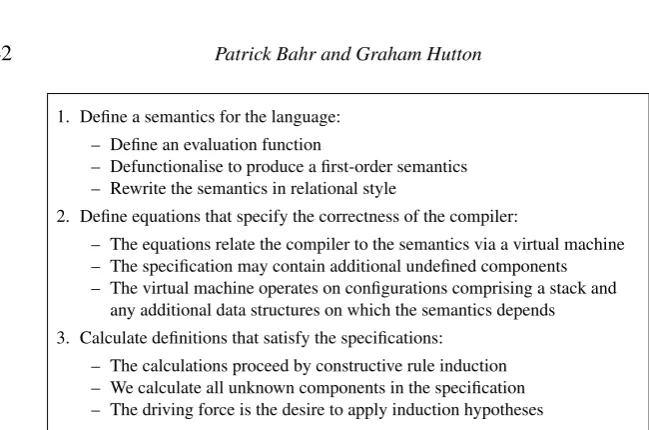
In summary, we have shown how a compiler for simple arithmetic expressions can be developed using a combined three-step approach, which is summarised below:
1. Define an evaluation function in a compositional manner;
2. Define equations that specify the correctness of the compiler;
3. Calculate definitions that satisfy these specifications.
Our full methodology for calculating compilers is given at the end of the article in figure 1 on page 42. For the purpose of exposition, however, we will introduce the details of the general approach step-by-step using example languages of increasing complexity, gradually refining our approach as we progress. These refinements to the methodology should not be confused with its application to calculate correct compilers.
2.6 Reflection
We conclude this section with some reflective remarks on our original and combined approaches to calculating a compiler for arithmetic expressions, together with some com-ments on the relationship between derivations and proofs.
Simplicity The original approach required the use of continuations and defunctionali-sation, which are traditionally regarding as being ‘advanced’ concepts, and may not be familiar to some readers who may be interested in calculating compilers. In contrast, the combined approach only uses simple equational reasoning techniques, in the form of constructive induction on the syntax of the source language.
Directness The original approach was driven by the desire to define generalised versions of the semantics for the source language, and the correctness of the resulting compiler arose indirectly as a consequence of the use of defunctionalisation. In contrast, the combined approach starts directly from the compiler correctness equations, from which the goal is then to calculate definitions that satisfy these equations. The use of equations of this form to express and then prove compiler correctness can be traced back to the pioneering work on compiler verification by McCarthy & Painter (1967).
Similarity The calculations in the combined approach proceed in a very similar manner to those in the original approach. Indeed, if we combine the original steps that introduce a stack and continuation into a single step by means of the specification
then the calculations have precisely the same structure, except that in the original ap-proach we introduce continuation combinators that are defunctionalised to code construc-tors, whereas in the combined approach we introduce the code constructors directly. The correspondence also becomes syntactically evident if we use an infix operator, say $$, for the functionexec. Then the specification forcomp0in the combined approach becomes
comp0x c$$s = c$$(eval x:s) (6)
which has the same structure as specification (5) above forevalC, except that we use $$ rather than function application (itself sometimes written as infix $), comp0 rather than evalC, and code rather than continuations. Using these specifications, the two calculations then become essentially the same. To illustrate this point, the base cases are shown side-by-side below; the inductive cases are just as similar.
evalC(Val n)c s
= {specification (5)} c(eval(Val n):s) = {definition ofeval}
c(n:s)
= {define:push n c s=c(n:s)} push n c s
comp0(Val n)c$$s
= {specification (6)} c$$(eval(Val n):s) = {definition ofeval}
c$$(n:s)
= {define:PUSH n c$$s=c$$(n:s)} PUSH n c$$s
Mechanisation Eliminating the use of continuations is also important from the point of view of mechanically verifying our calculations. In particular, when using our original approach to calculate compilers for more sophisticated languages, we sometimes needed to store continuations on the stack. For example, this arises when considering languages that support exception handling as we shall do in section 3. However, this has the consequence that the stack type becomes non-strictly-positive, and hence unsuitable for formalisation in proof assistants such as Coq and Agda (Dybjer, 1994). In contrast, there is no such problem when mechanising the calculations in our combined approach. All our compiler calculations have been mechanically verified in the Coq system, and the proof scripts are available online as supplementary material. The only difference between the calculations in the article and their formalisation in Coq is that in the latter case we define the virtual machines as relations rather than as functions, because the termination checker for Coq only accepts functions whose definitions are structurally recursive.
Exposition Given the benefits of the combined approach, why didn’t we simply present this straight off rather than first presenting a more complicated approach? The primary reason is that the original, stepwise approach providesmotivation and explanationfor the specifications and calculations that are used in the combined approach. Moreover, starting off with the stepwise approach also facilities a comparison with related work (section 6), which is traditionally based upon the use of continuations and defunctionalisation.
Derivation vs proof The purpose of our calculations is toderive definitions that satisfy their specifications. In addition, the calculations can also be read asproofsthat the defini-tions satisfy their specificadefini-tions. In particular, each of our calculadefini-tions starts off by applying a specification; if we remove this first step from the calculation and add a new step at the end that applies the definition, the calculation can then be read as a proof. For example, our calculation of the definitioncomp0(Val n)c=PUSH n cfrom specification (4),
exec(comp0(Val n)c)s
= {specification (4)} exec c(eval(Val n):s) = {definition ofeval}
exec c(n:s)
= {define:exec(PUSH n c)s=c(n:s)} exec(PUSH n c)s
can also be read as a proof that this definition satisfies the specification:
exec c(eval(Val n):s) = {definition ofeval}
exec c(n:s)
= {define:exec(PUSH n c)s=c(n:s)} exec(PUSH n c)s
= {definition ofcomp0} exec(comp0(Val n)c)s
We could have performed all calculations in the article in this form instead. Indeed, our calculations in Coq proceed in this way. However, from the point of view ofdiscovering definitions, as opposed to verifying them, we prefer the derivation-based approach.
3 Exceptions
We now extend the language of arithmetic expressions from section 2 with simple primi-tives for throwing and catching an exception:
dataExpr=Val Int|Add Expr Expr|Throw|Catch Expr Expr
Informally, Catch x h behaves as the expression x unless evaluation of x throws an exception, in which case the catch behaves as thehandler expressionh. An exception is thrown if evaluation ofThrowis attempted. To define the semantics for this extended language in the form of an evaluation function, we first recall theMaybetype:
That is, a value of typeMaybe ais eitherNothing, which we view as an exceptional value, or has the formJust x, which we view as a normal value (Spivey, 1990). Using this type, our original evaluator can be rewritten to take account of exceptions as follows:
eval ::Expr→Maybe Int eval(Val n) =Just n
eval(Add x y) =caseeval xof
Just n →caseeval yof
Just m →Just(n+m)
Nothing→Nothing Nothing→Nothing
eval Throw =Nothing eval(Catch x h) =caseeval xof
Just n →Just n Nothing→eval h
This function could also be defined more concisely by exploiting the fact that theMaybe type is monadic, but for calculation purposes we prefer the above definition. Monads are an excellent tool for abstraction, in particular for hiding the underlying ‘plumbing’ of com-putations. However, when calculating compilers such low-level details matter, in particular how different language features interact, so we prefer to use non-monadic definitions. The same comment applies to a number of other functions in this article.
The next step is to define equations that specify the correctness of the compiler for the extended language, by refining the equations for arithmetic expressions. As the source language becomes more complex, the more reasonable alternatives there are for how such a refinement is made. Because the calculation process is driven by the form of the specifica-tion, its choice plays a key role in determining the resulting implementations. We illustrate this idea by considering two alternative approaches for exceptions.
Moreover, we will also see a refinement of the calculation process itself, in particular by starting with apartial specificationfor the compiler, including apartial definitionfor the type of stack elements. The missing components in the specification are then derived during the calculation process. We will also see an example of a calculation that gets stuck, which requires us to go back and change the specification accordingly.
3.1 First approach: one code continuation
The first approach simply extrapolates the specification from section 2, in which the com-pilation functioncomp0takes a single code continuation as an additional argument. To this end, we use the same type for the new version of this function:
comp0::Expr→Code→Code
However, rather than takingStack= [Int]as before, we use an alternative representation of stacks, in which the elements are wrapped up in a new datatypeElem:
typeStack= [Elem]
The reason for this change is that we will extendElemwith a new constructor during the calculation process. We could also start with the original stack type and observe during the calculation that we need to change the definition to make it extensible. Indeed, this is precisely what happened when we did this calculation for the first time.
For arithmetic expressions, the desired behaviour ofcomp0was specified by the equation exec(comp0x c)s=exec c(eval x:s). In the presence of exceptions, this equation needs to be refined to take account of the fact thatevalnow returns a value of typeMaybe Intrather thanInt. Whenevalsucceeds, it is straightforward to modify the specification:
exec(comp0x c)s=exec c(VAL n:s) ifeval x=Just n
However, ifevalfails it is not clear howcomp0should behave, which we make explicit by introducing a new, but as yet undefined, functionfailto handle this case:
exec(comp0x c)s=fail x c s ifeval x=Nothing
Just as with the functioncomp0 itself, we aim to derive a definition forfailthat satisfies this equation during the calculation process. In summary, we now have the following partial specificationfor the new compilation functioncomp0in terms of an as yet undefined functionfail::Expr→Code→Stack→Stack:
exec(comp0x c)s = caseeval xof (7)
Just n →exec c(VAL n:s)
Nothing→fail x c s
We could now start to calculate a definition forcomp0from this equation by constructive induction onx. However, the calculation would soon get stuck. In particular, note that each of the variablesx,candshas two occurrences in the case expression in specification (7). Consequently, in order to use the induction hypotheses during the calculation, we have to make sure that the instantiations ofx, cand sare aligned. For example, during the calculation for addition, we would encounter the following term:
caseeval yof
Just m →exec(ADD c) (VAL m:VAL n:s)
Nothing→fail(Add x y)c s
To apply the induction hypothesis fory, this term would need to be rewritten to match the form of specification (7). To this end, the use of the codeADD c and the stackVAL m: VAL n:sin the Justcase above means that the Nothingcase needs to be rewritten into the formfail y(ADD c) (VAL n:s). The natural way to achieve this would be to introduce fail y(ADD c) (VAL n:s) =fail(Add x y)c sas a new defining equation forfail. However, this is not a valid definition because the expressionxis unbound in the body. In conclusion, we get stuck trying to keep the expression argument tofailaligned. A similar issue occurs with the code argument when applying the induction hypothesis forx.
specification, wherefailhas now the typeStack→Stack:
exec(comp0x c)s = caseeval xof (8)
Just n →exec c(VAL n:s)
Nothing→fail s
We now calculate a definition forcomp0 from this equation by constructive induction onx, aiming to rewrite the left-hand sideexec(comp0x c)sinto the formexec c0sfor some codec0, from which we can then conclude that the definitioncomp0x c=c0 satisfies the specification in this case. As in the previous section, in order to do this we will find that we need to introduce new constructors into the code type, along with their interpretation by exec. Moreover, this time around we will also need to add a new constructor to the stack type. To simplify the presentation, we introduce these new components within the calculations as we go along. The base cases forVal nandThroware easy:
exec(comp0(Val n)c)s
= {specification (8)} exec c(VAL n:s)
= {define:exec(PUSH n c)s=exec c(VAL n:s)} exec(PUSH n c)s
and
exec(comp0Throw c)s
= {specification (8)} fail s
= {define:exec FAIL s=fail s} exec FAIL s
The inductive case forAdd x ystarts in the same manner as the language without excep-tions. First we apply the specification, then we introduce a code constructorADDto bring the stack arguments into the form that we need to apply the induction hypothesis:
exec(comp0(Add x y)c)s
= {specification (8)} caseeval xof
Just n →caseeval yof
Just m →exec c(VAL(n+m):s)
Nothing→fail s Nothing→fail s
= {define:exec(ADD c) (VAL m:VAL n:s) =exec c(VAL(n+m):s)} caseeval xof
Just n →caseeval yof
Just m →exec(ADD c) (VAL m:VAL n:s)
Nothing→fail s Nothing→fail s
the form of specification (8), the use of the stackVAL m:VAL n:sin theJustcase means that the argument of failin theNothing case must be VAL n:s rather than just s. This observation gives our first defining equation forfail, and we continue as follows:
caseeval xof
Just n →caseeval yof
Just m →exec(ADD c) (VAL m:VAL n:s)
Nothing→fail s Nothing→fail s
= {define:fail(VAL n:s) =fail s} caseeval xof
Just n →caseeval yof
Just m →exec(ADD c) (VAL m:VAL n:s)
Nothing→fail(VAL n:s)
Nothing→fail s
= {induction hypothesis fory} caseeval xof
Just n →exec(comp0y(ADD c)) (VAL n:s)
Nothing→fail s
= {induction hypothesis forx} exec(comp0x(comp0y(ADD c)))s
Finally, we consider the inductive case forCatch x h. For this case, getting to the appli-cation of the induction hypothesis forhis straightforward:
exec(comp0(Catch x h)c)s
= {specification (8)} caseeval xof
Just n →exec c(VAL n:s)
Nothing→caseeval hof
Just m →exec c(VAL m:s)
Nothing→fail s
= {induction hypothesis forh} caseeval xof
Just n →exec c(VAL n:s)
Nothing→exec(comp0h c)s
Now we are in a similar position to the calculation forAdd, i.e. theNothingcase does not match the form of specification (8). In order for this to match, theNothingcase needs to be of the formfail s. That is, we need to solve the equation:
fail s=exec(comp0h c)s
constructorHANin theElemdatatype, and define a new equation forfailas follows:
fail(HAN h c:s) =exec(comp0h c)s
However, this approach would result in the source language expressionhbeing stored on the stack by the compiler, whereas it is natural to expect all expressions in the source language to be compiled away. An alternative approach that avoids this problem is to assume that the entire handler code comp0h cis provided on the stack by means of a HANconstructor with a single argument. In particular, if we define
fail(HAN c0:s) =exec c0s then by takingc0=comp0h cwe obtain the equation
fail(HAN(comp0h c):s) =exec(comp0h c)s
which is now close to the form that we need. Based upon this idea, we resume the calcula-tion, during which we introduce a code constructorUNMARKto bring the stack argument in the Justcase into the form that we need to apply the induction hypothesis for xby removing the unused handler element, a process known as ‘unmarking’ the stack:
caseeval xof
Just n →exec c(VAL n:s)
Nothing→exec(comp0h c)s
= {define:fail(HAN c0:s) =exec c0s} caseeval xof
Just n →exec c(VAL n:s)
Nothing→fail(HAN(comp0h c):s)
= {define:exec(UNMARK c) (VAL n:HAN :s) =exec c(VAL n:s)} caseeval xof
Just n →exec(UNMARK c) (VAL n:HAN(comp0h c):s)
Nothing→fail(HAN(comp0h c):s) = {induction hypothesis forx}
exec(comp0x(UNMARK c)) (HAN(comp0h c):s) = {define:exec(MARK c0c)s=exec c(HAN c0:s)}
exec(MARK(comp0h c) (comp0x(UNMARK c)))s
The final step above introduces a code constructorMARKthat encapsulates the process of pushing handler code onto the stack, similarly to thePUSHconstructor for values.
We complete the development of our compiler by considering the top-level compilation functioncomp::Expr→Code. For arithmetic expressions, the desired behaviour ofcomp was specified by the equationexec(comp x)s=eval x:s. Based upon our experience with comp0, in the presence of exceptions we refine this equation as follows:
exec(comp x)s = caseeval xof (9)
Just n →VAL n:s Nothing→fail s
calculation proceeds in the same manner as in section 2.5, during which we introduce a new code constructorHALTto bring the stack argument in theJustcase into the form that we need to apply the specification forcomp0:
exec(comp x)s
= {specification (9)} caseeval xof
Just n →VAL n:s Nothing→fail s
= {define:exec HALT s=s} caseeval xof
Just n →exec HALT(VAL n:s)
Nothing→fail s
= {specification (8)} exec(comp0x HALT)s
In conclusion, we have now calculated the target language, compiler, and virtual ma-chine for our language with exceptions, as summarised below.
Target language:
dataCode=HALT|PUSH Int Code|ADD Code| FAIL|MARK Code Code|UNMARK Code
Compiler:
comp :: Expr→Code
comp x =comp0x HALT
comp0 :: Expr→Code→Code comp0(Val n)c =PUSH n c
comp0(Add x y)c =comp0x(comp0y(ADD c))
comp0Throw c =FAIL
comp0(Catch x h)c=MARK(comp0h c) (comp0x(UNMARK c))
Virtual machine:
typeStack = [Elem]
dataElem =VAL Int|HAN Code
exec ::Code→Stack→Stack
exec HALT s =s
exec(PUSH n c)s =exec c(VAL n:s)
exec(ADD c) (VAL m:VAL n:s) =exec c(VAL(n+m):s)
exec FAIL s =fail s
exec(MARK c0c)s =exec c(HAN c0:s)
exec(UNMARK c) (VAL n:HAN :s) =exec c(VAL n:s)
fail ::Stack→Stack
fail(VAL n:s) =fail s
fail(HAN c:s) =exec c s
Note that the two equations that we derived for the function faildo not yield a total definition, because there is no equation for empty stack. In the definition above, we have chosen to definefail[ ] = [ ]in this case. In principle any choice would be fine, because the calculation does not depend on it. Our choice is motivated by the following observation: if we instantiates= [ ]in specification (8) we then obtain the empty stack as the result when evaluation fails, which is a natural representation of an uncaught exception.
Note also thatexecandfailare defined mutually recursively, and correspond to two exe-cution modes for the virtual machine, the first for when exeexe-cution is proceeding normally, and the second for when an exception has been thrown and a handler is being sought. In the latter case, the function fail implements the process known as ‘unwinding’ the stack (Chase, 1994a,b), in which elements are popped from the stack until an exception handler is found, at which point execution then transfers to the handler code.
The compiler derived above is essentially the same as that presented by Hutton & Wright (2004), except that our compiler here uses code continuations, and has been derived directly from a specification of its correctness, with all the compilation machinery falling naturally out of the calculation process. There was little room for alternative choices in the process: we could have compiled addition differently using the fact that it is commutative, and we could have compiled exception handlers dynamically as described above. Other-wise, the calculation process was fully determined by the desire to apply the induction hypotheses and to arrive at a term of the formexec c0s. This observation underlines the systematic nature of our approach, which only leaves a few design choices.
Finally, we note that the code produced by the above compiler is not fully linear, because theMARKconstructor takes two arguments of typeCode. This branching structure corre-sponds to the underlying branching in control flow in the semantics of theCatchoperation of the language. However, as demonstrated by Hutton & Wright (2004), if desired we can systematically transform the compiler to produce linear code, by modifyingMARKto take acode pointeras its first argument rather than code itself. Moreover, this transformation requires little additional effort to establish its correctness (Bahr, 2014).
3.2 Second approach: two code continuations
The approach presented in the previous section started with the same type for comp0 as for simple arithmetic expressions in section 2. In the context of exceptions, however, this approach made it more difficult to formulate the specification forcomp0, as the type for the function does not provide an explicit mechanism for dealing with failure.
In this second approach we modify the type forcomp0to reflect the addition of excep-tions to the language. In particular, just as the evaluation function evalreturns a Maybe type to represent the two forms of results that can be produced, we refine the type ofcomp to take two code continuations as arguments rather than just one:
typeStack= [Elem]
dataElem=VAL Int
The idea behind the new type forcomp0 is that the first continuation argument will be used if evaluation is successful and the second if evaluation fails, an approach sometimes calleddouble-barrelledcontinuations (Thielecke, 2002). This intuition is formalised in the following specification for the intended behaviour ofcomp0, in which the argumentsscand fcare the success and failure code continuations, andsis the stack:
exec(comp0x sc fc)s = caseeval xof (10) Just n →exec sc(VAL n:s)
Nothing→exec fc s
From this specification, we calculate the definition forcomp0by constructive induction on the expressionx. The cases forValandThroware again easy:
exec(comp0(Val n)sc fc)s
= {specification (10)} exec sc(VAL n:s)
= {define:exec(PUSH n c)s=exec c(VAL n:s)} exec(PUSH n sc)s
and
exec(comp0Throw sc fc)s
= {specification (10)} exec fc s
Because the failure continuation is built intocomp0, the calculation forCatch now be-comes much simpler. In particular, we don’t have to manipulate theNothingcase into a form that usesfail, as the execution of any code sequence with a stack of the appropriate shape suffices. Hence, we can immediately apply the induction hypotheses:
exec(comp0(Catch x h)sc fc)s
= {specification (10)} caseeval xof
Just n →exec sc(VAL n:s)
Nothing→casehof
Just m →exec sc(VAL m:s)
Nothing→exec fc s
= {induction hypothesis forh} caseeval xof
Just n →exec sc(VAL n:s)
Nothing→exec(comp0h sc fc)s
= {induction hypothesis forx} exec(comp0x sc(comp0h sc fc))s
constructor ADD that does this for theJust case. Adjusting the stack argument for the Nothingcase is now simpler compared to the calculation in section 3.1 as we may use any code sequence, for which purpose we introduce aPOPconstructor:
exec(comp0(Add x y)sc fc)s
= {specification (10)} caseeval xof
Just n →caseeval yof
Just m →exec sc(VAL(n+m):s)
Nothing→exec fc s Nothing→exec fc s
= {define:exec(ADD c) (VAL m:VAL n:s) =exec c(VAL(n+m):s)} caseeval xof
Just n →caseeval yof
Just m →exec(ADD sc) (VAL m:VAL n:s)
Nothing→exec fc s Nothing→exec fc s
= {define:exec(POP c) (VAL :s) =exec c s} caseeval xof
Just n →caseeval yof
Just m →exec(ADD sc) (VAL m:VAL n:s)
Nothing→exec(POP fc) (VAL n:s)
Nothing→exec fc s
= {induction hypothesis fory} caseeval xof
Just n →exec(comp0y(ADD sc) (POP fc)) (VAL n:s)
Nothing→exec fc s
= {induction hypothesis forx}
exec(comp0x(comp0y(ADD sc) (POP fc))fc)s
We complete the calculation by considering the top-level compilation functioncomp:: Expr→Code. Starting from a specification of the desired behaviour,
exec(comp x)s = caseeval xof (11)
Just n →VAL n:s Nothing→s
we calculate a definition for comp as follows, during which we introduce a new code constructorHALTthat is used in both the success and failure cases:
exec(comp x)s
= {specification (11)} caseeval xof
Just n →VAL n:s Nothing→s
= {define:exec HALT s=s} caseeval xof
Nothing→exec HALT s
= {specification (10)} exec(comp0x HALT HALT)s
We could also have introduced a special-purpose code constructor for the failure case, say exec CRASH s=s, but for our simple exception language it suffices to useHALTfor both cases. However, for a more sophisticated source language that features different kinds of exceptions, using such an additional constructor may be important.
In conclusion, we have now calculated an alternative target language, compiler, and virtual machine for our language with exceptions, as summarised below.
Target language:
dataCode=HALT|PUSH Int Code|ADD Code|POP Code
Compiler:
comp :: Expr→Code
comp x =comp0x HALT HALT
comp0 :: Expr→Code→Code→Code
comp0(Val n)sc fc =PUSH n sc
comp0(Add x y)sc fc =comp0x(comp0y(ADD sc) (POP fc))fc comp0Throw sc fc =fc
comp0(Catch x h)sc fc=comp0x sc(comp0h sc fc)
Virtual machine:
exec ::Code→Stack→Stack
exec HALT s =s
exec(PUSH n c)s =exec c(VAL n:s)
exec(ADD c) (VAL m:VAL n:s) =exec c(VAL(n+m):s)
exec(POP c) (VAL :s) =exec c s
3.3 Reflection
We conclude this section with some comments on the two approaches to calculating a compiler for exceptions, concerning scalability and partiality.
contrast, the approach using two code continuations exploited that we do have such static knowledge, in the form of the failure continuation.
We can also identify a third approach, which combines the benefits of the first two. This ‘hybrid’ approach is based upon a function comp0 with separate code continuations for success and failure as in the second approach, whose behaviour in the case when evaluation fails is specified in terms of an undefined functionfailas in the first:
exec(comp0x sc fc)s = caseeval xof
Just n →exec sc(VAL n:s)
Nothing→fail fc s
The compiler that results from this specification avoids the explicit cleaning up of the stack withPOPinstructions of the second approach, but instead relies on stack unwinding in a similar manner to the first. In the course of the calculation a new stack element constructor similar toHANis introduced but no handler argument is necessary as we have an explicit failure code continuation as part ofcomp0.
Partiality The calculations in this section followed the general approach from section 2. However, we used two additional techniques to make the approach more powerful:
• We used apartial specificationfor thecomp0function. The specification forcomp0 is effectively the induction hypothesis for the calculation of its definition. For the simple expression language in section 2, determining the appropriate induction hy-pothesis was straightforward. However, the more sophisticated the source language grows, the more difficult this becomes. The technique of using a partial specification leaves some of the details of the induction hypothesis open and allows us to derive these during the calculation itself. Part of the difficulty of determining an appropriate induction hypothesis lies in the fact that it may need to explicitly refer to details of the virtual machine implementation. By using a partial specification, these details are left open and are instead derived during the calculation, such as the functionfail that defines the behaviour of the virtual machine when an exception is thrown.
• We used apartial definition for theStack type. This technique is crucial for more sophisticated languages. While our approach is targetted at deriving stack machines, the actual details of the stack type are difficult to anticipate as they will only become apparent as we calculate the definition forcomp0.
Both of the above techniques are measures to reduce the amount of required prior knowledge of the result. The calculations in this section start with very few assumptions about the final outcome. Indeed, these assumptions, expressed in the specification for comp0, can be summarised as “if evaluation is successful put the resulting value on the stack and continue execution, otherwise do something else”. The calculation process then fills out the details of how this is achieved and what “something else” means.
4 State
typeState=Int
dataExpr=Val Int|Add Expr Expr|Throw|Catch Expr Expr|Get|Put Expr Expr
Informally,Getreturns the current value of the reference cell, whilePut x ysets the cell to the value of the expressionxand then behaves as the expression y. Alternatively, we could have chosenPutto take one argument and instead have an additional sequencing operatorSeqthat takes two arguments. However, we prefer to keep the source language small in order to focus on the essence of the problem.
The addition of state is particularly interesting as it interacts with the exception handling mechanism of the language. In particular, there are two different ways of combining ex-ceptions and state from a semantic perspective, depending on whether the current state is retained or discarded when an exception is thrown. If the state is retained then an exception handler sees the state as it was when the exception was thrown. If the state is discarded then the handler sees the state as it was when the enclosingCatchwas entered. For brevity, we refer to the former case asglobal state, and the latter aslocal state.
We shall calculate a compiler for the global state semantics. The calculation for the local state semantics is similar and can be found in the appendix that forms part of the online supplementary material. Our calculations are based upon the ‘one continuation’ approach from section 3.1, but we could just as well use any other approach from section 3.
4.1 Specification
The global state semantics retains the current state in case of an exception, which is reflected in the new type for the evaluation function as follows:
eval::Expr→State→(Maybe Int,State)
That is, no matter whether an exception is thrown or not,evalalways returns a new state. Using this type, the evaluation function from section 3.1 can be refined to take account of state by simply threading through the current state. We write the state asq, reserving the use of the symbolsfor stacks throughout the article for consistency:
eval(Val n)q = (Just n,q)
eval(Add x y)q =caseeval x qof
(Just n,q0) →caseeval y q0of
(Just m,q00) →(Just(n+m),q00) (Nothing,q00)→(Nothing,q00) (Nothing,q0)→(Nothing,q0)
eval Throw q = (Nothing,q)
eval(Catch x h)q=caseeval x qof
(Just n,q0) →(Just n,q0) (Nothing,q0)→eval h q0 eval Get q = (Just q,q)
eval(Put x y)q =caseeval x qof
(Just n,q0) →eval y n
Note that in the case forCatch, when the handlerh is invoked it uses the stateq0 from when the exception was thrown, which formalises our earlier intuition for global state. Extending the specification of the compilation functioncomp0from section 3.1 to state is straightforward. First of all, the type forcomp0itself remains the same,
comp0::Expr→Code→Code
but we refine the type of the execution functionexecto transform pairs comprising a stack and a state, which we termconfigurations, rather than just transforming a stack:
exec::Code→Conf→Conf
typeConf = (Stack,State)
More generally, the same principle also applies to semantics that utilise environments or heaps: all additional data structures required for the semantics are combined with the stack to form a configuration of type Conf, and the execution function exectransforms such configurations. The previous type for execwas just the special case where no additional data structures were required. The initial type for stacks is the same as before:
typeStack= [Elem]
dataElem=VAL Int
The specification for the desired behaviour ofcomp0is similar to the case without state, except that we now have to thread through the current state:
exec(comp0x c) (s,q) = caseeval x qof (12)
(Just n,q0) →exec c(VAL n:s,q0) (Nothing,q0)→fail(s,q0)
This is again a partial specification in terms of an as yet undefined functionfailfor the case when evaluation fails, this time of typeConf →Conf. In a similar manner to section 3.1, iffailtookxandcas additional arguments, our calculation would get stuck.
4.2 Calculation
We now calculate a definition forcomp0from the specification by constructive induction onx, during which we also derivefail. The cases forValandThroware easy as usual:
exec(comp0(Val n)c) (s,q) = {specification (12)}
exec c(VAL n:s,q)
= {define:exec(PUSH n c) (s,q) =exec c(VAL n:s,q)} exec(PUSH n c) (s,q)
and
exec(comp0Throw c) (s,q) = {specification (12)}
fail(s,q)
The cases forAddandCatchproceed along similar lines to section 3.1. The calculations can be found in the appendix in the online supplimentary material.
Finally, we come to the calculations for the new language features. The case forGetis straightforward, and introduces a code constructorLOADthat encapsulates the process of pushing the current value of the state onto the top of the stack:
exec(comp0Get c) (s,q) = {specification (12)}
exec c(VAL q:s,q)
= {define:exec(LOAD c) (s,q) =exec c(VAL q:s,q)} exec(LOAD c) (s,q)
The case forPutis more interesting. However, it follows a common pattern that we have seen a number of times now: we introduce a code constructorSAVE to bring the stack argument into the form that we need to apply an induction hypothesis, in this case by popping the top value from the stack and setting the state to this value:
exec(comp0(Put x y)c) (s,q) = {specification (12)}
caseeval x qof
(Just n,q0) →caseeval y nof
(Just m,q00) →exec c(VAL m:s,q00) (Nothing,q00)→fail(s,q00)
(Nothing,q0)→fail(s,q0) = {induction hypothesis fory}
caseeval x qof
(Just n,q0) →exec(comp0y c) (s,n) (Nothing,q0)→fail(s,q0)
= {define:exec(SAVE c0) (VAL n:s,q0) =exec c0(s,n)} caseeval x qof
(Just n,q0) →exec(SAVE(comp0y c)) (VAL n:s,q0) (Nothing,q0)→fail(s,q0)
= {induction hypothesis forx} exec(comp0x(SAVE(comp0y c))) (s,q)
In summary, we have calculated the definitions shown below. As in section 3.1, we make failinto a total function by adding an equation for the case when the stack is empty, and define the top-level compilation functioncompby simply applyingcomp0toHALT. Target language:
dataCode=HALT|PUSH Int Code|ADD Code| FAIL|MARK Code Code|UNMARK Code| LOAD Code|SAVE Code
Compiler:
comp :: Expr→Code
comp0 ::Expr→Code→Code comp0(Val n)c =PUSH n c
comp0(Add x y)c =comp0x(comp0y(ADD c))
comp0Throw c =FAIL
comp0(Catch x h)c=MARK(comp0h c) (comp0x(UNMARK c))
comp0Get c =LOAD c
comp0(Put x y)c =comp0x(SAVE(comp0y c))
Virtual machine:
dataElem =VAL Int|HAN Code
exec ::Code→Conf →Conf
exec HALT(s,q) = (s,q)
exec(PUSH n c) (s,q) =exec c(VAL n:s,q)
exec(ADD c) (VAL m:VAL n:s,q) =exec c(VAL(n+m):s,q)
exec FAIL(s,q) =fail(s,q)
exec(MARK h c) (s,q) =exec c(HAN h:s,q)
exec(UNMARK c) (VAL n:HAN :s,q) =exec c(VAL n:s,q)
exec(LOAD c) (s,q) =exec c(VAL q:s,q)
exec(SAVE c) (VAL n:s,q) =exec c(s,n)
fail ::Conf →Conf
fail([ ],q) = ([ ],q)
fail(VAL n:s,q) =fail(s,q)
fail(HAN h:s,q) =exec h(s,q)
4.3 Reflection
Configurations The introduction of state only required a single refinement to our ap-proach: instead of operating on a stack, the virtual machineexecnow operates on a config-urations comprising a stack and a state. This generalisation from stacks to configconfig-urations arose from the type of the evaluation functionevalfor global state, which takes an input state and produces an output state. However, this is an instance of a more general principle, in which all additional data structures on whichevaldepends are packaged up in the type of configurations alongside the stack. This also includes the state in the case of the local state semantics, even though an output state is not always returned. Similarly, in other cases whereevaltakes a data structure as an argument without returning an updated version, we include it in the configuration type. For example, in a language with variable binding, as we shall consider in section 5,evaltakes an environment as input but does not return an updated version, but we include the environment in the configuration type.
restored if the handler is invoked, while for global state the current state is used when a handler is invoked. As in all our calculations, these behaviours arose naturally from the desire to apply induction hypotheses during the calculation process, and didn’t require any prior knowledge of how the two forms of state can or should be implemented.
5 Lambda Calculus
For our final example, we consider a call-by-value variant of the lambda calculus. To simplify the presentation, we base our language on simple arithmetic expressions, but the same techniques apply if the language is extended with other features such as exceptions and state, and if the evaluation strategy is changed to other approaches such as call-by-name or call-by-need. We will also see two further refinements of the calculation process: the use of defunctionalisation to transform the semantics into a first-order form, and the use of relational semantics rather than functional semantics.
5.1 Syntax
We extend our language of arithmetic expressions with the three basic primitives of the lambda calculus: variables, abstraction, and application. To avoid having to consider issues of variable capture and renaming, which are not difficult but would be distracting to the presentation, we represent variables using de Bruijn indices:
dataExpr=Val Int|Add Expr Expr|Var Int|Abs Expr|App Expr Expr
Informally,Var iis the variable with de Bruijn indexi>0,Abs xconstructs an abstraction over the expressionx, andApp x yapplies the abstraction that results from evaluating the expressionxto the value of the expressiony. For example, the function λn→(λm→ n+m)that adds two integer values is represented as follows:
add ::Expr
add=Abs(Abs(Add(Var1) (Var0)))
5.2 Semantics
Because the language now has first-class functions, it no longer suffices to use integers as the value domain for the semantics, and we also need to consider functional values:
dataValue=Num Int|Fun(Value→Value)
Moreover, the semantics also requires anenvironmentto interpret free variables. Using de Bruijn indices we can represent an environmentesimply as a list of values, with the value of variableigiven by indexing into the list at positioni, written ase!!i:
typeEnv= [Value]
eval ::Expr→Env→Value eval(Val n)e =Num n
eval(Add x y)e=caseeval x eof
Num n→caseeval y eof
Num m→Num(n+m)
eval(Var i)e =e!!i
eval(Abs x)e =Fun(λv→eval x(v:e))
eval(App x y)e=caseeval x eof Fun f→f (eval y e)
For example, applyingevalto the expressionApp(App add(Val1)) (Val2)and the empty environment[ ]gives the resultNum3, as expected. Note that because expressions in our source language may be badly formed or fail to terminate,evalis now a partial function. We will return to this issue at the end of this section.
We could now attempt to calculate a compiler based upon the above semantics. However, we would get stuck in theAbscase, at least if we used a straightforward specification for the compiler, due to the fact thatevalis now a higher-order function, by virtue of the fact that abstractions denote functions of typeValue→Value. However, this problem is easily addressed using defunctionalisation, which introduces a new data typeLamfor lambda abstractions. Within the definition forevalthere is only one form of such functions that is actually used, namely in the case forAbswhen we returnλv→eval x(v:e). We represent functions of this form by means of a single constructorClofor theLamtype, which takes the expressionxand environmenteas arguments:
dataLam=Clo Expr Env
The name of the constructor corresponds to the fact that an expression combined with an environment that captures its free variables is known as a closure. The fact that values of type Lamrepresent functions of typeValue→Value can be formalised by defining a function that maps from one to the other:
apply :: Lam→(Value→Value)
apply(Clo x e) =λv→eval x(v:e)
The name of this function derives from the fact that when its type is written in curried form as Lam→Value→Value, it can be viewed as applying the representation of a lambda expression to an argument value to give a result value. Using these ideas, we can now apply defunctionalisation to rewrite the semantics for our language in first-order form by replacing functions of typeValue→Value by values of typeLam. This changes the definition ofevalfor theAbsandAppcases as follows:
eval(Abs x)e =Fun(Clo x e)
eval(App x y)e=caseeval x eof
Fun c→apply c(eval y e)
The other cases for the functionevalremain unchanged. Moreover, the definition of the Valuetype uses the typeLaminstead ofValue→Value:
Because the definitions forLamandapplyare each just single equations, we inline them to simplify the definitions, resulting in the following semantics:
dataValue =Num Int|Clo Expr Env
eval ::Expr→Env→Value eval(Val n)e =Num n
eval(Add x y)e=caseeval x eof
Num n→caseeval y eof
Num m→Num(n+m)
eval(Var i)e =e!!i eval(Abs x)e =Clo x e eval(App x y)e=caseeval x eof
Clo x0e0→eval x0(eval y e:e0)
However, in rewritingevalin first-order form we have now introduced another problem: the semantics is no longer compositional, i.e. structurally recursive, because in the case for App x ywe make a recursive calleval x0on the auxiliary expression x0 that results from evaluating the argument expressionx. Hence, when calculating a compiler based upon this semantics we can no longer use simple structural induction as in our previous examples, but must use the more general approach ofrule induction(Winskel, 1993).
The use of rule induction is another refinement of our calculation methodology. In order to make this use of rule induction explicit, we reformulate the functional evaluation semantics evalin a relational manner as a big-step operational(or natural) semantics, writing x ⇓e v to mean that the expression x can evaluate to the value v within the environmente. Formally, the evaluation relation ⇓ ⊆Expr×Env×Valueis defined by the following set of inference rules, which are obtained simply by rewriting the above definition for theevalfunction in relational style:
Val n ⇓e Num n
x ⇓e Num n y ⇓e Num m Add x y ⇓e Num(n+m)
e!!i is defined
Var i ⇓e e!!i
Abs x ⇓e Clo x e
x ⇓e Clo x0e0 y ⇓e v x0⇓v:e0 w
App x y ⇓e w
5.3 Specification
For the purposes of calculating a compiler based upon the above semantics, the types for the compilation function and virtual machine remain the same as for state:
comp0::Expr→Code→Code exec ::Code→Conf→Conf
However, because the semantics now requires the use of an environment, this is included in the type for configurations, following the advice from section 4.3:
As with previous examples, a stack is initially defined as a list of values, with the element type being extended as and when required during the calculation process:
typeStack= [Elem]
dataElem=VAL Value
The specification forcomp0is similar to the original case for simple arithmetic expres-sions, except that our semantics is now defined as an evaluation relation⇓, and the virtual machine now operates on configurations that comprise a stack and an environment:
exec(comp0x c) (s,e) =exec c(VAL v:s,e) ifx ⇓e v
Note that the precondition x ⇓e v means that the specification only applies to lambda expressions whose evaluation terminates; we will return to this issue in section 5.5. It is straightforward to calculate a compiler from the above specification. However, the result is not satisfactory. In particular, the fact that a value can be a closure that includes an unevaluated expression means that such expressions will be manipulated by the resulting virtual machine, whereas as we already noted with exceptions, it is natural to expect all expressions in the source language to be compiled away. The solution is the same as for exceptions: we simply replace the expression component of a closure by compiled code for the expression, by means of the following new type definitions:
dataValue0=Num0Int|Clo0Code Env0 typeEnv0 = [Value0]
In turn, these new types are then used to redefine the other basic types:
typeConf = (Stack,Env0)
typeStack= [Elem]
dataElem=VAL Value0
Changing these definitions means that the above specification for comp0 is no longer type correct, because evalandexecnow operate on different versions of the value type, namelyValueandValue0, respectively. We therefore need a conversion function between the two types. The case forNumis trivial, while we leave the case forCloundefined at present, and aim to derive a definition for this case during the calculation process:
conv ::Value→Value0 conv(Num n) =Num0n conv(Clo x e) =???
We liftconvto environments by mapping the function over the list of values:
convE ::Env→Env0 convEe=map conv e
Using these ideas, it is now straightforward to modify the specification for the compilation functioncomp0to take care of the necessary type conversions:
5.4 Calculation
Based upon specification (13), we now calculate definitions for the compiler and the virtual machine by constructive rule induction on the assumptionx ⇓e v. In each case, we aim to rewrite the left-hand sideexec(comp0x c) (s,convEe)of the equation into the form exec c0(s,convEe)for some codec0, from which we can then conclude that the definition comp0x c=c0satisfies the specification in this case. As with previous examples, along the way we will introduce new constructors into the code and stack types, and new equations forexec. Moreover, as part of the calculation we will also complete the definition for the conversion functionconv. The cases forValandVarare straightforward:
exec(comp0(Val n)c) (s,convEe)
= {specification (13)}
exec c(VAL(conv(Num n)):s,convEe)
= {definition ofconv}
exec c(VAL(Num0n):s,convEe)
= {define:exec(PUSH n c) (s,e) =exec c(VAL(Num0n):s,e)} exec(PUSH n c) (s,convEe)
and
exec(comp0(Var i)c) (s,convEe)
= {specification (13)}
exec c(VAL(conv(e!!i)):s,convEe)
= {indexing lemma}
exec c(VAL(map conv e!!i):s,convEe)
= {definition ofconvE}
exec c(VAL(convEe!!i):s,convEe)
= {define:exec(LOOKUP i c) (s,e) =exec c(VAL(e!!i):s,e)} exec(LOOKUP i c) (s,convEe)
The indexing lemma used above is thatf(xs!!i) = (map f xs)!!i, for any strict functionf, listxs, and indexiof the appropriate types. This lemma, which arises as the free theorem (Wadler, 1989) for the type of !!, allows us to generalise overconvEewhen defining the behaviour ofexecfor the new code constructorLOOKUPthat encapsulates the process of looking up a variable in the environment. Strictness of the functionconvfollows from the fact that it is defined by pattern matching on its argument value. Alternatively, we could have avoided reasoning about strictness by using a list indexing operator that makes the possibility of failure explicit by returning aMaybetype.
In the case forAdd, we can assumex ⇓e Num n andy ⇓e Num mby the inference rule that defines the behaviour of Add x y, together with induction hypotheses for the expressionsxandy. The calculation then follows the same pattern as for simple arithmetic expressions, with the minor addition of applying the conversion functionconv:
exec(comp0(Add x y)c) (s,convEe)
= {specification (13)}
exec c(VAL(conv(Num(n+m))):s,convEe)