A Feature-Enriched Tree Kernel for Relation Extraction
Le Sun
and
Xianpei Han
State Key Laboratory of Computer Science
Institute of Software, Chinese Academy of Sciences
HaiDian District, Beijing, China.
{sunle, xianpei}@nfs.iscas.ac.cn
Abstract
Tree kernel is an effective technique for rela-tion extracrela-tion. However, the tradirela-tional syn-tactic tree representation is often too coarse or
ambiguous to accurately capture the semantic relation information between two entities. In this paper, we propose a new tree kernel, called feature-enriched tree kernel (FTK), which can enhance the traditional tree kernel by: 1) refining the syntactic tree representation by annotating each tree node with a set of dis-criminant features; and 2) proposing a new tree kernel which can better measure the syn-tactic tree similarity by taking all features into consideration. Experimental results show that our method can achieve a 5.4% F-measure im-provement over the traditional convolution tree kernel.
1
Introduction
Relation Extraction (RE) aims to identify a set of predefined relations between pairs of entities in text. In recent years, relation extraction has re-ceived considerable research attention. An effec-tive technique is the tree kernel (Zelenko et al., 2003; Zhou et al., 2007; Zhang et al., 2006; Qian et al., 2008), which can exploit syntactic parse tree information for relation extraction. Given a pair of entities in a sentence, the tree kernel-based RE method first represents the relation information between them using a proper sub-tree (e.g., SPT – the sub-tree enclosed by the shortest path linking the two involved entities). For example, the three syntactic tree representations in Figure 1. Then the similarity between two trees are computed using a tree kernel, e.g., the convolution tree kernel pro-posed by Collins and Duffy (2001). Finally, new relation instances are extracted using kernel based classifiers, e.g., the SVM classifier.
Unfortunately, one main shortcoming of the
[image:1.595.325.504.221.299.2]traditional tree kernel is that the syntactic tree rep-resentation usually cannot accurately capture the
Figure 1. The ambiguity of possessive structure
relation information between two entities. This is mainly due to the following two reasons:
1) The syntactic tree focuses on representing syntactic relation/structure, which is often too coarse or ambiguous to capture the semantic re-lation information. In a syntactic tree, each node indicates a clause/phrase/word and is only labeled with a Treebank tag (Marcus et al., 1993). The Treebank tag, unfortunately, is usually too coarse or too general to capture semantic information. For example, all the three trees in Figure 1 share the same possessive syntactic structure, but ex-press quite different semantic relations: where “Mary’s brothers” expresses PER-SOC Family
relation, “Mary’s toys” expresses Possession
rela-tion, and “New York’s airports” expresses
PHYS-Located relation.
2) Some critical information may lost during sub-tree representation extraction. For example, in Figure 2, when extracting SPT representation, all nodes outside the shortest-path will be pruned, such as the nodes [NN plants] and [POS ’s] in tree
T1. In this pruning process, the critical
infor-mation “word town is the possessor of the
posses-sive phrase the town’s plants” will be lost, which
in turn will lead to the misclassification of the
DISC relation between one and town.
This paper proposes a new tree kernel, referred as feature-enriched tree kernel (FTK), which can effectively resolve the above problems by enhanc-ing the traditional tree kernel in followenhanc-ing ways:
1) We refine the syntactic tree
representa-tion by annotating each tree node with a set of dis-criminant features. These features are utilized to
NP NP NN NN POS
Mary 's brothers
(a) (b) (c)
NP NP NN NN POS
Mary 's toys
NP NP NN NN POS
NY 's airports
better capture the semantic relation information between two entities. For example, in order to dif-ferentiate the syntactic tree representations in Fig-ure 1, FTK will annotate them with several
fea-tures indicating “brother is a male sibling”, “toy
is an artifact”, “New York is a city”, “airport is facility”, etc.
2) Based on the refined syntactic tree
repre-sentation, we propose a new tree kernel –
[image:2.595.331.499.73.290.2]feature-enriched tree kernel, which can better measure the similarity between two trees by also taking all fea-tures into consideration.
Figure 2. SPT representation extraction
We have experimented our method on the ACE 2004 RDC corpus. Experimental results show that our method can achieve a 5.4% F-measure im-provement over the traditional convolution tree kernel based method.
This paper is organized as follows. Section 2 describes the feature-enriched tree kernel. Section 3 presents the features we used. Section 4 dis-cusses the experiments. Section 5 briefly reviews the related work. Finally Section 6 concludes this paper.
2
The Feature-Enriched Tree Kernel
In this section, we describe the proposed feature-enriched tree kernel (FTK) for relation extraction.
2.1 Refining Syntactic Tree Representation
As described in above, syntactic tree is often too coarse or too ambiguous to represent the semantic relation information between two entities. To re-solve this problem, we refine the syntactic tree representation by annotating each tree node with a set of discriminant features.
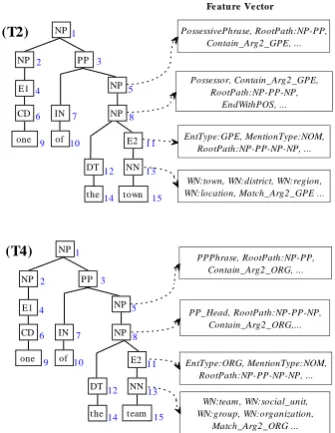
Figure 3. Syntactic tree enriched with features
Specifically, for each node in a syntactic tree , we represent it as a tuple:
where is its phrase label (i.e., its Treebank tag),
and is a feature vector which indicates the
characteristics of node , which is represented as:
where fi is a feature and is associated with a weight
. The feature we used includes charac-teristics of relation instance, phrase properties and context information (See Section 3 for details).
For demonstration, Figure 3 shows the feature-enriched version of tree T2 and tree T4 in Figure
2. We can see that, although T2 and T4 share the
same syntactic structure, the annotated features can still differentiate them. For example, the NP5
node in tree T2 and the NP5 node in tree T4 are
differentiated using their features
Possessive-Phrase and PPPhrase, which indicate that NP5 in
T2 is a possessive phrase, meanwhile NP5 in T4 is
a preposition phrase.
2.2 Feature-Enriched Tree Kernel
This section describes how to take into account the annotated features for a better tree similarity.
In Collins and Duffy’s convolution tree kernel (CTK), the similarity between two trees T1 and T2
is the number of their common sub-trees:
Using this formula, CTK only considers whether two enumerated sub-trees have the identical
syn-tactic structure (the indicator is 1 if the
NP NP PP CD one IN E1 of NP NP NN town E2 DT the POS 's NN plants NP NP PP CD one IN E1 of NP NP NN town E2 DT the Prune NP NP PP CD one IN E1 of NP NP DT NN the teams E2 PP IN in USA NP NN Prune NP NP PP CD one IN E1 of NP NP NN teams E2 DT the (T1) (T2) (T3) (T4) NP NP PP CD one IN E1 of NP NP NN town E2 DT the
(T2) PossessivePhrase, RootPath:NP-PP,
Contain_Arg2_GPE, ... Possessor, Contain_Arg2_GPE, RootPath:NP-PP-NP, EndWithPOS, ... EntType:GPE, MentionType:NOM, RootPath:NP-PP-NP-NP, ...
WN:town, WN:district, WN:region, WN:location, Match_Arg2_GPE ...
PPPhrase, RootPath:NP-PP, Contain_Arg2_ORG, ... PP_Head, RootPath:NP-PP-NP, Contain_Arg2_ORG,... EntType:ORG, MentionType:NOM, RootPath:NP-PP-NP-NP, ...
WN:team , WN:social_unit, WN:group, WN:organization,
Match_Arg2_ORG ...
Fe ature Ve ctor
1
2 3
4 5
6 7 8
9 10 11
12 14 13 15 NP NP PP CD one IN E1 of NP NP NN team E2 DT the (T4) 1 2 3 4 5
6 7 8
[image:2.595.91.269.229.440.2]two sub-trees and have the identical syntac-tic structure and 0 otherwise). Such an assumption makes CTK can only capture the syntactic struc-ture similarity between two trees, while ignoring other useful information.
To resolve the above problem, the
feature-en-riched tree kernel (FTK) compute the similarity between two trees as the sum of the similarities between their common sub-trees:
where is the similarity between
enumer-ated sub-trees and , which is computed as:
where is the same indicator function as in
CTK; is a pair of aligned nodes between
and , where and are correspondingly in
the same position of tree and ; is the
set of all aligned node pairs; is the
feature vector similarity between node and ,
computed as the dot product between their feature
vectors and .
Notice that, if all nodes are not annotated with
features, will be equal to . In this
perspective, we can view as a similarity
adjusted version of , i.e., only
considers whether two nodes are equal, in contrast further considers the feature similarity
between two nodes.
The Computation of FTK. As the same as CTK, FTK can be efficiently computed as:
where is the set of nodes in tree , and
evaluates the sum of the similarities of
common sub-trees rooted at node and node ,
which is recursively computed as follows:
1)If the production rules of and are
differ-ent, = 0;
2)If both and is pre-terminal nodes,
; Otherwise go to step 3;
3)Calculate recursively as:
¢(n1;n2) =¸£(1 +sim(n1; n2))
£ #chX(n1)
k=1
(1 + ¢(ch(n1; k); ch(n2; k)) ¢(n1;n2) =¸£(1 +sim(n1; n2))
£ #chX(n1)
k=1
(1 + ¢(ch(n1; k); ch(n2; k))
3
Features for Relation Extraction
This section presents the features we used to en-rich the syntactic tree representation.
3.1 Instance Feature
Relation instances of the same type often share some common characteristics. In this paper, we add the following instance features to the root node of a sub-tree representation:
1) Syntactico-Semantic structure. A fea-ture indicates whether a relation instance has the following four syntactico-semantic structures in
(Chan & Roth, 2011) – Premodifiers, Possessive,
Preposition, Formulaic and Verbal.
2) Entity-related information of argu-ments. Features about the entity information of
arguments, including: a) #TP1-#TP2: the concat
of the major entity types of arguments; b)
#ST1-#ST2: the concat of the sub entity types of
argu-ments; c) #MT1-#MT2: the concat of the mention
types of arguments.
3) Base phrase chunking features. Fea-tures about the phrase path between two argu-ments and the phrases’ head before and after the arguments, which are the same as the phrase chunking features in (Zhou, et al., 2005).
3.2 Phrase Feature
As discussed in above, the Treebank tag is too coarse to capture the property of a phrase node. Therefore, we enrich each phrase node with fea-tures about its lexical pattern, its content infor-mation, and its lexical semantics:
1) Lexical Pattern. We capture the lexical pattern of a phrase node using the following
fea-tures: a) LP_Poss: A feature indicates the node is
a possessive phrase; b) LP_PP: A feature
indi-cates the node is a preposition phrase; c) LP_CC:
A feature indicates the node is a conjunction
phrase; d) LP_EndWithPUNC: A feature indicates
the node ends with a punctuation; e)
LP_EndWith-POSS: A feature indicates the node ends with a possessive word.
2) Content Information. We capture the property of a node’s content using the following
features: a) MB_#Num: The number of mentions
contained in the phrase; b) MB_C_#Type:A
fea-ture indicates that the phrase contains a mention
with major entity type #Type; c) MW_#Num: The
number of words within the phrase.
3) Lexical Semantics. If the node is a pre-terminal node, we capture its lexical semantic by adding features indicating its WordNet sense in-formation. Specifically, the first WordNet sense of the terminal word, and all this sense’s hyponym senses will be added as features. For example,
region#1, …} will be added as features to the [NN New York] node in Figure 1.
3.3 Context Information Feature
The context information of a phrase node is criti-cal for identifying the role and the importance of a sub-tree in the whole relation instance. This pa-per captures the following context information:
1) Contextual path from sub-tree root to the phrase node. As shown in Zhou et al. (2007), the context path from root to the phrase node is an effective context information feature. In this paper, we use the same settings in (Zhou et al., 2007), i.e., each phrase node is enriched with its context paths of length 1, 2, 3.
2) Relative position with arguments. We observed that a phrase’s relative position with the relation’s arguments is useful for identifying the role of the phrase node in the whole relation in-stance. To capture the relative position infor-mation, we define five possible relative positions between a phrase node and an argument, corre-sponding match, cover, within, overlap and other. Using these five relative positions, we capture the context information using the following features:
a) #RP_Arg1Head_#Arg1Type: a feature in-dicates the relative position of a phrase node with
argument 1’s head phrase, where #RP is the
rela-tive position (one of match, cover, within, overlap,
other), and #Arg1Type is the major entity type of argument 1. One example feature may be
Match_Arg1Head_LOC.
b) #RP_Arg2Head_#Arg2Type: The relative position with argument 2’s head phrase;
c) #RP_Arg1Extend_#Arg1Type: The rela-tive position with argument 1’s extended phrase; d) #PR_Arg2Extend_#Arg2Type: The rela-tive position with argument 2’s extended phrase.
Feature weighting. Currently, we set all
fea-tures with an uniform weight , which is
used to control the relative importance of the ture in the final tree similarity: the larger the fea-ture weight, the more important the feafea-ture in the final tree similarity.
4
Experiments
4.1 Experimental Setting
To assess the feature-enriched tree kernel, we evaluate our method on the ACE RDC 2004 cor-pus using the same experimental settings as (Qian et al., 2008). That is, we parse all sentences using the Charniak’s parser (Charniak, 2001), relation instances are generated by iterating over all pairs of entity mentions occurring in the same sentence.
In our experiments, we implement the
feature-en-riched tree kernel by extending the SVMlight
(Joa-chims, 1998) with the proposed tree kernel
func-tion (Moschitti, 2004). We apply the one vs.
oth-ers strategy for multiple classification using SVM.
For SVM training, the parameter C is set to 2.4 for all experiments, and the tree kernel parameter λ is tuned to 0.2 for FTK and 0.4 (the optimal param-eter setting used in Qian et al.(2008)) for CTK.
4.2 Experimental Results
4.2.1 Overall performance
We compare our method with the standard convo-lution tree kernel (CTK) on the state-of-the-art context sensitive shortest path-enclosed tree rep-resentation (CSPT, Zhou et al., 2007). We exper-iment our method with four different feature set-tings, correspondingly: 1) FTK with only instance
features – FTK(instance); 2) FTK with only
phrase features – FTK(phrase); 3) FTK with only
context information features – FTK(context); and
4) FTK with all features – FTK. The overall
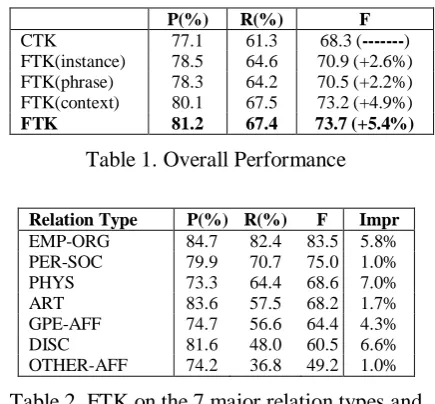
per-formance of CTK and FTK is shown in Table 1, the F-measure improvements over CTK are also shown inside the parentheses. The detailed perfor-mance of FTK on the 7 major relation types of ACE 2004 is shown in Table 2.
P(%) R(%) F
CTK 77.1 61.3 68.3 (---) FTK(instance) 78.5 64.6 70.9 (+2.6%) FTK(phrase) 78.3 64.2 70.5 (+2.2%) FTK(context) 80.1 67.5 73.2 (+4.9%)
[image:4.595.307.525.431.633.2]FTK 81.2 67.4 73.7 (+5.4%)
Table 1. Overall Performance
Relation Type P(%) R(%) F Impr
EMP-ORG 84.7 82.4 83.5 5.8% PER-SOC 79.9 70.7 75.0 1.0% PHYS 73.3 64.4 68.6 7.0% ART 83.6 57.5 68.2 1.7% GPE-AFF 74.7 56.6 64.4 4.3% DISC 81.6 48.0 60.5 6.6% OTHER-AFF 74.2 36.8 49.2 1.0%
Table 2. FTK on the 7 major relation types and their F-measure improvement over CTK
From Table 1 and 2, we can see that:
1) By refining the syntactic tree with
discri-minant features and incorporating these features into the final tree similarity, FTK can significantly improve the relation extraction performance: compared with the convolution tree kernel
base-line CTK, our method can achieve a 5.4%
2) All types of features can improve the per-formance of relation extraction: FTK can corre-spondingly get 2.6%, 2.2% and 4.9% F-measure improvements using instance features, phrase fea-tures and context information feafea-tures.
3) Within the three types of features, context
information feature can achieve the highest F-measure improvement. We believe this may be-cause: ① The context information is useful in providing clues for identifying the role and the
im-portance of a sub-tree; and ② The context-free
as-sumption of CTK is too strong, some critical in-formation will lost in the CTK computation.
4) The performance improvement of FTK
varies significantly on different relation types: in Table 2, most performance improvement gains
from the EMP-ORG, PHYS, GPE-AFF and DISC
relation types. We believe this may because the discriminant features will better complement the
syntactic tree for capturing EMP-ORG, PHYS,
GPE-AFF and DISC relation. On contrast the fea-tures may be redundant to the syntactic infor-mation for other relation types.
System P(%) R(%) F
Qian et al., (2008): composite kernel 83.0 72.0 77.1 Zhou et al., (2007): composite kernel 82.2 70.2 75.8
Ours: FTK with CSPT 81.2 67.4 73.7
Zhou et al., (2007): context sensitive CTK with CSPT
81.1 66.7 73.2
Ours: FTK with SPT 81.1 66.2 72.9
Jiang & Zhai (2007): MaxEnt classi-fier with features
74.6 71.3 72.9
Zhang et al., (2006): composite kernel 76.1 68.4 72.1 Zhao & Grishman, (2005): Composite
kernel
69.2 70.5 70.4
Zhang et al., (2006): CTK with SPT 74.1 62.4 67.7
Table 3. Comparison of different systems on the ACE RDC 2004 corpus
4.2.2 Comparison with other systems
Finally, Table 3 compares the performance of our method with several other systems. From Table 3, we can see that FTK can achieve competitive
per-formance: ① It achieves a 0.8% F-measure
im-provement over the feature-based system of Jiang & Zhai (2007); ② It achieves a 0.5% F-measure improvement over a state-of-the-art tree kernel: context sensitive CTK with CSPT of Zhou et al.,
(2007); ③ The F-measure of our system is slightly
lower than the current best performance on ACE 2004 (Qian et al., 2008) – 73.7 vs. 77.1, we believe this is because the system of (Qian et al., 2008) adopts two extra techniques: composing tree ker-nel with a state-of-the-art feature-based kerker-nel and
using a more proper sub-tree representation. We believe these two techniques can also be used to further improve the performance of our system.
5
Related Work
This section briefly reviews the related work. A classical technique for relation extraction is to model the task as a feature-based classification problem (Kambhatla, 2004; Zhou et al., 2005; Jiang & Zhai, 2007; Chan & Roth, 2010; Chan & Roth, 2011), and feature engineering is obviously the key for performance improvement. As an al-ternative, tree kernel-based method implicitly de-fines features by directly measuring the similarity between two structures (Bunescu and Mooney, 2005; Bunescu and Mooney, 2006; Zelenko et al, 2003; Culotta and Sorensen, 2004; Zhang et al., 2006). Composite kernels were also be used (Zhao and Grishman, 2005; Zhang et al., 2006).
The main drawback of the current tree kernel is that the syntactic tree representation often cannot accurately capture the relation information. To re-solve this problem, Zhou et al. (2007) took the an-cestral information of sub-trees into consideration; Reichartz and Korte (2010) incorporated depend-ency type information into a tree kernel; Plank and Moschitti (2013) and Liu et al. (2013) embedded semantic information into tree kernel. Bloehdorn and Moschitti (2007a, 2007b) proposed Syntactic Semantic Tree Kernels (SSTK), which can cap-ture the semantic similarity between leaf nodes. Moschitti (2009) proposed a tree kernel which specify a kernel function over any pair of nodes between two trees, and it was further extended and applied in other tasks in (Croce et al., 2011; Croce et al., 2012; Mehdad et al., 2010).
6
Conclusions and Future Work
This paper proposes a feature-enriched tree kernel, which can: 1) refine the syntactic tree representa-tion; and 2) better measure the similarity between two trees. For future work, we want to develop a feature weighting algorithm which can accurately measure the relevance of a feature to a relation in-stance for better RE performance.
Acknowledgments
References
Agichtein, E. and Gravano, L. 2000. Snowball: Ex-tracting relations from large plain-text collections. In: Proceedings of the 5th ACM Conference on Dig-ital Libraries, pp. 85–94.
Plank, B. and Moschitti, A. 2013. Embedding Semantic Similarity in Tree Kernels for Domain Adaptation of Relation Extraction”. In: Proceedings of ACL 2013.
Banko, M., Cafarella, M. J., Soderland, S., Broadhead, M. and Etzioni, O. 2007. Open information extrac-tion from the Web. In: Proceedings of the 20th Inter-national Joint Conference on Artificial Intelligence, pp. 2670–2676.
Bunescu, R. and Mooney, R. 2005. A shortest path de-pendency kernel for relation extraction. In: Pro-ceedings of the Human Language Technology Con-ference and the ConCon-ference on Empirical Methods in Natural Language Processing, pp.724–731.
Bloehdorn, S. and Moschitti, A. 2007a. Combined Syn-tactic and Semantic Kernels for Text Classification. In: Proceedings of the 29th European Conference on Information Retrieval (ECIR).
Bloehdorn, S. and Moschitti, A. 2007b. Structure and semantics for expressive text kernels. In: Proceeding of ACM 16th Conference on Information and Knowledge Management (CIKM).
Bunescu, R. and Mooney. R., 2006. Subsequence ker-nels for relation extraction. In: Advances in Neural Information Processing Systems 18, pp. 171–178.
Charniak, E., 2001. Immediate-head parsing for lan-guage models. In: Proceedings of the 39th Annual Meeting on Association for Computational Linguis-tics, pp. 124-131.
Chan, Y. S. and Roth, D. 2010. Exploiting background knowledge for relation extraction. In: Proceedings of the 23rd International Conference on Computa-tional Linguistics, pp. 152–160.
Chan, Y. S. and Roth, D. 2011. Exploiting syntactico-semantic structures for relation extraction. In: Pro-ceedings of the 49th Annual Meeting of the Associ-ation for ComputAssoci-ational Linguistics, pp. 551–560.
Croce, D., Moschitti, A. and Basili, R. 2011. Struc-tured lexical similarity via convolution kernels on dependency trees. In: Proceedings of the 2011 Con-ference on Empirical Methods in Natural Language Processing, pp. 1034–1046.
Croce, D., Moschitti, A., Basili, R. and Palmer, M. 2012. Verb Classification using Distributional Sim-ilarity in Syntactic and Semantic Structures. In: Pro-ceedings of ACL 2012, pp. 263-272.
Culotta, A. and Sorensen, J. 2004. Dependency tree kernels for relation extraction. In: Proceedings of
the 42nd Annual Meeting of the Association for Computational Linguistics, pp. 423–429.
Grishman, R. and Sundheim, B. 1996. Message under-standing conference-6: A brief history. In: Proceed-ings of the 16th International Conference on Com-putational Linguistics, pp. 466–471.
Collins, M. and Duffy, N., 2001. Convolution Kernels for Natural Language. In: Proceedings of NIPS 2001.
Liu, D., et al. 2013. Incorporating lexical semantic similarity to tree kernel-based Chinese relation ex-traction. In: Proceedings of Chinese Lexical Seman-tics 2013.
Jiang, J. and Zhai, C. 2007. A systematic exploration of the feature space for relation extraction. In: Pro-ceedings of the Human Language Technology Con-ference of the North American Chapter of the Asso-ciation for Computational Linguistics, pp. 113–120.
Joachims, T. 1998. Text Categorization with Su pport Vector Machine: learning with many rele-vant features. ECML-1998: 137-142.
Kambhatla, N. 2004. Combining lexical, syntactic, and semantic features with maximum entropy models for extracting relations. In: the Proceedings of 42st An-nual Meeting of the Association for Computational Linguistics, pp. 178–181.
Krause, S., Li, H., Uszkoreit, H., & Xu, F. 2012. Large-scale learning of relation-extraction rules with dis-tant supervision from the web. In: Proceedings of ISWC 2012, pp. 263-278.
Marcus, M. P., Marcinkiewicz, M. A., & Santorini, B. 1993. Building a large annotated corpus of English: The Penn Treebank. Computational linguistics, 19(2), 313-330.
Moschitti, A. 2004. A study on Convolution Kernels for Shallow Semantic Parsing. In: Proceedings of the 42-th Conference on Association for Computational Linguistic (ACL-2004).
Moschitti, A. 2009. Syntactic and semantic kernels for short text pair categorization. In: Proceedings of the 12th Conference of the European Chapter of the ACL (EACL 2009), pp. 576–584.
Mehdad, Y., Moschitti, A. and Zanzotto, F. 2010. Syn-tactic/Semantic Structures for Textual Entailment Recognition. In: Proceedings of Human Language Technology - North American chapter of the Asso-ciation for Computational Linguistics.
Mintz, M., Bills, S., Snow, R. and Jurafsky D. 2009.
Qian L., Zhou G., Kong F., Zhu Q., and Qian P., 2008.
Exploiting constituent dependencies for tree kernel based semantic relation extraction. In: Proceedings of the 22nd International Conference on
Computa-tional Linguistics, pp. 697-704.
Reichartz, F. and H. Korte, et al. 2010. Semantic rela-tion extracrela-tion with kernels over typed dependency trees. In: Proceedings of the 16th ACM SIGKDD international conference on Knowledge discovery and data mining.
Zelenko, D., Aone, C., and Richardella, A. 2003. Ker-nel methods for relation extraction. Journal of Ma-chine Learning Research, 3:1083–1106.
Zhang, M., Zhang, J., and Su, J. 2006. Exploring syn-tactic features for relation extraction using a convo-lution tree kernel. In: Proceedings of the Human Language Technology Conference and the North American Chapter of the Association for Computa-tional Linguistics, pages 288–295.
Zhang, M., Zhang, J., Su, J. and Zhou, G. 2006. A com-posite kernel to extract relations between entities with both flat and structured features. In Proceed-ings of the 21st International Conference on Com-putational Linguistics and the 44th Annual Meeting of the Association for Computational Linguistics, pages 825–832.
Zhao, S. and Grishman, R. 2005. Extracting relations with integrated information using kernel methods. In Proceedings of the 43rd Annual Meeting of the Association for Computational Linguistics, pages 419–426.
Zhou, G., Su, J., Zhang, J., and Zhang, M. 2005. Ex-ploring various knowledge in relation extraction. In Proceedings of the 43rd Annual Meeting of the As-sociation for Computational Linguistics, pages 427– 434.
Zhou, G. and Zhang M. 2007. Extracting relation in-formation from text documents by exploring various types of knowledge. Information Processing & Man-agement 43(4): 969--982.