Proceedings of the 45th Annual Meeting of the Association of Computational Linguistics, pages 704–711, Prague, Czech Republic, June 2007. c2007 Association for Computational Linguistics
Forest-to-String Statistical Translation Rules
Yang Liu , Yun Huang , Qun Liu and Shouxun Lin
Key Laboratory of Intelligent Information Processing Institute of Computing Technology
Chinese Academy of Sciences P.O. Box 2704, Beijing 100080, China
{yliu,huangyun,liuqun,sxlin}@ict.ac.cn
Abstract
In this paper, we propose forest-to-string rules to enhance the expressive power of tree-to-string translation models. A forest-to-string rule is capable of capturing non-syntactic phrase pairs by describing the cor-respondence between multiple parse trees and one string. To integrate these rules into tree-to-string translation models, auxil-iary rules are introduced to provide a gen-eralization level. Experimental results show that, on the NIST 2005 Chinese-English test set, the tree-to-string model augmented with forest-to-string rules achieves a relative im-provement of4.3%in terms of BLEU score over the original model which allows tree-to-string rules only.
1 Introduction
The past two years have witnessed the rapid de-velopment of linguistically syntax-based translation models (Quirk et al., 2005; Galley et al., 2006; Marcu et al., 2006; Liu et al., 2006), which induce tree-to-string translation rules from parallel texts with linguistic annotations. They demonstrated very promising results when compared with the state of the art phrase-based system (Och and Ney, 2004) in the NIST2006machine translation evaluation1. While Galley et al. (2006) and Marcu et al. (2006) put emphasis on target language analysis, Quirk et al. (2005) and Liu et al. (2006) show benefits from modeling the syntax of source language.
1
See http://www.nist.gov/speech/tests/mt/
One major problem with linguistically syntax-based models, however, is that tree-to-string rules fail to syntactify non-syntactic phrase pairs because they require a syntax tree fragment over the phrase to be syntactified. Here, we distinguish between syn-tactic and non-synsyn-tactic phrase pairs. By “synsyn-tactic” we mean that the phrase pair is subsumed by some syntax tree fragment. The phrase pairs without trees over them are non-syntactic. Marcu et al. (2006) report that approximately 28%of bilingual phrases are non-syntactic on their English-Chinese corpus.
We believe that it is important to make available to syntax-based models all the bilingual phrases that are typically available to phrase-based models. On one hand, phrases have been proven to be a simple and powerful mechanism for machine translation. They excel at capturing translations of short idioms, providing local re-ordering decisions, and incorpo-rating context information straightforwardly. Chi-ang (2005) shows significant improvement by keep-ing the strengths of phrases while incorporatkeep-ing syn-tax into statistical translation. On the other hand, the performance of linguistically syntax-based mod-els can be hindered by making use of only syntac-tic phrase pairs. Studies reveal that linguissyntac-tically syntax-based models are sensitive to syntactic anal-ysis (Quirk and Corston-Oliver, 2006), which is still not reliable enough to handle real-world texts due to limited size and domain of training data.
Various solutions are proposed to tackle the prob-lem. Galley et al. (2004) handle non-constituent phrasal translation by traversing the tree upwards until reaches a node that subsumes the phrase. Marcu et al. (2006) argue that this choice is
propriate because large applicability contexts are re-quired.
For a non-syntactic phrase pair, Marcu et al. (2006) create a xRS rule headed by a pseudo, non-syntactic nonterminal symbol that subsumes the phrase and corresponding multi-headed syntactic structure; and one sibling xRS rule that explains how the non-syntactic nonterminal symbol can be com-bined with other genuine nonterminals so as to ob-tain genuine parse trees. The name of the pseudo nonterminal is designed to reflect how the corre-sponding rule can be fully realized. However, they neglect alignment consistency when creating sibling rules. In addition, it is hard for the naming mecha-nism to deal with more complex phenomena.
Liu et al. (2006) treat bilingual phrases as lexi-calized TATs (Tree-to-string Alignment Template). A bilingual phrase can be used in decoding if the source phrase is subsumed by the input parse tree. Although this solution does help, only syntactic bilingual phrases are available to the TAT-based model. Moreover, it is problematic to combine the translation probabilities of bilingual phrases and TATs, which are estimated independently.
In this paper, we propose forest-to-string rules which describe the correspondence between multi-ple parse trees and a string. They can not only cap-ture non-syntactic phrase pairs but also have the ca-pability of generalization. To integrate these rules into tree-to-string translation models, auxiliary rules are introduced to provide a generalization level. As there is no pseudo node or naming mechanism, the integration of forest-to-string rules is flexible, rely-ing only on their root nodes. The forest-to-strrely-ing and auxiliary rules enable tree-to-string models to derive in a more general way, while the strengths of con-ventional tree-to-string rules still remain.
2 Forest-to-String Translation Rules
We define a tree-to-string ruleras a tripleT ,˜ S,˜ A˜, which describes the alignmentA˜between a source parse treeT˜ =T(f1J)and a target stringS˜ =eI1. A source string f1J, which is the sequence of leaf nodes ofT(f1J), consists of both terminals (source words) and nonterminals (phrasal categories). A tar-get string eI1 is also composed of both terminals (target words) and nonterminals (placeholders). An
IP
NP
NN
ÿ
VP
SB VP
NP
NN VV
þ
PU
[image:2.612.383.473.71.190.2]The gunman was killed by police .
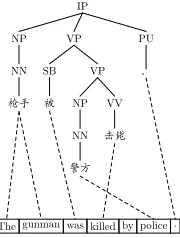
Figure 1: An English sentence aligned with a Chi-nese parse tree.
alignmentA˜is defined as a subset of the Cartesian product of source and target symbol positions:
˜
A⊆ {(j, i) :j= 1, . . . , J;i= 1, . . . , I}
A derivation θ = r1 ◦ r2 ◦ . . . ◦ rn is a left-most composition of translation rules that explains how a source parse tree T = T(f1J), a target sen-tenceS = eI1, and the word alignment A are syn-chronously generated. For example, Table 1 demon-strates a derivation composed of only tree-to-string rules for theT, S, Atuple in Figure 12.
As we mentioned before, tree-to-string rules can not syntactify phrase pairs that are not subsumed by any syntax tree fragments. For example, for the phrase pair“ ÿ ”, “The gunman was”in
Fig-ure 1, it is impossible to extract an equivalent tree-to-string rule that subsumes the same phrase pair because valid tree-to-string rules can not be multi-headed.
To address this problem, we propose forest-to-string rules3 to subsume the non-syntactic phrase pairs. A forest-to-string ruler4is a tripleF ,˜ S,˜ A˜, which describes the alignmentA˜betweenK source parse trees F˜ = ˜T1K and a target string S˜. The source string f1J is therefore the sequence of leaf nodes ofF˜.
Auxiliary rules are introduced to integrate forest-to-string rules into tree-forest-to-string translation models. An auxiliary rule is a special unlexicalized tree-to-string rule that allows multiple source nonterminals
2We use “
X” to denote a nonterminal in the target string. If there are more than one nonterminals, they are indexed.
3
The term “forest” refers to an ordered and finite set of trees. 4
No. Rule
(1) ( IP ( NP ) ( VP ) ( PU ) ) X1X2X3 1:1 2:2 3:3
(2) ( NP ( NN ÿ) ) The gunman 1:1 1:2
(3) ( VP ( SB ) ( VP ( NP ( NN ) ) ( VVþ) ) ) was killed byX 1:1 2:4 3:2
(4) ( NN ) police 1:1
[image:3.612.140.476.71.133.2](5) ( PU ) . 1:1
Table 1: A derivation composed of only tree-to-string rules for Figure 1.
No. Rule
(1) ( IP ( NP ) ( VP ( SB ) ( VP ) ) ( PU ) ) X1X2 1:1 2:1 3:2 4:2 (2) ( NP ( NN ÿ) ) ( SB ) The gunman was 1:1 1:2 2:3
(3) ( VP ( NP ) ( VVþ) ) ( PU ) killed byX. 1:3 2:1 3:4
[image:3.612.148.466.167.218.2](4) ( NP ( NN ) ) police 1:1
Table 2: A derivation composed of tree-to-string, forest-to-string, and auxiliary rules for Figure 1.
to correspond to one target nonterminal, suggesting that the forest-to-string rules that are rooted at such source nonterminals can be integrated.
For example, Table 2 shows a derivation com-posed of tree-to-string, forest-to-string, and auxil-iary rules for the T, S, A tuple in Figure 1. r1 is an auxiliary rule,r2andr3are forest-to-string rules, andr4is a conventional tree-to-string rule.
Following Marcu et al. (2006), we define the probability of a tupleT, S, A as the sum over all derivationsθi∈Θthat are consistent with the tuple,
c(Θ) = T, S, A. The probability of each deriva-tionθiis given by the product of the probabilities of all the rulesp(rj)in the derivation.
P r(T, S, A) =
θi∈Θ,c(Θ)=T,S,A
rj∈θi
p(rj) (1)
3 Training
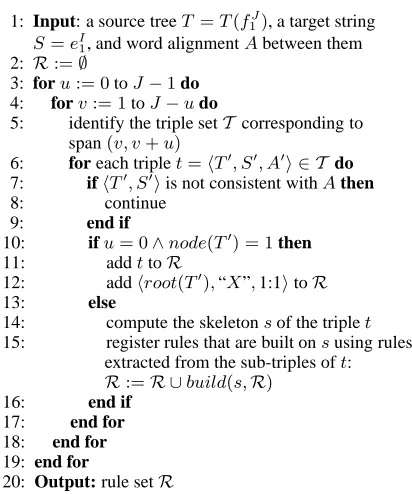
We obtain tree-to-string and forest-to-string rules from word-aligned, source side parsed bilingual cor-pus. The extraction algorithm is shown in Figure 2. Note thatTdenotes either a tree or a forest.
For each span, thetree/forest, string, alignment triples are identified first. If a triple is consistent with the alignment, the skeleton of the triple is computed then. A skeletonsis a rule satisfying the following:
1. s∈ R(t),sis induced fromt.
2. node(T(s)) ≥ 2, the tree/forest ofs contains two or more nodes.
3. ∀r ∈ R(t)∧node(T(r)) ≥ 2, T(s) ⊆ T(r), the tree/forest ofsis the subgraph of that of any
rcontaining two or more nodes.
1: Input: a source treeT =T(f1J), a target string
S=eI1, and word alignmentAbetween them
2: R:=∅
3: foru:= 0toJ−1do
4: forv:= 1toJ−udo
5: identify the triple setT corresponding to span(v, v+u)
6: for each triplet=T, S, A ∈ T do
7: ifT, Sis not consistent withAthen
8: continue
9: end if
10: ifu= 0∧node(T) = 1then
11: addttoR
12: addroot(T),“X”,1:1toR
13: else
14: compute the skeletonsof the triplet
15: register rules that are built onsusing rules extracted from the sub-triples oft:
R:=R ∪build(s,R)
16: end if
17: end for
18: end for
19: end for
20: Output: rule setR
Figure 2: Rule extraction algorithm.
Given the skeleton and rules extracted from the sub-triples, the rules for the triple can be acquired.
For example, the algorithm identifies the follow-ing triple for span(1,2)in Figure 1:
( NP ( NN ÿ) ) ( SB ),“The gunman was”, 1:1 1:2 2:3
The skeleton of the triple is:
( NP ) ( SB ),“X1X2”, 1:1 2:2
As the algorithm proceeds bottom-up, five rules have already been extracted from the sub-triples, rooted at “NP” and “SB” respectively:
( NP ),“X”, 1:1
( NP ( NN ) ),“X”, 1:1
( NP ( NN ÿ) ),“The gunman”, 1:1 1:2
[image:3.612.312.518.252.499.2]( SB ),“X”, 1:1
( SB ),“was”, 1:1
Hence, we can obtain new rules by replacing the source and target symbols of the skeleton with corre-sponding rules and also by modifying the alignment information. For the above triple, the combination of the five rules produces2×3 = 6new rules:
( NP ) ( SB ),“X1X2”, 1:1 2:2
( NP ) ( SB ),“Xwas”, 1:1 2:2
( NP ( NN ) ) ( SB ),“X1X2”, 1:1 2:2
( NP ( NN ) ) ( SB ),“Xwas”, 1:1 2:2
( NP ( NN ÿ) ) ( SB ),“The gunmanX”, 1:1 1:2 ( NP ( NN ÿ) ) ( SB ),“The gunman was”, 1:1 1:2 2:3
Since we need only to check the alignment con-sistency, in principle all phrase pairs can be captured by tree-to-string and forest-to-string rules. To lower the complexity for both training and decoding, we impose four restrictions:
1. Both the first and the last symbols in the target string must be aligned to some source symbols.
2. The height of a tree or forest is no greater than
h.
3. The number of direct descendants of a node is no greater thanc.
4. The number of leaf nodes is no greater thanl.
Although possible, it is infeasible to learn aux-iliary rules from training data. To extract an auxil-iary rule which integrates at least one forest-to-string rule, one need traverse the parse tree upwards until one reaches a node that subsumes the entire forest without violating the alignment consistency. This usually results in very complex auxiliary rules, es-pecially on real-world training data, making both training and decoding very slow. As a result, we construct auxiliary rules in decoding instead.
4 Decoding
Given a source parse treeT(f1J), our decoder finds the target yield of the single best derivation that has source yield ofT(f1J):
ˆ
S = argmax
S,A P r(T, S, A)
= argmax
S,A
θi∈Θ,c(Θ)=T,S,A
rj∈θi
p(rj)
1: Input: a source parse treeT =T(f1J)
2: foru:= 0toJ−1do
3: forv:= 1toJ−udo
4: for eachTspanning fromvtov+udo
5: ifTis a tree then
6: for each usable tree-to-string rulerdo
7: for each derivationθinferred fromr
and derivations in matrix do
8: addθto matrix[v, v+u, root(T)]
9: end for
10: end for
11: search subcell divisionsD[v, v+u]
12: for each subcell divisiond∈ D[v, v+u]do
13: ifdcontains at least one forest cell then 14: construct auxiliary rulera
15: for each derivationθinferred fromra
and derivations in matrix do
16: addθto matrix[v, v+u, root(T)]
17: end for
18: end if
19: end for
20: else
21: for each usable forest-to-string rulerdo
22: for each derivationθinferred fromr
and derivations in matrix do 23: addθto matrix[v, v+u,“”] 24: end for
25: end for
26: search subcell divisionsD[v, v+u]
27: end if
28: end for
29: end for
30: end for
31: find the best derivationθˆin matrix[1, J, root(T)]and get the best translationSˆ=e(ˆθ)
[image:4.612.314.529.68.502.2]32: Output: a target stringSˆ
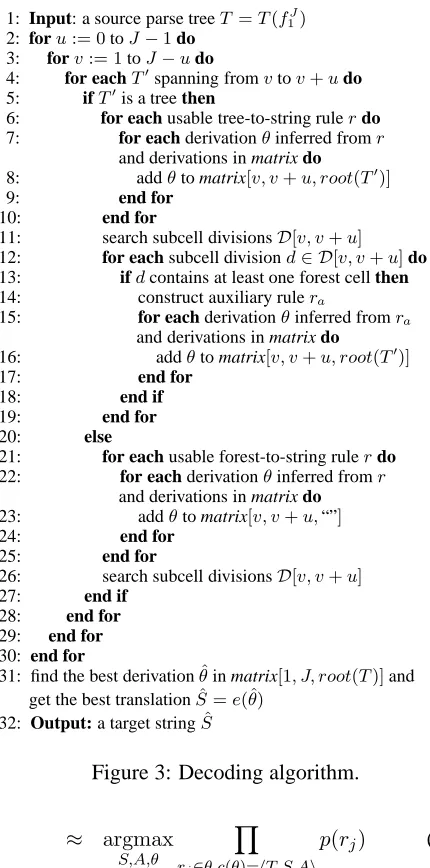
Figure 3: Decoding algorithm.
≈ argmax
S,A,θ
rj∈θ,c(θ)=T,S,A
p(rj) (2)
Figure 3 demonstrates the decoding algorithm. It organizes the derivations into an array matrix whose cells matrix[j1, j2, X]are sets of derivations.
[j1, j2, X]represents a tree/forest rooted atX span-ning fromj1 to j2. We use the empty string “” to denote the pseudo root of a forest.
Next, we will explain how to infer derivations for a tree/forest provided a usable rule. IfT(r) = T, there is only one derivation which contains only the rule r. This usually happens for leaf nodes. If
T(r) ⊂ T, the rule r resorts to derivations from subcells to infer new derivations. Suppose that the decoder is to translate the source tree in Figure 1 and finds a usable rule for[1,5,“IP”]:
Subcell Division Auxiliary Rule
[1,1][2,2][3,5] ( IP ( NP ) ( VP ( SB ) ( VP ) ) ( PU ) ) X1X2X3 1:1 2:2 3:3 4:3 [1,2][3,4][5,5] ( IP ( NP ) ( VP ( SB ) ( VP ) ) ( PU ) ) X1X2X3 1:1 2:1 3:2 4:3 [1,3][4,5] ( IP ( NP ) ( VP ( SB ) ( VP ( NP ) ( VV ) ) ) ( PU ) ) X1X2 1:1 2:1 3:1 4:2 5:2
[image:5.612.102.511.70.127.2][1,1][2,5] ( IP ( NP ) ( VP ) ( PU ) ) X1X2 1:1 2:2 3:2
Table 3: Subcell divisions and corresponding auxiliary rules for the source tree in Figure 1
Since the decoding algorithm proceeds in a bottom-up fashion, the uncovered portions have al-ready been translated.
For [1,1,“NP”], suppose that we can find a derivation in matrix:
( NP ( NN ÿ) ),“The gunman”, 1:1 1:2
For[2,4,“VP”], we find a derivation in matrix:
( VP ( SB ) ( VP ( NP ( NN )) (VVþ) ) ),
“was killed byX”, 1:1 2:4 3:2
( NN ),“police”, 1:1
For[5,5,“PU”], we find a derivation in matrix:
( PU ),“.”, 1:1
Henceforth, we get a derivation for [1,5,“IP”], shown in Table 1.
A translation ruleris said to be usable to an input tree/forestT if and only if:
1. T(r) ⊆T, the tree/forest ofr is the subgraph ofT.
2. root(T(r)) = root(T), the root sequence of
T(r)is identical to that ofT.
For example, the following rules are usable to the tree “( NP ( NR ) ( NN ) )”:
( NP ( NR ) ( NN ) ),“X1X2”, 1:2 2:1
( NP ( NR ) ( NN ) ),“ChinaX”, 1:1 2:2 ( NP ( NR ) ( NN ) ),“China economy”, 1:1 2:2
Similarly, the forest-to-string rule
( ( NP ( NR ) ( NN ) ) ( VP ) ),“X1X2X3”, 1:2 2:1 3:3
is usable to the forest
( NP ( NRï) ( NN) ) ( VP (VV )( NN ) )
As we mentioned before, auxiliary rules are spe-cial unlexicalized tree-to-string rules that are built in decoding rather than learnt from real-world data. To get an auxiliary rule for a cell, we need first identify its subcell division.
A cell sequence c1, c2, . . . , cn is referred to as a subcell division of a cellcif and only if:
1. c1.begin=c.begin
1: Input: a cell[j1, j2], the derivation array matrix, the subcell division arrayD
2: ifj1=j2then
3: pˆ:= 0
4: for each derivationθin matrix[j1, j2,·]do
5: pˆ:=max(p(θ),pˆ)
6: end for
7: add{[j1, j2]}: ˆptoD[j1, j2]
8: else
9: if[j1, j2]is a forest cell then 10: pˆ:= 0
11: for each derivationθin matrix[j1, j2,·]do
12: pˆ:=max(p(θ),pˆ)
13: end for
14: add{[j1, j2]}: ˆptoD[j1, j2]
15: end if
16: forj:=j1toj2−1do
17: for each divisiond1∈ D[j1, j]do
18: for each divisiond2∈ D[j+ 1, j2]do
19: create a new division:d:=d1⊕d2
20: adddtoD[j1, j2]
21: end for
22: end for
23: end for
24: end if
25: Output: subcell divisionsD[j1, j2]
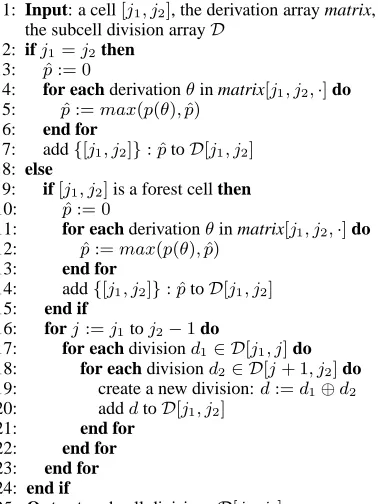
Figure 4: Subcell division search algorithm.
2. cn.end=c.end
3. cj.end+ 1 =cj+1.begin,1≤j < n
Given a subcell division, it is easy to construct the auxiliary rule for a cell. For each subcell, one need transverse the parse tree upwards until one reaches nodes that subsume it. All descendants of these nodes are dropped. The target string consists of only nonterminals, the number of which is identical to that of subcells. To limit the search space, we as-sume that the alignment between the source tree and the target string is monotone.
Table 3 shows some subcell divisions and corre-sponding auxiliary rules constructed for the source tree in Figure 1. For simplicity, we ignore the root node label.
There are2n−1 subcell divisions for a cell which has a length ofn. We need only consider the
[image:5.612.316.505.164.416.2]cell divisions which contain at least one forest cell because tree-to-string rules have already explored those contain only tree cells.
The actual search algorithm for subcell divisions is shown in Figure 4. We use matrix[j1, j2,·]to de-note all trees or forests spanning fromj1toj2. The subcell divisions and their associated probabilities are stored in an array D. We define an operator⊕ between two divisions: their cell sequences are con-catenated and the probabilities are accumulated.
As sometimes there are no usable rules available, we introduce default rules to ensure that we can al-ways get a translation for any input parse tree. A de-fault rule is a tree-to-string rule5, built in two ways:
1. If the input tree contains only one node, the target string of the default rule is equal to the source string.
2. If the height of the input tree is greater than one, the tree of the default rule contains only the root node and its direct descendants of the input tree, the string contains only nontermi-nals, and the alignment is monotone.
To speed up the decoder, we limit the search space by reducing the number of rules used for each cell. There are two ways to limit the rule table size: by a fixed limita of how many rules are retrieved for each cell, and by a probability thresholdαthat spec-ify that the rule probability has to be above some value. Also, instead of keeping the full list of deriva-tions for a cell, we store a top-scoring subset of the derivations. This can also be done by a fixed limit
bor a thresholdβ. The subcell division arrayD, in which divisions containing forest cells have priority over those composed of only tree cells, is pruned by keeping onlya-best divisions.
Following Och and Ney (2002), we base our model on log-linear framework and adopt the seven feature functions described in (Liu et al., 2006). It is very important to balance the preference between conventional tree-to-string rules and the newly-introduced forest-to-string and auxiliary rules. As the probabilities of auxiliary rules are not learnt from training data, we add a feature that sums up the
5
There are no default rules for forests because only tree-to-string rules are essential to tree-to-tree-to-string translation models.
node count of auxiliary rules of a derivation to pe-nalize the use of forest-to-string and auxiliary rules.
5 Experiments
In this section, we report on experiments with Chinese-to-English translation. The training corpus consists of31,149sentence pairs with843,256 Chi-nese words and 949,583 English words. For the language model, we used SRI Language Modeling Toolkit (Stolcke, 2002) to train a trigram model with modified Kneser-Ney smoothing (Chen and Good-man, 1998) on the 31,149 English sentences. We selected 571 short sentences from the 2002 NIST MT Evaluation test set as our development corpus, and used the2005 NIST MT Evaluation test set as our test corpus. Our evaluation metric is BLEU-4 (Papineni et al., 2002), as calculated by the script mteval-v11b.pl with its default setting except that we used case-sensitive matching of n-grams. To perform minimum error rate training (Och, 2003) to tune the feature weights to maximize the sys-tem’s BLEU score on development set, we used the script optimizeV5IBMBLEU.m (Venugopal and Vo-gel, 2005).
We ran GIZA++ (Och and Ney, 2000) on the training corpus in both directions using its default setting, and then applied the refinement rule “diag-and” described in (Koehn et al., 2003) to obtain a single many-to-many word alignment for each sen-tence pair. Next, we employed a Chinese parser written by Deyi Xiong (Xiong et al., 2005) to parse all the 31,149 Chinese sentences. The parser was trained on articles1-270of Penn Chinese Treebank version1.0and achieved79.4%in terms of F1 mea-sure.
Given the word-aligned, source side parsed bilin-gual corpus, we obtained bilinbilin-gual phrases using the training toolkits publicly released by Philipp Koehn with its default setting. Then, we applied extrac-tion algorithm described in Figure 2 to extract both tree-to-string and forest-to-string rules by restricting
h = 3,c = 5, and l = 7. All the rules, including bilingual phrases, tree-to-string rules, and forest-to-string rules, are filtered for the development and test sets.
Rule L P U Total
BP 251,173 0 0 251,173
TR 56,983 41,027 3,529 101,539
[image:7.612.315.537.71.162.2]FR 16,609 254,346 25,051 296,006
Table 4: Number of rules used in experiments (BP: bilingual phrase, TR: tree-to-string rule, FR: forest-to-string rule; L: lexicalized, P: partial lexicalized, U: unlexicalized).
System Rule Set BLEU4
Pharaoh BP 0.2182±0.0089
BP 0.2059±0.0083
TR 0.2302±0.0089
Lynx
[image:7.612.73.301.72.131.2]TR + BP 0.2346±0.0088 TR + FR + AR 0.2402±0.0087
Table 5: Comparison of Pharaoh and Lynx with dif-ferent rule sets.
1. lexicalized: all symbols in both the source and target strings are terminals
2. unlexicalized: all symbols in both the source and target strings are nonterminals
3. partial lexicalized: otherwise
Table 4 shows the statistics of rules used in our ex-periments. We find that even though forest-to-string rules are introduced the total number (i.e. 73,592) of lexicalized tree-to-string and forest-to-string rules is still far less than that (i.e. 251,173) of bilingual phrases. This difference results from the restriction we impose in training that both the first and last sym-bols in the target string must be aligned to some source symbols. For the forest-to-string rules, par-tial lexicalized ones are in the majority.
We compared our system Lynx against a freely available phrase-based decoder Pharaoh (Koehn et al., 2003). For Pharaoh, we set a = 20, α = 0,
b= 100,β= 10−5, and distortion limitdl= 4. For Lynx, we seta= 20,α = 0,b = 100, andβ = 0. Two postprocessing procedures ran to improve the outputs of both systems: OOVs removal and recapi-talization.
Table 5 shows results on test set using Pharaoh and Lynx with different rule sets. Note that Lynx is capable of using only bilingual phrases plus
de-Forest-to-String Rule Set BLEU4
None 0.2225±0.0085
L 0.2297±0.0081
P 0.2279±0.0083
U 0.2270±0.0087
L + P + U 0.2312±0.0082
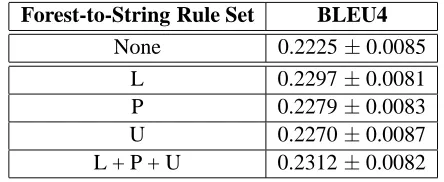
Table 6: Effect of lexicalized, partial lexicalized, and unlexicalized forest-to-string rules.
fault rules to perform monotone search. The 95%
confidence intervals were computed using Zhang’s significance tester (Zhang et al., 2004). We mod-ified it to conform to NIST’s current definition of the BLEU brevity penalty. We find that Lynx out-performs Pharaoh significantly. The integration of forest-to-string rules achieves an absolute improve-ment of 1.0% (4.3% relative) over using tree-to-string rules only. This difference is statistically sig-nificant (p < 0.01). It also achieves better result than treating bilingual phrases as lexicalized tree-to-string rules. To produce the best result of 0.2402, Lynx made use of26,082tree-to-string rules,9,219
default rules,5,432forest-to-string rules, and2,919
auxiliary rules. This suggests that tree-to-string rules still play a central role, although the integra-tion of forest-to-string and auxiliary rules is really beneficial.
Table 6 demonstrates the effect of forest-to-string rules with different lexicalization levels. We set
a= 3,α = 0,b = 10, andβ = 0. The second row “None” shows the result of using only tree-to-string rules. “L” denotes using tree-to-string rules and lex-icalized forest-to-string rules. Similarly, “L+P+U” denotes using tree-to-string rules and all forest-to-string rules. We find that lexicalized forest-to-forest-to-string rules are more useful.
6 Conclusion
In this paper, we introduce forest-to-string rules to capture non-syntactic phrase pairs that are usually unaccessible to traditional tree-to-string translation models. With the help of auxiliary rules, forest-to-string rules can be integrated into tree-to-forest-to-string mod-els to offer more general derivations. Experiment re-sults show that the tree-to-string model augmented with forest-to-string rules significantly outperforms
[image:7.612.78.296.202.292.2]the original model which allows tree-to-string rules only.
Our current rule extraction algorithm attaches the unaligned target words to the nearest ascendants that subsume them. This constraint hampers the expres-sive power of our model. We will try a more general way as suggested in (Galley et al., 2006), making no a priori assumption about assignment and using EM training to learn the probability distribution. We will also conduct experiments on large scale training data to further examine our design philosophy.
Acknowledgement
This work was supported by National Natural Sci-ence Foundation of China, Contract No. 60603095
and60573188.
References
Stanley F. Chen and Joshua Goodman. 1998. An empir-ical study of smoothing techniques for language mod-eling. Technical report, Harvard University Center for Research in Computing Technology.
David Chiang. 2005. A hierarchical phrase-based model for statistical machine translation. In Proceedings of ACL 2005, pages 263–270, Ann Arbor, Michigan, June.
Michel Galley, Mark Hopkins, Kevin Knight, and Daniel Marcu. 2004. What’s in a translation rule? In Proceedings of HLT/NAACL 2004, pages 273–280, Boston, Massachusetts, USA, May.
Michel Galley, Jonathan Graehl, Kevin Knight, Daniel Marcu, Steve DeNeefe, Wei Wang, and Ignacio Thayer. 2006. Scalable inference and training of context-rich syntactic translation models. In Proceed-ings of COLING/ACL 2006, pages 961–968, Sydney, Australia, July.
Philipp Koehn, Franz Joseph Och, and Daniel Marcu. 2003. Statistical phrase-based translation. In Proceed-ings of HLT/NAACL 2003, pages 127–133, Edmonton, Canada, May.
Yang Liu, Qun Liu, and Shouxun Lin. 2006. Tree-to-string alignment template for statistical machine trans-lation. In Proceedings of COLING/ACL 2006, pages 609–616, Sydney, Australia, July.
Daniel Marcu, Wei Wang, Abdessamad Echihabi, and Kevin Knight. 2006. Spmt: Statistical machine trans-lation with syntactified target language phrases. In Proceedings of EMNLP 2006, pages 44–52, Sydney, Australia, July.
Franz J. Och and Hermann Ney. 2000. Improved statis-tical alignment models. In Proceedings of ACL 2000, pages 440–447.
Franz J. Och and Hermann Ney. 2002. Discriminative training and maximum entropy models for statistical machine translation. In Proceedings of ACL 2002, pages 295–302.
Franz J. Och and Hermann Ney. 2004. The alignment template approach to statistical machine translation. Computational Linguistics, 30(4):417–449.
Franz J. Och. 2003. Minimum error rate training in sta-tistical machine translation. In Proceedings of ACL 2003, pages 160–167.
Kishore Papineni, Salim Roukos, Todd Ward, and Wei-Jing Zhu. 2002. Bleu: a method for automatic eval-uation of machine translation. In Proceedings of ACL 2002, pages 311–318, Philadephia, USA, July.
Chris Quirk and Simon Corston-Oliver. 2006. The im-pact of parse quality on syntactically-informed statis-tical machine translation. In Proceedings of EMNLP 2006, pages 62–69, Sydney, Australia, July.
Chris Quirk, Arul Menezes, and Colin Cherry. 2005. De-pendency treelet translation: Syntactically informed phrasal SMT. In Proceedings of ACL 2005, pages 271–279, Ann Arbor, Michigan, June.
Andreas Stolcke. 2002. Srilm - an extensible lan-guage modeling toolkit. In Proceedings of Interna-tional Conference on Spoken Language Processing, volume 30, pages 901–904.
Ashish Venugopal and Stephan Vogel. 2005. Consid-erations in maximum mutual information and mini-mum classification error training for statistical ma-chine translation. In Proceedings of the Tenth Confer-ence of the European Association for Machine Trans-lation, pages 271–279.
Deyi Xiong, Shuanglong Li, Qun Liu, and Shouxun Lin. 2005. Parsing the penn chinese treebank with seman-tic knowledge. In Proceedings of IJCNLP 2005, pages 70–81.