
University of Windsor University of Windsor
Scholarship at UWindsor
Scholarship at UWindsor
Electronic Theses and Dissertations Theses, Dissertations, and Major Papers
1-1-2006
Integrated hybrid channel assignment and distributed power
Integrated hybrid channel assignment and distributed power
control in wireless mobile networks using evolution strategy.
control in wireless mobile networks using evolution strategy.
Tahira Farid
University of Windsor
Follow this and additional works at: https://scholar.uwindsor.ca/etd
Recommended Citation Recommended Citation
Farid, Tahira, "Integrated hybrid channel assignment and distributed power control in wireless mobile networks using evolution strategy." (2006). Electronic Theses and Dissertations. 6944.
https://scholar.uwindsor.ca/etd/6944
INTEGRATED HYBRID CHANNEL ASSIGNMENT
AND DISTRIBUTED POWER CONTROL IN
WIRELESS MOBILE
NETWORKS USING EVOLUTION STRATEGY
By
TAHIRA FARID
A Thesis Submitted to die Faculty of Graduate Studies and Research
through School of Computer Science
in Partial Fulfillment of the Requirements for the Degree of
Master of Science at the University of Windsor
Windsor, Ontario, Canada
2006
1*1
Library and Archives CanadaPublished Heritage Branch
Bibliotheque et Archives Canada
Direction du
Patrimoine de I'edition
395 W ellington Street Ottawa ON K1A 0N4 Canada
395, rue W ellington Ottawa ON K1A 0N4 Canada
Your file Votre reference ISBN: 978-0-494-34904-5 Our file Notre reference ISBN: 978-0-494-34904-5
NOTICE:
The author has granted a non exclusive license allowing Library and Archives Canada to reproduce, publish, archive, preserve, conserve, communicate to the public by
telecommunication or on the Internet, loan, distribute and sell theses
worldwide, for commercial or non commercial purposes, in microform, paper, electronic and/or any other formats.
AVIS:
L'auteur a accorde une licence non exclusive permettant a la Bibliotheque et Archives Canada de reproduire, publier, archiver,
sauvegarder, conserver, transmettre au public par telecommunication ou par I'lnternet, preter, distribuer et vendre des theses partout dans le monde, a des fins commerciales ou autres, sur support microforme, papier, electronique et/ou autres formats.
The author retains copyright ownership and moral rights in this thesis. Neither the thesis
nor substantial extracts from it may be printed or otherwise reproduced without the author's permission.
L'auteur conserve la propriete du droit d'auteur et des droits moraux qui protege cette these. Ni la these ni des extraits substantiels de celle-ci ne doivent etre imprimes ou autrement reproduits sans son autorisation.
In compliance with the Canadian Privacy Act some supporting forms may have been removed from this thesis.
While these forms may be included in the document page count,
their removal does not represent any loss of content from the
Conformement a la loi canadienne sur la protection de la vie privee, quelques formulaires secondaires ont ete enleves de cette these.
Abstract
The primary goal of a cellular radio system is to provide communication ser
vices to a large number of mobile users. However, the increasing demand of
new services in this field is in contrast to the limited resources such as radio
spectrum and transm itter power available in the current communication sys
tems. As the number of mobile users grows rapidly, available channels and
transm itter power must be used efficiently to improve the system capacity.
The role of Channel Assignment is to allocate channels to cells or mobiles in
such a way as to minimize call blocking or call dropping probabilities, as well
as to maximize the quality of service. On the other hand, the role of power
control is to assign power level to each transm itter so th at the signal quality
is maintained and interference is minimized. Existing papers have focused on
optimizing the assignment of channels assuming th a t the allocation of trans
m itter power is known and fixed and vice versa.
In this thesis, we develop an efficient evolution strategy to address the prob
lem of integrating Channel Assignment and Power Control. The proposed ap
proach uses an efficient problem representation, defines an appropriate fitness
function and m utation operators to optimize both Channel Assignment and
Power Control. Our experiments and discussions show better system capac
ity, decrease in the blocking probability while maintaining the desired carrier-
to-interference (CIR) ratio compared to the experiments done in literature
A cknow ledgem ent
I would like have this opportunity to express my deepest gratitude to my ad
visor Dr. Alioune Ngom for his supervision, patience and valuable insights
throughout my graduate studies. W ith his enthusiasm and commitment he
made this whole journey of mine a magnificent experience. Under his super
vision, I had the chance to further develop my analytical and organizational
skills in research.
I would like to thank Dr. Christie Ezeife for her valuable teachings which
helped me to gain extensive knowledge in various academic fields.
I am grateful to the committee members Dr. A runita Jaekel, Dr. Kemal
Tepe and Dr. Robert Kent for their constructive criticism and valuable advises.
Many thanks to School of Computer Science staffs Roxana, Gloria and Anis
for their support during the two years of my masters. My deepest gratitude
to Kanishka for his support and assistance in the mathematical applications
related to my thesis.
Finally, I wish to thank my Parents and my brother for their encouragement
and support without which this research would have been be a daunting task
Table of Contents
A bstract iii
Acknowledgem ent iv
List o f Tables viii
List of Figures ix
1 Introduction 1
1.1 Mobile C om m unication... 1
1.2 Evolution of Cellular S y s te m s ... 2
1.3 Cellular Radio S y ste m s... 4
1.4 Channel A s s ig n m e n t... 6
1.4.1 Channel Assignment S c h e m e s ... 6
1.4.2 Channel Assignment C o n stra in s ... 7
1.4.3 Dynamic Channel A ssig n m en t... 9
1.5 Power C o n tro l... 9
1.5.1 Related S tu d ie s ... 10
1.6 Fundamentals of Evolution S tra te g y ...12
1.7 Problem S ta te m e n t... 15
1.8 C o n trib u tio n s ...15
2 Literature R eview and Survey 17
2.1 EA in Base Station P la c e m e n t... 17
2.2 EA in Call Admission C o n tr o l... 19
2.3 Channel A s s ig n m e n t... 20
2.3.1 EA in Fixed Channel A ssig n m e n t... 21
2.3.2 Dynamic Channel A llocation...25
2.3.3 EA in Dynamic Channel A llo c atio n ... 26
2.4 Power Control Schem es... 28
2.5 Integrated Channel Assignment and Power C o n t r o l ... 31
2.5.1 DCA with Power Control ... 32
3 Proposed M ethodology 35 3.1 HCA S tr a te g y ... 36
3.2 Power C o n tro l... 38
3.2.1 Problem S ta te m e n t...38
3.2.2 Distributed Power Control ( D P C ) ... 42
3.3 Proposed Evolution Strategy A p p ro a c h ...43
3.3.1 Problem R e p re s e n ta tio n ... 43
3.3.2 Initial P a r e n t ... 44
3.3.3 M utation ...45
3.3.4 Fitness Function ... 45
3.4 HCA with D P C ... 47
3.5 ES a l g o r i t h m ... 49
4 Experim ents and Discussion 51 4.1 Cellular Network Model A s s u m p tio n ... 52
4.2 Implementation D e ta ils ...54
4.2.1 Determination of Allocation Matrix A ...54
4.2.2 Determination of the cross-link gain Matrix F ... 54
4.3 Traffic M o d e l ... 56
4.4 Initial Power Issue (Link Admission) ...57
4.5 S im u latio n ... 58
5 Conclusion and Future D irection 76
Bibliography 78
List of Tables
4.1 Characteristics of 21:49 H C A - D P C ... 61
4.2 Characteristics of 35:35 H C A - D P C ...61
List of Figures
1.1 Cellular Network A rc h ite c tu re ... 5
1.2 A Typical Representation of a Solution in ES genes=7 Repro duced from [ 6 1 ] ...14
1.3 Basic Concept of ES Reproduced from [6 1 ]... 14
1.4 Swapping Operator Reproduced from [61] 14
3.1 Neighbors of a Given Cell [ 7 3 ] ... 37
3.2 System Geometry and Link G a in s ... 39
4.1 Cellular Model Assumption ...52
4.2 Distance between two c e l l s ...55
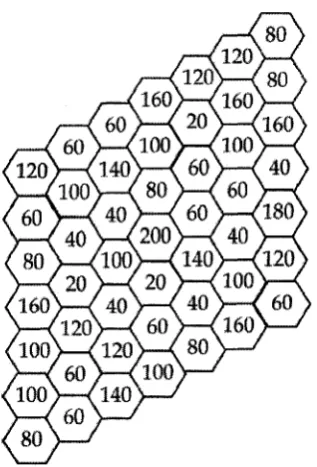
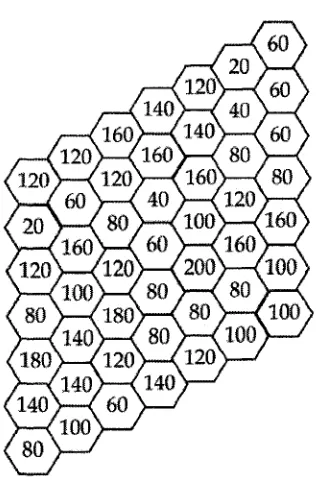
4.3 Non Uniform traffic distribution pattern 1 with initial Poisson arrival rates (C a lls/h o u r)...56
4.4 Non Uniform traffic distribution pattern 2 with initial Poisson arrival rates (C a lls/h o u r)...57
4.5 Performance of proposed (//, A)-ES (HCA-DPC) in terms of blocking probability compared to the HCA proposed in [73] with FCA 21 and DCA 49, /r = 1, A = 10, L — 10 (Pattern 1) . . . . 60
4.7 Performance of proposed (/x, A)-ES (HCA-DPC) in terms of
blocking probability compared to the HCA proposed in [73] with
FCA 49 and DCA 21, /x = 1, A = 10, L = 10 (Pattern 1) . . . . 62 4.8 Performance of proposed (/x, A)-ES (HCA-DPC) in terms of
blocking probability compared to the HCA proposed in [73] for
the entire cellular network with non-uniform traffic distribution
according to pattern 1 ...63
4.9 Performance of proposed (/x, A)-ES (HCA-DPC) in terms of
blocking probability compared to the HCA proposed in [73] for
the entire cellular network with non-uniform traffic distribution
according to pattern 2 ...64
4.10 Performance of proposed (/x, A)-ES (HCA-DPC) in terms of
blocking probability for different values of /x and A with nonuni
form traffic distribution according to P attern 1 for FCA 21 and
DCA 4 9 ... 65
4.11 Performance of proposed (/x, A)-ES (HCA-DPC) in terms of
blocking probability for different values of /x and A with nonuni
form traffic distribution according to P attern 1 for FCA 35 and
DCA 3 5 ... 66
4.12 Performance of proposed (/x, A)-ES (HCA-DPC) in terms of
blocking probability for different values of /x and A with nonuni
form traffic distribution according to P attern 1 for FCA 49 and
DCA 2 1 ... 67
4.13 Performance of proposed (/x, A)-ES (HCA-DPC) in terms of
dropping probability for the entire network with nonuniform
4.14 Performance of proposed (fx, A)-ES (HCA-DPC) in terms of blocking probability using different values of L with nonuniform
traffic distribution according to Pattern 1 for FCA 21 and DCA
49 ...69
4.15 Performance of proposed (n, A)-ES (HCA-DPC) in terms of blocking probability using different values of L with nonuniform traffic distribution according to Pattern 1 for FCA 21 and DCA 49 ... 70
4.16 Performance of proposed (/x,A)-ES (HCA-DPC) and (jx. A)-ES (HCA-DPC) in terms of call blocking probability with nonuni form traffic distribution according to Pattern 1 for FCA 21 and DCA 4 9 ... 71
4.17 Performance of proposed (fx, A)-ES (HCA-DPC) and (fx, A)-ES (HCA-DPC) in terms of call blocking probability with nonuni form traffic distribution according to P attern 1 for FCA 21 and DCA 4 9 ... 72
4.18 Simulation of Call Arrival E v e n t...73
4.19 Simulation of Call Release Event ...74
Chapter 1
Introduction
1.1
M obile C om m unication
Mobile communication is the fastest growing filed in the telecommunication
industry. Like other technological developments, the development in wireless
mobile communication has passed through several stages. The pioneering ex
periments in land mobile communication dates back to 1920’s in Detroit, USA
when personnel of the Detroit police departm ent’s radio bureau began exper
imenting on a band near 2 MHz for vehicular mobile service. In 1928 the
department commenced regular one-way radio communication with its patron
cars. Further progress was made in 1933 when one police departm ent in New
Jersey initiated regular two way communications with its patrol cars, a major
advance over previous one-way systems. This two way radio became standard
throughout the country as the very high frequency system placed transm it
ters in patrol cars to enable patrolmen to communicate with headquarters and
other cars instead of just receiving calls.
The mobile telephony services were extended to the commercial arena to
wards the end of the Second World War. By late 1940s, Bell Systems embarked
on a program of supplying ’’public correspondence systems” (communication
Communi-cation Commission (FCC) classified these services as Domestic Public Land
Mobile Radio Service (DPLMRS). In 1946, the first interconnection of mo
bile users to the public telephone network was made to allow calls from fixed
stations to mobile users, when FCC granted license to AT&T (American Tele
phone and Telegraph) company to operate in St. Louis. The system used a
central high power transm itter to cover a metropolitan area up to 50 miles or
more from the transm itter. W ith this concept, it became difficult to reuse the
same frequency. The inefficient use of spectrum severely limited the system
capacity. By 1969, ITMS (Improved Mobile Telephone Service) become the
first standard autom atic 450 MHz frequency range service which allowed as
signment of free channels automatically and the system was full duplex and
customers could do their own dialing. In spite of the fact th a t mobile service
was, indeed, a scarce luxury, by late 1970’s, the demand for service was rising
rapidly [38].
A solution to this problem emerged in 1974 when researchers at Bell Lab
oratories in USA developed the concept of wireless cellular telephone system
and eventually the authorization was granted to Illinois Bell in 1978. The
cellular concept replaced the use of a large geographical area where a high
power transm itters is placed at high elevation at the center of the area with
a large geographic area divided into a number of non-overlapping small geo
graphic areas, called cells, equipped with low power transmitters. This cellular
organization allowed frequency reuse among geographically distant cells, thus
greatly expanding the system capacity [47], [56]. It also allowed cells to be
sized according to subscribers’ density and traffic demand of a given area.
1.2
E volution o f Cellular System s
The Nordic Mobile Telephone System (NMT) was the first to introduce cel
450 to 900 MHz band. In 1983, cellular systems began in the United States
in Chicago with the release of the Advanced Mobile Phone Service (AMPS)
operating in 800 MHz, and other cities followed rapidly. Asia, Latin Amer
ica and Oceanic Countries later adopted to the AMPS standard and AMPS
emerged as the largest potential market for cellular communications. Britain
introduced another technology called Total Access Communications Systems
(TACS) in 1985, operating at 900 MHz. Many other technologies were devel
oped, however, AMPS, NMT and TACS were the most successful technologies
[67]. These are all part of the ’’First Generation” cellular systems and were
analog systems providing only basic speech services.
Despite of the popularity of the analog systems, they were unable to handle
the growing capacity needs in a cost efficient manner. Each system followed
different standard making it impossible for a person to use the same cellu
lar phone in different countries. As a result, standardization committees for
’’Second Generation” cellular systems worldwide adopted the digital technol
ogy, which conformed to three standards; one for Europe and international
applications known as Global Mobile Systems (GSM), one for North America
known as IS-54 or TDMA (North American Digital Cellular), and a one for
Japan known as Japanese Digital Cellular (JDC). The advantages of digital
systems over analog system included ease of signaling, lower levels of inter
ference, integration of transmission and switching, higher capacity potentials,
and new services like d ata services, encryption of speech and d ata and Inte
grated Services Digital Network [71]. Second generation cellular systems are,
however, still optimized for voice services and are not well suited for d ata
communications.
D ata communication is an im portant requirement in the current environ
ment of Internet, electronic commerce and multimedia communications. Not
only do subscribers want these services, they want ubiquitous access (i.e. access
cellular systems referred to as Personal Communication Systems (PCS), aim at
providing integrated services such as data, voice, image and video to stationary
and non-stationary subscribers without temporal and spatial restrictions. The
need for third generation mobile communications technology was recognized
as far back as the 1980s. the International Telecommunications Union (ITU)
was heavily involved and the work within the ITU was originally known as
Future Public Land Mobile Telecommunications Systems (FPLMTS). Exam
ples of PCS include Person Handphone System and Digital Enhanced Cordless
Telecommunications (DECT) [71].
1.3
Cellular R adio System s
The beginning of cellular concept gave a major breakthrough in the develop
ment of mobile communication systems. Though most people say ’’cell phone” ,
this term is actually short for ’’cellular phone” , which is named after the wire
less technology th a t they work on. The cellular principle divides a covered
geographical area into a set of smaller service areas, called cells. Four possible
geometric shapes were proposed for the design and layout of the cellular sys
tem: the circle, the square, the equilateral triangle, and the regular hexagon.
Among the four, the regular hexagon was found to be the best over the other
shapes [46]. In practice, the cell sizes are irregular and depend on the terrain
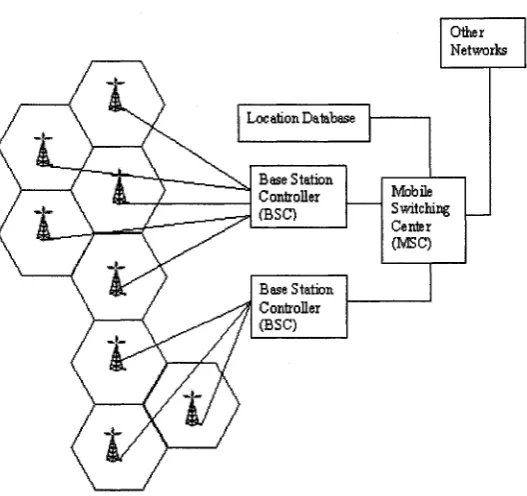
and propagation condition. Figure 1.1 shows typical cellular system architec
ture.
Each cell has a base station and a number of mobile terminals i.e. mobile
phones, palms, laptops, or other mobile devices. The base station is equipped
with radio transmission and reception equipments. The mobile terminals com
municate through wireless links with the base station associated with the cell.
The base station provides the interface between the mobile telephone switch
Loc abori Database
Base Station Controller (BSC)
Base Station Controller (BSC)
Mobile Switching Center (MSC)
Figure 1.1: Cellular Network Architecture
central coordinating element for all cell sites, controls call processing, handles
billing activities, performs channel assignment, and provides the necessary con
nection with the public switching telephone network (PSTN) [61]. The base
station is responsible for the communication between the mobile terminal and
the rest of the information network. A base station can communicate with mo
bile terminals as long as they are within its operating range and the operating
range depends on the transmission power of the base station. Radio energy
dissipates over distance, so the mobile terminals must be within the operating
1.4
C hannel A ssignm ent
To establish communication with a base station, a mobile terminal must ob
tain a channel from the base station. A channel comprises of two frequencies;
one frequency (the forward link or downlink) for transmission from the base
station to the mobile terminal, the other frequency (the reverse link or up
link) for transmission from the mobile terminal to the base station. As these
two channels are assigned simultaneously, however, in many studies they are
considered as one single link. This ideal link is considered to be a generic
communication resource depending on the multiple access technique used by
the cellular network and may be a fixed radio frequency for a frequency divi
sion multiple access (FDMA), or a particular time slot within a frame for a
time division multiple access (TDMA), or a specific code for a code division
multiple access (CDMA) [58].
The capacity of a cellular system can be described in terms of the available
channels or the users the system can support. The total number of channels
made available to a system depends on the allocated spectrum and the band
width of each channel. The available frequency spectrum is limited and since
the number of mobile users is increasing everyday, the channels must be reused
as much as possible to increase the system capacity. This requires proper chan
nel assignment scheme. The role of a channel assignment scheme is to allocate
channels to cells or mobiles in a way as to minimize the call blocking or call
dropping probabilities, and also to maximize the quality of service.
1.4.1 C h an n el A ssig n m en t Schem es
Many channel assignment schemes have been studied extensively to maximize
the frequency reuse. Channel assignment is generally classified into two cate
gories: Fixed Channel Assignment (FCA) and Dynamic Channel Assignment
on a pre-estimated traffic intensity. In DCA, there is no permanent allocation
of channels to cells as the entire set of available channels is accessible to all
the cells, and the channels are assigned on a call-by-call basis in a dynamic
manner [15]. DCA method makes cellular systems more efficient in real-life
scenarios where the traffic distribution is unknown or changes with time, but
has the disadvantage of requiring more complex control and is generally time
consuming [61].
FCA scheme is simple but does not adapt to changing traffic conditions and
user distribution. Moreover, the frequency planning becomes more difficult in
a microcellular environment as it is based on the accurate knowledge of traffic
and interference conditions. These deficiencies are overcome by DCA but FCA
out performs most known DCA schemes under heavy load conditions [Lai 96
from GT], Various extensions or combinations of FCA and DCA schemes have
been discussed in the literature. The most basic are the Hybrid Channel
Assignment (HCA) [73] and the Borrowing Channel Assignment (BCA) [11].
HCA combines the feature of both FCA and DCA and one set of channels
are allocated as per the FCA scheme and another set is allocated as per the
DCA scheme. In BCA, the channel assignment is initially fixed. If a cell has
all the channels occupied, for incoming calls the cell borrows channels from
its neighboring cells and thus call blocking prevented [61]. A comprehensive
survey on channel assignment schemes can be found in [39].
1.4.2
C h an n el A ssig n m en t C on strain s
In the process of channel assignment, radio transmission in a channel may
cause interferences in other channels. Such interferences degrade the signal
quality and the quality of service. Some of the potential sources of radio inter
ference to a call are Co-channel Interference (caused by allocation of the same
channel to certain pair of the cells close enough to cause interference), Adja
pairs of cells simultaneously) and Co-site Interference (caused by allocation of
channels in the same cell th a t are not separated by some minimum spectral
distance). These constrains are known as hard constrains or electromagnetic
compatibility constrains [50]. To overcome the hard constraints like cochannel
interference constrain, heuristics have been proposed in studies for FCA and
DCA including simulated annealing [20], tabu search [9], neural networks [41],
[25] and genetic algorithms [16], [43], [18] and Evolutionary Strategy [61]. The
process of Channel Assignment must satisfy the hard constrains and the de
mand of the channels in a cell. Beside these constrains there are some other
conditions th a t th a t may improve the performance of the channel allocation
technique. These conditions are called soft constrains and are the packing con
dition, the resonance condition and the limitation of reassignment operations
[58].
W ith the packing condition, the minimum number of channels is used every
time a call arrives. This condition allows the use of channels th a t are already
in use in other cells without violating the cochannel interference constrain.
The resonance condition allocates the same channels to cells th a t belong to
the same reuse scheme. Reuse scheme allows the discrete channels assigned to
a specific cell to be reused in different cells separated by a distance sufficient
enough to bring the value of co-channel interference to a tolerable level thereby
reusing each channel many times. The minimum distance required between
the centers to two cells using the same channel to maintain the desired signal
quality is known as the reused distance.
Finally, limiting reassignment tries to assign, where possible, the same
channels assigned before, thus limiting the reassignment of channels. This is
due to the fact th a t excessive rearrangement may lead to undesirable results
1.4.3 D y n a m ic C han n el A ssign m en t
The traditional channel allocation method, the Fixed Channel Allocation (FCA)
is not very efficient for utilization of available spectrum, and impractical in
microcell communication systems as large number of cells, irregularities in
propagation and traffic distribution make pre-allocation of channels almost
impossible. Dynamic Channel Allocation (DCA) had long been pursued as
the answer for coping with time and spatial variations of traffic demand in
communication networks.
In DCA, the entire set of available channels is accessible to all the cells
and the channels are assigned on a call-by-call basis in a dynamic manner.
This makes the scheme adaptable to the changing traffic conditions. DCA can
be depicted as follows: let us consider a mobile communication system with
C cells and F channels. Let k denote a cell involved in call arrival, P ( k , t) denotes the set of channels of the ongoing calls in k at time t. then the set of
eligible channels in k a t time t is given by I ( k , t) = F — P(k, t). The problem of DCA is to choose channels from the set I ( k , t ) as carefully as not to select any interfering channels in the eligible channel poll.
1.5
Pow er C ontrol
Power must be given to a transm itter to support communication. Transmitter
or receiver power is a scarce resource. Excessive use of power for transmis
sion causes faster drainage of power resulting in short battery life, and also
causes interference to other uses. In cellular network, the signal quality is
usually determined by the Signal-to-Interference Ratio (SIR) or the Carrier-
to-Interference Ratio (CIR). CIR is defined as the ratio between the desired
averaged received signal power from the transm itter of the cell where it is lo
cated and the overall averaged received signal power from transm itters using
the level of interference in the network depend upon the transm itter power.
Power control is a resource management process th a t is used to adjust adjust
transmission power in each base-mobile link such th a t the interference in other
receiver locations is minimized, the signal quality is maintained.
Power control can suppress the adjacent channel interference, the cochan
nel interference, and minimize power consumption to extend terminal batter
life. Undoubtedly power control can raise the network capacity. It consists of
techniques and algorithms used to manage and adjust the transm itter power
of base stations and mobile terminals. This is required for the forward link as
well as the reverse link.
1.5.1
R ela ted S tu d ies
In the design of large high capacity cellular radio systems, cochannel inter
ference caused by frequency reuse is the single most limiting factor on the
system capacity. Many transm itter power control schemes have been proposed
to control this interference for a given channel allocation. Most of the early
work in power control schemes has focused on algorithms th a t aim at keep
ing the received power of the desired signal at some constant level. This has
the favorable effect th a t the requirements on the receiver dynamic range are
smaller, which results in better adjacent channel protection [79]. Results indi
cate an increase of capacity by roughly a factor of two compared to systems
with fixed transm itter power. However, detailed investigations show th a t the
constant-received power control has only limited ability to reduce cochannel
interference.
In [1], Aein took an analytical approach towards frequency reuse interfer
ence in satellite systems and introduced the concept of CIR balancing. The
balancing concept was successfully used in [3] in the context of cellular radio
in general and spread-spectrum systems in particular which was further in
probability in [77] and [78]. These power control procedures along with some
other centralized approaches, however, depend on full knowledge of the gain
in all propagation paths, both intended base-mobile paths and unwanted, in
terference paths. Therefore, these optimum algorithms serves mainly as a tool
to derive upper bounds on the performance of interference control schemes,
rather than being suited for actual implementation [79].
Many distributed power control approaches have been proposed and in
vestigated which are suitable for practical implementation and require far less
measurements and allow distributed operations. In [2], author proposed a sim
ple proportional control algorithm which increases the transm itter power when
the CIR level is too low and decreases the power when the CIR level is more
than adequate. Combination of power control with other resource allocation
has been an active area of research. A combination of power control with
dynamic channel allocation has been studied in [49], [73], [36], a combination
with base station assignment has been studied in [34], [75]. In [55], the au
thors have proposed a joint resource allocation algorithm th at tries to allocate
as many mobile users as possible to every available channel in the system with
simultaneous assignment of base stations and power levels.
The power control algorithms proposed in literature can be broadly clas
sified as centralized or decentralized (distributed). Centralized power control
schemes have been proposed in [1],[28], [77], [78] while many decentralized
power control schemes have been proposed and can be found in [23], [29], [74],
[79]. A centralized power control has a central controller th at maintains infor
mation about all the radio links in the system and it decides control actions
for all users. A detailed study on the power control problem can be found in
[60]. On the other hand, a distributed controller only controls the power of
one single transm itter based on local information. In this thesis, we propose a
distributed power control strategy coupled with hybrid channel assignment to
Different approaches towards the optimization of integrated channel assign
ment (DCA) and power control have been proposed in [14], [24], [31], [45], [49],
[63]. In this thesis, we propose a distributed power control strategy coupled
with hybrid channel assignment to optimize channel allocation in such a way
th at the CIR requirements are meet to maintain desired signal quality and
minimum power is consumed.
1.6
Fundam entals o f E volution Strategy
In this section, we briefly describe a heuristic approach called Evolution S trat
egy (ES) which is the main optimization tool used in our optimization problem.
Rechenberg [59] pioneered ES. This method belongs to the general category of
heuristic optimization methods called Evolutionary Algorithms (EA). EA was
proposed in 1990 to describe a class of direct, probabilistic search techniques
based on the selection mechanism adopted by natural systems [5]. Genetic
Algorithms (GA), Genetic Programming (GP), Evolution Strategy (ES) and
Evolutionary Programming (EP) are some of the representatives of EA. A
survey on GA, EP, and ES can be found in [22].
ES was initially applied on optimization problems with discrete variables.
In ES, the pool of candidate solution is known as the population and the to
tal number of individuals in a population is known as the population size.
Each individual solution is associated with an objective value. The objective
value represents the individual solution’s performance in relation to the pa
rameter being optimized. It also reflects an individual solution’s performance
in relation to other potential solutions in the search space. In ES, a candi
date solution (offspring) is produced from a given existing solution (parent)
by applying various reproduction operators like mutation and recombination.
M utation adds vectors of Gaussian random variables with zero mean and spec
[61]. W ith recombination operator, mixing of different solutions is achieved.
The best solution generated in one generation becomes the parent for the next
generation. It is an iterative method, therefore, the process of selection and
application of reproduction is repeated until a terminating criterion is met. At
the end, the solution of the problem is represented by the best individual so
far in all generations. Following the basic steps involved in an ES algorithm:
1. Generate A individual as the initial population
2. Evaluate individuals according to fitness f
3. Select /z best individuals as the parent population and discard the rest
4. Apply reproduction operator i.e. mutation to create A offspring from /z
parents
5. Continue from Step 2 until the termination criteria is met or the prede
termined number of generations have been produced and evaluated.
Schwefel [68] introduced two common variations of ES; (/z + A)-ES and
(/z, A)-ES. Both the approaches use /z parents to produce A offsprings. However,
they differ in the selection of individuals for the next generation. In (/z + A)-
ES, n best individuals from all the (/z + A) individuals are selected to form the next generation, but in (/z, A)-ES, /z best individuals from the set of A are
selected to form the next generation. In this thesis, we take the model used by
Nissen in [51], and [52] to adapt to the ES heuristics to our specific problem.
Following Nissen, ES is a (1,A)-ES, where one parent generates A offsprings and
individuals are vectors of integers th a t are generated from parents by randomly
swapping values. Figure 1.2 depicts a typical representation of a solution in ES
and Figure 1.3 and 1.4 depicts the concept of ES and the swapping operator.
We also employ (/z+A)-ES with /z = 1 and compare both (1, A)-ES and (1+A)-
4 3 6 2 5 1 7
Figure 1.2: A Typical Representation of a Solution in ES genes=7 Reproduced from [61]
Parent solution
Reproduction
S e ta tio n o f « w jnm nt
Figure 1.3: Basic Concept of ES Reproduced from [61]
3 8 2 S 1 7
Swap
■o
1.7
P roblem Statem ent
In this thesis, we integrated hybrid channel assignment and distributed power
control (HCA-DPC) using Evolution Strategy to address the problem of finding
an optimal assignment of channels given the transm itter power and co-channel
interference is minimized. The HCA strategy used is adopted from [73]. We
have modified the energy function employed in [73] for ES to include the CIR
requirements. The minimization of the energy function gives the optimal chan
nel allocation with the best link gain m atrix to meet the CIR requirements and
to optimize power.
Our proposed scheme uses the hard and soft conditions in [73]. Our ES
method optimizes the channel assignment as well as the power consumption
and minimizes interference. An efficient problem representation and an ap
propriate fitness function is used to search for a (near) optimal allocation of
channels with efficient CIR objectives for a given cell th a t receives an incoming
call. The performance of our method yields better results than th a t of [73].
1.8
C ontributions
Our contributions are as follows:
1. An original, novel and efficient Evolution Strategy approach integrating
Hybrid Channel Assignment (HCA) with Distributed Power Control (DPC)
for better and robust optimization.
2. An objective function using channel allocation and power control scheme
for channel allocation optimization with cochannel free assignment.
3. An efficient way to incorporate power control into channel assignment
in way to th a t selection of channels always meet the CIR requirements and
optimal power is achieved.
4. ES to integrate both channel and power resource management which
5. A novel way to handle the dropping of ongoing calls using the distributed
power control algorithm.
6. Employ both (//, A)-ES and (p + A)-ES algorithm and compare their performances to our specific problem.
1.9
O rganization o f th e R eport
Chapter 2 introduces the contribution of evolutionary algorithms in wireless
mobile communication area and gives a brief survey on the existing methods
th a t are relevant to our problem. In Chapter 3 we describe the HCA scheme,
the ES algorithm, the DPC scheme and our method of combining the problem
of finding an optimal channel assignment with power control. Chapter 4 deals
with basic assumptions of the cellular model used in the simulation, imple
mentation details and results. Finally Chapter 5 concludes the dissertation
Chapter 2
Literature Review and Survey
This chapter details the contribution of Evolutionary Algorithm in the field
of Wireless Mobile Communication, compares different approaches as well as
also surveys the existing methods th a t are used for both channel and power
resource management schemes relevant to our problem.
2.1
EA in B ase S tation Placem ent
The infrastructure cost and planning complexity of a cellular network is closely
related to the number of base stations required to achieve the desired level of
coverage (locations covered by the selected number of base stations) and ca
pacity [71]. Therefore, one of the most challenging design problems in cellular
network is deciding on the locations of the base stations and the minimum
number of base stations required to serve a given area while providing an ac
ceptable quality of service to the mobile users. In the literature many practical
approaches have been proposed to solve this problem. This includes the use
of GA in [8], [32], Simulated Annealing in [4], [35] and Tabu Search in [44].
For finding precise base station location, numerous factors such as traffic
density, channel condition, interference scenario, the number of base stations,
De-termining the location of base stations is known to be NP-hard. Given a list
of potential sites in a service area where base station may be located, the goal
is to use the knowledge of the radio propagation characteristics of the area
to select sites in such a way as to minimize their number while maximizing
coverage in the area [71]. The radio propagation characteristics can be deter
mined using ray-tracing software or by using empirical propagation models for
path loss. There exists a trade off between coverage and the number of base
stations. The higher is the number of base stations, the greater is the cover
age, but there is also correspondingly greater radio interference and network
cost. Some of the papers th a t describe the application of EA in base station
placement problem are briefly described below:
• In [8], Genetic Algorithm approach has been presented to address this
problem. The paper assumes th a t a list of N possible locations th a t guaran
tees 100% radio coverage is known before hand. The candidate solutions are
represented using a N bit binary string, with a 1 at each bit position if there
is a base station at the location corresponding to th a t bit, and zero otherwise.
The chromosomes are evaluated by the fitness function chosen as shown in
Equation 2.1.
fitn e s s (individual) = Cover^ lte ° (2.1)
Where Cover R ate01 is the radio coverage (the percentage of locations cov ered by the selected base stations, and o: is a parameter th at is tuned to favor
coverage with respect to the number of transm itters and is assigned a value
of 2 in this paper. Finally, N B is the number of selected Base Stations. This fitness function maximizes the coverage and minimizes the number of trans
mitters. Selection based on fitness value, one-point crossover and mutation
operators (flipping of the value of a randomly chosen bit of the string with a
2.2
EA in Call A dm ission Control
In mobile communication system, it is generally preferred to block a new call
than to drop an ongoing call. Hence, allocation of radio resources to every user
whenever they are available may not be the optimal strategy in terms of system
performance as this may result in an inability to serve a handoff call. Thus,
one of the im portant design issues is the finding of a call admission policy th a t
provides optimal system performance. Call Admission Control (CAC) policy
determines under what conditions a new call to a mobile in a particular cell
should be adm itted or blocked.
In [76], authors have considered the evolution of a state-based call ad
mission policies using GA. According to them, a call admission policy is a
collection of adm it/reject decisions corresponding to the services requested at
each state of the system. In each cell, the states refer to the number of oc
cupied channels. The assumptions made by the paper are as follows: a linear
cellular system, two types of service request; new call set request and handoff
request, three binary decisions; admit a new call, admit a handoff call from
the left cell and admit a handoff call from the right cell.
The paper assumes th a t all cells can access the F channels available in the system. For a linear cellular system with C cells, the total number of global states for the three decisions is 3 (F + 1 )°. The paper considered a local policy where each cell uses state information from its k left and k right nearest neighbors as well as its own state information. The state space is thus reduced
to 3(F + l )2fc+1l. The value of k is either 0 or 1. The policy is represented as binary string with a bit 1 for accepting the service and 0 for denying the
service. An example with 16 channels and 9 cells need 30 bits for the policy
with k = 0 and 3000 bits with k = 1. The performance of the system is defined as weighted measure of new call and handoff call and is defined as [76].
Where, Pn is the new call blocking probability, Ph is the handoff blocking probability and the value of w determines the extent to which dropped calls are considered less desirable than blocked calls. This represents the cost function
to be minimized.
2.3
C hannel A ssignm ent
The channel assignment problem has been shown to be NP-hard [33]. In liter
ature, many techniques have been proposed to solve FCA and DCA problem
based on fixed reuse distance concept. This include the use of neural networks
[19], [25], [41], the use of simulated annealing [20], the use of genetic algorithm
[7], [10], [?], [43], [50], [66], and the use of graph theoretic approach [27], [64]
in FCA. The goal of all these approaches is to provide an optimal assignment
of the available radio spectrum.
The neural network approach of Hopfield and Tank [19], [41] was shown to
be an inappropriate technique as it had greater tendency to get stuck in local
optima [42]. Some of the disadvantages of graph theoretic approach [20] are
the following:
• Graph theoretic approach is based on hard interference decisions indicat
ing whether the same channel can be simultaneously used in two radio cells.
Such a decision is questionable because interference depends upon several un
certain factors such as special distribution of traffic.
• Graph theoretic approach only aims at minimizing the used spectrum. It
does not exploit the optimum use of available channels.
Simulated annealing approach [20], [48], achieves the global optimum asymp
totically but its rate of convergence is very slow and requires a carefully de
signed cooling schedule [50]. Tabu search is good at exploring the search space
by avoiding the inefficient paths. This way it requires less computational time
ca-pacity as well as good method for avoiding oscillation of solutions which makes
it unsuitable for large scale problems [71].
2 .3.1
E A in F ix ed C han n el A ssign m en t
For every incoming call, a channel is selected with the restraints of electromag
netic constraints (EMC). EMC can be represented by minimum channel sepa
ration between any pairs of channels assigned to a pair of cells or cell itself [70].
If there are F channels to serve C cells in the system, the minimum channel separation is described by a symmetric compatibility m atrix X[C, C] and each element of X is a non-negetive integer. Each element A y(i, j = 1 • • • C) repre sents the minimum channel separation required between channels assigned to
cells i and j.
• Each diagonal element X u represents the minimum separation distance required between any two channels at cell i to satisfy co-cell interference con straint.
• Each non-diagonal element A y represents the minimum separation dis
tance in channel between any two channels assigned to cells i and j respectively. For example, if Ay = 0, then no frequency separation is needed between
the channels used in cell i and cell j and the channels used in cell i can be reused in cell j.
If the compatibility m atrix is binary, then Ay = 1 indicates the same
channels cannot be reused by cells i and j , and if it can be reused then A y = 0. Another basic requirement of channel assignment is the traffic requirement
of each cell. A vector T of length C can model the traffic demand of which an element T* denotes the number of channels used in the ith cell. This vector can be obtained by analyzing the traffic at each cell. In reality, the value of T
should be a function of time due to arrival of new calls, termination of ongoing
calls, and handovers.
which satisfies all the constraints mentioned above. The allocation m atrix
A[C, F] is such th a t the element A y of A is 1 if channel % is assigned to cell j
and a 0 otherwise.
In general the cost due to violation of interference constraints can be given
in Equation 2.3 [40].
/ = f cosite T fadjacentchannel T fcochannel (2-3)
where,
O F F
fcosite = Z E E AikAn<t>{i, I) (2.4) i=1 fc=1Ijtk
here I) = 0 if \k — l\ > X y and i = j and 1 otherwise.
f c c
fadjacentchannel
E E E
A ikA jk5{i,j) (2.5) fc=l i—l j^iwhere S(i, j ) = 0 if X y < 1 and 1 otherwise.
C F F
fcochannel
—
E E E
AikA jk<f)(i, j )(2.6)
i=l k=1j^k
where 4>(i, j ) — 0 if X y — 0 and 1 otherwise.
In Equation 2.3, fcosite takes care of the co-cite interference, f adjacentchannei
takes care of the adjacent channel interference and fcochannel takes care of the co-channel interference. The cost due to the violation of interference / ' is
minimized if f cosite, fadjacentchannel and fcochannel are minimized. The cost due to the violation of traffic demand requirements i.e. assigning a different rather
than required number of channels at each cell can be modeled as an error term
ftraffic as [40].
f m l / i e
= E(r< “ E
A i t ^<2'7)
The cost to be minimized can be expressed as shown in Equation 2.8 [40].
f — f + f t r a f f i c (2.8)
In Equation 2.8, / will be minimized if / ' and ftraffic are minimized. Some of the papers th a t describe the use of Evolutionary Algorithms to fixed channel
assignment problem is described below:
• In [43], authors have used GA to find an optimal channel assignment ma
trix. The constraints considered in the paper are the interference constraints
(co-site and co-channel) and traffic demand. In the encoding chosen for GA, a
chromosome represents a cell in the cellular system and the length of the chro
mosome is sum of the number of channels required in the cell. Thus, a typical
chromosome is a linear arrangement of channels for each cell. Each chromo
some is evaluated by an objective function th a t encompasses traffic demand
and interference constraints. The paper uses standard mutation operator and
slightly modified partially matched crossover (PMX).
• In [66], GA is used as well. The objective function treats the non
interference constraints (co-channel, co-site and adjacent channel) as soft con
straints and traffic demand satisfaction as a hard constraint. W ith this ap
proach, a solution th a t minimizes the severity of any interference is always
found. This is useful in situations where demand and interference constraints
are such th a t no interference free solutions are available for the network. Thus,
the formulation attem pts to minimize the severity of any interference. The
genetic representation of the solution is binary channel assignment m atrix
A[C,F]. The fitness of the choromosome is measured by Equation 2.9 [66].
C F F
F(A)=X E
A »X
cX
<2-9>
j-1 k= i j=i i=i
Here P is a factor th a t assigns a penalty to each assignment according to the recursive relations: Pj,%,m+1 = m a x (0 ,P j^m- i) , Pj,i,1 = X ji and P j^\ — 0, for m = 1, • • • m —1. The paper has designed a crossover and m utation operator in such a way th a t the feasibility of the solution is guaranteed. The paper also
provides an insight into the roles of crossover and mutation operator; crossover
operator improves co-channel and adjacent channel interference while mutation
operator eliminates co-site interference.
• Paper [50], has also used GA to find an optimal channel assignment
matrix. The constraints considered in the paper are interference constraint
(co-channel, adjacent channel and co-site), and traffic demand constraints with
non-uniform traffic distribution among the cells. In the paper, the authors
have described a modified genetic-fix-algorithm th a t creates and manipulates
chromosomes with fixed size (i.e. in binary representation, the number of
ones is fixed) and utilize an encoding scheme called the minimum-separation
encoding. In the encoding chosen for GA, a chromosome is a binary string
th at represents the channel assignment m atrix through concatenation of rows.
The chromosome structure incorporates both the traffic demand and co
site constraint. If dmin is the minimum number of frequency bands by which channels assigned to x th cell must differ to prevent co-site constraint, then, the minimum separation encoding scheme works by eliminating (dmin — 1) zeros following each 1 in each row of the channel assignment matrix. This com
pression reduces the search space. A chromosome is evaluated by an objective
function th a t includes only the co-channel and adjacent channel constraints.
The genetic-fix algorithm defines its own mutation and crossover operator is
such a way th a t the fixed number of ones is always preserved.
• In [10], authors have used GA to find the minimum required bandwidth
th a t satisfy a given channel demand without violating interference constrains.
In the encoding chosen for GA, a chromosome is a frequency assignment m atrix
or -1 or 9.
Aij = 0 : ilj channel is not used in the j th cell and the use of ith channel in the j th cell will not result in any interference.
—1 : channel is used in the j th cell.
A ^ = — 1: ilj channel is not used in the j th cell and the ith channel cannot used in the j th cell.
The paper considered the value of F to be sufficiently large, so th at some
channel are left unused even after adequate channels have been allocated to all
cells. A ^ = 9 indicates th a t the ith channel is unused in the j th cell. The fitness of the chromosome is measured by the frequency bandwidth a chromosome uses
i.e. by its F value. In case of chromosomes with same value of F, one with higher number of 0’s i.e. solution, which allows more channels to be added
without violating interference is considered the fittest. The paper presents an
algorithm to generate the initial population and also defines a genetic mutation
operator on those valid chromosomes such th a t the resulting chromosome is
also a valid solution.
2.3.2
D y n a m ic C han n el A llo c a tio n
In [37], the problem of dynamic channel assignment was formulated as a gen
eralization of traditional mutual exclusion problem. They have proposed an
algorithm called ” Relaxed M utual Exclusive” algorithm which prevents certain
pair of cells from simultaneously using the same channel. In [69], authors have
studied the application of reinforcement learning to dynamic channel alloca
tion. They formulated the DCA as a dynamic programming problem. Besides
these approaches, a number of DCA algorithms have been proposed [12], [13],
[15], [58], [17], [64], [61], [62], [80], [81]. These algorithms can be classified
into two classes of DCA schemes based on the type of information used in
allocating a channel [71].
of a channel is based on the measurement of carrier-to-interference ratio. In
[26] and [53], the propagation measurement is made from each base station
to mobile and vice-versa. A channel I is allocated to a new call if it does not cause any interference to the calls already in progress on I and at the same time does not receive any interference from the existing calls in the system.
2. In traffic adaptive scheme, the channel allocation decision is based on
the traffic conditions in neighboring cells of a cell involved in a call arrival.
Various traffic adaptive schemes have been proposed. The traffic adaptive
schemes can be classified into various groups. One such category is exhaustive
searching DCA [15],[17], [58], [62], [65], [80], [81]. Exhaustive searching D-ring
HCA has also been proposed in [73]. In exhaustive searching each channel
is associated with a cost. The cost of a channel reflects the impact of allo
cating this channel on the on going calls in the system. When a call arrives,
the system tries to allocate the channel with the minimum cost. Our pro
posed HCA strategy employs an exhaustive searching DCA while it adheres
to interference adaptive scheme as it allocates a channel also based on the
carrier-to-interference ratio.
2.3 .3
E A in D y n a m ic C han n el A llo ca tio n
Neural network based DCA [58], genetic algorithm based DCA [62], evolution
ary strategy based DCA [61] and evolutionary strategy based HCA [73] have
been proposed which are described below as they are relevant to our approach.
All the approaches use an energy function for the cell involved in the arrival
of a call.
• In [58], the energy function includes factors such as co-channel inter
ference, traffic requirement, packing condition, limiting rearrangement, and
resonance condition. A Hopfield neural network was designed with respect to
this energy function. The equilibrium point of the network is found by solving
the neurons gives the desired solution. The performance of the algorithm was
measured in terms of probability of blocking of new calls. The neural network
approach easily converges to local optima [50].
• In [62], the energy function includes all those terms proposed in [58]. A
binary chromosome represents a cell from the cellular system where a call is
referred. A gene represents a channel where a free channel is assigned a 0 while
an occupied channel is assigned a 1. The length of the chromosome is always
equal to the total number of channels available to the system. The fitness
of the chromosome is measured by the energy function. The chromosome
with the minimum energy gives the desired solution. The call is blocked if
the desired solution causes co-channel interference and does not satisfy the
traffic requirement of the cell at th a t time. Otherwise, the call is successful
and the channel usage information of the cell is updated according to the
desired solution. The performance of the algorithm was measured in terms of
probability of blocking of new calls.
• In [61], the energy function includes all those terms proposed in [58]
except the traffic requirement term. The traffic requirement is incorporated
in the problem representation, therefore, the fitness function is simplified. It
uses the same problem representation as in [62]. The number of ones in the
chromosome is equal to the traffic requirement of the cell at th a t instant.
The energy function determines the fitness of the chromosome. The fittest
chromosome is the desired solution. If the desired solution causes interference
the call is blocked. Otherwise, the call is successful, and the channel usage
information of the cell is update according to the fittest chromosome. The
proposed algorithm performed better than those proposed in [58] and [62],
• In [73], authors proposed a new HCA strategy called D-ring strategy
using distributed dynamic channel assignment based on fixed reuse distance
concept. The fixed reuse distance is labeled as D which states th a t D rings
allocated to a host cell from the channels which are not in the D ring zone of
the host, therefore, cochannel interference is always satisfied. The length of
the chromosome is equal to d where d represents the current traffic demand in the cell involved in a call arrival. The size of solution vector is smaller than
[61] and yields a faster running time. Also, it takes care of the traffic demand
constraint as the number of channels in the solution vector equals the demand
of channels in the cell.
The fitness function is simplified as compared to [61], as one of the ma
jor hard constraints, the co-channel interference is taken care by the D-ring
strategy. The soft constraints like packing condition, resonance and limiting
reassignment are taken care by the energy function which provides simpler
and faster calculation than [61]. The minimization of the energy function
gives a near optimal channel allocation. Our proposed dynamic channel al
location methodology is based on this HCA strategy where we use dynamic
reuse distance concept rather than D-ring strategy for the cochannel inter
ference constraint and integrate this approach with an efficient power control
scheme.
2.4
Pow er C ontrol Schem es
Various power control algorithms have been proposed in the literature [6], [23],
[29], [30], [57],[74], [78], [79]. All the power control approach presented can be
described as centralized or distributed power control. One major constraint
discussed in most of the papers is the cochannel interference th a t every user
generates for all other users when sharing the same channel. Some techniques
proposed sectorization and beamforming using smart antenna arrays to sup
press interference, while some other techniques proposed adaptively controlling
the power levels of all the users in the network. The idea is to keep the power
channel condition. This would eliminate unnecessary interference to other
users and would also minimize the power consumption for the user.
Aein [1] addressed the problem of balancing the CIRs on all radio links
to reach a common CIR in satellite systems. The existence and uniqueness
of a feasible power vector associated with the eigen value of the gain m atrix
are found to be consequences of the Perron-Frobenius theorem. Aein’s work
was refined further and an iterative procedure was proposed to determine the
unique set of carrier power levels and demonstrated th a t maximizing the com
mon CIR is equivalent to maximizing the minimum CIR over all radio links. In
[3], authors improved and applied these results to the spread-spectrum system.
Zander [77], [78] refined the concepts of [1] and [3] and focussed on the dis
tributed implementation of these algorithms and their relationship to dynamic
channel allocation.
Below the methods proposed in [6] and [57] are discussed briefly which are
relevant to our problem.
• In [57], the interference reduction capability of antenna arrays and the
power control algorithms have been considered as means to increase the ca
pacity of the wireless communication networks. The beamformer with omni
directional antennas is used as well as power control algorithms to maximize
the CIR and noise ratio. An iterative algorithm is proposed to jointly update
the transm itter powers and the beamformer weights so th at it converges to the
jointly optimal beamforming and transmission power vector.
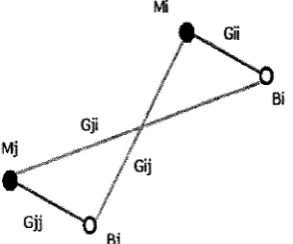
A set of M transmitter-receiver pairs which share the same channel is considered. The CIR at the Ith receiver is given by Equation 2.10 [57].
r , = G ii^ (2.io)
The link gain between transm itter i and receiver j is denoted by Gy, and the
![Figure 1.2: A Typical Representation of a Solution in ES genes=7 Reproduced from [61]](https://thumb-us.123doks.com/thumbv2/123dok_us/1478346.1180985/26.610.168.420.473.636/figure-typical-representation-solution-es-genes-reproduced.webp)
![Figure 3.1: Neighbors of a Given Cell [73]](https://thumb-us.123doks.com/thumbv2/123dok_us/1478346.1180985/49.610.205.409.141.318/figure-neighbors-of-a-given-cell.webp)
![Figure 4.5: Performance of proposed (//, A)-ES (HCA-DPC) in terms of blocking probability compared to the HCA proposed in [73] with FCA 21 and DCA 49, /i = 1, A = 10, L — 10 (Pattern 1)](https://thumb-us.123doks.com/thumbv2/123dok_us/1478346.1180985/72.612.122.505.97.384/figure-performance-proposed-block-probability-compared-proposed-pattern.webp)
![Figure 4.6: Performance of proposed (p, A)-ES (HCA-DPC) in terms of blocking probability compared to the HCA proposed in [73] with FCA 35 and DCA 35,/r = 1, A = 10, L = 10 (Pattern 1)](https://thumb-us.123doks.com/thumbv2/123dok_us/1478346.1180985/73.610.115.505.99.380/figure-performance-proposed-terms-probability-compared-proposed-pattern.webp)
