Abstract—Risk Management is one of the most relevant approaches and systematic application of strategies, procedures and practices management that have been introduced in literature to identifying and analysing risks which exist through the whole life of a product or a process. As a quality management tool, the novelty of this paper suggests a modified Failure Modes and Effect Analysis (FMEA) for understanding the non-technical risk comprehensively, and to attain a systemic methodology by decomposing the risk for nine risk categories including an appropriate 84 Risk Indicators (RI's) within all those categories through the Life Cycle (LC) stages of power plants. These risk categories have been identified as: economic risks, environmental and safety health risks, social risks, technological risks, customer/demand risks, supply chain risks, internal and operational business process risks, human resources risks and management risks. These indicators are collected from literatures. The enhanced FMEA has combined the exponential and the weighted geometric mean (WGM) to calculate the Exponential Weighted Geometric Mean-RPN (EWGM-RPN). The EWGM-RPN can be used to evaluate the risk level, after which the high-risk areas can be determined. Subsequently, effective actions either preventive or corrective can be taken in time to reduce the risk to an acceptable level. However, in this paper the FMEA will not adapt an action plan. Due to that, all RPN's will be considered depending on the point scale (1 to 5) afterward, the results will be combined and extended later with AHP. This developed methodology is able to boost effective decision- making about risks, improve the awareness towards the risk management at power plants, and assist the top management to have an acceptable and preferable understanding of the organisation than lower level managers do who are close to the day-to-day (tactical plan). Additionally, this will support the organisation to develop strategic plans which are for long term. And the essential part of applying this methodology is the economic benefit. Also, this paper includes developed sustainability perspective indicators with a new fourth pillar, which is the technological dimension. The results of the analysis show that the potential strategic makers should pay special attention to the environmental and internal and operational business process risks. The developed methodology will be applied and validated for different power plants in the Middle East. An expanded validation is required to completely prove drawbacks and benefits after completing the Analytical Hierarchy Process (AHP) model.
Keywords—Exponential Weighted Geometric Mean-RPN (EWGM-RPN), Failure Mode and Effects Analysis (FMEA), Risk Indicators (RI) and Risk Management (RM).
Sahar M. ALMashaqbeh: PhD Research student at the University of Bradford, Bradford, UK. Sponsored from the Hashemite University/Jordan. ([email protected]);J. E. Munive-Hernandez, Lecturer in Advanced Manufacturing Engineering ([email protected]); M. K. Khan, Professor of Abdul Wali Khan University, Mardan, KP, Pakistan.
I. Introduction
I DENTIFYING and setting appropriate indicators to evaluate and assess the business performance is very important needs. Reference [9] clarifies that risk indicators will be changed due to the nature of business operating. Furthermore, their study has been explained the obstacles that are prohibited from building an effective and efficient indicators, which are summarised as: there is no detailed description or standardised process on data collection, calculation and submission, and the indicator system is a voluntary one and may be pursued with differing intentions.
In the same context, [11] shows that companies that have been implementing the FMEA are very limited additionally, it has been illustrated that FMEA is suitable to identify risk factors that are internal to the company or the process. Moreover, [6] clarifies the obstacles and the reasons that prevent of applying the FMEA, and they summed up as: note enough knowledge of FMEA procedures, there is no noticeable explicit value yet, it is not recognised or required by industry, is too time consuming, it is difficult to estimate the failure modes using it, no enough failures are experienced to justify and it is too confusing or complicated.
The balance between the energy supply and demand/consumption, is the significant challenge in the energy sector, where this refers to the limitation storage of electricity (electricity is not a commodity and cannot be stores). Therefore, any unbalance between supply and demand may cause interrupts and thus can destroy the power system, which cause a key challenges such as forced outage (unplanned generation failure) .Depending on that and due to the continuity of power market; the development of risk management in energy sector can support and help to balance between supply and demand [7]. Reference [18] claims that a complete and fully understanding of the risk factors is the first step in risk management. In addition to that, [18]-[8] confirm that risk cannot be removed but it can be managed and alleviated to a reasonable level.
Applied FMEA for non-technical risk, will support the companies to take strategic long-term decisions, where FMEA in the current researches try to cover and focus on the technical part only which is related to the operational level. Furthermore, there are not any mechanisms to communicate the strategic level therefore; the novelties of this research are in using FMEA to allocate, understand and analyse different risks categories (economic, operational, technological, Sahar Mohammad AL Mashaqbeh, J. Eduardo Munive Hernandez and M. Khurshid Khan
environmental/safety and health, social, management risks, demand risk, supply risk and human resources risks).
Taking into account all that have been previously said, the aim of this paper is to addressing, understanding and analysing various types of non-technical risks at power plants. To achieving that, qualitative analysis of various risks in different industries and focused on energy sector has been performed. However, extensive review of literature in the area of risk management in energy sector has been executed to cover all types of risk that may happen. Moreover, the risk categories include a sustainability indicators group, and this makes the study more comprehensive and unique either in inclusion various categories of risk or on the way of using the FMEA to identifying and understanding these risks.
This paper apply FMEA to identify the risk indicators in power plant sector, where the conventional FMEA has been modified using the EWGM, afterward, the results will be combined later with Analytic Hierarchy Process (AHP) technique to determine the Key Risk Indicators (KRI's) at the power plants and develop the AHP risk model.
A. Risk Management in Energy Sector:
The role of power plants is very crucial for continuous and reliable electrical energy supply. which is important for development the country and the economy [4].The energy sector faces a broad group of risks (demand, transportation and market conditions,….etc.), these risks that can interrupt the operations and cause significant adverse effects in the energy sector either short-term or long term performance of the energy organisation. These risks and interruptions will emerge from process /products such as: natural disasters, equipment failures or terrorist attacks, political, economic or environmental concerns [1].Due to that, it is important to develop a risk based optimisation model of power plants, to predict, address and manage these risks.
To improve the service of electrical energy supply, an integral approach for identification of the existing and the potential risks of power plants should be handled. Risks have been presented in every stage, from the commission phase to decommission of power plants; therefore, it is important to identify risks in all stages: commissioning and starting; fuel supply and delivering; operating, running, maintenance and Ash disposal; and finally the decommission stage). The Real understanding for these risks, the effects will emerge from each risk and put control procedures to alleviate them will be beneficial for the organisations in enhancing their performance, and give the ability for the organisation to select the best decisions. These, will guide them to reduce the cost and the inefficiency in the operation process of an organisation, protect human and equipment, then the profitability will be increased [4].
B. Developed FMEA Methodology:
Reference [20], defines the FMEA as a preventive approach for failures locating and keeping the reliability. Furthermore,[3] describes the FMEA as a crucial tool to improve the design of manufacturing and process. Moreover, it can be used to improve reliability, reduce life cycle risk of organisations, and develop a preventive maintenance plan for in-service machinery. In contrast, [19] defines it as a method uses to address the potential failure modes, their causes, and the effects of each failure on the system (product or process). Reference [10], utilises the FMEA as a tool for non- technical risk, for example, the lack of interaction between the five project management processes will affect the overall progress hence, FMEA can help in solving this risk.
The purpose of FMEA in logistics processes is to check if the product will reach the consumer. Reference [2], define the FMEA as a method uses to identify the potential failure of a process, a product or a service and then the occurrence and the impact of these failures can be determined. The importance of risk can be specified by calculating the Risk priority Number (RPN) for each risk, which has been evaluated by three factors (Severity (S), Occurrence (O), and Detectability (D). By multiplying the values for (S), (O), and (D), the risk priority number (RPN) is obtained and expressed in (1) [5].
(1)
Where the:
Severity (S), is the seriousness (effects) of the failure;
Occurrence (O), is the frequency of the failure;
Detection (D), is the ability to detect the failure.
The modified FMEA methodology in this paper combines the exponential and the weighted geometric mean to improve the results of FMEA and alleviates some of the conventional method drawbacks.
The ranking for the criteria can have any value. There is no standard for this value, rating scales usually range (1 to 5), (1 to 7) or (1 to 10), there are two very common rankings applied in all industries. One is the ranking based on (1 to 5) point scale and the second, a (1 to 10) point scale. The ranking of (1 to 5) is limited but offered expediency. However, the higher number representing the higher seriousness or risk. The experience and engineering judgment and opinions have been required to determine the RPN’s values where each potential problem is rated according to three rating scales (S, O and D). In a typical FMEA evaluation, a number of rating scales are given for each of these three factors. By multiplying the values of (S, O and D), the risk priority number is obtained [5]-[16].
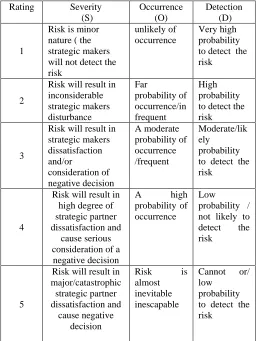
Depending on [17], the modified occurrence, detection and severity ratings scale are shown in own TABLE Ι. The changes are made for the categories criteria definitions to emphasis their implications for a strategic partner’s decision-making process.
TABLE Ι
FMEA Rating System (Developed by the Authors)
According to [10], FMEA have been divided into two main groups:
1. FMEA Project (Product) or DFMEA (Design FMEA) which has been using through addressing the potential failure of the products during the development cycle.
2. Process FMEA (PFMEA) and this has been using to address the potential failures due to imperfection of the manufacturing process, to accommodate and support the process production to meet the design requirements.
II. Research Methodology
The risks in energy sector are more complicated and this means that the identification and classification of risk process will become difficult. Therefore; it's preferable and
also as recommended by the academics and operators, to make a decomposition by following a structural method [14]. Framework for risk decomposition using FMEA has been adapted and developed through the life cycle stages of power plants.
This paper seeks to build a systematic methodology for developing the FMEA that will can be used in other industry where this methodology is:
Ease in understanding and implementing;
Repeated (can be applied in other power plants by making a small modifications for some environmental indicators);
Systematically implemented;
Formalized;
Continuously improved.
The first step to construct the FMEA, is to study all risks either internal or external of power plant (supplier, regulations, business environment (internal & external)). After which, all risk indicators at the power plants have been identified from literatures and some related indicators in environmental part have been added. Afterwards, the identified risk indicators are classified to nine categories to be easier of understanding and analysing. However, to satisfy that; this paper attempts to find the causes of each risk but, unfortunately, this is a very difficult process where the risk types are rare therefore, some examples have been mentioned for these kinds of risks. Next, occurrence, severity and detectability are determined. Subsequently, the RPN have been calculated depending on the conventional method and using the EWGM method. Normally, when RPN are calculated, the FMEA team will produce an action plan (either corrective or preventive actions) depending on the RPN value, which dictates the risk area. However, this paper will stop at this stage and the value of RPN’s will be used later and combined with AHP.
III. Research Background
It is imperative to develop a methodology to manage risks in power plants, which play a vital role in generating electricity. This can obtain and represent the complex relationships, using multiple sources of data to address the dynamic risk impacts in power plants. These risks and interruptions will emerge from a process , a products ,natural disasters, equipment failures or terrorist attacks, political, economic or environmental concerns [1]. However, many scholars just have focused on analyse the risk types especially, for nuclear power plants, the majority of the studies have been carried out to analyse several technical risks and to develop a conceptual, analytical and dynamic model to investigate the technical risks in power plants.
The literatures that cover the risks and the benefits in energy sector are limited to nuclear energy; these literatures provide different indicators, which include economic and Detection (D) Occurrence (O) Severity (S) Rating Very high probability to detect the risk
unlikely of occurrence Risk is minor
nature ( the strategic makers will not detect the risk
1
High probability to detect the risk Far
probability of occurrence/in frequent Risk will result in
inconsiderable strategic makers disturbance 2 Moderate/lik ely probability to detect the risk
A moderate probability of occurrence /frequent Risk will result in
strategic makers dissatisfaction and/or consideration of negative decision 3 Low
probability / not likely to
detect the
risk
A high
probability of occurrence Risk will result in
high degree of strategic partner dissatisfaction and
cause serious consideration of a negative decision 4
Cannot or/
low probability to detect the risk
Risk is
almost inevitable inescapable Risk will result in
environmental aspects. In contrast, the social dimension have been interested and studied less than other dimensions where this refers to the difficulty of quantifying that either in energy sector or any other sectors of activity , where the social indicators are the most contentious and difficult to select, define and measure it, either on conceptual or empirical level [15]. Reference [13], emphasis to find practical tools for initiating the social sustainability pillar where this dimension is the weakest pillar of sustainability which refers to the theoretical and analytical data related to social aspect.
This paper has used a modified (FMEA) to identify 84 risk indicators in power plants sector and will be combined later with the AHP technique to determine the Key Risk Indicators (KRI's) and develop the AHP risk model. This study covers all types of risks in power plants and develops a new pillar of sustainability, where this makes the study more comprehensive and unique either in inclusion various categories of risk or on the way of using the FMEA to identifying and understanding the non-technical risks.
IV. FMEA Risk Indicators
This paper aims to define, develop and build comprehensive risk identification indicators from power plants. A classification and analysis have been conducted to categorise and capture 84 risk indicators through nine risk categories; four of these categories are sustainability risk indicators. These categories are: (economical risks, environmental/safety & health risks, social risks and the new pillar which is the technological dimension ) , customer/demand risks, supply chain risk, internal business process and operational risks, human resources risks and management risks. These indicators should be understood, reviewed and evaluated to determine the rank of those factors.
In this research, a new comprehensive conceptualised risk classification framework for risk decomposition is adapted and developed using an enhanced FMEA methodology. The developed methodology would be a generic one and can be modified in some categories as per the organisation objectives, where this methodology will help the companies at the strategic and tactical level decision process.
The ranking scale has been used in this paper is (1 to 5) scale. However, in this paper all risks will be considered regardless the RPN values where the aim of FMEA is to understand the risk then the ranking & weightings of each risk will be explored in the next phase of this study by using the AHP technique. Furthermore, this paper provides a new
FMEA methodology using EWGM where applying this method help in generating more accurate, practical and reasonable results.
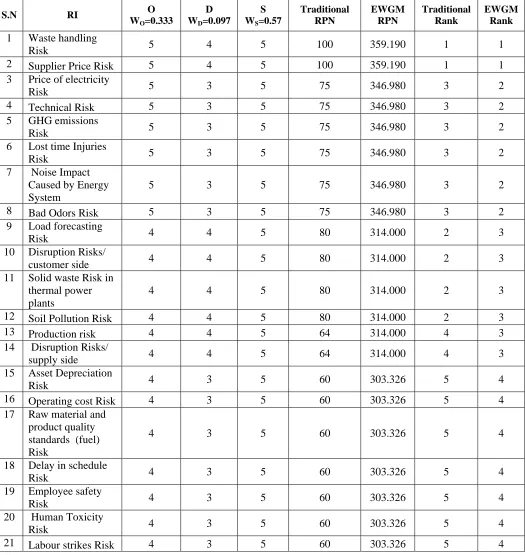
The novelty of this study is not only in the number and the varieties of non-technical risks that cover all types, but also in enhancing the conventional FMEA. Part of the risk indicators that have been used are demonstrated in TABLE Ⅲ.
V. Results & Analysis:
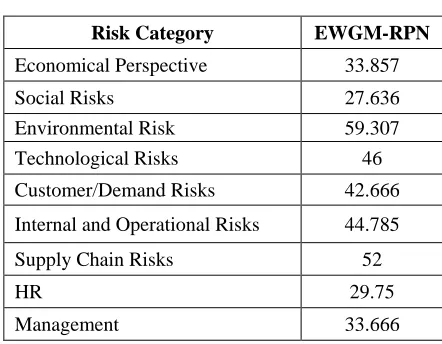
From TABLE ᴨ and Ⅲ , it can be seen that the highest RPN is precisely in environmental risk (59.307), followed by internal and operational business process risks (44.78).These results will be changed depending on power plants and the policy of the country. Therefore, the same FMEA methodology can be applied and different results will be generated. The results of RPN in this paper have been calculated for a typical power plants in the Middle East where some of these risk particularly, the economics risks are limited (ex. the power plants transactions in U.S. Dollar have negligible currency risk since the currency is fixed against the U.S. Dollar . In the same way, the generating companies are not exposed to credit risk because the only client of the company is the National Company in that country, as it is wholly owned by the Government [12].
[image:4.612.349.570.518.690.2]This paper shows that how the FMEA can be used for non-technical risks and depending on understanding the risks and the RPN values; the FMEA team can apply a convenient preventive or correction action. Due to the difficulty in gathering all the required information in the present methodology of FMEA; risk categories are determined according to the experience and expert opinions in power plants.
TABLE II
EWGM-RPN for all Risk Categories
Risk Category EWGM-RPN
Economical Perspective 33.857
Social Risks 27.636
Environmental Risk 59.307
Technological Risks 46
Customer/Demand Risks 42.666
Internal and Operational Risks 44.785
Supply Chain Risks 52
HR 29.75
TABLE Ⅲ
Part of FMEA Results for some Risk Indicators of Power Plants
S.N RI O
WO=0.333
D WD=0.097
S WS=0.57
Traditional RPN
EWGM RPN
Traditional Rank
EWGM Rank
1 Waste handling
Risk 5 4 5 100 359.190 1 1
2 Supplier Price Risk 5 4 5 100 359.190 1 1
3 Price of electricity
Risk 5 3 5 75 346.980 3 2
4 Technical Risk 5 3 5 75 346.980 3 2
5 GHG emissions
Risk 5 3 5 75 346.980 3 2
6 Lost time Injuries
Risk 5 3 5 75 346.980 3 2
7 Noise Impact Caused by Energy System
5 3 5 75 346.980 3 2
8 Bad Odors Risk 5 3 5 75 346.980 3 2
9 Load forecasting
Risk 4 4 5 80 314.000 2 3
10 Disruption Risks/
customer side 4 4 5 80 314.000 2 3
11 Solid waste Risk in thermal power plants
4 4 5 80 314.000 2 3
12 Soil Pollution Risk 4 4 5 80 314.000 2 3
13 Production risk 4 4 5 64 314.000 4 3
14 Disruption Risks/
supply side 4 4 5 64 314.000 4 3
15 Asset Depreciation
Risk 4 3 5 60 303.326 5 4
16 Operating cost Risk 4 3 5 60 303.326 5 4
17 Raw material and product quality standards (fuel) Risk
4 3 5 60 303.326 5 4
18 Delay in schedule
Risk 4 3 5 60 303.326 5 4
19 Employee safety
Risk 4 3 5 60 303.326 5 4
20 Human Toxicity
Risk 4 3 5 60 303.326 5 4
VI. Conclusions
The developed FMEA methodology has been used in this paper can boost effective decision-making about risks, improve power plants towards risk management, and assist the top management to have an acceptable and preferable understanding of the organisation than lower level managers do who are close more to the day-to- day (tactical plan) organizational operations.
The results of FMEA model will be combined with the AHP technique to rank the risks in power plants and develop an AHP risk model. Furthermore, this paper includes the sustainability indicators in the analysis phase of risks in power plants additionally, a fourth pillar of sustainability has been added where this makes the study more comprehensive which will be deeply explained in the extended future study of this research.
ACKNOWLEDGMENT
This work is supported by the Hashemite university/Jordan .Authors would like to express their great appreciation for this support.
REFERENCES
[1] Achebe, K. O. (2011) Risk Based Models for the Optimization of Oil and Gas Supply Chain Critical Infrastructure, Public Health. doi: 10.3141/2100-07.
[2] Almannai, B., Greenough, R. Ã. and Kay, J. (2008) ‘A decision support tool based on QFD and FMEA for the selection of manufacturing automation technologies’, 24, pp. 501–507. doi: 10.1016/j.rcim.2007.07.002.
[3] Carlson, C. (2012) Effective FMEAs : achieving safe, reliable, and economical products and processes using failure mode and effects analysis. Hoboken, N.J.: John Wiley & Sons. Available at: http://www.123library.org/book_details/?id=50401.
[4] Chan, S. T. (2009) ‘IDENTIFYING RISK FACTORS IN THE GENERATING SECTION OF THE POWER PLANTS By’, (May).
[5] Chin, K., Chan, A. and Yang, J. (2008) ‘Development of a fuzzy FMEA based product design system’, pp. 633–649. doi: 10.1007/s00170-006-0898-3.
[6] Curkovic, S., Scannell, H. and Wagner, B. (2013) ‘Using FMEA for Supply Chain Risk Management’, (March 2016).
[7] Eydeland, A. and Wolyniec, K. (2003) Energy and Power Risk Management, New Developments in Modeling, Pricing, and
Hedging, Cnx.Org. Available at:
http://cnx.org/exports/[email protected]/energy-and-power-20.pdf.
[8] Garbuzova-schlifter, M. and Madlener, R. (2016) ‘AHP-based risk analysis of energy performance contracting projects in Russia’, Energy Policy. Elsevier, 97, pp. 559–581. doi: 10.1016/j.enpol.2016.07.024.
[9] Geng, Y. et al. (2012) ‘Towards a national circular economy indicator system in China: An evaluation and critical analysis’, Journal of Cleaner Production. Elsevier Ltd, 23(1), pp. 216– 224. doi: 10.1016/j.jclepro.2011.07.005.
[10]Gomes, C. W. et al. (2012) ‘FMEA to Improve the Project Management’, 36.
[11]Jóhannsson, Þ. (2015) Supply Chain Risk Assessment. at
Reykjavík University.
[12]Jordan, E. R. C. H. K. of (2011) Electricity Regulatory Commission.
[13]Labuschagne, C. and Brent, A. C. (2006) ‘Social indicators for sustainable project and technology life cycle management in the process industry’, International Journal of Life Cycle Assessment, 11(1), pp. 3–15. doi: 10.1065/lca2006.01.233. [14]Li, C. (2016) Risk Modelling and Simulation of Chemical Supply
Chains using a System Dynamics Approach. [15]OECD (2007) Risks and Benefits of Nuclear Energy.
[16]Stamatis, D. H. (2003) Failure mode and effect analysis: FMEA from theory to execution. ASQ Quality Press.
[17]Totten, G. E., Xie, L. and Funatani, K. (2003) Handbook of Mechanical Alloy Design. doi: 10.1201/9780203913307. [18]Trigilio, S. (2006) ‘Applying the Principles of Risk Management
To Nuclear Power Plant Safety’, (July).
[19]Vodenicharova, M. (2017) ‘Opportunities for the applications of FMEA Model in logistics processes in Bulgarian enterprises’, 8(1), pp. 31–41. doi: 10.1515/jlst-2017-0003.