University of Warwick institutional repository:
http://go.warwick.ac.uk/wrap
A Thesis Submitted for the Degree of PhD at the University of Warwick
http://go.warwick.ac.uk/wrap/55525
This thesis is made available online and is protected by original copyright.
Please scroll down to view the document itself.
Comparing Model Reuse with Model
Building: An Empirical Study of Learning
from Simulation
Thomas Monks
A thesis submitted in partial fulfilment of the
requirements for the degree of Doctor of Philosophy
Warwick Business School, University of Warwick
Contents
Acknowledgements xiii
Declaration of authorship xv
Abstract 1
1 Introduction 3
1.1 Overview . . . 3
1.2 DES Study Involvement: Learning Outcomes . . . 7
1.2.1 Queuing concepts used in the thesis . . . 8
1.3 DES Study Efficiency: Model Reuse . . . 9
1.4 Research Objectives and Contribution . . . 14
1.5 Thesis Structure . . . 16
2 Simulation and Learning 19 2.1 Introduction . . . 19
2.2 Model Building and Learning . . . 20
2.2.1 Introduction . . . 20
2.2.2 Conceptual Literature . . . 21
2.2.3 Empirical Studies . . . 25
2.2.4 Conclusions on Model Building and Learning . . . 29
2.3 Model Use and Learning . . . 30
2.3.1 DES Research . . . 31
2.3.2 SD Research . . . 32
2.3.3 Conclusions on Model Use and Learning . . . 35
2.4.1 Discrete-Event Simulation and Credibility . . . 36
2.4.2 Human Computer Interaction and Credibility . . . 37
2.4.3 Media, Marketing and Credibility . . . 38
2.4.4 Persuasion Theories and Credibility . . . 39
2.4.5 Conclusions on models, learning and credibility . . . 41
2.5 Summary . . . 42
3 Learning Framework 44 3.1 Introduction . . . 44
3.2 A Theory-of-Action Framework . . . 45
3.3 Single-Loop Learning: Attitude Change . . . 48
3.3.1 Attitude Theory . . . 48
3.3.2 Persuasion Theory . . . 50
3.4 Double-Loop learning: Transfer . . . 53
3.5 Summary . . . 57
4 Experimental Design and Predictions 60 4.1 Introduction . . . 60
4.2 Pilot Experiments . . . 61
4.3 Design of Experiment . . . 64
4.3.1 Participants . . . 64
4.3.2 Independent Variables . . . 65
4.3.3 Case Study . . . 67
4.3.4 Dependent Variables . . . 69
4.3.5 Predictions . . . 71
4.4 Questionairre Design . . . 73
4.4.1 Attitude Questionnaire . . . 74
4.4.2 Credibility Questionnaire . . . 75
4.4.3 Reasoning Questionnaire (Transfer of Learning) . . . 76
4.5 Experiment Procedure . . . 80
4.5.1 Introduction to Simulation . . . 80
4.5.2 Model Building . . . 82
4.5.3 Model Building with Limited Experimentation . . . 88
4.5.4 Model Reuse . . . 88
5 Single-Loop Learning Results 92
5.1 Introduction . . . 92
5.1.1 Attitude Measures . . . 93
5.1.2 Supporting Measures . . . 93
5.2 Analysis Considerations . . . 95
5.2.1 Outlier Analysis . . . 95
5.2.2 Regression to the Mean . . . 96
5.2.3 Procedures to deal with regression to the mean . . . 98
5.3 Descriptive Results . . . 101
5.3.1 Model Building . . . 101
5.3.2 Model Building with Limited Experimentation . . . 104
5.3.3 Model Reuse . . . 107
5.3.4 Summary . . . 110
6 Single-Loop Learning Comparison 112 6.1 Introduction . . . 112
6.2 Analysis Considerations . . . 114
6.2.1 Standardising the Effect of an Independent Variable . . . 115
6.2.2 Bootstrap Inference . . . 117
6.2.3 Distribution of Participant Ability . . . 118
6.3 Graphical Results . . . 119
6.3.1 MR Versus MB . . . 119
6.3.2 MR Versus MBL . . . 128
6.3.3 MB Versus MBL . . . 132
6.4 Inferential Results . . . 136
6.4.1 MR versus MB . . . 137
6.4.2 MR versus MBL . . . 139
6.4.3 MB versus MBL . . . 142
6.5 Summary . . . 144
7 Discussion of Single-Loop Results 146 7.1 Hypothesis 1: Correct Direction of Attitude Change . . . 146
7.1.1 Mechanism: Complexity . . . 148
7.1.2 Mechanism: Discovery and Novelty . . . 149
7.2.1 Mechanism: Confirmation Bias and Hypothesis Fixation . . . 153
7.3 Hypotheses 3 and 4: Credibility Judgements . . . 155
7.4 Applicability to real world simulation studies . . . 157
7.4.1 Timings of Attitude Measurement . . . 157
7.4.2 Novice Decision Makers . . . 158
7.5 Summary and Implications . . . 160
8 Double-Loop Learning Results 164 8.1 Introduction . . . 164
8.1.1 Participants and Procedure . . . 165
8.1.2 Reasoning Variables . . . 166
8.1.3 Supporting Variables: Confidence . . . 166
8.1.4 Supporting Variables: Single-Loop Learning . . . 167
8.1.5 Coding of Transfer of Learning . . . 167
8.2 Model Building . . . 168
8.2.1 Transfer Success Summary . . . 168
8.2.2 Transfer Success by Scenario . . . 169
8.2.3 Relationship with Single-Loop Learning . . . 172
8.3 Model Building with Limited Experimentation . . . 174
8.3.1 Transfer Success Summary . . . 174
8.3.2 Transfer Success by Scenario . . . 176
8.3.3 Relationship with Single-Loop Learning . . . 177
8.4 Model Reuse . . . 178
8.4.1 Transfer Success Summary . . . 178
8.4.2 Transfer Success by Scenario . . . 179
8.4.3 Relationship with Single-Loop Learning . . . 180
8.5 Summary . . . 182
9 Double-Loop Learning Comparison 183 9.1 Introduction . . . 183
9.1.1 Predictions and Exploratory Tests . . . 184
9.2 Analysis Considerations . . . 184
9.2.1 Inference using Categorical Variables . . . 184
9.2.2 High Confidence Cut-Off . . . 185
9.3.1 MR versus MB . . . 185
9.3.2 MR versus MBL . . . 190
9.3.3 MB versus MBL . . . 194
9.4 Inferential Results . . . 198
9.4.1 MR versus MB . . . 199
9.4.2 MR versus MBL . . . 200
9.4.3 MB versus MBL . . . 202
9.5 Summary of Group Differences . . . 203
10 Discussion of Double-Loop Results 205 10.1 Differences in learning between conditions . . . 206
10.2 A model of learning in the experiment . . . 209
10.3 Experiment versus Real World Decision Making . . . 212
10.3.1 Level of Experimentation . . . 212
10.3.2 Type of Experimentation . . . 212
10.3.3 Model Complexity . . . 213
10.3.4 Background Knowledge of Decision Makers . . . 214
10.3.5 Choice of Transfer Concepts . . . 215
10.4 Implications . . . 215
10.4.1 Increased experimentation through reuse . . . 216
10.4.2 Building a model and limiting experimentation . . . 217
11 Conclusions 219 11.1 Introduction . . . 219
11.2 Summary of Research Objectives . . . 220
11.3 Summary of main findings . . . 221
11.4 Contributions to Simulation Theory . . . 223
11.4.1 An empirical comparison of the impact of model building and reuse on learning223 11.4.2 Insight into how generic models aid learning . . . 225
11.4.3 Generation of focussed hypotheses on learning mechanisms . . . 227
11.4.4 A framework for future research . . . 227
11.5 Limitations . . . 228
11.5.1 External Validity versus Results from one Experiment . . . 229
11.5.2 Sample Size . . . 232
11.5.4 Individuals versus Groups . . . 234
11.5.5 Measurement of learning . . . 234
11.6 Further Work to Address Limitations . . . 236
11.6.1 Manipulating the learning and transfer domains . . . 236
11.6.2 Extending the Experiment to Include Groups . . . 237
11.6.3 Inclusion of real managers and decision makers . . . 239
11.7 Further Work Testing Generated Hypotheses . . . 240
11.7.1 Test of Novelty Heuristic . . . 240
11.7.2 Test of Variety of Experimentation . . . 242
11.8 Further Work to Refine the Experiment . . . 243
11.8.1 Refining the Model Building Procedure . . . 243
11.8.2 Adding a Control Condition . . . 245
11.8.3 Adding a Transfer Hint . . . 246
11.8.4 Comparing Methods for Experimentation . . . 246
11.9 Final Comments . . . 248
References 249 A Design of Experiment Appendix 259 A.1 Case Study . . . 259
A.1.1 Introduction . . . 259
A.1.2 The Problem: How can A&E performance be improved? . . . 259
A.1.3 The A&E Process . . . 260
A.1.4 Your Task . . . 261
A.1.5 MR Task Description . . . 262
A.1.6 MBL Predefined Scenarios . . . 262
A.1.7 St Specific’s Hospital: Data Sheet . . . 264
A.2 Model Documentation . . . 267
A.2.1 Objectives . . . 267
A.2.2 Level of Detail . . . 269
A.2.3 Simplifications and Assumptions . . . 270
A.2.4 Model Building Procedure . . . 271
A.3 Research Questionairre . . . 272
B Single-Loop Comparison Appendix 291
B.1 Analysis Considerations . . . 291
B.1.1 Calculating an effect size . . . 291
B.1.2 The percentile bootstrap method . . . 291
B.1.3 Mann-Whitney Test Approach . . . 292
B.1.4 Multiple Comparison Control . . . 293
B.2 Retrospective Comparison of Exam Marks . . . 295
B.2.1 Descriptive Statistics . . . 296
B.2.2 Inferential Results: Between Groups . . . 296
B.2.3 Conclusions . . . 297
B.3 Comparison of results adjusted for regression to the mean and original data . . . 299
B.3.1 MR versus MB . . . 299
B.3.2 MR versus MBL . . . 301
B.3.3 MB versus MBL . . . 303
C Double-Loop Learning Appendix 305 C.1 Correlations Results . . . 305
D Double-Loop Comparison Appendix 308 D.1 Analysis Considerations . . . 308
D.1.1 Calculating an Odds Ratio . . . 308
List of Figures
1.1 Example Reuse Cost Curves . . . 11
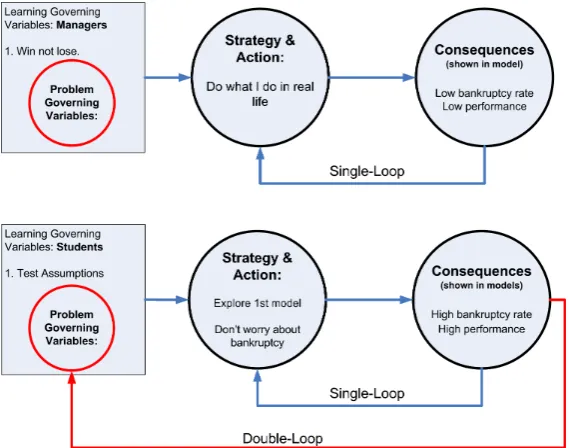
3.1 An illustration of single and double-loop learning . . . 45
3.2 Learning systems used by management and students participants in Bakken et al. (1994) . . 47
3.3 Expectancy Value Model . . . 49
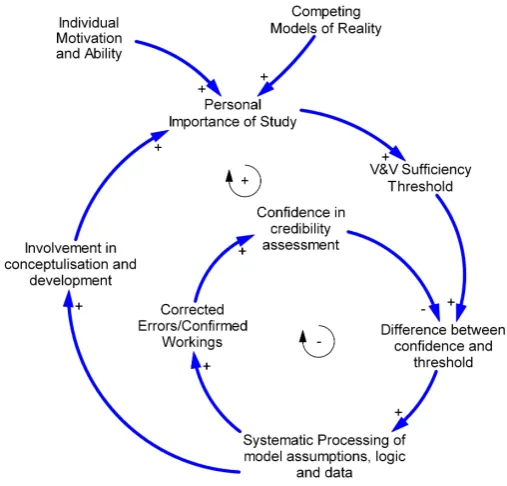
3.4 Example of Sufficiency Thresholds . . . 51
3.5 Sufficiency Thresholds for Verification and Validation . . . 52
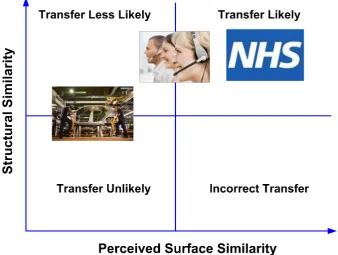
3.6 Transfer of Learning . . . 55
4.1 Levels of Independent Variable . . . 66
4.2 Case Study Model Visuals . . . 68
4.3 Introductory Model . . . 81
4.4 Model Building: Stage One Model . . . 83
4.5 Results Dashboard Screenshot . . . 84
4.6 Model Building Procedure . . . 87
4.7 Model Building Procedure . . . 88
4.8 High level view of experiment . . . 90
5.1 Process Variables Grouped by Correct and IncorrectT radeU til . . . 103
5.2 Process Variables Grouped by Correct and IncorrectT radeU til . . . 109
6.1 Interpretting Effect Sizes . . . 116
6.2 Q-Q Plots of Attitude Change . . . 120
6.3 Histogram of the number of new variables identified in experimentation . . . 122
6.4 Histogram of the scenario numbers for first new variable . . . 123
6.5 Box Plots of Credibility Measures . . . 126
6.6 Q-Q Plots of Attitude Change . . . 129
6.7 Box Plots of Credibility Measures . . . 130
6.8 Q-Q Plots of Attitude Change . . . 133
7.1 Output Examples: Before and After Increasing Radiology Level of Detail . . . 150
7.2 A Possible Credibility Mechanism in the Experiment . . . 156
8.1 MB Participants Transfer Success . . . 170
8.2 MB Participants: Distribution of Differences between S4 and S6 Confidence . . . 172
8.3 MBL Participants: Percenatage of Transfer Success and Median Confidence by Scenario . . . 176
8.4 MR Participants: Percenatage of Transfer Success and Median Confidence by Scenario . . . . 180
9.1 Prediction Success MR versus MB . . . 186
9.2 MR versus MB: Mean Transfer Success . . . 186
9.3 MR versus MB Transfer Results by Scenario . . . 187
9.4 MR Vs. MB Boxplot of High Confidence Errors . . . 189
9.5 MR Vs. MB Sensitivity of High Confidence Cut-off . . . 190
9.6 Prediction Success MR versus MBL . . . 191
9.7 MR versus MBL: Mean Transfer Success . . . 192
9.8 MR Vs. MBL Transfer Results by Scenario . . . 192
9.9 MR Vs. MBL Boxplot of High Confidence Errors . . . 193
9.10 MR Vs. MBL Sensitivity of High Confidence Cut-off . . . 194
9.11 Prediction Success MB versus MBL . . . 195
9.12 MB Vs. MBL - Mean Transfer Success . . . 196
9.13 MB Vs. MBL Transfer Results by Scenario . . . 196
9.14 MB Vs. MBL Boxplot of High Confidence Errors . . . 197
9.15 MB Vs. MBL Sensitivity of High Confidence Cut-off . . . 198
10.1 Novelty Heuristic Related to Learning . . . 210
11.1 Control Condition . . . 245
A.1 Model Building Process Flow . . . 271
B.1 Boxplots of QAM Marks . . . 297
B.2 MR versus MB MaxUtil Q-Q Plots: Original and Adjusted . . . 300
B.3 Q-Q Plot of TradeUtil MR versus MBL (adjusted data) . . . 302
B.4 MR versus MBL MaxUtil Q-Q Plots: Original and Adjusted . . . 302
B.5 MB versus MBL TradeUtil Q-Q Plots: Original and Adjusted . . . 304
List of Tables
1.1 Fletcher and Worthington’s levels of genericity . . . 11
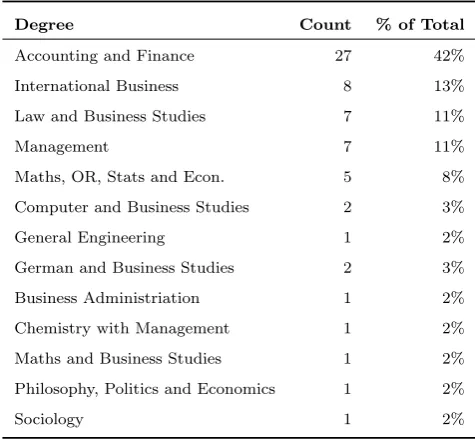
4.1 Participant Degree Courses . . . 65
4.2 Summary of Dependent Variables . . . 69
4.3 Single-Loop Learning Hypotheses . . . 72
4.4 Double-Loop Learning Hypotheses . . . 73
4.5 Transfer Scenarios . . . 77
4.6 Exert from Stage One Conceptual Model . . . 85
5.1 Attitude Measures . . . 94
5.2 MB Participant Difference Scores . . . 101
5.3 MB Participant Difference Scores by Polarity . . . 102
5.4 ElimVar before and after adjustment for RTM: MB Subgroups . . . 102
5.5 MBL Participant Difference Scores . . . 105
5.6 MBL Participant Difference Scores by Polarity . . . 105
5.7 ElimVar before and after adjustment for RTM: MBL Subgroups . . . 106
5.8 MBL Credibility Measures . . . 107
5.9 MR Participant Difference Scores . . . 107
5.10 MR Participant Difference Scores by Polarity . . . 108
5.11 ElimVar before and after adjustment for RTM: MR Subgroups . . . 108
5.12 Summary of Single-Loop Result by Condition . . . 110
6.1 Summary of Single-Loop Predictions . . . 113
6.2 Standard Interpretation of Effect Sizes . . . 116
6.3 New variables identified in first scenario. . . 123
6.4 New Variables and Use in Experimentation . . . 124
6.5 Summary of MR versus MB attitude change hypothesis support . . . 127
6.6 Summary of MR versus MB credibility hypothesis support . . . 128
6.7 Summary of MR versus MBL attitude change hypothesis support . . . 132
6.9 Summary of MB versus MBL attitude change hypothesis support . . . 135
6.10 Summary of MB versus MBL credibility differences . . . 136
6.11 Summary of Inferential Results for MR versus MB attitude change . . . 137
6.12 Summary of Inferential Results for MR versus MBL attitude change . . . 140
6.13 Summary of Inferential Results for MB versus MBL attitude change . . . 142
6.14 Summary of Single-Loop Findings . . . 145
7.1 Important Findings . . . 163
8.1 Summary of Transfer Scenarios . . . 165
8.2 Reasoning Measures . . . 166
8.3 MB Transfer Success Summary . . . 168
8.4 Mean Transfer Success by Confidence Level for MB participants . . . 169
8.5 MBL Transfer Success Summary . . . 175
8.6 Mean Transfer Success by Confidence Level for MBL participants . . . 175
8.7 MR Transfer Success Summary . . . 179
8.8 Mean Transfer Success by Confidence Level for MR participants . . . 179
8.9 Summary of Descriptive Results . . . 182
9.1 Summary of Predictions and Exploratory Tests . . . 184
9.2 MR versus MB Summary of Inferential Support for Predictions . . . 199
9.3 MR versus MB Support for Differences in Confidence . . . 200
9.4 MR versus MBL Summary of Inferential Support for Predictions . . . 200
9.5 MR versus MBL - Summary of Differences in Scenario Results . . . 201
9.6 MR versus MBL Support for Differences in Confidence . . . 201
9.7 MB versus MBL Summary of Inferential Support for Predictions . . . 202
9.8 MB versus MBL Support for Differences in Confidence . . . 203
9.9 Summary of within and between group differences . . . 203
10.1 Summary of difference across conditions . . . 210
10.2 Summary of Generated Hypotheses and Advice . . . 216
11.1 Novelty Identification Test . . . 240
11.2 Novelty Heuristic Test . . . 241
11.3 Variety of Experimentation Test . . . 243
B.1 QAM1 Marks . . . 297
B.2 QAM2 Marks . . . 297
B.3 MR versus MB Comparison . . . 300
B.4 MR versus MBL Comparison . . . 301
C.1 Variables Listed in the Correlation Analysis . . . 305
C.2 MB Significant Correlations . . . 306
C.3 MBL Significant Correlationsrs . . . 307
C.4 MR Significant Correlationsrs . . . 307
D.1 Example Contingency Table for Scenario X . . . 308
D.2 MR versus MBL - Chi-Square Test of Association Results . . . 310
Acknowledgements
Firstly, I would like to thank my supervisor Professor Stewart Robinson for his
constant guidance and support during the PhD. Stewart has helped me ‘keep it
simple’; something I initially thought I was good at, but quickly learnt that I was not.
I have no doubt that without him I would still be languishing in an overcomplicated
analysis in a darkened corner of the business school. Not only has Stewart improved
my understanding of analysis and simulation he has also shown me that I will never
beat (or get near) his marathon and half marathon times.
I would also like to thank my second supervisor Dr Kathy Kotiadis. Like Stewart,
Kathy has provided a huge amount of support and guidance during my PhD and was
always available if needed. I am especially grateful for the time and support Kathy
gave me during Stewart’s study leave (walking in the mountains in New Zealand).
Although they are all anonymous, thanks must be given to my research
partic-ipants. They delighted, frustrated, fascinated and amused me in equal measure. I
believe that a lot of them enjoyed the research and that they learnt something from
it. I have at least two pieces of evidence to support these conclusions. Firstly, I saw a
large number of the participants all took the elective simulation course run by WBS
in the months following the experiment. I like to think that the experiment may
have contributed to this decision in some manner. Secondly, the participant who
compared using dedicated resources to manage patient emergency flows to
resources worked better.
To my good friends - Rupal Rana, John Broomfield, Emma Stringfellow,
Stavri-anna Dimitriou and Antuela Tako - all I can say is that the time went too quickly.
Thanks for making the experience such an enjoyable one. Thanks to my colleagues
and friends in the OR group and elsewhere: the group secretaries, Sue Shaw and
Racheal Monnington, who have helped me countless times over the years as my
brain gradually turned to PhD mush; Etienne Rouwette for his invaluable help and
advice on experiments and psychology; Les Oakshot and Katy Hoad for braving
the simulation coursework sessions with me and many more that no doubt I have
missed.
Thanks must also go to the ESRC whose financial support allowed me undertake
a PhD and travel to a conference in the U.S, while all the time hiding from a recession
in the real world. Special thanks go to the WBS OR group for providing me financial
support to pay my rent during those final months and the WBS doctoral programme
for partly funding my experimentation costs.
Special thanks go to my parents and brother, Tim, for their encouragement
throughout the PhD. Thanks to mum for cooking so many amazing dinners to keep
me going over that last Christmas while I finished my thesis. Thanks to Tim for
providing extremely valuable and amusing distractions from my PhD from time to
time as well as understanding my topic. Thanks to Dad, well for just being Dad.
Finally, to my darling Stephanie thanks for your all of your patience with me.
Thanks for putting up with me living away for three years, endless hours of talking
about simulation (sorry) and my obsession with electric guitars. To put it simply, I
couldn’t have done it without you.
Declaration of authorship
I, Thomas Monks, declare that this thesis entitled: ‘Comparing Model Reuse and
Model Building: An empirical study of learning from simulation’ and the work
presented are my own. I confirm that:
• This work was done wholly while in candidature for this research degree;
• This thesis contains no material which has been accepted for the award of any other degree or diploma in any university;
• I have acknowledged all main sources of help;
• The work described in this thesis has served the material for several published conference papers and presentations which are listed below.
Refereed Conference Proceedings
• Monks, T., Robinson, S. and Kotiadis, K. (2009), Model reuse versus model development: Effects on credibility and learning, in M. D. Rossetti, R. R.
Hill, B. Johansson, A. Dunkin and R. G. Ingalls, eds, ‘Proceedings of the
2009 Winter Simulation Conference’, Institute of Electrical and Electronics
Engineers, Inc., Piscataway, New Jersey.
• Monks, T and Robinson, S and Kotiadis, K. (2010). Model Reuse versus Model Development: Effects on Single-Loop Learning. In Proceedings of the
Conference Presentations and Seminars
• Monks. T, Robinson, S and Kotiadis K, (2009). Model Reuse Versus Model Development, Young Operational Research Society Conference 2009 (YOR16).
• Monks. T, Robinson, S and Kotiadis K, (2009). Model Reuse Versus Model Development.Operational Research Society Conference 2009 (OR51).
• Monks. T, Robinson, S and Kotiadis K, (2009). Model Reuse Versus Model Development: Effects on Credibility and Learning. Winter Simulation
Con-ference 2009
• Monks. T, Robinson, S and Kotiadis K, (2010). An Empirical Study of Learning from Simulation. Warwick Business School Seminar Series.
• Monks. T, Robinson, S and Kotiadis K, (2010). Model Reuse Vs Model Development: Effects on Single-Loop Learning. Operational Research Society
Simulation Workshop 2010 (SW10).
• Monks. T, Robinson, S and Kotiadis K, (2010). Transfer of Learning in Simulation Studies. Operational Research Society Conference 2010 (OR52).
Signed:
Abstract
What are the benefits of involving decision makers in simulation model development?
Do decision makers learn more about their problem if they are involved in model
development than if they had been excluded? This thesis presents an experiment
which compares decision maker learning outcomes and process in two different types
of discrete-event simulation (DES) study. The first is a traditional simulation project
where decision makers take the role of domain experts and are involved in the
building of a simulation model through to its use. The second is where a model is
reused rather than built. Sixty four undergraduate participants were individually
involved in one of three experimental conditions: development of an A&E simulation
model and its subsequent use; development of the same model, but with less time
for model use; or were presented with the model already developed and asked to
reuse it. Participants of each condition were then allowed to run the model, change
variables and review results in an attempt to improve the performance of the system.
Learning was measured at two levels: attitude change, to infer learning about
a business problem, and transfer of learning, to infer a deeper learning. Results
indicated that, firstly, model building aided participant’s discovery of aspects of the
problem that were previously unconsidered. However, attitudes about these novel
aspects of the problem were only converted to transferable knowledge when
exper-imentation was not limited. Secondly, participants that reused the model learnt
although these tended to be focused on factors with which participants were most
familiar. In fact, model reuse participants learnt more following this approach than
by scrutinizing the results of each scenario in detail.
Little empirical evidence exists to support the discussions and the view that
involvement in model building aids learning. This thesis contributes to this debate
by providing insight into the mechanisms that influence learning. Moreover, results
suggest that learning from experimentation when reusing a model is also valid,
although the process followed may be different. Of course, there are limitations to
the approach used to perform the comparison. For instance, the experiment uses
novice decision makers and measures attitude immediately after the experiment.
Reflection on such points is used to aid the generation of testable hypotheses that
Chapter 1
Introduction
1.1
Overview
Computer simulation is one of the most widely applied Operational Research (OR)
techniques. Like all other applications of OR its purpose is to aid individuals,
man-agement or otherwise, make decisions through model building and use. Due to the
focus on decision making, simulation modellers often discuss the benefit of modelling
in terms of learning as opposed to finding optimal solutions to problems. That is,
there is a strong belief within the simulation community that computer simulation
provides a platform for a decision maker to understand both the consequences of
their actions and the dynamic behaviour they observe in the real system. There are
three often quoted reasons why simulation models benefit learning.
The first reason is that a model is a simplification of a system (Pidd, 2009).
This is advantageous primarily as the real world is far from simple. This complexity
does not just stem from the size of the real system; more likely the behaviour of a
real system over time is opaque to those that work within it. This can be due to
the delays between cause and effect, variation in event occurrences, and interaction
world a model, simulation or otherwise, is always a concrete simplification of the
system it represents (Pidd, 2009). It has a specific model objective(s), explicitly
stated assumptions, observable logic and is built by a modeller. Hence the value of
simplification as an aid to learning is that the model should be well understood and
transparent to modellers and decision makers alike.
The second reason quoted is that a simulation model has a specific objective
and can be used to search for ways to meet that objective. Experimentation with
model inputs such as available resources, business rules and policies can help identify
actions that can be taken in the real world to help improve performance (Pidd, 2004;
Robinson, 2004). Of course, one might argue that this experimentation could also
be conducted on the real system. If the real system exists, this is true, but data
collection may be extremely costly, slow or even dangerous. Model use aids learning
as it provides a repeatable procedure, collecting data in a relatively efficient manner,
that can be used to explore the consequences of what if scenarios.
The final argument quoted is that in order to build a simulation model it is often
necessary to involve the decision makers and this can be particularly beneficial for learning (e.g. Robinson, 2004). Initially a simulation modeller may know very little
about the problem and the system of study. To build the model the modeller must
elicit and validate relevant data from the decision makers and other individuals who
work within the system. There is a strong belief that this involvement aids decision
maker learning by helping them think the problem through more thoroughly or in ways not previously considered. In fact, it is often stated that a large proportion
of the learning occurs during model building. In addition to changing individual’s
attitudes towards action it is believed that this process can aid ‘deeper learning’
-knowledge that can be transferred and used again. This belief might be described
as a high involvement hypothesis.
that the building of acomputer simulation can be a time consuming process (Robin-son et al., 2004). In fact, given the budget restrictions often found in industry and
public sector projects a simulation modeller may seek ways to reduce the scope of
a simulation study; for example, only perform a limited amount of experimentation
after the model is built. Thus many research projects in computer simulation have
considered the problem of how models can be built quicker. One possible approach
that has gained popularity is the reuse of an existing simulation model specially
designed to be used with multiple similar systems. For example, an NHS trust may
wish to evaluate the impact and side effects of a policy in operating theatre
manage-ment on the rest of the hospital. To develop a whole hospital model from scratch is
clearly an expensive and time consuming exercise and may not even be deliverable
in time to aid a decision. If, however, a suitable model already existed (G¨unal and
Pidd, 2010, currently provide the only example) that could be reused for the new
objective this would benefit the decision maker in two ways:
1. study feasibility would be increased: it is possible to complete the study to
time and cost constraints;
2. the time saved could be used to increase the scope of simulation study: more
scenarios can be simulated;
In particular, it would seem that the reuse of the hospital model would aid
learning based on the two points listed above. The model is relatively simple;
hence understandable compared to the real hospital and can be used for extensive
experimentation.
At this point it is worth highlighting that model reuse incorporates model use,
but the two should not be considered as the same thing. Model use, as already
discussed, refers to the process of using a validated simulation model to experiment
the process by which the simulation study is run; i.e. the identification, acquisition,
validation and use of a suitable simulation model. This process, of course, influences
the time available for model use. Thus more experimentation should be possible
relative to if the model was built from scratch. One problem, however, may be that
reuse of full models appears to be at odds with the high involvement hypothesis: that
involvement of decision makers in model building substantially aids their learning.
To date no studies have considered reuse from the perspective of learning. This
thesis describes an experiment to test the high involvement hypothesis in a
discrete-event simulation (DES) context. If the hypothesis is true then individuals involved in
the building of a DES model before its use should learn more than when they are not
involved i.e. if they simply reuse a full model for experimentation. Another useful
output of such a comparison should be the identification of mechanisms that aid
and inhibit decision maker learning. Of course, as the experiment is a simplification
of a real simulation study there will be important differences that must be reflected
on before results can be interpreted in any useful manner. These reflections should
give rise to some new more focused hypotheses of learning in studies where decision
makers are involved in model building, use and reuse.
The remainder of this introductory chapter is organised as follows. The following
two sections provide introductory discussions of two key concepts used throughout
the thesis. The first of these introduces details on the type of learning that is
theo-rised to occur during involvement in model building and involvement in simulation
projects in general. The second provides an introduction to DES model reuse, with
a particular emphasis on the reuse of generic models. The section illustrates that
only a very limited number of model reuse studies have considered the impact of
reuse on learning and decision making. The final two sections of the chapter list the
1.2
DES Study Involvement: Learning Outcomes
In order to conduct an experiment of learning from simulation, the type of learning
outcomes from a DES study must be explored. Within the OR and simulation
liter-ature the term learning is often expressed at two levels of outcome, sometimes linked
to the concept of transparency. The first is a change in attitude towards strategy or
action. For example, a manufacturing manager’s attitude towards achieving 100%
utilisation of machines in his or her production line may change dramatically after a
DES study aiming to increase throughput. The second outcome is inherently linked
to the first and represents a change in problem understanding for a decision maker.
For example, the same manufacturing manager may initially see that aiming for
100% utilisation of machines is counterproductive for increasing throughput in the
factory, but then also gain an understanding of why performance behaves in this
manner. This second level of learning should be transferable, to some extent, to
similar situations encountered in the future.
Discussions of the benefit of involving decision makers in modelling can be traced
back to the 1960’s. Churchman and Schainblatt (1965) emphasise that a position of
mutual understanding is essential for implementation success. That is, involvement
of decision makers or clients is important as modellers must gain an understanding of
the decision maker’s position as well as the decision makers learning about the model
and the modeller’s position. This involvement is believed to give rise to transparency
(Ward, 1989; Lane, 1994): an understanding of the computer and mental models of
the problem by decision makers. It is theorised that this transparency aids reflection
on the differences between computer and mental models of the problem to create
attitude change and a ’deeper’ transferable knowledge. Section 2.2 provides a more
detailed literature review of this area.
These types of learning are often referred to as single-loop and double-loop
learning that is used instrumentally to solve an immediate business problem i.e.
‘what should we do to improve performance’. Double-loop learning incorporates
attitude change, but adding understanding about the causes of the problem.
Ar-gyris and Sch¨on (1996) state that double-loop learning is much more difficult for
individuals or organisations to achieve than single-loop (the theory is that as it is
more comfortable and less challenging to solve instrumental problems) and that
of-ten some help is required to stimulate double-loop inquiry. It is ofof-ten believed that
simulation provides this ‘assistance’ and fosters a degree of double-loop learning
(Lane, 1995; Senge, 1990). Chapter 3 explores double-loop learning in detail and
provides a framework for understanding attitude change and transfer of learning.
1.2.1 Queuing concepts used in the thesis
This thesis focuses on decision maker involvement in DES modelling i.e. models
of queuing systems. The concepts that participants in the experiment learn about
related to two key concepts in all queuing systems, resource utilisation and
pro-cess variation. This section provides an overview of the key queuing concepts that
participants learn about in the experiment.
The relationship between resource utilisation, variation and performance
Often in a queuing system, for example a manufacturing line or an A&E department,
it is desirable to have a high utilisation of expensive resources, such as machines or
staff. However, when a system is subject to process variation, for example, when
machine cycle times vary or arrivals of patients are unpredictable, there is a
trade-off between the speed at which an entity can travel through the system and the
utilisation of resources. In particular at high levels of resource utilisation and process
Reducing process variation
The relationship described above often means that it is desirable to reduce the
process variation in queuing systems; for example, reducing the variation in machine
breakdowns by implementing a routine maintenance program. The results of such
initiatives reduce the severity of the resource utilisation and performance trade-off;
meaning that the same performance can now be achieved with higher utilisation of
expensive resources.
1.3
DES Study Efficiency: Model Reuse
The opening paragraphs to this chapter discussed the potential benefits of simulation
models as an input to a decision making process. That is, learning is aided through
the simplified nature of models, through their use and through involvement in their
construction. The previous section expanded on this general discussion by providing
an overview of the DES approach to simulation, its use for modelling the effects of
process variation and its relationship to queuing theory, i.e. the potential for learning
about queuing processes through DES.
Although DES offers these benefits one problem with the approach in practice is
that it can take a long time to design, build and use the model relative to a simple
analytical model (Robinson et al., 2004; Pidd, 2004). Indeed some limited data exists
to support this view: Cochran et al. (1995) found that a typical project, included
in their sample, lasted between one to three months. This duration isn’t always
acceptable to a decision maker with a limited budget or limited time available; for
example, a healthcare professional or a small manufacturing firm may need to make
a decision quite quickly. Thus in practice the time and budget available dictates the
design, objectives and level of detail included in a model (Law, 1993).
This issue has led to much research into the problem of improving the efficiency of
and Owen, 1960), component based simulation (Pidd and Carvalho, 2006),
compo-nent storage (Arons and Boer, 2001), discovery and retrieval using web services and
ontologies (Bell et al., 2008), grabbing and gluing simulations (Paul and Taylor,
2002), reuse at the conceptual level (Balci and Ormsby, 2007; Balci and Nance. N,
2008), reuse of full, possibly ’generic’, models (e.g. G¨unal and Pidd, 2010, 2009;
Kaylani et al., 2008; Fletcher et al., 2007; G¨unal and Pidd, 2006; Sinreich and
Mar-mor, 2004; Brown and Powers, 2000; Pidd, 1992; Pierce and Drevna, 1992) and the
validity of reuse (e.g. Spiegel et al., 2005; Malak and Paredis, 2004; Tolk, 1999).
Figure 1.1a illustrates a typical financial argument for reuse adapted from Pidd’s
model in Robinson et al. (2004). The chart illustrates a smoothed (i.e. assuming
a fixed adaptation cost) reduction in costs as the model or piece of software is
reused. Although Figure 1.1a intuitively makes sense, quite often software code
requires a substantial amount of refactoring (a reduction in internal dependencies
of the code, but still producing the same behaviour) before it is reusable in new
projects (Fowler, 1999). Dependency problems may also be found in a simulation
project where a full model is reused. For example, Robinson et al. (2004) briefly
discuss the maintenance planning model originally built for a telecommunications
provider reused with a water utility company. However, much of the simulation
code was not directly reusable in the new context, possibly due a high dependency
of the code to the original problem. Therefore a substantial amount of rework was
required. Figure 1.1b illustrates this issue through an alternative hypothetical reuse
cost curve. Here a number of costly refactoring efforts are necessary in the early
reuse attempts before benefits can be achieved.
A number of DES studies have focussed on developing generic models to try and solve the refactoring problem and useability problem. Models can be defined
at four generic levels in terms of abstraction and transportability (Fletcher and
(a)Illustration of the cost reduction expected from reuse (adapted from Robinson et al (2004)).
(b) Alternative view of reuse costs
Figure 1.1: Example Reuse Cost Curves. K(N) = average cost/use. C = cost of developing for first use, A = adaptation cost, N = number of times that software is reused. Illustration of the extra effort
needed to reuse a model if it is not designed for reuse.
and transportable and refers to generic principles; for example, the Department of Health demonstrates a generic lesson to all NHS primary care trusts that patients
queue substantially longer when utilisation of beds/nurses and so on rise above 80%.
This level is closer to DES and its relationship to queuing theory than an actual
computer model analysing the performance of a system.
Table 1.1: Fletcher and Worthington’s levels of genericity
Level 1: A generic principle model; e.g. patients queue longer when resources are utilised at>80%
Level 2: A generic framework; e.g. a healthcare toolkit in a simulation package Level 3: A setting-specific generic model; e.g a simulation model A&E departments
in the England.
Level 4: A specific model; e.g. a simulation model A&E department x
At the other extreme the fourth level has the lowest level of abstraction and
with anything more than the specific system modelled. This might be viewed as a model found in a more traditional DES study such as the maintenance model
discussed in Robinson et al. (2004).
In between these extremes come genericframeworks andsetting-specific generic
models. Frameworks provide the building blocks for models within a domain; for
example a simulation package may come with healthcare specific resources and
ac-tivities included. More generally commercial DES packages encapsulate a generic
model, e.g. 3 phase (Tocher and Owen, 1960), and components comprising a
frame-work relevant for all queuing systems and problems. A setting-specific generic model
might be, for example, a hospital (G¨unal and Pidd, 2010) or an A&E department
(G¨unal and Pidd, 2009; Fletcher et al., 2007) that can be reused at multiple NHS
Trusts across England. These models tend to be data driven (Pidd, 1992) and can
be parameterised with local data for reuse.
Although work has been done to create generic models, the costs and effort
reduction benefits of reuse may be difficult to achieve due to the perceived credibility
of the simulation model by the decision makers (Robinson et al., 2004). This seems
to be particularly problematic when the modeller(s) and decision makers did not
build or were not involved in the creation of the model. The so called ‘not invented
here syndrome’ (Sutcliffe, 2003) requires effort in validation and verification by the
modellers and decision makers. In fact, it is often believed that this effort may be
more than if the model was built from scratch. Hence something similar to the cost
curve in Figure 1.1b may be seen in a model reuse study even if a generic model is
employed.
Only two DES studies have considered the decision maker or simulation user
aspect of reuse. These exceptions are the suggestion to review generic model
as-sumptions with the client by Ozdemirel (1991) and the discussion of client based
Ozdemirel (1991) presents an expert system called GUIDES that allows users
of generic simulation models to review model assumptions. Users either accept or
reject assumptions leading to a measure of ‘model acceptance’ calculated as the
per-centage of assumptions accepted. The method is presented as a practical approach
to measuring acceptance of a generic model. However, this recommendation seems
to have little difference to the standard guidance for a traditional simulation study.
For example, Law (2007) emphasises that it is essential to review model assumptions
with clients in order to build credible simulation models.
Taking a case study approach Fletcher et al. (2007) discuss the use of a generic
A&E model with ten NHS trusts across the UK. An unexpected benefit of initial
demonstrations of the generic model was that it was the first time that many of
the stakeholders had met together to discuss the issues facing their department.
Although the model was not parameterised with local data, and instead used high
level national data, it was used to facilitate these discussions and help stakeholder
gain some insight into the local issues. Fletcher et al. (2007) also discuss issues and
obstacles in reusing the model. For example, they note that barriers to successful
reuse typically were data quality or low client motivation. This adds an interesting
dimension to reuse beyond model validity, but the issues they bring out, such as
low data quality, could plausibly appear in any traditional study where a model is
developed.
These two studies highlight two points. Firstly, that generic models have been
used as an input into a decision making process where stakeholders had no
involve-ment in developinvolve-ment. Secondly, variables other than cost should be considered
in simulation studies where model reuse is possible. Another factor to consider is
proposed by many experienced DES and System Dynamics (SD) authors: high
in-volvement of clients in model development leads to more learning for decision making
high involvement hypothesis is true then we would expect studies where involvement in modelling is minimal, for example, the reuse of a generic model, to produce less
learning relative to studies where involvement is high.
1.4
Research Objectives and Contribution
As is evident from the previous section there are competing goals within a DES
project. It is important that decision makers and stakeholder are involved and
en-gaged in the building and use of a simulation model to aid learning. In fact, many
simulation authors discuss a high involvement hypothesis: namely that a large pro-portion of the benefit of simulation is delivered through involvement of decision
makers in model building. At the same time the realities and pressures of decision
making push modellers and researchers to seek ever more efficient methods of
deliv-ering models to clients. Even the most involved decision maker will have little use
for a model that is delivered after the world has moved on.
Due to these competing goals a lot of research has been conducted into model
reuse. The existing work has largely been of a technical nature, but has been fruitful
in, among other areas (see section 1.3 for a summary), delivering feasible ways to
reuse specially designed models. Thesegeneric models are parameterised with data rather than built from ‘scratch’ and hence offer the hope of drastically increasing
the chances of gaining modelling insights in a useful amount of time.
This thesis focuses on these two competing objectives and explores the differences
in learning between traditional DES studies and those where models are reused. At
a general level the objective of this thesis is to test the high involvement hypothesis
against the benefit of increased experimentation offered by reusing a model assuming
a fixed budget of time. If the high involvement hypothesis is true and substantial in
effect size, it should be possible to recreate the effect in a laboratory setting. This
experimen-tation) against a model reuse process. In addition to the general test of the high
involvement hypothesis this research aims to:
1. Empirically identify mechanisms that aid decision maker learning within model
building;
2. Empirically identify mechanisms that aid decision maker learning within model
reuse and experimentation;
3. Empirically identify mechanisms that inhibit learning from DES models;
Although some limited literature exists exploring learning in simulation studies,
little research has been conducted to explicitly compare learning from involvement
in simulation model building and (re)use. An explanation for this may the difficulty
in finding or gaining access to real comparable simulation studies of model building
and reuse. Another reason may be the need for knowledge about the large body of
learning research within psychology; a research field in which OR and simulation
has, understandably, had limited involvement. To achieve the objectives outlined
above this thesis provides an account and details results of an alternative approach
to studying learning from DES modelling using a psychology style laboratory
ex-periment methodology. The expected contributions from achieving these objectives
are:
1.) An empirical comparison of the impact of model building and reuse
on learning
Little empirical evidence exists to support the discussions and view that involvement
in model building aids learning. This thesis provides a simple empirical test of the
hypothesis that has not been attempted before. Analysis of the experimental results
and differences between the experiment and real simulation studies should provide
2.) Insight into how generic models aid learning
Little is known about the impact of generic models on a simulation user’s behaviour.
The experiment offers a chance to observe the reuse of a model. Differences in the
approach to experimentation used by participants involved in model building and
reuse should offer insight into how generic models can be used to aid decision maker
learning.
3.) Generation of focussed hypotheses on learning mechanisms
The learning mechanisms identified in the experiment should also be testable and
thus can be explored in more detail. Future research may use these results to
structure an analysis or test methods for improving learning in simulation studies.
4.) A framework for future research
To date no research has attempted to involve participants in the building of a
sim-ulation model in a laboratory environment. Development of the materials for the
experiment will provide a framework for involving participants in model building
and measuring their learning that can be reused and adapted for future work.,
1.5
Thesis Structure
The thesis is organised as follows:
Chapter two provides a review of the OR and simulation literature that has con-sidered learning from modelling. This is concon-sidered from three perspectives: learning
from model building, learning from model use and relationship between credibility
and learning. This review concludes that learning from models can be thought of
as a process of improving decision makers understanding of a.) the computer model
to changes in attitude about the course of action to take and a deeper
understand-ing about the underlyunderstand-ing behaviour of a system that can be transferred elsewhere.
The review also illustrates that although some empirical studies explore learning
from quantitative modelling they are focussed on demonstrating that learning
oc-curs rather than how or where decision makers learn in the process. Moreover, little
learning research has been undertaken in the DES domain.
Chapter three frames the existing OR and simulation literature on learning in terms of Argyris and Sch¨on (1996) concepts of single-loop and double-loop learning.
The chapter links single-loop learning to attitude change and double-loop learning
to both attitude change and transfer of learning. Several simulation examples of
learning under this framework are provided. This is followed by a review of the
attitude change/persuasion and transfer of learning literature from psychology. The
chapter concludes with a discussion of a measurement approach for single-loop and
double-loop learning.
Chapter four details a psychology style laboratory experiment to measure single-loop and double-single-loop learning. The chapter firstly describes how participants in
the experiment, undergraduate business students, are either involved one of three
experimental conditions: the reuse or building (with high or low experimentation)
of a DES model of a case study A&E department in England. This is followed
by a description of the research hypotheses, the single (attitude) and double-loop
(attitude and transfer) dependent variables and the materials used for measurement.
The chapter ends with a detailed procedure for conducting the experiment.
A descriptive account of single-loop learning in the three experimental
condi-tions, described in chapter four, is presented inchapter five. The aim of this chapter is to familiarise readers with the results by condition without any formal testing of
hypotheses. Conclusions of the analysis serve as a basis for a detailed comparison
Chapter six provides a formal comparison of the single-loop learning results in respect to the research hypotheses. For clarity these are presented as both graphical
and inference tests. The chapter also details the issues in undertaking the analysis
and procedures used to help e.g. bootstrapping. The results are followed by a
discussion focussing on the possible learning mechanisms found in the experiment
inchapter seven.
A descriptive account of double-loop learning in the three experimental
condi-tions is presented in chapter eight. The aim of this chapter is to familiarise readers with the transfer of learning results and correlations with single-loop variables by
condition without any formal testing of hypotheses. Conclusions of the analysis
serve as a basis for a detailed comparison between conditions.
Chapter nine provides a formal comparison of the double-loop learning results in respect to the research hypotheses. For clarity these are presented as both graphical
and inference tests. The results from this chapter are discussed with respect to the
single-loop results (chapters five and six) inchapter ten.
The thesis is concluded with chapter eleven. In addition to a summary of the main findings this chapter provides a discussion of the contribution of the research
to the simulation literature on the value of modelling and model reuse as well as
the limitations. Further work is discussed under three headings: work to address
limitations, work to test the hypotheses generated by the research and work to refine
the experiment. The thesis ends with a brief discussion on how the simulation
community view model building and use and the potential for generic models to
Chapter 2
Simulation and Learning
2.1
Introduction
This chapter provides an overview of the simulation literature, DES or otherwise,
that is relevant for understanding learning that can occur in a modelling
inter-vention. As the aims of the research are to explore decision maker learning given
involvement in model building and model reuse, the chapter tackles these areas
separately.
The chapter starts with a review of the conceptual and empirical literature
rel-evant to model building. This argues that involvement of decision makers in model
building aids transparency of both the computer modeland their own mental mod-els of the problem. The learning outcomes frequently discussed are attitude change
towards action and development of a deep transferable knowledge, although there
is little empirical data available to support these claims.
This is followed by a review of DES and SD literature that explores learning
from a use perspective. In fact, much of the simulation learning research falls into
this category. Furthermore, although many authors are positive about the potential
In order to learn from a simulation model it seems necessary that decision makers
and users feel the model is credible. Thus the third section of this chapter focuses
on simulation study credibility and studies exploring it. Although much has been
written on methods to build credibility in a simulation study little has been done to
measure and test it. Thus a number of other fields that are interested in credibility
are briefly reviewed. The chapter concludes with a summary of the main points
covered in the review.
2.2
Model Building and Learning
2.2.1 Introduction
The OR and simulation literature on the benefits of model building can be divided
into three categories: conceptual, empirical studies with a user focus and empirical
studies with a modeller focus.
Firstly, there is the discussion or conceptual category (Churchman and
Schain-blatt, 1965; Radnor et al., 1970; Urban, 1974; Ward, 1989; Senge, 1990; Lane, 1994;
Alessi, 2000; Dhir, 2001; Robinson, 2004). This literature stresses the importance
of involvement of decision makers in model building and its benefits for learning
(both by the modeller and the decision maker) (e.g. Churchman and Schainblatt,
1965; Alessi, 2000; Dhir, 2001; Robinson, 2004), as well as improving the chances of
implementation (e.g. Churchman and Schainblatt, 1965; Radnor et al., 1970; Urban,
1974). Underpinning both these areas seems to be the idea that involvement
im-proves model transparency (Ward, 1989) as well as transparency of decision makers’
own mental model of the problem (Lane, 1994). In turn this improved transparency
aids attitude change towards action and creation of deep transferable learning.
The second category of literature contains empirical studies of decision maker
(Thomke, 1998; Rouwette et al., 2010) and experimental laboratory based (Shields,
2001). There are two important observations about these studies. Firstly, they are
not DES based; they are either quantitative/qualitative System Dynamics or Finite
Element simulation. Secondly, the two field work studies, although data rich, do
not have the specific objective of identifying learning during different phases of a
modelling intervention (i.e. model building versus model use). Hence it is difficult
to pull out the relative benefits of model building from the studies.
The third and final category of literature contains empirical studies with a
mod-eller focus. These will be mentioned briefly, but are not the focus of the current study
and hence will not be taken further. The most widely recognised study into model
building within OR literature was conducted by Willemain (1995). This examined
the process that expert modellers used in model building. Findings indicated a
highly iterative process. More recent studies have shown that expert modellers may
follow a more linear process when building DES models, at least relative to expert
System Dynamic modellers (Tako, 2009) and that expert modellers may spend more
time on conceptual modelling and validation than novices Wang and Brooks (2011).
The remainder of this section reviews the conceptual and empirical literature in
greater detail.
2.2.2 Conceptual Literature
The argument advocating the importance of involving decision makers in model
building can be traced back to the 1960’s. Churchman and Schainblatt (1965) discuss
the ‘problem of implementation’ and advocate a position of mutual understanding
between OR modellers and OR decision makers. That is, the modeller needs to do
more than just design solutions and communicate these effectively or simply attempt
to persuade the decision maker. A modeller must attempt to understand the decision
building process and eventual model.
This message has been repeated in the OR and simulation literature over the
years with the emphasis on involvement of decision makers in the model building
process. During these discussions the topic of the learning is typically touched upon.
Robinson (2004) provides a nice summary of the argument:
‘The development and use of a simulation model forces people to think
through issues that otherwise may not have been considered. The
mod-eller seeks information, asks for data and questions assumptions, all of
which lead to an improved knowledge and understanding of the system
that is being simulated.’ (Robinson, 2004, :10)
This is described as implementation as learning; the process of developing and
experimenting with the simulation model has led to a shift in beliefs, attitudes
and behaviour of simulation clients (Robinson, 2004) as well as changes for the
system process or policy under study. The mechanism for learning during the model
building stage of an intervention seems to be linked to two key factors of the decision
makers. Firstly, the decision makers take the role of the major knowledge repository
for the modeller (Pidd, 1988). Secondly, much of the desired information, such as
management approaches and system workings, are tacit knowledge (Forrester, 1994;
Ford and Sterman, 1998) used by the decision maker. To build the model, the
modeller must access this tacit knowledge through the procedures Robinson lists
above. Thus the model building process forces ‘people to think through issues that
otherwise may not have been considered’ Robinson (2004).
The learning mechanism outlined above may well arise from what is commonly
referred to in the OR literature as model transparency. Ward (1989) defines a model
as transparent if it is well understood by the decision maker. Ward argues a decision
other factors relating to transparency that would seem to stem from or are aided by
involvement in the model building process:
• The decision maker receives clear explanations of the model workings;
• The decision maker is addressing what they regard as an important problem and sets aside time to examine the analysis;
• The decision maker is familiar with management science methods
• The decision maker is concerned with a continuing or recurring decision prob-lem and has helped evolve a model of this over time.
Thus the information seeking and questioning of decision makers by modellers
during model building leads to improved model transparency. Model transparency
equates to improved understanding about the model and its relation to the real
world problem by decision makers.
The discussion of transparency can be extended to include transparency of the
mental models of decision makers. Lane (1994) provides an overview of a (System
Dynamics) simulation process called modelling as learning that has a strong
under-lying ethos of involving decision makers in model building to create transparency.
Lane’s process views a model as a transitional object: ‘a model that allows users to
feed in their assumptions and have played back to them the consequences of these
assumptions’ (Lane, 1994). Lane argues that that formulating the decision
mak-ers assumptions into a SD model increases the transparency of both the computer
model and the decision makers’ own mental models.
In addition to the conceptual discussion of the approach and its benefits, Lane
provides an overview of several studies where the process was applied. For example,
Lane discusses one case where two groups of stakeholders within a manufacturing
organisation disagreed about the effect of a maintenance shutdown policy on
produc-tion capacity. Involving the stakeholders in the model building process allowed the
assump-tions’ (Lane, 1994) that the two groups were working from. The learning generated
from the model building was the reflection on these assumptions and a change in
attitude by the groups about the proposed maintenance policy.
Alessi (2000) discusses the relative educational benefit of building versus using
simulation models. He points out that the ‘deeper’ knowledge created by building
a model is largely an untested assumption, albeit one that he accepts. Deeper
knowledge is defined as ‘knowledge that can be used, in contrast to inert knowledge
that is difficult or impossible to use outside of the immediate situation’ (Alessi, 2000).
This transferability of learning would again seem to be linked to the transparency
of a mental model. Alessi (2000) explains the reasoning behind this argument:
‘The activities of model building require a learner to use and manipulate
the knowledge not just observe or repeat it. This is likely to improve
not only the recall of the relevant knowledge, but its application and
transfer’
Some care must be taken about Alessi’s discussion as he is referring to individuals
who directly build the computer model. In the context of OR and DES this will
typically be a modeller with the relevant expertise in facilitation, software, statistics
and methodology. Learning for a modeller may be quite different than that for the
decision maker. In a DES study, for example, a simulation modeller may have
to develop novel modelling approaches to handle issues with missing data or to
enable the model to be built quickly using available data; much of which might be
transferable to future projects with the same or similar companies. It is less likely
that a decision maker will undergo this type of learning. However, it is plausible
to assume that if the real world problem is related to queuing, as in a typical DES
project, then the decision maker may learn some general queuing theory results. For
In summary, and for the sake of understanding, it is useful to separate the
learn-ing discussed into two categories. The first type of learnlearn-ing refers to attitude change
towards, for example, policy actions, intentions and beliefs about system behaviour.
Clearly, transparency of computer and mental models is important to form
appro-priate attitudes. However, a well understood mental model also implies a level of
transferability. That is, the decision maker should be able to apply what they have
learnt elsewhere. Of course, this new application context must be analogous or, more
likely, contain analogous parts to the first context for the decision maker to recognise
the opportunity to transfer what they have learnt from the modelling intervention.
The OR and simulation papers discussed take the position that involvement of
de-cision makers in model building improves the likelihood of this deeper learning, i.e.
attitude change and transferability of learning, through increased transparency of
the computer and mental models.
So far the OR and simulation literature discussing the benefits of involving clients
in model building for learning has been discussed. The next section introduces the
literature that has taken an empirical approach to explore learning from modelling.
2.2.3 Empirical Studies
The second category of literature contains empirical studies of decision maker
learn-ing from involvement in simulation model buildlearn-ing. Although the studies discussed
are useful in understanding learning from the involvement of building simulation
models; these in general do not directly compare quantitative simulation model
building to model (re)use; they are either qualitative model building (Shields, 2001,
2002) or based on a full modelling interventions including substantial
experimenta-tion (Thomke, 1998; Rouwette et al., 2010). Moreover, none of the studies to be
discussed is focussed on discrete-event simulation. This section examines the
section.
Before reviewing this literature in detail it is worth pointing out that a number of
experimental SD studies have compared the effect of the level of model transparency
on learning without including participants in the building of the model. Rouwette
et al. (2004) conduct a literature survey of the factors influencing individual decision
maker rationality when using SD simulation models. They find four studies that
support the conceptual discussion regarding transparency aiding learning. These
experiments provide transparency via introduction to the conceptual model (Young
et al., 1992), teaching of SD and the model (Gr¨oßler, 1998; Gr¨oßler et al., 2000) or
providing details of the conceptual model as the participants struggle with the model
(O’Neill, 1992). These studies indirectly support the belief that model building aids
learning through increased transparency.
Turning to the literature that explores learning from involvement in the
mod-elling process, the most recent example is an extensive study into attitude change
conducted by Rouwette et al. (2010). They develop and test a conceptual model for
attitude change in group model building (GMB) interventions based on the Theory
of Planned Behaviour (Ajzen, 1991) and theories of persuasion (Petty and Cacioppo,
1986; Chaiken et al., 1989). These theories are discussed in detail in Section 3.3.
Rouwette et al. use data from seven SD field studies they conduct for different
clients; for example, a housing association, an oil company and the ministry of
transport. The study uses a pre-test post-test (i.e. before and after the intervention)
design making use of content analysis (for project reports), questionnaires and
post-test interviews. In total 14 variables are measured across three areas: context,
mechanism and outcome. A full list of these along with an explanation can be
found in Rouwette et al. (2010); a more detailed account can be found in Rouwette
(2003). Here only an overview of the most relevant findings is given.