
How users shape a comfortable indoor climate : a socio technical analysis of visions in research and daily practice at home : a case study based exploration on complexes underlying differences between calculated and actual energy consumption in housing
127
0
0
Full text
(2) PREFACE AND ACKNOWLEDGEMENT This report contains my thesis project as being part of the master program Philosophy of Science Technology and Society (PSTS) at the University of Twente. The main aim of the PSTS master is to critically analyze and assess the influence of science and technology on society. Within this program I choose the specialization profile Science, Technology and Society (STS) track, because of its ‘empirical orientation’: research that analyses empirically specific technologies and technological practices and discourses. The purpose is to understand the way in which technological artifacts and practices give shape to, and are themselves shaped by our society and culture; and subsequently, provide evaluations of technologies and their correlated social and cultural impacts. Due to my Bachelor’s program Industrial Design Engineering (IDE), I am trained to design new products, and developed a specific interest in what comes about next. What happens to the products in the world of users? My previous training and current interest fit well with STS area of ‘shaping use in design’ and ‘shaping design in use’. Or in other words, how ‘use’ is anticipated and pre-structured during the design process and how the resulting technology is ‘completed’ or (re)shaped in use. In my graduation project I aimed to study an innovation from the perspective of co-shaping technology and use. It was my goal to conduct research where theoretical knowledge and research skills from the STS track are integrated with know-how and competences gained during my education as industrial designer. Furthermore, I would welcome the chance to orientate as an intern on the professional field. As I sit down to write the final words of this thesis, I realize that it worked out very well, that I can feel satisfied and am happy that the thesis is written. But this thesis would not exist without support of others. On this page, I would like to thank them cordially. I have had good fortune of having two supervisors while working on this project: Ellen van Oost at the University of Twente and Marleen Spiekman at TNO research institute. Thanks for letting me take part in the research, giving free rein to develop my project and let me carry it out at my own pace. I am grateful for your time spend on my thesis, your support, critical discussion, helpful guidance and comments, and for your belief in my work. Furthermore, I would like to thank my second assessor Kornelia Konrad for her useful feedback as well. I also want to thank the research group Energy and Comfort Systems of TNO for giving me a place to work. Special thanks to those researchers-informants who took time out their busy schedules to talk to me about their work, gave access to documents and facilities. I am also highly indebted to those who participated in the interviews, welcomed my at their homes and shared personal details about their indoor climate practices with me. The informants provided the necessary foundation for this study. The next big thank-you goes to all people who helped me in the process of writing this thesis by motivating me, giving advice, critical discussion, reviewing my English writings, and commenting on my drafts. Special thanks to Boudewijn, Julia, Daan and Michiel for their effort and Joke and Silvia who never hesitated to help me with any problem. I am really grateful for the encouragement of my family, especially my parents, and friends, who always kept confidence in a good result despite the ups and downs I passed through, and of course for the valuable distraction during this project. Finally, Michiel thank you for your love, support and patience, which has been a great motivation through this time. Rotterdam, January 2015. 2.
(3) ABSTRACT The indoor at home, the place in which most of us spend most of our lives, is surrounded with energy-intensive technologies to keeping us comfortable, whether through heating, cooling, ventilation or warm tap water. These climatic technologies are studied by TNO’s research group ‘Energy and Comfort Systems’. The researchers investigate the technical aspects of the dual purpose of these systems: save energy and improve comfort. Problematic is that these systems should reduce energy at home; however calculated energy use in research setting differs from actual energy consumption in housing. Within ECS grows awareness that users and their behavior play an important role too in saving energy at home. Yet, social and technical considerations of energy savings are studied separately within TNO institute and the insight in mutual interdependencies are still limited. An exploratory study into users’ behavior and indoor climate technologies at home with a socio-technical perspective towards the problem was desirable. The purpose of this thesis was to identify underlying dynamics behind the difference between calculated energy use in research and actual energy consumption in housing, by comparing how users shape a comfortable indoor climate at home with how researchers anticipate users, their behavior and comfort needs in ECS research on indoor climate systems. In line with this purpose, two separate studies were designed to gather data about the ECS research domain and cases of everyday practice at home. The method of research included semi-structured interviews with researchers at work and as well as with users at home. The research questions for ECS research were answered concerning constructions of comfort, user representations and design logics behind the research process. The findings demonstrated that normalization and standards play a major role in the research setting. The cases at home showed a great variety of daily practices. Nevertheless, the research questions were answered by identifying shared dimensions of users’ meaning and realization of comfort in regards to the indoor climate. It was difficult to explain user climatic behavior by their use logics only, also ‘household logics’ and the material infrastructure have influence. The findings of ECS research and daily practices at home were compared to deduce clues for differences between calculated and actual energy consumption in housing. It can be concluded that a major underlying dynamic is the mismatch that researchers understand shaping a comfortable indoor climate at a technical achievement of technology, while the shaping of a comfortable indoor climate in daily practice turns out to be a socio-technical achievement that depends on the home environment.. 3.
(4) CONTENTS 1. 2. 3. 4. 5. 6. 7. Introduction ..................................................................................................................................... 6 1.1. Energy savings at TNO ............................................................................................................. 7. 1.2. Energy research in Science and Technology Studies ............................................................... 9. 1.3. Purpose of the thesis and research question ........................................................................ 10. 1.4. Scientific and philosophical relevance .................................................................................. 11. 1.5. Outline of the thesis .............................................................................................................. 12. Theoretical Framework ................................................................................................................. 13 2.1. An Science and Technology Studies approach ...................................................................... 13. 2.2. Research questions................................................................................................................ 22. Methodology ................................................................................................................................. 24 3.1. Research design for the Energy & Comfort Systems research .............................................. 24. 3.2. Research design for indoor climate practices at homes ....................................................... 26. 3.3. Comparison of Energy & Comfort Systems research and daily practices at homes ............. 29. 3.4. Limitations ............................................................................................................................. 29. Shaping a comfortable indoor climate in ECS research: users, comfort and design logic ............ 30 4.1. Portrayal of core principles of ECS research ......................................................................... 30. 4.2. User representation .............................................................................................................. 32. 4.3. Construction of comfort ........................................................................................................ 45. 4.4. Design logic behind using standards ..................................................................................... 50. 4.5. Conclusions............................................................................................................................ 53. Shaping a comfortable indoor climate at home: meaning, realization and user logic ................. 55 5.1. Gallery with six portraits of users and climatic interfaces at home ...................................... 56. 5.2. Meaning of a comfortable indoor climate and the user logic behind................................... 59. 5.3. Realization of a comfortable indoor climate: interaction and negotiation........................... 74. 5.4. behind climate behavior: use logic, household logic and technical infrastructure .............. 82. 5.5. Conclusions............................................................................................................................ 86. Comparison ................................................................................................................................... 88 6.1. Comparison between ECS research and daily practice at home ........................................... 88. 6.2. changing design logic towards inclusion of use logic ............................................................ 95. Conclusions, discussions and recommendations ........................................................................ 100 7.1. Conclusions.......................................................................................................................... 100. 7.2. General discussion of this research ..................................................................................... 102. 7.3. Theoretical discussion and recommendations for STS research ......................................... 103 4.
(5) 7.4. Practical discussion and recommendation for ECS research .............................................. 106. References ........................................................................................................................................... 109 Annex A: Generic interview schedule for ECS researchers ................................................................. 112 Annex B: Overview data collection of ECS research practice .............................................................. 114 Annex C: Generic interview schedule for ‘user’-respondents............................................................. 115 Annex D: Overview data collection of daily practices at home........................................................... 117 Annex E: Emiel ..................................................................................................................................... 118 Annex F: Brenda & Marieke ................................................................................................................ 119 Annex G: Tineke................................................................................................................................... 121 Annex H: Tamar ................................................................................................................................... 123 Annex I: Karina & Edwin ...................................................................................................................... 125 Annex J: Sanne..................................................................................................................................... 126. 5.
(6) 1 INTRODUCTION The indoor at home, the place in which most of us spend most of our lives, is surrounded with technologies for heating, ventilation and cooling. Whatever the weather outside, we can use the central heating to create a pleasing temperature, open windows for fresh air, or turn on the airco when it is too warm inside. These devices enable us to create a comfortable indoor climate in our house. The indoor climate of buildings is set to be one of the crucial sites to battle energy problems of the built environment in the Netherlands. The Dutch built environment1 contributes up to 30% of the national energy consumption, and thus has a great potential for savings. Therefore, it is able to make an important contribution to the realization of energy objectives (Rijksoverheid, 2012). A core measure for energy savings in the built environment is to improve the energy performance in buildings. The development of energy efficient buildings requires building related technologies that need less energy (BZK, 2011). However the success of energy reductions of such technologies will depend strongly on how people interact with them. The innovations have not yet lead to substantial behavioral changes, in particular with regard to energy savings. Various studies have shown that, for instance, heating behavior of residents is even more important than it has previously been assumed (BZK, 2011; IEA-ECBCS, 2012; Jeeninga, Uyterlinde, & Uitzinger, 2001). Also, new energy saving technologies are quite often difficult to use in an appropriate way. (BZK, 2011). As a result, it still seems difficult to achieve more energy efficient behavior by only introducing new technology in buildings. Actors in the built environment2 have recognized this problem and acknowledge that the actual role of users of new technologies should be taken under stronger consideration during the development of energy efficient technologies (BZK, 2011). At home, we do not simply consume energy resources when they interact with energy efficient technologies to heat or cool ventilate their place. Much of the energy used in habitation is devoted to keeping people comfortable, whether through heating, cooling or ventilation (Shove, 2010). It is the user’s need of a comfortable indoor climate that requires the use of energy efficient technologies. Seen from this perspective, what matters is the service of “comfort” that the energy efficient technologies provide. In simple related energy terms, if saving energy is the focus and the goal is to stimulate energy efficient use behavior of indoor climate systems, then so are users’ meaning of comfort and the manners of its provision by energy efficient systems (Shove, 2010; Wilhite, Shove, Lutzenhiser, & Kempton, 2000). Research organization TNO is actively involved in research aiming to reduce energy in the built environment. Both energy efficient technologies as well as energy use behavior are studied, however the insights into the mutual interdependencies still are limited. TNO gave me, as PSTS student, the opportunity to explore an area that focusses on a better understanding of the impact of usertechnology interactions on energy performance. However, the energy consumption itself of these user-technologies interactions is not at the center of attention, but rather the comfortable indoor climate that they provide at home. This thesis aims to contribute, from a Science and Technology. 1. The ‘built environment’ is the material and spatial human-made living environment that provide setting for living, working and playing, ranging in scale from buildings to cities that often include their supporting infrastructure such as energy networks. 2 The ‘built environment’ is also a national program which goal is to reduce energy in the built environment. A national network of various actors works towards energy reduction.. 6.
(7) Studies (STS) perspective, to insights how users behave with building related systems, their meaning of comfort regarding the indoor climate and the provision of comfort at home. The outline of this this introductory chapter is as follow: section 1.1 energy saving research at TNO. This section introduces research institute TNO, the research group Energy & Comfort Systems, and current research approach to energy savings within TNO. Section 1.2 gives a short overview of academic energy research with a socio-technical perspective. Section 1.3 describes the problem, the goal of this thesis, the research question and research plan. Section 1.4 gives the justification of this thesis, and finally, the structure of the thesis is given in section 1.5.. 1.1 ENERGY SAVINGS AT TNO TNO is a Dutch research institute for applied science that facilitates innovation in contemporary society. TNO supports companies, government bodies and public organizations with innovative, practicable knowledge. The institute often works in association with the government and works closely together with universities and industries. Research at TNO is organized around themes that all have a prominent place in the Dutch national innovation agenda3. Each theme is studied by three centers of expertise: Technical Sciences; Earth, Environmental and Life Sciences; and Behavioral & Societal Sciences. Each center of expertise is subdivided in research groups4. R ESEARCH GROUP ENERGY AND COMFORT SYSTEMS & TECHNOLOGIES WITH A DUAL PURPOSE One of TNO’s research groups is Energy & Comfort Systems (ECS). The ECS of researchers are technical experts and ECS research covers projects that belong to the theme “build environment5”. The ECS group was formed after a merger of two teams from Apeldoorn and Delft. The research activities in Apeldoorn were previously focused on the engineering of building related systems and those in Delft were more directed towards the quality of the indoor environment. Since the two teams joined into the research group Energy & Comfort Systems, the common goal is to create innovations that contribute to the realization of an energy neutral built environment in 20506 (TNO, 2014b). In the quest to reduce energy in the build environment, ECS research is directed at technical innovations in areas like building related systems, indoor environment, energy monitoring and performance. Some of the ECS researchers investigate energy efficient building related technologies that aim to improve the quality of the indoor environment. Building related systems are also called “indoor climate systems”. Such systems should contribute to a comfortable indoor environment of buildings by heating, cooling, ventilation and warm tap water. As the name of the research group Energy & Comfort Systems already suggest, the climatic systems pursue two objectives, viz. both energy efficiency as comfort. Accordingly, ECS has a dual approach towards these systems, the researchers focus on their energy performance as well as its “comfort” as the quality of the indoor climate. The ECS research activities include functional testing, modelling, simulations, evaluation of quality of the indoor climate, and certification of new indoor climate systems. Other ECS researchers 3. TNO focuses its research on seven societal themes: healthy living; defense, safety and security; transport and mobility; information society; industrial innovation; energy; built environment. TNO research is geared to evaluate new developments around these seven themes and how they interact. 4 For more information about TNO and its organization, visit their website: www.tno.nl 5 For TNO, the built environment refers to “the urban environment in which we live, being determined by the interrelationship between design, building and infrastructure”(TNO, 2014a). ECS is one of the actors that are involved in the national network that works together towards energy savings in the built environment. 6 This means that new buildings need to be energy-neutral and total energy in built environment used in 2030 will be half the energy used now (TNO, 2014b).. 7.
(8) are involved in the development of new energy performance standards, like the so called “energy label 7 ”. Furthermore, the group also offers consulting services for energy monitoring and performances of building related systems to industries. All these and other ECS research activities and innovations aim to reduce energy consumption in the build environment. G ROWING AWARENESS IN ECS : USER BEHAVIOR IS IMPORTANT FOR ENERGY SAVING TECHNOLOGIES In theory, the technological innovations should result in more energy efficient buildings. However in practice, there are some problematic matters around these innovations. One of the problems that estimated energy consumption of these innovations in research differs from the actual energy consumption of these innovations in buildings8. For example, when indoor climate systems are tested in the TNO laboratories, the systems show excellent energy performance. But as soon these systems are placed in buildings with users, they show “shortcomings” and do not match with the predicted energy savings. Within the ECS department awareness grows that user behavior plays an important role in causing differences between calculated and actual energy consumption of energy efficient innovations. It seems that the required energy is not only determined by the “material” efficiency of for instance indoor climate systems, but also by the “human capability” of use behavior. Users are mainly anticipated by means of standards in ECS research. But in reality users often behave rather different as envisioned during research work. Some researchers come to recognize that that unforeseen aspects on user’s side (partly) reduce the energy saving potential of technologies. C URRENT ENERGY RESEARCH AT TNO : SEPARATION OF SOCIAL AND TECHNICAL CONSIDERATIONS While it seems that the users and technologies together contribute to energy saving, are social and technical considerations of energy research approached independently within TNO organization. The technical experts of ECS mainly address the technical considerations of innovations. Although that ECS does research the actual energy consumption in household settings9, ECS has difficulties to apply these insights to contribute effectively to energy savings. In such research, they tend to describe energy efficiency and comfortable indoor climate conditions in technical terms and search for technical solutions to save energy and deliver comfort by means of a technology. The research innovation should technically guarantee that the intended energy and comfort functions are performed and work under specified circumstances. Users are not necessarily absent in such work, but the ECS researchers often think about them in abstract notions. Users are implicated10 and the heterogeneity and complexity of users are usually not taken into account in ECS research. In reality 7 The energy label is an example of an innovative method that gives insights in the energy performance of a house. 8 An clear example of this issue is the estimated energy-use indicated by the energy label quite often deviates from energy consumption in actual practice (Guerra Santin, 2010; Menkveld & Leidelmeijer, 2010). In theory, the label gives an indication of the building required energy. The energy consumption presented on the label is a reflection of the quality of a house. This means that it provides information about i.e. the degree of isolation and the energy performance of the building related installation. Thus, the energy label suggests nothing about how the house is used. In practice, the energyuse of houses also depends on its residents. Use behavior is an important factor in explaining the actual energy consumption (Branco, Lachal, Gallinelli, & Weber, 2004; De Groot, Spiekman, & Opstelten, 2008; Linden, Carlsson-Kanyama, & Eriksson, 2006). Although there are indications that behavior seriously affects the energy performance of a house, little is known about it (Itard, Meijer, & Guerra Santin, 2009). 9 This research is directed at actual energy consumption. It emphasizes the measuring of what happens and attempt to discover correlations between energy level, temperature or ventilation at home as function of type of building, climate installations, income etc. Studies investigate that people open their window if it is warm, but do not investigate underlying reasons, how this is part of daily life and how it influences their behavior. 10 Implicated actor is a term that refers to “those silent or not present, but affected by the action” and refer to two categories of actors: ”those not physically present but who are discursively constructed and targeted by others” and “those who are physically present but who are generally silenced by those in power (Oudshoorn & Pinch, 2008, p. 546).. 8.
(9) however, the circumstances vary and so it is difficult to predict the effectiveness of energy efficient technologies. The more social issues and behavioral aspects related to energy reduction are studied too within TNO; but elsewhere by research groups that are covered by TNO’s expertise center Behavioral & Societal Science. In general, behavioral science research inclines to track down the reasons of users for behaving as they do in handling energy or reveal social factors that explain certain energy consumption. But here the complexities of interaction with i.e. indoor climate systems are hardly considered. Most studies on energy use are quantitative studies and investigate underlying social, psychological, demographic and economic factor that influences individual households’ energy consumption (Guerra Santin, 2010; Itard et al., 2009; Menkveld & Leidelmeijer, 2010). These studies are performed to gather and develop useful insights for influencing behavior (Jeeninga et al., 2001; Jelsma, 2005). Behavioral science research on energy consumption within TNO takes place in similar ways. As a consequence, social and technical issues of energy reduction are studied separately within TNO. The insights into the mutual interdependencies are still limited. A perspective that treats the social and technical aspects of energy consumption equally at the same time is lacking. Because awareness grows among ECS researchers that users and technologies co-operate in energy consumption, a socio-technical viewpoint desirable for ECS research.. 1.2 ENERGY RESEARCH IN SCIENCE AND TECHNOLOGY STUDIES In the field of Science and Technology Studies (STS), some academics like Ganzevles, Jelsma and Shove have studied energy efficient innovations with a socio-technical perspective; however limited research on the dual purpose of such technologies is available. A prime example of socio-technical perspective that researched the a dual approach on energy is Jurgen Ganzevles’ dissertation about the development of energy technologies for housing11 (2007). He gives an actor-network analysis of how engineers of Energieonderzoek Centrum Nederland (ECN) claim dual effectively of ECN energy technologies and concepts, in the sense these energy innovations protects the environment by being energy efficient and please consumers with comfortable houses at the same time. Ganzevles explored four cases of how ECN engineers try to fulfill this promise in the practice of designing, developing and testing. However, the actual fulfillment of the dual promise of energy efficiency and comfort of ECN technologies and concepts at homes of users was outside Ganzevles’ research scope. The actual use practice is within range of another STS academic Jaap Jelsma. Jelsma attempts to bridge the gap between technology and behavior (Jelsma, 1999, 2005, 2006b; Jelsma & Knot, 2002) and explores concepts of use in engineering, psychology, economics, sociology and anthropology that suffer from the conceptual break between material objects on the one hand and social phenomena on the other. For Jelsma is it relevant that developers in advance take the actual use of a technology into account to reduce unintended outcomes. They should develop a suitable “script” for technology so that users understand it’s the energy efficient purpose and are able live with it in a meaningful way. He offers developers an analytical approach based on the script method in which social and technical sides get equal attention, as a tool for making energy efficient household technologies that are more socially informed, so that it corresponds to what users consider comfortable. Although that. 11 Full Dutch title is “Technologie voor Mens en Milieu, Een actor-netwerk analysis van de ontwikkeling van energietechnologie voor woningen.. 9.
(10) the actual use practice is within the range of his work, a limited amount of studies with real users are available. Whereas Jelsma still focusses on energy, Shove focusses on the comfort that resource intensive technologies provide at home. Shove does not focus on the energy that such technologies consume, but offers insights into other aspects of energy, namely energy consumption patterns at home (Hand & Shove, 2007; Shove, 2003). Shove brings together the sociology of consumption of energy and technology to investigate the social meaning and realization of the practice that requires energy. The core set of concern are the interdependencies between (everyday energy consumption) practices and socio-technological devices. Shove understands energy consuming practices like bathing, heating, air conditioning and laundering as part of normal everyday life. To her, homes, domestic appliances and clothes play a crucial role in daily practices, and she questions how and why people perform their daily rituals associated with them. Shove (2003) interrogates the meaning and normality of such practices and weights them in light of terms like comfort, cleanliness and convenience. Shove (1998)is critical of the highly technological focused research on energy consumption, and addresses sociological issues of, for example, comfort (Shove, Chappels, Lutzenhiser, & Hackett, 2008). Shove (2010) argues that when energy consumption of technology is the focus, than so is comfort at home, because much of the energy in dwellings is devoted to keep people ‘comfortable’. Although some examples of academic studies with a socio-technical perspective on dual purpose of energy and comfort innovations, socio-technical research on actual energy use behavior at home of users, the place where the innovations should fulfill their dual promise of energy efficiency and comfort is hardly available.. 1.3 PURPOSE OF THE THESIS AND RESEARCH QUESTION The purpose of this thesis is to examine user-technology interaction in the actual homely environment from a socio-technical point of view, in a way that it can contribute to insight in differences in anticipated and actual energy use behavior in housing. This is relevant, because as mentioned earlier, a problematic issue for ECS is that calculated energy efficiency of building related systems in ECS research differs from actual energy performance of these innovations in buildings. This interferes with ECS goal to contribute to the realization of an energy neutral built environment. Awareness grows within ECS that the challenge lies in linking social and technical considerations of energy research. A socio-technical understanding of how users interact with indoor climate systems at home would be a way to bridge the gap between theoretical intentions of ECS research and practical outcomes. Academic research with a socio-technical perspective that investigates the dual purpose of energy efficient technologies in practice is hardly available. But, such work may inform further innovation on the way towards energy efficient technologies that support users’ comfort at home better, in responsible use of scarce recourses. The central research question of this thesis is: How do users realize a comfortable indoor climate at home? This question will be approached from two points of view, that of users themselves and that of ECS researchers. This requires two sub studies. The main study takes place at homes of users, the other takes place within the ECS research division. This is essential, because without reference data on anticipated use(r)behavior in ECS research, it is impossible to relate the findings of the actual users in 10.
(11) practice to ECS expectation on energy consumption and deviated behavior. Therefore, ECS research will be analyzed as well. For both sub studies holds that anyone who lives in a house with building related technologies for the indoor climate could be said to be a user. Of all indoor climate technologies, heating and ventilation systems are of main interest. As pointed out earlier, indoor climate systems have a dual purpose: energy saving and comfort. The energy saving potential of heating and ventilation systems will not be the focal point, but the comfortable indoor climate they aim at. Because in homing, users do not simply consume energy through indoor climate systems, but the comfort that the energy resources provide via heating and ventilation practices. At home users interact with indoor climate systems to heat or ventilate their indoor environment so that it results in a pleasant atmosphere. Therefore when comfort requires the use of energy intensive technologies, and energy savings are relevant, then so are the meaning of comfort and manners of provision. Comfort will not be conceptualized beforehand, but rather explored empirically in order to understand either users’ own meaning of comfort and their behavior when they create a comfortable indoor climate at home, or ECS researchers’ understanding of comfort regarding the indoor climate and its realization. The main study that takes place at the homes of users has a socio-technical perspective on user behavior in creating a comfortable indoor climate in the home environment. So, the focus is not the direct re-actions of users on either one heating or ventilating system separated from the environment, but rather on user behavior that takes place within domestic setting. This means that the complexity and heterogeneity of the socio- technical setting at home are taken into account as well. At the same time, both social and technical aspects will be considered equally, as well as the whole dynamic of the complex socio-technical situation of the house and household. This study will be explorative, since such research as well as its approach is relatively novel in the research field on domestic energy use practices. The empirical data for this thesis is collected via qualitative case studies and rely primarily on interviews with users at their own home. The goal is to provide insight in users’ understanding of comfort and indoor climate, the realization of a comfortable indoor climate in their domestic socio-technical environment, and underlying social and technical dynamics that may explain the indoor climate situation as it is at home. The second study that is set in the ECS department has a socio-technical view on anticipated users and use behavior with indoor climate systems, and projected provision of comfort in houses that are present in ECS research. Empirical data sources for this study are interviews with ECS researchers and documents created or used by ECS researchers. The goal is to provide insights in ECS understanding about users and comfort in ECS research and underlying motivations why research regarding users and comfort is done as it is. The results of both studies will be compared in the end with the aim to shed light on dynamics underlying differences between anticipated and actual energy use behavior in housing. These insights may feed back into ECS research aiming at research that supports users well-being better in the in the home environment, in responsible of scares resources.. 1.4 SCIENTIFIC AND PHILOSOPHICAL RELEVANCE The scientific relevance of this thesis lies in the application of socio-technical perspective on the problem of variation between anticipated and actual energy use behavior. Such an approach is relatively new for TNO. Usually research is focused on one single climate system and the reactions of users towards this technology are examined. These kind of user-technology analyses are usually isolated from the broader socio-material environment in which the studied reactions take place. It is 11.
(12) uncommon for TNO to take into account the socio-material environment and the complex dynamics of the network within the house. My theoretical perspective helps to overcome the mainstream break between social and technical considerations in practice. Both social and technical aspects will be reflected at the same time by studying user-technology interactions. The philosophical justification of this thesis lies in the conceptual framework that will be employed to reflect on the problem. In this reflection, the variation between predicted and actual use behavior will be approached with a socio-technical perspective. The socio-technical approach towards on energy use behavior is regarded a probe in this domain and therefore considered as an exploratory study to investigate and evaluate how this can be used in practice. This socio-technical perspective will be applied to study six cases empirically. This approach is already employed in the design practice by Ganzevles (2007). This thesis will study how such an approach can be deployed in the use practice and provide recommendations for further application. The application of this conceptual framework may also give empirical insight of how “the good life” is given form, in terms of how a comfortable indoor climate is shaped by the socio-material environment of the house.. 1.5 OUTLINE OF THE THESIS This thesis is outlined in seven chapters. After this introductory chapter, the structure is as follows: Chapter two gives and overview of the STS literature that is applied to build the theoretical fundament used in this thesis, and employs it to reformulate the research questions. Chapter three presents the two research designs for the ECS research domain and users at home. It details for both the research strategies, methods and sources applied, as well as further data analysis. The findings of the exploration of ECS research are covered in chapter four. The fourth chapter describes form the standpoint of ECS researchers the representation of users; the construction of comfort; and the design logic behind ECS research process. Chapter five introduces six cases of users and some of their typical (un)comfortable indoor climate situations at home. It highlights how users give meaning to a comfortable indoor climate, their negotiations with other household members and interactions with climatic interfaces at home. It explores the user logic behind the realization of a comfortable indoor climate and discovers that at home counts more than only user logics behind behavior. Chapter six draws an aggregate comparison between the outcomes of the studies of ECS research domain and users at home. Finally, chapter seven gives the conclusions of this thesis and provides a general, theoretical and practical discussion and provides recommendations for STS and ECS research.. 12.
(13) 2 THEORETICAL FRAMEWORK The purpose of this chapter is to develop a theoretical framework from which the research questions will be elaborated. Section 2.1 introduces the relevant theories from Science and Technology Studies. The research questions will be motivated and formulated in section 2.2.. 2.1 AN SCIENCE AND TECHNOLOGY STUDIES APPROACH This subsection describes first Actor Network Theory as an approach to overcome the distinction between social and technical. The second theory presented is script theory, as a way to bridge design and use networks by means of the script of technology. The third theory, the appropriation of technology, serves as an analytic tool to explore technology in use in daily life. The fourth part introduces the the twin concepts design and user logic are described. These stem from a methodology for designing “moralized products” that aim to reduce unintended outcomes. Finally, the last part provides the concept of everyday ‘practice’ as a way to explore the dual promise of energy efficiency and comfort of technologies at home. A CTOR NETWORK PERSPECTIVE ON BEHAVIOR The core idea of Actor Network Theory is that human and non-human and their conjunctions should be treated equal in a network of people and artifacts. ANT is considered to be a promising theoretical framing for this thesis, because it makes no a priori distinction between the social and technical. Furthermore, ANT is considered relevant as being a material-semiotic method to for exploring the relations within networks and mapping outcomes brought about by networks of human and nonhumans. In this radical approach people and technology enjoy the same conceptual status and are treated symmetrically. Both humans and non-humans are termed actants by (Latour, 1992) as entities possessing agency having the ability to influence their environment. ANT scholars see technical objects as being made by social actors, but these objects push back on people, because of the specific material structure and design, and influence decisions that people make and affect the way they move through the world. Actor-networks are understood as alliances that necessarily always consist of both human and non-humans, who always are related to each other in dynamic and complex ways. Within networks people and technology interact and co-evolve with each other. As a collective, the network produces certain outcomes. Established sociotechnical networks may destabilize, change and re-stabilize. Latour (1992) studied how artefacts can be purposely designed to replace human action and how things in interaction with human are allowing and limiting human’s behavior. According to Latour, devices do often not receive the attention they deserve in social analyses and are often made invisible because of the focus on human behavior. When people behave moral, this is due to the social character of human, but as Verbeek (2005) interprets Latour, almost all our behavior is mediated by objects, devices and systems developed by designers. Behavior is embedded in mundane technologies and mirrors conceptions about behavior that are present in society. The ethics embedded in the material world is not taken into account. Latour (1992) calls that “the missing masses” in our society and social analyses. Latour argues that technologies play such an active role in mediating human relationship that we cannot understand human behavior and the consequences, without an understanding of how technologies shape our everyday live at a micro level. Technologies are not neutral but play a mediating role, not simple as intermediary, but as a mediator that actively contributes to the way in 13.
(14) which actions are realized (Verbeek, 2005). Division of action between human and non-human actors in carrying out tasks is referred to as delegation. Analyzing delegation is asking who is doing what, and where for whom and for what reasons in a certain technological set up (Jelsma, 2005). In this way, distribution of tasks, responsibilities and trust between human and nonhumans can be studied. In this thesis the daily practice of shaping a comfortable indoor climate is understood as taking place within the dynamic domestic network in which users and technology are interwoven and continuously interact. I consider the outcome of these interactions of users as behavior. Household, climate systems and other technological artifacts are situated in the complex socio-technical set-up of the house in which human and non-humans act to create and maintain a comfortable climate. Human behavior is thus understood as resulting from the socio-technical interactions, rather than resulting from human motivation as most traditional behavioral studies do. The socio-technical organization of the household practice thus is constitutive for the users’ energy behavior. In the next section, I will elaborate more in detail how one can conceptualize the agency of the nonhuman, the artifacts. Madeleine Akrich (1992), another scholar in the ANT tradition, has developed the concept of script to describe the agency of technological artefacts. T HE SCRIPT - CONCEPT AS BRIDGE BETWEEN DESIGN AND USE Madeleine Akrich’s work is closely related to the network approach of Bruno Latour. Latour and Akrich show that design and use are remotely connected via technological designs. Akrich gives with the script theory (1992) an opening to connect the networks of design and use, and study relationships between designers of a technology and its users. According to her, designers materialize their predictions about envisioned use into the technical content of their product. Akrich calls this end-product a script. She drew the analogy between script and scenario of a film or play: “The technical realization of innovator’s beliefs about the relationships between an object and actors is an attempt to predetermine the settings that users are asked to imagine for a particular piece of technology” (1992, p. 208). Thus like a film scenario, a script “define[s] a framework of action together with the actors and the space in which they are supposed to act” (Akrich, 1992, p. 208). A script forces user actions, while counteracting others: it has a facilitating force on behavior. Users need to read, decipher and interpret the script for themselves in order to act accordingly. During the design stage, designers and other technical experts work on new technologies that have to be functional in an envisioned future practice of use. They in-scribe their visions about this future in the design of their new technologies. Designers “configure the user” (Woolgar, 1991). Akrich (1992) suggests that engineers anticipate deliberately and unconsciously when they define interests, skills, motives and behavior of future users and use settings which become materialized in the shape of the technology. Designers construct user representations (Akrich, 1995). This means that they have to imagine specific users of the technology and analyze what needs these users have. User representations are often defined with reference to market surveys and tests and/or based on designers’ first hand experiences or visions (Akrich, 1995). Technologies are then designed in accordance with constructed user representations with certain needs and competencies. Designers do not only inscribe their vision of users into the artifact, but also about use. Designers develop a program of action for the combined intentions of humans and functions of artifacts (Latour, 1992). They delegate actions and responsibilities to technical objects, by inscribing the program of action into the object, which then becomes materialized and objectified in the technology. The result of the design stage is a material object like installations and devices that point to a presupposed end-use for which they have been designed. Akrich (1992) argues that the material 14.
(15) form of technology, the script, has a facilitating force on user behavior; it pre-scribes users’ actions when they use it. Scripts give technological artifacts agency by inviting certain actions while inhibiting other types of action (Verbeek, 2005). According to Oudshoorn and Pinch (2003) technologies have scripts that attribute and delegate specific capabilities, actions, responsibilities to users and technological artifacts. When the material object enters the use setting, real users need to decipher the inscriptions inscribed in the hardware by the designers in order to use it. For the deciphering of original intentions of the designers, the term de-scription was introduced (Akrich & Latour, 1992). Description can happen consciously or by routine. The reaction of the user gives body to the designers’ project. However, a script can never determine users’ behavior completely. Users have a degree of freedom to “read” and interpret the script in different ways than was originally envisioned by designers. They have a broader range of options for embedding an object in use practice than just describe and follow the materialized intentions of the designers. The script theory provides methods for the interaction of designers, technology and users of indoor climate. However designers and users are separated, they communicate indirectly via the script of the design of indoor climate systems. The designer sends his design to the world of users and they “communicate” via the script of the design. In this way, the script approach allows taking into account the active role of indoor climate systems in constituting shaping a comfortable indoor climate in a non-deterministic way. It zooms in on action, addressing how humans act in their world and shape existence. The script approach shows that agency and responsibilities are distributed and delegated over various actors in networks. The script concept thus bridges design and use practices of indoor climate. It allows for transcending the dichotomy of either technological or behavioral approaches on energy consumption and is therefore a suitable conceptual basis for a socio-technical analysis. On the design side, the concept of script invites to think about the material “messages” that a device should communicate and how to take account of heterogeneity of envisioned use practices. On the use side, the script concept invites to study user-technology relations in a symmetrical way. Insights from these latter type of studies, can feedback into the design practices and further the development of technologies that better fit within user practices. In my study, I focus on how users in interaction with their material environment, create a comfortable climate in their homes. The use of indoor systems studied in this thesis is thus located in the users’ houses. A house is a highly scripted environment which contains more than one technology. Clearly, the physical structure of a house consists of an interrelated set of material and (infra)structural elements and technologies that all influence the behavior of a user in creating comfortable indoor climate. The scripts of the indoor climate systems and material structure of the house encourage and discourage certain user behavior by specific elements of their design. Which technologies and material structures play a role cannot be determined a priory, but will become clear in the use setting. Most studies that use the script theory focus on the use of one specific technological artifact and highlight user-technology relations. My research addresses use in daily practice that is way much more complex: it involves both various human actors like household members, as well as a diversity of material climate technology actors. This allows not only for focusing on the study of user-technology relations, but also user-user relations and technologytechnology relations can be studied. Perhaps new types of “mismatches” come to the fore: e.g. mismatches of involved scripts (counteracting scripts) or counteracting human actors. Akrich (1992) 15.
(16) suggests that by going back and forth between design and use activities of technology and reconstructing conditions and mechanisms that define relations, understandings of the role of technology will be enriched. Mechanisms for appropriation and acceptation of technologies by users are not fully explored within the script approach. Therefore I will combine script theory with domestication theory. A PPROPRIATING TECHNOLOGIES IN DAILY LIFE Domestication theory focuses on the world of users, particular the cultural and social processes that enable or constrain the users’ agency in relation to a new technology. It offers an analytic tool to capture how users “tame” new technology (Silverstone & Haddon, 1996). Central in domestication approach is that technological development does not end when a product is launched, but that a technology can only become fully functional, through the process of cultural appropriation. Then users give meaning to the technology from their own socio-technical background (Oudshoorn & Pinch, 2008). Domestication theory describes various dimensions of the process that a new technology has to go through, before it fits into the routine and practices of everyday life of users. Most useful for the purpose of this thesis is the appropriation dimension, which refers to the particular way(s) of active appropriation in which users accept, reject or change the script of technology in practice (Lie & Sorensen, 1996; Silverstone & Haddon, 1996). Appropriation of technologies in everyday life is “the practical as well as emotional adaption of technologies”: it is to make an object meaningful into one’s life (Lie & Sorensen, 1996, p. 17). Appropriation involves objectification, whereby the technology becomes finds it physical place into the life of users. The use and the integration of the technology into a pattern of daily life are central. Appropriation also concerns a process of incorporation when the interpretative flexibility of a technology allows the ordinary user to find new functions and meanings. This includes both practical and symbolic aspects of adaption and use of technologies into everyday routines and patterns. It takes into account the collective effort on the part of the household; at the same time it is individual work as well as collective outcomes of negotiations, challenges to power and control and rulemaking. When a design enters the use world, users have to perform certain interaction with the technology in order to meet its designers’ goals. It is not always the case that the script of technology is understood. For instance this can happen if embodied user representations are inadequate, thus when designers envisioned the user and use practice insufficient or inappropriate. But even once the script is understood; there is no guarantee that it will be followed by users. The script of an object is not totally inflexible: there is considerable room for other interpretations and actions of users. Users are not powerless, but active actors. Detailed empirical investigation showed that depending on users’ context and background, they may put the technology aside or find out forms of unintended use. Wyatt(2003) shows that resistance and non-use of the internet includes voluntary aspects12. Norman (1988) shows that users struggle with everyday things and use technologies accidentally different as intended. Kline and Pinch (1996) demonstrate that users also deliberately deal different with technologies. Users can read and the script in their own way as never was envisioned by. 12. Non users are somehow inferior and difficult to locate, but can explain us about avoidance behavior and active resistance. Wyatt (2003) identified four different types of non-users: “resisters” who do not want to use a certain technology, “rejecters” people who no longer use technology, because they find it boring, expensive or have alternatives, “excluded” who cannot access the technology and “expelled” who do not longer use a technology because of loss of access.. 16.
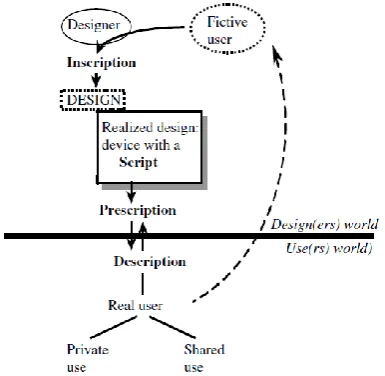
(17) designers. Lie and Sorensen (1996) consider users as “tinkerers13”, who shape actively their life trough creative manipulations of objects in relations to their practical needs and competencies. They may develop anti-programs: unforeseen ways of use or non-use that mismatch designers program of actions (Latour, 1992). If appropriation of technology does not occurs as expected by its makers, undesirable effects may take place. For my thesis it is important to emphases on the qualitative understanding of the complexity of interactions that produce certain effects. Stories in which users appropriate those technologies in unforeseen ways, may explain why unwelcome effect of over and/or underestimation of energy consumption takes place. Detailed insight is needed on how current systems function in the hybrid daily practice, in other words, how the users interact with existing scripts inside the house and what they do to realize a comfortable indoor climate. The study of indoor climate systems in everyday life is an effort to look at technology in use. The daily use of indoor climate systems is more than just the use of only indoor climate systems; its use is associated with other home and household activities. The everyday use practice denotes routines of human existence and what we do over and over again (Lie & Sorensen, 1996). These ‘social practices of use or cultural meanings of artefacts cannot be fully anticipated in the design phase and only developed during the implementation of technologies (Rohracher, 2005). Therefore, users’ re-actions on scripts should to be anticipated by analyzing how the division of competences between the material structure of the house and users can be located, which part of behavior is caused by technological components and what is left to the user. This distribution depends on the positioning to existing technologies and practices and, how this positioning affects the meaning and status of the indoor climate systems in questions. This cannot be determined a priori. Jaap Jelsma (1999) suggests that in such cases, empirical insight is needed in the use practice. According to him, designers should learn about the current use practice for which they design scripts. Jelsma suggest that the underlying logic of such use practices should be identified. In the next section more about Jelsma’s approach. T HINKING ABOUT BEHAVIOR IN TERMS OF THE DESIGN AND USE OF TECHNOLOGY Jaap Jelsma offers a conceptual background in which the different perspectives from both designers and users are integrated. It serves as a design methodology for designing “moralized products”, which aims to reduce unintended outcomes. He builds further on ANT perspective and script approach. Figure 1 illustrates how Jelsma connects script terminology with design and use networks. It shows the force and directions of scripts on the scale of an artifact.. 13. They understand a ‘tinkerer’ as a bricoleur in Lévi-Strauss’s terms (1966). A bricoleur is adept at many tasks and at putting persisting things together in new ways adapting his project to a finite stock of materials and tools. Lévi-Strauss says that the universe of the bricoleur is closed, and he often is forced to make do with whatever is at hand. The bricoleur approximates a ‘savage mind’ in contrast to engineers, who approximate a ‘scientific mind’.. 17.
(18) Figure 1: world of designers and users connected via script terminology (Jelsma, 2006a, p. 224).. In this situation, the fictive user is implicated by designers. According to Jelsma, empirical insights about use(rs)world should inform designers, otherwise this framework would suffer from technological determinism and to avoid design/use processes being perceived practically as linear (Jelsma, 2006a). Jelsma (2005)argues that the material view of human action is clarifying, but one-sided, because the mind reflects on these entities. Material objects develop in a hybrid environment: partly material, partly mental. In the practice of design and use studies, analyses would be incomprehensible without representations and studies of the related mental reflections of designers and users (Jelsma, 2005). Jelsma uses insights from other fields to overcome the break between material objects and social processes. He introduced the twin concepts design logic and user logic. Design logic is the driver that guides the process of inscription and principles of a local design practice. The development of technologies occurs never in empty social space, but takes always place in networks with certain design practices. The consistent whole of ideas, views, values and intentions in the design stage of technology are covered by the concept design logic (Jelsma, 2005). Often design logic is blackboxed14 in work routines, according to Jelsma (2006a), and accordingly has a taken for granted status. Jelsma (2006b) reasons that for successful design thorough understanding is required of the drivers of action of use. Designers should know the underlying logic of the respective use practice. User logic is based on a complex, but for users consistent, mixture of values, preferences, intentions, and conventions (Jelsma, 2005), which are being “shaped and driven not only in social and cultural context, but also by material (dis)stimuli” that are part of the use practice (Jelsma, 2006a, p. 94). Many actions are carried out by routine, and users may not be aware of underlying reasons of their behavior. This does not mean that (s)he does not know these reasons. In most cases, if you question them, they will be able to explain why (s)he uses and object as (s)he does. They often are able to open the blackbox of their daily routines. Jelsma suggest that the use practice should be represented. Such representation should be based on a reconstruction of the underlying logic of human-technology interactions. According to Jelsma 14. Adapted by STS studies, a black box is a technical artifact that appears self-evident and obvious to the observer. Technologies as mundane as a seat belt (Latour, 1992) can be considered complex black boxes that depend on techniques, materials, thought processes and behavior. Opening the black box of technology leads the way to an investigation of the ways in which a variety of social aspects and technical elements are associated and come together as a durable whole, or black box.. 18.
(19) (1999) such reconstruction cannot be derived from current theoretical behavior models, but should be based on empirical data of the use practice. For the reconstruction and representation of the use practice Jelsma suggests a set of methods and techniques for data collection that are central to UserCentered Design. Although Jelsma was initially directed at optimizing only energy efficient appliances (1999, 2006a), he applied his methodology in the meantime for designing a complex service system for textile maintenance (Jelsma & Knot, 2002) . Thence complexity increased due to the increase of scale: the number of actors, relevant interaction mediated by technologies, and material infrastructures increased drastically. The researchers were not only concerned with core activities related to the service system, but also with activities in other domains. These activities of users in other domains may intervene with and influence core activities, and should be included in the analysis of user logic of core activities, because it increases the future “fit” in broader use practice. This means that more user logics have to be reconstructed. My research will not be focused on a specific technology, feature or service, but on the daily practice of shaping a comfortable indoor climate. It is not a priori clear which technologies and material infrastructures will contribute to this indoor climate practice; so this has to be studied empirically. I expect that Jelsma’s theory can be used to examine a research and use practice without a clear focus on one concrete technology and that in terms of complexity it seems similar to the reconstruction of design logic and user logic for service systems. However, a system may have competing script logics, and in the case that more human actors are involved (more person households) the user logics may also differ for each human actor. In other words, conflicting user logics may exist too in a daily practice. What makes the twin concept of logics interesting for this thesis is that (Jelsma, 2005) argues that design and user logic are logics in motion. Design logic may change while developers struggle with resistance outside the scope of development of technology. The researchers of ECS struggle also with a mismatch between calculated and actual energy consumption. They consider social issues as part of the problem, but these are presently outside their scope. This may be an opening for change of design logic. User logic may change when something in their socio-material environment changes. E VERYDAY PRACTICE AS CONCEPT TO EXPLORE THE DUAL PROMISE OF TECHNOLOGY AT HOME Sociologist Elisabeth Shove offers a way to think about everyday practices (Hand & Shove, 2007; Shove, 1998, 2003, 2010). Shove builds upon conceptual resources from science and technology studies and from social theories of consumption and practice. Her work is directed at sociological versions of (energy) consumption of everyday practices and explores relational aspects between use, design, ordinary technologies, material cultures and conventions of comfort, cleanliness and convenience. At the core of work of Elisabeth Shove is the concept of ‘practice’. The concept of ‘practice’ embraces aspects of five concepts of acquisition, scripting, appropriation, assembly, normalization (Ingram, Shove, & Watson, 2007). These concepts do not fit together in a seamless theoretic whole, as Shove argues, because they all have their own intellectual ancestry. Nevertheless they all contribute to insight into co-constitutive relation between the symbolic significance of technology and realization of practices. Most of these concepts are already explained above, here follows in short Shove understandings of the five concepts that make up the notion of ‘practice’. The first concept of acquisition has different strands, but according to Shove is generally about the reasons why people acquire new goods. The second concept of scripting is derived from Akrich, and is for Shove the 19.
(20) territory in which technology are accorded as a measure of agency, depending upon how they are designed, technologies permit and present certain courses of action and ‘configure’ their users. She explains that in the concept of ‘scripting’ the focus is on technologies as material entities, the symbolic side of technologies is explored with the third concept of appropriation. She takes this concepts from work of Silverstone15. For Shove what matters of ‘appropriation’ is the relation between technologies and the actions of the users, and that it makes a point of that the nature of meaning, use and purpose depend on context and situation. Whereas the concepts ‘scripting’ and ‘appropriation’ are used to describe interactions between people and disconnected technologies, with the notion of assembly Shove follows Latour in the way in which complexes of technology and users relate to each other in networks. The term assembly highlights to Shove the dynamic nature of technologies in use. For example, that technologies interdependency develops in the processes involved in organizing materials in the domains of, for example, domestic use practices. She uses the term normalization to refer to the process through which new technologies and arrangements become stabilized. Again, Shove does not claim that these concepts can be immediately plugged into a methodology for ‘practices’, but she suggests that these help together to light up the dark side of cycles of design and consumption. Shove puts the ‘doing’ – that is the practice itself- at the center. Shove finds it important to understand technology as part of the practice that they make possible. Shove mentions that that practices develop from, establish and make sense of forms of bodily and mental activity, technologies and their use, and agrees with Jaap Jelsma that use logic and background knowledge in the form of understanding, knowhow, states of emotion play a role. She argues that practices cannot be reduced to any of these elements alone. Shove focusses on the sociology of consumption of energy and technology. She does not focus on the energy that technologies consume in daily practice, but highlights other aspects of resource intensive user-technology interactions at home. She explores the comfort, cleanliness and convenience that technologies provide in everyday practices (Shove, 2003). Everyday practices that consume energy are normal household practices like bathing, laundering and cleaning. All sorts of socio-technical (f)actors at home play part in everyday practices and Shove investigates how and why people organization their daily practices as they do. She interrogates the normality, social meaning and realization of the practices that require energy. This way of thinking is helpful for this thesis, because it allows placing the everyday practice of ‘shaping of a comfortable indoor climate’ at the center of research. The practice of ‘shaping a comfortable indoor climate’ can be considered as an energy consuming practice. In the indoor climate practice at home, play all sorts of socio-technical (f)actors at home a role. Shove’s works helps to highlight comfort issues that are related to energy consuming practices of the indoor climate. Shove (2010) would argue that people at home do not simply interact with climatic technology to consume energy in the normal household practice of indoor climate, but do so for good reasons. For example, much of the energy used at home is used to keep people comfortable. In other words, people interact with heating and ventilation systems to realize a comfortable indoor climate. Seen from this perspective, what matters at home is the service of “comfort” that the energy efficient technologies provide in practice. Shove argues that if saving energy is the focus and the goal is to stimulate energy efficient use behavior of indoor climate systems, then so are users’. 15. For example: Silverstone, Hirsch, and Morley (1992) and Silverstone (1993). 20.
(21) meaning of comfort and the way how this is facilitated by the technologies (Shove, 2010; Wilhite et al., 2000). I N CONCLUSION In the previous sections, relevant STS approaches were presented. At the start, ANT was introduced as a relevant perspective for this thesis, because it understands behavior as resulting from dynamic socio-technical interactions. Also, ANT treats humans and non-humans equally, in the sense that both possess agency: technology has an active role in shaping users’ behavior, as well as designers and user play an active role in its shaping. However, this is not to say that all (non)humans have the same power and/or role in technological development. Further theories were proposed to describe the specific roles and types of agency technology, designers and users. The design and use networks were connected by means of the script theory. This theory focuses on the specific agency of designers and technology. The agency of users was explained by means of studies about the appropriation of technology in daily life. An important consequence of the application of these theories is that understanding of technology varies when studied from the perspective of makers or from the perspective of users. Finally, to complete the theoretical frame the twin concepts design and user logic were introduced. These concepts are remarkable as tools to study mental drivers behind specific behavior in research and/or use practices. Rooted in the foregoing, an integral approach to study use behavior in daily practice of shaping a indoor climate at home can be reconstructed. This approach does not only support bridging the gap between social and technical, but it also enables to analyze how agency and responsibilities are delegated and distributed over the socio-material design and use network. This is important for the analysis of underlying drivers of users’ behavior in daily life. As mentioned earlier, the house will be considered as a socio-technical environment in which household members, material and other technological artifacts that all individually influence behavior of users in shaping an indoor climate. The physical infrastructure of a home is a highly scripted environment that plays a core role in producing the experience of the user. Scripts encourage and discourage certain forms of use by specific elements of its design and have an effect on user behavior. But, in practice also values, preferences, intentions and conventions of users are part of indoor climate practice and contribute to user logic. In this thesis, user logic will be examined without a focus on one concrete technology, but with an emphasis on the core practice of shaping an indoor climate at home. This daily practice at home is complex and dynamic: it involves many actors, and relevant interactions mediated by technologies and material infrastructures. The core practice of the indoor climate may intervene with, and may be influenced by other household practices in everyday life. However these other doings should be taken into account too, because they may indicate underlying reasons for doing the core practices as it is done. This thesis does not focus on the energy consumption of user-technology interactions, but explores users’ meaning and realization of comfort within the indoor climate practice at home. Comfort will not be conceptualized beforehand, but rather explored empirically in order to understand either users’ own meaning of comfort and their behavior when they create a comfortable indoor climate at home, or ECS researchers’ understanding of comfort regarding the indoor climate and its realization. The final remark is about the specification of the user. The various authors are referred to in developing this theoretical framework, have used the term user in relation to several types of users. In this thesis, anyone who lives in a house with indoor climate systems could be said to be a user. I 21.
Figure
+7


Outline
DISCUSSION
INCOMPETENT USER’ AS ARGUMENT TO KEEP TECHNICAL INCOMPETENT USERS AT DISTANCE
4.4.1 ‘E CS RESEARCH LOGICS ’ BEHIND USING STANDARDS
HOUSING SELECTION
DISCUSSION OF HOUSING SELECTION AS LOGICS OF USERS BEHIND A COMFORTABLE INDOOR CLIMATE
FEELING AT HOME
DISCUSSION OF FEELING AT HOME AS USER LOGICS BEHIND A COMFORTABLE INDOOR CLIMATE
INDOOR CLIMATE AS AN INTERPLAY OF WARMTH AND FRESH AIR IN THE LOGICS OF USERS
BRENDA AND MARIEKE BATTLE WITH EACH OTHER AND THEIR VENTILATION SYSTEM
DIFFERENT VOCABULARIES FOR TWO INDOOR CLIMATE CONDITIONS
Related documents
3.2. “ Industrialized WTO ” and “ industrialized PTA ” trade effects Our results above suggest that PTA trade creation is not homoge- neous across agreements. To the
• perform an independent review of the Kennedy Space Center (KSC) Quality Planning Requirements Document to address the quality assurance program and its administration,
In another study 385 of the 386 women who underwent medical termination of pregnancy between 12 and 24 weeks of gestation (i.e., 200 mg of mifepristone orally followed 36 to 48
Introduction: The study purpose is to create multivariable risk pre- diction models that use patient characteristics, surgical site classifi- cations, and planned mesh
The Balanced Scorecard concept has been adopted by all types of organizations (manufacturing and service, for-profit and not-for-profit, private and public) in virtually
To restore the switch, open a Telnet session (a new IP address may be required), then enter the Config Restore command from within an Admin session as shown in the
He will (a) sit on the rolling seat, (b) roll into the spaceship, and (c) close the rear hatch behind him. The spaceship and seat spaced under the stage to allow the pilot an
Analysis of ARS zones in relation to photographs of fishing boats revealed most gannets adopted a mixed foraging strategy - ARS zones occurred both in the presence and absence
