TypeSQL: Knowledge-based Type-Aware Neural Text-to-SQL Generation
Tao Yu
Yale University [email protected]
Zifan Li
Yale University [email protected]
Zilin Zhang
Yale University
Rui Zhang
Yale University [email protected]
Dragomir Radev
Yale University
Abstract
Interacting with relational databases through natural language helps users of any back-ground easily query and analyze a vast amount of data. This requires a system that under-stands users’ questions and converts them to SQL queries automatically. In this paper we present a novel approach, TYPESQL, which
views this problem as a slot filling task. Addi-tionally, TYPESQL utilizes type information
to better understand rare entities and numbers in natural language questions. We test this idea on the WikiSQL dataset and outperform the prior state-of-the-art by 5.5% in much less time. We also show that accessing the con-tent of databases can significantly improve the performance when users’ queries are not well-formed. TYPESQL gets 82.6% accuracy, a
17.5% absolute improvement compared to the previous content-sensitive model.
1 Introduction
Building natural language interfaces to relational databases is an important and challenging problem (Li and Jagadish,2014;Pasupat and Liang,2015; Yin et al.,2016;Zhong et al.,2017;Yaghmazadeh et al.,2017;Xu et al.,2017;Wang et al.,2017a). It requires a system that is able to understand natu-ral language questions and generate corresponding SQL queries. In this paper, we consider the Wik-iSQL task proposed byZhong et al.(2017), a large scale benchmark dataset for the text-to-SQL prob-lem. Given a natural language question for a table and the table’s schema, the system needs to pro-duce a SQL query corresponding to the question.
We introduce a knowledge-based type-aware text-to-SQL generator, TYPESQL. Based on the
prior state-of-the-art SQLNet (Xu et al., 2017), TYPESQL employs a sketch-based approach and
views the task as a slot filling problem (Fig-ure 2). By grouping different slots in a
reason-able way and capturing relationships between at-tributes, TYPESQL outperforms SQLNet by about
3.5% in half of the original training time.
Furthermore, natural language questions of-ten contain rare entities and numbers specific to the underlying database. Some previous work (Agrawal and Srikant,2003) already shows those words are crucial to many downstream tasks, such as infering column names and condition values in the SQL query. However, most of such key words lack accurate embeddings in popular pre-trained word embedding models. In order to solve this problem, TYPESQL assigns each word a type as
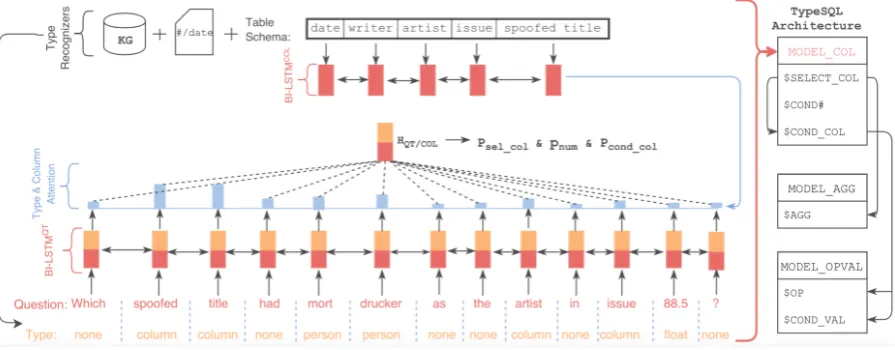
an entity from either the knowledge graph, a col-umn or a number. For example, for the question in Figure1, we label “mort drucker” asPERSON
ac-cording to our knowledge graph; “spoofed title,” “artist” and “issue” asCOLUMNsince they are
col-umn names; and “88.5” as FLOAT. Incorporating
this type information, TYPESQL further improves
the state-of-the-art performance by about another 2% on the WikiSQL dataset, resulting in a final 5.5% improvement in total.
Moreover, most previous work assumes that user queries contain exact column names and en-tries. However, it is unrealistic that users al-ways formulate their questions with exact col-umn names and string entries in the table. To tackle this issue, when scaleability and privacy are not of a concern, the system needs to search databases to better understand what the user is querying. Our content-sensitive model TYPESQL
+ TC gains roughly 9% improvement compared to the content-insensitive model, and outperforms the previous content-sensitive model by 17.5%.
2 Related Work
Semantic parsing maps natural language to mean-ingful executable programs. The programs could
Figure 1: TYPESQL consists of three slot-filling models on the right. We only showMODEL COLon the left for
brevity.MODEL AGGandMODEL OPVALhave the similar pipelines.
be a range of representations such as logic forms (Zelle and Mooney,1996;Zettlemoyer and Collins, 2005; Wong and Mooney, 2007; Das et al., 2010;Liang et al., 2011;Banarescu et al., 2013;Artzi and Zettlemoyer, 2013;Reddy et al., 2014;Berant and Liang,2014;Pasupat and Liang, 2015). Another area close to our task is code gen-eration. This task parses natural language descrip-tions into a more general-purpose programming language such as Python (Allamanis et al.,2015; Ling et al.,2016;Rabinovich et al.,2017;Yin and Neubig,2017).
As a sub-task of semantic parsing, the text-to-SQL problem has been studied for decades ( War-ren and Pereira,1982;Popescu et al.,2003,2004; Li et al., 2006; Giordani and Moschitti, 2012; Wang et al.,2017b). The methods of the Database community (Li and Jagadish,2014;Yaghmazadeh et al.,2017) involve more hand feature engineer-ing and user interactions with the systems. In this work, we focus on recent neural network based ap-proaches (Yin et al.,2016;Zhong et al.,2017;Xu et al.,2017;Wang et al.,2017a;Iyer et al.,2017). Dong and Lapata (2016) introduce a sequence-to-sequence approach to converting text to logi-cal forms. Most of previous work focus on spe-cific table schemas, which means they use a sin-gle database in both train and test. Thus, they don’t generalize to new databases. Zhong et al. (2017) publish the WikiSQL dataset and propose a sequence-to-sequence model with reinforcement learning to generate SQL queries. In the problem definition of the WikiSQL task, the databases in the test set do not appear in the train and
develop-SELECT$AGG $SELECT COL
WHERE$COND COL $OP $COND VAL
(AND$COND COL $OP $COND VAL)*
Figure 2: SQL Sketch. The tokens starting with “$” are slots to fill. “*” indicates zero or moreANDclauses.
ment sets. Also, the task needs to take different ta-ble schemas into account.Xu et al.(2017) further improve the results by using a SQL sketch based approach employing a sequence-to-set model.
3 Methodology
Like SQLNet, we employ a sketch-based approach and format the task as a slot filling problem. Fig-ure2shows the SQL sketch. Our model needs to predict all slots that begin with$in Figure2.
Figure 1 illustrates the architecture of TYPE
-SQL on the right and a detailed overview of one of three main modelsMODEL COLon the left. We
first preprocess question inputs by type recogni-tion (Secrecogni-tion3.1). Then we use two bi-directional LSTMs to encode words in the question with their types and the column names separately (Section 3.2). The output hidden states of LSTMs are then used to predict the values for the slots in the SQL sketch (Section3.3).
3.1 Type Recognition for Input Preprocessing
In order to create one-to-one type input for each question, we, first, tokenize each question inton
-grams of length 2 to 6, and use them to search over the table schema and label any column name ap-pears in the question asCOLUMN. Then, we assign
self-explanatory categories: INTEGER, FLOAT, DATE,
andYEAR. To identify named entities, we search
for five types of entities: PERSON,PLACE,COUN -TRY, ORGANIZATION, and SPORT, on Freebase1
using grams as keyword queries. The five cate-gories cover a majority of entities in the dataset. Thus, we do not use other entity types provided by Freebase. Domain-specific knowledge graphs can be used for other applications.
In the case where the content of databases is available, we match words in the question with both the table schema and the content and labels of the columns as COLUMN and match the entry
values as the corresponding column names. For example, the type in the Figure1would be [none, column, column, none, artist, artist, none, none, column, none, column, issue, none] in this case. Other parts in the Figure 1 keep the same as the content-insensitive approach.
3.2 Input Encoder
As shown in the Figure1, our input encoder con-sists of two bi-directional LSTMs, BI-LSTMQT
and BI-LSTMCOL. To encode word and type
pairs of the question, we concatenate embeddings of words and their corresponding types and in-put them toBI-LSTMQT. Then the output hidden
states areHQTandHCOL, respectively.
For encoding column names, SQLNet runs a bi-directional LSTM over each column name. We first average the embeddings of words in the col-umn name. Then, we run a singleBI-LSTMCOL
between column names. This encoding method improves the result by 1.5% and cuts the training time by half. Even though the order of column names does not matter, we attribute this improve-ment to the fact that the LSTM can capture their occurrences and relationships.
3.3 Slot-Filling Model
Next, we predict values for the slots in the SQL sketch. For the slots in Figure 2, SQL-Net has a separate model for each of them which do not share their trainable parameters. This creates five models for the five slots and one model for $COND# (12 BI-LSTMs in
to-tal). However, since the predict procedures of $SELECT COL, $COND COL, and $COND#
are similar, we combine them into a single model. Additionally, $COND COL depends on
1https://developers.google.com/freebase/
the output of $SELECT COL, which reduces er-rors of predicting the same column in these two slots $COND COL Moreover, we group$OP and
$COND VALtogether because both depend on the outputs of$COND COL. Furthermore, we use one model for$AGGbecause we notice that the$AGG
model converges much faster and suffers from overfitting when combined with other models. Fi-nally, TYPESQL consists of three models (Figure 1right):
• MODEL COL for $SELECT COL, $COND#
and$COND COL
• MODEL AGGfor$AGG
• MODEL OPVALfor$OPand$COND VAL
where the parameters of BI-LSTMQT and BI
-LSTMCOL are shared in each model (6 BI -LSTMs in total).
Since all three models use the same way to com-pute the weighted question and type representa-tion HQT/COL using the column attention mecha-nism proposed in SQLNet, we first introduce the following step in all three models:
αQT/COL=softmax(HCOLWctH>QT)
HQT/COL =αQT/COLHQT
wheresoftmaxapplies the softmax operator over each row of the input matrix, αQT/COL is a matrix of attention scores, and HQT/COL is the weighted question and type representation. In our equations, we useWandVto represent all trainable
param-eter matrices and vectors, respectively.
MODEL COL-$SELECT COL HQT/COL is used to predict the column name in the$SELECT COL:
s=Vseltanh(Wselc HCOL> +WqtselH>QT/COL)
Psel col =softmax(s)
MODEL COL-$COND# Unlike SQLNet, we compute number of conditions in theWHEREin a
simpler way:
Pnum=softmaxVnumtanh(Wnum
qt PiH>QT/COLi)
Dev Test
Acclf Accqm Accex Acclf Accqm Accex
Content Insensitive
Dong and Lapata(2016) 23.3% - 37.0% 23.4% - 35.9%
Augmented Pointer Network (Zhong et al.,2017) 44.1% - 53.8% 42.8% - 52.8%
Seq2SQL (Zhong et al.,2017) 49.5% - 60.8% 48.3% - 59.4%
SQLNet (Xu et al.,2017) - 63.2% 69.8% - 61.3% 68.0%
TypeSQL w/o type-awareness (ours) - 66.5% 72.8% - 64.9% 71.7%
TypeSQL (ours) - 68.0% 74.5% - 66.7% 73.5%
Content Sensitive
Wang et al.(2017a) 59.6% - 65.2% 59.5% - 65.1%
TypeSQL+TC (ours) - 79.2% 85.5% - 75.4% 82.6%
Table 1: Overall results on WikiSQL. Acclf, Accqm, and Accex denote the accuracies of exact string, canonical
representation, and execute result matches between the synthesized SQL with the ground truth respectively. The top six results are content-insensitive, which means only the question and table schema are used as inputs. The bottom two are content-sensitive, where the models use the question, the table schema, and the content of databases.
Dev Test
Accagg Accsel Accwhere Accagg Accsel Accwhere Seq2SQL (Zhong et al.,2017) 90.0% 89.6% 62.1% 90.1% 88.9% 60.2% SQLNet (Xu et al.,2017) 90.1% 91.5% 74.1% 90.3% 90.9% 71.9%
TypeSQL (ours) 90.3% 93.1% 78.5% 90.5% 92.2% 77.8%
[image:4.595.94.505.60.189.2]TypeSQL+TC (ours) 90.3% 93.5% 92.8% 90.5% 92.1% 87.9%
Table 2: Breakdown results on WikiSQL. Accagg, Accsel, and Accwhereare the accuracies of canonical
represen-tation matches onAGGREGATOR,SELECT COLUMN, and WHEREclauses between the synthesized SQL and the ground truth respectively.
MODEL COL-$COND COL We find that SQL-Net often selects the same column name in the
$COND COL as $SELECT COL, which is incor-rect in most cases. To avoid this problem, we pass the weighted sum of question and type hid-den states conditioned on the column chosen in
$SELECT COL HQT/SCOL (expended as the same shape ofHQT/COL) to the prediction:
c=Vcoltanh(Wcol
c H>COL+WcolqtH>QT/COL+Wscolqt H>QT/SCOL)
Pcond col=softmax(c)
MODEL AGG-$AGG Given the weighted sum of question and type hidden states conditioned on the column chosen in $SELECT COL HQT/SCOL,
$AGGis chosen from{NULL,MAX,MIN,COUNT, SUM,AVG}in the same way as SQLNet:
Pagg=softmax Vaggtanh(Waggqt H>QT/SCOL)
MODEL OPVAL-$OP For each predicted condi-tion column, we choose a$OPfrom{=, >, <}by:
Pop=softmax Wopt tanh(W op
c H>COL+W
op
qtH>QT/COL)
MODEL OPVAL-$COND VAL Then, we need to generate a substring from the question for each
predicted column. As in SQLNet, a bi-directional LSTM is used for the encoder. It employs a pointer network (Vinyals et al.,2015) to compute the dis-tribution of the next token in the decoder. In par-ticular, the probability of selecting the i-th token wiin the natural language question as the next
to-ken in the substring is computed as:
v=Vvalt tanh(Wvalqt HQTi +Wvalc HCOL+Wvalh h)
Pcond val=softmax(v)
wherehis the hidden state of the previously
gen-erated token. The generation process continues until the hENDi token is the most probable next token of the substring.
4 Experiments
Dataset We use the WikiSQL dataset (Zhong et al., 2017), a collection of 87,673 examples of questions, queries, and database tables built from 26,521 tables. It provides train/dev/test splits such that each table is only in one split. This requires model to generalize to not only new questions but new table schemas as well.
Py-Torch (Paszke et al.,2017). We concatenate pre-trained Glove (Pennington et al.,2014) and para-phrase (Wieting and Gimpel, 2017) embeddings. The dimensions and dropout rates of all hidden layers are set to 120 and 0.3 respectively. We use Adam (Kingma and Ba, 2015) with the de-fault hyperparameters for optimization. The batch size is set to 64. The same loss functions in (Xu et al., 2017) are used. Our code is available at https://github.com/taoyds/typesql.
Results and Discussion Table1shows the main results on the WikiSQL task. We compare our work with previous results using the three eval-uation metrics used in (Xu et al., 2017). Table 2 provides the breakdown results on AGGREGA -TION,SELECTION, andWHEREclauses.
Without looking at the content of databases, our model outperforms the previous best work by 5.5% on execute accuracy. According to Table2, TYPESQL improves the accuracy of SELECT by
1.3% and WHERE clause by 5.9%. By encoding column names and grouping model components in a simpler but reasonable way, TYPESQL achieves
a much higher result on the most challenging sub-task WHERE clause. Also, the further
improve-ment of integrating word types shows that TYPE
-SQL could encode the rare entities and numbers in a better way.
Also, if complete access to the database is al-lowed, TYPESQL can achieve 82.6% on execute
accuracy, and improves the performance of the previous content-aware system by 17.5%. Al-though (Zhong et al.,2017) enforced some limita-tions when creating the WikiSQL dataset, there are still many questions that do not have any column name and entity indicator. This makes generat-ing the right SQLs without searchgenerat-ing the database content in such cases impossible. This is not a crit-ical problem for WikiSQL but is so for most real-world tasks.
5 Conclusion and Future Work
We propose TYPESQL for text-to-SQL which
views the problem as a slot filling task and uses type information to better understand rare enti-ties and numbers in the input. TYPESQL can use
the database content to better understand the user query if it is not well-formed. TYPESQL
signifi-cantly improves upon the previous state-of-the-art on the WikiSQL dataset.
Although, unlike most of the previous work, the
WikiSQL task requires model to generalize to new databases, the dataset does not cover some impor-tant SQL operators such as JOIN and GROUP BY. This limits the generalization of the task to other SQL components. In the future, we plan to ad-vance this work by exploring other more complex datasets under the database-split setting. In this way, we can study the performance of a general-ized model on a more realistic text-to-SQL task which includes many complex SQL and different databases.
Acknowledgement
We thank Alexander Fabbri for his help in review-ing.
References
Rakesh Agrawal and Ramakrishnan Srikant. 2003. Searching with numbers. IEEE Trans. Knowl. Data Eng., 15(4):855–870.
Miltiadis Allamanis, Daniel Tarlow, Andrew D. Gor-don, and Yi Wei. 2015. Bimodal modelling of source code and natural language. In ICML, vol-ume 37 of JMLR Workshop and Conference Pro-ceedings, pages 2123–2132. JMLR.org.
Yoav Artzi and Luke Zettlemoyer. 2013. Weakly su-pervised learning of semantic parsers for mapping instructions to actions. Transactions of the Associa-tion forComputaAssocia-tional Linguistics.
Laura Banarescu, Claire Bonial, Shu Cai, Madalina Georgescu, Kira Griffitt, Ulf Hermjakob, Kevin Knight, Philipp Koehn, Martha Palmer, and Nathan Schneider. 2013. Abstract meaning representation for sembanking. InProceedings of the 7th Linguis-tic Annotation Workshop and Interoperability with Discourse.
Jonathan Berant and Percy Liang. 2014. Semantic parsing via paraphrasing. In Proceedings of the 52nd Annual Meeting of the Association for Compu-tational Linguistics (Volume 1: Long Papers), pages 1415–1425, Baltimore, Maryland. Association for Computational Linguistics.
Dipanjan Das, Nathan Schneider, Desai Chen, and Noah A. Smith. 2010. Probabilistic frame-semantic parsing. InNAACL.
Li Dong and Mirella Lapata. 2016. Language to logi-cal form with neural attention. InProceedings of the 54th Annual Meeting of the Association for Compu-tational Linguistics, ACL 2016, August 7-12, 2016, Berlin, Germany, Volume 1: Long Papers.
Srinivasan Iyer, Ioannis Konstas, Alvin Cheung, Jayant Krishnamurthy, and Luke Zettlemoyer. 2017. Learning a neural semantic parser from user feed-back. CoRR, abs/1704.08760.
Diederik P. Kingma and Jimmy Ba. 2015. Adam: A method for stochastic optimization. The 3rd Inter-national Conference for Learning Representations, San Diego.
Fei Li and HV Jagadish. 2014. Constructing an in-teractive natural language interface for relational databases. VLDB.
Yunyao Li, Huahai Yang, and HV Jagadish. 2006. Constructing a generic natural language interface for an xml database. In EDBT, volume 3896, pages 737–754. Springer.
P. Liang, M. I. Jordan, and D. Klein. 2011. Learn-ing dependency-based compositional semantics. In
Association for Computational Linguistics (ACL), pages 590–599.
Wang Ling, Phil Blunsom, Edward Grefenstette, Karl Moritz Hermann, Tom´as Kocisk´y, Fumin Wang, and Andrew Senior. 2016. Latent predictor networks for code generation. InACL (1). The As-sociation for Computer Linguistics.
Panupong Pasupat and Percy Liang. 2015. Compo-sitional semantic parsing on semi-structured tables. In Proceedings of the 53rd Annual Meeting of the Association for Computational Linguistics and the 7th International Joint Conference on Natural Lan-guage Processing of the Asian Federation of Nat-ural Language Processing, ACL 2015, July 26-31, 2015, Beijing, China, Volume 1: Long Papers, pages 1470–1480.
Adam Paszke, Sam Gross, Soumith Chintala, Gre-gory Chanan, Edward Yang, Zachary DeVito, Zem-ing Lin, Alban Desmaison, Luca Antiga, and Adam Lerer. 2017. Automatic differentiation in pytorch.
NIPS 2017 Workshop.
Jeffrey Pennington, Richard Socher, and Christo-pher D. Manning. 2014. Glove: Global vectors for word representation. InEMNLP, pages 1532–1543. ACL.
Ana-Maria Popescu, Alex Armanasu, Oren Etzioni, David Ko, and Alexander Yates. 2004. Modern natural language interfaces to databases: Compos-ing statistical parsCompos-ing with semantic tractability. In
Proceedings of the 20th international conference on Computational Linguistics, page 141. Association for Computational Linguistics.
Ana-Maria Popescu, Oren Etzioni, and Henry Kautz. 2003. Towards a theory of natural language inter-faces to databases. In Proceedings of the 8th in-ternational conference on Intelligent user interfaces, pages 149–157. ACM.
Maxim Rabinovich, Mitchell Stern, and Dan Klein. 2017. Abstract syntax networks for code generation and semantic parsing. InACL (1), pages 1139–1149. Association for Computational Linguistics.
Siva Reddy, Mirella Lapata, and Mark Steedman. 2014. Large-scale semantic parsing without question-answer pairs. Transactions of the Association for Computational Linguistics, 2:377–392.
Oriol Vinyals, Meire Fortunato, and Navdeep Jaitly. 2015. Pointer networks. In C. Cortes, N. D. Lawrence, D. D. Lee, M. Sugiyama, and R. Garnett, editors,Advances in Neural Information Processing Systems 28, pages 2692–2700. Curran Associates, Inc.
Chenglong Wang, Marc Brockschmidt, and Rishabh Singh. 2017a. Pointing out sql queries from text.
Technical Report.
Chenglong Wang, Alvin Cheung, and Rastislav Bodik. 2017b. Synthesizing highly expressive sql queries from input-output examples. InProceedings of the 38th ACM SIGPLAN Conference on Programming Language Design and Implementation, pages 452– 466. ACM.
David HD Warren and Fernando CN Pereira. 1982. An efficient easily adaptable system for interpreting nat-ural language queries. Computational Linguistics, 8(3-4):110–122.
John Wieting and Kevin Gimpel. 2017. Pushing the limits of paraphrastic sentence embeddings with millions of machine translations. arXiv preprint arXiv:1711.05732.
Yuk Wah Wong and Raymond J. Mooney. 2007. Learn-ing synchronous grammars for semantic parsLearn-ing with lambda calculus. In Proceedings of the 45th Annual Meeting of the Association for Computa-tional Linguistics (ACL-2007), Prague, Czech Re-public.
Xiaojun Xu, Chang Liu, and Dawn Song. 2017. Sqlnet: Generating structured queries from natural language without reinforcement learning. arXiv preprint arXiv:1711.04436.
Navid Yaghmazadeh, Yuepeng Wang, Isil Dillig, and Thomas Dillig. 2017. Sqlizer: Query synthesis from natural language. Proc. ACM Program. Lang., 1(OOPSLA):63:1–63:26.
Pengcheng Yin, Zhengdong Lu, Hang Li, and Ben Kao. 2016. Neural enquirer: Learning to query tables in natural language. InProceedings of the Twenty-Fifth International Joint Conference on Artificial Intelli-gence, IJCAI 2016, New York, NY, USA, 9-15 July 2016, pages 2308–2314.
John M. Zelle and Raymond J. Mooney. 1996. Learn-ing to parse database queries usLearn-ing inductive logic programming. In AAAI/IAAI, pages 1050–1055, Portland, OR. AAAI Press/MIT Press.
Luke S. Zettlemoyer and Michael Collins. 2005. Learning to map sentences to logical form: Struc-tured classification with probabilistic categorial grammars. UAI.
Victor Zhong, Caiming Xiong, and Richard Socher. 2017. Seq2sql: Generating structured queries from natural language using reinforcement learning.