Multilingual Dependency Parsing using Bayes Point Machines
Simon Corston-Oliver Microsoft Research One Microsoft Way Redmond, WA 98052
Anthony Aue Microsoft Research One Microsoft Way Redmond, WA 98052
Kevin Duh Dept. of Electrical Eng.
Univ. of Washington Seattle, WA 98195
Eric Ringger Computer Science Dept.
Brigham Young Univ. Provo, UT 84602
Abstract
We develop dependency parsers for Ara-bic, English, Chinese, and Czech using Bayes Point Machines, a training algo-rithm which is as easy to implement as the perceptron yet competitive with large margin methods. We achieve results com-parable to state-of-the-art in English and Czech, and report the first directed depen-dency parsing accuracies for Arabic and Chinese. Given the multilingual nature of our experiments, we discuss some issues regarding the comparison of dependency parsers for different languages.
1 Introduction
Dependency parsing is an alternative to constituency analysis with a venerable tradition going back at least two millenia. The last century has seen at-tempts to formalize dependency parsing, particu-larly in the Prague School approach to linguistics (Tesni`ere, 1959; Melˇcuk, 1988).
In a dependency analysis of syntax, words directly modify other words. Unlike constituency analysis, there are no intervening non-lexical nodes. We use the terms child and parent to denote the dependent term and the governing term respectively.
Parsing has many potential applications, rang-ing from question answerrang-ing and information re-trieval to grammar checking. Our intended ap-plication is machine translation in the Microsoft Research Treelet Translation System (Quirk et al.,
2005; Menezes and Quirk, 2005). This system ex-pects an analysis of the source language in which words are related by directed, unlabeled dependen-cies. For the purposes of developing machine trans-lation for several language pairs, we are interested in dependency analyses for multiple languages.
The contributions of this paper are two-fold: First, we present a training algorithm called Bayes Point Machines (Herbrich et al., 2001; Harrington et al., 2003), which is as easy to implement as the per-ceptron, yet competitive with large margin meth-ods. This algorithm has implications for anyone interested in implementing discriminative training methods for any application. Second, we develop parsers for English, Chinese, Czech, and Arabic and probe some linguistic questions regarding depen-dency analyses in different languages. To the best of our knowledge, the Arabic and Chinese results are the first reported results to date for directed depen-dencies. In the following, we first describe the data (Section 2) and the basic parser architecture (Section 3). Section 4 introduces the Bayes Point Machine while Section 5 describes the features for each lan-guage. We conclude with experimental results and discussions in Sections 6 and 7.
2 Data
We utilize publicly available resources in Arabic, Chinese, Czech, and English for training our depen-dency parsers.
For Czech we used the Prague Dependency Tree-bank version 1.0 (LDC2001T10). This is a corpus of approximately 1.6 million words. We divided the data into the standard splits for training,
opment test and blind test. The Prague Czech De-pendency Treebank is provided with human-edited and automatically-assigned morphological informa-tion, including part-of-speech labels. Training and evaluation was performed using the automatically-assigned labels.
For Arabic we used the Prague Arabic De-pendency Treebank version 1.0 (LDC2004T23). Since there is no standard split of the data into training and test sections, we made an approxi-mate 70%/15%/15% split for training/development test/blind test by sampling whole files. The Ara-bic Dependency Treebank is considerably smaller than that used for the other languages, with approx-imately 117,000 tokens annotated for morphologi-cal and syntactic relations. The relatively small size of this corpus, combined with the morphological complexity of Arabic and the heterogeneity of the corpus (it is drawn from five different newspapers across a three-year time period) is reflected in the relatively low dependency accuracy reported below. As with the Czech data, we trained and evaluated us-ing the automatically-assigned part-of-speech labels provided with the data.
Both the Czech and the Arabic corpora are anno-tated in terms of syntactic dependencies. For En-glish and Chinese, however, no corpus is available that is annotated in terms of dependencies. We there-fore applied head-finding rules to treebanks that were annotated in terms of constituency.
For English, we used the Penn Treebank version 3.0 (Marcus et al., 1993) and extracted dependency relations by applying the head-finding rules of (Ya-mada and Matsumoto, 2003). These rules are a simplification of the head-finding rules of (Collins, 1999). We trained on sections 02-21, used section 24 for development test and evaluated on section 23. The English Penn Treebank contains approxi-mately one million tokens. Training and evaluation against the development test set was performed us-ing human-annotated part-of-speech labels. Evalu-ation against the blind test set was performed us-ing part-of-speech labels assigned by the tagger de-scribed in (Toutanova et al., 2003).
For Chinese, we used the Chinese Treebank ver-sion 5.0 (Xue et al., 2005). This corpus contains approximately 500,000 tokens. We made an approx-imate 70%/15%/15% split for training/development
test/blind test by sampling whole files. As with the English Treebank, training and evaluation against the development test set was performed using human-annotated part-of-speech labels. For evalu-ation against the blind test section, we used an im-plementation of the tagger described in (Toutanova et al., 2003). Trained on the same training section as that used for training the parser and evaluated on the development test set, this tagger achieved a to-ken accuracy of 92.2% and a sentence accuracy of 63.8%.
The corpora used vary in homogeneity from the extreme case of the English Penn Treebank (a large corpus drawn from a single source, the Wall Street Journal) to the case of Arabic (a relatively small corpus–approximately 2,000 sentences–drawn from multiple sources). Furthermore, each language presents unique problems for computational analy-sis. Direct comparison of the dependency parsing results for one language to the results for another language is therefore difficult, although we do at-tempt in the discussion below to provide some basis for a more direct comparison. A common question when considering the deployment of a new language for machine translation is whether the natural lan-guage components available are of sufficient quality to warrant the effort to integrate them into the ma-chine translation system. It is not feasible in every instance to do the integration work first and then to evaluate the output.
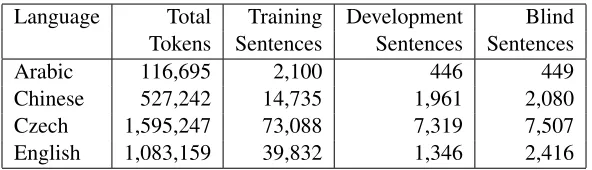
Table 1 summarizes the data used to train the parsers, giving the number of tokens (excluding traces and other empty elements) and counts of sen-tences.1
3 Parser Architecture
We take as our starting point a re-implementation of McDonald’s state-of-the-art dependency parser (McDonald et al., 2005a). Given a sentencex, the
goal of the parser is to find the highest-scoring parse
ˆ
yamong all possible parsesy∈Y:
ˆ
y = arg max
y∈Y s(x, y) (1)
1The files in each partition of the Chinese and Arabic data are given at http://research.microsoft.com/˜simonco/
Language Total Training Development Blind Tokens Sentences Sentences Sentences
Arabic 116,695 2,100 446 449
[image:3.612.159.455.56.141.2]Chinese 527,242 14,735 1,961 2,080 Czech 1,595,247 73,088 7,319 7,507 English 1,083,159 39,832 1,346 2,416
Table 1: Summary of data used to train parsers.
For a given parsey, its score is the sum of the scores
of all its dependency links(i, j)∈y:
s(x, y) = !
(i,j)∈y
d(i, j) = !
(i,j)∈y
w·f(i, j) (2)
where the link (i, j) indicates a head-child
depen-dency between the token at positioniand the token
at positionj. The scored(i, j)of each dependency link (i, j) is further decomposed as the weighted
sum of its featuresf(i, j).
This parser architecture naturally consists of three modules: (1) a decoder that enumerates all possi-ble parses y and computes the argmax; (2) a
train-ing algorithm for adjusttrain-ing the weightswgiven the training data; and (3) a feature representationf(i, j).
Two decoders will be discussed here; the training al-gorithm and feature representation are discussed in the following sections.
A good decoder should satisfy several proper-ties: ideally, it should be able to search through all valid parses of a sentence and compute the parse scores efficiently. Efficiency is a significant issue since there are usually an exponential number of parses for any given sentence, and the discrimina-tive training methods we will describe later require repeated decoding at each training iteration. We re-implemented Eisner’s decoder (Eisner, 1996), which searches among all projective parse trees, and the Chu-Liu-Edmonds’ decoder (Chu and Liu, 1965; Edmonds, 1967), which searches in the space of both projective and non-projective parses. (A pro-jective tree is a parse with no crossing dependency links.) For the English and Chinese data, the head-finding rules for converting from Penn Treebank analyses to dependency analyses creates trees that are guaranteed to be projective, so Eisner’s algo-rithm suffices. For the Czech and Arabic corpora, a non-projective decoder is necessary. Both algo-rithms areO(N3), whereN is the number of words
in a sentence.2 Refer to (McDonald et al., 2005b) for a detailed treatment of both algorithms.
4 Training: The Bayes Point Machine
In this section, we describe an online learning al-gorithm for training the weights w. First, we ar-gue why an online learner is more suitable than a batch learner like a Support Vector Machine (SVM) for this task. We then review some standard on-line learners (e.g. perceptron) before presenting the Bayes Point Machine (BPM) (Herbrich et al., 2001; Harrington et al., 2003).
4.1 Online Learning
An online learner differs from a batch learner in that it adjusts w incrementally as each input sample is revealed. Although the training data for our pars-ing problem exists as a batch (i.e. all input sam-ples are available during training), we can apply online learning by presenting the input samples in some sequential order. For large training set sizes, a batch learner may face computational difficulties since there already exists an exponential number of parses per input sentence. Online learning is more tractable since it works with one input at a time.
A popular online learner is the perceptron. It ad-justswby updating it with the feature vector when-ever a misclassification on the current input sample occurs. It has been shown that such updates con-verge in a finite number of iterations if the data is lin-early separable. The averaged perceptron (Collins, 2002) is a variant which averages the wacross all iterations; it has demonstrated good generalization especially with data that is not linearly separable, as in many natural language processing problems.
2The Chu-Liu-Edmonds’ decoder, which is based on a maxi-mal spanning tree algorithm, can run inO(N2), but our simpler
Recently, the good generalization properties of Sup-port Vector Machines have prompted researchers to develop large margin methods for the online set-ting. Examples include the margin perceptron (Duda et al., 2001), ALMA (Gentile, 2001), and MIRA (which is used to train the parser in (McDonald et al., 2005a)). Conceptually, all these methods attempt to achieve a large margin and approximate the maxi-mum margin solution of SVMs.
4.2 Bayes Point Machines
The Bayes Point Machine (BPM) achieves good generalization similar to that of large margin meth-ods, but is motivated by a very different philoso-phy of Bayesian learning or model averaging. In the Bayesian learning framework, we assume a prior distribution over w. Observations of the training data revise our belief of w and produce a poste-rior distribution. The posteposte-rior distribution is used to create the finalwBPMfor classification:
wBPM =Ep(w|D)[w] =
|V!(D)|
i=1
p(wi|D)wi (3)
where p(w|D) is the posterior distribution of the weights given the dataDandEp(w|D)is the
expec-tation taken with respect to this distribution. The term|V(D)|is the size of theversion spaceV(D), which is the set of weightswithat is consistent with
the training data (i.e. the set ofwithat classifies the
training data with zero error). This solution achieves the so-calledBayes Point, which is the best approx-imation to the Bayes optimal solution given finite training data.
In practice, the version space may be large, so we approximate it with a finite sample of sizeI. Further,
assuming a uniform prior over weights, we get the following equation:
wBPM=Ep(w|D)[w]≈
I
!
i=1 1
Iwi (4)
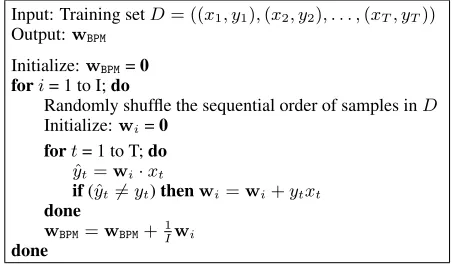
Equation 4 can be computed by a very simple al-gorithm: (1) Train separate perceptrons on different random shuffles of the entire training data, obtaining a set ofwi. (2) Take the average (arithmetic mean)
of the weightswi. It is well-known that perceptron
training results in different weight vector solutions
Input: Training setD= ((x1, y1),(x2, y2), . . . ,(xT, yT)) Output:wBPM
Initialize:wBPM=0
fori= 1 to I;do
Randomly shuffle the sequential order of samples inD
Initialize:wi=0
fort= 1 to T;do
ˆ
yt=wi·xt
if(yˆt!=yt)thenwi=wi+ytxt
done
wBPM=wBPM+1Iwi
[image:4.612.311.537.58.190.2]done
Figure 1: Bayes Point Machine pseudo-code.
if the data samples are presented sequentially in dif-ferent orders. Therefore, random shuffles of the data and training a perceptron on each shuffle is effec-tively equivalent to sampling different models (wi)
in the version space. Note that this averaging op-eration should not be confused with ensemble niques such as Bagging or Boosting–ensemble tech-niques average the output hypotheses, whereas BPM averages the weights (models).
The BPM pseudocode is given in Figure 1. The inner loop is simply a perceptron algorithm, so the BPM is very simple and fast to implement. The outer loop is easily parallelizable, allowing speed-ups in training the BPM. In our specific implemen-tation for dependency parsing, the line of the pseu-docode corresponding to [yˆt = wi·xt] is replaced
by Eq. 1 and updates are performed for each in-correct dependency link. Also, we chose to average each individual perceptron (Collins, 2002) prior to Bayesian averaging.
Finally, it is important to note that the definition of the version space can be extended to include weights with non-zero training error, so the BPM can handle data that is not linearly separable. Also, although we only presented an algorithm for linear classifiers (pa-rameterized by the weights), arbitrary kernels can be applied to BPM to allow non-linear decision bound-aries. Refer to (Herbrich et al., 2001) for a compre-hensive treatment of BPMs.
5 Features
where one is hypothesized to be the parent and the other to be the child, we extract the word of the par-ent token, the part of speech of the parpar-ent token, the word of the child token, the part of speech of the child token and the part of speech of certain adjacent and intervening tokens. Some of these atomic fea-tures are combined in feature conjunctions up to four long, with the result that the linear classifiers de-scribed below approximate polynomial kernels. For example, in addition to the atomic features extracted from the parent and child tokens, the feature [Par-entWord, ParentPOS, ChildWord, ChildPOS] is also added to the feature vector representing the depen-dency between the two tokens. Additional features are created by conjoining each of these features with the direction of the dependency (i.e. is the parent to the left or right of the child) and a quantized measure of the distance between the two tokens. Every token has exactly one parent. The root of the sentence has a special synthetic token as its parent.
Like McDonald et al, we add features that con-sider the first five characters of words longer than five characters. This truncated word crudely approx-imates stemming. For Czech and English the addi-tion of these features improves accuracy. For Chi-nese and Arabic, however, it is clear that we need a different backoff strategy.
For Chinese, we truncate words longer than a sin-gle character to the first character.3 Experimental results on the development test set suggested that an alternative strategy, truncation of words longer than two characters to the first two characters, yielded slightly worse results.
The Arabic data is annotated with gold-standard morphological information, including information about stems. It is also annotated with the output of an automatic morphological analyzer, so that re-searchers can experiment with Arabic without first needing to build these components. For Arabic, we truncate words to the stem, using the value of the lemma attribute.
All tokens are converted to lowercase, and num-bers are normalized. In the case of English, Czech and Arabic, all numbers are normalized to a
sin-3There is a near 1:1 correspondence between characters and morphemes in contemporary Mandarin Chinese. However, most content words consist of more than one morpheme, typi-cally two.
gle token. In Chinese, months are normalized to a MONTH token, dates to a DATE token, years to a YEAR token. All other numbers are normalized to a single NUMBER token.
The feature types were instantiated using all or-acle combinations of child and parent tokens from the training data. It should be noted that when the feature types are instantiated, we have considerably more features than McDonald et al. For example, for English we have 8,684,328 whereas they report 6,998,447 features. We suspect that this is mostly due to differences in implementation of the features that backoff to stems.
The averaged perceptrons were trained on the one-best parse, updating the perceptron for every edge and averaging the accumulated perceptrons af-ter every sentence. Experiments in which we up-dated the perceptron based on k-best parses tended to produce worse results. The Chu-Liu-Edmonds al-gorithm was used for Czech. Experiments with the development test set suggested that the Eisner de-coder gave better results for Arabic than the Chu-Liu-Edmonds decoder. We therefore used the Eisner decoder for Arabic, Chinese and English.
6 Results
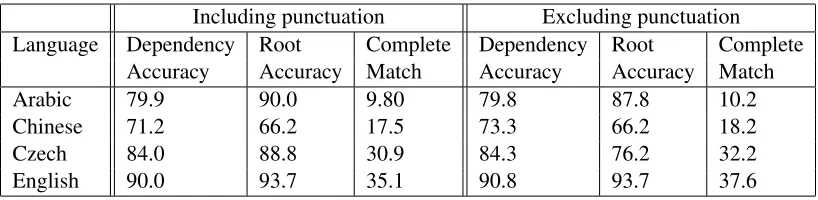
Table 2 presents the accuracy of the dependency parsers. Dependency accuracy indicates for how many tokens we identified the correct head. Root ac-curacy, i.e. for how many sentences did we identify the correct root or roots, is reported as F1 measure, since sentences in the Czech and Arabic corpora can have multiple roots and since the parsing algorithms can identify multiple roots. Complete match indi-cates how many sentences were a complete match with the oracle dependency parse.
Including punctuation Excluding punctuation Language Dependency Root Complete Dependency Root Complete
Accuracy Accuracy Match Accuracy Accuracy Match
Arabic 79.9 90.0 9.80 79.8 87.8 10.2
Chinese 71.2 66.2 17.5 73.3 66.2 18.2
Czech 84.0 88.8 30.9 84.3 76.2 32.2
[image:6.612.102.511.56.156.2]English 90.0 93.7 35.1 90.8 93.7 37.6
Table 2: Bayes Point Machine accuracy measured on blind test set.
comparison of parse results across languages is still difficult for reasons to do with the different nature of the languages, the corpora and the differing stan-dards of linguistic detail annotated, but a compar-ison of parsers for two different languages where both results include punctuation is at least preferable to a comparison of results including punctuation to results excluding punctuation.
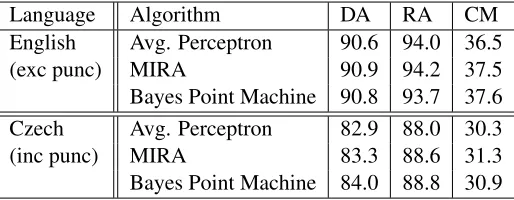
The results reported here for English and Czech are comparable to the previous best published num-bers in (McDonald et al., 2005a), as Table 3 shows. This table compares McDonald et al.’s results for an averaged perceptron trained for ten iterations with no check for convergence (Ryan McDonald, pers. comm.), MIRA, a large margin classifier, and the current Bayes Point Machine results. To determine statistical significance we used confidence intervals for p=0.95. For the comparison of English depen-dency accuracy excluding punctuation, MIRA and BPM are both statistically significantly better than the averaged perceptron result reported in (McDon-ald et al., 2005a). MIRA is significantly better than BPM when measuring dependency accuracy and root accuracy, but BPM is significantly better when measuring sentences that match completely. From the fact that neither MIRA nor BPM clearly outperforms the other, we conclude that we have successfully replicated the results reported in (Mc-Donald et al., 2005a) for English.
For Czech we also determined significance using confidence intervals for p=0.95 and compared re-sults including punctuation. For both dependency accuracy and root accuracy, MIRA is statisticallty significantly better than averaged perceptron, and BPM is statistically significantly better than MIRA. Measuring the number of sentences that match com-pletely, BPM is statistically significantly better than
averaged perceptron, but MIRA is significantly bet-ter than BPM. Again, since neither MIRA nor BPM outperforms the other on all measures, we conclude that the results constitute a valiation of the results reported in (McDonald et al., 2005a).
For every language, the dependency accuracy of the Bayes Point Machine was greater than the ac-curacy of the best individual perceptron that con-tributed to that Bayes Point Machine, as Table 4 shows. As previously noted, when measuring against the development test set, we used human-annotated part-of-speech labels for English and Chi-nese.
Although the Prague Czech Dependency Tree-bank is much larger than the English Penn TreeTree-bank, all measurements are lower than the corresponding measurements for English. This reflects the fact that Czech has considerably more inflectional morphol-ogy than English, leading to data sparsity for the lex-ical features.
Language Algorithm DA RA CM English Avg. Perceptron 90.6 94.0 36.5 (exc punc) MIRA 90.9 94.2 37.5 Bayes Point Machine 90.8 93.7 37.6 Czech Avg. Perceptron 82.9 88.0 30.3 (inc punc) MIRA 83.3 88.6 31.3 Bayes Point Machine 84.0 88.8 30.9
Table 3: Comparison to previous best published results reported in (McDonald et al., 2005a).
[image:7.612.178.435.57.157.2]Arabic Chinese Czech English Bayes Point Machine 78.4 83.8 84.5 91.2 Best averaged perceptron 77.9 83.1 83.5 90.8 Worst averaged perceptron 77.4 82.6 83.3 90.5
Table 4: Bayes Point Machine accuracy vs. averaged perceptrons, measured on development test set, ex-cluding punctuation.
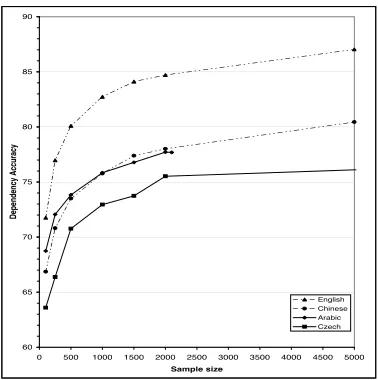
dependency accuracy for five runs at each sample size up to 5,000 sentences. English and Chinese accuracies in this graph use oracle part-of-speech tags. At all sample sizes, the dependency accu-racy for English exceeds the dependency accuaccu-racy of the other languages. This difference is perhaps partly attributable to the use of oracle part-of-speech tags. However, we suspect that the major contribu-tor to this difference is the part-of-speech tag set. The tags used in the English Penn Treebank encode traditional lexical categories such as noun, prepo-sition, and verb. They also encode morphological information such as person (the VBZ tag for exam-ple is used for verbs that are third person, present tense–typically with the suffix -s), tense, number and degree of comparison. The part-of-speech tag sets used for the other languages encode lexical cat-egories, but do not encode morphological informa-tion.5 With small amounts of data, the perceptrons do not encounter sufficient instances of each lexical item to calculate reliable weights. The perceptrons are therefore forced to rely on the part-of-speech in-formation.
It is surprising that the results for Arabic and Chi-nese should be so close as we vary the size of the
5For Czech and Arabic we followed the convention estab-lished in previous parsing work on the Prague Czech Depen-dency Treebank of using the major and minor part-of-speech tags but ignoring other morphological information annotated on each node.
training data (Figure 2) given that Arabic has rich morphology and Chinese very little. One possible explanation for the similarity in accuracy is that the rather poor root accuracy in Chinese indicates parses that have gone awry. Anecdotal inspection of parses suggests that when the root is not correctly identi-fied, there are usually cascading related errors.
Czech, a morphologically complex language in which root identification is far from straightfor-ward, exhibits the worst performance at small sam-ple sizes. But (not shown) as the samsam-ple size in-creases, the accuracy of Czech and Chinese con-verge.
7 Conclusions
We have successfully replicated the state-of-the-art results for dependency parsing (McDonald et al., 2005a) for both Czech and English, using Bayes Point Machines. Bayes Point Machines have the ap-pealing property of simplicity, yet are competitive with online wide margin methods.
We have also presented first results for depen-dency parsing of Arabic and Chinese, together with some analysis of the performance on those lan-guages.
60 65 70 75 80 85 90
0 500 1000 1500 2000 2500 3000 3500 4000 4500 5000
Sample size
D
ep
en
de
nc
y
A
cc
ur
ac
y
[image:8.612.91.280.74.264.2]English Chinese Arabic Czech
Figure 2: Dependency accuracy at various sample sizes. Graph shows average of five samples at each size and measures accuracy against the development test set.
Acknowledgements
We would like to thank Ryan McDonald, Otakar Smrˇz and Hiroyasu Yamada for help in various stages of the project.
References
Y.J. Chu and T.H. Liu. 1965. On the shortest
arbores-cence of a directed graph. Science Sinica, 14:1396–
1400.
Michael John Collins. 1999. Head-Driven Statistical
Models for Natural Language Processing. Ph.D. the-sis, University of Pennsylvania.
M. Collins. 2002. Discriminative training methods for hidden markov models: Theory and experiments with
perceptron algorithms. InProceedings of EMNLP.
R. O. Duda, P. E. Hart, and D. G. Stork. 2001. Pattern
Classification. John Wiley & Sons, Inc.: New York.
J. Edmonds. 1967. Optimum branchings.Journal of
Re-search of the National Bureau of Standards, 71B:233– 240.
Jason M. Eisner. 1996. Three new probabilistic models
for dependency parsing: An exploration. In
Proceed-ings of COLING 1996, pages 340–345.
Claudio Gentile. 2001. A new approximate maximal
margin classification algorithm. Journal of Machine
Learning Research, 2:213–242.
Edward Harrington, Ralf Herbrich, Jyrki Kivinen, John C. Platt, and Robert C. Williamson. 2003.
On-line bayes point machines. In Proc. 7th Pacific-Asia
Conference on Knowledge Discovery and Data Min-ing, pages 241–252.
Ralf Herbrich, Thore Graepel, and Colin Campbell.
2001. Bayes point machines. Journal of Machine
Learning Research, pages 245–278.
M. Marcus, B. Santorini, and M. Marcinkiewicz. 1993. Building a large annotated corpus of english: The Penn
Treebank. Computational Linguistics, 19(2):313–330.
Ryan McDonald, Koby Crammer, and Fernando Pereira. 2005a. Online large-margin training of dependency
parsers. InProceedings of the 43rd Annual Meeting of
the Assocation for Computational Linguistics. Ryan McDonald, Koby Crammer, and Fernando Pereira.
2005b. Online large-margin training of dependency parsers. Technical Report MS-CIS-05-11, Dept. of Computer and Information Science, Univ. of Pennsyl-vania.
Igor A. Melˇcuk. 1988. Dependency Syntax: Theory and
Practice. State University of New York Press. Arul Menezes and Chris Quirk. 2005. Microsoft
re-search treelet translation system: IWSLT evaluation. InProceedings of the International Workshop on Spo-ken Language Translation.
Chris Quirk, Arul Menezes, and Colin Cherry. 2005. De-pendency treelet translation: Syntactically informed
phrasal SMT. InProceedings of the 43rd annual
meet-ing of the Association for Computational Lmeet-inguistics.
Lucien Tesni`ere. 1959. ´El´ements de syntaxe structurale.
Librairie C. Klincksieck.
Kristina Toutanova, Dan Klein, Christopher D. Manning, and Yoram Singer. 2003. Feature-rich part-of-speech
tagging with a cyclic dependency network. In
Pro-ceedings of HLT-NAACL 2003, pages 252–259. Qin Iris Wang, Dale Schuurmans, and Dekang Lin. 2005.
Strictly lexical dependency parsing. In Proceedings
of the Ninth International Workshop on Parsing Tech-nologies, pages 152–159.
Nianwen Xue, Fei Xia, Fu-Dong Chiou, and Martha Palmer. 2005. The penn chinese treebank: Phrase
structure annotation of a large corpus. Natural
Lan-guage Engineering, 11(2).