Joint Extraction of Events and Entities within a Document Context
Bishan Yang
Carnegie Mellon University 5000 Forbes Avenue Pittsburgh, PA, 15213 [email protected]
Tom Mitchell Carnegie Mellon University
5000 Forbes Avenue Pittsburgh, PA, 15213 [email protected]
Abstract
Events and entities are closely related; entities are often actors or participants in events and events without entities are uncommon. The interpretation of events and entities is highly contextually dependent. Existing work in in-formation extraction typically models events separately from entities, and performs infer-ence at the sentinfer-ence level, ignoring the rest of the document. In this paper, we propose a novel approach that models the dependen-cies among variables of events, entities, and their relations, and performs joint inference of these variables across a document. The goal is to enable access to document-level contextual information and facilitate context-aware predictions. We demonstrate that our approach substantially outperforms the state-of-the-art methods for event extraction as well as a strong baseline for entity extraction.
1 Introduction
Events are things that happen or occur; they in-volve entities (people, objects, etc.) who perform or are affected by the events and spatio-temporal as-pects of the world. Understanding events and their descriptions in text is necessary for any generally-applicable machine reading systems. It is also essen-tial in facilitating practical applications such as news summarization, information retrieval, and knowl-edge base construction.
The interpretation of event descriptions is highly contextually dependent. To make correct predic-tions, a model needs to account for mentions of
events and entities together with the discourse con-text. Consider, for example, the following excerpt from a news report:
“On Thursday, there was a massive U.S.aerial bombardmentin which more than 300Tomahawk cruise missilesrained down on Baghdad. Earlier Saturday, Baghdadwas againtargeted. ...”
The excerpt describes two U.S. attacks on Baghdad. The two event anchors (triggers) are boldfaced and the mentions of entities and spatio-temporal infor-mation are italicized. The first event anchor “aerial bombardment” along with its surrounding entity mentions — “U.S.”, “Tomahawk cruise missiles”, and “Baghdad”, describe an attack from the U.S. on Baghdad with Tomahawk cruise missiles being the weapon. The second sentence on its own contains little event-related information, but together with the context of the previous sentence, it indicates another U.S. attack on Baghdad.
State-of-the-art event extraction systems have dif-ficulties inferring such information due to two main reasons. First, they extract events and entities in separate stages: entities such as people, organiza-tion, and locations are first extracted by a named entity tagger, and then these extracted entities are used as inputs for extracting events and their argu-ments (Li et al., 2013). This often causes errors to propagate. In the above example, if the entity tagger mistakenly identifies “Baghdad” as a person, then the event extractor will fail to extract “Baghdad” as the place where the attack happened. In fact, ous work (Li et al., 2013) observes that using previ-ously extracted entities in event extraction results in
a substantial decrease in performance compared to using gold-standard entity information.
Second, most existing work extracts events in-dependently from each individual sentence, ignor-ing the rest of the document (Li et al., 2013; Judea and Strube, 2015; Nguyen and Grishman, 2015). Very few attempts have been made to incorporate document context for event extraction. Ji and Gr-ishman (2008) model the information flow in two stages: the first stage trains classifiers for event triggers and arguments within each sentence; the second stage applies heuristic rules to adjust the classifiers’ outputs to satisfy document-wide (or document-cluster-wide) consistency. Liao and Gr-ishman (2010) further improved the rule-based in-ference by training additional classifiers for event triggers and arguments using document-level infor-mation. Both approaches only propagate the highly confident predictions from the first stage to the sec-ond stage. To the best of our knowledge, there is no unified model that jointly extracts events from sen-tences across the whole document.
In this paper, we propose a novel approach that simultaneously extracts events and entities within a document context.1 We first decompose the
learn-ing problem into three tractable subproblems: (1) learning the dependencies between a single event and all of its potential arguments, (2) learning the co-occurrence relations between events across the doc-ument, and (3) learning for entity extraction. Then we combine the learned models for these subprob-lems into a joint optimization framework that simul-taneously extracts events, semantic roles, and enti-ties in a document. In summary, our main contribu-tions are:
1. We propose a structured model for learning within-event structures that can effectively cap-ture the dependencies between an event and its arguments, and between the semantic roles and entity types for the arguments.
2. We introduce a joint inference framework that combines probabilistic models of within-event structures, event-event relations, and entity
ex-1The code for our system is available
at https://github.com/bishanyang/
EventEntityExtractor.
traction for joint extraction of the set of entities and events over the whole document.
3. We conduct extensive experiments on the Au-tomatic Content Extraction (ACE) corpus, and show that our approach significantly outper-forms the state-of-the-art methods for event ex-traction and a strong baseline for entity extrac-tion.
2 Task Definition
We adopt the ACE definition for entities ((LDC), 2005a) and events ((LDC), 2005b):
• Entity mention: An entity is an object or set of objects in the world. An entity mention is a reference to an entity in the form of a noun phrase or a pronoun.
• Event trigger: the word or phrase that clearly expresses its occurrence. Event triggers can be verbs, nouns, and occasionally adjectives like “dead” or “bankrupt”.
• Event argument: event arguments are entities that fill specific roles in the event. They mainly include participants (i.e., the entities that are in-volved in the event) and general event attributes such as place and time, and some event-type-specific attributes that have certain values (e.g., JOB-TITLE, CRIME).
We are interested in extracting entity mentions, event triggers, and event arguments. We consider ACE entity types PER, ORG, GPE, LOC, FAC, VEH, WEA and ACE VALUE and TIME expres-sions2, and focus on 33 ACE event subtypes, each
of which has its own set of semantic roles for the potential arguments. There are 35 such roles in to-tal, but we collapse 8 of them that are time-related (e.g., TIME-HOLDS, TIME-AT-END) into one, be-cause most of these roles have very few training ex-amples. Figure 2 shows an example of ACE anno-tations for events and entities in a sentence. Note that not every entity mention in the sentence is in-volved in events and a single entity mention can be associated with multiple events.
2To simplify notation, we include values and times when
Figure 1:An example of ACE annotations of events and entities. The event triggers and the entity mentions are marked in different colors. Each event trigger has an event subtype marked above it and each entity mention has an entity type marked above it. Each event trigger evokes an event with semantic roles that are filled by entity mentions. The roles are marked on the links between event trigger and entity mentions. For example, “conviction” evokes a CONVICTevent, and has the CRIMEand DEFENDANTroles filled
by “blasphemy” and “Christian man” respectively.
3 Approach
In this section, we describe our approach for joint extraction of events and entities within a document context. We first decompose the learning problem into three tractable subproblems: learning within-event structures, learning within-event-within-event relations, and learning for entity extraction. We will describe the probabilistic models for learning these subproblems. Then we present a joint inference framework that in-tegrates these learned models into a single model to jointly extract events and entities across a document.
3.1 Learning Within-event Structures
As described in Section 2, a mention of an event con-sists of an event trigger and a set of event arguments. Each event argument is also an entity mention with an entity type. In the following, we develop a proba-bilistic model to learn such dependency structure for each individual event mention.
Given a document x, we first generate a set of event trigger candidates T and a set of entity can-didates N.3 For each trigger candidate i ∈ T, we
associate it with a discrete variableti that takes
val-ues from the 33 ACE event types and a NONEclass indicating other events or no events. Denote the set of entity candidates that are potential arguments for trigger candidateiasNi.4 For eachj ∈ Ni, we
as-sociate it with a discrete variable rij which models
the event-argument relation between trigger candi-dateiand entity candidatej. It takes values from 28 semantic roles and a NONEclass indicating invalid
3We describe how to extract these candidates in Section 4. 4In this paper we only consider entity mentions that are in
the same sentence as the trigger to be potential event arguments due to the ACE annotations. However, our model is general and can handle event-argument relations across sentences with appropriate features.
…
… ti
ri1 ri2 rim
a1 a2 am
Figure 2: A factor graph representation of the within-event model, relating the event typetiof trigger candidate ito the
role typerijof each argument candidatejalong with its entity
typeaj.
roles. Each argument candidatejis also associated with an entity type variableaj, which takes values
from 9 entity types and a NONEclass indicating in-valid entity types.
We define the joint distribution of variables ti,
ri·={rij}j∈Ni, anda·={aj}j∈Ni conditioned on
the observations, which can be factorized according to the factor graph shown in Figure 2:
pθ(ti,ri·,a·|i,Ni, x)∝exp
θT1f1(ti, i, x)+
X
j∈Ni
θT2f2(rij, i, j, x) +
X
j∈Ni
θT3f3(ti, rij, i, j, x)+
X
j∈Ni θT
4f4(aj, j, x) +
X
j∈Ni θT
5f5(rij, aj, j, x)
(1)
whereθ1, ...,θ5are vectors of parameters that need
to be estimated, andf1, ..., f5 are different forms of
[image:3.612.317.543.491.603.2]PERSON, TIME, and PLACE. In addition, a NONE event type should not take any arguments. Similarly, each semantic role should be filled with entities with compatible types. For example, the PERSON role type can only be filled with an entity of type PER. However, a NONE role type can be filled with an entity of any type. To account for these compati-bility constraints, we enforce the probabilities of all invalid configurations to be zero.
Features. f1, f2, andf4 are unary feature
func-tions that depend on trigger variable ti, argument
variablerij, and entity variableaj respectively. We
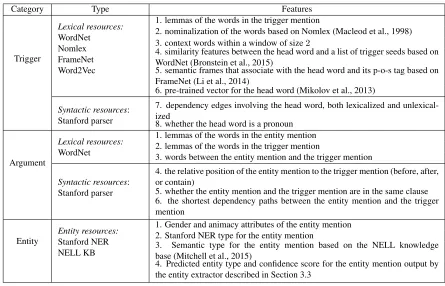
construct a set of features for each feature function (see Table 1). Many of these features overlap with those used in previous work (Li et al., 2013; Li et al., 2014), except for the word embedding fea-tures for triggers and the feafea-tures for entities which are derived from multiple entity resources. f3 and
f5 are pairwise feature functions that depend on
trigger-argument pair (ti, rij) and argument-entity
pair (rij, aj) respectively. We consider simple
in-dicator functions 1t,r and 1r,a as features (1y(x)
equals 1 whenx=yand0otherwise).
Training. For model training, we find the opti-mal parametersθusing the maximum-likelihood es-timates with an L2 regularization:
θ∗ = arg max
θ L(θ)−λ||θ||
2 2
L(θ) =X
i
logp(ti,ri·,a·|i,Ni, x)
We use L-BFGS to optimize the training objective. To calculate the gradient, we use the sum-product algorithm to compute the exact marginals for the unary cliques ti, rij, aj and the pairwise cliques
(ti, rij),(rij, aj). Typically the training
complex-ity for graphical models with unary and pairwise cliques is quadratic in the size of the label set. How-ever, the complexity of our model is much lower than that since we only need to compute the joint distributions over valid variable configurations. De-note the number of event subtypes as T, the num-ber of event argument roles asN, the average num-ber of argument roles for each event subtype ask1,
the average number of entity types for each event argument as k2, and the average number of
argu-ment candidates for each trigger candidate as M. The complexity of computing the joint distribution
isO(M×(k1T+k2N)), andk1andk2are expected
to be small in practice (k1 = 6, k2 = 3in ACE).
3.2 Learning Event-Event Relations
So far we have described a model for learning struc-tures for a single event. However, the inference of the event types for individual events may depend on other events that are mentioned in the document. For example, an ATTACK event is more likely to occur with INJURE and DIE events than with life events like MARRYand BORN. In order to capture this in-tuition, we develop a pairwise model of event-event relations in a document.
Our training data consists of all pairs of trigger candidates that co-occur in the same sentence or are connected by a coreferent subject/object if they are in different sentences.5 We want to propagate
in-formation between these trigger pairs since they are more likely to be related.
Formally, given a trigger candidate pair (i, i0),
we estimate the probabilities for their event types
(ti, ti0)as
pφ(ti, ti0|x, i, i0)∝exp
φTg(ti, ti0, x, i, i0)
(2)
whereφis a vector of parameters andgis a feature function that depends on the trigger candidate pair and their context. We consider both trigger-specific features and relational features. For trigger-specific features, we use the same trigger features listed in Table 1. For relational features, we consider for each pair of trigger candidates: (1) whether they are con-nected by a conjunction dependency relation (based on dependency parsing); (2) whether they share a subject or an object (based on dependency pars-ing and coreference resolution); (3) whether they have the same head word lemma; (4) whether they share a semantic frame based on FrameNet. During training, we use L-BFGS to compute the maximum-likelihood estimates ofφ.
3.3 Entity Extraction
For entity extraction, we trained a standard linear-chain Conditional Random Field (CRF) (Lafferty et al., 2001) using the BIO scheme (i.e., identifying the Beginning, the Inside and the Outside of the
5We use the Stanford coreference system (Lee et al., 2013)
Category Type Features
Trigger
Lexical resources: WordNet Nomlex FrameNet Word2Vec
1. lemmas of the words in the trigger mention
2. nominalization of the words based on Nomlex (Macleod et al., 1998) 3. context words within a window of size2
4. similarity features between the head word and a list of trigger seeds based on WordNet (Bronstein et al., 2015)
5. semantic frames that associate with the head word and its p-o-s tag based on FrameNet (Li et al., 2014)
6. pre-trained vector for the head word (Mikolov et al., 2013)
Syntactic resources: Stanford parser
7. dependency edges involving the head word, both lexicalized and unlexical-ized
8. whether the head word is a pronoun
Argument
Lexical resources: WordNet
1. lemmas of the words in the entity mention 2. lemmas of the words in the trigger mention
3. words between the entity mention and the trigger mention
Syntactic resources: Stanford parser
4. the relative position of the entity mention to the trigger mention (before, after, or contain)
5. whether the entity mention and the trigger mention are in the same clause 6. the shortest dependency paths between the entity mention and the trigger mention
Entity Entity resources:Stanford NER NELL KB
1. Gender and animacy attributes of the entity mention 2. Stanford NER type for the entity mention
3. Semantic type for the entity mention based on the NELL knowledge base (Mitchell et al., 2015)
[image:5.612.82.527.57.343.2]4. Predicted entity type and confidence score for the entity mention output by the entity extractor described in Section 3.3
Table 1:Features for event triggers, event arguments, and entity mentions.
text segments). We use features that are similar to those from previous work (Ratinov and Roth, 2009): (1) current words and part-of-speech tags; (2) con-text words in a window of size 2; (3) word type such as all-capitalized, is-capitalized, and all-digits; (4) Gazetteer-based entity type if the current word matches an entry in the gazetteers collected from Wikipedia (Ratinov and Roth, 2009). In addition, we consider pre-trained word embeddings (Mikolov et al., 2013) as dense features for each word in order to improve the generalizability of the model.
3.4 Joint Inference
Our end goal is to extract coherent event mentions and entity mentions across a document. To achieve this, we propose a joint inference approach that al-lows information flow among the three local models and finds globally-optimal assignments of all vari-ables, including the trigger variablest, the argument role variablesr, and the entity variablesa. Specifi-cally, we define the following objective:
max t,r,a
X
i∈T
E(ti,ri·,a·)+
X
i,i0∈T
R(ti, ti0)+
X
j∈N
D(aj)
(3)
The first term is the sum of confidence scores for in-dividual event mentions based on the parameter es-timates from the within-event model. E(ti,ri·,a·)
can be further decomposed into three parts.
E(ti,ri·,a·) = logpθ(ti|i,Ni, x) +
X
j∈Ni
logpθ(ti, rij|i,Ni, x)
+ X
j∈Ni
logpθ(rij, aj|i,Ni, x)
The second term is the sum of confidence scores for event relations based on the parameter estimates from the pairwise event model, whereR(ti, ti0) = logpφ(ti, ti0|i, i0, x). The third term is the sum of confidence scores for entity mentions, where
D(aj) = logpψ(aj|j, x) and pψ(aj|j, x) is the
marginal probability derived from the linear-chain CRF described in Section 3.3. The optimization is subjected to agreement constraints that enforce the overlapping variables among the three components to agree on their values.
the problem using a dual decomposition algorithm AD3 (Martins et al., 2011). AD3 has been shown
to be orders of magnitude faster than a general pur-pose ILP solver in practice (Das et al., 2012). It is also particularly suitable for our problem since it in-volves decompositions that have many overlapping simple factors. We observed that AD3 recovers the
exact solutions for all the test documents in our ex-periments and the runtime for labeling each docu-ment is only three seconds in average in a 64-bit ma-chine with two 2GHz CPUs and 8GB of RAM.
4 Experiments
We conduct experiments on the ACE2005 corpus.6
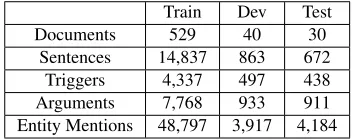
It contains text documents from a variety of sources such as newswire reports, weblogs, and discussion forums. We use the same data split as in Li et al. (2013). Table 2 shows the data statistics.
We adopt the evaluation metrics for events as de-fined in Li et al. (2013). An event trigger is cor-rectly identified if its offsets match those of a gold-standard trigger; and it is correctly classified if its event subtype (33 in total) also match the subtype of the gold-standard trigger. An event argument is correctly identified if its offsets and event subtype match those of any of the reference argument men-tions in the document; and it is correctly classified if its semantic role (28 in total) is also correct. For en-tities, a predicted mention is correctly extracted if its head offsets and entity type (9 in total) match those of the reference entity mention.
Note that our approach requires entity mention candidates and event trigger candidates as input. In-stead of enumerating all possible text spans, we generate high-quality entity mentions from the k -best predictions of our CRF entity extractor (in Sec-tion 3.3).7 Similarly, we train a CRF for event
trig-ger extraction using the same features except for the gazetteers, and generate trigger candidates based on the k-best predictions. We set k = 50 for enti-ties andk = 10for event triggers based on perfor-mance on the development set. They cover 92.3% of the gold-standard entity mentions and 96.3% of the gold-standard event triggers in the test set.
6http://www.itl.nist.gov/iad/mig/tests/
ace/2005/
7During training, we randomly split the training data into 10
Train Dev Test
Documents 529 40 30
[image:6.612.338.515.60.130.2]Sentences 14,837 863 672 Triggers 4,337 497 438 Arguments 7,768 933 911 Entity Mentions 48,797 3,917 4,184
Table 2:Statistics of the ACE2005 dataset.
4.1 Results
Event Extraction. We compare the proposed models WITHINEVENT (in Section 3.1) and JOIN -TEVENTENTITY (in Section 3.4) with two strong baselines. One is JOINTBEAM (Li et al., 2013), a state-of-the-art event extractor that uses a structured perceptron with beam search for sentence-level joint extraction of event triggers and arguments. The other is STAGEDMAXENT, a typical two-stage ap-proach that detects event triggers first and then event arguments. We use the same event trigger candidates and entity mention candidates as input to all the comparing models except for JOINTBEAM, because JOINTBEAM only extracts event mentions and as-sumes entity mentions are given. We consider a re-alistic experimental setting where no gold-standard annotations are available for entities during testing. To obtain results from JOINTBEAM, we ran the ac-tual system8used in Li et al. (2013) using the entity
mentions output by our CRF-based entity extractor. Table 3 shows the average9 precision, recall, and
F1 score for event triggers and event arguments. We can see that our WITHINEVENT model, which ex-plicitly models the trigger-argument dependencies and argument-role-entity-type dependencies, out-performs the MaxEnt pipeline, especially in event argument extraction. This shows that modeling the trigger-argument dependencies is effective in reduc-ing error propagation.
Comparing to the state-of-the-art event extrac-tor JOINTBEAM, the improvements introduced by WITHINEVENTare substantial in both event triggers and event arguments. We believe there are two main reasons: (1) WITHINEVENT considers all possible joint trigger/argument label assignments, whereas
parts and consider thek-best predictions for each part.
8https://github.com/oferbr/
BIU-RPI-Event-Extraction-Project
9We report the micro-average scores as in previous work (Li
Event Trigger
Identification Event TriggerClassification Event ArgumentIdentification Argument RoleClassification
Model P R F1 P R F1 P R F1 P R F1
JOINTBEAM(Li et al., 2013) 76.6 58.7 66.5 74.0 56.7 64.2 74.6 25.5 38.0 68.8 23.5 35.0
STAGEDMAXENT 73.9 66.5 70.0 70.4 63.3 66.7 75.7 20.2 31.9 71.2 19.0 30.0
WITHINEVENT 76.9 63.8 69.7 74.7 62.0 67.7 72.4 37.2 49.2 69.9 35.9 47.4
[image:7.612.72.544.60.141.2]JOINTEVENTENTITY 77.6 65.4 71.0∗ 75.1 63.3 68.7 73.7 38.5 50.6∗ 70.6 36.9 48.4∗
Table 3:Event extraction results on the ACE2005 test set.∗indicates that the difference in F1 compared to the second best model (WITHINEVENT) is statistically significant (p <0.05).
Model Trigger Arg
CROSS-DOC(Ji and Grishman, 2008) 67.3 42.6 CNN (Nguyen and Grishman, 2015) 67.6
[image:7.612.93.282.292.330.2]-JOINTEVENTENTITY 68.7 48.4 Table 4:Comparison of the results (F1 score) of JOINTEVEN -TENTITYand the best known results on ACE event trigger
clas-sification and argument role clasclas-sification.
Model P R F1
CRFENTITY 85.5 73.5 79.1
JOINTEVENTENTITY 82.4 79.2 80.7∗
Table 5: Entity extraction results on the ACE2005 test set. ∗ indicates statistical significance (p <0.05).
JOINTBEAM considers only a subset of the possi-ble assignments based on a heuristic beam search. More specifically, when predicting labels for token
i, JointBeam considers only the K-best (K = 4
in their paper) partial trigger/argument label con-figurations for the previous i−1 tokens. As the length of the sentence increases, a large amount of information will be thrown away. (2) WITH -INEVENTmodels argument-role-entity-type depen-dencies, whereas JOINTBEAM assumes the entity types are given. This can cause error propagation.
JOINTEVENTENTITY provides the best perfor-mance among all the models on all evaluation cate-gories. It boosts both precision and recall compared to WITHINEVENT.10 This demonstrates the advan-tages of JOINTEVENTENTITYin allowing informa-tion propagainforma-tion across event meninforma-tions and entity mentions and making more context-aware and se-mantically coherent predictions.
We also compare the results of JOINTEVENTEN -TITY with the best known results on the ACE event
10All significance tests reported in this paper were computed
using the paired bootstrap procedure (Berg-Kirkpatrick et al., 2012) with 10,000 samples of the test documents.
Model PER GPE ORG TIME
CRFENTITY 85.1 87.0 65.4 78.4 JOINTEVENTENTITY 87.1 87.0 70.2 80.2 Table 6:Entity extraction results (F1 score) per entity type.
extraction task in Table 4. CROSS-DOC (Ji and Gr-ishman, 2008) performs cross-document inference of events using document clustering information, and CNN (Nguyen and Grishman, 2015) is a convo-lutional neural network for extracting event triggers at the sentence level. We see that JOINTEVENTEN -TITY outperforms both models and achieves new state-of-the-art results for event trigger and argu-ment extraction in an end-to-end evaluation setting.
Entity Extraction. In addition to extracting event mentions, JOINTEVENTENTITYalso extracts entity mentions. We compare its output with the output of a strong entity extraction baseline CRFENTITY (de-scribed in Section 3.3). Table 5 shows the (micro-)average precision, recall, and F1 score. We see that JOINTEVENTENTITY introduces a significant im-provement in recall and F1. Table 6 further shows the F1 score for four major entity types PER, GPE, ORG, and TIME in ACE. The promising improve-ments indicate that joint modeling of events and en-tities allows for more accurate predictions about not only events but also entities.
4.2 Error Analysis
in-Error Type Missing Spurious Misclassified TRIGGER 62.1% 34.2% 3.7%
ARGUMENT 71.2% 24.7% 4.1%
[image:8.612.84.290.62.107.2]ENTITY 43.4% 30.5% 26.1% Table 7: Classification of errors made by JOINTEVENTEN
-TITY.
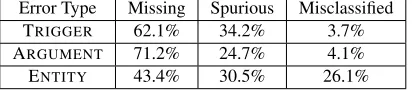
correct triggers and find that there are only 5% of such cases. For event arguments, the majority of the errors relates to missing arguments and only 4.1% is about misclassified argument roles. Among the missing event arguments, 10% of them has correctly identified entity types.
In general, the errors for event extraction are com-monly due to three reasons: (1) Lexical sparsity. For example, in the sentence “At least three mem-bers of a family ... were hacked to death ...”, our model fails to detect that “hacked” triggers an AT -TACKevent, because it has never seen “hacked” with this sense during training. Using WordNet and pre-trained word vectors may alleviate the sparsity issue. It is also important to disambiguate word senses in context. (2) Shallow understanding of context, es-pecially long-range context. For example, given the sentence “She is being held on 50,000 dollars bail on a charge of first-degree reckless homicide ...”, the model detects that “homicide” triggers an event, but fails to detect that “She” refers to the AGENT who committed the homicide. This is mainly due to the complex long-distance dependency between the trigger and the argument. (3) Use of complex language such as metaphor, idioms, and sarcasm. Addressing these phenomena is in general difficult since it requires richer background knowledge and more sophisticated inference.
For entity extraction, we find that integrating event information into entity extraction successfully improves recall and F1. However, since the ACE dataset is restricted to a limited set of events, a large portion of the sentences does not contain any event triggers and event arguments that are of interest. For these sentences, there is little or no benefit of joint modeling. We also find that some entity misclassifi-cation errors can be avoided if entity coreference in-formation is available. We plan to investigate coref-erence resolution as an additional component to our joint model in future work.
5 Related Work
Event extraction has been mainly studied using the ACE data (Doddington et al., 2004) and biomedi-cal data for the BioNLP shared tasks (Kim et al., 2009). To reduce task complexity, early work em-ploys a pipeline of classifiers that extracts event trig-gers first, and then determines their arguments (Ahn, 2006; Bj¨orne et al., 2009). Recently, Convolutional Neural Networks have been used to improve the pipeline classifiers (Nguyen and Grishman, 2015; Chen et al., 2015). As pipeline approaches suf-fer from error propagation, researchers have pro-posed methods for joint extraction of event trig-gers and arguments, using either structured percep-tron (Li et al., 2013), Markov Logic (Poon and Vanderwende, 2010), or dependency parsing algo-rithms (McClosky et al., 2011). However, exist-ing joint models largely rely on heuristic search to aggressively shrink the search space. One ex-ception is work in Riedel and McCallum (2011), which uses dual decomposition to solve joint infer-ence with runtime guarantees. Our work is similar to Riedel and McCallum (2011). However, there are two main differences: first, our model extracts both event mentions and entity mentions; second, it performs joint inference across sentence boundaries. Although our approach is evaluated on ACE, it can be easily adapted to BioNLP data by using appropri-ate features for events triggers, argument roles, and entities. We consider this as future work.
Jurafsky (2009; 2011) learn narrative schemas by linking event verbs that have coreferring syntactic arguments. Our model also adopts this intuition to relate event triggers across sentences. In addition, each event argument is grounded by its entity type (e.g., an entity mention of type PER can only fill roles that can be played by a person).
6 Conclusion
In this paper, we introduce a new approach for auto-matic extraction of events and entities across a docu-ment. We first decompose the learning problem into three tractable subproblems: learning within-event structures, learning event-event relations, and learn-ing for entity extraction. We then integrate these learned models into a single model that performs joint inference of all event triggers, semantic roles for events, and entities across the whole document. Experimental results demonstrate that our approach outperforms the state-of-the-art event extractors by a large margin and substantially improves a strong en-tity extraction baseline. For future work, we plan to integrate entity and event coreference as additional components into the joint inference framework. We are also interested in investigating the integration of more sophisticated event-event relation models of causality and temporal ordering.
Acknowledgments
This work was supported in part by NSF grant IIS-1250956, and in part by the DARPA DEFT program under contract FA87501320005. We would like to thank members of the CMU NELL group for helpful comments. We also thank the anonymous reviewers for insightful suggestions.
References
David Ahn. 2006. The stages of event extraction. In
Proceedings of the Workshop on Annotating and Rea-soning about Time and Events, pages 1–8. Association for Computational Linguistics.
Jonathan Berant, Vivek Srikumar, Pei-Chun Chen, Brad Huang, Christopher D Manning, Abby Vander Lin-den, Brittany Harding, and Peter Clark. 2014. Mod-eling biological processes for reading comprehension.
In Proceedings of the 2014 Conference on Empirical
Methods in Natural Language Processing (EMNLP),
pages 1499–1510. Association for Computational Lin-guistics.
Taylor Berg-Kirkpatrick, David Burkett, and Dan Klein. 2012. An empirical investigation of statistical signifi-cance in nlp. InProceedings of the 2012 Joint Confer-ence on Empirical Methods in Natural Language Pro-cessing and Computational Natural Language
Learn-ing (EMNLP-CoNLL), pages 995–1005. Association
for Computational Linguistics.
Jari Bj¨orne, Juho Heimonen, Filip Ginter, Antti Airola, Tapio Pahikkala, and Tapio Salakoski. 2009. Extract-ing complex biological events with rich graph-based feature sets. InProceedings of the Workshop on Cur-rent Trends in Biomedical Natural Language
Process-ing: Shared Task, pages 10–18. Association for
Com-putational Linguistics.
Ofer Bronstein, Ido Dagan, Qi Li, Heng Ji, and Anette Frank. 2015. Seed-based event trigger labeling: How far can event descriptions get us? InACL Volume 2:
Short Papers, pages 372–376. Association for
Compu-tational Linguistics.
Nathanael Chambers and Dan Jurafsky. 2008. Jointly combining implicit constraints improves temporal or-dering. In Proceedings of the Conference on Em-pirical Methods in Natural Language Processing
(EMNLP), pages 698–706. Association for
Computa-tional Linguistics.
Nathanael Chambers and Dan Jurafsky. 2009. Unsu-pervised learning of narrative schemas and their par-ticipants. InProceedings of the Joint Conference of the 47th Annual Meeting of the ACL and the 4th Inter-national Joint Conference on Natural Language
Pro-cessing of the AFNLP: Volume 2-Volume 2, pages 602–
610. Association for Computational Linguistics. Nathanael Chambers and Dan Jurafsky. 2011.
Template-based information extraction without the templates. In
Proceedings of the 49th Annual Meeting of the Asso-ciation for Computational Linguistics: Human
Lan-guage Technologies-Volume 1, pages 976–986.
Asso-ciation for Computational Linguistics.
Yubo Chen, Liheng Xu, Kang Liu, Daojian Zeng, and Jun Zhao. 2015. Event extraction via dynamic multi-pooling convolutional neural networks. In Proceed-ings of the 53rd Annual Meeting of the Association for Computational Linguistics and the 7th Interna-tional Joint Conference on Natural Language
Process-ing (ACL-IJCNLP), volume 1, pages 167–176.
Associ-ation for ComputAssoci-ational Linguistics.
2: Proceedings of the Sixth International Workshop on
Semantic Evaluation, pages 209–217. Association for
Computational Linguistics.
Quang Xuan Do, Wei Lu, and Dan Roth. 2012. Joint inference for event timeline construction. In Proceed-ings of the 2012 Joint Conference on Empirical Meth-ods in Natural Language Processing and
Computa-tional Natural Language Learning (EMNLP-CoNLL),
pages 677–687. Association for Computational Lin-guistics.
George R Doddington, Alexis Mitchell, Mark A Przy-bocki, Lance A Ramshaw, Stephanie Strassel, and Ralph M Weischedel. 2004. The automatic content extraction (ace) program-tasks, data, and evaluation. InProceedings of the Fourth International Conference
on Language Resources and Evaluation (LREC-2004).
European Language Resources Association (ELRA). Heng Ji and Ralph Grishman. 2008. Refining event
ex-traction through cross-document inference. In
Pro-ceedings of ACL-08: HLT, pages 254–262.
Associa-tion for ComputaAssocia-tional Linguistics.
Alex Judea and Michael Strube. 2015. Event extraction as frame-semantic parsing. Proceedings of the Fourth Joint Conference on Lexical and Computational
Se-mantics (*SEM 2015), pages 159–164.
Jin-Dong Kim, Tomoko Ohta, Sampo Pyysalo, Yoshi-nobu Kano, and Jun’ichi Tsujii. 2009. Overview of bionlp’09 shared task on event extraction. In Proceed-ings of the Workshop on Current Trends in Biomedical
Natural Language Processing: Shared Task, pages 1–
9. Association for Computational Linguistics.
John Lafferty, Andrew McCallum, and Fernando CN Pereira. 2001. Conditional random fields: Probabilis-tic models for segmenting and labeling sequence data.
In Proc. 18th International Conf. on Machine
Learn-ing (ICML), pages 282–289.
Linguistic Data Consortium (LDC). 2005a. English annotation guidelines for enti-ties. https://www.ldc.upenn.edu/ sites/www.ldc.upenn.edu/files/
english-entities-guidelines-v5.6. 6.pdf.
Linguistic Data Consortium (LDC). 2005b. English annotation guidelines for events.
https://www.ldc.upenn.edu/ sites/www.ldc.upenn.edu/files/ english-events-guidelines-v5.4.3. pdf.
Heeyoung Lee, Angel Chang, Yves Peirsman, Nathanael Chambers, Mihai Surdeanu, and Dan Jurafsky. 2013. Deterministic coreference resolution based on entity-centric, precision-ranked rules. Computational Lin-guistics, 39(4):885–916.
Qi Li, Heng Ji, and Liang Huang. 2013. Joint event ex-traction via structured prediction with global features.
InProceedings of the 51st Annual Meeting of the
As-sociation for Computational Linguistics (ACL), pages 73–82. Association for Computational Linguistics. Qi Li, Heng Ji, Yu Hong, and Sujian Li. 2014.
Construct-ing information networks usConstruct-ing one sConstruct-ingle model. In
Proceedings of the Conference on Empirical
Meth-ods on Natural Language Processing (EMNLP), pages
1846–1851. Association for Computational Linguis-tics.
Shasha Liao and Ralph Grishman. 2010. Using docu-ment level cross-event inference to improve event ex-traction. InProceedings of the 48th Annual Meeting of the Association for Computational Linguistics (ACL), pages 789–797. Association for Computational Lin-guistics.
Catherine Macleod, Ralph Grishman, Adam Meyers, Leslie Barrett, and Ruth Reeves. 1998. Nomlex: A lexicon of nominalizations. In Proceedings of
EU-RALEX, volume 98, pages 187–193. Citeseer.
Andr´e FT Martins, Mario AT Figeuiredo, Pedro MQ Aguiar, Noah A Smith, and Eric P Xing. 2011. An augmented lagrangian approach to constrained map in-ference. InProceedings of the International
Confer-ence on Machine Learning (ICML).
David McClosky and Christopher D Manning. 2012. Learning constraints for consistent timeline extraction.
In Proceedings of the 2012 Joint Conference on
Em-pirical Methods in Natural Language Processing and Computational Natural Language Learning
(EMNLP-CoNLL), pages 873–882. Association for
Computa-tional Linguistics.
David McClosky, Mihai Surdeanu, and Christopher D Manning. 2011. Event extraction as dependency pars-ing. In Proceedings of the 49th Annual Meeting of the Association for Computational Linguistics:
Hu-man Language Technologies (ACL), pages 1626–1635.
Association for Computational Linguistics.
Tomas Mikolov, Ilya Sutskever, Kai Chen, Greg S Cor-rado, and Jeff Dean. 2013. Distributed representa-tions of words and phrases and their compositionality.
InAdvances in neural information processing systems
(NIPS), pages 3111–3119.
neural networks. In Proceedings of ACL-IJCNLP
2015 Volume 2: Short Papers, pages 365–371.
Associ-ation for ComputAssoci-ational Linguistics.
Hoifung Poon and Lucy Vanderwende. 2010. Joint infer-ence for knowledge extraction from biomedical litera-ture. InHuman Language Technologies: The 2010 An-nual Conference of the North American Chapter of the
Association for Computational Linguistics (NAACL),
pages 813–821. Association for Computational Lin-guistics.
Lev Ratinov and Dan Roth. 2009. Design challenges and misconceptions in named entity recognition. In
Proceedings of the Thirteenth Conference on
Compu-tational Natural Language Learning, pages 147–155.
Association for Computational Linguistics.
Sebastian Riedel and Andrew McCallum. 2011. Fast and robust joint models for biomedical event extraction. In
Proceedings of the Conference on Empirical Methods
in Natural Language Processing (EMNLP), pages 1–