warwick.ac.uk/lib-publications
Original citation:Sperling, J., Bartley, T. J., Donati, G., Barbieri, M., Jin, X.-M., Datta, Animesh, Vogel, W. and Walmsley, I. A.. (2016) Quantum correlations from the conditional statistics of incomplete data. Physical Review Letters, 117 (8).
Permanent WRAP URL:
http://wrap.warwick.ac.uk/81279
Copyright and reuse:
The Warwick Research Archive Portal (WRAP) makes this work by researchers of the University of Warwick available open access under the following conditions. Copyright © and all moral rights to the version of the paper presented here belong to the individual author(s) and/or other copyright owners. To the extent reasonable and practicable the material made available in WRAP has been checked for eligibility before being made available.
Copies of full items can be used for personal research or study, educational, or not-for-profit purposes without prior permission or charge. Provided that the authors, title and full bibliographic details are credited, a hyperlink and/or URL is given for the original metadata page and the content is not changed in any way.
Publisher’s statement:
© 2016 American Physical Society
Published version: http://dx.doi.org/10.1103/PhysRevLett.117.083601
A note on versions:
The version presented in WRAP is the published version or, version of record, and may be cited as it appears here.
Quantum Correlations from the Conditional Statistics of Incomplete Data
J. Sperling,1,2,*T. J. Bartley,2,3 G. Donati,2M. Barbieri,2,4 X.-M. Jin,2,5 A. Datta,6 W. Vogel,1 and I. A. Walmsley2
1
Arbeitsgruppe Theoretische Quantenoptik, Institut für Physik, Universität Rostock, D-18051 Rostock, Germany 2
Clarendon Laboratory, University of Oxford, Parks Road, Oxford OX1 3PU, United Kingdom 3
Universität Paderborn, Warburger Strasse 100, 33098 Paderborn, Germany 4
Dipartimento di Scienze, Università degli Studi Roma Tre, Via della Vasca Navale 84, 00146 Rome, Italy 5
State Key Laboratory of Advanced Optical Communication Systems and Networks, Institute of Natural Sciences & Department of Physics and Astronomy, Shanghai Jiao Tong University, Shanghai 200240, China
6
Department of Physics, University of Warwick, Coventry CV4 7AL, United Kingdom (Received 4 March 2016; published 19 August 2016)
We study, in theory and experiment, the quantum properties of correlated light fields measured with click-counting detectors providing incomplete information on the photon statistics. We establish a correlation parameter for the conditional statistics, and we derive the corresponding nonclassicality criteria for detecting conditional quantum correlations. Classical bounds for Pearson’s correlation parameter are formulated that allow us, once they are violated, to determine nonclassical correlations via the joint statistics. On the one hand, we demonstrate nonclassical correlations in terms of the joint click statistics of light produced by a parametric down-conversion source. On the other hand, we verify quantum correlations of a heralded, split single-photon state via the conditional click statistics together with a generalization to higher-order moments. We discuss the performance of the presented nonclassicality criteria to successfully discern joint and conditional quantum correlations. Remarkably, our results are obtained without making any assumptions on the response function, quantum efficiency, and dark-count rate of photodetectors.
DOI:10.1103/PhysRevLett.117.083601
Introduction.—The photon statistics of light lie at the heart of quantum optics. Starting with the landmark experi-ments of Hanbury Brown and Twiss [1], the photon distribution can be used to determine whether or not the field is consistent with a classical description. The classical theory of radiation is properly satisfied when the quantum state of light can be written as classical mixtures of coherent states. Whenever such a description fails, this is referred to as nonclassical light [2]. However, uncovering nonclassical phenomena in the presence of loss, decoherence, and using imperfect devices is typically very challenging [3–5]. Moreover, quantum behavior defines the foundation of modern quantum technologies [6], which results in a pressing need for reliable tools to process quantum states that are robust against real world environments. As the physical implementations become ever more complex, it is helpful if analysis techniques place minimal assumptions on the underlying principle of operation of such devices.
Characterizing the correlations of two beams of light,A andB, can be done in two ways. First, one can access the nonclassical character of light via joint correlation functions, similar to the proposal of Hanbury Brown and Twiss [1]. Second, one can ask: “How well is the outcome of a measurement in systemBdetermined for a fixed outcome inA?”and“Is the degree of determination compatible with classical light?”While the first approach is based on the joint probability distribution, the latter questions address the conditional statistics. In quantum systems, the conditional type of correlations leads to quantum effects such as
steering[7,8]. However, conditional correlations are typically not studied in the context of nonclassical radiation fields.
In general, quantum features of the photon number statistics can be accessed with nonclassicality tests[9–15]. However, detectors that directly measure the photon distribution are not commercially available as they require, for instance, cryogenic cooling; see[16]for an overview. To gain significant albeit incomplete information about a given state of light, it is possible to consider technically much simpler systems con-sisting of multiple on-off detectors, that is, avalanche photo-diodes (APDs) in the Geiger mode[17,18]. Examples of such schemes are given by CCD detectors [19–23] and multi-plexing layouts[24–27]. In the latter scenario, one splits light into several spatial beams or temporal bins with smaller intensities, each being measured with an APD. The main feature of the resulting click-counting statistics is its binomial character[28], which significantly differs from the Poissonian form of the photon-number distribution; see, also, Refs.[29,30]. Therefore, the nonclassicality probes have to be adjusted properly to correctly uncover nonclassical light [31,32]. Such a technique directly identifies quantumness in integrated waveguides[33]or systems with high losses[34]. These state-of-the-art implementations underline the function-ality of click-counting detectors for applications in realistic scenarios. However, such techniques are specific to joint correlations of quantum states, and they may fail to uncover the conditional nonclassicality.
minimal assumptions on the detectors. For this reason, we formulate a conditional correlation parameter and derive its bounds for classical light. We additionally compute the classical limits for Pearson’s correlation coefficient for inferring nonclassicality of the joint click distribution. By implementing a parametric-down-conversion source, we produce differently quantum correlated states of light that are probed with our approaches. Our method for the nonclassical conditional statistics is generalized and applied to access higher-order moments.
The primary aim of this work is to demonstrate how a general theoretical analysis of click statistics can be used to highlight nonclassical behavior from a range of quantum states. We illustrate the utility of this analysis with several examples from typical experimental data. The strength of the methodology that will be introduced lies in its ability to identify and discriminate joint and conditional nonclassi-cality with minimal assumptions about how the data were acquired and the characteristics of the detector. In particu-lar, this nonclassicality can be correctly determined even when the raw data arising from different states appear very similar, due to the effects of noise and loss.
Click-counting detectors.—Let us briefly recall the theory of click-counting devices. The probability that
a¼0;…; NA out of NA APDs produce a coincidence click event is[28]
cðaÞ ¼
∶
NA
a
ˆ
πa
Að1ˆ−πˆAÞNA−a∶
; ð1Þ
with πˆA¼1ˆ−exp½−ΓðnˆA=NAÞ. In this normally ordered expectation value,h∶ ∶i,nˆAis the photon number operator and Γ is the so-called detector response function. One typically considers a linear responseΓðxÞ ¼ηxþν (quan-tum efficiencyη; dark count rateν). Here, we do not assume any form ofΓ. Moreover, the click-statistics gives incomplete information about the photon statistics, because an inversion of a finite number of clicks to an infinite number of possible photon states is, in principle, impossible. Similar to the single mode case in Eq.(1), one can describe the joint click-counting distribution cða; bÞ for two light fields A and B [35]. In this case, the joint statistics is given by the operatorsπˆAandπˆB as well as the numbers of APDsNAandNB.
The features of the click-counting statistics and the quantum statistics are closely related, for example,
h∶ðΔπˆAÞ2∶i ¼NA
VarcðaÞðaÞ−EcðaÞðaÞ(NA−EcðaÞðaÞ)
N2
AðNA−1Þ ;
ð2Þ
withΔπˆA¼πˆA−h∶πˆA∶iand the symbolEcðaÞand VarcðaÞ stand for the expectation value and the variance of the marginal statistics cðaÞ ¼PNB
b¼0cða; bÞ, respectively [31,35]. It has been similarly shown for the covariance that
Covcða;bÞða; bÞ ¼NANBh∶ΔπˆAΔπˆB∶i: ð3Þ
For measuring quantum effects of a single mode, one can define the binomialQ parameter[31],
QcðaÞ¼ NA
VarcðaÞðaÞ
EcðaÞðaÞ(NA−EcðaÞðaÞ)−1≥ cl:
0: ð4Þ
For classical light, this parameter is non-negative. If this condition is violated, one has sub-binomial light [32,33]. However, the value of the binomial Q parameter cannot give information about the correlations betweenaandb.
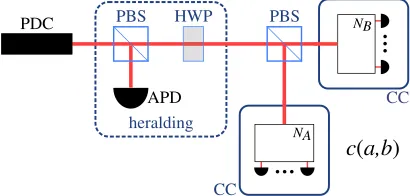
Experimental setup and generated states.—We illustrate the measurement layout in Fig. 1. In our experiment, we adopt time-multiplexed click-counting detectors, which separate the incoming light into NA¼NB ¼8 distinct bins, by the use of two cascaded, unbalanced fiber Mach-Zehnder interferometers [25,32]. To generate our two-mode squeezed vacuum (TMSV) states,ð1−λ2Þ1=2
P∞
n¼0λnjniAjniB (0<λ<1), we pump a nonlinear potas-sium-dihydrogen-phosphate crystal via type-II collinear parametric down-conversion [36]. This produces photon pairs in orthogonal polarization modes. These modes are split at a polarizing beam splitter and directed to two spatially separated time-multiplexed detectors. We obtain a set of joint countsCða; bÞ, which we normalize to obtain the joint click probabilities cða; bÞ. At a pump pulse repetition rate of 250 kHz, we obtain single-click count rates of the order ∼1kHz, and taking data for approx-imately ten minutes yields ∼107 data points. The split-photon (SP) states, tj1iAj0iBþ ð1−t2Þ1=2j0iAj1iB (0< t <1), are produced by heralding a single photon from the parametric down-conversion process, and splitting it into two modes. The analysis is carried out in the same fashion as for the TMSV state, but with∼106data points. Heralding decreases the data rate and, therefore, the overall counts during stable operation of the experiment. For technical details on the error analysis and the experi-ment, we also refer to the Supplemental Material [37] (Sec. D and Sec. E).
[image:3.612.335.540.532.630.2]A single case per state would be sufficient to illustrate the utility of our analysis. However, we also show how this
FIG. 1. Schematic of the generation of a two-mode squeezed-vacuum state (excluding the dashed framed pattern) with a para-metric down-conversion (PDC) source and a single photon split at a polarizing beam splitter (PBS). The latter one is generated by heralding onto the click of the single APD and rotated in polarization with a half-wave plate (HWP). Each resulting mode is sent to an 8-bin time-multiplexed detector serving as our click counter (CC).
technique captures the variability under standard exper-imental conditions; in this respect, we analyzed statistics arising from two TMSV states and three SP states. We have click numbers in the interval0.03≤Ecða;bÞðaþbÞ≤0.11 for the states TMSV1and TMSV2, as well as for the three states SP1;2;3(cf. TableIand Sec. E in[37]). As a classical reference, we also characterized a two-mode coherent state,
jαiAjβiB, by blocking the signal and sending laser light into the free port of the last PBS in Fig. 1.
Conditional quantum correlations.—The conditional statistics, pðbjaÞ ¼pða; bÞ=pðaÞ, determines how well the outcome of b is determined for a givenavalue. The variance of the conditional statistics, VarpðbjaÞðbÞ, describes the uncertainty ofbfor a fixeda. In addition, if the outcome of a conditionais more likely than another one, this should also have a larger contribution to this uncertainty. Hence, we formulate a correlation measure in terms of the mean conditional varianceEpðaÞ(VarpðbjaÞðbÞ)in the form
κpðbjaÞ¼1−EpðaÞ(
VarpðbjaÞðbÞ)
VarpðbÞðbÞ : ð5Þ
In[37](Sec. B), we characterize the conditional correlation coefficient in Eq.(5). There, we show that0≤κpðbjaÞ ≤1 and that the lower and the upper bound is attained for any uncorrelated and any perfectly correlated probability dis-tribution, respectively.
For the conditional click statistics, let us formulate the bounds ofκcðbjaÞfor classical light. For a classical state, the conditional statisticscðbjaÞis also classical[37](Sec. A). Thus, we find the following constraint for classical states:
κcðbjaÞ≤ cl:
κcl:max
cðbjaÞ; ð6Þ
with
κcl:max cðbjaÞ ¼1−
EcðaÞ½EcðbjaÞðbÞ(NB−EcðbjaÞðbÞ)
NBVarcðbÞðbÞ : ð7Þ
The latter bound has been obtained by inserting constraints on the conditional variance of a classical signal into
Eq. (5). That is, the conditional binomial parameter
QcðbjaÞ implies, in this case, VarcðbjaÞðbÞ≥EcðbjaÞðbÞ
½NB−EcðbjaÞðbÞ=NB, cf. Eq.(4).
Whenever inequality (6) is violated, the degree of determination of b in terms of κcðbjaÞ is too large to be compatible with classical light. Hence, we have constructed a measure for quantum correlations for conditional click-counting statistics. The given boundκcl:max
cðbjaÞ is tight, as for any binomial click statistics, for instance for coherent states, holds VarcðbjaÞðbÞ ¼EcðbjaÞðbÞ½NB−EcðbjaÞðbÞ=NB. For comparison, we derived similar bounds for the photon-counting theory[37] (Sec. C).
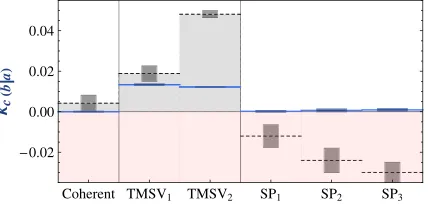
We directly applied the conditional correlation parameter to our measured data, see Fig.2. The uncorrelated, classical coherent state is compatible with the expectationκcðbjaÞ≈
κcl:max
cðbjaÞ ≈0. The quantum correlations of the TMSV state are not accessible with the conditional correlation param-eter, κcðbjaÞ≤κcl:cðbmaxjaÞ. For the SP states, we encounter the fact that κcl:max
[image:4.612.93.520.102.200.2]cðbjaÞ <0. Since κcðbjaÞ is necessarily non-negative, we have, in such a case, κcl:cðbmaxjaÞ <0≤κcðbjaÞ, which violates the classical constraint (6). Thus, the SP states exhibit a nonclassical conditional correlation. TABLE I. Success of the nonclassicality correlation tests. The symbol“✓”describes a significant verification of quantum correlations, otherwise, we put“×”. The the summed click numberEcða;bÞðaþbÞand the higher-order conditional nonclassicality numberNcðbjaÞ[Eq.(12)] are explicitly given in the second and last row, respectively, including their relative errors.
State Ecða;bÞðaþbÞ κcðbjaÞ>κclcð:bmaxjaÞ jγcða;bÞj>γclcð:a;bmaxÞ NcðbjaÞ<0 NcðbjaÞ
Coherent 0.03614ð10.20%Þ × × × −4.8×10⁻⁵ð143%Þ TMSV1 0.03801ð10.19%Þ × ✓ × −3.7×10⁻³ð137%Þ TMSV2 0.10582ð10.080%Þ × ✓ × −5.0×10⁻³ð168%Þ SP1 0.03768ð10.28%Þ × × ✓ −4.46×10⁻⁵ð13.5%Þ SP2 0.07028ð10.29%Þ ✓ × ✓ −1.67×10⁻⁴ð12.4%Þ SP3 0.09019ð10.23%Þ ✓ × ✓ −2.55×10⁻⁴ð11.7%Þ
Coherent TMSV1 TMSV2 SP1 SP2 SP3
0.02 0.00 0.02 0.04
c
b
a
FIG. 2. Results of conditional correlation coefficient κcðbjaÞ (blue, solid lines) and the corresponding classical boundsκcl:max
[image:4.612.332.546.524.626.2]Classical bounds for joint correlations.—For an arbitrary joint probability distribution pða; bÞ, a well-established measure of joint correlations is Pearson’s correlation coefficient [39]
γpða;bÞ¼
Covpða;bÞða; bÞ
ffiffiffiffiffiffiffiffiffiffiffiffiffiffiffiffiffiffiffiffiffiffiffiffiffiffiffiffiffiffiffiffiffiffiffiffiffiffiffiffiffiffiffiffiffiffi
Varpða;bÞðaÞVarpða;bÞðbÞ
q : ð8Þ
For statistically independent random variables a and b, we have γpða;bÞða; bÞ ¼0. A (negative) positive value characterizes (anti-)correlations. The ultimate bound for any statistics is jγpða;bÞða; bÞj≤1.
Let us derive the bound for classical states. The covari-ance of the joint click-counting distribution can be bounded for classical states via a normally ordered form of the Cauchy-Schwarz inequality
jh∶ΔπˆAΔπˆB∶ij≤ cl:
jh∶ðΔπˆAÞ2∶ij1=2jh∶ðΔπˆBÞ2∶ij1=2: ð9Þ The normally ordered variances can be given in terms of Eq.(2)for systemsAandB. Using the definitions ofγcða;bÞ in Eq.(8), QcðaÞ, andQcðbÞ, we conclude
−γcl:max: cða;bÞ ≤
cl:
γcða;bÞ≤ cl:
γcl:max:
cða;bÞ ; ð10Þ
where
γcl:max cða;bÞ ¼
NANBQcðaÞQcðbÞ
ðNA−1ÞðNB−1ÞðQcðaÞþ1ÞðQcðbÞþ1Þ
1=2:
ð11Þ
Interestingly, the bound for a classical Pearson’s correlation coefficient γcl:max
cða;bÞ can be written solely in terms of the measured binomialQparameters forAandB, as well as the numbers of APDs,NAandNB. In[37](Sec. C), we give a similar relation for the photon-counting detectors in terms of the MandelQparameter[10]. There, we also construct a nonlinearly, perfectly correlated state whose quantum correlations cannot be inferred via γpða;bÞ, but can be uncovered withκpðbjaÞ.
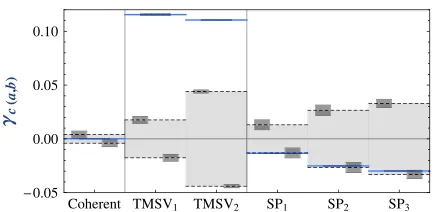
In Fig.3, we show the application of the classical constraint (10)to our measurements. The value of the coherent state is consistent with the expected value γcða;bÞ ¼0. The TMSV and the SP states are significantly correlatedγcða;bÞ >0and anticorrelated γcða;bÞ<0, respectively. In addition, the TMSV states clearly exceed the classical boundγcl:cða;bmaxÞ, while this is not true for the SP states. Thus, the TMSV states show joint nonclassical correlations.
Our results show that the correlation parameters κcðbjaÞ and γcða;bÞ are sensitive to different kinds of quantum correlations and complement each other. On the one hand, the conditional correlation coefficient detects quantum correlations of the SP states in terms of the conditioned click statistics cðbjaÞ. On the other hand, Pearson’s
correlation coefficient is sensitive to correlations of the joint click statisticscða; bÞ which applies to the TMSV states.
Higher-order conditional correlations.—The error bars in Fig.2for the SP states indicate that the significance of verified conditional quantum correlations decreases with decreasing summed click number Ecða;bÞðaþbÞ. Hence, we will extend our method to higher-order conditional correlations. The conditional statistics cðbjaÞ can be written in a form similar to Eq.(1)in terms of conditional, normally ordered expectation values: cðbjaÞ ¼
h∶NB
b πˆbBð1ˆA−πˆBÞNB−b∶ija. In Refs.[34,35], we introduced and applied a method to characterize higher-order non-classicality based on normally ordered moments of the click statistics. Here, the corresponding condition can be rewritten as
NcðbjaÞ¼ min a¼0;…;NAfh∶
ˆ
fa†fˆa∶ijag≥ cl:
0; ð12Þ
withfˆa¼PNB=2
m¼0fmjaπˆmB and using the coefficient vector
ðf0ja;…; fNB=2jaÞT. The coefficient vectors are chosen to be the eigenvectors to the minimal eigenvalue of the conditional matrix of moments, ðh∶πˆBmþm0∶ijaÞNB=2
m;m0¼0, for
minimizing the individual normally ordered, conditional expectation valuesh∶fˆa†fˆa∶ija [34,35].
The higher-order conditional nonclassicality-number NcðbjaÞ in Eq. (12) is given in Table I together with a benchmark of the implemented methods. The classical coherent state and the TMSV state do not exhibit signifi-cant negativities and, thus, do not violate condition(12). By contrast, all SP states are clearly distinct from the classical upper bound, even state SP1(which has the lowest summed click number, see TableI). Note that additional results of our analysis can be found in Sec. E in the Supplemental Material [37]. While joint quantum correlations are typically studied, the conditional quantum correlations considered here directly characterize the success of the measurement-induced generation of nonclassical states of light with imperfect detectors. This also includes the generation of nonclassicality exhibited in higher orders.
Coherent TMSV1 TMSV2 SP1 SP2 SP3
0.05 0.00 0.05 0.10
c
a
,
[image:5.612.329.552.43.149.2]b
FIG. 3. Results of Pearson’s correlation coefficientγcða;bÞ(blue, solid lines) and the corresponding classical bounds γcl:max
cða;bÞ (black, dashed lines) are shown. The light gray areas show the classically allowed ranges.
Conclusions.—We described and implemented rigorous and straightforwardly applicable approaches to uncovering quantum correlated light fields. We established a correlation coefficient for conditional statistics for accessing conditional quantum correlations measured with informationally incom-plete click-counting detectors. For accessing quantum cor-relations of the joint statistics, we derived the bounds for Pearson’s correlation coefficient for classical light. Applying both techniques, we successfully characterized nonclassical photon correlations for the experimentally generated light fields. The corresponding criteria are solely based on the measured click statistics without any need for knowing or correcting for the quantum efficiency, the dark count rate, and the exact response function of our detection system. A generalization to higher order moments of conditional statistics was also included. Conditional quantum correla-tions have been uncovered for split-photon states by using second- and higher-order moments criteria. The joint quan-tum correlations of two-mode squeezed-vacuum states have been identified via Pearson’s correlation coefficient.
In addition, our analysis is flexible in that it has straightforward extensions to general detection schemes based on click counting. In particular, this includes the cases of bright squeezed vacuum sources or when corre-lations occur in the temporal-spectral degree of freedom. Hence, our methods provide simple and yet powerful approaches for verifying different types of quantum corre-lated light fields for applications under realistic conditions.
This work has received funding from the European Union Horizon 2020 Research and Innovation Program (QCUMbER, Grant Agreement No. 665148). M. B. is supported by a Rita Levi-Montalcini Fellowship of MIUR. A. D. is partly supported by the UK EPSRC (Grant No. EP/K04057X/2) and the UK National Quantum Technologies Programme (Grants No. EP/ M01326X/1 and No. EP/M013243/1). I. A. W. acknowl-edges EPSRC (Grant No. EP/K034480/1), ERC (Grant No. MOQUACINO), and the UK National Quantum Technologies Programme.
*
Corresponding author. jan.sperling@uni‑rostock.de
[1] R. Hanbury Brown and R. Q. Twiss, Correlation between photons in two coherent beams of light,Nature (London)
177, 27 (1956).
[2] U. M. Titulaer and R. J. Glauber, Correlation functions for coherent fields,Phys. Rev.140, B676 (1965).
[3] W. N. Plick, P. M. Anisimov, J. P. Dowling, H. Lee, and G. S. Agarwal, Parity detection in quantum optical metrology without number-resolving detectors, New J. Phys. 12,
113025 (2010).
[4] A. Datta, L. Zhang, N. Thomas-Peter, U. Dorner, B. J. Smith, and I. A. Walmsley, Quantum metrology with imperfect states and detectors,Phys. Rev. A83, 063836 (2011).
[5] F. Caruso, V. Giovannetti, C. Lupo, and S. Mancini, Quantum channels and memory effects,Rev. Mod. Phys.
86, 1203 (2014).
[6] P. Kok, W. J. Munro, K. Nemoto, T. C. Ralph, J. P. Dowling, and G. J. Milburn, Linear optical quantum computing with photonic qubits,Rev. Mod. Phys.79, 135 (2007). [7] H. M. Wiseman, S. J. Jones, and A. C. Doherty, Steering,
Entanglement, Nonlocality, and the Einstein-Podolsky-Rosen Paradox,Phys. Rev. Lett.98, 140402 (2007). [8] P. Chowdhury, T. Pramanik, A. S. Majumdar, and G. S.
Agarwal, Einstein-Podolsky-Rosen steering using quantum correlations in non-Gaussian entangled states,Phys. Rev. A
89, 012104 (2014).
[9] H. J. Kimble, M. Dagenais, and L. Mandel, Photon Anti-bunching in Resonance Fluorescence,Phys. Rev. Lett.39,
691 (1977).
[10] L. Mandel, Sub-Poissonian photon statistics in resonance fluorescence,Opt. Lett.4, 205 (1979).
[11] G. S. Agarwal and K. Tara, Nonclassical character of states exhibiting no squeezing or sub-Poissonian statistics,Phys.
Rev. A 46, 485 (1992).
[12] W. Vogel, Nonclassical Correlation Properties of Radiation Fields,Phys. Rev. Lett.100, 013605 (2008).
[13] A. Miranowicz, M. Bartkowiak, X. Wang, Yu-xi Liu, and F. Nori, Testing nonclassicality in multimode fields: A unified derivation of classical inequalities,Phys. Rev. A82, 013824
(2010).
[14] M. Avenhaus, K. Laiho, M. V. Chekhova, and C. Silberhorn, Accessing Higher Order Correlations in Quantum Optical States by Time Multiplexing,Phys. Rev. Lett.104, 063602
(2010).
[15] A. Allevi, S. Olivares, and M. Bondani, Measuring high-order photon-number correlations in experiments with multimode pulsed quantum states, Phys. Rev. A 85,
063835 (2012).
[16] G. S. Buller and R. J. Collins, Single-photon generation and detection,Meas. Sci. Technol.21, 012002 (2010). [17] G. Zambra, A. Andreoni, M. Bondani, M. Gramegna, M.
Genovese, G. Brida, A. Rossi, and M. G. A. Paris, Exper-imental Reconstruction of Photon Statistics without Photon Counting, Phys. Rev. Lett.95, 063602 (2005).
[18] G. Brida, M. Genovese, M. Gramegna, A. Meda, F. Piacentini, P. Traina, E. Predazzi, S. Olivares, and M. G. A. Paris, Quantum state reconstruction using binary data from on/off photodetection,Adv. Sci. Lett.4, 1 (2011). [19] E. Waks, E. Diamanti, B. C. Sanders, S. D. Bartlett, and Y.
Yamamoto, Direct Observation of Nonclassical Photon Statistics in Parametric Down-Conversion,Phys. Rev. Lett.
92, 113602 (2004).
[20] O. Haderka, J. Peˇrina, Jr., M. Hamar, and J. Peˇrina, Direct measurement and reconstruction of nonclassical features of twin beams generated in spontaneous parametric down-conversion,Phys. Rev. A71, 033815 (2005).
[21] E. Lantz, J.-L. Blanchet, L. Furfaro, and F. Devaux, Multi-imaging and Bayesian estimation for photon counting with EMCCDs, Mon. Not. R. Astron. Soc.386, 2262 (2008). [22] J.-L. Blanchet, F. Devaux, L. Furfaro, and E. Lantz,
Measurement of Sub-Shot-Noise Correlations of Spatial Fluctuations in the Photon-Counting Regime, Phys. Rev.
[23] R. Chrapkiewicz, W. Wasilewski, and K. Banaszek, High-fidelity spatially resolved multiphoton counting for quantum imaging applications,Opt. Lett.39, 5090 (2014).
[24] J.Řehàček, Z. Hradil, O. Haderka, J. Perina, Jr., and M.ˇ Hamar, Multiple-photon resolving fiber-loop detector,Phys.
Rev. A67, 061801(R) (2003).
[25] D. Achilles, C. Silberhorn, C.Śliwa, K. Banaszek, and I. A. Walmsley, Fiber-assisted detection with photon number resolution,Opt. Lett.28, 2387 (2003).
[26] M. J. Fitch, B. C. Jacobs, T. B. Pittman, and J. D. Franson, Photon-number resolution using time-multiplexed single-photon detectors,Phys. Rev. A68, 043814 (2003). [27] J. S. Lundeen, A. Feito, H. Coldenstrodt-Ronge, K. L.
Pregnell, C. Silberhorn, T. C. Ralph, J. Eisert, M. B. Plenio, and I. A. Walmsley, Tomography of quantum detectors,Nat.
Phys.5, 27 (2009).
[28] J. Sperling, W. Vogel, and G. S. Agarwal, True photo-counting statistics of multiple on-off detectors,Phys. Rev. A
85, 023820 (2012).
[29] R. Chrapkiewicz, Photon counts statistics of squeezed and multimode thermal states of light on multiplexed on-off detectors,J. Opt. Soc. Am. B31, B8 (2014). [30] F. M. Miatto, A. Safari, and R. W. Boyd, Theory of
multi-plexed photon number discrimination,arXiv:1601.05831.
[31] J. Sperling, W. Vogel, and G. S. Agarwal, Sub-Binomial Light,Phys. Rev. Lett.109, 093601 (2012).
[32] T. J. Bartley, G. Donati, X.-M. Jin, A. Datta, M. Barbieri, and I. A. Walmsley, Direct Observation of Sub-Binomial Light,Phys. Rev. Lett.110, 173602 (2013).
[33] R. Heilmann, J. Sperling, A. Perez-Leija, M. Gräfe, M. Heinrich, S. Nolte, W. Vogel, and A. Szameit, Harnessing click detectors for the genuine characterization of light states,Sci. Rep.6, 19489 (2016).
[34] J. Sperling, M. Bohmann, W. Vogel, G. Harder, B. Brecht, V. Ansari, and C. Silberhorn, Uncovering Quantum Corre-lations with Time-Multiplexed Click Detection,Phys. Rev.
Lett.115, 023601 (2015).
[35] J. Sperling, W. Vogel, and G. S. Agarwal, Correlation measurements with on-off detectors, Phys. Rev. A 88,
043821 (2013).
[36] P. J. Mosley, J. S. Lundeen, B. J. Smith, P. Wasylczyk, A. B. U’Ren, C. Silberhorn, and I. A. Walmsley, Heralded Gen-eration of Ultrafast Single Photons in Pure Quantum States,
Phys. Rev. Lett.100, 133601 (2008).
[37] See Supplemental Material at http://link.aps.org/
supplemental/10.1103/PhysRevLett.117.083601 for
addi-tional aspects of the theory and the data analysis, which includes Refs. [10,28,31,34,35,38].
[38] D. R. Brillinger, The calculation of cumulants via condi-tioning,Ann. Inst. Stat. Math.21, 215 (1969).
[39] K. Pearson, Notes on regression and inheritance in the case of two parents,Proc. R. Soc. London58, 240 (1895).