Proceedings of the 2019 Conference on Empirical Methods in Natural Language Processing 240
Jointly Learning Entity and Relation Representations
for Entity Alignment
Yuting Wu1, Xiao Liu1, Yansong Feng1,2∗, Zheng Wang3 and Dongyan Zhao1,2
1Wangxuan Institute of Computer Technology, Peking University, China 2The MOE Key Laboratory of Computational Linguistics, Peking University, China
3School of Computing, University of Leeds, U.K.
{wyting,lxlisa,fengyansong,zhaodongyan}@pku.edu.cn [email protected]
Abstract
Entity alignment is a viable means for inte-grating heterogeneous knowledge among dif-ferent knowledge graphs (KGs). Recent devel-opments in the field often take an embedding-based approach to model the structural infor-mation of KGs so that entity alignment can be easily performed in the embedding space. However, most existing works do not explic-itly utilize useful relation representations to assist in entity alignment, which, as we will show in the paper, is a simple yet effective way for improving entity alignment. This paper presents a novel joint learning frame-work for entity alignment. At the core of our approach is a Graph Convolutional Network (GCN) based framework for learning both en-tity and relation representations. Rather than relying on pre-aligned relation seeds to learn relation representations, we first approximate them using entity embeddings learned by the GCN. We then incorporate the relation ap-proximation into entities to iteratively learn better representations for both. Experiments performed on three real-world cross-lingual datasets show that our approach substantially outperforms state-of-the-art entity alignment methods.
1 Introduction
Knowledge graphs (KGs) transform unstructured knowledge into simple and clear triples of<head entity, relation, tail entity> for rapid response and reasoning of knowledge. They are an effec-tive way for supporting various NLP-enabled tasks like machine reading (Yang and Mitchell, 2017), information extraction (Wang et al., 2018a), and question-answering (Zhang et al.,2018b).
Even though many KGs originate from the same resource, e.g., Wikipedia, they are usually created independently. Therefore, different KGs often use
∗
Corresponding author.
different expressions and surface forms to indicate equivalent entities and relations – let alone those built from different resources or languages. This common problem of heterogeneity makes it diffi-cult to integrate knowledge among different KGs. A powerful technique to address this issue is En-tity Alignment, the task of linking entities with the same real-world identity from different KGs.
Classical methods for entity alignment typically involve a labor-intensive and time-consuming pro-cess of feature construction (Mahdisoltani et al.,
2013) or rely on external information constructed by others (Suchanek et al.,2011). Recently, efforts have been devoted to the so-called embedding-based approaches. Representative works of this direction include JE (Hao et al.,2016), MTransE (Chen et al., 2017), JAPE (Sun et al., 2017), IP-TransE (Zhu et al.,2017), and BootEA (Sun et al.,
2018). More recent work (Wang et al.,2018b) uses the Graph Convolutional Network (GCN) (Kipf and Welling,2017) to jointly embed multiple KGs. Most of the recent works (e.g., JE, MTransE, JAPE, IPTransE and BootEA) rely on the translation-based models, such as TransE (Bordes et al.,2013), which enable these approaches to en-code both entities and relations of KGs. These methods often put more emphasis on the entity embeddings, but do not explicitly utilize relation embeddings to help with entity alignment. An-other drawback of such approaches is that they usually rely on pre-aligned relations (JAPE and IPTransE) or triples (MTransE). This limits the scale at which the model can be effectively per-formed due to the overhead for constructing seed alignments for large KGs. Alternative meth-ods like GCN-based models, unfortunately, can-not directly obtain relation representations, leav-ing much room for improvement.
improve tasks like information extraction (Miwa and Bansal,2016;Bekoulis et al.,2018). We hy-pothesize that this will be the case for entity align-ment too; that is, the rich relation information could be useful for improving entity alignment as entities and their relations are usually closely re-lated. Our experiments show that this is even a conservative target: by jointly learning entity and relation representations, we can promote the re-sults of both entity and relation alignment.
In this work, we aim to build a learning frame-work that jointly learns entity and relation repre-sentations for entity alignment; and we want to achieve this with only a small set of pre-aligned entities but not relations. Doing so will allow us to utilize relation information to improve entity alignment without paying extra cost for construct-ing seed relation alignments.
Our work is enabled by the recent breakthrough effectiveness of GCNs (Kipf and Welling,2017) in extracting useful representations from graph struc-tures. Although GCNs provide a good starting point, applying it to develop a practical and effi-cient framework to accurately capture relation in-formation across KGs is not trivial. Because a vanilla GCN operates on the undirected and un-labeled graphs, a GCN-based model like (Wang et al.,2018b) would ignore the useful relation in-formation of KGs. While the Relational Graph Convolutional Network (R-GCN) (Schlichtkrull et al.,2018) can model multi-relational graphs, ex-isting R-GCNs use a weight matrix for each rela-tion. This means that an R-GCN would require an excessive set of parameters to model thousands of relations in a typical real-world KG, making it difficult to learn an effective model on large KGs.
A key challenge of our joint learning framework is how to generate useful relation representations at the absence of seed relation alignments, and to ensure the framework can scale to a large number of types of relations. We achieve this by first ap-proximating the relation representations using en-tity embeddings learned through a small amount of seed entity alignments. We go further by con-structing a new joint entity representation consist-ing of both relation information and neighborconsist-ing structural information of an entity. The joint rep-resentations allow us to iteratively improve the model’s capability of generating better entity and relation representations, which lead to not only better entity alignment, but also more accurate
re-lation alignment as a by-product.
We evaluate our approach by applying it to three real-world datasets. Experimental results show that our approach delivers better and more robust results when compared with state-of-the-art meth-ods for entity and relation alignments. The key contribution of this paper is a novel joint learning model for entity and relation alignments. Our ap-proach reduces the human involvement and the as-sociated cost in constructing seed alignments, but yields better performance over prior works.
2 Related Work
2.1 Entity Alignment
Until recently, entity alignment would require intensive human participation (Vrandeˇci´c and Kr¨otzsch, 2014) to design hand-crafted features (Mahdisoltani et al.,2013), rules, or rely on exter-nal sources (Wang et al.,2017). In a broader con-text, works in schema and ontology matching also seek help from additional information by using e.g., extra data sources (Nguyen et al.,2011), en-tity descriptions (Lacoste-Julien et al.,2013;Yang et al., 2015), or semantics of the web ontology language (Hu et al., 2011). Performance of such schemes is bounded by the quality and availability of the extra information about the target KG, but obtaining sufficiently good-quality annotated data could be difficult for large KGs.
Recently, embedding-based entity alignment methods were proposed to reduce human involve-ment. JE (Hao et al., 2016) was among the first attempts in this direction. It learns embeddings of different KGs in a uniform vector space where en-tity alignment can be performed. MTransE (Chen et al., 2017) encodes KGs in independent em-beddings and learns transformation between KGs. BootEA (Sun et al., 2018) exploits a bootstrap-ping process to learn KG embeddings. SEA (Pei et al.,2019) proposes a degree-aware KG embed-ding model to embed KGs. KDCoE (Chen et al.,
2018) is a semi-supervised learning approach for co-training embeddings for multilingual KGs and entity descriptions. They all use translation-based models as the backbone to embed KGs.
multiple rounds of interactions between the primal and dual graphs, RDGCN can effectively incorpo-rate more complex relation information into entity representations and achieve promising results for entity alignment. However, existing methods only focus on entity embeddings and ignore the help that relation representations can provide on this task.
MTransE and NTAM are two of a few meth-ods that try to perform both relation and entity alignments. However, both approaches require high-quality seed alignments, such as pre-aligned triples or relations, for relation alignment. Our ap-proach advances prior works by jointly modeling entities and relations by using only asmall setof pre-aligned entities (but not relations) to simulta-neously perform entity and relation alignments.
2.2 Graph Convolutional Networks
GCNs (Duvenaud et al., 2015; Kearnes et al.,
2016;Kipf and Welling,2017) are neural networks operating on unlabeled graphs and inducing fea-tures of nodes based on the strucfea-tures of their neighborhoods. Recently, GCNs have demon-strated promising performance in tasks like node classification (Kipf and Welling, 2017), relation extraction (Zhang et al.,2018a), semantic role la-beling (Marcheggiani and Titov, 2017), etc. As an extension of GCNs, the R-GCNs (Schlichtkrull et al.,2018) have recently been proposed to model relational data for link prediction and entity classi-fication. However, R-GCNs usually require a large number of parameters that are often hard to train, when applied to multi-relational graphs.
In this work, we choose to use GCNs to first encode KG entities and to approximate relation representations based on entity embeddings. Our work is the first to utilize GCNs for jointly align-ing entities and relations for heterogeneous KGs.
3 Problem Formulation
We now introduce the notations used in this paper and define the scope of this work.
A KG is formalized as G = (E, R, T), where E, R, T are the sets of entities, relations and triples, respectively. Let G1 = (E1, R1, T1) and
G2 = (E2, R2, T2) be two different KGs.
Usu-ally, some equivalent entities between KGs are already known, defined as alignment seeds L = {(ei1, ei2)|ei1 ∈E1, ei2 ∈E2}.
We define the task of entity or relation
align-ment as automatically finding more equivalent en-tities or relations based on known alignment seeds. In our model, we only use known aligned entity pairs as training data for both entity and relation alignments. The process of relation alignment in our framework is unsupervised, which does not need pre-aligned relation pairs for training.
4 Our Approach
Given two target KGs, G1 and G2, and a set of
known aligned entity pairs L, our approach uses
GCNs (Kipf and Welling,2017) with highway net-work (Srivastava et al.,2015) gates to embed en-tities of the two KGs and approximate relation se-mantics based on entity representations. By link-ing entity representations with relation representa-tions, they promote each other in our framework and ultimately achieve better alignment results.
4.1 Overall Architecture
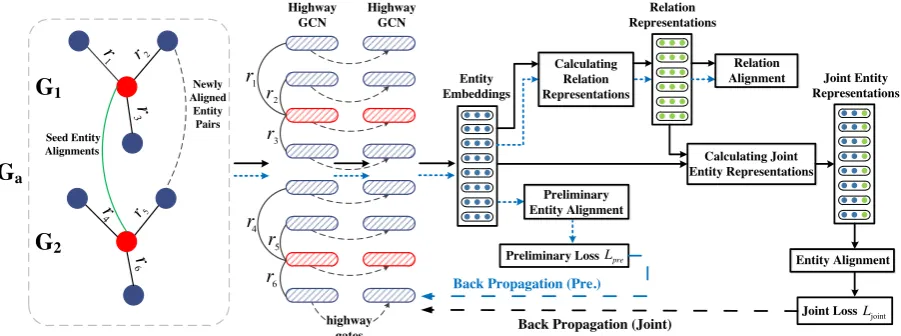
As illustrated in Figure 1, our approach consists of three stages: (1) preliminary entity alignment, (2) approximating relation representations, and (3) joint entity and relation alignment.
In the first stage, we utilize GCNs to embed en-tities of various KGs in a unified vector space for preliminary entity alignment. Next, we use the en-tity embeddings to approximate relation represen-tations which can be used to align relations across KGs. In the third stage, we incorporate the rela-tion representarela-tions into entity embeddings to ob-tain the joint entity representations, and continue using GCNs to iteratively integrate neighboring structural information to achieve better entity and relation representations.
4.2 Preliminary Entity Alignment
As shown in Figure1, we put G1 andG2 in one
graphGa = (Ea, Ra, Ta)to form our model’s
in-put. We utilize pre-aligned entity pairs to train our model and then discover latent aligned entities.
Graph Convolutional Layers. Our entity
alignment model utilizes GCNs to embed en-tities in Ga. Our model consists of multiple
stacked GCN layers so that it can incorporate higher degree neighborhoods. The input for GCN layer l is a node feature matrix, X(l) =
{x(l)1 ,x(l)2 , ...,x(l)n |x(l)i ∈ Rd
(l)
}, where n is the number of nodes (entities) of Ga, and d(l) is the
us-G1
G2
Ga
Highway GCN
Highway GCN
Entity Embeddings
Calculating Relation Representations
Relation Representations
Calculating Joint Entity Representations
Joint Entity Representations
Joint Loss highway
gates Seed Entity
Alignments
Newly Aligned
Entity Pairs
Back Propagation (Joint)
Preliminary LossLpre
joint L
1 r r2
3r
2
r 1 r
3 r
4
r r5
6r
4
r
5 r
6
r Back Propagation (Pre.)
Preliminary Entity Alignment
Relation Alignment
[image:4.595.75.526.62.230.2]Entity Alignment
Figure 1: Overall architecture of our model. The blue dotted lines denote the process of preliminary entity align-ment and preliminary relation alignalign-ment using approximate relation representations, and the black solid lines denote the process of continuing using GCNs to iteratively learn better entity and relation representations.
ing forward propagation as:
X(l+1)= ReLU( ˜D−12A˜D˜− 1
2X(l)W(l)), (1)
where A˜ = A + I is the adjacency matrix of Gawith self-connections, I is an identity matrix,
˜
Djj=PkA˜jk, andW(l)∈Rd
(l)×d(l+1)
is a layer-specific trainable weight matrix.
Inspired by (Rahimi et al.,2018) that uses high-way gates (Srivastava et al., 2015) to control the noise propagation in GCNs for geographic local-ization, we also employ layer-wise highway gates to build a Highway-GCN (HGCN) model. Our layer-wise gates work as follow:
T(X(l)) =σ(X(l)W(l)T +b(l)T ), (2)
X(l+1)=T(X(l))·X(l+1)+(1−T(X(l)))·X(l) (3)
whereX(l) is the input to layerl+ 1; σ is a sig-moid function; · is element-wise multiplication;
W(l)T andb(l)T are the weight matrix and bias vector for the transform gateT(X(l)), respectively.
Alignment. In our work, entity alignment is
performed by simply measuring the distance be-tween two entity nodes on their embedding space. With the output entity representations X0 =
{x01,x02, ...,xn0 |x0i ∈ Rd˜}, for entitiese
1fromG1
ande2 fromG2, their distance is calculated as:
d(e1, e2) =kx0e1−x 0
e2kL1. (4)
Training. We use a margin-based scoring func-tion as the training objective, to make the distance
between aligned entity pairs to be as close as pos-sible, and the distance between positive and nega-tive alignment pairs to be as large as possible. The loss function is defined as:
L= X
(p,q)∈L
X
(p0,q0)∈ L0
max{0, d(p, q)−d(p0, q0)+γ},
(5) where γ > 0 is a margin hyper-parameter; L0
stands for the negative alignment set ofL.
Rather than simply random sampling for nega-tive instances, we look for more challenging neg-ative samples, e.g., those with subtle differences from the positive ones, to train our model. Given a positive aligned pair (p, q), we choose the K -nearest entities ofp(orq) according to Eq. 4in the embedding space to replaceq(orp) as the negative instances.
4.3 Approximating Relation Representations
experiments in Section6suggest that this is a rea-sonable assumption.
Given a relationr∈Ra, there is a set of triples
ofr, Tr = {(hi, r, tj)|hi ∈ Hr, tj ∈ Tr}, where
HrandTrare the sets of head entities and tail
en-tities of relation r, respectively. For a relationr, its representation can be approximated as:
r=f(Hr,Tr), (6)
whereris the approximated representation of re-lationr. Hr andTrare the sets of HGCN-output
embeddings of head entities and tail entities of re-lationr.f(·)is a function to produce relation rep-resentations with input entity vectors, which can take many forms such asmean, adding, concate-nation or more complex models. In our model, we compute the relation representation for r by first concatenating its averaged head and tail en-tity representations, and then introducing a matrix
WR ∈ R2 ˜d×m as a learnable shared linear
trans-formation on relation vectors. Here,d˜is the num-ber of features in each HGCN-output entity em-bedding andm is the number of features in each relation representation.
With the relation representations in place, rela-tion alignment can be performed by measuring the similarity between two relation vectors. For rela-tionr1fromG1andr2fromG2, their similarity is
computed as:
s(r1, r2) =kr1−r2kL1−β
|Pr1r2|
|HTr1 ∪HTr2|
, (7)
where r1 and r2 are the relation representations
for r1 andr2. In addition to calculating the
dis-tance between the two relation vectors, we believe that the more aligned entities exist in the entities that are connected to the two relations, the more likely the two relations are equivalent. Thus, for r1andr2, we collect the pre-aligned entities
exist-ing in the head/tail entities of these two relations as the setPr1r2 = {(ei1, ei2)|ei1 ∈ HTr1, ei2 ∈
HTr2,(ei1, ei2) ∈ L}. HTr1 and HTr2 are the
sets of head/tail entities for relationr1 andr2
re-spectively.βis a hyper-parameter for balance. In our framework, relation alignment is ex-plored in an unsupervised fashion, in which we do not have any pre-aligned relations as training data.
4.4 Joint Entity and Relation Alignment
The first two stages of our approach could already produce a set of entity and relation alignments, but
we do not stop here. Instead, we attentively fuse the entity and relation representations and further jointly optimize them using the seed entity align-ments. Our key insight is that entity and rela-tion alignment tasks are inherently closely related. This is because aligned entities tend to have some relations in common, and similar relations should have similar categories of head and tail entities.
Specifically, we first pre-train the entity align-ment model (Section4.2) until its entity alignment performance has converged to be stable. We as-sume that both the pre-trained entity and approxi-mate relation representations can provide rich in-formation for themselves. Next, for each entity, we aggregate the representations of its relevant re-lations into a relation context vector, which is fur-ther combined with its pre-trained entity represen-tation to form a new joint entity represenrepresen-tation.
Formally, for each entitye ∈ Ea, its new joint
representationejointcan be calculated as:
ejoint=g(e,Re), (8)
whereeis the HGCN-output representation of en-titye. Re is the set of relation representations of
e’s relevant relations. g(·) is a function to pro-duce the new joint entity representation by taking
eandReas input, which can also take many forms
of operations. In our model, we calculate ejoint
by first summing all relation representations inRe
and then concatenating e with the summed rela-tion context vector.
After getting the new joint entity representa-tions, Xjoint, we continue optimizing our model
against the seed entity alignments, where we use the joint entity representations to calculate the training loss according to Eq. 5 to continue up-dating HGCNs1. Note that the joint entity repre-sentations are composed of entity embeddings and relation representations, while the relation repre-sentations are also constructed based on the en-tity embeddings. Hence, after backpropagation of the loss calculated using the joint entity represen-tations, we optimize the entity embeddings.
5 Experimental Setup
5.1 Datasets
We use DBP15K datasets from (Sun et al.,2017) to evaluate our approach. DBP15K contains three
DBP15K #Ent. #Rel. #Rel tr. Alignments
#Ent. #Rel.
ZH-EN ZH 66,469 2,830 153,929 1,5000 890 EN 98,125 2,317 237,674
JA-EN JA 65,744 2,043 164,373 1,5000 529 EN 95,680 2,096 233,319
[image:6.595.75.289.64.131.2]FR-EN FR 66,858 1,379 192,191 1,5000 212 EN 105,889 2,209 278,590
Table 1: Summary of the DBP15K datasets.
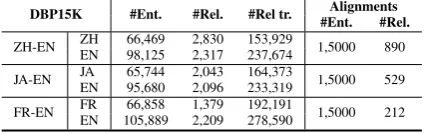
cross-lingual datasets that were built from the En-glish version to Chinese, Japanese and French ver-sions of DBpedia. Each contains data from two KGs in different languages and provides 15K pre-aligned entity pairs. Besides, each dataset also provides some pre-aligned relations. We manually aligned more relations from the three datasets and removed the ambiguously aligned relation pairs to construct the test sets for relation alignment. Ta-ble1shows the statistics of the three datasets. We stress that our approach achieves entity and rela-tion alignments simultaneously using only a small number of pre-aligned entities, and relation align-ments are only used for testing. Following the pre-vious works (Sun et al.,2017;Wang et al.,2018b;
Sun et al.,2018), we use 30% of the pre-aligned entity pairs as training data and 70% for testing. Our source code and datasets are freely available online2.
5.2 Implementation Details
We set γ = 1, β = 20, and learning rate to 0.001. We sampleK = 125negative pairs every 50 epochs. We use entity names in different KGs for better model initialization. We translate non-English entity names to non-English via Google Trans-late, and the entity features are initialized with pre-trained English word vectors glove.840B.300d3 in our model. Note that Google Translate does not always give accurate translations for named entities. We inspected 100 English translations for Japanese and Chinese entity names, and dis-covered that around 20% of the translations are wrong. The errors are mainly attributed to the missing of titles/modifications and wrong interpre-tations for person/location names. The inaccurate translation poses further challenges for our model.
5.3 Competitive Approaches
Entity Alignment.For entity alignment, we com-pare our approach against six embedding-based
2
https://github.com/StephanieWyt/HGCN-JE-JR 3http://nlp.stanford.edu/projects/glove/
entity alignment methods discussed in Section 1: JE (Hao et al.,2016), MTransE (Chen et al.,2017), JAPE (Sun et al., 2017)4, IPTransE (Zhu et al.,
2017), BootEA (Sun et al.,2018) and GCN (Wang et al.,2018b). Among those, BootEA is the best-performing model on DBP15K.
Relation Alignment. For relation alignment, we compare our approach with the state-of-the-art BootEA (denoted by BootEA-R), and MTransE (denoted by MTransE-R). Note that MTransE pro-vides five implementation variants for its align-ment model. To provide a fair comparison, we choose the one that does not use paligned re-lations but gives the best performance for a triple-wise alignment verification (Chen et al.,2017) - a closely related task for relation alignment. Since BootEA and MTransE are translation-based mod-els that encode both entities and relations, re-lation alignment can be done by measuring the similarities between two relation representations. Furthermore, to evaluate the effectiveness of our proposed relation approximation method, we also build BootEA-PR and MTransE-PR for relation alignment according to Section4.3.
5.4 Evaluation Methodology
Model Variants. To evaluate our design choices, we provide different implementation variants with the following denotations. HGCN is our base GCN model with highway gates and entity name initialization. It has several variants, described as follows. HGCN-PE(Section4.2) and HGCN-PR (Section4.3) are our preliminary models for en-tity and relation alignments, respectively. HGCN-JE and HGCN-JR are our complete models that use joint representations to further improve en-tity alignment and relation alignment (Section
4.4). Finally, GCN-PE and GCN-PRare the pliminary GCN-based models for entity and re-lation alignments respectively, which use entity name initializationbut no highway gates; GCN-JE and GCN-JR are the corresponding joint learning models; and GCN-JE-ris the randomly initialized version of GCN-JEwithout entity name initializa-tion.
4
Metrics.Like prior works (Sun et al.,2017;Wang et al.,2018b;Sun et al.,2018), we use Hits@k as our evaluation metric. A Hits@k score is com-puted by measuring the proportion of correctly aligned entities ranked in the top k list. Hence, we prefer higher Hits@k scores that indicate bet-ter performance.
6 Experiment Results
In this section, we first show that our com-plete model consistently outperforms all alterna-tive methods across datasets, metrics and align-ment tasks. We then analyze the impact of prior alignment data size on model performance, show-ing that our approach requires significantly less training data but achieves better performance over the best-performing prior method. Finally, we use a concrete example to discuss how jointly learned entity and relation representations can be used to improve both entity and relation alignments.
6.1 Entity Alignment
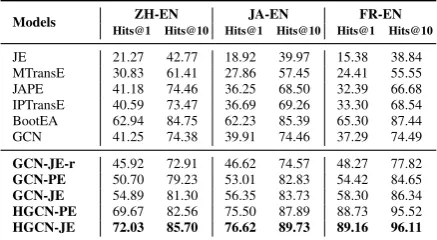
Table 2 reports the performance for entity align-ment of all compared approaches. The top part of the table shows the performance of prior ap-proaches. By using a bootstrapping process to expand the training data, BootEA clearly out-performs all prior methods. By capturing the rich neighboring structural information, GCN out-performs all other translation-based models on Hits@1, and over IPTransE, MTransE and JE on Hits@10.
The bottom part of Table2shows how our pro-posed techniques, i.e., entity name initialization, joint embeddings and layer-wise highway gates, can be used within a GCN framework to im-prove entity alignment. After initialized with the machine-translated entity names, GCN-PE con-siderably improves GCN on all datasets. The im-provement suggests that even rough translations of entity names (see Section 5.2) can still pro-vide important epro-vidence for entity alignment and finally boost the performance. By employing layer-wise highway gates, HGCN-PE further im-proves GCN-PE, giving a 34.31% improvement on Hits@1 onDBP15KF R−EN, and also
outper-forms the strongest baseline BootEA. This sub-stantial improvement indicates that highway gates can effectively control the propagation of noisy information. Our complete framework HGCN-JE gives the best performance across all metrics
Models ZH-EN JA-EN FR-EN
Hits@1 Hits@10 Hits@1 Hits@10 Hits@1 Hits@10
JE 21.27 42.77 18.92 39.97 15.38 38.84 MTransE 30.83 61.41 27.86 57.45 24.41 55.55 JAPE 41.18 74.46 36.25 68.50 32.39 66.68 IPTransE 40.59 73.47 36.69 69.26 33.30 68.54 BootEA 62.94 84.75 62.23 85.39 65.30 87.44 GCN 41.25 74.38 39.91 74.46 37.29 74.49
GCN-JE-r 45.92 72.91 46.62 74.57 48.27 77.82
GCN-PE 50.70 79.23 53.01 82.83 54.42 84.65
GCN-JE 54.89 81.30 56.35 83.73 58.30 86.34
HGCN-PE 69.67 82.56 75.50 87.89 88.73 95.52
[image:7.595.307.526.63.183.2]HGCN-JE 72.03 85.70 76.62 89.73 89.16 96.11
Table 2: Performance on entity alignment.
Models ZH-EN JA-EN FR-EN
Hits@1 Hits@10 Hits@1 Hits@10 Hits@1 Hits@10
MTransE-R 3.03 8.88 2.65 10.21 3.30 14.62 MTransE-PR 32.81 57.64 31.00 56.14 18.87 44.34 BootEA-R 55.17 70.00 47.83 67.67 36.79 58.49 BootEA-PR 45.28 85.37 41.40 79.77 30.19 60.38
GCN-PR 66.18 82.81 60.87 81.47 38.21 52.83
GCN-JR 70.22 82.81 63.89 81.10 41.98 53.77
HGCN-PR 69.33 84.49 63.14 81.26 41.51 54.25
[image:7.595.309.526.218.317.2]HGCN-JR 70.34 85.39 65.03 83.55 42.45 56.60
Table 3: Performance on relation alignment.
and datasets. Comparing JE with HGCN-PE and GCN-JE with GCN-HGCN-PE (2.36% and 4.19% improvements of Hits@1 onDBP15KZH−EN
re-spectively), we observe that joining entity and relation alignments improves the model perfor-mance. Even without entity name initialization, GCN-JE-r still has obvious advantages over JE, MTransE, JAPE, IPTransE and GCN. The results reinforce our claim that merging the relation infor-mation into entities can produce better entity rep-resentations. We stress that our proposed meth-ods are not restricted to GCNs or HGCNs, but can be flexibly integrated with other KG representa-tion models as well.
6.2 Relation Alignment
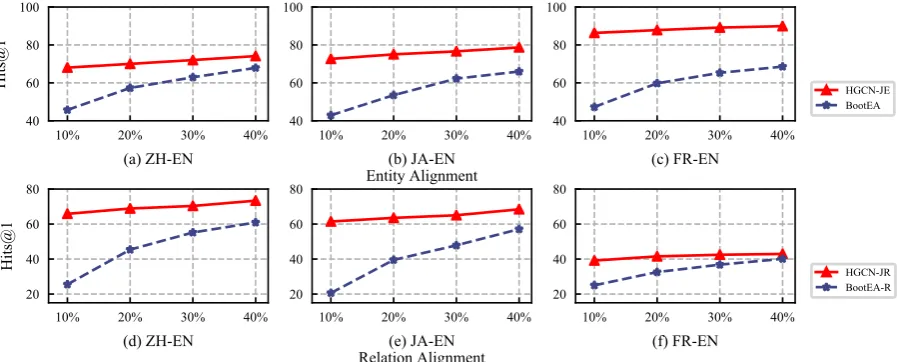
in-Figure 2: (a)-(c) report the performance for entity alignment of HGCN-JE and BootEA when they are trained with different proportions of seed entity alignments on the three DBP15K datasets. (d)-(f) show the relation alignment performance of HGCN-JR and BootEA-R under corresponding conditions. The x-axes are the proportions of seed alignments, and the y-axes are Hits@1 scores.
formation of its head and tail entities.
The strong entity alignment model BootEA also performs well for relation alignment. Using the re-lation embeddings from BootEA, BootEA-R de-livers the best Hits@1 in MTransE and BootEA variants. Using our approximation strategy hurts BootEA-R in Hits@1, but we see improvements on Hits@10 across all datasets. This suggests that our approximation method can bring more related candidates, but may lack precision to select top-ranked candidates, comparing to explicitly rela-tion modeling in translarela-tion-based models.
Our framework, HGCN-JR, delivers the best re-lation alignment results across datasets and met-rics, except for Hits@10 on DBP15KF R−EN.
Like entity alignment, we also observe that join-ing entity and relation alignments improves rela-tion alignment, as evidenced by the better perfor-mance of HGCN-JR and GCN-JR over HGCN-PR and GCN-PR, respectively. That is, joint modeling produces better entity representations, which in turn provide better relation approximations. This can promote the results of both alignment tasks.
6.3 Analysis
Impact of Available Seed Alignments. To
ex-plore the impact of the size of seed alignments on our model, we compare our HGCN with BootEA by varying the proportion of pre-aligned entities from 10% to 40% with a step of 10%. Figure 2
(a-c) illustrate the Hits@1 for entity alignment of HGCN-JE and BootEA on three datasets. As the
amount of seed alignments increases, the perfor-mances of both models on all three data sets grad-ually improve. HGCN-JE consistently obtains su-perior results compared to BootEA, and seems to be insensitive to the proportion of seed alignments. For example, HGCN-JE still achieves 86.40% for Hits@1 onDBP15KF R−EN when only using 10%
of training data. This Hits@1 score is 17.84% higher than that of BootEA when BootEA uses 40% of seed alignments.
Figure 2 (d-f) show the Hits@1 for relation alignment of JR and BootEA-R. HGCN-JR also consistently outperforms BootEA-R, and gives more stable results with different ratios of seed entity alignments. These results further con-firm the robustness of our model, especially with limited seed entity alignments.
Case Study. Figure 3 shows an example from
DBP15KF R−EN. In the stages of preliminary
en-tity alignment and relation alignment, our model correctly predicts the aligned entity pair (v2, v5)
and relation pair (r2,r5). After examining the full
experimental data5, we find that the entities with more neighbors, such asv2andv5(indicating
Nor-way), and the high-frequency relations, such asr2
and r5 (indicating country), are easier to align,
since such entities and relations have rich struc-tural information that can be exploited by a GCN. After jointly learning entity and relation represen-tations, the extra neighboring relation information
[image:8.595.76.525.63.244.2]pays
[Gare_de_Hauketo] [Norvège]
[Hauketo_Station] coun
try [Norway] [Ligne_d'Østfold]
lig nes
[Østfold_Line]
line
ville
[Oslo] [Holmlia_Station] prest
ation
……
FR
v vEN
1
v v2
3 v
5
v
6 v 4
v
1
r r2
3
r
5 r
6
r
4
r
……
Figure 3: A real-world example from DBP15KF R−EN. [v2;v5] and [r2; r5] are
re-spectively the aligned entities and aligned relations after performing preliminary entity and relation align-ments. [vF R;vEN]and[v1;v4]are the newly aligned
entity pairs, and r1 and r4 are the newly aligned
relations, which are discovered using jointly learned entity and relation representations. Jointly optimizing alignment tasks leads to the sucessful discovery of new aligned relation and entity pairs.
(e.g., the aligned relations (r2, r5)) enables our
model to successfully alignvF R andvEN. If we
keep updating the model to learn better entity and relation representations, our alignment framework can successfully uncover more entity and relation alignments such as (v1, v4) and (r1, r4). This
shows that joint representations can improve both entity and relation alignments.
7 Conclusions
This paper presents a novel framework for entity alignment by jointly modeling entities and rela-tions of KGs. Our approach does not require pre-aligned relations as training data, yet it can simul-taneously align entities and relations of heteroge-neous KGs. We achieve this by employing gated GCNs to automatically learn high-quality entity and relation representations. As a departure from prior work, our approach constructs joint entity representations that contain both relation informa-tion and entity informainforma-tion. We demonstrate that the whole is greater than the sum of its parts, as the joint representations allow our model to itera-tively improve the learned representations for both entities and relations. Extensive experiments on three real-world datasets show that our approach delivers better and more robust performance when compared to state-of-the-art methods.
Acknowledgments
This work is supported in part by the Na-tional Hi-Tech R&D Program of China (No.
2018YFB1005100), the NSFC Grants (No.
61672057, 61672058, 61872294), and a UK
Royal Society International Collaboration Grant (IE161012). For any correspondence, please contact Yansong Feng.
References
Giannis Bekoulis, Johannes Deleu, Thomas Demeester, and Chris Develder. 2018. Adversarial training for multi-context joint entity and relation extraction. In Proceedings of the 2018 Conference on Empirical Methods in Natural Language Processing, pages 2830–2836.
Antoine Bordes, Nicolas Usunier, Alberto Garcia-Duran, Jason Weston, and Oksana Yakhnenko. 2013. Translating embeddings for modeling multi-relational data. In Advances in neural information processing systems, pages 2787–2795.
Muhao Chen, Yingtao Tian, Kai-Wei Chang, Steven Skiena, and Carlo Zaniolo. 2018. Co-training em-beddings of knowledge graphs and entity descrip-tions for cross-lingual entity alignment. In Proceed-ings of the Twenty-Seventh International Joint Con-ference on Artificial Intelligence, IJCAI-18.
Muhao Chen, Yingtao Tian, Mohan Yang, and Carlo Zaniolo. 2017. Multilingual knowledge graph em-beddings for cross-lingual knowledge alignment. In Proceedings of the 26th International Joint Confer-ence on Artificial IntelligConfer-ence (IJCAI).
David K Duvenaud, Dougal Maclaurin, Jorge Ipar-raguirre, Rafael Bombarell, Timothy Hirzel, Alan Aspuru-Guzik, and Ryan P Adams. 2015. Convolu-tional networks on graphs for learning molecular fin-gerprints. In Advances in Neural Information Pro-cessing Systems 28, pages 2224–2232.
Yanchao Hao, Yuanzhe Zhang, Shizhu He, Kang Liu, and Jian Zhao. 2016. A joint embedding method for entity alignment of knowledge bases. In Proceed-ings of China Conference on Knowledge Graph and Semantic Computing (CCKS2016), pages 3–14.
Wei Hu, Jianfeng Chen, and Yuzhong Qu. 2011. A self-training approach for resolving object corefer-ence on the semantic web. In Proceedings of the 20th international conference on World wide web.
Steven Kearnes, Kevin Mccloskey, Marc Berndl, Vi-jay Pande, and Patrick Riley. 2016. Molecular graph convolutions: moving beyond fingerprints. Journal of Computer-Aided Molecular Design, 30(8):1–14.
Thomas N. Kipf and Max Welling. 2017. Semi-supervised classification with graph convolutional networks. InInternational Conference on Learning Representations (ICLR).
of the 19th ACM SIGKDD international conference on Knowledge discovery and data mining.
Shengnan Li, Xin Li, Rui Ye, Mingzhong Wang, Haip-ing Su, and YHaip-ingzi Ou. 2018. Non-translational alignment for multi-relational networks. In Pro-ceedings of the Twenty-Seventh International Joint Conference on Artificial Intelligence, IJCAI-18, pages 4180–4186.
Farzaneh Mahdisoltani, Joanna Biega, and Fabian M Suchanek. 2013. Yago3: A knowledge base from multilingual wikipedias. InCIDR.
Diego Marcheggiani and Ivan Titov. 2017. Encoding sentences with graph convolutional networks for se-mantic role labeling. In Proceedings of the 2017 Conference on Empirical Methods in Natural Lan-guage Processing, pages 1506–1515.
Makoto Miwa and Mohit Bansal. 2016. End-to-end relation extraction using LSTMs on sequences and tree structures. InProceedings of the 54th Annual Meeting of the Association for Computational Lin-guistics, pages 1105–1116.
Thanh Nguyen, Viviane Moreira, Huong Nguyen, Hoa Nguyen, and Juliana Freire. 2011. Multilingual schema matching for wikipedia infoboxes. Proc. VLDB Endow.
Shichao Pei, Lu Yu, Robert Hoehndorf, and Xiangliang Zhang. 2019. Semi-supervised entity alignment via knowledge graph embedding with awareness of de-gree difference. InThe World Wide Web Conference, WWW ’19, pages 3130–3136.
Afshin Rahimi, Trevor Cohn, and Timothy Baldwin. 2018. Semi-supervised user geolocation via graph convolutional networks. InProceedings of the 56th Annual Meeting of the Association for Computa-tional Linguistics, pages 2009–2019.
Michael Schlichtkrull, Thomas N Kipf, Peter Bloem, Rianne Van Den Berg, Ivan Titov, and Max Welling. 2018. Modeling relational data with graph convolu-tional networks. InEuropean Semantic Web Confer-ence, pages 593–607.
Rupesh Kumar Srivastava, Klaus Greff, and J¨urgen Schmidhuber. 2015. Highway networks. arXiv preprint arXiv:1505.00387.
Fabian M. Suchanek, Serge Abiteboul, and Pierre Senellart. 2011. Paris: Probabilistic alignment of re-lations, instances, and schema. Proc. VLDB Endow., 5(3):157–168.
Zequn Sun, Wei Hu, and Chengkai Li. 2017. Cross-lingual entity alignment via joint attribute-preserving embedding. In International Semantic Web Conference, pages 628–644.
Zequn Sun, Wei Hu, Qingheng Zhang, and Yuzhong Qu. 2018. Bootstrapping entity alignment with knowledge graph embedding. InProceedings of the
Twenty-Seventh International Joint Conference on Artificial Intelligence, IJCAI-18, pages 4396–4402.
Denny Vrandeˇci´c and Markus Kr¨otzsch. 2014. Wiki-data: A free collaborative knowledgebase. Commu-nications of the ACM, 57:78–85.
Guanying Wang, Wen Zhang, Ruoxu Wang, Yalin Zhou, Xi Chen, Wei Zhang, Hai Zhu, and Huajun Chen. 2018a. Label-free distant supervision for re-lation extraction via knowledge graph embedding. In Proceedings of the 2018 Conference on Empiri-cal Methods in Natural Language Processing, pages 2246–2255.
Xuepeng Wang, Kang Liu, Shizhu He, Shulin Liu, Yuanzhe Zhang, and Jun Zhao. 2017. Multi-source knowledge bases entity alignment by lever-aging semantic tags.Chinese Journal of Computers, 40(3):701–711.
Zhichun Wang, Qingsong Lv, Xiaohan Lan, and Yu Zhang. 2018b. Cross-lingual knowledge graph alignment via graph convolutional networks. In Pro-ceedings of the 2018 Conference on Empirical Meth-ods in Natural Language Processing, pages 349– 357.
Yuting Wu, Xiao Liu, Yansong Feng, Zheng Wang, Rui Yan, and Dongyan Zhao. 2019. Relation-aware en-tity alignment for heterogeneous knowledge graphs. In Proceedings of the Twenty-Eighth International Joint Conference on Artificial Intelligence, IJCAI-19, pages 5278–5284.
Bishan Yang and Tom Mitchell. 2017. Leveraging knowledge bases in lstms for improving machine reading. InProceedings of the 55th Annual Meeting of the Association for Computational Linguistics.
Yang Yang, Yizhou Sun, Jie Tang, Bo Ma, and Juanzi Li. 2015. Entity matching across heterogeneous sources. InProceedings of the 21th ACM SIGKDD International Conference on Knowledge Discovery and Data Mining.
Yuhao Zhang, Peng Qi, and Christopher D. Man-ning. 2018a. Graph convolution over pruned de-pendency trees improves relation extraction. In Em-pirical Methods in Natural Language Processing (EMNLP).
Yuyu Zhang, Hanjun Dai, Zornitsa Kozareva, Alexan-der J Smola, and Le Song. 2018b. Variational reasoning for question answering with knowledge graph. In Thirty-Second AAAI Conference on Ar-tificial Intelligence.