An Improved Solution Algorithm for Two-Job
Shop Scheduling Problems with Availability
Constraints
Riad Aggoune
∗Abstract—This paper presents a reduced-complexity algorithm for exactly solving two-job shop scheduling problems where an arbitrary number of non-availability periods may occur on each of them machines (m >2). Considering the limited availabil-ity of machines makes the scheduling models more realistic in comparison to usual ones. The proposed solution algorithm is an extension of the geometric approach developed for the classical two-job shop problem. It is based on a new representation that allows dealing with modified processing times and thus considering unavailability constraints of several kinds.
Keywords: Shop scheduling, Availability constraints, Geometric approach, Complexity
1
Introduction
Integrating practical constraints into traditional models is an important issue for researchers and practitioners in scheduling. Among those realistic considerations is the limited availability of the machines. Indeed in actual workshops planning horizons may contain time periods corresponding to preventive maintenance tasks or dedi-cated to the execution of urgent orders. Those unavail-ability constraints may prevent or postpon the ordinary execution of jobs, and must be taken into account when building schedules.
During the last decade a fast growing number of stud-ies were dedicated to scheduling problems with machine availability consideration. We may refer to the state of the art proposed in [12]. Two-machine flow shop prob-lems were studied in [4] and [7], who established com-plexity and performance guarantee results. In [10], sev-eral one machine and the associated job shop problems were addressed. Several kinds of availability constraints are defined in the scheduling literature. In the strictly non-preemptive model [1], the execution of an operation can be interrupted neither by an unavailability period nor by another operation. In [8] and [9] the author de-fined three models of availability constraints, namely the
∗Public Research Centre Henri Tudor, Business & Systems
Ana-lytics Unit, 6, rue de Luxembourg, BP144, L-4002 Esch-sur-Alzette Tel/Fax: +352.42.59.91.545/555 Email: [email protected]
resumable, non-resumable and semi-resumable cases. In the latter, it is possible to execute a part of an oper-ation before the unavailability of a machine (hole) and then to complete its execution after the hole, possibly with a penalty proportional to the already executed part. When there is no penalty, operation are said to be re-sumable, whereas a maximal penalty corresponds to the non-resumable model. In [10], the authors defined by crossable availability periods the ones that allow jobs to be preempted. Flexibility on the availability constraints was introduced in [1]. In that study the maintenance activity is not fixed in advance but must be determined during the scheduling procedure. Time windows in which their position may vary are thus assigned to maintenance tasks. More recently, authors in [11] proposed heuristics for the permutation flow shop problem, where the ma-chines are not available at the beginning of the planning period.
In this paper, we present a new polynomial algorithm for scheduling job shops with two jobs and availability con-straints. More precisely, we assume that there can be an arbitrary number of non-availability periods on each of the m machines (with m >2). The unavailability peri-ods, due to preventive maintenance activity for instance, are supposed to be known in advance and fixed. The goal of the algorithm is to schedule operations of the two jobs in order to minimize the schedule length. The remain-der of this paper is organized as follows. We first present the considered problems in Section 2. Section 3 describes in details the temporized geometric approach that allows exactly scheduling two-jobs with non-preemptive avail-ability constraints. The new solution algorithm and its direct extensions to general availability models are finally presented in Section 4. Section 5 concludes the paper.
2
Problem description
The job shop scheduling problem with two jobs and avail-ability constraints can be stated as follows: Two jobs J1 and J2 must be executed on a set of m machines M = {M1, M2, ...Mm}. Each job Ji consists of a lin-ear sequence of ni operations M = {Oi,1, Oi,2, ...Oi,ni}.
time and each operation Oi,j of job Ji needs one ma-chine Mj at a time, during pi,j time-units. An arbi-trary number Kj of unavailability periods may occur on each machine Mj. Let K be the maximal number of holes, i.-e. K = maxj=1,...,m{Kj}. Starting time and duration of these tasks are known in advance and fixed. Objective is to determine the execution dates for the operations such that to above constraints are satis-fied and the makespan is minimized. According to the notation introduced in [12], the scheduling problem can be denoted J, N Cwin|n= 2|Cmax, whereN Cwinmeans that unavailability periods are arbitrarily distributed on the machines. It is shown in [2], that the strictly non-preemptive scheduling problem is polynomial and its complexity is equal toO(Ks4), where s=max{n
1, n2}.
The solution algorithm applies for any regular criteria. An extension of this work to the resumable case is also proposed. In what follows we show that the complexity of problem J, N Cwin|n= 2|Cmax can be improved and that the new polynomial algorithm applies not only to the resumable model but to a general model including all cases of fixed availability constraints. This general model was introduced in [3].
We associate with each operation Oi,j a coefficient αi,j which represents the proportion of operationOi,jto redo after the unavailability period interrupting the operation. It represents its resumable character. Thus αi,j = 0 if
Oi,j is resumable, αi,j = 1 if Oi,j is non-resumable and 0≤αi,j≤1 if Oi,j is semi-resumable. We also associate coefficientβi,j,k to an operationOi,j which must be pro-cessed on machineMrand which can be interrupted by an unavailability period hr,k. It represents the preemptive character of Oi,j or the crossable character of availabil-ity period hr,k. Thus,βi,j,k = 0 if hr,k is non-crossable or Oi,j is strictly non-preemptive. In this case, there is a disjunction between Oi,j and hr,k. On the opposite,
βi,j,k = 1 if hr,k is crossable and Oi,j is preemptive. In this case, the position ofOi,jin relation tohr,k, depends on the resumable character of Oi,j.
3
Temporized geometric approach
In this section, we present the temporized geometric ap-proach proposed in [2], which allows solving two-job shop scheduling problems with availability constraints. For sake of clarity, we first describe the classical geometric ap-proach for the makespan minimization and give complex-ity results. Then, we explain how the algorithm is mod-ified to integrate non-premptive availability constraints. For sake of clarity, we use example the following example in the remainder of the paper to illustrate the approaches. There are two jobs to be scheduled on four machines. The manufacturing processes of jobs are as follows:
J1 = {M1(2), M2(4), M3(2), M4(1)} and J2 =
{M3(1), M1(2), M2(3), M4(2)}.
3.1
The geometric approach
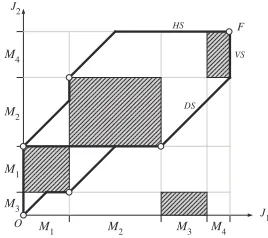
The idea behind the graphical approach consists in re-ducing the two-job shop scheduling problem in a shortest path one (see for instance [5] and the references therein). The approach starts by representing the scheduling prob-lem in a two-dimension plane with rectangular objects as obstacles defined as follows:
• Each axis corresponding to one job is decomposed in ni sub-intervals according to the manufacturing process of the job. A sub-interval Ii,j corresponds to operationOi,j (i.e. operationj of jobJi) and its length is equal to the processing time of that opera-tion.
• A rectangle defined by sub-intervals I1,k1 and I2,k2
is an obstacle, denoted as (k1, k2), if and only if
op-erationsO1,k1 and O2,k2 use the same machine.
• The upper and right boundaries of the rectangle defined by the origin O (which indicates the start of processing of the two jobs) and the final point F = (Pn1
k=1p1,k,
Pn2
k=1p2,k) (which points out the finish of processing of the two jobs) is considered as a degenerated obstacle (see Figure 1).
In Figure 1, the rectangle defined by I1,1 and I2,2 is an
obstacle as the first operation ofJ1 and the second
oper-ation ofJ2are both performed on machineM1.
A feasible solution of the two-job shop scheduling prob-lem corresponds to a path going from the originO to the final point F, which avoids the interior of any obstacle (k1, k2) seeing that operationsO1,k1 and O2,k2 are
per-formed on the same machine and the preemption is not allowed. The path is composed of horizontal segments where only jobJ1is processed (segmentHSin Figure 1),
vertical segments where only job J2 is processed
(seg-mentV S in Figure 1) and diagonal segments where jobs J1andJ2are performed concurrently using different
ma-chines (segmentDSin Figure 1). The lengthLof a path, which is equal to the duration of the associated schedule, isL=P(horizontal segments) +P(vertical segments) + (1/√2)P(diagonal segments).
Accordingly, the determination of the optimal schedule for theJ|n = 2|Cmaxbecomes a shortest path problem in the two-dimension plane, which consists of finding a shortest trajectory that connects the originOto the final pointF. This shortest path problem can equivalently be obtained in a digraphG= (V, E, d) defined as follows:
J2
F
O
J
1 xxxxxxxxxxxxxxxxxxxxxx
xxxxxxxxxxxxxxxxxxxxxx xxxxxxxxxxxxxxxxxxxxxx xxxxxxxxxxxxxxxxxxxxxx xxxxxxxxxxxxxxxxxxxxxx xxxxxxxxxxxxxxxxxxxxxx xxxxxxxxxxxxxxxxxxxxxx xxxxxxxxxxxxxxxxxxxxxx xxxxxxxxxxxxxxxxxxxxxx xxxxxxxxxxxxxxxxxxxxxx xxxxxxxxxxxxxxxxxxxxxx xxxxxxxxxxxxxxxxxxxxxx xxxxxxxxxxxxxxxxxxxxxx xxxxxxxxxxxxxxxxxxxxxx xxxxxxxxxxxxxxxxxxxxxx xxxxxxxxxxxxxxxxxxxxxx xxxxxxxxxxxxxxxxxxxxxx
xxxxxxxxxxxxxxxxxxxxxx xxxxxxx xxxxxxx xxxxxxx xxxxxxx xxxxxxx xxxxxxx xxxxxxx xxxxxxx xxxxxxx xxxxxxx xxxxxxx xxxxxxx
xxxxxxxxxxxx xxxxxxxxxxxx xxxxxxxxxxxx xxxxxxxxxxxx xxxxxxxxxxxx xxxxxxxxxxxx xxxxxxxxxxxx xxxxxxxxxxxx xxxxxxxxxxxx xxxxxxxxxxxx xxxxxxxxxxxx xxxxxxxxxxxx
xxxxxxxxxxxx xxxxxxxxxxxx xxxxxxxxxxxx xxxxxxxxxxxx xxxxxxxxxxxx xxxxxxxxxxxx
M
1 M2 M3 M4
M
1
M
2
M
3
M
4
HS
[image:3.595.230.364.78.197.2]DS VS
Figure 1: The shortest path in the plane
• Each node vi ∈V − {F} has at most two outgoing arcs. These arcs are obtained by progressing diag-onally (45◦) until an obstacle (k1, k2) is hit. If the
obstacle (k1, k2) is the final obstacle, the node F
is the only successor of vi, otherwise the SE and
N W corners of (k1, k2) are immediate successors of vi (see Figure 1). Hereafter, the south-east corner of an obstacle (k1, k2) is denoted SE(k1,k2) and the
north-west corner is denotedN W(k1,k2).
• The distance between vi and a south-east (resp. north-west) corner is the projection along the x (resp. y) axis.
In Figure 1, diagonal progress fromN W(2,3)hits the
up-per boundary of the final obstacle and hence the only successor of N W(2,3) is the node F. Diagonal progress
fromSE(1,2) hits the obstacle (2,3) and thus theSE(2,3)
andN W(2,3)are its two immediate successors. The path
((O, SE(1,2)),(SE(1,2), SE(2,3)),(SE(2,3), F)) is the
short-est path of length 11 corresponding to performJ1andJ2
in parallel until instantt= 1, finishO1,1 whileJ2waits,
performJ1 and J2 in parallel betweent = 2 and t = 4,
finish O1,2 while J2 waits, perform again J1 and J2 in
parallel between t = 6 and t = 9, and then finish with the last operation ofJ2.
The graphical approach can be extended to solve the two-job shop scheduling problem with any regular criterion Φ(C1, C2) where Ci(i = 1,2) is the completion time of job Ji. This extension has been proposed in [14] and consists in evaluating the criterion each time the upper or right boundary of the final obstacle is reached, i.-e when a job is completed.
The complexity of the graphical approach is based on the property that the constructed digraph is sufficient to find an optimal solution of J |n = 2|Φ ([5]) and can be ontained in O(rlogr) steps where r is the number of obstacles ([13], and [5]). The graphical approach can be extended to solve the two-job shop scheduling prob-lem with additional constraints, namely when preemp-tion [14], precedence constraints and release dates [6] are
considered.
3.2
Temporized approach
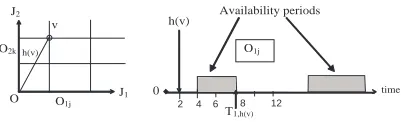
The temporized geometric approach (TGA) proposed in [2] is a polynomial algorithm for solving the two-job shop scheduling problem with availability constraints in the strictly non-premptive case. TGA is mainly based on the definition of earliest dates associated with each vertex of the network representing the problem. This characteriza-tion allows to integrate the evolucharacteriza-tion of time and thus to deal with the limited availability of the machines. More precisely, we compute for each vertexv of the plane with obstacles the earliest date, noted h(v), and which corre-sponds to the smallest duration to reach vertex v from the originO(note thath(O) = 0). Thus,h(v) is equal to the length of the shortest path going fromO to v. Tests are realized each time an operation has to be started, i.-e. each time a path crosses a vertical or horizontal line, so as to verify if the machine necessary for its execution is available. Knowing the earliest dateh(v) of vertex v, an availability test on directionJ1 (resp. J2) consists in
determining the availability timeT1,h(v)(resp. T2,h(v)) of
the machine associated with the next operation of jobJ1
(resp. J2).
In Figure 2, operation O1,j job J1 cannot be processed
at time h(v) = 2 , since it cannot be completed before the first unavailability period of the machine. Operations being strictly non-premptable, the execution ofO1,j can start (in the earliest) at time T1,h(v) = 8 which is equal
to the ending time of the first unavailability period.
Starting from a given vertex v with earliest date h(v), several ways to progress and determine its successors are to be considered:
• If the operations of the two jobs cannot start at time h(v), vertexv is duplicated. A waiting vertex vw is created andvwis the only successor ofv.
• If there is an availability problem in direction J1
(resp. J2), the progression is made along the
h(v) v
J1
J2
O1j
O2k
O
O1j
time
0 h(v)
T1,h(v)
Availability periods
4 6
[image:4.595.202.406.77.138.2]2 8 12
Figure 2: Availability test on directionJ1
execute the operations of jobJ2(resp. J1), until job J1 (resp. J2) becomes available. A singular vertex s, from which a diagonal progression is possible, is added as the unique successor ofv.
• If there is no availability problem, i. -e. if the oper-ations of the two jobs can be executed at timeh(v), the progression works as in the classical geometric approach: It is made in the diagonal direction until an obstacle is hit. If this obstacle represents a ma-chines conflict, itsN W andSE corners are the two direct successors of vertexv. If the hit obstacle is the final one, point F is added as the unique successor ofv.
In [2], it is proved that networkNcomposed by the points listed above is sufficient to find an optimal solution for problem J, N Cwin|n= 2|Cmax, and that N can be ob-tained inO(Ks4) steps, wheres is the number of
obsta-cles, equal toO(n1.n2). Then, the complexity of problem J, N Cwin|n= 2|Cmax is O(Ks4). Using the same pro-ceed as in [14], it can be shown that the results applies to any regular criterion Φ(C1, C2). The resumable problem
is also sovable in O(Ks4) steps [2]. However, the tem-porized geometric approach does not apply to the semi-resumable case. Finally, the consideration of head and tails, and precedence constraints as in [6] is also possible and problemJ, N Cwin|n = 2 ;prec;ri|max(Ci,j+qi,j) is solvable inO(Ks6) steps, what provides lower bounds
for the job shop scheduling problem with availability con-straints [2]. Note that the increasing in the complexity of TGA regarding the classical geometric approch is due to the introduction of new points, namely singular and waiting vertices, during the construction of the network associated with the search of a shortest path.
4
Improved approach
We develop in this section the improved approach for problem J, N Cwin|n= 2|Cmax including all cases of fixed availability constraints. As the TGA algorithm, it is based on the introduction of earliest dates for the vertices of the network associated with the problem. We propose a new definition of availability tests that allows to integrate the actual availability of the machines with-out introducing additionnal points. Indeed, we propose not to focus on the time an operation can start according
to the availability of the involved machine but the time needed to complete the operation. It is thus necessary to modify the way the graphical representation is defined.
4.1
New Representation
In the proposed approach we keep the classical represen-tation in the plane with obstacles of the scheduling prob-lem. However, the two axis are decomposed into unitary sub-intervals Ii,j which lenght are no more proportional to the processing times of the associated operationsOi,j. Instead, we propose to divide the sub-intervals according to the processing times. As a consequence, the simulta-neous execution of two operations O1,j and O2,k job J1
andJ2cannot be not represented by a diagonal leg (with
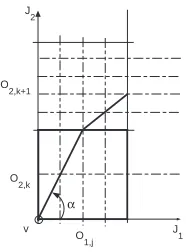
an angle of 45 deg), but follows a direction induced by the processing times of the involved operations. Let us consider the following example, illustrated in Figure 3, where one operation O1,j of job J1 and two operations O2,k and O2,k+1 of jobs J2 are represented by unitary
intervals. The processing times are respectively equal to p1,j = 4,p2,k= 2 andp2,k+1= 5. Starting from vertexv,
the simultaneous execution ofO1,j andO2,k corresponds to a progression in the direction given by angleα.
Sincep1,j > p2,k, the execution ofO2,kfinishes before the one ofO1,j. Thus, the path crosses the upper boundary of the square corresponding to the operations. When oper-ationO2,k+1 can start, ∆1,j = 2 units ofO1,j are already executed. As in the classical geomtric approach, the min-imal quantity betweenp2,k+1 andp1,1−∆1,j = 2 can be executed before the path crosses the next horizontal or vertical line.
Angle α is such that the length of its opposite side L2,k,which correponds to the progression of jobJ2 is:
L2,k=
min(p1,j−∆1,j, p2,k−∆2,k)
p2,k
, (1)
α
O
1,j
O
2,k
J
1
J
2
O
2,k+1
[image:5.595.249.342.74.200.2]v
Figure 3: New progression
The lenght L1,j of the adjacent side of angle α, which corresponds to the execution of jobJ1is given by:
L1,j =
min(p1,j −∆1,j, p2,k−∆2,k)
p1,j
. (2)
Finally, angleαis defined by:
tanα=L2,k L1,j
= p1,j p2,k
. (3)
In the example considered in Figure 3, the path progress-ing from v first goes in direction α = arctan(p1,j
p2,k) =
arctan(42) ≈ 63deg. Then, the direction is given by arctan( p1,j
p2,k+1) =arctan(
4
5)≈39deg.
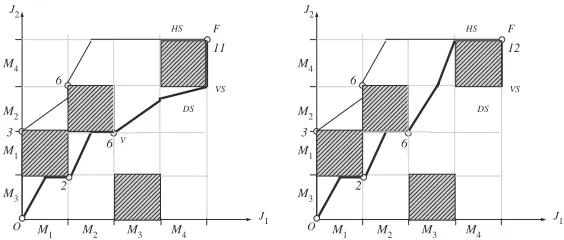
Figure 4 (left) shows the new representation for the prob-lem given by previous example and where no availability constraint is considered. Numbers represent the earli-est dates associated with the vertices. We can see that the set of vertices is the same as in Figure 1. Indeed, the new representation respects the rates of executions between operations of the two jobs. Pathes hit the ob-stacles at the same portions of operations. The main difference with the classical graphical approach is that it is no more possible to read the distances between ver-tices by (orthogonal) projections of the legs on the axis. However, we are more interested in the time needed to reach a vertex v′ starting from vertex v, than in the
ge-ometrical distance between them. That information is already included in the definition of the earliest dates of the vertices. The general distance, which is the length of the shortest path between two vertices v and v′ is thus
defined by formula ˜d(v, v′) =h(v′)−h(v).
4.2
Availability Constraints
The main advantage from using this new representation is that it allows dealing with modified processing times and thus easily integrate availability constraints in the scheduling problem. In fact, the only additional step is to suppose that the processing times of operations are
not fixed in advance but depend on their starting times (which are given by the earliest datesh(v) of the consid-ered vertices) and the availability of the machines. Given a vertex v with earliest date h(v), we compute the time needed to complete next operations of jobJ1 andJ2.
The new availability tests we propose thus consist in find-ing the modified processfind-ing times of operations. In the stricly non-preemptive model, the new processing times include the initial ones and possibly an iddle time (cor-responding to the time preceding an availability period) and the duration of an availability period. In the ex-ample provided by Figure 2, the modified processing time of operation O1,j is ˜p1,j = 10. More precisely, ˜
p1,j = (Sr,1−h(v)) +Pr,1+p1,j, where Sr,1 and Pr,1
are respectively the starting time and the duration of the first unavailability period of the considered machineMr.
When the modified processing times ˜p1,j and ˜p2,kare cal-culated for operationsO1,j andO2,kof jobsJ1andJ2
re-spectively, the progression is done in the direction given by angleαsuch that:
tanα= p˜1,j ˜ p2,k
. (4)
For instance, let suppose that machine M3 is
unavail-able between times S3,1 = 7 andS3,1+P3,1 = 9 in the
considered example. The first part of the shortest path given by Figure 4 remains the same. If we consider the last two operations of jobs and vertex v which earliest date ish(v) = 6, then processing time of operation O1,3
of job J1 becomes ˜p1,3 = (S3,1−h(v)) +P3,1+p1,3 =
(7−6) + 2 + 2 = 5. The other processing times remain unchanged. Thus, the path from vertexvgoes first in the direction given by angle α= arctan(p˜1,3
p2,3) = arctan(
5 3).
Then the path crosses the horizontal line corresponding to the last operation of jobJ2. The new direction for the
path is given byα=arctan(p˜1,3
˜
p2,4) =arctan(
5
2). The next
[image:5.595.48.294.287.375.2]J2
F
O xxxxxxxxxxxx J1
xxxxxxxxxxxx xxxxxxxxxxxx xxxxxxxxxxxx xxxxxxxxxxxx xxxxxxxxxxxx xxxxxxxxxxxx xxxxxxxxxxxx xxxxxxxxxxxx xxxxxxxxxxxx xxxxxxxxxxxx xxxxxxxxxxxx
M1 M2 M3 M4 M1 M2 M3 M4 HS DS VS xxxxxxxxxxxx xxxxxxxxxxxx xxxxxxxxxxxx xxxxxxxxxxxx xxxxxxxxxxxx xxxxxxxxxxxx xxxxxxxxxxxx xxxxxxxxxxxx xxxxxxxxxxxx xxxxxxxxxxxx xxxxxxxxxxxx xxxxxxxxxxxx xxxxxxxxxxx xxxxxxxxxxx xxxxxxxxxxx xxxxxxxxxxx xxxxxxxxxxx xxxxxxxxxxx xxxxxxxxxxx xxxxxxxxxxx xxxxxxxxxxx xxxxxxxxxxx xxxxxxxxxxx xxxxxxxxxxx xxxxxxxxxxxx xxxxxxxxxxxx xxxxxxxxxxxx xxxxxxxxxxxx xxxxxxxxxxxx xxxxxxxxxxxx xxxxxxxxxxxx xxxxxxxxxxxx xxxxxxxxxxxx xxxxxxxxxxxx xxxxxxxxxxxx xxxxxxxxxxxx 2 6 11 3 6 v J2 F
O xxxxxxxxxxxx J1
xxxxxxxxxxxx xxxxxxxxxxxx xxxxxxxxxxxx xxxxxxxxxxxx xxxxxxxxxxxx xxxxxxxxxxxx xxxxxxxxxxxx xxxxxxxxxxxx xxxxxxxxxxxx xxxxxxxxxxxx xxxxxxxxxxxx
[image:6.595.157.439.76.196.2]M1 M2 M3 M4 M1 M2 M3 M4 HS DS VS xxxxxxxxxxxx xxxxxxxxxxxx xxxxxxxxxxxx xxxxxxxxxxxx xxxxxxxxxxxx xxxxxxxxxxxx xxxxxxxxxxxx xxxxxxxxxxxx xxxxxxxxxxxx xxxxxxxxxxxx xxxxxxxxxxxx xxxxxxxxxxxx xxxxxxxxxxx xxxxxxxxxxx xxxxxxxxxxx xxxxxxxxxxx xxxxxxxxxxx xxxxxxxxxxx xxxxxxxxxxx xxxxxxxxxxx xxxxxxxxxxx xxxxxxxxxxx xxxxxxxxxxx xxxxxxxxxxx xxxxxxxxxxxx xxxxxxxxxxxx xxxxxxxxxxxx xxxxxxxxxxxx xxxxxxxxxxxx xxxxxxxxxxxx xxxxxxxxxxxx xxxxxxxxxxxx xxxxxxxxxxxx xxxxxxxxxxxx xxxxxxxxxxxx xxxxxxxxxxxx 2 6 12 3 6
Figure 4: New representation, without (left) and with (right) availability constraints
an operation Oi,j which starts at time h(v) and cannot be completed before the starting timeSr,k of an unavail-ability periodhr,k is obtained by the general formula:
˜
pi,j= (Sr,k−h(v))+Pr,k+pi,j+βi,j,k(αi,j−1)(Sr,k−h(v)). (5)
=Pr,k+pi,j+ [1 +βi,j,k(αi,j−1)](Sr,k−h(v)).
5
Conclusions and Future Work
We proposed in this paper a new polynomial algorithm for solving two-job shop scheduling problems with avail-ability constraints. This algorithm outperforms existing one not only in term of complexity but also regarding its applications. Indeed, the new algorithm solves two-jobs problems for all fixed availability constraints mod-els. A problem that remains open is wether a similar approach can be developed in case of flexible availaibility constraints.
References
[1] Aggoune, R., “Minimizing the Makespan for the Flow Shop Scheduling Problem with Availability Constraints,” European Journal of Operational Re-search, V153, pp. 534-543, 2004.
[2] R. Aggoune and M.-C. Portmann. “Flow shop scheduling problem with limited machine availabil-ity: A heuristic approach,”International Journal of Production Economics, V99, pp. 4-15, 2006.
[3] Azem, S., Aggoune, R., Dauzere-Peres, and S., “A mathematical model for job shop scheduling with re-source availability constraints,” International Con-ference on Industrial Engineering and System Man-agement (IESM 2007), Beijing, China, May 2007.
[4] Blazewicz, J., Breit, J., Formanowicz, P., Kubiak, W., Schmidt, G., “Heuristic algorithms for the
two-machine flow-shop problem with limited two-machine availability,”Omega Journal, 29, 599–608, 2001.
[5] Brucker, P., “An efficient algorithm for the job-shop problem with two jobs,” Computing, 40:353–359, 1988.
[6] Brucker, P., Jurisch, B., “A new lower bound for the job-shop scheduling problem,”European Journal of Operational Research, V64, pp 156-167, 1993.
[7] Kubiak, W., Blazewicz, J., Formanowicz, P., Breit, J., Schmidt, G., “Two-machine flow shops with lim-ited machine availability,”European Journal of Op-erational Research, V136, pp. 528-540, 2002.
[8] Lee, C.-Y., “Two-machine flowshop scheduling with availability constraints,” Journal of Global Opti-mization, V9, pp. 395-416, 1996.
[9] Lee, C.-Y., “Minimizing the makespan for the two-machine flowshop scheduling with availability con-straints,”European Journal of Operational Research, V114, pp. 420-429, 1999.
[10] Mauguire, P., Billaut, J-C., Bouquard, J.-L., “New single machine and job-shop scheduling problems with availability constraints,”Journal of Scheduling, V8, pp. 211-231, 2005.
[11] Perez-Gonzalez, P., Framinan, J. M., “Schedul-ing permutation flowshops with initial availability constraint: Analysis of solutions and constructive heuristics,” Computers and Operations Research, V36, pp. 2866-2876, 2009.
[12] Schmidt, G., “Scheduling with limited machine availability,” European Journal of Operational Re-search, V121, pp. 1-15, 2000.
[13] Sotskov, Y.N., “Optimal servicing two jobs with a regular criterion,”in: Automation of Designing Pro-cesses, Minsk, pp. 86-95, 1985 (in Russian).