Multiple Aspect Summarization Using Integer Linear Programming
Kristian Woodsend and Mirella Lapata Institute for Language, Cognition and Computation
School of Informatics, University of Edinburgh 10 Crichton Street, Edinburgh EH8 9AB
[email protected],[email protected]
Abstract
Multi-document summarization involves many aspects of content selection and sur-face realization. The summaries must be informative, succinct, grammatical, and obey stylistic writing conventions. We present a method where such individual aspects are learned separately from data (without any hand-engineering) but optimized jointly using an integer linear programme. The ILP framework allows us to combine the decisions of the expert learners and to select and rewrite source content through a mixture of objective setting, soft and hard constraints. Experimental results on the TAC-08 data set show that our model achieves state-of-the-art performance using ROUGE and signifi-cantly improves the informativeness of the summaries.
1 Introduction
Automatic summarization has enjoyed wide popu-larity in natural language processing (see the pro-ceedings of the Document Understanding and Text Analysis conferences) due to its potential for prac-tical applications but also because it incorporates many important aspects of both natural language un-derstanding and generation. Of the many summa-rization paradigms that have been identified over the years (see Sparck Jones (1999) and Mani (2001) for comprehensive overviews), multi-document sum-marization — the task of producing summaries from clusters of thematically related documents — has consistently attracted attention.
Despite considerable research effort, the auto-matic generation of multi-document summaries that resemble those written by humans remains chal-lenging. This is primarily due to the task itself which is complex and subject to several constraints: the summary must be maximally informative and minimally redundant, grammatical, coherent, adhere to a pre-specified length and stylistic conventions. An ideal model would learn to output summaries that simultaneously meet all these constraints from data (i.e., document clusters and their correspond-ing summaries). This global inference problem is, however, hard — the solution space is large and the lack of easily accessible datasets an obstacle to joint learning. It is thus no surprise that previous work has focused on specific aspects of joint learning.
Initial global formulations of the multi-document summarization task focused on extractive summa-rization and used approximate greedy algorithms for finding the sentences of the summary. Goldstein et al. (2000) search for the set of sentences that are both relevant and non-redundant, whereas Filatova and Hatzivassiloglou (2004) model multi-document summarization as an instance of the maximum cov-erage set problem.1 More recent work improves on the search problem by considering exact solutions and permits a limited amount of rewriting. McDon-ald (2007) proposes an integer linear programming formulation that maximizes the sum of relevance scores of the selected sentences penalized by the
1GivenC, a finite set of weighted elements, a collection T of
subsets ofC, and an integerk, find thoseksets that maximize the total number of elements in the union ofT’s members (Hochba, 1997).
sum of redundancy scores of all pairs of selected sentences. Gillick et al. (2008) develop an exact so-lution for a model similar to Filatova and Hatzivas-siloglou (2004) under the assumption that the value of a summary is the sum of values of the unique con-cepts (approximated by bigrams) it contains. Subse-quent work (Gillick et al., 2009; Berg-Kirkpatrick et al., 2011) extends this model to allow sentence com-pression in the form of word or constituent deletion. In this paper we propose a model for multi-document summarization that attempts to cover many different aspects of the task such as content se-lection, surface realization, paraphrasing, and stylis-tic conventions. These aspects are learned separately using specific “expert” predictors, but are optimized jointly using an integer linear programming model (ILP) to generate the output summary.2 All experts are learned from data without requiring additional annotation over and above the summaries written for each document cluster. Our predictors include the use of unique bigram information to model con-tent and avoid redundancy, positional information to model important and poor locations of content, and language modeling to capture stylistic conventions. Learning each predictor separately gives better gen-eralization, while the ILP framework allows us to combine the decisions of the expert learners through the use of objectives, hard and soft constraints.
The experts work collaboratively to rewrite the content using rules extracted from document clusters and model summaries. We adopt the synchronous tree substitution grammar (STSG) formalism (Eis-ner, 2003) which can model non-isomorphic tree structures (the grammar rules can comprise trees of arbitrary depth) and is thus suited to text-rewriting tasks which typically involve a number of local mod-ifications to the input text. Specifically, we pro-pose quasi-synchronous tree substitution grammar (QTSG) as a flexible formalism to learn general tree-edits fromloosely-alignedphrase structure trees.
We evaluate our model on the 100-word
“non-2Our task is standard multi-document summarization and
should not be confused with “guided” summarization where system and human summarizers are given a list of important aspects to cover in the summary. Our usage of the term aspects broadly refers to the different types of constraints (e.g., relating to content or style) a summary must meet, but these are learned rather than specified in advance.
update” summarization task as defined in the the Text Analysis Conference (TAC 2008). Experimen-tal results show that our method obtains perfor-mance comparable and in some cases superior to state-of-the-art, in terms of ROUGE and human rat-ings of summary grammaticality and informative-ness. Importantly, there is nothing inherent in our model that is specific to this particular summariza-tion task. As all of the different experts are learned from data, it could easily adapt to other summariza-tion styles or convensummariza-tions as needed.
2 Related work
Recent years have seen increased interest in global inference methods for summarization. ILP-based models have been developed for several subtasks ranging from sentence compression (Clarke and La-pata, 2008), to single- and multi-document sum-marization (McDonald, 2007; Martins and Smith, 2009; Gillick and Favre, 2009; Woodsend and Lap-ata, 2010; Berg-Kirkpatrick et al., 2011), and head-line generation (Deshpande et al., 2007; Wood-send et al., 2010). Most of these approaches are ei-ther purely extractive or implement a single rewrite operation, namely word deletion. Although it is well-known that hand-written summaries often ex-hibit additional edits and sentence recombinations (Jing, 2002), the challenges involved in acquiring the rewrite rules, interfacing them with inference, and ensuring grammatical output make the develop-ment of abstractive models non-trivial.
which they learn using a maximum-margin SVM trained on annotated gold-standard compressions.
Our multi-document summarization model jointly optimizes different aspects of the task involving both content selection and surface realization. Each indi-vidual aspect has its own dedicated expert, which we argue is advantageous as it renders inference simpler and affords flexibility (e.g., additional aspects can be incorporated into the model or trained separately on different datasets). Our work differs from Gillick et al. (2009) and Berg-Kirkpatrick et al. (2011) in three important respects. Firstly, we develop a genuinely abstractive model that is not limited to deletion. Our rewrite rules are encoded in quasi-synchronous tree substitution grammar and learned automatically from source documents and their summaries. Un-like previous applications of STSG to sentence com-pression (Cohn and Lapata, 2009; Cohn and Lap-ata, 2008) our quasi-synchronous TSG does not at-tempt to learn the complete translation from source to target sentence; it only loosely links the syntactic structure of the two (Smith and Eisner, 2006), and is therefore well suited to describing the relation-ship between documents and their abstracts. Sec-ondly, our content selection component extends to features beyond the bigram horizon, as we learn to identify important concepts based on syntactic and positional information. We also learn which words are unlikely to appear in a summary. Thirdly, unlike Berg-Kirkpatrick et al. (2011) our model does not try to learn all the parameters (e.g., content, rewrite rules, style) of the summarization problem jointly; although decoupling learning from inference is per-haps less elegant from a modeling perspective, the learning process is more robust and reliable.
3 Modeling
There are many aspects to producing a good sum-mary of multiple documents. The important con-tent needs to be captured, typically key facts in each individual document, and information seen across the cluster. Stylistic features may be differ-ent in the summary from original documdiffer-ents. For instance, summaries tend to use more concise lan-guage, sources are not attributed as they are in news articles, and relative dates are not included. In addi-tion, the summary must be fluent, coherent, and
re-spect a pre-specified maximum length requirement. We present an approach where elements of all the above considerations are learned from training data by separate dedicated components, and then com-bined in an integer linear programme. Content se-lection is performed partly through identifying the most salient topics (bigrams); an additional compo-nent learns to identify which information from the source documents should be in the summary based on positional information. Meanwhile, in terms of surface realization, a language model identifies the words that should not be in the output summaries, whereas a separate component learns to exclude sentences that are poor candidates for summaries. QTSG rules, learned from the training corpus, are used to generate alternative compressions and para-phrases of the source sentences, in the style suit-able for the summaries. Finally, an ILP model com-bines the output of these components into a sum-mary, jointly optimizing content selection and sur-face realization preferences, and providing the flexi-bility to treat some components as soft while others as hard constraints.
3.1 Document Representation
Given an input sentence, our approach deconstructs it into component phrases and clauses, typical of a phrase structure parser. In our experiments, we ob-tain this representation from the output of the Stan-ford parser (Klein and Manning, 2003) but any other broadly similar parser could be used instead. Nodes in the parse tree represent points where QTSG rules can be applied (and paraphrases generated), and they also represent decision points for the ILP. In the fol-lowing, we will refer to these decision nodes as the set
N
, and decisions for each node using the binary variablezi,i∈N
.3.2 Content Selection Using Bigrams
We follow Gillick et al. (2008) in modeling the infor-mation content of the summary as the weighted sum of the individual information units it contains. We represent information units as the set of bigrams
B
its information units:
fB(z) =
∑
j∈B
wjbj (1)
wherewjis the weight of concept j,bja binary
vari-able to indicate if concept j is present in the sum-mary, and j∈
B
.Importantly, each information unit is counted only once; this encourages wide coverage of the source documents, and removes any drive towards redun-dant information without actively discouraging it, contrary to other global formulations where redun-dancy measures form part of the objective (McDon-ald, 2007). The counting mechanism is achieved by linking the variableszindicating nodes in the parse tree andbindicating bigrams:
bj≤
∑
i∈N:j∈Bizi ∀j∈
B
(2)where
B
i⊂B
is the subset of bigrams that arecon-tained in node i. A drawback of the global nature of this counting mechanism, however, is that it can-not be integrated with local features such as those described below; our approach takes local features into account but these are weighted by other compo-nents.
3.3 Content Selection Using Salience
The bigram approach is a powerful method for identifying important concepts within the document cluster. It works particularly well in the sentence ex-traction paradigm. However, additional elements are known to be good predictors of important informa-tion. Examples include the position of a sentence in the document (e.g., first sentences often con-tain salient information), whether it concon-tains proper nouns, numbers, pronouns, mentions of money, and so on. We decided to learn which of these elements (represented as nodes in the parse tree) are infor-mative from training data. Specifically, sentences in the cluster documents were aligned to sentences from corresponding human summaries. Alignment was based rather simply on identifying the sentence pairs with the highest number of overlapping bi-grams, without compensating for sentence length, or matching the sequence of information in the sum-maries and source documents (Nelken and Schieber,
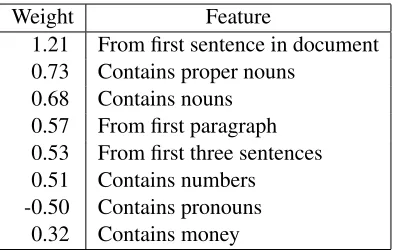
Weight Feature
1.21 From first sentence in document 0.73 Contains proper nouns
0.68 Contains nouns 0.57 From first paragraph 0.53 From first three sentences 0.51 Contains numbers -0.50 Contains pronouns
[image:4.612.329.528.56.181.2]0.32 Contains money
Table 1: Weights and features of SVM that predicts the salience of summary content. Negative weights indicate information that should not be included in the summary.
2006). Matched sentences in the source documents were given positive labels, while unaligned sen-tences were given negative labels. These labels were then propagated to phrase structure nodes.
We trained an SVM on this data (tree nodes and their labels) using surface features that do not over-lap with bigram information: sentence and para-graph position, POS-tag information. Table 1 shows the most important features learned by the model as predictors of salient content.
The summary can be given a salience score fS(z)
using the raw SVM prediction scores of the individ-ual parse tree nodes:
fS(z) =
∑
i∈N
(Φ(i)·θ)zi (3)
whereΦ(i)is the feature vector for nodei, andθthe
weights learned by the SVM.
3.4 Surface Realization Using Style
Some sentences in the source documents will make poor summary sentences, despite the information they contain, and therefore contrary to the predic-tions of the content selection indicators described above. This may be because the source sentence is very short, or is expressed as a quotation, or con-tains many pronouns that will not be resolved when the sentence is extracted.
Weight Feature
-1.04 Word count less than 10 -0.83 Word count less than 20 -0.30 Question
-0.30 Quotation
[image:5.612.105.266.54.140.2]-0.14 Personal pronouns
Table 2: Weights and features of SVM that predicts poor candidate sentences.
the model as predictors of poor sentences, and the weights assigned to them, are shown in Table 2.
The predictions of the SVM are incorporated into the ILP as a hard constraint, by forcing all parse tree nodes within those sentences predicted as poor (the set
N
−) to be zero:zi=0 ∀i∈
N
−. (4)3.5 Surface Realization Using Lexical Preferences
Human-written summaries differ from the source news articles in a number of ways. They delete ex-traneous information, merge material from several sentences, employ paraphrases and syntactic trans-formations, change the order of the source sentences and replace phrases or clauses with more general or specific descriptions. We could attempt to learn the “language of summaries” with a language model which we could then use to guide the generation process (e.g., by producing maximally probable out-put). Aside from the logistics of gathering training data large enough to provide robust estimates, we believe that a more compelling approach is to focus on the words that areunlikelyto appear in the sum-mary despite appearing in the source documents.
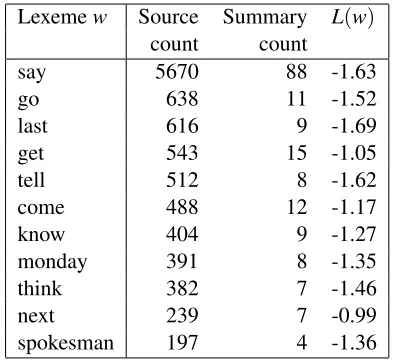
A comparison of the language models generated from the source documents and model summaries, even at the unigram level, is revealing. Table 3 shows lexemes that appear in both source and summary documents, but where the likelihood of the lexeme appearing in the summary is much less than that of it appearing the document, taking into account that the summary is much shorter anyway. The fi-nal column shows the log10-ratio (L(w)) between the two probabilities. We can see that least prob-able words are those that correspond to attribut-ing information sources (e.g.,said, told, according
Lexemew Source Summary L(w)
count count
say 5670 88 -1.63
go 638 11 -1.52
last 616 9 -1.69
get 543 15 -1.05
tell 512 8 -1.62
come 488 12 -1.17
know 404 9 -1.27
monday 391 8 -1.35
think 382 7 -1.46
next 239 7 -0.99
spokesman 197 4 -1.36
Table 3: Counts of lexemes in the source news articles and summaries, and measure of the ratio of their probabilities (for most common lexemes with ratio<−0.95).
to, spokesman), dates described relatively (e.g.,last Monday), and events that are in the process of hap-pening (e.g.,coming, going).
As the amount of training data tends to be lim-ited — there are usually only a few human-written summaries available per document cluster — we use a unigram language model, but conceivably a longer-rangen-gram could be employed in the same vein. We incorporate preferences about summary language into the model as a soft constraint. The log-ratio values fLR(z)are included in the objective and defined at the tree node level:
fLR(z) =
∑
i∈Nw
∑
∈WiL(w)zi (5)
whereL(w),w∈
W
iis the log-ratio value for anin-dividual wordw:
L(w) =log10 Psrc(w) Psum(w)
,
Psrc(w)andPsum(w)are the probabilities of wordw appearing in the source and summary documents re-spectively, and
W
i is the set of words at parse tree [image:5.612.328.525.56.236.2]3.6 Quasi-synchronous Tree Substitution Grammar
Rewrite rules involving substitutions, deletions and reorderings are captured in our model using a quasi-synchronous tree substitution grammar. Given an in-put (source) sentence S1 or its parse tree T1, the QTSG contains rules for generating possible trans-lation trees T2. A grammar node in the target tree T2 is modeled on a subset of nodes in the source tree, with a rather loose alignment between the trees.
We extract QTSG rules from aligned source and summary sentence pairs represented by their phrase structure trees. Our algorithm builds up a list of leaf node alignments based on lexical iden-tity. Direct parent nodes are aligned where more than one child node aligns. This quasi-synchronous “bottom-up” process gives us better ability to match non-isomorphic structures. We do not assume an alignment between source and target root nodes, nor do we require a surjective alignment of all target nodes to the source tree. QTSG rules are then cre-ated from aligned nodes above the leaf node level if all the nodes in the target tree can be explained us-ing nodes from the source. Individual rewrite rules describe the mapping of source tree fragments into target tree fragments, and so the grammar represents the space of valid target trees that can be produced from a given source tree (Eisner, 2003; Cohn and Lapata, 2009).
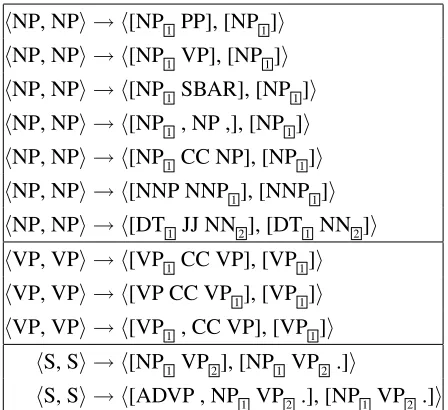
Examples of the most frequent QTSG rules learned by the above process are shown in Figure 1. Many of the rules relate to the compression of noun phrases through deletion, and examples are shown in the upper box. Others capture the compression of verb phrases (middle box). An important rewrite op-eration is the abstraction of a sentence from a more complex source sentence, adding final punctuation if necessary (lower box).
At generation, paraphrases are created from source sentence parse trees by identifying and ap-plying QTSG rules with matching structure. The transduction process starts at the root node of the parse tree, applying QTSG rules to sub-trees un-til leaf nodes are reached. Note that we do not use the Bayesian probability model normally associated with quasi-synchronous grammars (Smith and Eis-ner, 2006); instead, we ask the QTSG to provide
hNP, NPi → h[NP1 PP], [NP1]i
hNP, NPi → h[NP1 VP], [NP1]i
hNP, NPi → h[NP1 SBAR], [NP1]i
hNP, NPi → h[NP1 , NP ,], [NP1]i
hNP, NPi → h[NP1 CC NP], [NP1]i
hNP, NPi → h[NNP NNP1], [NNP1]i
hNP, NPi → h[DT1 JJ NN2], [DT1 NN2]i
hVP, VPi → h[VP1 CC VP], [VP1]i
hVP, VPi → h[VP CC VP1], [VP1]i
hVP, VPi → h[VP1 , CC VP], [VP1]i
hS, Si → h[NP1 VP2], [NP1 VP2 .]i
[image:6.612.315.539.56.261.2]hS, Si → h[ADVP , NP1 VP2 .], [NP1 VP2 .]i
Figure 1: Examples of most frequently learned QTSG rules. Boxed subscripts show aligned nodes.
paraphrases that areacceptablerather thanprobable, and generate all paraphrases licensed by the QTSG. The alternative paraphrases are incorporated into the target phrase structure tree as choices that the ILP can make. We use the set
C
⊂N
to be the set of nodes where a choice of paraphrases is avail-able, andC
i⊂N
,i∈C
to be the actual paraphrasesofi. Where there are alternatives, it makes sense of course to select only one, which we implement using the constraint:
∑
j∈Ci
zj=zi ∀i∈
C
, j∈C
i (6)More generally, we need to constrain the output to ensure that a parse tree structure is maintained. For each nodei∈
N
, the setD
i⊂N
contains the list ofdependent nodes (both ancestors and descendants) of nodei, so that each set
D
i contains the nodes thatdepend on the presence of i. We introduce a con-straint to force nodeito be present if any of its de-pendent nodes are chosen:
zj→zi ∀i∈
N
,j∈D
i (7)3.7 The ILP Objective
soft and hard constraints described in the preceding sections. The objective of the optimization problem is to maximize the score contributed by the various elements of content selection (fB(z)and fS(z)) and soft surface realization constraints (fLR(z)) :
max
z fB(z) +fS(z) +fLR(z) (8)
This objective is subject to the constraints (2), (4), (6), and (7) that represent hard constraint decisions, or maintain the logical integrity of the model. An overall length constraint completes the model:
∑
i∈N
lizi≤lmax (9)
whereliis the number of words generated by
choos-ing nodei, andlmax is the global word length limit. Note that the scores in the objective are for each tree node and not each sentence. This affords the model flexibility: the content selection elements are generally not competing with each other to give a decision on a sentence (see McDonald (2007)). In-stead, components are marking positive and nega-tive nodes. The ILP is implicitly searching the gram-mar rules for ways to rewrite the sentence, with the aim of including the salient nodes while removing negative-scoring nodes (deleting them increases the score of the node to zero). Figure 2 shows an exam-ple of a source sentence where the bigram, salience and language preference components of the ILP work together to score nodes in the parse tree. The nodes NP1, VP3 and VP4 all have positive scores, while “said Tuesday” is negative. As a rewrite pos-sibility, the rewrite rule shown bottom left is avail-able, which will remove the negative node. Further rewrite rules allow VP2 to be compressed. The out-put actually generated by the model used sub-trees (b) and (d) — the final text is included in Table 6.
4 Experimental Set-up
Data Our model was evaluated on the TAC non-update multi-document summarization task which involves generating a 100-word-limited summary from a cluster of 10 related input documents; ad-ditionally, TAC provides a set of four model sum-maries for each cluster, written by human experts. We used the 44 document clusters from TAC-2009 as training data, to learn the different elements of
the model. The 48 document clusters of TAC-2008 were reserved for the generation of test summaries.3
Training The two components described in Sec-tions 3.3 and 3.4 were trained using binary SVM classifiers, with labels inferred automatically via alignment. The salience classifier was trained on 102,754 node instances (16,042 positive and 86,712 negative). The style classifier was trained on 20,443 sentence instances (2,083 positive and 18,360 neg-ative). We learned the feature weights with a linear SVM, using the software SVM-OOPS (Woodsend and Gondzio, 2009). Because of the high compres-sion rate in this task, sentence alignment leads to an unbalanced data set. We compensated for this by us-ing different SVM hyper-parametersC+ andC− as the loss multiplier for misclassification of positive and negative training samples respectively. SVM hyper-parameters were chosen that gave the high-est F1 values using 10-fold cross-validation. The salience SVM obtained a precision of 0.28 and re-call of 0.43. Precision for the style SVM was 0.20 and recall 0.63, respectively. The classifiers on their own would thus not be great predictors of salience or style, but in practice they were useful for break-ing ties in bigram scores.
Aligned sentences from the training data were also used to learn the quasi-synchronous tree sub-stitution grammar, using the process described in Section 3.6. Rules seen fewer than 3 times were re-moved, resulting in a total of 339 QTSG rules. Two unigram language models (see Section 3.5) were trained on the source articles and summaries, respec-tively. Their probabilities were compared to give the word list shown in Table 3. We removed words with a source count less than 50, providing a list of 60 lex-emes. The resulting integer linear programmes were solved using SCIP,4 and it took 55 seconds on aver-age to read in and solve a document cluster problem.
Evaluation We compared our model against two systems. As a baseline, we used the ICSI-1 extrac-tive system (Gillick et al., 2008) which is also based on ILP and was highly ranked in the TAC-2008 evaluation. We also compared against the “learned phrase compression” system of Berg-Kirkpatrick et
3This split follows Berg-Kirkpatrick et al. (2011).
(a) S
.
. VP
said Tuesday
NP
a top space official ,
, S
VP2
SBAR4
if its maiden unmanned spacecraftChandrayaan-1, slated tobe launchedby2008, is successful in
mapping the lunar surface
VP3
will launch more mis-sions to the moon
NP1
India
(b) S
. VP2 NP1
(c) VP2
VP3
(d) VP2
SBAR4 VP3
hS, Si →
h[NP1 VP2], [NP1 VP2 .]i
hVP2, VP2i → h[VP3 SBAR], [VP3]i
hVP2, VP2i →
[image:8.612.79.533.57.284.2]h[VP3 SBAR4], [VP3 SBAR4]i
Figure 2: Sentence representation provided to the ILP. (a) The source sentence representation (child nodes condensed for space reasons).Bigramsare shown in bold, slanted text indicatesphrases with high salience scores fS, whilesaid Tuesdayis penalized by fLR. Alternative sub-trees (b), (c) and (d) are created using QTSG rules (dashed lines). The output sentence (see Table 6) was generated from sub-trees (b) and (d).
al. (2011) (henceforth B-K), which has the highest reported ROUGE scores that we are aware of.5 In addition to the full model described in Section 3, we also produced outputs where each of the five compo-nents described in Sections 3.2–3.6 were removed, to assess their individual contribution.
We evaluated the output summaries in two ways, using automatic measures and human judgements. Automatic evaluation was performed with ROUGE
(Lin and Hovy, 2003) using TAC-2008 parame-ter settings. We report bigram overlap (ROUGE-2) and skip-bigram (ROUGE-SU4) recall values. We
also used Translation Edit Rate (TER, Snover et al. (2006)) to examine the systems’ rewrite potential. TER is defined as the minimum number of edits
(insertions, deletions, substitutions, and shifts) re-quired to change the system output so that it exactly matches a reference (here, the reference is the most closely aligning source sentence). The perfect TER score is 0, however note that it can be higher than 1 due to insertions.
Our judgement elicitation study was conducted as follows. We randomly selected ten document
5We are grateful to Taylor Berg-Kirkpatrick for making his
system output available to us.
clusters from the test set and generated summaries with our model (and its lesser variations). We also included the corresponding ICSI-1 and B-K sum-maries, and one randomly-selected model summary. The study was conducted over the Internet using Mechanical Turk and was completed by 54 volun-teers, all self reported native English speakers. Par-ticipants were first asked to read the documents in each cluster. Next, they were asked a few compre-hension questions to ensure they had understood and processed the documents. Finally, they were pre-sented with a summary and asked to rate it along two dimensions: grammaticality (is the summary fluent and grammatical?), and informativeness (are the main topics captured in the summary?). The sub-jects used a 1–5 rating scale, with half-points al-lowed. Participants who declared themselves as non-native English speakers, did not answer the compre-hension questions correctly or took only a few min-utes to complete the task were eliminated.
5 Results
Models ROUGE TER (%) Sentences
2-R SU4-R Ins Del Sub Shift Count CR (%) Mod (%)
ICSI-1 11.03 13.96 — — — — 200 — —
B-K 11.71 14.47 0.2 26.2 2.3 0.4 216 74.0 63.9
MA-ILP 11.37 14.47 0.7 11.6 5.3 0.6 191 89.1 61.8
ILP w/o bigrams 9.24 12.66 0.8 15.4 11.8 1.2 205 85.4 80.0 ILP w/o salience 11.38 14.71 1.1 19.1 12.0 1.3 233 82.1 92.3 ILP w/o style 11.83 15.09 1.4 17.4 18.9 1.7 271 84.1 86.3 ILP w/o log-ratio 11.41 14.70 1.2 16.9 12.5 1.5 223 84.3 90.1
[image:9.612.93.522.56.196.2]ILP w/o QTSG 10.32 13.68 0 0 0 0 163 100.0 0
Table 4: Performance of the multiple-aspect ILP model against comparison systems using ROUGE and the four com-ponents of TER (insertion, deletion, substitution, shifts). In the lower section, performance of our model without (w/o) each component in turn. The final columns show the number of source sentences, the average compression ratio, and the proportion of sentences modified.
from the upper section of Table 4, the systems incor-porating some form of rewriting gain slightly higher ROUGE scores than ICSI-1. The multiple aspects ILP system (MA-ILP) yields ROUGE scores simi-lar to B-K, despite performing rewriting operations which increase the scope for error and without re-quiring any hand-crafted compression rules or man-ually annotated training data. Indeed, the outputs of the two systems are not significantly different under ROUGE (using a pairedt-test, p>0.5).
In the lower section of Table 4, we show the per-formance of our model when each of the contribut-ing components described in Section 3 are removed. Clearly the bigram content indicators are an impor-tant element for the ROUGE scores, as their removal yields a reduction of 2.46 points (see the row ILP w/o bigrams in Table 4). The model without QTSG rules (ILP w/o QTSG) is effectively limited to sen-tence extraction, and removing rewrite rules also lowers ROUGE scores to levels similar to ICSI-1. ROUGE scores are increased by allowing the model to select “poor quality” sentences (ILP w/o style), higher indeed than those of the B-K system. The inclusion of non-summary language (ILP w/o log-ratio) does not affect ROUGE scores to the same ex-tent that bigrams and QTSG do.
Table 4 includes a break-down of the systems’ rewrite operations as measured by TER. We also
show the number of source sentences (Count), the average compression ratio (CR %) and the propor-tion of sentences modified (Mod %) by each system. As can be seen, MA-ILP draws on fewer sentences,
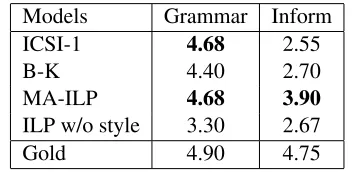
Models Grammar Inform
ICSI-1 4.68 2.55
B-K 4.40 2.70
MA-ILP 4.68 3.90
ILP w/o style 3.30 2.67
[image:9.612.338.514.269.355.2]Gold 4.90 4.75
Table 5: Mean ratings on system output output.
performs less deletion and more rewriting than B-K. The number of deletions increases when individual ILP components are removed and so does the num-ber of substitutions. All the subsystems are more ag-gressive in their rewriting than when used in com-bination (higher TER, higher compression rate and
a larger number of sentences are modified). Expect-edly, when removing the QTSG rules, the ILP is lim-ited to a pure extractive system (last row in Table 4). The results of our human evaluation study are shown in Table 5. We elicited grammaticality and in-formativeness ratings for a randomly selected model summary, ICSI-1, B-K, the multiple aspect ILP (MA-ILP), and the ILP w/o style which we in-cluded in this study as it performed best under ROUGE. ICSI-1, B-K, and MA-ILP are rated highly on the grammaticality dimension. MA-ILP is in-distinguishable from the sentence extraction sys-tem (ICSI-1). Both syssys-tems are significantly more grammatical than B-K (α<0.05, using a Post-hoc
Florida’s Governor Jeb Bush asked the US Supreme Court to intervene to keep a comatose woman alive, over the wishes of her husband, who wants to disconnect the feeding tube that has sustained her for 14 years. Her husband, Michael Schiavo, and her parents, Robert and Mary Schindler, have conflicts of interest that pre-vent them from fairly deciding whether to keep her alive. Some doctors have testified that Terri Schiavo is in a persistent vegetative state with no hope for recovery. The state House in Florida passed a bill Thursday to extend life support for a brain-damaged woman.
The space agencies of India and France signed an agreement to cooperate in launching a satellite in four years that will help make climate predictions more accurate. The Indian Space Research Orga-nization (ISRO) has short-listed experiments from five nations including the United States, Britain and Germany, for a slot on India’s unmanned moon mission Chandrayaan-1 to be undertaken by 2006-2007, the Press Trust of India (PTI) re-ported Monday. India will launch more missions to the moon if its maiden unmanned spacecraft Chandrayaan-1, slated to be launched by 2008, is successful in mapping the lunar surface.
Table 6: Example summaries generated by the multiple aspects model (MA-ILP).
sentences and quotations from being included in the summary even if they have quite high bigram or content scores. Without it, the model tends to gen-erate summaries that are fragmentary and lacking proper context, resulting in lower grammaticality (and informativeness) when judged by humans. The MA-ILP system obtains the highest rating with re-spect to information content. It is significantly better (α<0.05) than ICSI-1 and B-K. This is not entirely
surprising as our model includes additional content selection elements over and above the bigram units. There is still a significant gap from all systems to the gold-standard human-authored summaries. Example output summaries of the full ILP model are shown in Table 6.
Overall, we obtain best results when considering
the contributions from the individual model experts collectively. This suggests that additional improve-ments could be obtained with more experts. It is also possible that optimizing the relative weightings of experts in the ILP objective would improve output. The TERanalysis shows that the experts have a tem-pering effect on each other, resulting in less aggres-sive, but qualitatively better, rewriting than when used individually. Generally, experts work together to shape an output sentence, but they can also com-pete. In the future, we also plan to test the ability of the model to adapt to other multi-document sum-marization tasks, where the location of summary in-formation is not as regular as it is in news articles. We would also like interface our model with sen-tence ordering and more generally with some notion of the coherence of the generated summary.
Acknowledgments We are grateful to Micha El-sner for his input on earlier versions of this work. We would also like to thank members of the ILCC at the School of Informatics for valuable discus-sions and comments. We acknowledge the support of EPSRC through project grants EP/I032916/1 and EP/I017127/1.
References
Taylor Berg-Kirkpatrick, Dan Gillick, and Dan Klein. 2011. Jointly learning to extract and compress. In Proceedings of the 49th Annual Meeting of the Asso-ciation for Computational Linguistics: Human Lan-guage Technologies, pages 481–490, Portland, Ore-gon.
James Clarke and Mirella Lapata. 2008. Global infer-ence for sentinfer-ence compression: An integer linear pro-gramming approach. Journal of Artificial Intelligence Research, 31:273–381.
Trevor Cohn and Mirella Lapata. 2008. Sentence com-pression beyond word deletion. InProceedings of the 22nd International Conference on Computational Lin-guistics, pages 137–144, Manchester, UK.
Trevor Cohn and Mirella Lapata. 2009. Sentence com-pression as tree transduction. Journal of Artificial In-telligence Research, 34:637–674.
Proceedings of the Main Conference, pages 444–451, Rochester, New York.
Jason Eisner. 2003. Learning non-isomorphic tree map-pings for machine translation. InProceedings of the ACL Interactive Poster/Demonstration Sessions, pages 205–208, Sapporo, Japan.
Elena Filatova and Vasileios Hatzivassiloglou. 2004. A formal model for information selection in multi-sentence text extraction. In Proceedings of the 20th International Conference on Computational Linguis-tics, pages 397–403, Geneva, Switzerland.
Dan Gillick and Benoit Favre. 2009. A scalable global model for summarization. InProceedings of the Work-shop on Integer Linear Programming for Natural Lan-guage Processing, pages 10–18, Boulder, Colorado. Dan Gillick, Benoit Favre, and Dilek Hakkani-t¨ur. 2008.
The ICSI summarization system at TAC 2008. In Pro-ceedings of the Text Analysis Conference.
Dan Gillick, Benoit Favre, Dilek Hakkani-t¨ur, Berndt Bohnet, Yang Liu, and Shasha Xie. 2009. The ICSI/UTD summarization system at TAC 2009. In Proceedings of the Text Analysis Conference.
Jade Goldstein, Vibhu Mittal, Jaime Carbonell, and Mark Kantrowitz. 2000. Multi-document summarization by sentence extraction. In Proceedings of the 2000 NAACL–ANLP Workshop on Automatic Summariza-tion, pages 40–48, Seattle, Washington.
Dorit S. Hochba. 1997. Approximating covering and packing problems: Set cover, vertex cover, in-dependent set, and related problems. In Dorit S. Hochba, editor, Approximation Algorithms for NP-Hard Problems, pages 94–143. PWS Publishing Com-pany, Boston, MA.
Honyang Jing. 2002. Using Hidden Markov modeling to decompose human-written summaries. Computa-tional Linguistics, 28(4):527–544.
Dan Klein and Christopher D. Manning. 2003. Accurate unlexicalized parsing. InProceedings of the 41st As-sociation for Computational Linguistics, pages 423– 430, Sapporo, Japan.
Chin-Yew Lin and Eduard H. Hovy. 2003. Automatic evaluation of summaries using n-gram co-occurrence statistics. InProceedings of HLT–NAACL, pages 71– 78, Edmonton, Canada.
Inderjeet Mani. 2001. Automatic Summarization. John Benjamins Pub Co.
Andr´e Martins and Noah A. Smith. 2009. Summariza-tion with a joint model for sentence extracSummariza-tion and compression. InProceedings of the Workshop on In-teger Linear Programming for Natural Language Pro-cessing, pages 1–9, Boulder, Colorado.
Ryan McDonald. 2007. A study of global inference algo-rithms in multi-document summarization. In
Proceed-ings of the 29th European conference on IR Research, pages 557–564, Rome, Italy.
Rani Nelken and Stuart Schieber. 2006. Towards ro-bust context-sensitive sentence alignment for monolin-gual corpora. InProceedings of the 11th Conference of the European Chapter of the Association for Com-putational Linguistics, pages 161–168, Trento, Italy. David Smith and Jason Eisner. 2006. Quasi-synchronous
grammars: Alignment by soft projection of syntactic dependencies. InProceedings of Workshop on Statis-tical Machine Translation, pages 23–30, NYC. Matthew Snover, Bonnie Dorr, Richard Schwartz,
Lin-nea Micciulla, and John Makhoul. 2006. A study of translation edit rate with targeted human annotation. InProceedings of the 7th Conference of the Associa-tion for Machine TranslaAssocia-tion in the Americas, pages 223–231, Cambridge.
Karen Sparck Jones. 1999. Automatic summarizing: Factors and directions. In Inderjeet Mani and Mark T. Maybury, editors,Advances in Automatic Text Summa-rization, pages 1–33. MIT Press, Cambridge.
Kristian Woodsend and Jacek Gondzio. 2009. Exploiting separability in large-scale linear support vector ma-chine training. Computational Optimization and Ap-plications.
Kristian Woodsend and Mirella Lapata. 2010. Automatic generation of story highlights. InProceedings of the 48th Annual Meeting of the Association for Computa-tional Linguistics, pages 565–574, Uppsala, Sweden. Kristian Woodsend, Yansong Feng, and Mirella Lapata.