Using Semantic Relations to Refine Coreference Decisions
Heng Ji David Westbrook Ralph Grishman
Department of Computer Science New York University New York, NY, 10003, USA
[email protected] [email protected] [email protected]
Abstract
We present a novel mechanism for im-proving reference resolution by using the output of a relation tagger to rescore coreference hypotheses. Experiments show that this new framework can im-prove performance on two quite different languages -- English and Chinese.
1 Introduction
Reference resolution has proven to be a major obstacle in building robust systems for information extraction, question answering, text summarization and a number of other natural language processing tasks.
Most reference resolution systems use represen-tations built out of the lexical and syntactic attrib-utes of the noun phrases (or “mentions”) for which reference is to be established. These attributes may involve string matching, agreement, syntactic dis-tance, and positional information, and they tend to rely primarily on the immediate context of the noun phrases (with the possible exception of sen-tence-spanning distance measures such as Hobbs distance). Though gains have been made with such methods (Tetreault 2001; Mitkov 2000; Soon et al. 2001; Ng and Cardie 2002), there are clearly cases where this sort of local information will not be suf-ficient to resolve coreference correctly.
Coreference is by definition a semantic relationship: two noun phrases corefer if they both refer to the same real-world entity. We should therefore expect a successful coreference system to exploit world knowledge, inference, and other
forms of semantic information in order to resolve hard cases. If, for example, two nouns refer to people who work for two different organizations, we want our system to infer that these noun phrases cannot corefer. Further progress will likely be aided by flexible frameworks for representing and using the information provided by this kind of semantic relation between noun phrases.
This paper tries to make a small step in that di-rection. It describes a robust reference resolver that incorporates a broad range of semantic information in a general news domain. Using an ontology that describes relations between entities (the Auto-mated Content Extraction program1 relation ontol-ogy) along with a training corpus annotated for relations under this ontology, we first train a classi-fier for identifying relations. We then apply the output of this relation tagger to the task of refer-ence resolution.
The rest of this paper is structured as follows. Section 2 briefly describes the efforts made by previous researchers to use semantic information in reference resolution. Section 3 describes our own method for incorporating document-level semantic context into coreference decisions. We propose a representation of semantic context that isolates a particularly informative structure of interaction between semantic relations and coreference. Sec-tion 4 explains in detail our strategies for using relation information to modify coreference deci-sions, and the linguistic intuitions behind these strategies. Section 5 then presents the system archi-tectures and algorithms we use to incorporate rela-tional information into reference resolution.
1
The ACE task description can be found at
Section 6 presents the results of experiments on both English and Chinese test data. Section 7 pre-sents our conclusions and directions for future work.
2 Prior Work
Much of the earlier work in anaphora resolution (from the 1970’s and 1980’s, in particular) relied heavily on deep semantic analysis and inference procedures (Charniak 1972; Wilensky 1983; Carbonell and Brown 1988; Hobbs et al. 1993). Using these methods, researchers were able to give accounts of some difficult examples, often by encoding quite elaborate world knowledge. Capturing sufficient knowledge to provide adequate coverage of even a limited but realistic domain was very difficult. Applying these reference resolution methods to a broad domain would require a large scale knowledge-engineering effort.
The focus for the last decade has been primarily on broad coverage systems using relatively shallow knowledge, and in particular on corpus-trained sta-tistical models. Some of these systems attempt to apply shallow semantic information. (Ge et al. 1998) incorporate gender, number, and animaticity information into a statistical model for anaphora resolution by gathering coreference statistics on particular nominal-pronoun pairs. (Tetreault and Allen 2004) use a semantic parser to add semantic constraints to the syntactic and agreement con-straints in their Left-Right Centering algorithm. (Soon et al. 2001) use WordNet to test the seman-tic compatibility of individual noun phrase pairs. In general these approaches do not explore the possi-bility of exploiting the global semantic context provided by the document as a whole.
Recently Bean and Riloff (2004) have sought to acquire automatically some semantic patterns that can be used as contextual information to improve reference resolution, using techniques adapted from information extraction. Their experiments were conducted on collections of texts in two topic areas (terrorism and natural disasters).
3 Relational Model of Semantic Context
Our central goal is to model semantic and corefer-ence structures in such a way that we can take ad-vantage of a semantic context larger than the
individual noun phrase when making coreference decisions. Ideally, this model should make it possi-ble to pick out important features in the context and to distinguish useful signals from background noise. It should, for example, be able to represent such basic relational facts as whether the (possibly identical) people referenced by two noun phrases work in the same organization, whether they own the same car, etc. And it should be able to use this information to resolve references even when sur-face features such as lexical or grammatical attrib-utes are imperfect or fail altogether.
In this paper we present a Relational Corefer-ence Model (abbreviated as RCM) that makes pro-gress toward these goals. To represent semantic relations, we use an ontology (the ACE 2004 tion ontology) that describes 7 main types of rela-tions between entities and 23 subtypes (Table 1).2 These relations prove to be more reliable guides for coreference than simple lexical context or even tests for the semantic compatibility of heads and modifiers. The process of tagging relations implic-itly selects relevant items of context and abstracts raw lists of modifiers into a representation that is deeper, but still relatively lightweight.
Relation Type Example Agent-Artifact
(ART)
Rubin Military Design, the makers of the Kursk Discourse (DISC) each of whom Employment/
Membership (EMP-ORG)
Mr. Smith, a senior pro-grammer at Microsoft
Place-Affiliation (GPE-AFF)
Salzburg Red Cross offi-cials
Person-Social (PER-SOC)
relatives of the dead
Physical (PHYS)
a town some 50 miles south of Salzburg
Other-Affiliation (Other-AFF)
[image:2.612.313.542.380.577.2]Republican senators
Table 1. Examples of the ACE Relation Types
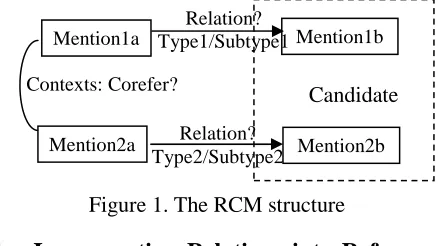
Given these relations we can define a semantic context for a candidate mention coreference pair (Mention 1b and Mention 2b) using the structure
2
depicted in Figure 1. If both mentions participate in relations, we examine the types and directions of their respective relations as well as whether or not their relation partners (Mention 1a and Mention 2a) corefer. These values (which correspond to the edge labels in Figure 1) can then be factored into a coreference prediction. This RCM structure assimilates relation information into a coherent model of semantic context.
Figure 1. The RCM structure
4 Incorporating Relations into Reference Resolution
Given an instance of the RCM structure, we need to convert it into semantic knowledge that can be applied to a coreference decision. We approach this problem by constructing a set of RCM patterns and evaluating the accuracy of each pattern as positive or negative evidence for coreference. The resulting knowledge sources fall into two catego-ries: rules that improve precision by pruning incor-rect coreference links between mentions, and rules that improve recall by recovering missed links.
To formalize these relation patterns, based on Figure 1, we define the following clauses:
A: RelationType1 = RelationType2 B: RelationSubType1 = RelationSubType2 C: Two Relations have the same direction Same_Relation: A∧B∧C
CorefA: Mention1a and Mention2a corefer
CorefBMoreLikely: Mention1b and Mention2b are more likely to corefer
CorefBLessLikely: Mention1b and Mention2b are less likely to corefer
From these clauses we can construct the follow-ing plausible inferences:
Rule (1)
Likely CorefBLess CorefA
lation
Same_Re ∧¬ ⇒
Rule (2)
Likely CorefBLess CorefA
lation
Same ∧ ⇒
¬ _Re
Rule (3)
Likely CorefBMore CorefA
lation
Same_Re ∧ ⇒
Rule (1) and (2) can be used to prune corefer-ence links that simple string matching might incor-rectly assert; and (3) can be used to recover missed mention pairs.
The accuracy of Rules (1) and (3) varies depend-ing on the type and direction of the particular rela-tion shared by the two noun phrases. For example, if Mention1a and Mention 2a both refer to the same nation, and Mentions 1b and 2b participate in citizenship relations (GPE-AFF) with Mentions 1a and 2a respectively, we should not necessarily conclude that 1b and 2b refer to the same person. If 1a and 2a refer to the same person, however, and 1b and 2b are nations in citizenship relations with 1a and 2a, then it would indeed be the rare case in which 1b and 2b refer to two different nations. In other words, the relation of a nation to its citizens is one-to-many.
Our system learns broad restrictions like these by evaluating the accuracy of Rules (1) and (3) when they are instantiated with each possible rela-tion type and direcrela-tion and used as weak classifi-ers. For each such instantiation we use cross-validation on our training data to calculate a reli-ability weight defined as:
| Correct decisions by rule for given instance |
| Total applicable cases for given instance |
We count the number of correct decisions for a rule instance by taking the rule instance as the only source of information for coreference resolution and making only those decisions suggested by the rule’s implication (interpreting CorefBMoreLikely as an assertion that mention 1b and mention 2b do in fact corefer, and interpreting CorefBLessLikely as an assertion that they do not corefer).
Every rule instance with a reliability weight of 70% or greater is retained for inclusion in the final system. Rule (2) cannot be instantiated with a single type because it requires that the two relation types be different, and so we do not perform this filtering for Rule (2) (Rule (2) has 97% accuracy across all relation types).
This procedure yields 58 reliable (reliability weight > 70%) type instantiations of Rule (1) and (3), in addition to the reliable Rule 2. We can Relation?
Type2/Subtype2 Mention1a
Mention2a
Candidate Mention1b
Mention2b Relation?
Type1/Subtype1
recover an additional 24 reliable rules by conjoining additional boolean tests to less reliable rules. Tests include equality of mention heads, substring matching, absence of temporal key words such as “current” and “former,” number agreement, and high confidence for original coreference decisions (Mention1b and Mention2b). For each rule below the reliability threshold, we search for combinations of 3 or fewer of these restrictions until we achieve reliability of 70% or we have exhausted the search space.
We give some examples of particular rule instances below.
Example for Rule (1)
Bush campaign officials ... decided to tone down a post-debate rally, and were even considering can-celing it.
…
The Bush and Gore campaigns did not talk to each other directly about the possibility of postpone-ment, but went through the debate commission's di-rector, Janet Brown...Eventually, Brown recommended that the debate should go on, and neither side objected, according to campaign offi-cials.
Two mentions that do not corefer share the same nominal head (“officials”). We can prune the coreference link by noting that both occurrences of “officials” participate in an Employee-Organization (EMP-ORG) relation, while the Or-ganization arguments of these two relation in-stances do not corefer (because the second occurrence refers to officials from both cam-paigns).
Example for Rule (2)
Despite the increases, college remains affordable and a good investment, said College Board Presi-dent Gaston Caperton in a statement with the sur-veys. …
A majority of students need grants or loans -- or both -- but their exact numbers are unknown, a College Board spokesman said.
“Gaston Caperton” stands in relation EMP-ORG/Employ-Executive with “College Board”, while "a College Board spokesman" is in relation EMP-ORG/Employ-Staff with the same
organiza-tion. We conclude that “Gaston Caperton” does not corefer with "spokesman."
Example for Rule (3)
In his foreign policy debut for Syria, this Sunday Bashar Assad met Sunday with Egyptian President Hosni Mubarak in talks on Mideast peace and the escalating violence in the Palestinian territories. …
The Syrian leader's visit came on a fourth day of clashes that have raged in the West Bank, Gaza Strip and Jerusalem……
If we have detected a coreference link between “Syria” and “Syrian,” as well as EMP-ORG/ Employ-Executive relations between this country and two noun phrases “Bashar Assad” and “leader”, it is likely that the two mentions both refer to the same person. Without this inference, a resolver might have difficulty detecting this coreference link.
5 Algorithms
Figure 2. System Pipeline (Test Procedure)
Coreference Rules
Baseline Maxent Coref Classifiers
Relation Tagger
Final coreference decisions
Entities Relation Features
In this section we will describe our algorithm for incorporating semantic relation information from the RCM into the reference resolver. In a nutshell, the system applies a baseline statistical resolver to generate multiple coreference hypotheses, applies a relation tagger to acquire relation information, and uses the relation information to rescore the coreference hypotheses. This general system archi-tecture is shown in Figure 2.
In section 5.1 below we present our baseline coreference system. In Section 5.2 we describe a system that combines the output of this baseline system with relation information to improve per-formance.
5.1 Baseline System
Baseline reference resolver
As the first stage in the resolution process we apply a baseline reference resolver that uses no relation information at all. This baseline resolver goes through two successive stages.
First, high-precision heuristic rules make some positive and negative reference decisions. Rules include simple string matching (e.g., names that match exactly are resolved), agreement constraints (e.g., a nominal will never be resolved with an en-tity that doesn't agree in number), and reliable syn-tactic cues (e.g., mentions in apposition are resolved). When such a rule applies, it assigns a confidence value of 1 or 0 to a candidate mention-antecedent pair.
The remaining pairs are assigned confidence values by a collection of maximum entropy mod-els. Since different mention types have different coreference problems, we separate the system into different models for names, nominals, and pro-nouns. Each model uses a distinct feature set, and for each instance only one of these three models is used to produce a probability that the instance represents a correct resolution of the mention. When the baseline is used as a standalone system, we apply a threshold to this probability: if some resolution has a confidence above the threshold, the highest confidence resolution will be made. Otherwise the mention is assumed to be the first mention of an entity. When the baseline is used as a component of the system depicted in figure 2, the confidence value is passed on to the rescoring stage described in 5.2 below.
Both the English and the Chinese coreference models incorporate features representing agree-ment of various kinds between noun phrases (number, gender, humanness), degree of string similarity, synonymy between noun phrase heads, measures of distance between noun phrases (such as the number of intervening sentences), the pres-ence or abspres-ence of determiners or quantifiers, and a wide variety of other properties.
Relation tagger
The relation tagger uses a K-nearest-neighbor algo-rithm. We consider a mention pair as a possible instance of a relation only when: (1) there is at most one other mention between their heads, and (2) the coreference probability produced for the pair by the baseline resolver is lower than a thresh-old. Each training / test example consists of the pair of mentions and the sequence of intervening words. We defined a distance metric between two examples based on:
1 whether the heads of the mentions match
1 whether the ACE types of the heads of the mentions match (for example, both are people or both are organizations)
1 whether the intervening words match
To tag a test example, we find the k nearest training examples, use the distance to weight each neighbor, and then select the most heavily weighted class in the weighted neighbor set.
Name tagger and noun phrase chunker
Our baseline name tagger consists of a HMM tagger augmented with a set of post-processing rules. The HMM tagger generally follows the Nymble model (Bikel et al. 1997), but with a larger number of states (12 for Chinese, 30 for English) to handle name prefixes and suffixes, and, for Chinese, transliterated foreign names separately. For Chinese it operates on the output of a word segmenter from Tsinghua University. Our nominal mention tagger (noun phrase chunker) is a maximum entropy tagger trained on treebanks from the University of Pennsylvania.
5.2 Rescoring stage
stage simply applies the baseline maxent models, without any relation information, and produces a probability of coreference. This probability becomes a feature in the second (rescoring) stage of maxent classification, together with features representing the relation knowledge sources. If a high reliability instantiation of one of the RCM rules (as defined in section 4 above) applies to a given mention-antecedent pair, we include the following features for that pair: the type of the RCM rule, the reliability of the rule instantiation, the relation type and subtype, the direction of the relation, and the tokens for the two mentions.
The second stage helps to increase the margin between correct and incorrect links and so effects better disambiguation. See figure 3 below for a more detailed description of the training and test-ing processes.
Training
1. Calculate reliability weights of relation knowl-edge sources using cross-validation (for each of k divisions of training data, train relation tagger on k – 1 divisions, tag relations in remaining division and compute reliability of each relation knowledge source using this division).
2. Use high reliability relation knowledge sources to generate relation features for 2nd stage Maxent training data.
3. Apply baseline coreference resolver to 2nd stage training data.
4. Using output of both 2 and 3 as features, train 2nd stage Maxent resolver.
Test
1. Tag relations.
2. Convert relation knowledge sources into fea-tures for second stage Maxent models.
3. Use baseline Maxent models to get coreference probabilities for use as features in second stage Maxent models.
4. Using output of 2 and 3 as features for 2nd stage Maxent model, apply 2nd stage resolver to make final coreference decisions.
Figure 3. Training and Testing Processes
6 Evaluation Results
6.1 Corpora
We evaluated our system on two languages: English and Chinese. The following are the training corpora used for the components in these two languages.
English
For English, we trained the baseline maxent coreference model on 311 newswire and newspaper texts from the ACE 2002 and ACE 2003 training corpora. We trained the relation tagger on 328 ACE 2004 texts. We used 126 newswire texts from the ACE 2004 data to train the English second-stage model, and 65 newswire texts from the ACE 2004 evaluation set as a test set for the English system.
Chinese
For Chinese, the baseline reference resolver was trained on 767 texts from ACE 2003 and ACE 2004 training data. Both the baseline relation tagger and the rescoring model were trained on 646 texts from ACE 2004 training data. We used 100 ACE texts for a final blind test.
6.2 Experiments
We used the MUC coreference scoring metric (Vilain et al 1995) to evaluate3 our systems.
To establish an upper limit for the possible improvement offered by our models, we first did experiments using perfect (hand-tagged) mentions and perfect relations as inputs. The algorithms for
3
these experiments are identical to those described above except for the omission of the relation tagger training. Tables 2 and 3 show the performance of the system for English and Chinese.
Performance Recall Precision F-measure Baseline 74.5 86.6 80.1 Rescoring 78.3 87.0 82.4
Table 2. Performance of English system with perfect mentions and perfect relations
Performance Recall Precision F-measure Baseline 87.5 83.2 85.3 Rescoring 88.8 84.7 86.7
Table 3. Performance of Chinese system with perfect mentions and perfect relations
We can see that the relation information provided some improvements for both languages. Relation information increased both recall and precision in both cases.
We then performed experiments to evaluate the impact of coreference rescoring when used with mentions and relations produced by the system. Table 4 and Table 5 list the results.4
Performance Recall Precision F-measure Baseline 77.2 87.3 81.9 Rescoring 80.3 87.5 83.7
Table 4. Performance of English system with system mentions and system relations
Performance Recall Precision F-measure Baseline 75.0 76.3 75.6 Rescoring 76.1 76.5 76.3
Table 5. Chinese system performance with system mentions and system relations
4
Note that, while English shows slightly less relative gain from rescoring when using system relations and mentions, all of these scores are higher than the perfect mention/perfect relation scores. This increase may be a byproduct of the fact that the system mention tagger output contains almost 8% fewer scoreable mentions than the perfect mention set (see footnote 3). With a difference of this magnitude, the particular mention set selected can be expected to have a sizable impact on the final scores.
The improvement provided by rescoring in trials using mentions and relations detected by the system is considerably less than the improvement in trials using perfect mentions and relations, particularly for Chinese. The performance of our relation tagger is the most likely cause for this difference. We would expect further gain after improving the relation tagger.
A sign test applied to a 5-way split of each of the test corpora indicated that for both languages, for both perfect and system mentions/relations, the system that exploited relation information signifi-cantly outperformed the baseline (at the 95% con-fidence level, judged by F measure).
6.3 Error Analysis
Errors made by the RCM rules reveal both the drawbacks of using a lightweight semantic representation and the inherent difficulty of semantic analysis. Consider the following instance:
Card's interest in politics began when he became
president of the class of 1965 at Holbrook High School…In 1993, he became president and chief
executive of the American Automobile
Manufac-turers Association, where he oversaw the lobbying
against tighter fuel-economy and air pollution regu-lations for automobiles…
The two occurrences of “president” should core-fer even though they have EMP-ORG/Employ-Executive relations with two different organiza-tions. The relation rule (Rule 1) fails here because it doesn't take into account the fact that relations change over time (in this case, the same person filling different positions at different times). In these and other cases, a little knowledge is a dan-gerous thing: a more complete schema might be able to deal more thoroughly with temporal and other essential semantic dimensions.
Nevertheless, performance improvements indi-cate that the rewards of the RCM’s simple seman-tic representation outweigh the risks.
7 Conclusion and Future Work
that these small inroads into semantic territory do indeed offer performance improvements. Further-more, the method is low-cost and not domain-specific.
These experiments also suggest that some gains can be made through the exploration of new archi-tectures for information extraction applications. The “resolve coreference, tag relations, resolve coreference” procedure described above could be seen as one and a half iterations of a “resolve coreference then tag relations” loop. Seen in this way, the system poses the question of whether fur-ther gains could be made by pushing the iterative approach further. Perhaps by substituting an itera-tive procedure for the pipeline architecture’s linear sequence of stages we can begin to address the knotty, mutually determining nature of the interac-tion between semantic relainterac-tions and coreference relations. This approach could be applied more broadly, to different NLP tasks, and also more deeply, going beyond the simple one-and-a-half-iteration procedure we present here. Ultimately, we would want this framework to boost the perform-ance of each component automatically and signifi-cantly.
We also intend to extend our method both to cross-document relation detection and to event de-tection.
Acknowledgements
This research was supported by the Defense Ad-vanced Research Projects Agency under Grant N66001-04-1-8920 from SPAWAR San Diego, and by the National Science Foundation under Grant 03-25657. This paper does not necessarily reflect the position or the policy of the U.S. Gov-ernment.
References
David Bean, Ellen Riloff. 2004. Unsupervised learning of contextual role knowledge for coreference resolu-tion. Proc. HLT-NAACL 2004, pp. 297-304.
Daniel M. Bikel, Scott Miller, Richard Schwartz, and Ralph Weischedel. 1997. Nymble: A high-performance learning name-finder. Proc. Fifth Conf.
on Applied Natural Language Processing,
Washing-ton, D.C., pp. 194-201.
Carbonell, Jaime and Ralf Brown. 1988. Anaphora reso-lution: A multi-strategy approach. Proc. COLING
1988, pp.96-101
Eugene Charniak. 1972. Toward a model of children's story comprehension. Ph.D. thesis, Massachusetts Insti-tute of Technology, Cambridge, MA.
Niyu Ge, John Hale and Eugene Charniak. 1998. A sta-tistical approach to anaphora resolution. Proc. the Sixth Workshop on Very Large Corpora.
Jerry Hobbs, Mark Stickel, Douglas Appelt and Paul Martin. 1993. Interpretation as abduction. Artificial Intelligence, 63, pp. 69-142.
Ruslan Mitkov. 2000. Towards a more consistent and comprehensive evaluation of anaphora resolution al-gorithms and systems. Proc. 2nd Discourse
Anaph-ora and AnaphAnaph-ora Resolution Colloquium, pp.
96-107
Vincent Ng and Claire Cardie. 2002. Improving ma-chine learning approaches to coreference resolution.
Proc. ACL 2002, pp.104-111
Wee Meng Soon, Hwee Tou Ng, and Daniel Chung Yong Lim. 2001. A machine learning approach to coreference resolution of noun phrases.
Computa-tional Linguistics, Volume 27, Number 4, pp.
521-544
Joel R. Tetreault. 2001. A corpus-based evaluation of centering and pronoun resolution. Computational
Linguistics, Volume 27, Number 4, pp. 507-520
Joel R. Tetreault and James Allen. 2004. Semantics, Dialogue, and Pronoun Resolution. Proc. CATALOG
'04 Barcelona, Spain.
Marc Vilain, John Burger, John Aberdeen, Dennis Con- nolly, and Lynette Hirschman. 1995. A model-theoretic coreference scoring scheme. Proc. the 6th
Message Understanding Conference (MUC-6). San
Mateo, Cal. Morgan Kaufmann.