Proceedings of the Third Conference on Machine Translation (WMT), Volume 2: Shared Task Papers, pages 689–709
Findings of the WMT 2018 Shared Task on Quality Estimation
Lucia Specia and Fr´ed´eric Blain
Department of Computer Science University of Sheffield, UK
{l.specia,f.blain}@sheffield.ac.uk
Varvara Logacheva
Neural Networks and Deep Learning Lab MIPT, Moscow, Russia
Ram´on F. Astudillo
L2F, INESC-ID-Lisboa Lisbon, Portugal
Andr´e Martins
Unbabel & Instituto de Telecomunicac¸˜oes Lisbon, Portugal
Abstract
We report the results of the WMT18 shared task on Quality Estimation, i.e. the task of predicting the quality of the output of ma-chine translation systems at various granular-ity levels: word, phrase, sentence and doc-ument. This year we include four language pairs, three text domains, and translations pro-duced by both statistical and neural machine translation systems. Participating teams from ten institutions submitted a variety of systems to different task variants and language pairs.
1 Introduction
This shared task builds on its previous six edi-tions to further examine automatic methods for es-timating the quality of machine translation (MT) output at run-time, without the use of reference translations. It includes the (sub)tasks of word-level, phrase-word-level, sentence-level and document-level estimation. In addition to advancing the state of the art at all prediction levels, our goals include:
• To study the performance of quality estima-tion approaches on the output of neural MT systems. We do so by providing datasets for two language pairs where source segments were translated by both statistical phrase-based and neural MT systems.
• To study the predictability of missing words in the MT output. To do so, for the first time we provide data annotated for such errors at training time.
• To study the predictability of source words that lead to errors in the MT output. To do so, for the first time we provide source segments annotated for such errors at the word level.
• To study the effectiveness of manually as-signed labels for phrases. For that we provide
a dataset where each phrase was annotated by human translators.
• To investigate the utility of detailed informa-tion logged during post-editing. We do so by providing post-editing time, keystrokes, as well as post-editor ID.
• To study quality prediction for documents from errors annotated at word-level with added severity judgements. This is done us-ing a new corpus manually annotated with a fine-grained error taxonomy, from which document-level scores are derived.
This year’s shared task provides new training and test datasets for all tasks, and allows partici-pants to explore any additional data and resources deemed relevant. Tasks make use of large datasets produced either from post-editions or annotations by professional translators, or from direct human annotations. The following text domains are avail-able for different languages and tasks: informa-tion technology (IT), life sciences, and product ti-tle and descriptions on sports and outdoor activ-ities. In-house statistical and neural MT systems were built to produce translations for the two first domains, while an online system was used for the third domain.
The four tasks are defined as follows: Task 1
aims at predicting post-editing effort at sentence level (Section5); Task2aims at predicting words
that need editing, as well as missing words and incorrect source words (Section 6); Task 3 aims
at predicting phrases that need editing, as well as missing phrases and incorrect source phrases (Sec-tion7); and Task 4 (Section8) aims at predicting a score for an entire document as a function of the proportion of incorrect words in such a document, weighted by the severity of the different errors.
Five datasets and language pairs are used for different tasks (Section 4): English-German (Tasks 1, 2) and English-Czech (Tasks 1, 2) on the IT domain, English-Latvian (Tasks 1, 2) and German-English (Tasks 1, 2, 3), both on the life sciences domain, English-French (Task 4) with product titles and descriptions within the sports and outdoor activities domain.
Participants are provided with a baseline set of features for each task, and a software package to extract these and other quality estimation features, and perform model learning (Section 2). Partici-pants (Section3) could submit up to two systems for each task and language pair. A discussion on the main goals and findings from this year’s task is given in Section9.
2 Baseline systems
Sentence-level baseline system: For Task 1,
QUEST++1 (Specia et al.,2015) was used to
ex-tract17MT system-independent features from the
source and translation (target) files and parallel corpora:
• Number of tokens in the source and target sentences.
• Average source token length.
• Average number of occurrences of the target word within the target sentence.
• Number of punctuation marks in source and target sentences.
• Language model (LM) probability of source and target sentences based on models built using the source or target sides of the parallel corpus used to train the SMT system.
• Average number of translations per source word in the sentence as given by the IBM model 1 extracted using the SMT parallel corpus, and thresholded such that P(t|s) > 0.2orP(t|s)>0.01.
• Percentage of unigrams, bigrams and tri-grams in frequency quartiles 1 (lower
fre-quency words) and 4 (higher frequency
words) in the source language extracted from the source side of the SMT parallel corpus. • Percentage of unigrams in the source
sen-tence seen in the source side of the SMT par-allel corps.
These features were used to train a Support Vec-tor Regression (SVR) algorithm using a Radial
1https://github.com/ghpaetzold/
questplusplus
Basis Function (RBF) kernel within the SCIKIT -LEARNtoolkit.2 Theγ,andC parameters were
optimised via grid search with 5-fold cross valida-tion on the training set, resulting in γ=0.01, = 0.0825, C = 20. This baseline system has been
consistently used as the baseline system for all editions of the sentence-level task (Callison-Burch
et al.,2012;Bojar et al.,2013,2014,2015,2016,
2017), and has proved strong enough for predict-ing various forms of post-editpredict-ing effort across a range of language pairs and text domains for sta-tistical MT systems. This year it is also bench-marked on neural MT outputs.
Word-level baseline system: For Task 2, the
baseline features were extracted with the MAR -MOT tool (Logacheva et al., 2016). These are 28
features that have been deemed the most informa-tive in previous research on word-level QE, mostly inspired by (Luong et al.,2014). This is the same baseline system used in WMT17:
• Word count in the source and target sen-tences, and source and target token count ra-tio. Although these features are sentence-level (i.e. their values will be the same for all words in a sentence), the length of a sentence might influence the probability of a word be-ing wrong.
• Target token, its left and right contexts of one word.
• Source word aligned to the target token, its left and right contexts of one word. The alignments were given by the SMT system that produced the automatic translations. • Boolean dictionary features: target token is
a stop word, a punctuation mark, a proper noun, or a number.
• Target language model features:
– The order of the highest order ngram which starts and end with the target to-ken.
– The order of the highest order ngram which starts and ends with the source to-ken.
– The part-of-speech (POS) tags of the tar-get and source tokens.
– Backoff behaviour of the ngrams
(ti−2, ti−1, ti), (ti−1, ti, ti+1),
(ti, ti+1, ti+2), where ti is the target
token (backoff behaviour is computed as described by (2011)).
In addition to that, six new features were in-cluded which contain combinations of other fea-tures, and which proved useful in (Kreutzer et al.,
2015;Martins et al.,2016):
• Target word + left context. • Target word + right context. • Target word + aligned source word.
• POS of target word + POS of aligned source word.
• Target word + left context + source word. • Target word + right context + source word.
The baseline system models the task as a sequence prediction problem using the Linear-Chain Conditional Random Fields (CRF) algo-rithm within the CRFSuite tool.3 The model was
trained using passive-aggressive optimisation al-gorithm.
We note that this baseline system was only used to predict OK/BAD classes for existing words in the MT output. No baseline system was provided for predicting missing words or erroneous source words.
Phrase-level baseline system: The phrase-level system is identical to the one used in last year’s shared task. The phrase-level features were also extracted with MARMOT, but they are different from the word-level features. They are based on the sentence-level features in QUEST++.4 These are the so-called “black-box” features – features that do not use the internal information from the MT system. The baseline uses the following 72
features:
• Source phrase frequency features:
– average frequency of ngrams (unigrams, bigrams, trigrams) in different quartiles of frequency (the low and high fre-quency ngrams) in the source side of the SMT parallel corpus.
– percentage of distinct source ngrams (unigrams, bigrams, trigrams) seen in the source side of the SMT parallel cor-pus.
3http://www.chokkan.org/software/
crfsuite/
4http://www.quest.dcs.shef.ac.uk/
quest_files/features_blackbox
• Translation probability features:
– average number of translations per source word in the phrase as given by the IBM model 1 extracted using the SMT parallel corpus (with different translation probability thresholds: 0.01,
0.05,0.1,0.2,0.5).
– average number of translations per source word in the phrase as given by the IBM model 1 extracted using the SMT parallel corpus (with different translation probability thresholds: 0.01, 0.05,0.1,0.2,0.5) weighted by the
fre-quency of each word in the source side of the parallel SMT corpus.
• Punctuation features:
– difference between numbers of various punctuation marks (periods, commas, colons, semicolons, question and excla-mation marks) in the source and the tar-get phrases.
– difference between numbers of various punctuation marks normalised by the length of the target phrase.
– percentage of punctuation marks in the target or source phrases.
• Language model features:
– log probability of the source or target phrases based on models built using the source or target sides of the parallel cor-pus used to train the SMT system.
– perplexity of the source and the target phrases using the same models as above.
• Phrase statistics:
– lengths of the source or target phrases.
– ratio between the source and target phrase lengths.
– average length of tokens in source or tar-get phrases.
– average occurrence of target word within the target phrase.
• Alignment features:
– number of unaligned target words, us-ing the word alignment provided by the SMT decoder.
– average number of alignments per word in the target phrase.
• Part-of-speech features:
– percentage of content words in the source or target phrases.
– percentage of words of a particular part of speech tag (verb, noun, pronoun) in the source or target phrases.
– ratio of numbers of words of a particu-lar part of speech (verb, noun, pronoun) between the source and target phrases.
– percentage of numbers and alphanu-meric tokens in the source or target phrases.
– ratio between the percentage of numbers and alphanumeric tokens in the source and target phrases.
Analogously to the baseline word-level system, we treat phrase-level QE as a sequence labelling task, and model it using CRF from the CRFSuite toolkit and the passive-aggressive optimisation al-gorithm.
Once more, this baseline system was only used to predict OK/BAD classes for existing phrases in the MT output. No baseline system was provided for predicting missing phrases or erroneous source phrases.
3 Participants
Table1lists all participating teams submitting sys-tems to any of the tasks. Each team was allowed up to two submissions for each task variant and language pair. In the descriptions below, participa-tion in specific tasks is denoted by a task identifier (T1 = Task 1, T2 = Task 2, T3 = Task 3, T4 = Task 4).
CMU-LTI (T2):
The CMU-LTI team proposes a Contextual Encoding model for QE. The model consists in three major parts that encode the local and global context information for each tar-get word. The first part uses an embedding layer to represent words and their POS tags in both languages. The second part leverages a one-dimensional convolution layer to inte-grate local context information for each target word. The third part applies a stack of feed-forward and recurrent neural networks to fur-ther encode the global context in the sentence
before making the predictions. Syntactic fea-tures, such as ngrams, are then integrated to the final feed-forward layer in the neu-ral model. This model achieves competitive results on the Czech and English-Latvian word-level QE task.
JU-USAAR (T2):
JU-USAAR presents two approaches to word-level QE: (i) a Bag-of-Words (BoW) model, and (ii) a Paragraph Vector (Doc2Vec) model (Le and Mikolov, 2014). In the BoW model, bag-of-words are prepared from source sentences for each target word appear-ing in both the MT and PE output in the train-ing data. For every target word appeartrain-ing in the MT output in the development set, the cosine similarity between the corresponding source sentence and the bag-of-words for the same target word is computed. From this re-sult, a threshold (for the target word) is de-fined above which the word is retained (i.e., considered ‘OK’). In the Doc2Vec-based ap-proach, for each target word appearing in both MT and PE output in the training data, two document vectors are prepared from (i) the corresponding source sentences and (ii) the bag-of-words (as in the BoW model) of the target word. Next, the similarity between these two document vectors for every target word is computed. From the Doc2Vec sim-ilarity score and the corresponding PE deci-sion (i.e., whether or not the target word is retained in the PE in the training dataset), a system level threshold is defined. For the test set sentences, if the Doc2Vec similarity score for a target word exceeds this threshold value, then the target word labelled as ‘OK’, other-wise it is labelled as ‘BAD’.
MEQ (T1)
ID Participating team
CMU-LTI Carnegie Melon University, US (Hu et al.,2018)
JU-USAAR Jadavpur University, India & University of Saarland, Germany (Basu et al.,2018) MQE Vicomtech, Spain (Etchegoyhen et al.,2018)
QEbrain Alibaba Group Inc, US (Wang et al.,2018)
RTM Referential Translation Machines, Turkey (Bic¸ici,2018) SHEF University of Sheffield, UK (Ive et al.,2018b)
TSKQE University of Hamburg (Duma and Menzel,2018)
UAlacant University of Alacant, Spain (S´anchez-Mart´ı´ınez et al.,2018) UNQE Jiangxi Normal University, China
UTartu University of Tartu, Estonia (Yankovskaya et al.,2018)
Table 1: Participants in the WMT18 Quality Estimation shared task.
via simple arithmetic means on rescaled val-ues, i.e., no machine learning is used. Since it is unsupervised, the method can only be meaningfully evaluated on the ranking task. sMQE uses the same two features as uMQE, but with supervision. A Support Vector Re-gressor based on these two features is trained on the available data and used to predict QE scores.
QEbrain (T1, T2):
QE brain uses a conditional target language model as a robust feature extractor with a novel bidirectional transformer which is pre-trained on a large parallel corpus filtered to contain “in-domain like” sentences. For QE inference, the feature extraction model can produce not only the high-level joint latent semantic representation between the source and the machine translation, but real-valued measurements of possible erroneous tokens based on the prior knowledge learned from the parallel data. More specifically, it uses the multi-head self-attention mechanism and transformer neural networks (Vaswani et al., 2017) to build the language model. It con-tains one transformer encoder for the source and a bidirectional transformer encoder for the target. After the feature extraction model is trained, the features are extracted and com-bined with human-crafted features from the QE baseline system and fed into a Bi-LSTM predictive model for QE. A greedy ensemble selection method is used to decrease the in-dividual model errors and increase model di-versity. The bi-LSTM QE model is trained on the official QE data plus artificially gener-ated data and fine-tuned with only the official WMT18 QE data.
RTM (T1, T2, T3, T4):
These submissions build on the previ-ous year’s Referential Translation Machine (RTM) approach (Bic¸ici,2017). RTMs pre-dict data translation between the instances in the training set and the test set using inter-pretants, data close to the task instances. In-terpretants provide context for the prediction task and are used during the derivation of the features measuring the closeness of the test sentences to the training data, the difficulty of translating them, and to identify transla-tion acts between any two data sets for build-ing prediction models. Task-specific qual-ity prediction RTM models are built using the WMT News translation task corpora, tak-ing MT models as a black-box and predict-ing translation scores independently on the MT model. Multiple machine learning tech-niques are used and averaged based on their training set performance for label prediction. For sequence classification tasks (T2 and T3), Global Linear Models with dynamic learning
(Bicici,2013) are used.
SHEF (T1, T2, T3, T4):
SHEF submitted two systems per task vari-ant: PT and bRNN. SHEF-PT is based on a re-implementation of the POSTECH system of (Kim et al., 2017), SHEF-bRNN uses a bidirectional recurrent neural network (bRNN) (Ive et al., 2018a). PT systems are pre-trained using in-domain corpora provided by the organisers. bRNN systems uses two encoders to learn repre-sentations of<source, MT>sentence pairs.
a standard attention-based neural MT archi-tecture is used. Different parts of the source sentence are attended to produce MT word vectors. Phrase-level predictions are based on representations computed as the sum of their word vectors. For predicting source tags, the source and MT inputs to the mod-els are swapped. The document-level ar-chitecture wraps the sentence-level PT and bRNN architectures. PT systems are pre-trained using either additional in-domain or out-of-domain Europarl data. For the multi-task learning system (SHEF-mtl), weights of sentence-level modules are pre-trained to predict sentence MQM scores.
TSKQE (T1):
The TSKQE submissions represent an exten-sion over the previous UHH-STK submis-sions to the WMT17 QE shared task, which combine the power of sequence and tree ker-nels applied on source segments, candidate translation and back-translations of the MT output into the source language. In addi-tion, in order to predict the HTER scores, one of the current submissions also explores pseudo-references, which were obtained by translating the source sentences into the tar-get language using an online MT system. The sequence kernels were applied on the to-kenised data, while tree kernels were applied to dependency trees.
UAlacant (T1, T2):
The UAlacant submissions use phrase tables from OPUS5 and a two hidden layer
feed-forward neural network for word-level MT QE. Phrase tables are used to extract fea-tures for each word and gap in the machine-translated segment for which quality is esti-mated. These features are then used together with the baseline features for predicting the need of a deletion or an insertion. The neural network takes as input not only the features for the word and the gap on which a deci-sion is to be made, but also the features of the surrounding gaps and words in a sliding-window fashion within a context sliding-window of size three. The predictions made at the word level allow to obtain an approximate HTER 5http://opus.nlpl.eu/
score which is used for the submissions to the sentence-level task.
UNQE (T1):
The UNQE submissions employ the uni-fied neural network architecture (UNQE) for sentence-level QE tasks (Li et al., 2018). The approach combines a bidirectional RNN encoder-decoder with attention mechanism sub-network and an RNN into a single large neural network, which extracts the quality vectors of the translation outputs through the bidirectional RNN encoder-decoder, and predicts the HTER value of the transla-tion output by RNN. The input text goes through tokenisation, true casing and sub-word unit segmentation. The models are pre-trained with a large parallel bilingual cor-pus and fine-tuned with the training data of the sentence-level QE share task. The re-sults submitted are averages of the predicted HTER scores under different dimension set-tings.
UTartu (T1):
4 Datasets
This year we further expand the datasets used in WMT17 by adding: more instances (see Table2), more languages (four language pairs), more MT architectures (neural and statistical MT), and dif-ferent types of annotation (manual and extracted from manual post-editing). In addition, new data was collected and provided for Task 4, on a fifth language pair and third text domain.
4.1 Tasks 1 and 2
The initial data was collected as part of the QT21 project6 and is fully described in (Specia et al.,
2017). However, for all language pairs and MT system types, we filtered this data to remove most cases with no edits performed. A skewed distri-bution towards good quality translations has been shown to be a problem in previous years, and is even more critical with NMT outputs, where up to about half of the MT sentences require no post-editing at all. We kept only a small proportion of HTER=0 sentences in training, development and test sets.
The structure used for the data has been the same since WMT15. Each data instance consists of (i) a source sentence, (ii) its automatic trans-lation into the target language, (iii) the manually post-edited version of the automatic translation, (iv) one or more post-editing effort scores as la-bels. Professional post-edits are used to extract labels for the two different levels of granularity (word and sentence). Table 2 shows the various resulting datasets for English-German (EN-DE), German-English (DE-EN), English-Latvian (EN-LV) and English-Czech (EN-CS), for both statisti-cal (SMT) and neural (NMT) outputs.
English-German and English-Czech sentences are from the IT domain and were translated by an in-house phrase-based SMT system, and in ad-dition by an in-house encoder-decoder attention-based NMT system for English-German. We note that the original dataset sizes for these languages was 30,000 sentences in total for English-German (per MT system type), and 45,000 for English-Czech. The large reduction in the NMT version of the English-German data indicates the high qual-ity of the NMT system used to produce these sen-tences: a large number of sentences was filtered out for having undergone no edits by translators.
6http://www.qt21.eu/
German-English and English-Latvian sentences are from the life sciences (pharmaceutical) do-main and were translated by an in-house phrase-based SMT system, and in addition by an in-house encoder-decoder attention-based NMT system for English-Latvian. The original sentence numbers for these languages were 45,000 and 20,738, re-spectively (per MT system type).
4.2 Task 3
This task uses a subset of the German-English SMT data from Task 1 (5,921 sentences for train-ing, 1,000 for development and 543 for test) where each phrase (as produced by the SMT decoder) has been annotated (as a phrase) by humans with four labels (see Section 7). This subset was se-lected after post-editing by filtering out transla-tions with HTER=0 and with a HTER=0.30 and above, and then randomly selecting a subset large enough while fitting the annotation budget. The latter criterion was used to rule out sentences with too many errors, since these are generally too hard or impossible to annotate for errors by humans.
We used BRAT7 to perform the phrase
la-belling. The annotator – a professional transla-tor – was given the translations to annotate, along with their respective source sentence. We pro-vided them with a preset environment where all translations were pre-labelled at phrase-level be-forehand as OK. The annotator’s task was then to change the labels of the incorrect phrases. The labelling was done following a ‘pessimistic’ ap-proach, where we requested the annotator to only consider a phrase to be OK if all its words were OK. This task has two variants, as we describe later: Task3a, where a phrase annotation is prop-agate to all of its words and the task is framed as a word-level prediction task; and Task3b, where prediction is done at the phrase level. Table 3 shows the statistics of the resulting datasets for these variants of the task.
Since the data used for this task is a subset of the dataset of that used for Task 1, we selected as test sentences also a subset of the test set for Task 1.
4.3 Task 4
The document-level task data consists of short
product descriptionstranslated from English to French, extracted from the Amazon Product
Train. Dev. Test
Language pair # Sentences # Words # Sentences # Words # Sentences # Words
DE-EN 25,963 493,010 1,000 18,817 1,254 23,522
EN-DE-SMT 26,273 442,074 1,000 16,565 1,926 32,151
EN-DE-NMT 13,442 234,725 1,000 17,669 1,023 17,649
EN-LV-SMT 11,251 225,347 1,000 20,588 1,315 26,661
EN-LV-NMT 12,936 258,125 1,000 19,791 1,448 28,945
[image:8.595.91.507.62.173.2]EN-CS 40,254 728,815 1,000 18,315 1,920 34,606
Table 2: Statistics of the datasets used for Tasks 1 and 2: Total number of (source) sentences and words (after tokenisation) for training, development and test for each language pair and MT system type.
Task3a # Sentences # Words # BAD
Train. 5,921 126,508 35,532
Dev. 1,000 28,710 6,153
Test 543 7,464 3,089
Task3b # Sentences # Phrases # BAD
Train. 5,921 50,834 10,451
Dev. 1,000 8,566 1,795
[image:8.595.77.286.226.340.2]Test 543 4,391 868
Table 3: Statistics of the data used for Task 3. Num-ber of sentences, phrases, words and BAD labels for training, development and test.
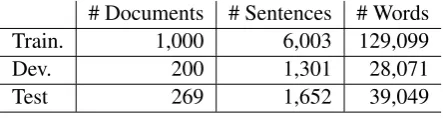
# Documents # Sentences # Words
Train. 1,000 6,003 129,099
Dev. 200 1,301 28,071
Test 269 1,652 39,049
Table 4: Statistics of the data used for Task 4. Number of documents, sentences and (target) words for train-ing, development and test.
views dataset (McAuley et al., 2015; He and
McAuley, 2016).8 More specifically, the data is
a selection of Sports and Outdoors product titles and descriptions in English which has been ma-chine translated into French using a state of the art online neural MT system. The most popular products (those with more reviews) were chosen. This data poses interesting challenges for machine translation: titles and descriptions are often short and not always a complete sentence. Spans cover-ing one or more tokens were annotated with error labels following fine-grained error taxonomy, as described in more detail in Section8. The dataset statistics are presented in Table 4. This is the largest ever released collection with word-level er-rors manually annotated.
8http://jmcauley.ucsd.edu/data/amazon/
.
5 Task 1: Predicting sentence-level quality
This task consists in scoring (and ranking) transla-tion sentences according to the proportransla-tion of their words that need to be fixed. HTER is used as quality score, i.e. the minimum edit distance be-tween the machine translation and its manually post-edited version.
Labels Three labels were available: percentage of edits need to be fixed (HTER) (primary label), post-editing time in seconds, and counts of vari-ous types of keystrokes. The PET tool (Aziz et al., 2012)9 was used to collect various types of
in-formation during post-editing. HTER labels were computed using the TERCOM tool10with default
settings (tokenised, case insensitive, exact match-ing only), with scores capped to 1.
Evaluation Evaluation was performed against the true HTER label and/or ranking, using the fol-lowing metrics:
• Scoring: Pearson’s r correlation score
(pri-mary metric, official score for ranking system submissions), Mean Absolute Error (MAE) and Root Mean Squared Error (RMSE).
• Ranking: Spearman’sρrank correlation.
Statistical significance on Pearsonr was
com-puted using the William’s test.11
Results For Task 1, Tables 5, 6, 7 and8 sum-marise the results for English–German, German– English, English–Latvian and English-Czech, re-spectively, ranking participating systems best to worst using Pearson’srcorrelation as primary key.
[image:8.595.72.294.395.454.2]Spearman’sρcorrelation scores should be used to rank systems for the ranking variant of the evalua-tion.
The top two systems for this task, the QEBrain model and UNQE models, show a large perfor-mance gap with respect to the rest of the sys-tems, for both SMT and NMT data. It is inter-esting to note that both systems outperform the SHEF-PT system by a large margin. SHEF-PT is a reimplementation of the POSTECH system, which showed the top performance in 2017.
6 Task 2: Predicting word-level quality
This task evaluates the extent to which we can de-tect word-level errors in MT output. Often the overall quality of a translated segment is signifi-cantly harmed by specific errors in a small num-ber of words. As in previous years, each token of the target sentence is labeled as OK/BAD based on an available post-edited sentence. In addition to this, this year we also took into consideration word omission errors and the detection of words in the source related to target side errors. These types of errors become particularly relevant in the context of NMT systems. The code to produce this new set of tags from any prior WMT corpora is available for download.12
Target word labels As in previous years, the binary labels for each target token (OK and BAD) were derived automatically by aligning each machine translated sentence with its post-edited counterpart sentence. The alignment at token-level was performed using the TERCOM tool. De-fault settings were used and shifts were disabled. Target tokens originating from insertion or substi-tution errors were labeled as BAD. All other to-kens were labeled as OK.
Gap and source word labels To annotate dele-tion errors, gap ‘tokens’ between each word and at the beginning of each target sentence were in-troduced. These gaps tokens were labeled as BAD in the presence of one or more deletion errors and OK otherwise. To annotate the source words re-lated to insertion or substitution errors in the ma-chine translated sentence, the IBM Model 2 align-ments from fastalign (Dyer et al.,2013) were used. Each token in the source sentence was aligned to the post-edited sentence. For each token in the
12https://github.com/Unbabel/
word-level-qe-corpus-builder
post-edited sentence deleted or substituted in the machine translated text, the corresponding aligned source tokens were labeled as BAD. In this way, deletion errors also result in BAD tokens in the source, related to the missing words. All other words were labeled as OK.
Evaluation Analogously to last year’s task, the primary evaluation metric is the multiplication of
F1-scores for the OK and BAD classes, denoted
as F1-Mult. The same metric was applied to gap
and source token labels. We also reportF1-scores
for individual classes for completeness. We test the significance of the results using randomisa-tion tests (Yeh, 2000) with Bonferroni correction (Abdi,2007).
Results The results for Task 2 are summarised in Tables9,10,11and12, ordered by the F1-mult
metric.
The number of submissions per language pair was different, which limits any conclusions that can be made with respect to general rankings of systems. The English-German and German-English tasks – Tables9, 10 – had the most sys-tems participating. As in previous years, results in Task1 and Task2 are correlated. In this case the same system, QEBrain, wins both tasks for these language pairs. Since some of the other systems for Task 1 where specific for sentence-level pre-diction, the next system in the ranking is SHEF-PT, which lags behind by a margin slightly smaller than in Task 1. Another interesting result for this year is the differences between SMT and NMT datasets. For English-German, there is a clear drop in performance from SMT to NMT. This can be due to changes in the type of errors, or size of training sets, as we discuss in Section9.
Regarding the novel task variants of detection of gaps and source words that lead to errors, only a few teams submitted systems. The performance for these tasks is lower, but correlated with the performance of the main word-level task – predic-tion of target word errors. It is worth noting that the QEBrain system obtains notable performance for gap error detection, almost doubling the per-formance of other (few) participating systems for SMT data.
Model Pearsonr MAE RMSE Spearmanρ
SMTDATASET
•QEBrain DoubleBi w/ BPE+word-tok (ensemble) 0.74 0.09 0.14 0.75
QEBrain DoubleBi w/ BPE-tok 0.73 0.10 0.14 0.75
UNQE 0.70 0.10 0.14 0.72
TSKQE2 0.49 0.13 0.17 0.00
SHEF-PT 0.49 0.13 0.17 0.51
TSKQE1 0.48 0.13 0.17 0.00
UTartu/QuEst+Attention 0.43 0.14 0.17 0.42
UTartu/QuEst+Att+CrEmb3 0.42 0.14 0.17 0.42
sMQE 0.40 0.19 0.22 0.40
RTM MIX7 0.39 0.14 0.18 0.40
RTM MIX6 0.39 0.14 0.18 0.40
SHEF-bRNN 0.37 0.14 0.18 0.38
BASELINE 0.37 0.14 0.18 0.38
uMQE – – – 0.38
UAlacant** 0.39 0.18 0.23 0.39
NMTDATASET
•UNQE 0.51 0.11 0.17 0.61
•QEBrain DoubleBi w/ BPE+word-tok (ensemble) 0.50 0.11 0.17 0.60
•QEBrain DoubleBi w/ word-tok 0.50 0.11 0.17 0.60
TSKQE1 0.42 0.14 0.18 0.00
TSKQE2 0.41 0.14 0.18 0.00
SHEF-bRNN 0.38 0.13 0.18 0.48
SHEF-PT 0.38 0.13 0.18 0.47
UTartu/QuEst+Attention 0.37 0.13 0.18 0.44
sMQE 0.37 0.21 0.24 0.44
UTartu/QuEst+Att+CrEmb3 0.37 0.13 0.18 0.44
BASELINE 0.29 0.13 0.19 0.42
uMQE – – – 0.40
UAlacant** 0.23 0.21 0.26 0.24
RTM MIX5** 0.47 0.12 0.17 0.55
Table 5: Official results of the WMT18 Quality Estimation Task 1 for theEnglish–Germandataset. The winning submission is indicated by a•. Baseline systems are highlighted in grey, and ** indicates late submissions that were not considered for the official ranking of participating systems.
Model Pearsonr MAE RMSE Spearmanρ
•UNQE 0.77 0.09 0.13 0.73
•QEBrain DoubleBi w/ BPE+word-tok (ensemble) 0.76 0.10 0.13 0.73
•QEBrain DoubleBi w/ word-tok 0.75 0.10 0.14 0.72
sMQE 0.65 0.12 0.15 0.60
UTartu/QuEst+Att+CrEmb3 0.57 0.14 0.18 0.47
SHEF-PT 0.55 0.13 0.17 0.50
UTartu/QuEst+Attention 0.55 0.14 0.17 0.47
SHEF-bRNN 0.48 0.14 0.19 0.44
BASELINE 0.33 0.15 0.19 0.32
UAlacant** 0.63 0.12 0.17 0.60
RTM MIX5** 0.54 0.13 0.17 0.49
[image:10.595.81.531.545.709.2] [image:10.595.91.518.545.710.2]Model Pearsonr MAE RMSE Spearmanρ
SMT DATASET
•UNQE 0.62 0.12 0.16 0.58
sMQE 0.46 0.13 0.18 0.41
UTartu/QuEst+Att+CrEmb3 0.40 0.16 0.20 0.32
UTartu/QuEst+Attention 0.40 0.15 0.19 0.32
SHEF-bRNN 0.40 0.14 0.19 0.33
SHEF-PT 0.38 0.14 0.19 0.33
BASELINE 0.35 0.16 0.19 0.35
uMQE – – – 0.40
UAlacant** 0.36 0.20 0.26 0.34
RTM MIX** 0.35 0.14 0.19 0.28
NMTDATASET
•UNQE 0.68 0.13 0.17 0.67
sMQE 0.58 0.15 0.19 0.57
UTartu/QuEst+Att+CrEmb3 0.54 0.16 0.20 0.50
UTartu/QuEst+Attention 0.53 0.16 0.20 0.49
SHEF-PT 0.46 0.17 0.22 0.45
BASELINE 0.44 0.16 0.22 0.46
SHEF-bRNN 0.42 0.17 0.22 0.41
uMQE – – – 0.54
UAlacant** 0.56 0.17 0.22 0.55
RTM MIX** 0.54 0.16 0.20 0.50
Table 7: Official results of the WMT18 Quality Estimation Task 1 for theEnglish–Latviandataset. The winning submission is indicated by a•. Baseline systems are highlighted in grey, and ** indicates late submissions that were not considered for the official ranking of participating systems.
Model Pearsonr MAE RMSE Spearmanρ
•UNQE 0.69 0.12 0.17 0.71
SHEF-PT 0.53 0.15 0.19 0.54
SHEF-bRNN 0.50 0.16 0.20 0.51
UTartu/QuEst+Attention 0.45 0.16 0.20 0.46
UTartu/QuEst+Att+CrEmb3 0.41 0.17 0.21 0.40
BASELINE 0.39 0.17 0.21 0.41
sMQE 0.39 0.16 0.21 0.42
uMQE – – – 0.42
UAlacant** 0.44 0.18 0.23 0.46
RTM MIX** 0.52 0.15 0.20 0.53
Table 8: Official results of the WMT18 Quality Estimation Task 1 for theEnglish–Czechdataset. The winning submission is indicated by a•. Baseline systems are highlighted in grey, and ** indicates late submissions that were not considered for the official ranking of participating systems.
the general low performance of systems on the English-Latvian NMT data: all systems are tied with the baseline in terms of F1-mult. The
reim-plementation of the POSTECH system shows poor results on the NMT dataset, in this case it is unable to outperform the baseline. Results for English-Czech are very similar across systems.
7 Task 3: Predicting phrase-level quality
[image:11.595.69.527.63.377.2] [image:11.595.72.533.429.583.2]Labels We used the phrase segmentation pro-duced by the SMT decoder which generated the translations for the dataset. The phrases were annotated for errors using four classes: ’OK’, ’BAD’ – the phrase contain one or more errors, ’BAD word order’ – the phrase is in an incorrect position in the sentence, and ’BAD omission’ – a word is missing before/after a phrase. This task in further subdivided in two subtasks: word-level prediction (Task3a), and phrase-level prediction (Task3b).
The data for Task3a propagates the annotation of each phrase to its words, and thus uses word-level segmentation for both source and machine-translated sentences, such that the task can be ad-dressed as a word-level prediction task. In other words, all tokens in the target sentence are labelled according to the label of the phrase they belong to. Therefore, if the phrase is annotated as either ’OK’, ’BAD’ or ’BAD word order’, all tokens (and gap tokens) within that phrase are labelled as either ’OK’, ’BAD’ or ’BAD word order’. To an-notate omission errors, a gap token is inserted after each token and at the start of the sentence.
The data for Task3b has phrase-level segmen-tation with the labels assigned by the human an-notator to each phrase. A gap token is inserted after each phrase and at the start of the sen-tence. The gap is labelled as follows: ’OK’ or ’BAD omission’, where the latter indicates that one or more words are missing.
Evaluation Similarly to Task 2, our primary metric for predictions at word-level (Task3a) is the multiplication of the F1 scores of the OK and
BAD classes, F1-Mult, while for predictions at
phrase-level (Task3b), our primary metric is the phrase-level version of F1-Mult. The same
met-rics were applied to gap and source token labels for both sub-tasks, along with F1 scores for
indi-vidual classes for completeness. We also report F1 score for BAD word order labels on the target
tokens for Task3b. We computed statistical sig-nificance of the results using randomised test with Bonferroni correction, as in Task 2.
Results The results of the phrase-level task are given in Tables 13(Task3a) and14 (Task3b), or-dered by the F1-Mult metric.
Comparing the results for Task3a with the re-sults on German-English for Task 2 (Table10), it can be observed a general degradation of the F1
score on the BAD class, including for the base-line system. We attribute this phenomenon to the way the data for this task was created: for Task 2, the token labels were produced from post-editing, where each word was labelled independently from each others; while for this task, the token labels are deduced from a labelling at more coarse level (phrase), i.e. where words were not considered as individual tokens. Consequently, words that would be considered as correct during post-editing are here labelled as BAD, like to BAD phrase they belong to. The only two official submissions to this subtask (SHEF-PT and SHEF-bRNN) slightly outperform the baseline system, nevertheless with-out a statistically significant difference.
For the phrase-level predictions, the baseline system remains ahead by a significant margin of the only two official submissions, both from the University of Sheffield (SHEF-ATT-SUM and SHEF-PT). The overall performance in predicting phrases that are in incorrect position in a sentence (i.e. BAD word order) shows that this problem re-mains a very challenging task, as none of the sub-missions were able to obtain competitive F1score.
8 Task 4: Predicting document-level QE
This task consists in estimating a document-level quality score according to the amount of minor, major, and critical errors present in the translation. The predictions are compared to a ground-truth obtained from annotations produced by crowd-sourced human translators from Unbabel.13
Labels The data was annotated for errors at the word level using a fine-grained error taxonomy – Multidimensional Quality Metrics (MQM) (
Lom-mel et al., 2014) – similar to the one used in
(Sanchez-Torron and Koehn, 2016). MQM is
composed of three major branches: accuracy (the translation does not accurately reflect the source text), fluency (the translation affects the reading of the text) and style (the translation has stylistic problems, like the use of a wrong register). These branches include more specific issues lower in the hierarchy. Besides the identification of an error and its classification according to this typology (by applying a specific tag), the errors receive a severity scale that reflects the impact of each er-ror on the overall meaning, style, and fluency of the translation. An error can be minor(if it does
not lead to a loss of meaning and it doesn’t con-fuse or mislead the user),major(if it changes the meaning) orcritical(if it changes the meaning and carry any type of implication, or could be seen as offensive).
Document-level scores were then generated from the word-level errors and their severity us-ing the method described in Sanchez-Torron and
Koehn (2016, footnote 6). Namely, denoting by
n the number of words in the document, and by nmin,nmaj, andncrithe number of annotated
mi-nor, major, and critical errors, the final quality scores were computed as:
MQM Score= 1−nmin+ 5nmaj+ 10ncri
n (1)
Note that MQM values can be negative if the total severity exceeds the number of words.
Evaluation Submissions are evaluated as in Task 1 (see Section5), in terms of Pearson’s corre-lationrbetween the true and predicted
document-level scores.
Results The results of the document-level task are shown in Table 15. Due to the different nu-meric range, only the Pearson correlation scores are comparable to those of Task1. Comparing with the results for Task 1, it can be observed that the baseline system already obtains very high correla-tion. The neural model SHEF-PT-indomain out-performs the baseline by a modest margin, com-pared to the results obtained in Task 1.
Model Pearsonr MAE
•SHEF-PT-indomain 0.53 0.56
BASELINE 0.51 0.56
SHEF-mtl-bRNN 0.47 0.56
SHEF-mtl-PT-indomain** 0.52 0.57
[image:17.595.73.290.507.602.2]RTM MIX1** 0.11 0.58
Table 15: Official results of the WMT18 Quality Es-timation Task 4 for theEnglish–Frenchdataset. The winning submission is indicated by a•. Baseline sys-tem is in grey, and ** indicates late submissions that were not considered for the official ranking of partici-pating systems.
9 Discussion
In what follows, we discuss the main findings of this year’s shared task based on the goals we had previously identified for it.
Performance of QE approaches on the out-put of neural MT systems. As previously men-tioned, some of the data used for Tasks 1 and 2 is translated by both an SMT and an NMT system: the English-German and English-Latvian data. In Task 1, for English-German, the numbers of translations in the QE training data from the two systems are very different (26,273for SMT
and 13,442 for NMT) and thus no direct
com-parison can be made. This shows that the NMT system was of much higher quality than the SMT one, producing many more sentences that led to HTER=0. Of the sentences that remained, the
average NMT quality in the training data is still higher: HTER=0.154versus0.253for SMT. From
the results, the top systems do considerably better on the SMT data (r=0.74for SMT vs r=0.51for
NMT translations). This difference is also notice-able for the baseline system (r=0.37for SMT vs r=0.29 for NMT translations). This could
how-ever be because of the difference in number of samples and/or significant differences in distribu-tions of HTER scores in the two datasets. It is worth pointing out that the winning submissions are the same for both SMT and NMT transla-tion: QEBrain and UNQE. In fact, QE system are ranked very similarly for the two types of transla-tion.
For English-Latvian, the number of NMT and SMT QE training sentences is similar (12,936for
NMT and11,251for SMT). Their average HTER
scores is also more comparable: 0.278for NMT
and 0.215 for SMT. The difference in QE
sys-tem performance for this language pair is not as marked, but the trend is inverted when compared to English-German: QE systems do better on the NMT data (the top systems, UNQE, achieves
r=0.62for SMT vsr=0.68for NMT translations,
while the baseline achieves r=0.44 for SMT vs
r=0.35 for NMT translations), This could be
be-cause of the lower differences in the distribution of HTER scores in both sets. The ranking of QE sys-tems is exactly the same for both SMT and NMT translations.
not, and vice-versa. The main finding is that QE models seem to be robust to different types of translation, since their rankings are the same across datasets.
For Task 2, the trend is similar: QE sys-tems for English-German also perform better on SMT translations than on NMT translations (F1
-Mult=0.62 for SMT vs F1-Mult=0.44 for NMT),
and the inverse is observed for English-Latvian (F1-Mult=0.36 for SMT vs F1-Mult=0.43 for
NMT). The ranking of QE systems for the two types of translations differs more than for Task 1, especially for English-Latvian.
Task 4 uses NMT output only and it is hard to make any conclusions about whether the perfor-mance of the systems is good enough because this is the first time this task is organised. Generally speaking, this task proved hard, with the baseline system performing as well or better than the other submissions.
Predictability of missing words in the MT out-put. Only a subset of the systems that partici-pated in Task 2 submitted results for missing word detection. From the results obtained it seems clear that while this task is more difficult than target word error detection, high scores could be attained for the SMT data. Due to the small number of sub-mitted systems, it is unclear whether or not gap detection is more difficult for NMT data.
Predictability of source words that lead to er-rors in the MT output. Only a small set of teams submitted predictions for source words. From the submitted results, it can be observed that prediction of source words related to errors is a harder problem than detecting errors in the target language. This may be due to the fact that there may be more ambiguity with regards to which words should be related to errors in the target. In other words, in some cases a source word in a given context leads to incorrect translations, while in other cases the same source word in the same context will not lead to errors.
Effectiveness of manually assigned labels for phrases. With only one official (and one late) submission to the phrase-level QE task this year, it is hard to conclude whether having manual la-bels makes the task harder (although the baseline system performs as well as in the last edition), or whether the reason lies in the design of the neural models, which may not be suitable for this task.
Quality prediction for documents from errors annotated at word-level with added severity judgements. Since this is a new task and not many systems were submitted. Results show how-ever that it is possible to attain Pearson correlation scores that are comparable with those of sentence-level post-editing effort prediction. The perfor-mance gap between the neural model and the SVM baseline is smaller than in Task 1, which may be an indication for further potential gains using new deep learning architectures tailored for document-level.
Utility of additional evidence To investigate the utility of detailed information logged dur-ing post-editdur-ing, we offered to participants other sources of information: post-editing time, keystrokes, and actual edits. Surprisingly, no par-ticipating system requested these additional labels, and therefore this remains an open question.
10 Conclusions
This year’s edition of the QE shared task was the largest ever organised in many respects: number of tasks, number of languages, variety of tasks (three granularity levels), types of annotation (de-rived from post-editing or manual, source or tar-get), and number of samples annotated.
Over the years, we have attempted to find a balance between keeping the shared task as close as possible to previous editions – so as to make some form of comparison across years possible – and proposing new tasks and new interesting chal-lenges – so as to keep up to date with new de-velopments in the field, such as neural machine translations. We believe the current set of tasks covers a broad enough range of challenges that are far from solved, such as improving performance given smaller sets of instances, predicting source words that lead to errors, predicting gaps, use of additional evidence from post-editing, etc.
leaderboard. The submission pages for each task are as follows, where languages and task variants are frames as ‘phases’:
• Sentence level: https://
competitions.codalab.org/ competitions/19316
• Word level: https://competitions.
codalab.org/competitions/19306
• Phrase level:https://competitions. codalab.org/competitions/19308
• Document level: https://
competitions.codalab.org/ competitions/19309
Acknowledgments
The data and annotations collected for Tasks 1, 2 and 3 was supported by the EC H2020 QT21 project (grant agreement no. 645452). The shared task organisation was also sup-ported by the QT21 project, national funds through Fundac¸˜ao para a Ciˆencia e Tecnologia (FCT), with references UID/CEC/50021/2013 and UID/EEA/50008/2013, and by the European Re-search Council (ERC StG DeepSPIN 758969). We would also like to thank Julie Beli˜ao and the Unba-bel Quality Team for coordinating the annotation of the dataset used in Task 4.
References
Herv´e Abdi. 2007. The bonferroni and ˇsid´ak correc-tions for multiple comparisons. Encyclopedia of measurement and statistics, 3:103–107.
Wilker Aziz, Sheila Castilho Monteiro de Sousa, and Lucia Specia. 2012. Pet: a tool for post-editing and assessing machine translation. In Eighth Interna-tional Conference on Language Resources and Eval-uation, LREC, pages 3982–3987, Istanbul, Turkey.
Prasenjit Basu, Santanu Pal, and Sudip Kumar Naskar. 2018. Keep it or not: Word level quality estimation for post-editing. In Proceedings of the Third Con-ference on Machine Translation, Volume 2: Shared Tasks Papers, Brussels, Belgium. Association for Computational Linguistics.
Ergun Bic¸ici. 2017. Predicting translation performance with referential translation machines. In Proceed-ings of the Second Conference on Machine Trans-lation, Volume 2: Shared Task Papers, pages 540– 544, Copenhagen, Denmark. Association for Com-putational Linguistics.
Ergun Bic¸ici. 2018. Rtm results for predicting transla-tion performance. InProceedings of the Third Con-ference on Machine Translation, Volume 2: Shared Tasks Papers, Brussels, Belgium. Association for Computational Linguistics.
Ergun Bicici. 2013. Referential translation machines for quality estimation. InProceedings of the Eighth Workshop on Statistical Machine Translation, pages 343–351, Sofia, Bulgaria. Association for Computa-tional Linguistics.
Ondrej Bojar, Christian Buck, Chris Callison-Burch, Christian Federmann, Barry Haddow, Philipp Koehn, Christof Monz, Matt Post, Radu Soricut, and Lucia Specia. 2013. Findings of the 2013 Workshop on Statistical Machine Translation. In
Eighth Workshop on Statistical Machine Transla-tion, WMT, pages 1–44, Sofia, Bulgaria.
Ondrej Bojar, Christian Buck, Christian Federmann, Barry Haddow, Philipp Koehn, Johannes Leveling, Christof Monz, Pavel Pecina, Matt Post, Herve Saint-Amand, Radu Soricut, Lucia Specia, and Aleˇs Tamchyna. 2014. Findings of the 2014 workshop on statistical machine translation. InNinth Workshop on Statistical Machine Translation, WMT, pages 12–58, Baltimore, Maryland.
Ondˇrej Bojar, Rajen Chatterjee, Christian Federmann, Yvette Graham, Barry Haddow, Matthias Huck, Antonio Jimeno Yepes, Philipp Koehn, Varvara Logacheva, Christof Monz, Matteo Negri, Aure-lie Neveol, Mariana Neves, Martin Popel, Matt Post, Raphael Rubino, Carolina Scarton, Lucia Spe-cia, Marco Turchi, Karin Verspoor, and Marcos Zampieri. 2016. Findings of the 2016 conference on machine translation. InProceedings of the First Conference on Machine Translation, pages 131– 198, Berlin, Germany. Association for Computa-tional Linguistics.
Ondˇrej Bojar, Rajen Chatterjee, Christian Federmann, Yvette Graham, Barry Haddow, Matthias Huck, Philipp Koehn, Varvara Logacheva, Christof Monz, Matteo Negri, Matt Post, Raphael Rubino, Lucia Specia, and Marco Turchi. 2017. Findings of the 2017 conference on machine translation (wmt17). In Proceedings of the Second Conference on Ma-chine Translation, Volume 2: Shared Tasks Papers, Copenhagen, Denmark. Association for Computa-tional Linguistics.
Ondˇrej Bojar, Rajen Chatterjee, Christian Federmann, Barry Haddow, Matthias Huck, Chris Hokamp, Philipp Koehn, Varvara Logacheva, Christof Monz, Matteo Negri, Matt Post, Carolina Scarton, Lucia Specia, and Marco Turchi. 2015. Findings of the 2015 Workshop on Statistical Machine Translation. InProceedings of the Tenth Workshop on Statistical Machine Translation, pages 1–46, Lisbon, Portugal. Association for Computational Linguistics.
Findings of the 2012 workshop on statistical ma-chine translation. In Seventh Workshop on Sta-tistical Machine Translation, WMT, pages 10–51, Montr´eal, Canada.
Melania Duma and Wolfgang Menzel. 2018. The bene-fit of pseudo-reference translations in quality estima-tion of mt output. InProceedings of the Third Con-ference on Machine Translation, Volume 2: Shared Tasks Papers, Brussels, Belgium. Association for Computational Linguistics.
Chris Dyer, Victor Chahuneau, and Noah A Smith. 2013. A simple, fast, and effective reparameteriza-tion of ibm model 2. In Proceedings of the 2013 Conference of the North American Chapter of the Association for Computational Linguistics: Human Language Technologies, pages 644–648.
Thierry Etchegoyhen, Eva Mart´ınez Garcia, and An-doni Azpeitia. 2018. Supervised and unsupervised minimalist quality estimators: Vicomtech’s partici-pation in the wmt 2018 quality estimation task. In
Proceedings of the Third Conference on Machine Translation, Volume 2: Shared Tasks Papers, Brus-sels, Belgium. Association for Computational Lin-guistics.
Ruining He and Julian McAuley. 2016. Ups and downs: Modeling the visual evolution of fashion trends with one-class collaborative filtering. In
proceedings of the 25th international conference on world wide web, pages 507–517. International World Wide Web Conferences Steering Committee.
Junjie Hu, Wei-Cheng Chang, Yuexin Wu, and Graham Neubig. 2018. Contextual encoding for translation quality estimation. InProceedings of the Third Con-ference on Machine Translation, Volume 2: Shared Tasks Papers, Brussels, Belgium. Association for Computational Linguistics.
Julia Ive, Fr´ed´eric Blain, and Lucia Specia. 2018a. DeepQuest: a framework for neural-based qual-ity estimation. In Proceedings of COLING 2018, the 27th International Conference on Computational Linguistics: Technical Papers, Santa Fe, New Mex-ico.
Julia Ive, Carolina Scarton, Fr´ed´eric Blain, and Lucia Specia. 2018b. Sheffield submissions for the wmt18 quality estimation shared task. InProceedings of the Third Conference on Machine Translation, Volume 2: Shared Tasks Papers, Brussels, Belgium. Associ-ation for ComputAssoci-ational Linguistics.
Hyun Kim, Jong-Hyeok Lee, and Seung-Hoon Na. 2017. Predictor-estimator using multilevel task learning with stack propagation for neural quality estimation. In Proceedings of the Second Confer-ence on Machine Translation, Volume 2: Shared Tasks Papers, pages 562–568, Copenhagen, Den-mark. Association for Computational Linguistics.
Julia Kreutzer, Shigehiko Schamoni, and Stefan Rie-zler. 2015. QUality Estimation from ScraTCH (QUETCH): Deep Learning for Word-level Transla-tion Quality EstimaTransla-tion. InProceedings of the Tenth Workshop on Statistical Machine Translation, pages 297–303, Lisboa, Portugal. Association for Compu-tational Linguistics.
Quoc Le and Tomas Mikolov. 2014. Distributed repre-sentations of sentences and documents. In Proceed-ings of the 31st International Conference on Ma-chine Learning, pages 1188–1196.
Maoxi Li, Qingyu Xiang, Zhiming Chen, and Ming-weng Wang. 2018. A unified neural network for quality estimation of machine translation. IEICE Trans. Information and Systems, E101-D(9).
Varvara Logacheva, Chris Hokamp, and Lucia Specia. 2016. Marmot: A toolkit for translation quality es-timation at the word level. In Tenth International Conference on Language Resources and Evaluation, LREC, pages 3671–3674, Portoroz, Slovenia.
Arle Richard Lommel, Aljoscha Burchardt, and Hans Uszkoreit. 2014. Multidimensional quality metrics (MQM): A framework for declaring and describing translation quality metrics. Tradum`atica: tecnolo-gies de la traducci´o, 0(12):455–463.
Ngoc Quang Luong, Laurent Besacier, and Benjamin Lecouteux. 2014. Word confidence estimation for smt n-best list re-ranking. In Proceedings of the EACL 2014 Workshop on Humans and Computer-assisted Translation, pages 1–9, Gothenburg, Swe-den. Association for Computational Linguistics.
Andr´e F. T. Martins, Ram´on Astudillo, Chris Hokamp, and Fabio Kepler. 2016. Unbabel’s participation in the wmt16 word-level translation quality estimation shared task. InProceedings of the First Conference on Machine Translation, pages 806–811, Berlin, Germany. Association for Computational Linguis-tics.
Julian McAuley, Christopher Targett, Qinfeng Shi, and Anton Van Den Hengel. 2015. Image-based recom-mendations on styles and substitutes. In Proceed-ings of the 38th International ACM SIGIR Confer-ence on Research and Development in Information Retrieval, pages 43–52. ACM.
Sylvain Raybaud, David Langlois, and Kamel Smaili. 2011. ”this sentence is wrong.” detecting errors in machine-translated sentences. Machine Translation, 25(1):1–34.
Marina Sanchez-Torron and Philipp Koehn. 2016. Ma-chine translation quality and post-editor productiv-ity.AMTA 2016, Vol., page 16.
Lucia Specia, Kim Harris, Fr´ed´eric Blain, Aljoscha Burchardt, Viviven Macketanz, Inguna Skadina, Matteo Negri, , and Marco Turchi. 2017. Transla-tion quality and productivity: A study on rich mor-phology languages. InMachine Translation Summit XVI, pages 55–71, Nagoya, Japan.
Lucia Specia, Gustavo Paetzold, and Carolina Scarton. 2015. Multi-level translation quality prediction with quest++. InACL-IJCNLP 2015 System Demonstra-tions, pages 115–120, Beijing, China.
Ashish Vaswani, Noam Shazeer, Niki Parmar, Jakob Uszkoreit, Llion Jones, Aidan N Gomez, Ł ukasz Kaiser, and Illia Polosukhin. 2017. Attention is all you need. In I. Guyon, U. V. Luxburg, S. Bengio, H. Wallach, R. Fergus, S. Vishwanathan, and R. Gar-nett, editors, Advances in Neural Information Pro-cessing Systems 30, pages 5998–6008. Curran As-sociates, Inc.
Jiayi Wang, Kai Fan, Bo Li, Fengming Zhou, Box-ing Chen, Yangbin Shi, and Luo Si. 2018. Alibaba submission for wmt18 quality estimation task. In
Proceedings of the Third Conference on Machine Translation, Volume 2: Shared Tasks Papers, Brus-sels, Belgium. Association for Computational Lin-guistics.
Elizaveta Yankovskaya, Andre Tattar, and Mark Fishel. 2018. Quality estimation with force-decoded atten-tion and cross-lingual embeddings. InProceedings of the Third Conference on Machine Translation, Volume 2: Shared Tasks Papers, Brussels, Belgium. Association for Computational Linguistics.
Alexander Yeh. 2000. More Accurate Tests for the Statistical Significance of Result Differences. In