162
Findings of the NLP4IF-2019 Shared Task
on Fine-Grained Propaganda Detection
Giovanni Da San Martino1 Alberto Barr´on-Cede ˜no2 Preslav Nakov1
1 Qatar Computing Research Institute, HBKU, Qatar
2 Universit`a di Bologna, Forl`ı, Italy
{gmartino, pnakov}@hbku.edu.qa [email protected]
Abstract
We present the shared task on Fine-Grained Propaganda Detection, which was organized as part of the NLP4IF workshop at EMNLP-IJCNLP 2019. There were two subtasks. FLC is a fragment-level task that asks for the iden-tification of propagandist text fragments in a news article and also for the prediction of the specific propaganda technique used in each such fragment (18-way classification task). SLC is a sentence-level binary classification task asking to detect the sentences that con-tain propaganda. A total of 12 teams submit-ted systems for the FLC task, 25 teams did so for the SLC task, and 14 teams eventu-ally submitted a system description paper. For both subtasks, most systems managed to beat the baseline by a sizable margin. The leader-board and the data from the competition are available athttp://propaganda.qcri. org/nlp4if-shared-task/.
1 Introduction
Propaganda aims at influencing people’s mindset with the purpose of advancing a specific agenda. In the Internet era, thanks to the mechanism of sharing in social networks, propaganda cam-paigns have the potential of reaching very large audiences (Glowacki et al., 2018; Muller, 2018; Tard´aguila et al.,2018).
Propagandist news articles use specific techniques to convey their message, such as
whataboutism, red Herring, and name calling, among many others (cf. Section 3). Whereas proving intent is not easy, we can analyse the language of a claim/article and look for the use of specific propaganda techniques. Going at this fine-grained level can yield more reliable systems and it also makes it possible to explain to the user why an article was judged as propagandist by an automatic system.
With this in mind, we organised the shared task on fine-grained propaganda detection at the NLP4IF@EMNLP-IJCNLP 2019 workshop. The task is based on a corpus of news articles anno-tated with an inventory of 18 propagandist tech-niques at the fragment level. We hope that the corpus would raise interest outside of the commu-nity of researchers studying propaganda. For ex-ample, the techniques related to fallacies and the ones relying on emotions might provide a novel setting for researchers interested in Argumentation and Sentiment Analysis.
2 Related Work
Propaganda has been tackled mostly at the arti-cle level. Rashkin et al.(2017) created a corpus of news articles labelled as propaganda, trusted, hoax, or satire. Barr´on-Cede˜no et al. (2019) ex-perimented with a binarized version of that cor-pus: propaganda vs. the other three categories. Barr´on-Cedeno et al.(2019) annotated a large bi-nary corpus of propagandist vs. non-propagandist articles and proposed a feature-based system for discriminating between them. In all these cases, the labels were obtained using distant supervision, assuming that all articles from a given news out-let share the label of that outout-let, which inevitably introduces noise (Horne et al.,2018).
Unlike (Habernal et al., 2017,2018a,b), our cor-pus uses 18 techniques annotated on the same set of news articles. Moreover, our annotations aim at identifying the minimal fragments related to a technique instead of flagging entire arguments.
The most relevant related work is our own, which is published in parallel to this paper at EMNLP-IJCNLP 2019 (Da San Martino et al., 2019) and describes a corpus that is a subset of the one used for this shared task.
3 Propaganda Techniques
Propaganda uses psychological and rhetorical techniques to achieve its objective. Such tech-niques include the use of logical fallacies and ap-peal to emotions. For the shared task, we use 18 techniques that can be found in news articles and can be judged intrinsically, without the need to retrieve supporting information from external re-sources. We refer the reader to (Da San Martino et al., 2019) for more details on the propaganda techniques; below we report the list of techniques:
1. Loaded language. Using words/phrases with strong emotional implications (positive or nega-tive) to influence an audience (Weston,2018, p. 6).
2. Name calling or labeling. Labeling the ob-ject of the propaganda as something the target au-dience fears, hates, finds undesirable or otherwise loves or praises (Miller,1939).
3. Repetition. Repeating the same message over and over again, so that the audience will eventually accept it (Torok,2015;Miller,1939).
4. Exaggeration or minimization. Either rep-resenting something in an excessive manner: mak-ing thmak-ings larger, better, worse, or makmak-ing some-thing seem less important or smaller than it ac-tually is (Jowett and O’Donnell, 2012, p. 303), e.g., saying that an insult was just a joke.
5. Doubt. Questioning the credibility of some-one or something.
6. Appeal to fear/prejudice. Seeking to build support for an idea by instilling anxiety and/or panic in the population towards an alternative, possibly based on preconceived judgments.
7. Flag-waving. Playing on strong national feel-ing (or with respect to a group, e.g., race, gender, political preference) to justify or promote an ac-tion or idea (Hobbs and Mcgee,2008).
8. Causal oversimplification. Assuming one cause when there are multiple causes behind an issue. We includescapegoatingas well: the trans-fer of the blame to one person or group of people without investigating the complexities of an issue.
9. Slogans. A brief and striking phrase that may include labeling and stereotyping. Slogans tend to act as emotional appeals (Dan,2015).
10. Appeal to authority. Stating that a claim is true simply because a valid authority/expert on the issue supports it, without any other supporting evidence (Goodwin,2011). We include the special case where the reference is not an authority/expert, although it is referred to astestimonialin the liter-ature (Jowett and O’Donnell,2012, p. 237).
11. Black-and-white fallacy, dictatorship.
Presenting two alternative options as the only pos-sibilities, when in fact more possibilities exist (Torok, 2015). As an extreme case, telling the audience exactly what actions to take, eliminating any other possible choice (dictatorship).
12. Thought-terminating clich´e. Words or phrases that discourage critical thought and mean-ingful discussion about a given topic. They are typically short and generic sentences that offer seemingly simple answers to complex questions or that distract attention away from other lines of thought (Hunter,2015, p. 78).
13. Whataboutism. Discredit an opponent’s position by charging them with hypocrisy without directly disproving their argument (Richter,2017).
14. Reductio ad Hitlerum. Persuading an au-dience to disapprove an action or idea by suggest-ing that the idea is popular with groups hated in contempt by the target audience. It can refer to any person or concept with a negative connota-tion (Teninbaum,2009).
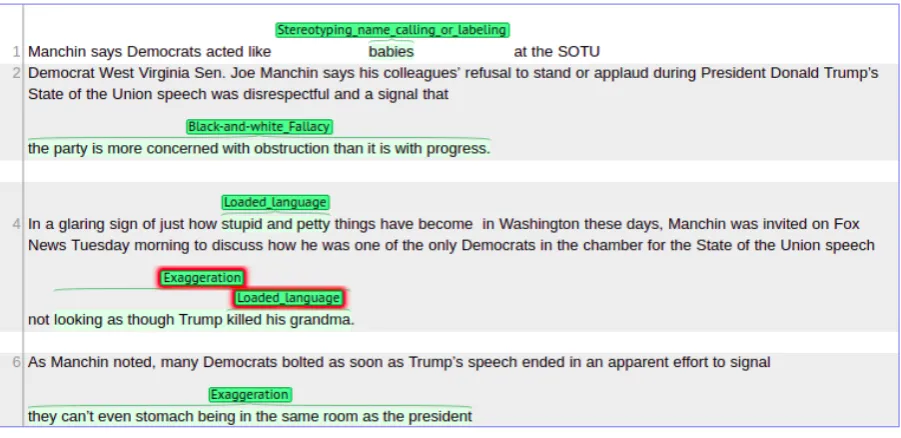
Figure 1: The beginning of an article with annotations.
16. Bandwagon. Attempting to persuade the target audience to join in and take the course of action because “everyone else is taking the same action” (Hobbs and Mcgee,2008).
17. Obfuscation, intentional vagueness, con-fusion. Using deliberately unclear words, to let the audience have its own interpretation (Supra-bandari,2007;Weston,2018, p. 8). For instance, when an unclear phrase with multiple possible meanings is used within the argument and, there-fore, it does not really support the conclusion.
18. Straw man. When an opponent’s proposi-tion is substituted with a similar one which is then refuted in place of the original (Walton,1996).
4 Tasks
The shared task features two subtasks:
Fragment-Level Classification task (FLC).
Given a news article, detect all spans of the text in which a propaganda technique is used. In addition, for each span the propaganda technique applied must be identified.
Sentence-Level Classification task (SLC). A sentence is considered propagandist if it contains at least one propagandist fragment. We then de-fine a binary classification task in which, given a sentence, the correct label, either propaganda or
non-propaganda, is to be predicted.
5 Data
The input for both tasks consists of news articles in free-text format, collected from 36 propagandist and 12 non-propagandist news outlets1 and then annotated by professional annotators. More de-tails about the data collection and the annotation, as well as statistics about the corpus can be found in (Da San Martino et al.,2019), where an earlier version of the corpus is described, which includes 450 news articles. We further annotated 47 addi-tional articles for the purpose of the shared task using the same protocol and the same annotators.
The training, the development, and the test par-titions of the corpus used for the shared task con-sist of 350, 61, and 86 articles and of 16,965, 2,235, and 3,526 sentences, respectively. Fig-ure 1 shows an annotated example, which con-tains several propaganda techniques. For ex-ample, the fragment babies on line 1 is an in-stance of bothName CallingandLabeling. Note that the fragment not looking as though Trump killed his grandmaon line 4 is an instance ofExaggeration or Minimisationand it overlaps with the fragment killed his grandma, which is an instance ofLoaded Language.
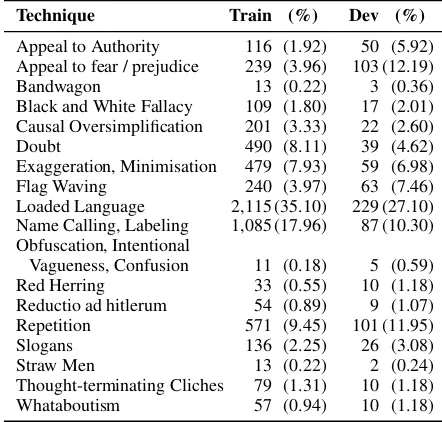
Table1reports the total number of instances per technique and the percentage with respect to the total number of annotations, for the training and for the development sets.
1We obtained the gold labels about whether a given news
Technique Train (%) Dev (%)
Appeal to Authority 116 (1.92) 50 (5.92) Appeal to fear / prejudice 239 (3.96) 103 (12.19)
Bandwagon 13 (0.22) 3 (0.36)
Black and White Fallacy 109 (1.80) 17 (2.01) Causal Oversimplification 201 (3.33) 22 (2.60)
Doubt 490 (8.11) 39 (4.62)
Exaggeration, Minimisation 479 (7.93) 59 (6.98)
Flag Waving 240 (3.97) 63 (7.46)
Loaded Language 2,115 (35.10) 229 (27.10) Name Calling, Labeling 1,085 (17.96) 87 (10.30) Obfuscation, Intentional
Vagueness, Confusion 11 (0.18) 5 (0.59)
Red Herring 33 (0.55) 10 (1.18)
Reductio ad hitlerum 54 (0.89) 9 (1.07)
Repetition 571 (9.45) 101 (11.95)
Slogans 136 (2.25) 26 (3.08)
Straw Men 13 (0.22) 2 (0.24)
Thought-terminating Cliches 79 (1.31) 10 (1.18)
[image:4.595.70.291.63.274.2]Whataboutism 57 (0.94) 10 (1.18)
Table 1: Statistics about the gold annotations for the training and the development sets.
6 Setup
The shared task had two phases: In the develop-ment phase, the participants were provided labeled training and development datasets; in the testing phase, testing input was further provided.
Phase 1. The participants tried to achieve the best performance on the development set. A live leaderboard kept track of the submissions.
Phase 2. The test set was released and the partici-pants had few days to make final predictions.
In phase 2, no immediate feedback on the submis-sions was provided. The winner was determined based on the performance on the test set.
7 Evaluation
FLC task. FLC is a composition of two sub-tasks: the identification of the propagandist text fragments and the identification of the techniques used (18-way classification task). While F1 mea-sure is appropriate for a multi-class classification task, we modified it to account for partial match-ing between the spans; see (Da San Martino et al., 2019) for more details. We further computed an F1 value for each propaganda technique (not shown below for the sake of saving space, but available on the leaderboard).
SLC task. SLC is a binary classification task with imbalanced data. Therefore, the official eval-uation measure for the task is the standard F1 mea-sure. We further report Precision and Recall.
8 Baselines
The baseline system for the SLC task is a very sim-ple logistic regression classifier with default pa-rameters, where we represent the input instances with a single feature: the length of the sentence. The performance of this baseline on the SLC task is shown in Tables4and5.
The baseline for the FLC task generates spans and selects one of the 18 techniques randomly. The inefficacy of such a simple random baseline is illustrated in Tables6and7.
9 Participants and Approaches
A total of 90 teams registered for the shared task, and 39 of them submitted predictions for a total of 3,065 submissions. For the FLC task, 21 teams made a total of 527 submissions, and for the SLC task, 35 teams made a total of 2,538 submissions.
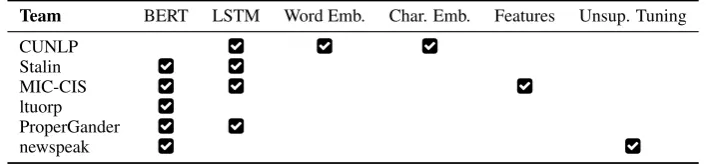
Below, we give an overview of the approaches as described in the participants’ papers. Tables2 and3offer a high-level summary.
9.1 Teams Participating in the
Fragment-Level Classification Only
Team newspeak (Yoosuf and Yang, 2019) achieved the best results on the test set for the FLC task using 20-way word-level classification based on BERT (Devlin et al.,2019): a word could be-long to one of the 18 propaganda techniques, to none of them, or to an auxiliary (token-derived) class. The team fed one sentence at a time in order to reduce the workload. In addition to ex-perimenting with an out-of-the-box BERT, they also tried unsupervised fine-tuning both on the 1M news dataset and on Wikipedia. Their best model was based on the uncased base model of BERT, with 12 Transformer layers (Vaswani et al.,2017), and 110 million parameters. Moreover, oversam-pling of the least represented classes proved to be crucial for the final performance. Finally, careful analysis has shown that the model pays special at-tention to adjectives and adverbs.
Team BERT LSTM Word Emb. Char. Emb. Features Unsup. Tuning
CUNLP
Stalin
MIC-CIS
ltuorp
ProperGander
newspeak
Table 2: Overview of the approaches for the fragment-level classification task.
Team BERT LSTM logreg USE CNN Embeddings Features Context
NSIT
CUNLP
JUSTDeep
Tha3aroon
LIACC
MIC-CIS
CAUnLP
YMJA
jinfen
[image:5.595.122.477.63.146.2]ProperGander
Table 3: Overview of the approaches used for the sentence-level classification task.
9.2 Teams Participating in the
Sentence-Level Classification Only
Team CAUnLP(Hou and Chen, 2019) used two context-aware representations based on BERT. In the first representation, the target sentence is fol-lowed by the title of the article. In the sec-ond representation, the previous sentence is also added. They performed subsampling in order to deal with class imbalance, and experimented with BERTBASE and BERTLARGE
TeamLIACC(Ferreira Cruz et al.,2019) used hand-crafted features and pre-trained ELMo em-beddings. They also observed a boost in perfor-mance when balancing the dataset by dropping some negative examples.
Team JUSTDeep(Al-Omari et al.,2019) used a combination of models and features, including word embeddings based on GloVe (Pennington et al.,2014) concatenated with vectors represent-ing affection and lexical features. These were combined in an ensemble of supervised models: bi-LSTM, XGBoost, and variations of BERT.
Team YMJA(Hua, 2019) also based their ap-proach on fine-tuned BERT. Inspired by kaggle
competitions on sentiment analysis, they created an ensemble of models via cross-validation.
Teamjinfen(Li et al.,2019) used a logistic re-gression model fed with a manifold of representa-tions, including TF.IDF and BERT vectors, as well as vocabularies and readability measures.
TeamTha3aroon(Fadel and Al-Ayyoub,2019) implemented an ensemble of three classifiers: two based on BERT and one based on a universal sen-tence encoder (Cer et al.,2018).
Team NSIT (Aggarwal and Sadana, 2019) ex-plored three of the most popular transfer learning models: various versions of ELMo, BERT, and RoBERTa (Liu et al.,2019).
TeamMindcoders(Vlad et al.,2019) combined BERT, Bi-LSTM and Capsule networks (Sabour et al.,2017) into a single deep neural network and pre-trained the resulting network on corpora used for related tasks, e.g., emotion classification.
Finally, teamltuorp (Mapes et al., 2019) used an attention transformer using BERT trained on Wikipedia and BookCorpus.
9.3 Teams Participating in Both Tasks
SLC Task: Test Set (Official Results)
Rank Team F1 Precision Recall
1ltuorp 0.6323 0.6028 0.6648
2 ProperGander 0.6256 0.5649 0.7009
3 YMJA 0.6249 0.6252 0.6246
4 MIC-CIS 0.6230 0.5735 0.6818
5 CUNLP 0.6183 0.5778 0.6648
6 Tha3aroon 0.6138 0.5309 0.7274 7 JUSTDeep 0.6112 0.5792 0.6468
8 CAUnLP 0.6109 0.5180 0.7444
9 LIPN 0.5962 0.5241 0.6914
10 LIACC 0.5949 0.5090 0.7158
11 aschern 0.5923 0.6050 0.5800
12 MindCoders 0.5868 0.5995 0.5747
13 jinfen 0.5770 0.5059 0.6712
14 guanggong 0.5768 0.5039 0.6744
15 Stano 0.5619 0.6666 0.4856
16 nlpseattle 0.5610 0.6250 0.5090
17 gw2018 0.5440 0.4333 0.7306
18 SDS 0.5171 0.6268 0.4400
19 BananasInPajamas 0.5080 0.5768 0.4538 20 Baseline 0.4347 0.3880 0.4941
21 NSIT 0.4343 0.5000 0.3838
22 Stalin 0.4332 0.6696 0.3202
23 Antiganda 0.3967 0.6459 0.2863 24 Debunkers 0.2307 0.3994 0.1622
25 SBnLP 0.1831 0.2220 0.1558
26 Sberiboba 0.1167 0.5980 0.0646
Table 4: Official test results for the SLC task.
TeamCUNLP(Alhindi et al.,2019) considered two approaches for the sentence-level task. The first approach was based on fine-tuning BERT. The second approach complemented the fine-tuned BERT approach by feeding its decision into a lo-gistic regressor, together with features from the Linguistic Inquiry and Word Count (LIWC)2 lexi-con and punctuation-derived features. Similarly to Gupta et al.(2019), for the fragment-level problem they used a Bi-LSTM-CRF architecture, combin-ing both character- and word-level embeddcombin-ings.
TeamProperGander (Madabushi et al.,2019) also used BERT, but they paid special attention to the imbalance of the data, as well as to the differ-ences between training and testing. They showed that augmenting the training data by oversampling yielded improvements when testing on data that is temporally far from the training (by increasing recall). In order to deal with the imbalance, they performed cost-sensitive classification, i.e., the er-rors on the smaller positive class were more costly. For the fragment-level classification, inspired by named entity recognition, they used a model based on BERT using Continuous Random Field stacked on top of an LSTM.
2http://liwc.wpengine.com/
SLC Task: Development Set
Rank Team F1 Precision Recall
1 Tha3aroon 0.6883 0.6104 0.7889
2 KS 0.6799 0.5989 0.7861
3 CAUnLP 0.6794 0.5943 0.7929
4 ProperGander 0.6767 0.5774 0.8173 5 JUSTDeep 0.6745 0.6234 0.7347
6 ltuorp 0.6700 0.6351 0.7090
7 CUNLP 0.6649 0.6198 0.7171
8 aschern 0.6646 0.6104 0.7293
9 jinfen 0.6616 0.5800 0.7699
10 YMJA 0.6601 0.6338 0.6887
11 SBnLP 0.6548 0.5674 0.7740
12 guanggong 0.6510 0.5737 0.7523
13 LIPN 0.6484 0.5889 0.7212
14 Stalin 0.6377 0.5957 0.6860
15 Stano 0.6374 0.6561 0.6197
16 BananasInPajamas 0.6276 0.5204 0.7902
17 Kloop 0.6237 0.5846 0.6684
18 nlpseattle 0.6201 0.6332 0.6075
19 gw2018 0.6038 0.5158 0.7280
20 MindCoders 0.5858 0.5264 0.6603
21 NSIT 0.5794 0.6614 0.5155
22 Summer2019 0.5567 0.6724 0.4749 23 Antiganda 0.5490 0.6609 0.4695
24 Cojo 0.5472 0.6692 0.4627
25 Baseline 0.4734 0.4437 0.5074 26 gudetama 0.4734 0.4437 0.5074
27 test 0.4734 0.4437 0.5074
[image:6.595.311.524.68.383.2]28 Visionators 0.4410 0.5909 0.3518 29 MaLaHITJuniors 0.3075 0.4694 0.2286
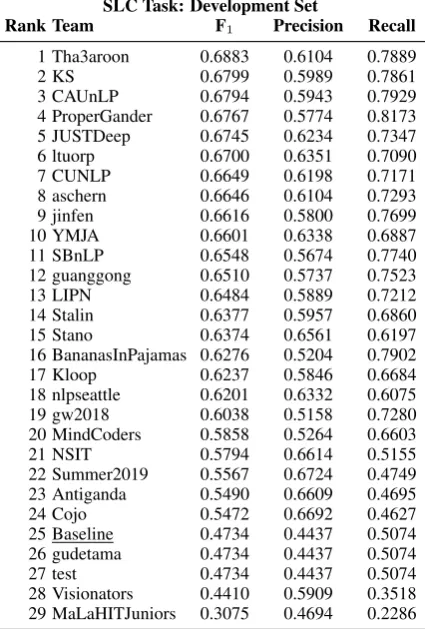
Table 5: Results for the SLC task on the development set at the end of phase 1 (see Section6).
10 Evaluation Results
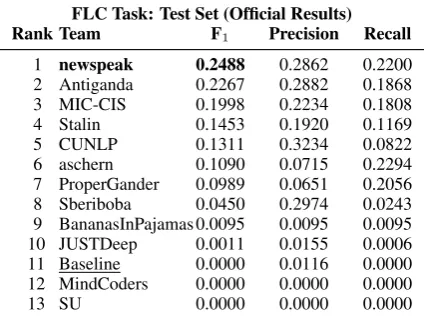
The results on the test set for the SLC task are shown in Table 4, while Table 5 presents the re-sults on the development set at the end of phase 1 (cf. Section6).3 The general decrease of the F1 values between the development and the test set could indicate that systems tend to overfit on the development set. Indeed, the winning teamltuorp
chose the parameters of their system both on the development set and on a subset of the training set in order to improve the robustness of their system. Tables6and7report the results on the test and on the development sets for the FLC task. For this task, the results tend to be more stable across the two sets. Indeed, teamnewspeakmanaged to almost keep the same difference in performance with respect to team Antiganda. Note that team
MIC-CISmanaged to reach the third position de-spite never having submitted a run on the develop-ment set.
3Upon request from the participants, we reopened the
[image:6.595.75.294.68.353.2]FLC Task: Test Set (Official Results)
Rank Team F1 Precision Recall
1 newspeak 0.2488 0.2862 0.2200
2 Antiganda 0.2267 0.2882 0.1868
3 MIC-CIS 0.1998 0.2234 0.1808
4 Stalin 0.1453 0.1920 0.1169
5 CUNLP 0.1311 0.3234 0.0822
6 aschern 0.1090 0.0715 0.2294
7 ProperGander 0.0989 0.0651 0.2056 8 Sberiboba 0.0450 0.2974 0.0243 9 BananasInPajamas 0.0095 0.0095 0.0095 10 JUSTDeep 0.0011 0.0155 0.0006 11 Baseline 0.0000 0.0116 0.0000 12 MindCoders 0.0000 0.0000 0.0000
13 SU 0.0000 0.0000 0.0000
Table 6: Official test results for the FLC task.
11 Conclusion and Further Work
We have described the
NLP4IF@EMNLP-IJCNLP 2019 shared task on fine-grained propaganda identification. We received 25 and 12 submissions on the test set for the sentence-level classification and the fragment-level classification tasks, respectively. Overall, the sentence-level task was easier and most submitted systems managed to outperform the baseline. The fragment-level task proved to be much more challenging, with lower absolute scores, but most teams still managed to outperform the baseline.
We plan to make the schema and the dataset publicly available to be used beyond NLP4IF. We hope that the corpus would raise interest outside of the community of researchers studying propa-ganda: the techniques related to fallacies and the ones relying on emotions might provide a novel setting for researchers interested in Argumentation and Sentiment Analysis.
As a kind of advertisement, Task 11 at SemEval 20204is a follow up of this shared task. It features two complimentary tasks:
Task 1 Given a free-text article, identify the pro-pagandist text spans.
Task 2 Given a text span already flagged as pro-pagandist and its context, identify the specific propaganda technique it contains.
This setting would allow participants to focus their efforts on binary sequence labeling for Task 1 and on multi-class classification for Task 2.
4http://propaganda.qcri.org/
semeval2020-task11/
FLC Task: Development Set
Rank Team F1 Precision Recall
1 newspeak 0.2422 0.2893 0.2084
2 Antiganda 0.2165 0.2266 0.2072
3 Stalin 0.1687 0.2312 0.1328
4 ProperGander 0.1453 0.1163 0.1934
5 KS 0.1369 0.2912 0.0895
6 CUNLP 0.1222 0.3651 0.0734
7 aschern 0.1010 0.0684 0.1928
8 gudetama 0.0517 0.0313 0.1479
9 AMT 0.0265 0.2046 0.0142
10 esi 0.0222 0.0308 0.0173
11 ltuorp 0.0054 0.0036 0.0107
12 Baseline 0.0015 0.0136 0.0008
13 CAUnLP 0.0015 0.0136 0.0008
[image:7.595.75.289.64.223.2]14 JUSTDeep 0.0010 0.0403 0.0005
Table 7: Results for FLC tasl on the development set. The values refer to the end of phase 1 (see section6)
Acknowledgments
This research is part of the Propaganda Analy-sis Project,5 which is framed within the Tanbih project.6 The Tanbih project aims to limit the ef-fect of “fake news”, propaganda, and media bias by making users aware of what they are reading, thus promoting media literacy and critical think-ing, which is arguably the best way to address dis-information and “fake news.” The project is de-veloped in collaboration between the Qatar Com-puting Research Institute (QCRI), HBKU and the MIT Computer Science and Artificial Intelligence Laboratory (CSAIL).
The corpus for the task was annotated by A Data Pro,7 a company that performs high-quality man-ual annotations.
References
Kartik Aggarwal and Anubhav Sadana. 2019. NSIT@NLP4IF-2019: Propaganda detection from news articles using transfer learning. In (Feldman et al.,2019).
Hani Al-Omari, Malak Abdullah, Ola AlTiti, and Samira Shaikh. 2019. JUSTDeep at NLP4IF 2019 Task 1: Propaganda detection using ensemble deep learning models. In (Feldman et al.,2019).
Tariq Alhindi, Jonas Pfeiffer, and Smaranda Muresan. 2019. Fine-tuned neural models for propaganda de-tection at the sentence and fragment levels. In ( Feld-man et al.,2019).
5
http://propaganda.qcri.org
6
http://tanbih.qcri.org
[image:7.595.307.524.65.231.2]Alberto Barr´on-Cede˜no, Giovanni Da San Martino, Is-raa Jaradat, and Preslav Nakov. 2019. Proppy: A system to unmask propaganda in online news. In Proceedings of the 33rd AAAI Conference on Artifi-cial Intelligence, AAAI ’19, pages 9847–9848, Hon-olulu, HI, USA.
Alberto Barr´on-Cedeno, Israa Jaradat, Giovanni Da San Martino, and Preslav Nakov. 2019. Proppy: Organizing the news based on their propagandistic content. Information Processing & Management, 56(5):1849–1864.
Piotr Bojanowski, Edouard Grave, Armand Joulin, and Tomas Mikolov. 2017. Enriching word vectors with subword information. Transactions of the Associa-tion for ComputaAssocia-tional Linguistics, 5:135–146.
Daniel Cer, Yinfei Yang, Sheng-yi Kong, Nan Hua, Nicole Limtiaco, Rhomni St. John, Noah Constant, Mario Guajardo-Cespedes, Steve Yuan, Chris Tar, Yun-Hsuan Sung, Brian Strope, and Ray Kurzweil. 2018. Universal sentence encoder. CoRR, abs/1803.11175.
Giovanni Da San Martino, Seunghak Yu, Alberto Barr´on-Cede˜no, Rostislav Petrov, and Preslav Nakov. 2019. Fine-grained analysis of propaganda in news articles. InProceedings of the 2019 Con-ference on Empirical Methods in Natural Language Processing and the 9th International Joint Confer-ence on Natural Language Processing, EMNLP-IJCNLP 2019, Hong Kong, China.
Lavinia Dan. 2015. Techniques for the Translation of Advertising Slogans. InProceedings of the Interna-tional Conference Literature, Discourse and Multi-cultural Dialogue, LDMD ’15, pages 13–23, Mures, Romania.
Jacob Devlin, Ming-Wei Chang, Kenton Lee, and Kristina Toutanova. 2019. BERT: Pre-training of deep bidirectional transformers for language under-standing. InProceedings of the 2019 Conference of the North American Chapter of the Association for Computational Linguistics: Human Language Tech-nologies, NAACL-HLT ’19, pages 4171–4186, Min-neapolis, MN, USA.
Adam Ek and Mehdi Ghanimifard. 2019. Synthetic propaganda embeddings to train a linear projection. In (Feldman et al.,2019).
Ibrahim Fadel, Ali Tuffaha and Mahmoud Al-Ayyoub. 2019. Pretrained ensemble learning for fine-grained propaganda detection. In (Feldman et al.,2019).
Anna Feldman, Giovanni Da San Martino, Alberto Barr´on-Cede˜no, Chris Brew, Chris Leberknight, and Preslav Nakov, editors. 2019. Proceedings of the 2019 Workshop on Natural Language Processing for Internet Freedom (NLP4IF): censorship, disinfor-mation, and propaganda. Hong Kong, China.
Andr´e Ferreira Cruz, Gil Rocha, and Henrique Lopes Cardoso. 2019. On sentence representations for pro-paganda detection: From handcrafted features to word embeddings. In (Feldman et al.,2019).
Monika Glowacki, Vidya Narayanan, Sam Maynard, Gustavo Hirsch, Bence Kollanyi, Lisa-Maria Neud-ert, Phil Howard, Thomas Lederer, and Vlad Barash. 2018. News and political information consumption in Mexico: Mapping the 2018 Mexican Presidential election on Twitter and Facebook. Technical Report COMPROP DATA MEMO 2018.2, Oxford Univer-sity, Oxford, UK.
Jean Goodwin. 2011. Accounting for the force of the appeal to authority. InProceedings of the 9th Inter-national Conference of the Ontario Society for the Study of Argumentation, OSSA ’11, pages 1–9, On-tario, Canada.
Pankaj Gupta, Khushbu Saxena, Usama Yaseen, Thomas Runkler, and Hinrich Schutze. 2019. Neu-ral architectures for fine-grained propaganda detec-tion in news. In (Feldman et al.,2019).
Ivan Habernal, Raffael Hannemann, Christian Pol-lak, Christopher Klamm, Patrick Pauli, and Iryna Gurevych. 2017. Argotario: Computational argu-mentation meets serious games. In Proceedings of the Conference on Empirical Methods in Natu-ral Language Processing, EMNLP ’17, pages 7–12, Copenhagen, Denmark.
Ivan Habernal, Patrick Pauli, and Iryna Gurevych. 2018a. Adapting serious game for fallacious argu-mentation to German: pitfalls, insights, and best practices. InProceedings of the Eleventh Interna-tional Conference on Language Resources and Eval-uation, LREC ’18, Miyazaki, Japan.
Ivan Habernal, Henning Wachsmuth, Iryna Gurevych, and Benno Stein. 2018b. Before name-calling: Dy-namics and triggers of ad hominem fallacies in web argumentation. InProceedings of the 2018 Confer-ence of the North American Chapter of the Associ-ation for ComputAssoci-ational Linguistics: Human Lan-guage Technologies, NAACL-HLT ’18, pages 386– 396, New Orleans, LA, USA.
Renee Hobbs and Sandra Mcgee. 2008. Teaching about propaganda: An examination of the historical roots of media literacy. Journal of Media Literacy Education, 6(62):56–67.
Benjamin D Horne, Sara Khedr, and Sibel Adali. 2018. Sampling the news producers: A large news and feature data set for the study of the complex media landscape. InProceedings of the International AAAI Conference on Web and Social Media, ICWSM ’18, pages 518–527, Stanford, CA, USA.
Yiqing Hua. 2019. Understanding BERT performance in propaganda analysis. In (Feldman et al.,2019).
Zhiheng Huang, Wei Xu, and Kai Yu. 2015. Bidi-rectional LSTM-CRF models for sequence tagging. CoRR, abs/1508.01991.
John Hunter. 2015. Brainwashing in a large group awareness training? The classical conditioning hy-pothesis of brainwashing. Master’s thesis, Uni-versity of Kwazulu-Natal, Pietermaritzburg, South Africa.
Garth S. Jowett and Victoria O’Donnell. 2012. What is propaganda, and how does it differ from persuasion? InPropaganda & Persuasion, chapter 1, pages 1–48. Sage Publishing.
Jinfen Li, Zhihao Ye, and Lu Xiao. 2019. Detection of propaganda using logistic regression. In (Feldman et al.,2019).
Yinhan Liu, Myle Ott, Naman Goyal, Jingfei Du, Man-dar Joshi, Danqi Chen, Omer Levy, Mike Lewis, Luke Zettlemoyer, and Veselin Stoyanov. 2019. RoBERTa: A robustly optimized BERT pretraining approach.arXiv, abs/1907.11692.
Harish Tayyar Madabushi, Elena Kochkina, and Castelle Michael. 2019. Cost-sensitive BERT for generalisable sentence classification on imbalanced data. In (Feldman et al.,2019).
Norman Mapes, Anna White, Radhika Medury, and Sumeet Dua. 2019. Divisive language and pro-paganda detection using multi-head attention trans-formers with deep learning BERT-based language models for binary classification. In (Feldman et al.,
2019).
Clyde R. Miller. 1939. The Techniques of Propaganda. From “How to Detect and Analyze Propaganda,” an address given at Town Hall. The Center for learning.
Robert Muller. 2018. Internet Research Agency Indict-ment. http://www.justice.gov/file/ 1035477/download.
Jeffrey Pennington, Richard Socher, and Christopher Manning. 2014. GloVe: Global vectors for word representation. InProceedings of the Conference on Empirical Methods in Natural Language Process-ing, EMNLP ’14, pages 1532–1543, Doha, Qatar.
Matthew Peters, Mark Neumann, Mohit Iyyer, Matt Gardner, Christopher Clark, Kenton Lee, and Luke Zettlemoyer. 2018. Deep contextualized word rep-resentations. In Proceedings of the 2018 Confer-ence of the North American Chapter of the As-sociation for Computational Linguistics: Human Language Technologies, NAACL-HLT ’2018, pages 2227–2237, New Orleans, LA, USA.
Hannah Rashkin, Eunsol Choi, Jin Yea Jang, Svitlana Volkova, and Yejin Choi. 2017. Truth of varying
shades: Analyzing language in fake news and polit-ical fact-checking. InProceedings of the 2017 Con-ference on Empirical Methods in Natural Language Processing, EMNLP ’17, pages 2931–2937, Copen-hagen, Denmark.
Monika L Richter. 2017. The Kremlin’s platform for ‘useful idiots’ in the West: An overview of RT’s ed-itorial strategy and evidence of impact. Technical report, Kremlin Watch.
Sara Sabour, Nicholas Frosst, and Geoffrey E. Hinton. 2017. Dynamic routing between capsules. In Pro-ceedings of the Annual Conference on Neural Infor-mation Processing Systems 2017, NIPS ’17, pages 3856–3866, Long Beach, CA, USA.
Francisca Niken Vitri Suprabandari. 2007. Ameri-can propaganda in John Steinbeck’s The Moon is Down. Master’s thesis, Sanata Dharma University, Yogyakarta, Indonesia.
Cristina Tard´aguila, Fabr´ıcio Benevenuto, and Pablo Ortellado. 2018. Fake news is poisoning Brazilian politics. WhatsApp can stop it. https://www. nytimes.com/2018/10/17/opinion/ brazil-election-fake-news-whatsapp. html.
Gabriel H Teninbaum. 2009. Reductio ad Hitlerum: Trumping the judicial Nazi card. Michigan State Law Review, page 541.
Robyn Torok. 2015. Symbiotic radicalisation strate-gies: Propaganda tools and neuro linguistic pro-gramming. In Proceedings of the Australian Se-curity and Intelligence Conference, pages 58–65, Perth, Australia.
Ashish Vaswani, Noam Shazeer, Niki Parmar, Jakob Uszkoreit, Llion Jones, Aidan N. Gomez, Lukasz Kaiser, and Illia Polosukhin. 2017. Attention is all you need. In Proceedings of the Conference on Neural Information Processing Systems, NIPS ’17, pages 5998–6008, Long Beach, CA, USA.
George-Alexandru Vlad, Mircea-Adrian Tanase, Cris-tian Onose, and Dumitru-Clementin Cercel. 2019. Sentence-level propaganda detection in news ar-ticles with transfer learning and BERT-BiLSTM-Capsule model. In (Feldman et al.,2019).
Douglas Walton. 1996. The straw man fallacy. Royal Netherlands Academy of Arts and Sciences.
Anthony Weston. 2018. A rulebook for arguments. Hackett Publishing.
Shehel Yoosuf and Yin Yang. 2019. Fine-grained pro-paganda detection with fine-tuned BERT. In ( Feld-man et al.,2019).